
The Complete Guide to Sport-Specific Training: How to Prepare Your Body for Any Activity (2026)

Last updated: October 4, 2026
Most recreational athletes train hard. Fewer train smart. And almost none train specifically for what their chosen sport actually demands of their body, which is where the real gap lives.
Sport-specific training is not about copying sport movements in the gym. It is about understanding what your activity genuinely asks of your muscles, joints, energy systems, and nervous system, and then preparing those systems in advance. Done well, it helps you perform better, reduces predictable injury risk, and keeps you capable of doing what you love well into your 60s, 70s, and beyond.
This guide is written for recreational athletes, weekend warriors, masters athletes, returning players, coaches, and fitness-minded adults who want a practical, evidence-aware approach to training for the sport or activity they care about most. It is not written for elite athletes chasing podiums. It is written for people who want to stay active, stay healthy, and stay in the game for decades.
For a curated collection of sport-specific training guides, visit our Choose your sport.
Key Takeaways
- Sport-specific training prepares the body for the actual physical demands of an activity, not just general fitness.
- The SAID principle (Specific Adaptation to Imposed Demands) explains why targeted training produces better results than generic exercise.
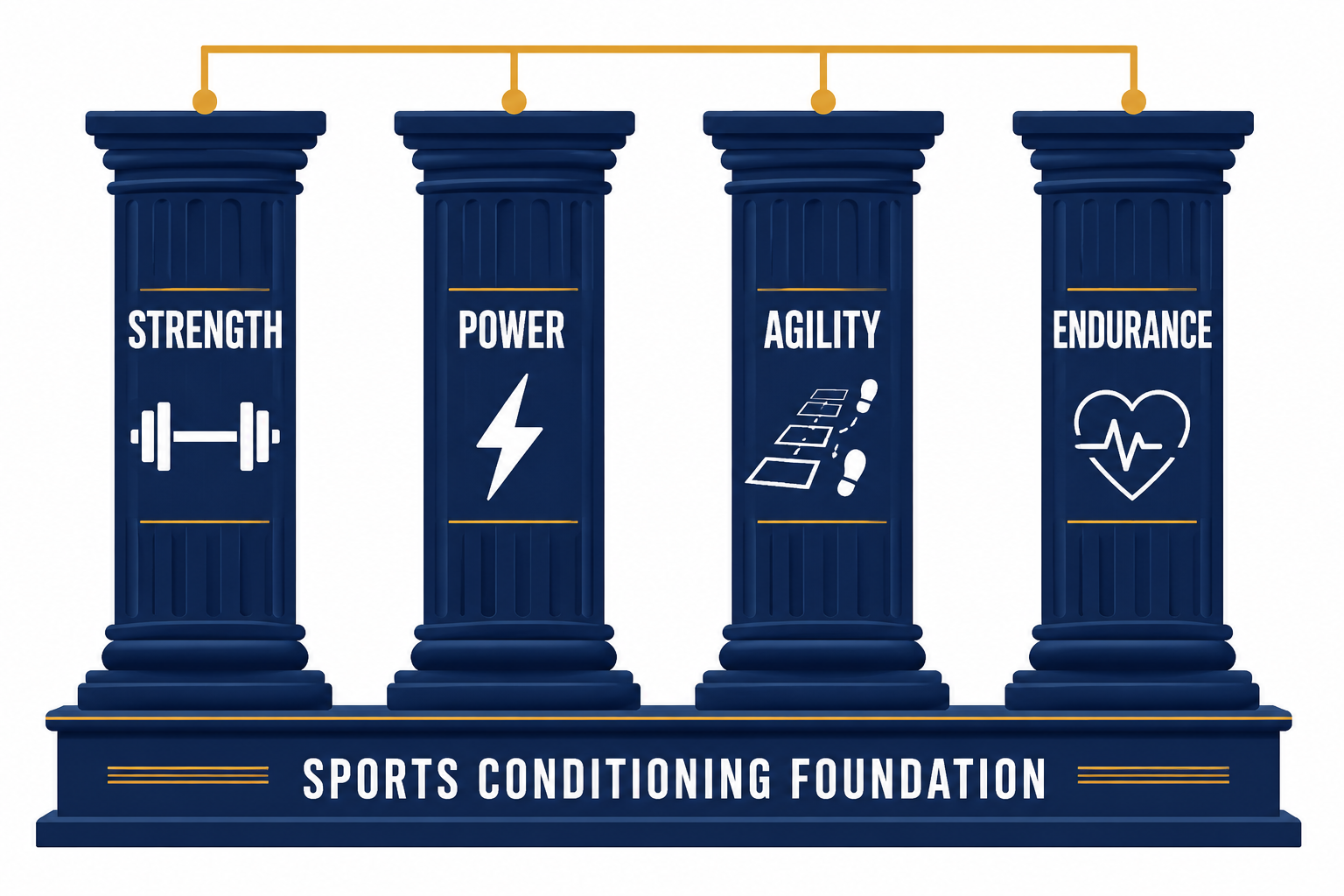
- The four pillars of sports conditioning are strength, power, agility and mobility, and endurance conditioning.
- Prehab exercises and injury prevention work should start before pain appears, not after.
- A focused 6- to 8-week block can improve readiness for a chosen activity. Its effect on injury risk varies with the sport, prior training, program quality, and the person doing it.
- What Is Sport-Specific Training?
- The SAID Principle: Why Your Body Adapts to What You Ask It to Do
- The 4 Pillars of Sports Conditioning
- Common Injury Patterns Across Sports and How to Prehab Them
- Periodization Basics: Off-Season vs. Pre-Season vs. In-Season Training
- How to Build a Simple 6–8 Week Prep Program for Any Sport
- Sample Sport-Specific Training Week
- Sport-Specific Training and Longevity: How to Keep Playing for Decades
- Choose Your Sport: Go Deeper With a Specific Training Guide
- Common Sport-Specific Training Mistakes to Avoid
- 📂 The Complete Guide to Sport-Specific Training
- Frequently Asked Questions
- Final Takeaway: Train for the Sport You Love and the Life You Want
What Is Sport-Specific Training?
Definition Box
Sport-specific training is a structured approach to physical preparation that targets the exact strength, power, mobility, agility, and endurance demands of a chosen sport or activity. It goes beyond general fitness by identifying what the body needs to perform safely and effectively in that specific context, and then building those capacities systematically.
In plain English: you are not just getting fitter. You are getting ready for something specific.
A recreational golfer needs rotational power, hip mobility, and spinal resilience. A recreational tennis player needs lateral agility, shoulder stability, and the ability to decelerate quickly. A masters skier needs quad strength, balance, and the ability to absorb impact through the lower body. A hiker preparing for a multi-day trek needs posterior chain endurance, ankle stability, and load-carrying capacity.
None of those needs are met by three sessions a week on a treadmill and some machine weights, even if that routine improves general health.
Sport-Specific Training vs. General Fitness
General fitness builds a broad base: cardiovascular health, basic muscular endurance, flexibility, and body composition. That base matters and should not be dismissed. But it does not prepare specific tissues, movement patterns, or energy systems for the particular demands of a sport.
The evidence is clear on this point. Injury risk in recreational sport is often highest at the start of a season or after a period of inactivity, precisely because the body has maintained general fitness but lost sport-readiness. The tissues are not conditioned for the specific loads, speeds, and directions the sport demands.
Sport-specific training bridges that gap.
Sport-Specific Does Not Mean Copying Your Sport in the Gym
This is where a lot of people go wrong. Swinging a golf club with a resistance band attached is not sport-specific training. Doing court-side lunges in tennis shoes is not sport-specific training. Mimicking a swimming stroke with dumbbells is not sport-specific training.
Here is the real issue: the gym is for building physical qualities, not rehearsing sport skills. You build strength, power, mobility, and resilience in the gym. You apply those qualities on the court, course, pitch, or mountain. The two things are related but they are not the same thing.
The goal of sport-specific training is to develop the physical capacities that the sport demands, not to simulate the sport itself in a controlled environment.
The SAID Principle: Why Your Body Adapts to What You Ask It to Do
What SAID Means
SAID stands for Specific Adaptation to Imposed Demands. It is one of the most well-supported principles in exercise science, and it is the foundation of all sport-specific training logic.
The simplest way to look at it is this: your body adapts to the exact stresses placed on it. If you train for endurance, your cardiovascular system and slow-twitch muscle fibres improve. If you train for strength, your neuromuscular system and connective tissue adapt to handle heavier loads. If you train for rotational power, the muscles, joints, and movement patterns involved in rotation become more capable.
The corollary is equally important. If you do not train for something, your body does not prepare for it. A runner who never does lateral movement training has not prepared their ankles, hips, or proprioceptive system for the demands of a sport that involves cutting and changing direction. That is not a failure of effort. It is a failure of specificity.
The Sport-Demand Checklist
Before building a sport-specific training program, it helps to map the actual demands of the activity. The following checklist applies to almost any sport or recreational activity.
Sport-Demand Analysis Checklist
| Demand Category | Questions to Ask | Examples |
|---|---|---|
| Movement Patterns | Does it involve running, jumping, throwing, swinging, climbing, paddling? | Tennis (swing), rowing (pull), skiing (squat and absorb) |
| Dominant Energy System | Is it aerobic (sustained), anaerobic (short bursts), or mixed? | Cycling (aerobic), basketball (mixed), sprinting (anaerobic) |
| Primary Muscle Groups | Which muscles do most of the work? | Golf (glutes, core, forearms), swimming (lats, shoulders, core) |
| Directional Demands | Does it involve lateral movement, rotation, deceleration, or vertical force? | Pickleball (lateral), baseball (rotation), hiking (vertical load) |
| Joint Load Zones | Which joints take the most repetitive stress? | Running (knees, ankles), climbing (fingers, shoulders), rowing (lower back) |
| Injury History in the Sport | What are the most common injuries in this activity? | ACL in soccer, rotator cuff in swimming, ankle sprain in basketball |
| Duration and Frequency | How long is a typical session or game? How often does the athlete compete? | Match length, weekly training volume, seasonal structure |
Working through this checklist before designing a program is not optional. It is the starting point. Without it, training defaults to generic, and generic preparation produces generic results.
How SAID Supports Longevity
The SAID principle does not just apply to performance. It applies to resilience and longevity as well.
Connective tissue, bone density, tendon stiffness, and neuromuscular coordination all adapt to the specific stresses placed on them. That means deliberately loading tissues in the patterns and directions the sport demands, progressively and over time, builds the structural resilience to handle those demands without breaking down.
For masters athletes and recreational players over 40, this is arguably more important than raw performance. The goal is not to be faster. The goal is to still be playing at 65.
The 4 Pillars of Sports Conditioning
What matters most is this: almost every sport draws on four core physical qualities. Build all four in proportion to your sport’s demands, and you have a solid foundation. Neglect one, and you have a weak link that the sport will eventually find.
Pillar 1 — Strength: Build the Base That Protects Every Joint
Strength is the foundation of every other physical quality. Power is built on strength. Agility is controlled by strength. Endurance is sustained by strength. And joint health is protected by the muscles that surround and support each joint.
The updated ACSM resistance training guidelines, released in early 2026 following a review of data from over 30,000 participants, make a clear point: any amount of resistance training improves strength, muscle size, power, and physical function. The emphasis is on consistency over complexity. You do not need a complicated program. You need a regular one.
For sport-specific purposes, strength training should prioritise:
- Compound movements that reflect the sport’s primary patterns (squat, hinge, push, pull, carry, rotate)
- Single-leg and unilateral work to address asymmetries and improve balance
- Posterior chain development (glutes, hamstrings, upper back) which is underdeveloped in most recreational athletes
- Grip and forearm strength for racket sports, climbing, rowing, and golf
- Core stability, not just core strength, meaning the ability to resist movement under load, not just produce it
Strength training for athletes is not about getting big. It is about building the structural integrity to handle sport demands safely and repeatedly. For those interested in building a broader foundation, our exercise guide for better health covers the fundamentals of structured physical activity across all fitness goals.
Pillar 2 — Power: Train the Ability to Produce Force Quickly
Power is strength applied at speed. It is what allows a tennis player to drive through a serve, a basketball player to jump for a rebound, or a skier to absorb a bump and recover balance instantly. Power is not just for young athletes. It is critical for anyone who wants to stay reactive, coordinated, and capable as they age.
Power training typically involves:
- Medicine ball throws and slams for rotational and explosive upper body power
- Jump training and plyometrics, introduced progressively and only after a strength base is established
- Olympic lifting derivatives (hang cleans, trap bar jumps) for advanced athletes with coaching
- Flywheel resistance training, which recent research suggests can improve vertical jump and sprint performance in team sport athletes when used consistently in-season
A key point: power training should come after a strength base is built, not before. Adding explosive work on top of weak, unprepared tissues is how injuries happen. The sequence matters.
Pillar 3 — Agility and Mobility: Move Well Before You Move Fast
Agility is the ability to change direction efficiently and safely. Mobility is the ability to move through a full range of motion with control. Both are undervalued in recreational sport preparation, and both are major contributors to injury risk when neglected.
Mobility training is not the same as static stretching. It involves:
- Dynamic warm-up routines that prepare joints for the ranges they will encounter in sport
- Hip mobility work for sports involving rotation, lunging, and lateral movement
- Thoracic spine mobility for golf, swimming, tennis, rowing, and any sport involving upper body rotation
- Ankle dorsiflexion work for sports involving squatting, jumping, landing, or trail running
Agility training involves:
- Ladder drills and cone patterns to train footwork and change-of-direction mechanics
- Reactive agility drills that respond to a visual or auditory cue, not just pre-planned patterns
- Deceleration training, which is often overlooked but is where many lower-limb injuries occur
The principle here is simple: move well before you move fast. Trying to train speed and agility on top of poor movement quality is not sport-specific training. It is injury preparation.
Pillar 4 — Endurance: Match Conditioning to the Sport
Endurance conditioning is not one-size-fits-all. The energy system demands of a 90-minute soccer match are completely different from those of a 30-minute recreational swim, a five-hour golf round, or a three-set recreational tennis match.
Let’s keep this practical. Match your conditioning to your sport’s actual energy demands:
| Sport Type | Primary Energy System | Conditioning Approach |
|---|---|---|
| Long-distance running, cycling, hiking, rowing | Aerobic (sustained) | Zone 2 steady-state work, progressive volume |
| Basketball, soccer, tennis, pickleball | Mixed (aerobic base plus repeated short bursts) | Interval training, tempo runs, aerobic base work |
| Sprinting, martial arts, climbing | Anaerobic (short, high-intensity efforts) | High-intensity intervals, work-rest ratio training |
| Golf, bowling, archery | Skill-dominant with low cardio demand | Postural endurance, walking capacity, focus on recovery |
Knowing which energy system your sport primarily uses prevents a common mistake: doing long slow cardio to prepare for a sport that is actually interval-based, or doing only high-intensity intervals for a sport that requires sustained aerobic output.
Common Injury Patterns Across Sports and How to Prehab Them
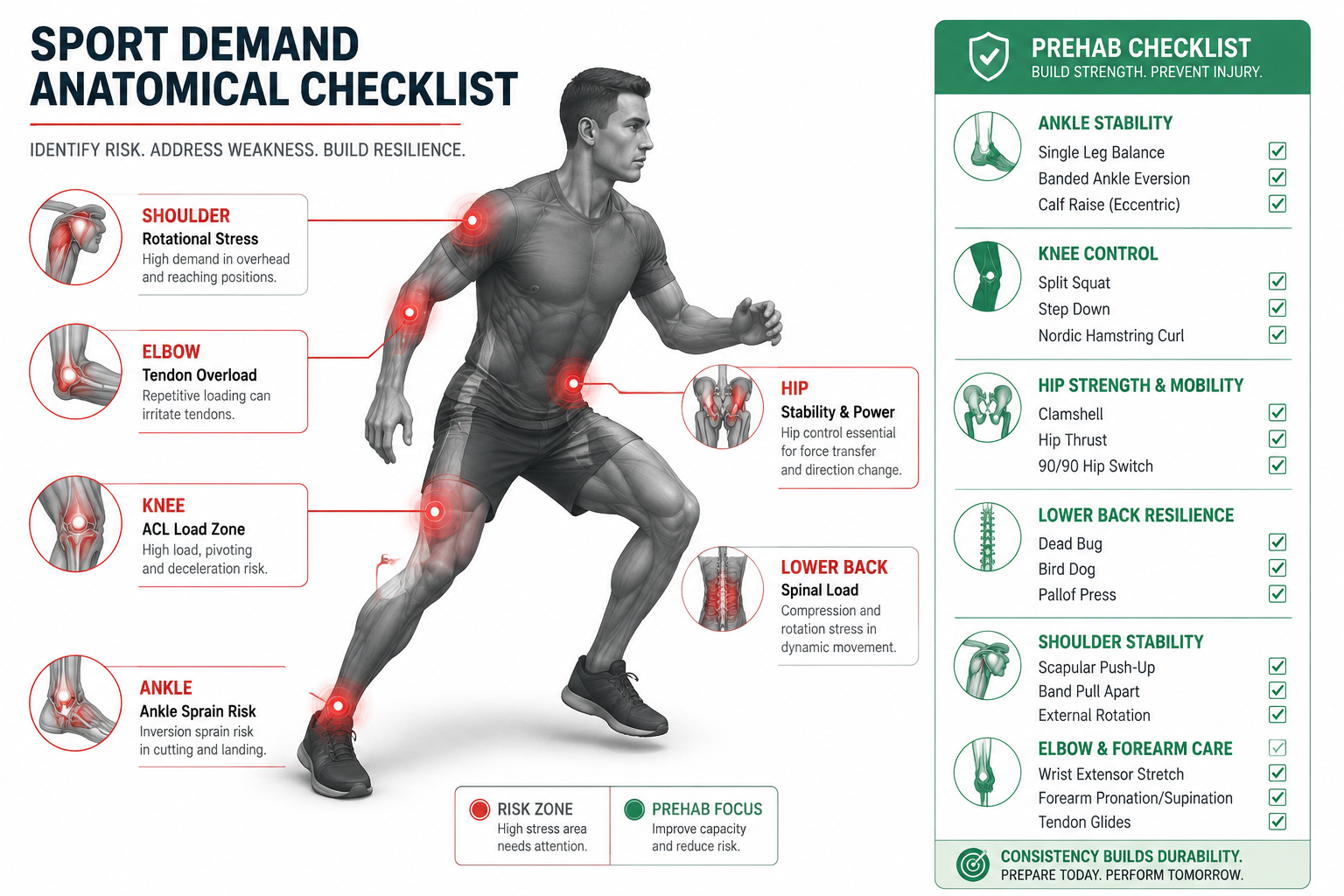
The evidence on sports injury prevention is consistent: exercise-based prehab programs, applied before injury occurs, can meaningfully reduce injury risk across a wide range of sports. The key word is “before.” Prehab is not rehabilitation. It is preparation.
Here is a practical map of the most common injury patterns across recreational sports and the prehab exercises that address them.
Ankle Sprains and Lower-Leg Overload
Most common in: basketball, soccer, pickleball, tennis, trail running, hiking, volleyball
Why it happens: weak peroneal muscles, poor proprioception, inadequate ankle dorsiflexion, and fatigue-related loss of control
Prehab approach:
- Single-leg balance progressions (eyes open, then closed, then on unstable surface)
- Banded ankle eversion and inversion exercises
- Calf raises (single-leg, slow eccentric phase)
- Tibialis anterior strengthening (toe raises against resistance)
- Agility ladder work for foot placement precision
Knee Pain, ACL Risk, and Poor Landing Mechanics
Most common in: soccer, basketball, skiing, volleyball, tennis, pickleball
Why it happens: quad dominance, weak glutes and hamstrings, poor hip control, valgus knee collapse on landing
Prehab approach:
- Glute strengthening (hip thrusts, lateral band walks, single-leg deadlifts)
- Hamstring eccentric work (Nordic curls, Romanian deadlifts)
- Landing mechanics training (focus on soft, controlled landings with knees tracking over toes)
- Single-leg squat progressions
- Neuromuscular training programs such as FIFA 11+ have shown meaningful reductions in lower-limb injury rates in team sport research
Hamstring, Groin, and Hip Flexor Strains
Most common in: running, soccer, basketball, martial arts, tennis, cycling
Why it happens: inadequate eccentric hamstring strength, hip flexor tightness from prolonged sitting, asymmetrical loading
Prehab approach:
- Nordic hamstring curls (one of the most evidence-supported exercises for hamstring injury reduction)
- Romanian deadlifts and single-leg variations
- Hip flexor stretching combined with active hip extension strengthening
- Adductor strengthening for groin resilience (Copenhagen plank, lateral band work)
Shoulder, Elbow, and Wrist Irritation
Most common in: swimming, tennis, golf, climbing, rowing, baseball, pickleball, surfing
Why it happens: repetitive overhead or rotational loading on unprepared rotator cuff, forearm, and wrist structures
Prehab approach:
- Rotator cuff strengthening (external rotation, internal rotation, side-lying ER)
- Scapular stability exercises (rows, face pulls, prone Y-T-W)
- Forearm and wrist strengthening (wrist curls, reverse curls, rice bucket work for climbers)
- Thoracic mobility work to reduce compensatory shoulder stress
Low-Back Irritation and Rotational Overload
Most common in: golf, rowing, tennis, cycling, hiking with heavy packs, surfing
Why it happens: poor hip mobility forcing the lumbar spine to compensate for rotation, weak deep core muscles, sustained flexion postures
Prehab approach:
- Anti-rotation core exercises (Pallof press, dead bugs, bird dogs)
- Hip mobility work to reduce lumbar compensation
- Glute strengthening to support pelvic stability
- Extension-based mobility work for cyclists and rowers who spend long periods in flexion
Periodization Basics: Off-Season vs. Pre-Season vs. In-Season Training
Periodization training simply means organising your training into phases, each with a different focus, so that you arrive at your sport’s peak demands in the best possible condition and avoid accumulating fatigue over time.
The simplest way to look at it is three phases: off-season, pre-season, and in-season.
Off-Season: Build the Engine and Fix Weak Links
The off-season is the most important training phase that most recreational athletes skip entirely.
This is when the body can tolerate higher training volumes without the added stress of competition. It is the time to:
- Build general strength across all major movement patterns
- Address mobility restrictions identified during the previous season
- Correct muscle imbalances and movement asymmetries
- Rebuild aerobic base capacity
- Allow full recovery from any accumulated wear from the previous season
Off-season training is not glamorous. There is no magic in it. But it is where long-term athletic capacity is built.
Pre-Season: Shift Toward Sport Demands
Pre-season training typically runs 6 to 12 weeks before the sport season begins. The focus shifts from general physical development to sport-specific preparation.
In this phase:
- Training volume begins to decrease as intensity increases
- Exercises become more sport-specific in their movement patterns and energy demands
- Power and agility work increases
- Sport-specific conditioning (intervals, drills, practice sessions) is introduced
- Prehab work continues with full consistency
This is where a structured 6 to 8 week sport-specific training program fits most naturally for recreational athletes who do not have a traditional off-season.
In-Season: Maintain, Recover, and Stay Available
The goal of in-season training is simple: maintain the physical qualities built in the off-season and pre-season, manage fatigue, and stay healthy enough to keep playing.
This is not the time to chase new strength records or add high-volume conditioning. The sport itself is providing the stimulus. The gym’s job is to maintain what was built and prevent detraining.
In-season training typically involves:
- 1 to 2 strength sessions per week, reduced in volume but maintained in intensity
- Continued prehab work, especially for the sport’s high-risk injury zones
- Prioritised recovery: sleep, nutrition, and active recovery sessions
Deloads and Recovery Weeks
Every 3 to 4 weeks, training volume should be reduced by approximately 30 to 40 percent for one week. This is called a deload, and it is not optional for long-term athletes.
Deloads allow the body to consolidate adaptations, reduce accumulated fatigue, and arrive at the next training block fresher and more responsive. Athletes who skip deloads tend to accumulate fatigue progressively until something breaks down, either performance or tissue health.
How to Build a Simple 6–8 Week Prep Program for Any Sport
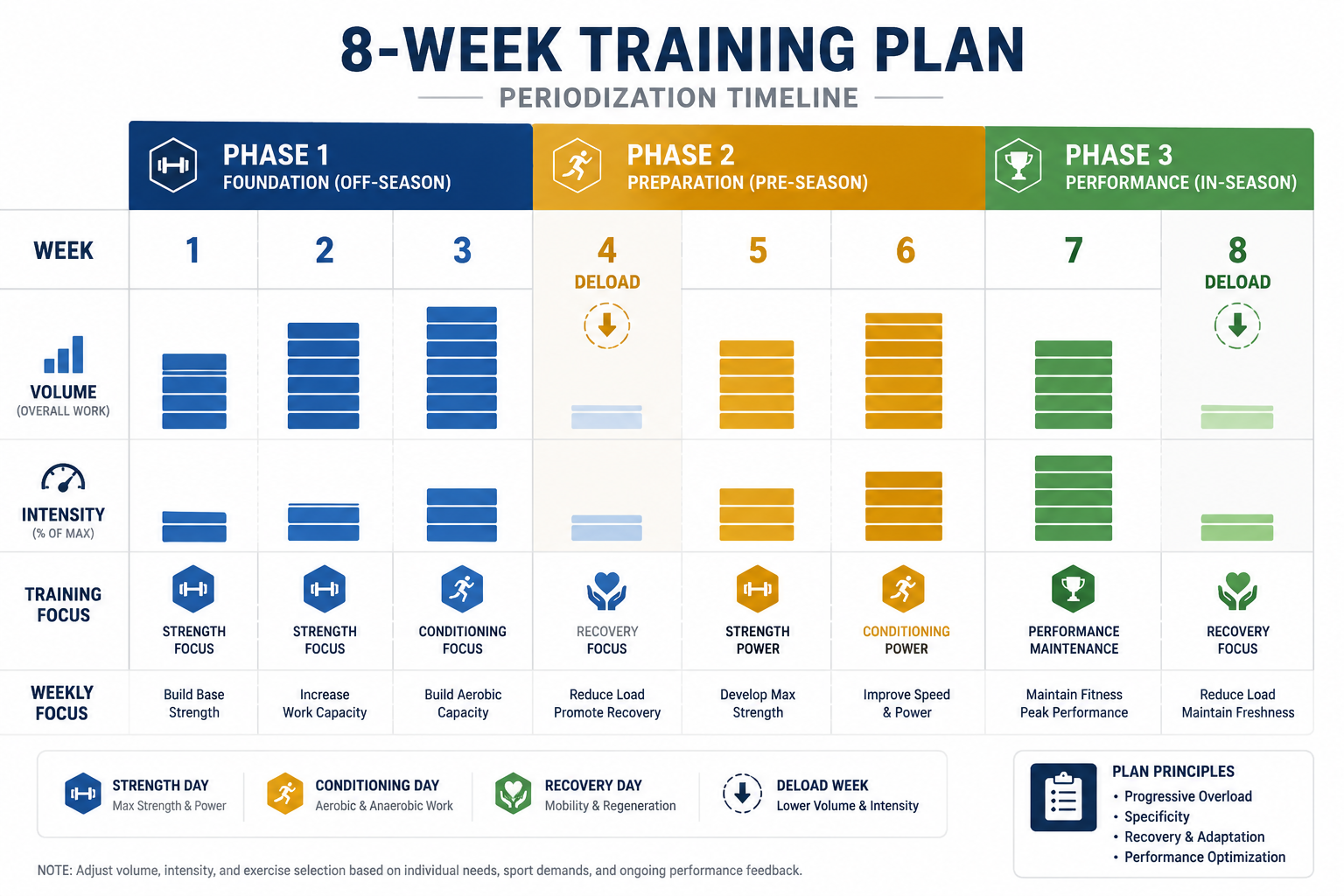
This section provides a practical framework for building a sport-specific training program from scratch. It applies whether you are preparing for a hiking trip, a tennis season, a ski week, or a return to recreational soccer after time away.
Step 1 — Choose the Sport or Activity Goal
Be specific. “Get fitter” is not a goal. “Complete a 3-day hiking trip in the Scottish Highlands in 8 weeks” is a goal. “Return to recreational tennis twice a week without shoulder pain” is a goal. Specificity determines everything that follows.
Step 2 — Identify the Sport’s Top 3 Physical Demands
Using the sport-demand checklist from the SAID section, identify the three most critical physical qualities for your chosen activity. For hiking: lower body endurance, ankle stability, and load-carrying capacity. For golf: rotational power, hip mobility, and grip strength. For basketball: lateral agility, explosive jumping, and aerobic-anaerobic conditioning.
Step 3 — Build the Weekly Structure
A practical weekly structure for a recreational athlete preparing for sport typically looks like this:
Sample Weekly Framework (Pre-Season Phase)
| Day | Session Type | Focus |
|---|---|---|
| Monday | Strength training | Lower body compound lifts, single-leg work |
| Tuesday | Conditioning or sport practice | Energy system work matched to sport |
| Wednesday | Active recovery or mobility | Mobility training, light walking, foam rolling |
| Thursday | Strength training | Upper body, core stability, prehab |
| Friday | Sport-specific conditioning | Agility drills, power work, or sport practice |
| Saturday | Longer aerobic session or sport | Endurance base or recreational play |
| Sunday | Rest or light activity | Full recovery |
This structure is a starting point, not a prescription. Adjust based on your current fitness level, available time, and sport demands.
Step 4 — Progress in Phases
A 6 to 8 week program typically runs across two phases:
Phase 1 (Weeks 1–3 or 1–4): Foundation
- Moderate intensity, moderate volume
- Focus on movement quality, strength base, and prehab
- Introduce sport-specific conditioning at low intensity
Phase 2 (Weeks 4–6 or 5–8): Sport-Specific Intensification
- Increase intensity, reduce overall volume
- Shift toward sport-specific power, agility, and conditioning
- Maintain strength work at reduced volume
- Deload in the final week before the season or event
Step 5 — Use the Minimum Effective Dose
More is not always better. The minimum effective dose principle means doing the least amount of training needed to produce the desired adaptation, leaving recovery capacity intact.
For most recreational athletes, this means:
- 2 to 3 strength sessions per week
- 1 to 2 conditioning sessions per week
- 1 to 2 sport practice or skill sessions per week
- Daily prehab work (10 to 15 minutes is sufficient)
Trying to do more than this while also playing the sport tends to produce accumulated fatigue rather than improved performance.
Step 6 — Track Readiness, Not Just Effort
Training effort is not the same as training readiness. Tracking how you feel before each session, sleep quality, resting heart rate, and subjective energy levels gives more useful information than just logging sets and reps.
Wearable sensor technology has advanced considerably in recent years, with flexible wearable devices now capable of continuous monitoring of physiological markers during training. While most recreational athletes do not need this level of monitoring, even a simple daily readiness score (1 to 10) logged in a notebook provides useful data for adjusting training load week to week.
Sample Sport-Specific Training Week
The following templates are practical starting points. They are not rigid prescriptions. Adjust based on your sport, current fitness, and available equipment.
Beginner or Returning Athlete Template
Context: Someone returning to sport after 6 or more months away, or a beginner with limited training history.
| Day | Session | Key Exercises |
|---|---|---|
| Mon | Full-body strength (45 min) | Goblet squat, dumbbell row, hip hinge, push-up, plank |
| Tue | Light conditioning (30 min) | Brisk walking, cycling, or swimming at easy pace |
| Wed | Mobility and prehab (20 min) | Hip circles, thoracic rotation, ankle drills, glute activation |
| Thu | Full-body strength (45 min) | Split squat, dumbbell press, single-leg deadlift, dead bug |
| Fri | Sport skill or light agility (30 min) | Sport practice at low intensity, or basic ladder drills |
| Sat | Aerobic activity (45–60 min) | Walk, cycle, swim, or recreational play at easy effort |
| Sun | Rest | Full recovery |
Intermediate Recreational Athlete Template
Context: Someone training regularly (3 to 4 days per week) and preparing for a specific sport season or event.
| Day | Session | Key Exercises |
|---|---|---|
| Mon | Lower body strength (60 min) | Barbell squat or trap bar deadlift, Romanian deadlift, Nordic curl, calf raise, lateral band walk |
| Tue | Sport conditioning (45 min) | Interval runs or drills matched to sport’s energy system |
| Wed | Upper body strength + core (60 min) | Pull-ups or rows, overhead press, rotator cuff work, Pallof press, anti-rotation drills |
| Thu | Mobility and active recovery (30 min) | Hip mobility, thoracic work, foam rolling, prehab circuit |
| Fri | Power and agility (45 min) | Medicine ball throws, jump training, change-of-direction drills |
| Sat | Sport practice or longer aerobic session | Recreational play or endurance work |
| Sun | Rest | Full recovery |
Masters Athlete Template
Context: Athletes aged 50 and over, with particular attention to recovery capacity, joint health, and longevity.
Key adjustments for masters athletes:
- Extend warm-up to 15 to 20 minutes
- Reduce training frequency to 2 strength sessions and 2 conditioning sessions per week
- Prioritise single-leg work and balance training
- Increase recovery time between hard sessions to 48 to 72 hours
- Maintain power training (do not drop it, but progress it slowly)
- Emphasise sleep and nutrition as non-negotiable recovery tools
| Day | Session | Key Exercises |
|---|---|---|
| Mon | Strength (50 min) | Trap bar deadlift, split squat, seated row, push-up variation, dead bug |
| Tue | Active recovery (30 min) | Walking, gentle cycling, mobility work |
| Wed | Conditioning (40 min) | Sport-matched intervals or aerobic work at comfortable effort |
| Thu | Rest or mobility (20 min) | Targeted prehab for sport’s high-risk zones |
| Fri | Strength + power (50 min) | Goblet squat, single-leg RDL, medicine ball slam, balance drills |
| Sat | Sport practice or recreational play | At manageable intensity |
| Sun | Rest | Full recovery |
Sport-Specific Training and Longevity: How to Keep Playing for Decades

This is where the conversation gets genuinely important for most of the people reading this guide.
The goal of sport-specific training for recreational athletes over 40 is not to perform like a 25-year-old. It is to stay capable, resilient, and active for as long as possible. Those are different goals, and they require a different mindset.
Movement Quality Is a Longevity Tool
Poor movement quality, such as limited hip mobility, stiff thoracic spine, weak single-leg control, and restricted ankle dorsiflexion, does not just affect sport performance. It affects daily life. It changes how you walk up stairs, how you get up from a chair, how you carry shopping, and how your body handles an unexpected slip or stumble.
Investing in movement quality through mobility training, strength work, and sport-specific preparation is one of the most practical things an adult can do to protect their independence and quality of life as they age. The research on daily habits of long-lived adults consistently points to maintained physical function and regular movement as key contributors to healthy ageing.
Strength Protects Independence
Muscle mass and strength decline with age if not actively maintained. This process, known as sarcopenia, accelerates after 60 and has real consequences for independence, fall risk, and metabolic health.
Resistance training, performed consistently, is the most effective intervention available for preserving muscle mass and strength across the lifespan. For athletes, this means maintaining strength training even during sport seasons, not abandoning it because the sport itself feels like enough.
Recovery nutrition also matters. Protein intake, in particular, supports muscle protein synthesis and recovery from training. For practical guidance on foods that support recovery and energy, our guide to magnesium-rich foods for sleep and recovery and our overview of anti-inflammatory foods for gut health are worth reading alongside this training guide.
Power and Balance Should Not Disappear After 40
Power, the ability to produce force quickly, declines faster with age than strength does. This matters because power is what catches you when you stumble, allows you to react quickly on a court, and gives you the ability to accelerate out of a difficult position on skis or a trail.
Maintaining some form of power training throughout life, even in modest doses such as medicine ball throws, jump squats, or fast-tempo resistance training, is an evidence-supported strategy for preserving reactive capacity and reducing fall risk in older adults.
Balance training, often dismissed as too simple to matter, is equally important. Single-leg balance, proprioceptive challenges, and reactive stability work should be a regular part of any masters athlete’s training regardless of sport.
The Goal Is Not to Train Like a Pro Athlete Forever
Let’s call it what it is: the goal of sport-specific training for recreational athletes is not elite performance. It is sustainable participation.
That means accepting that recovery takes longer as you age. It means building more rest into the weekly structure. It means prioritising prehab over pushing limits. It means choosing training methods that build resilience rather than simply accumulate fatigue.
The athletes who keep playing into their 60s and 70s are not the ones who trained the hardest in their 40s. They are the ones who trained consistently, recovered well, and stayed injury-free long enough to keep showing up.
Choose Your Sport: Go Deeper With a Specific Training Guide
Sport-specific training looks different depending on the activity. Below is a brief routing guide for the most common recreational sports, with notes on the key physical demands and preparation priorities for each.
Running: Focus on posterior chain strength, single-leg stability, progressive mileage build-up, and hip mobility. Calf strength and ankle resilience are critical for reducing overuse injury risk. Our guide to strength training for runners covers this in detail.
Golf: Rotational power, hip mobility, thoracic spine flexibility, grip strength, and glute activation are the primary targets. Low-back prehab is essential given the repetitive rotational demands.
Tennis: Lateral agility, shoulder stability, rotational power, and deceleration mechanics are the priorities. Elbow and wrist prehab should be ongoing for regular players. Our tennis and pickleball conditioning guide covers agility drills, shoulder health, and reaction speed work for players 50 and over.
Pickleball: Ankle stability, lateral movement, shoulder health, and aerobic-anaerobic conditioning are the key demands. Pickleball’s rapid growth in the 45 to 70 age group makes sport-specific preparation particularly relevant.
Soccer: Lower limb strength, lateral agility, aerobic base, and ACL prehab (particularly neuromuscular training for landing mechanics) are the foundation. Hamstring eccentric strength is critical.
Basketball: Vertical jump power, lateral agility, aerobic-anaerobic conditioning, and ankle stability are the primary demands. Knee prehab and landing mechanics training are important at any age.
Swimming: Shoulder stability and rotator cuff health are the primary prehab focus. Core stability, hip flexibility, and thoracic mobility support efficient technique and reduce overuse risk.
Cycling: Quad and glute strength, hip flexor mobility, and low-back resilience are the priorities. Upper body posture work counteracts the sustained flexion position. Our guide to cycling fitness covers how to build leg power, core stability, and endurance on the bike. For those looking at equipment options, our review of the best exercise bike for knee issues covers relevant considerations.
Hiking: Lower body endurance, ankle stability, posterior chain strength for descents, and load-carrying capacity are the key preparation targets. Our hiking and backpacking fitness guide covers how to build leg endurance, protect your joints on the trail, and prepare for multi-day trips. Our guide on how to start walking for exercise provides a useful entry point for building base fitness.
Skiing and Snowboarding: Quad strength, single-leg balance, hip stability, and impact absorption capacity are the priority demands. Our dedicated guide to best exercises for skiing covers this in detail, including a structured pre-season preparation program.
Baseball and Softball: Rotational power, shoulder and elbow health, hip mobility, and single-leg stability for throwing mechanics are the primary targets. Overhead throwing volume should be managed carefully.
Volleyball: Vertical jump power, shoulder stability, ankle resilience, and landing mechanics training are the key preparation areas.
Martial Arts: Full-body strength, hip mobility, rotational power, conditioning across multiple energy systems, and joint resilience across the entire kinetic chain are the demands. Balance and proprioception work supports both performance and injury reduction.
Climbing: Finger and forearm strength, shoulder stability, hip mobility, and body tension (core stability under load) are the primary targets. Finger tendon prehab is critical and often neglected by newer climbers.
Rowing: Posterior chain strength, hip hinge mechanics, thoracic mobility, and aerobic base are the priorities. Low-back prehab is essential given the high repetitive load on the lumbar spine.
Surfing: Hip mobility, rotational power, shoulder endurance, balance, and the ability to pop up explosively from a prone position are the key demands. Core stability and single-leg balance are foundational.
Strength Training for Masters Athletes: This is a sport in itself for many people over 50. The priorities are movement quality, progressive overload within recovery capacity, bone density maintenance, and longevity-focused programming that avoids chronic overtraining.
Common Sport-Specific Training Mistakes to Avoid
Mistake 1 — Training Hard but Not Specifically
High effort without specificity produces general fitness, not sport readiness. If the training does not address the actual demands of the sport, the gap between gym fitness and sport performance remains, and so does the injury risk.
Mistake 2 — Confusing Sport Mimicry with Sport Preparation
Swinging a weighted golf club, doing court-side agility drills in street shoes, or doing swim-stroke movements with dumbbells is not sport-specific training. The gym is for building physical qualities. The sport is where those qualities are applied.
Mistake 3 — Skipping Strength Because the Sport Is Cardio
Runners skip strength training. Cyclists skip strength training. Swimmers skip strength training. And then they wonder why they develop overuse injuries. Every endurance sport places repetitive loads on joints, tendons, and connective tissue. Strength training builds the resilience those structures need to handle that load.
Mistake 4 — Adding Speed and Plyometrics Too Soon
Plyometrics and speed work are high-demand training tools. Added before a strength base is established, they load unprepared tissues at high velocities. The result is often the injury the athlete was trying to prevent. Build strength first. Add power and speed work after.
Mistake 5 — Doing Prehab Only After Pain Starts
Prehab is not rehab. It is preparation. Waiting until the knee hurts to start doing glute work, or until the shoulder aches to start doing rotator cuff exercises, is too late. Prehab should be a consistent part of every training week, regardless of whether anything currently hurts.
Mistake 6 — Forgetting In-Season Maintenance
Many recreational athletes stop all gym training once their sport season starts. Within 4 to 6 weeks, the strength and power built in pre-season begins to decline. Two sessions per week of reduced-volume strength training is enough to maintain most of the adaptations built in the off-season. Dropping it entirely is a missed opportunity and a risk factor for late-season injury.
Frequently Asked Questions
What is sport-specific training?
Sport-specific training is a structured approach to physical preparation that targets the exact strength, power, mobility, agility, and endurance demands of a chosen sport or activity. It is distinct from general fitness because it is designed around the specific physical requirements of one activity, including its movement patterns, energy systems, primary muscle groups, and common injury risks.
How is sport-specific training different from regular workouts?
Regular workouts improve general physical health: cardiovascular fitness, basic strength, flexibility, and body composition. Sport-specific training builds on that base by developing the particular physical qualities the sport demands. A recreational golfer and a recreational swimmer may both do general fitness training, but their sport-specific preparation programs will look completely different because the demands of their sports are completely different.
What is the SAID principle?
SAID stands for Specific Adaptation to Imposed Demands. It is the foundational principle of sport-specific training. In plain English: your body adapts to the exact stresses placed on it. If you train for the specific demands of your sport, your body prepares for those demands. If you train generically, your body prepares generically. The SAID principle explains why targeted preparation produces better results than general fitness training alone.
How long does it take to prepare your body for a sport?
A sensible starting point is 6 to 8 weeks of structured sport-specific preparation before a season or event. This is enough time to build meaningful strength, address key movement deficiencies, and prepare the energy systems and tissues for sport demands. Athletes returning after a long break or those with significant fitness gaps may benefit from a longer preparation period of 10 to 16 weeks.
What are the four pillars of sports conditioning?
The four pillars are strength (building the structural base that protects joints and supports all other qualities), power (the ability to produce force quickly), agility and mobility (moving well through the required ranges and directions), and endurance conditioning (matching cardiovascular and muscular endurance to the sport’s energy demands). Neglecting any one of the four creates a weak link that the sport will eventually expose.
How do you prevent common sports injuries?
The evidence suggests that exercise-based prehab programs, applied consistently before injury occurs, can meaningfully reduce injury risk. The key elements are: strengthening the muscles around high-risk joints, training movement quality and landing mechanics, building eccentric strength in vulnerable muscle groups (particularly hamstrings), maintaining proprioception and balance, and continuing prehab work throughout the sport season rather than only before it starts.
Is sport-specific training useful after 40, 50, or 60?
It is arguably more useful after 40 than before. As the body ages, recovery takes longer, tissue resilience requires more deliberate maintenance, and the consequences of inadequate preparation are more significant. Sport-specific training for masters athletes focuses on movement quality, strength maintenance, power preservation, and injury prevention, all of which directly support both sport performance and long-term independence. The goal shifts from maximising performance to maximising sustainable participation.
How do you build a 6-week sport-specific training program?
Start by identifying the sport’s top three physical demands using a sport-demand analysis. Then build a weekly structure with 2 to 3 strength sessions, 1 to 2 conditioning sessions, and regular prehab work. Divide the 6 weeks into two phases: a foundation phase (weeks 1 to 3) focused on movement quality and strength base, and an intensification phase (weeks 4 to 6) focused on sport-specific power, agility, and conditioning. Use the minimum effective dose principle, track readiness alongside effort, and include a deload in the final week before the season begins.
Final Takeaway: Train for the Sport You Love and the Life You Want
The main takeaway is straightforward: sport-specific training is not about training harder. It is about training with intention.
Understanding what your sport actually demands, building the physical qualities that support those demands, and preparing your tissues before they are asked to perform is the most practical thing any recreational athlete can do to perform better and stay healthy longer.
The basics still do the heavy lifting here. Consistent strength training. Progressive conditioning matched to the sport. Regular prehab work. Sensible periodization. Adequate recovery. None of this is complicated, and none of it requires elite-level commitment. It requires showing up regularly and training with a purpose that goes beyond just burning calories or moving for its own sake.
For adults in their 40s, 50s, 60s, and beyond, the longevity angle is not a secondary consideration. It is the whole point. The athletes who keep playing for decades are not the ones who were the most talented or the most intense. They are the ones who prepared well, recovered consistently, and stayed available long enough to keep enjoying what they love.
Start with what gives the biggest return: a strength base, consistent prehab, and a training structure that matches your sport’s actual demands. Build from there. Keep it simple and consistent.
That is sport-specific training done well. And it works.
References
| # | Source | Direct URL |
|---|---|---|
| 1 | WHO Guidelines on Physical Activity and Sedentary Behaviour, 2020 | https://www.who.int/publications/i/item/9789240015128 |
| 2 | Physical Activity Guidelines for Americans, 2nd Edition, U.S. Department of Health and Human Services | https://odphp.health.gov/our-work/nutrition-physical-activity/physical-activity-guidelines/current-guidelines |
| 3 | ACSM Position Stand: Quantity and Quality of Exercise, Garber et al., 2011 | https://pubmed.ncbi.nlm.nih.gov/21694556/ |
| 4 | Exercise Interventions to Prevent Sports Injuries, Lauersen et al., 2014 | https://pubmed.ncbi.nlm.nih.gov/24100287/ |
| 5 | Resistance Training for Older Adults, NSCA Position Statement, Fragala et al., 2019 | https://doi.org/10.1519/JSC.0000000000003230 |
Medical Disclaimer
This article is for general educational purposes only and is not medical advice. Exercise needs vary. Stop if a movement causes sharp or worsening pain, and seek individual advice from a qualified clinician or exercise professional when returning after injury, managing a condition, or unsure how to progress.

Dave James is a health researcher and writer specialising in evidence-based nutrition, exercise, and longevity. He founded All Perfect Health to provide clear, practical health guidance rooted in current research and real-world experience.
📂 The Complete Guide to Sport-Specific Training
This article is part of the APH cluster. Use the links below to move between the pillar and child articles.
- YOU ARE HERE The Complete Guide to Sport-Specific Training: How to Prepare Your Body for Any Activity (2026)
- → Hiking and Backpacking Fitness: Build Leg Endurance and Protect Your Joints on the Trail
- → Tennis and Pickleball Conditioning for Adults 50+: Agility, Shoulder Health, and Reaction Speed
- → Cycling Fitness: Build Leg Power, Core Stability, and Endurance on the Bike
- → Strength Training for Runners: Prevent Injury and Build Speed
- → Best Exercises for Golf: Rotation, Power, and Back Protection
- → 10 Best Exercises for Skiing: Build Strength, Balance, and Endurance Before You Hit the Slopes