
Tennis and Pickleball Conditioning for Adults 50+: Agility, Shoulder Health, and Reaction Speed
Last updated: October 4, 2026
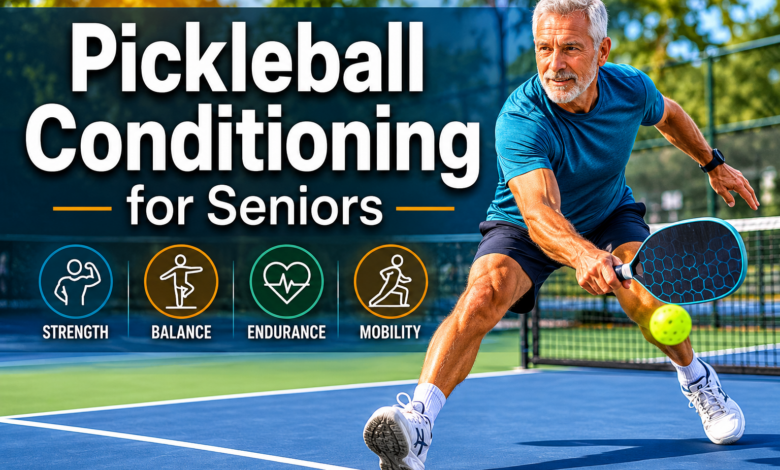
Roughly 24 million Americans now play pickleball, and a large share of them are over 50. That growth is genuinely good news. The sport is social, relatively low-impact, and accessible to people who have not exercised seriously in years. But accessible does not mean effortless. Pickleball demands quick lateral movement, sudden stops, overhead reaches, and split-second decisions — and those demands can expose gaps in conditioning that age quietly widens. Structured pickleball conditioning for seniors is not optional preparation for elite players. It is the practical foundation that keeps recreational players healthy, confident, and on the court for the long term.
This guide covers the three conditioning priorities that matter most for adults 50 and over: agility and court movement, shoulder health and rotator cuff resilience, and reaction speed. It also includes a realistic weekly plan, common mistakes to avoid, and a clear FAQ section.
Medical Safety Note: If you experience persistent pain, sharp pain, numbness, significant weakness, dizziness, chest pain, or a fall during exercise or play, stop and seek assessment from a qualified clinician before continuing. The guidance in this article is general and educational — it does not replace individual medical advice.
Key Takeaways
- Pickleball is accessible but still places real demands on lateral movement, shoulder stability, and reaction speed — especially after 50.
- Effective conditioning for older players rests on four pillars: mobility, strength, balance, and cardiovascular endurance. Skipping any one of them increases injury risk.
- Rotator cuff exercises for pickleball and shoulder exercises for tennis players are not optional extras — they are core injury-prevention work for anyone playing racket sports regularly.
- Reaction time drills for pickleball can improve with consistent, targeted practice, even in adults over 60.
- Simply playing more pickleball is not sufficient conditioning on its own. Off-court work on non-playing days makes a meaningful difference.
Table of Contents
- Why Tennis and Pickleball Conditioning Matters After 50
- The 3 Conditioning Priorities for Tennis and Pickleball Players
- Agility Training for Better Court Movement
- Shoulder Health for Tennis and Pickleball Players
- Reaction Speed Drills for Quicker Hands and Feet
- A Simple Weekly Conditioning Plan for Adults 50+
- Common Conditioning Mistakes Tennis and Pickleball Players Make
- Frequently Asked Questions
- Final Takeaway: Train to Stay on the Court
Why Tennis and Pickleball Conditioning Matters After 50
Pickleball is accessible, but it is not effortless
The appeal of pickleball for older adults is real. The court is smaller than a tennis court, the ball moves slower, and the social atmosphere tends to be welcoming. Research consistently links regular play to better cardiovascular health, improved balance, stronger bones, and reduced anxiety. A 2024 review of 27 studies found pickleball associated with better well-being and higher physical activity levels in older participants. Columbia University clinicians describe it as an effective aerobic activity for healthy aging.
But here is the real issue: the sport’s stop-start, lateral-heavy movement pattern places specific demands on hips, knees, ankles, and shoulders. A 10-year national study on orthopedic injuries in pickleball, published in 2025, highlighted rising injury incidence and identified the disproportionately older player demographic as a key reason why targeted conditioning programs matter. Simply showing up and playing more does not build the tissue tolerance or movement quality needed to handle those demands safely over time.
The 50+ body needs preparation, not avoidance
After 50, muscle mass declines gradually, reaction time slows, and joint mobility can narrow if it is not actively maintained. None of this means older adults should avoid pickleball. The evidence points clearly in the other direction — regular play supports cardiovascular health, cognitive function, and social connection in ways that are genuinely hard to replicate with other activities.
What it does mean is that the body needs deliberate preparation. A 2023 review in Cureus concluded that when “properly pursued,” pickleball is an excellent low-impact exercise for older adults — but the authors emphasised that conditioning programs should include progressive resistance training, balance work, and warm-up protocols specific to the lateral and stop-start nature of the game. That framing is useful. Preparation is not a barrier to playing. It is what makes playing sustainable.
For a broader look at exercising safely after 50, the how to exercise when you’re over 50 guide on this site covers foundational principles worth reading alongside this article.
The 3 Conditioning Priorities for Tennis and Pickleball Players
Agility: moving sideways, stopping, and changing direction
Most points in pickleball are decided by lateral movement — the ability to reach a ball that is not directly in front of you. Agility training for tennis players and pickleball players shares a common goal: improve the speed and control of sideways movement, first-step quickness, and the ability to decelerate without losing balance. For adults over 50, the deceleration piece is often the most neglected and the most important for injury prevention.
Shoulder health: keeping the rotator cuff and upper back strong
Every overhead shot, drive, and serve loads the shoulder. The rotator cuff — a group of four muscles that stabilise the shoulder joint — is the primary structure managing that load. Rotator cuff injuries are among the most common overuse problems in both pickleball and tennis. Rotator cuff exercises for pickleball and shoulder exercises for tennis players are not rehabilitation tools reserved for people already in pain. They are maintenance work that helps the shoulder handle repeated overhead and lateral loading without breaking down.
Reaction speed: seeing, deciding, and moving earlier
At the kitchen line, the ball can travel at speeds that leave very little time to think. Reaction speed in racket sports is partly neurological — how quickly the brain processes visual information and sends a movement signal — and partly a matter of positioning and paddle readiness. The good news is that reaction time drills for pickleball can produce real improvements with consistent practice, even in older adults.
Agility Training for Better Court Movement
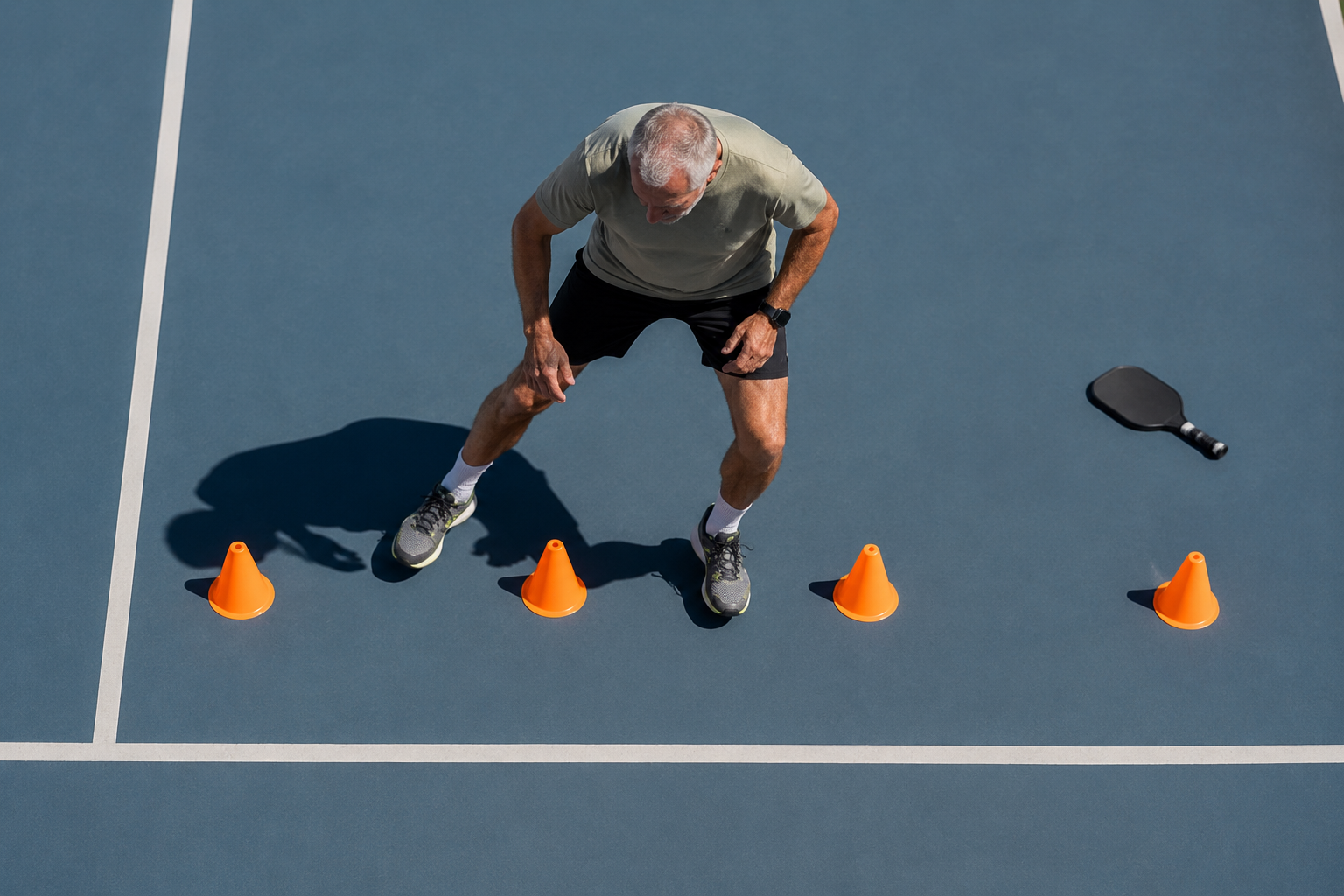
Lateral movement drills do not need to be complicated. The goal is to train the specific movement patterns the game demands — sideways shuffles, explosive first steps, controlled stops — in a way that is progressive and manageable for older joints.
Lateral shuffle drill
Mark two points roughly 10 to 12 feet apart (cones, tape, or court lines work fine). Shuffle laterally from one point to the other, staying low with knees slightly bent and weight on the balls of the feet. Touch the marker at each end, then return. Start with 4 to 6 repetitions at a controlled pace. The goal is control and clean footwork, not maximum speed. This is one of the most transferable pickleball agility drills for seniors because it mirrors the movement pattern used in almost every rally.
Split-step and first-step drill
The split-step is the small hop players use just before their opponent makes contact with the ball. It loads the legs and prepares the body to move in any direction. Practice the split-step by standing at the kitchen line, performing a small hop, then immediately stepping laterally left or right. Alternate directions. Do 10 to 15 repetitions. Over time, this trains the body to be in a ready position rather than flat-footed when the ball arrives.
Forward-back kitchen line drill
Start at the kitchen line, step back two paces, then drive forward back to the line. Repeat for 30 seconds. This trains the forward-back movement pattern used when transitioning from the baseline to the net — a common scenario where older players can lose balance if they are not conditioned for it.
Deceleration drill
Shuffle laterally at moderate speed, then stop cleanly on a marked spot without stumbling or overstepping. This is the drill most people skip, and it is arguably the most important for injury prevention for pickleball players. Falls and ankle sprains often happen during deceleration, not acceleration. Practice stopping with control before worrying about moving faster.
Shoulder Health for Tennis and Pickleball Players
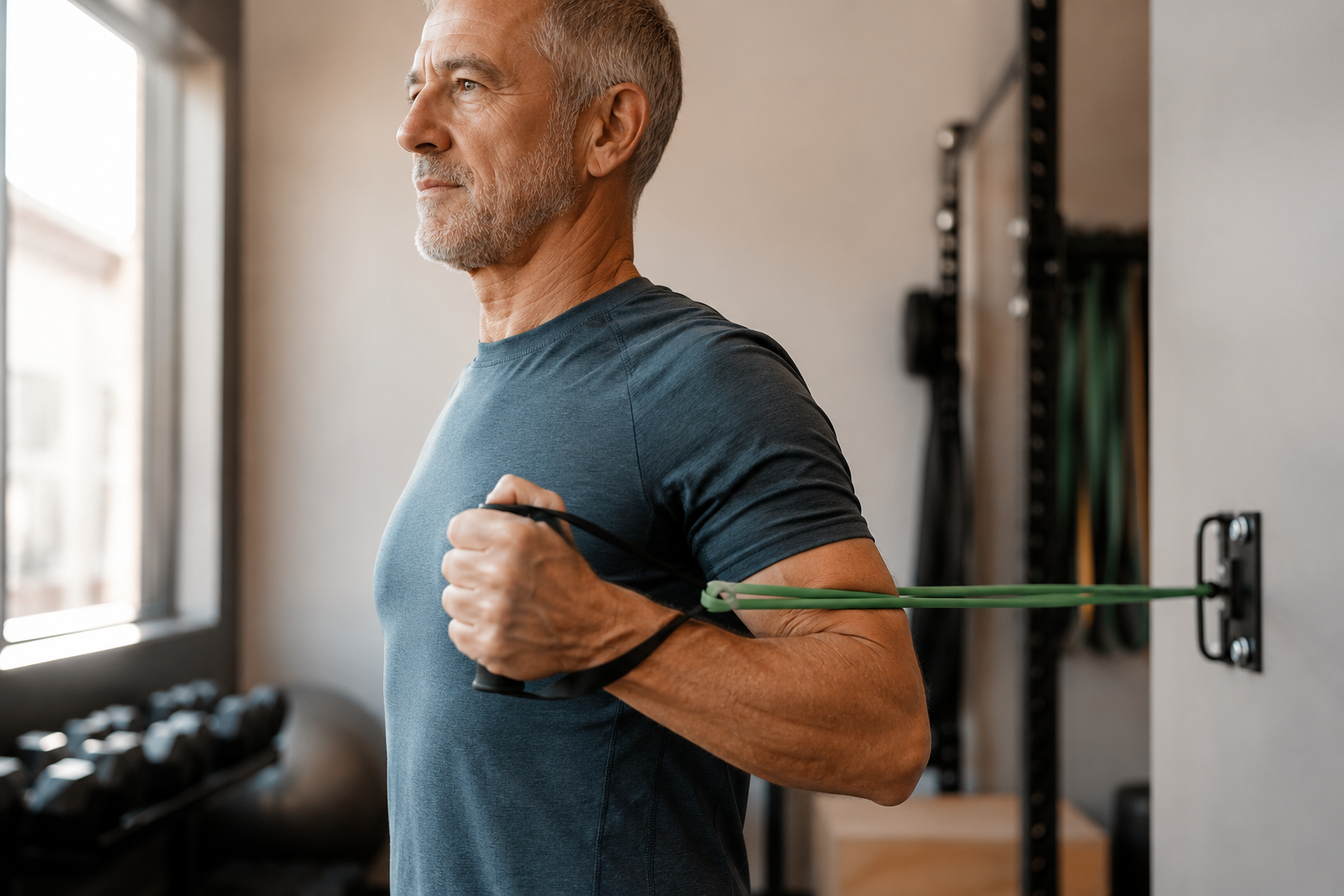
What the rotator cuff does
The rotator cuff keeps the head of the upper arm bone centred in the shoulder socket during movement. When it is weak or fatigued, the shoulder mechanics shift, and structures like the biceps tendon and subacromial bursa take on load they were not designed to handle. In racket sports, this matters because overhead shots and serves repeat this loading pattern dozens of times per session.
Banded external rotation
Anchor a light resistance band at elbow height. Stand sideways to the anchor point, elbow bent at 90 degrees and tucked close to the side. Rotate the forearm outward against the band’s resistance, hold briefly, then return slowly. Do 2 to 3 sets of 12 to 15 repetitions on each arm. This is one of the most evidence-supported rotator cuff exercises for pickleball and tennis. It directly strengthens the infraspinatus and teres minor — the muscles most involved in controlling the follow-through of a paddle swing.
Scapular wall slides or band pull-aparts
Healthy shoulder mechanics depend on the scapula (shoulder blade) moving correctly. Wall slides — standing with the back against a wall, arms at 90 degrees, and sliding them overhead while keeping contact with the wall — train the lower trapezius and serratus anterior, which control scapular movement. Band pull-aparts (holding a light band at shoulder height and pulling it apart horizontally) work the same muscles with slightly more resistance. Either exercise supports the upper back strength that shoulder exercises for tennis players and pickleball players need.
Controlled overhead mobility
Raise one arm overhead slowly, tracking whether the shoulder blade tilts, the lower back arches, or the elbow bends early. If any of these compensations appear, the overhead range of motion needs work before adding load. A simple doorway stretch — standing in a doorway with the arm at 90 degrees and gently rotating the chest forward — can help restore overhead mobility over time.
What to avoid with shoulder training
Avoid heavy overhead pressing (military press with significant weight) until baseline rotator cuff strength is established. Behind-the-neck exercises place the shoulder in a mechanically vulnerable position and are generally not worth the risk for older adults. The evidence suggests that controlled, lower-load, higher-repetition rotator cuff work produces better long-term outcomes for recreational players than heavy compound pressing.
Anti-inflammatory nutrition can also play a supporting role in managing the low-grade joint irritation that comes with regular play. The health benefits of turmeric and health benefits of ginger articles on this site summarise what the research actually shows on that front.
Reaction Speed Drills for Quicker Hands and Feet
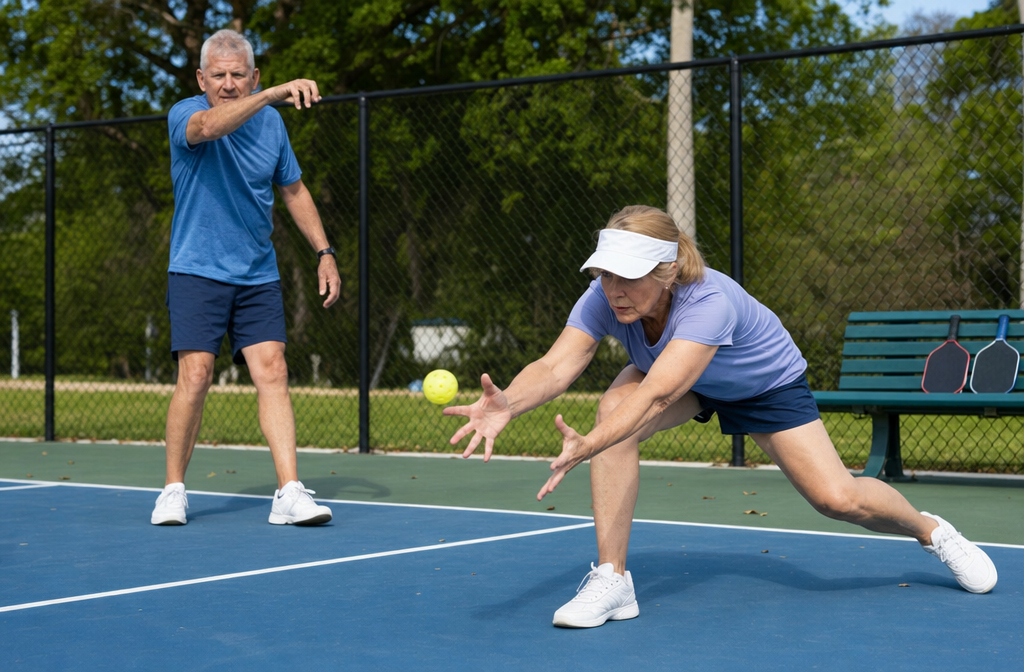
Ball drop reaction drill
One person holds a tennis ball at shoulder height and drops it without warning. The other person, standing an arm’s length away, tries to catch it before the second bounce. This simple drill trains the visual-to-motor response that determines whether a player reaches a fast volley in time. Start with the catcher’s hand already near the ball, then progressively increase the distance as reaction speed improves.
Random direction shuffle
A partner calls out “left,” “right,” “forward,” or “back” at random intervals. The player shuffles in the called direction immediately. This trains the brain to process a directional signal and execute a movement response — which is exactly what happens during a fast exchange at the kitchen line. This is one of the more underused reaction time drills for pickleball, but it directly addresses the cognitive component of court speed.
Paddle-ready volley reaction
Stand at the kitchen line with the paddle in the ready position (in front of the body, not at the side). A partner feeds balls randomly to the forehand and backhand sides at moderate pace. The goal is to block or redirect each ball using only a compact, controlled motion — no big swing. This trains the hands to react without over-committing to a direction, which is the key skill in fast kitchen exchanges.
Visual tracking drill
Follow a moving object — a partner swinging a paddle, a ball being tossed in the air — with the eyes without moving the head. This trains smooth pursuit eye movements, which deteriorate with age if not practised. Better visual tracking means the brain gets cleaner information about where the ball is going, which gives the body more time to respond.
A Simple Weekly Conditioning Plan for Adults 50+
Let’s keep this practical. The goal is not to add a second job. It is to build enough physical preparation that playing pickleball or tennis feels sustainable rather than punishing.
10-minute pre-play warmup
A pickleball warmup for seniors does not need to be elaborate. Ten minutes of the following is sufficient:
| Warmup Component | Duration | Purpose |
|---|---|---|
| Light walking or marching in place | 2 minutes | Raise heart rate gradually |
| Hip circles and leg swings | 2 minutes | Open hip mobility |
| Arm circles and shoulder rolls | 1 minute | Prepare shoulder joint |
| Lateral shuffle (slow) | 2 minutes | Activate lateral movement patterns |
| Split-step practice | 2 minutes | Prime the nervous system for quick response |
| Gentle torso rotation | 1 minute | Prepare the spine for rotational shots |
2-day weekly strength and mobility plan
On two non-consecutive days (for example, Tuesday and Friday), spend 20 to 30 minutes on:
- Banded external rotation: 2 to 3 sets of 12 to 15 reps each arm
- Band pull-aparts or wall slides: 2 sets of 12 to 15 reps
- Side lunges: 2 sets of 10 each leg (lateral movement strength)
- Single-leg balance hold: 30 seconds each leg (balance and ankle stability)
- Controlled overhead reach: 10 slow repetitions each arm
This structure aligns with guidance from the American Council on Exercise, which recommends 2 to 3 days of multijoint resistance training on non-consecutive days for older pickleball players. It also reflects the Physical Activity Guidelines for Americans, which recommend muscle-strengthening activities on at least two days per week for older adults.
For more structured home workout ideas, the home workouts and strength training section of this site has practical options that complement on-court play.
1-2 short reaction and agility sessions
Add one or two 10-minute agility and reaction sessions per week, either before play or on a separate day. Pick two or three drills from the sections above and rotate them. Consistency matters more than variety here.
Recovery rules
More is not always better. Rest days are where adaptation happens. Older adults generally need 48 hours of recovery between strength sessions. Sleep, hydration, and nutrition all affect how well the body absorbs training stress. Magnesium, in particular, plays a role in muscle function and recovery — the magnesium-rich foods guide on this site is a useful reference for dietary sources.
Common Conditioning Mistakes Tennis and Pickleball Players Make
Playing more as the only conditioning strategy. This is the most common error. Playing three or four times a week without off-court strength and mobility work builds sport-specific fatigue without building the tissue resilience to handle it. Orthopedic and sports medicine clinicians consistently flag this as a driver of overuse injuries in older players.
Skipping the warmup. A pickleball warmup for seniors is not optional. Cold muscles and stiff joints are more vulnerable to strains. Ten minutes is enough — but it needs to happen consistently, not just on days when there is extra time.
Ignoring balance work. Balance is a trainable quality, and it is one of the most important for injury prevention for pickleball players. Single-leg exercises, unstable surface work, and the deceleration drills above all contribute to balance that holds up under real-game conditions.
Treating shoulder pain as normal. Some muscle soreness after play is expected. Sharp pain, pain that persists more than 48 hours, or pain with specific movements (particularly overhead) should be assessed by a clinician. Continuing to play through shoulder pain without addressing the underlying cause tends to turn a manageable problem into a significant one.
Neglecting cardiovascular base fitness. Pickleball provides moderate cardiovascular stimulus — roughly 350 calories per hour for adults aged 40 to 85, according to ACE research. But supplementing with walking, cycling, or swimming on off-days builds the aerobic base that makes sustained play feel less taxing. This also supports the 150 minutes of moderate-intensity activity per week recommended by physical activity guidelines for older adults.
The exercise guide for better health and the joint-friendly and age-specific exercise section on this site both offer additional context for building a sustainable activity plan around court sports.
Frequently Asked Questions
What is the best conditioning for pickleball players over 50?
A sensible starting point is a combination of lateral movement drills, rotator cuff and upper back strengthening, single-leg balance work, and a consistent pre-play warmup. The evidence suggests that addressing all four pillars — mobility, strength, balance, and cardiovascular endurance — produces better outcomes than focusing on just one. Playing more pickleball without off-court work is not adequate conditioning on its own.
How often should older pickleball players do conditioning?
Two strength and mobility sessions per week on non-consecutive days, plus one or two short agility and reaction sessions, is a practical and evidence-aligned target. The warmup should happen before every session of play. Recovery days are not wasted days — they are when adaptation occurs.
What exercises help reduce shoulder pain risk in tennis and pickleball?
Banded external rotation, band pull-aparts, and scapular wall slides are the core rotator cuff exercises for pickleball and shoulder exercises for tennis players that most sports medicine practitioners recommend for recreational players. These exercises strengthen the muscles that stabilise the shoulder joint during overhead and lateral loading. They may reduce the risk of overuse injuries when performed consistently, though they do not guarantee protection against all shoulder problems.
Can reaction speed improve after 50?
Yes. Reaction time does slow with age, but it responds to targeted training. Ball drop drills, random direction shuffles, and visual tracking exercises all train the visual-to-motor response chain. Improvements tend to be modest but meaningful in practical terms — the difference between reaching a ball and missing it by a few inches. Consistency over weeks and months produces the clearest results.
Are tennis and pickleball conditioning needs the same?
Largely, yes — with some differences in emphasis. Both sports demand lateral movement, shoulder stability, and reaction speed. Tennis conditioning for older adults tends to place more emphasis on rotational power and longer-duration aerobic capacity due to the larger court and longer rallies. Pickleball conditioning for seniors places more emphasis on quick deceleration and kitchen-line hand speed. The core drills in this article transfer well to both sports, and agility training for tennis players and pickleball players can share most of the same programme structure.
Final Takeaway: Train to Stay on the Court
The main takeaway is this: pickleball and tennis are genuinely good for adults over 50, and the evidence supporting that claim is solid. But the sport’s demands — lateral movement, overhead loading, quick direction changes — require deliberate preparation, especially as the body changes with age.
Effective pickleball conditioning for seniors does not require a gym membership or hours of extra training. It requires consistency: a ten-minute warmup before every session, two short strength and mobility days per week, and a handful of targeted agility and reaction drills. That structure, applied regularly, helps prepare the body for what the game actually asks of it.
Start with what gives the biggest return. For most players over 50, that means the warmup (which almost everyone skips), the rotator cuff work (which almost everyone neglects), and the deceleration drill (which almost nobody practises). Get those three things right consistently, and the rest follows.
Keep it simple and consistent. The basics still do the heavy lifting.
References
| # | Citation purpose | Source | URL |
|---|---|---|---|
| 1 | Pickleball growth and “why now” angle | MarketWatch, citing SFIA participation data showing 24.3 million U.S. pickleball players in 2025 | https://www.marketwatch.com/story/pickleball-gets-its-largest-ever-investment-225-million-its-still-a-growth-sport-its-not-just-a-fad-6879191f |
| 2 | Older adult exercise guidelines: aerobic, strength, balance, multicomponent training | U.S. Office of Disease Prevention and Health Promotion, Physical Activity Guidelines for Americans | https://odphp.health.gov/our-work/nutrition-physical-activity/physical-activity-guidelines/current-guidelines |
| 3 | Pickleball injury patterns: sprains, strains, fractures, older adult risk | Verywell Health, Pickleball Injuries and How to Prevent Them | https://www.verywellhealth.com/pickleball-injuries-8656290 |
| 4 | Recent injury trend angle: older players, fractures, sprains, cardiac admissions | Kiplinger, Pickleball Injuries are Getting Out of Hand for Some Adults | https://www.kiplinger.com/retirement/happy-retirement/pickleball-injuries-are-getting-out-of-hand-for-some-adults |
| 5 | Tennis shoulder and rotator cuff support | van der Hoeven H, Kibler WB. Shoulder injuries in tennis players. British Journal of Sports Medicine. 2006 | https://bjsm.bmj.com/content/40/5/435 |
Medical Disclaimer
This article is for general educational purposes only and is not medical advice. Exercise needs vary. Stop if a movement causes sharp or worsening pain, and seek individual advice from a qualified clinician or exercise professional when returning after injury, managing a condition, or unsure how to progress.

Dave James is a health researcher and writer specialising in evidence-based nutrition, exercise, and longevity. He founded All Perfect Health to provide clear, practical health guidance rooted in current research and real-world experience.
📂 The Complete Guide to Sport-Specific Training
This article is part of the APH cluster. Use the links below to move between the pillar and child articles.
- Read the pillar: The Complete Guide to Sport-Specific Training: How to Prepare Your Body for Any Activity (2026)
- → Hiking and Backpacking Fitness: Build Leg Endurance and Protect Your Joints on the Trail
- YOU ARE HERE Tennis and Pickleball Conditioning for Adults 50+: Agility, Shoulder Health, and Reaction Speed
- → Cycling Fitness: Build Leg Power, Core Stability, and Endurance on the Bike
- → Strength Training for Runners: Prevent Injury and Build Speed
- → Best Exercises for Golf: Rotation, Power, and Back Protection
- → 10 Best Exercises for Skiing: Build Strength, Balance, and Endurance Before You Hit the Slopes