
Exercise guide for better health

Originally published: April 8, 2026 | Updated: September 30, 2026
Quick answer: Better health does not require a punishing routine. Start with regular walking or another form of cardio you can repeat, add two whole-body strength sessions each week, and keep mobility and balance in the picture. Once that base feels normal, intervals such as HIIT workouts are an option—not a compulsory starting point.
This is the All Perfect Health pillar for Exercise Basics, Walking & Cardio. It gives the big picture, then points readers to the guide that fits their next real step: starting to walk, adding intervals, choosing between walking and running, understanding heart-rate language, or using swimming as a lower-impact cardio option.
The practical route through this guide
- New or returning to exercise? Begin with How to Start Walking for Exercise.
- Already walking consistently? Explore Walking HIIT and other HIIT workouts when a little more intensity sounds useful.
- Want another cardio route? Choose walking versus running, swimming, or the activity you will genuinely keep doing.
Key takeaways
- Consistency comes before complexity. A regular walking habit is a strong foundation for cardio fitness and general health.
- A complete week has more than cardio. Add strength work, plus some mobility and balance practice, rather than asking one activity to do every job.
- The common guideline range is a useful target, not a pass/fail test: 150–300 minutes of moderate activity or 75–150 minutes of vigorous activity per week, plus strength work on two or more days.1
- Intervals are a tool. They can be done by walking, cycling, rowing, swimming, or bodyweight exercise; they are not reserved for athletes, but they are also not required for results.
- Choose the next step that fits your current capacity. The best plan is one that still makes sense next week.
Why this pillar starts with walking and cardio
Exercise is not one thing. It is a collection of capacities: being able to move for a while without getting unduly winded, produce and control force, get up and down from the floor, carry things, and stay steady as life gets busier or older. Regular physical activity is consistently associated with better long-term health outcomes, but the useful message is not that everyone needs an extreme program. It is that accumulating activity over time matters, and people do not need to wait for a perfect plan before beginning.2
Walking earns first place here because it is simple to start, easy to scale, and useful whether it stays the main activity or becomes the base beneath strength training, swimming, cycling, running, or intervals. It is not a lesser form of exercise. For many people, a brisk, repeatable walk is exactly the right place to build capacity and confidence.
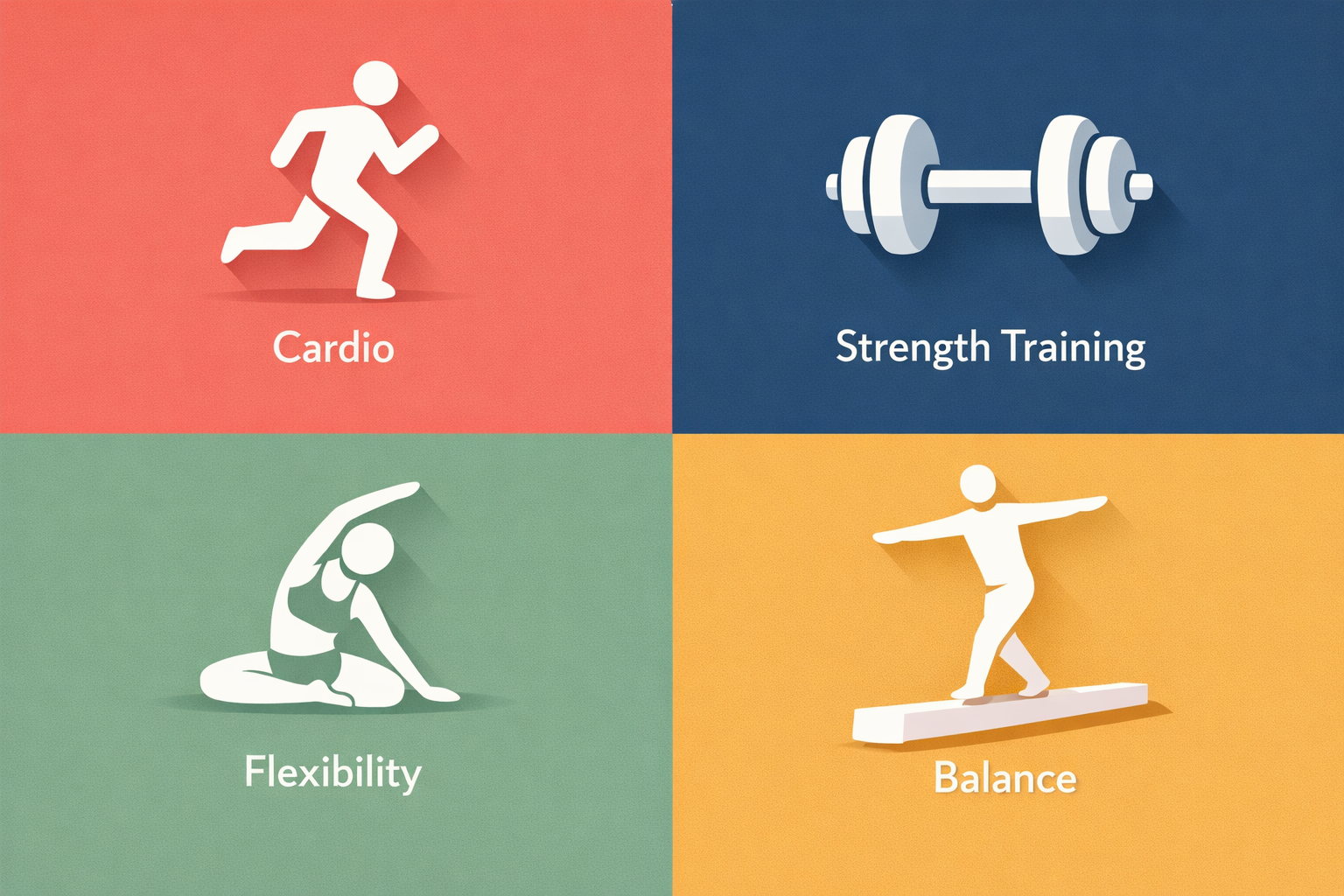
The four parts of a complete activity week
1. Cardio: build the engine
Cardio is any repeated activity that asks the heart, lungs, and working muscles to keep going: walking, hiking, cycling, swimming, rowing, jogging, dancing, and many gym machines all count. The right choice is usually the one that suits the person, the season, and the joints they have today—not the one with the best marketing.
Use the talk test rather than chasing a magic number. At a moderate effort, a person can speak in sentences but would not feel like singing. At a vigorous effort, speaking becomes brief and broken. This is a practical way to judge effort without pretending that one heart-rate number suits everyone.
2. Strength: keep the ability to do things
Strength training is the part that helps preserve or build the ability to push, pull, squat, hinge, carry, and get up. It can use bodyweight, dumbbells, resistance bands, machines, or a barbell. An umbrella review of systematic reviews found that resistance training improves muscle mass and strength in healthy adults; the exact tool matters less than a sensible, repeatable progression.3
For practical home options, use the Home Workout Routines guide or Bodyweight Strength Training. They belong to the Home Workouts & Strength cluster, but they support the complete week outlined here.
3. Mobility: keep useful ranges available
Mobility work does not need to become a separate sport. A few controlled movements for the ankles, hips, shoulders, and upper back can sit around walking or strength sessions. The aim is useful movement and comfort, not forcing range or collecting impressive stretches. Yoga, simple floor mobility, and a short warm-up can all serve this role.
4. Balance: practice it before it is a problem
Balance is trainable. It can be as ordinary as single-leg stands near a stable support, controlled step-ups, tai chi, or walking on varied but sensible terrain. Adults over 65 are specifically advised to include multicomponent activity that emphasizes balance and strength on three or more days when appropriate.1 Readers who want age- and joint-specific guidance should use How to Exercise When You’re Over 50.
Start moving: the walking route
For a person who is inactive, returning after a long break, or simply tired of overcomplicated programs, walking is the default starting point. Begin at a pace and duration that can be repeated. Ten to twenty minutes is enough to establish the habit; add time, hills, pace, or another day only when the current amount is settling in well.
The detailed plan is in How to Start Walking for Exercise. It covers shoes, pace, simple progression, and the difference between an easy stroll and a purposeful walk. The point is not to force a universal step count. It is to create a steady baseline that can grow.
A useful first target: choose three walk slots in the week and protect them like ordinary appointments. Once that is normal, extend one walk or make a small part of it brisker. Steady progress is more valuable than a heroic first week followed by nothing.
When to add intervals or HIIT
Intervals alternate easier and harder work. They are a way to vary effort, not a badge of fitness. A person who already walks comfortably might use short brisk segments within a walk. Someone with access to a bike or rower might use that equipment. A person who enjoys bodyweight circuits may choose a low-impact home option first.
HIIT Workouts covers the practical routes in more detail: walking HIIT, low-impact home HIIT, standard bodyweight sessions, and bike or rowing intervals. It also explains why Tabata is a specific protocol rather than another word for every interval workout.
Intervals are not a compulsory ladder after walking. A person can keep walking, swim, cycle, add strength training, or choose a different type of cardio. If intervals are used, begin with a proper warm-up, leave genuinely easy recovery periods, and stop the session when technique becomes sloppy rather than trying to “win” the workout.

Choose cardio by preference, not hype
There is no single “best” cardio method for every goal and every body. The choice can change with weather, access, skill, enjoyment, injury history, and available time. The table below is a way to choose a route, not a ranking.
| If you want… | A sensible route | Next guide |
|---|---|---|
| The simplest consistent start | Walking, gradually becoming more purposeful | Start Walking |
| A faster-paced option | Running, if it is enjoyable and tolerable | Walking vs. Running |
| A lower-impact cardio choice | Swimming or water-based exercise | Swimming guide |
| A way to vary effort | Walking, bike, rower, or home intervals | HIIT Workouts |
| Context for heart-rate language | Use numbers as an estimate, then compare them with real effort | Fat Burn Heart Rate |
What about the “fat-burn” heart-rate zone?
Heart-rate zones can be useful language for pacing, but they are not a shortcut around the total picture. A lower intensity may use a greater proportion of fat for fuel during that session; that does not make it a guaranteed route to body-fat loss, and it does not make harder exercise wrong. Weight change depends on the broader context: food intake, total activity, sleep, stress, health status, and whether the routine is sustained.
Use Fat Burn Heart Rate to understand the calculation and its limits. For most people, the more useful question is: Can I do this effort often enough to improve?
How much exercise is enough?
Public-health guidelines provide a useful reference point: adults are advised to build toward 150–300 minutes of moderate aerobic activity, 75–150 minutes of vigorous activity, or a mixture of the two each week, with muscle-strengthening activity involving major muscle groups on two or more days.1 That is a range for a whole week—not a demand for a daily gym session.
For someone starting below that range, more activity than before is still progress. The current guideline no longer requires activity to come in ten-minute blocks; shorter pieces count toward the whole.1 A ten-minute walk after lunch, a short strength circuit at home, and a longer walk on the weekend can be combined into a real week.
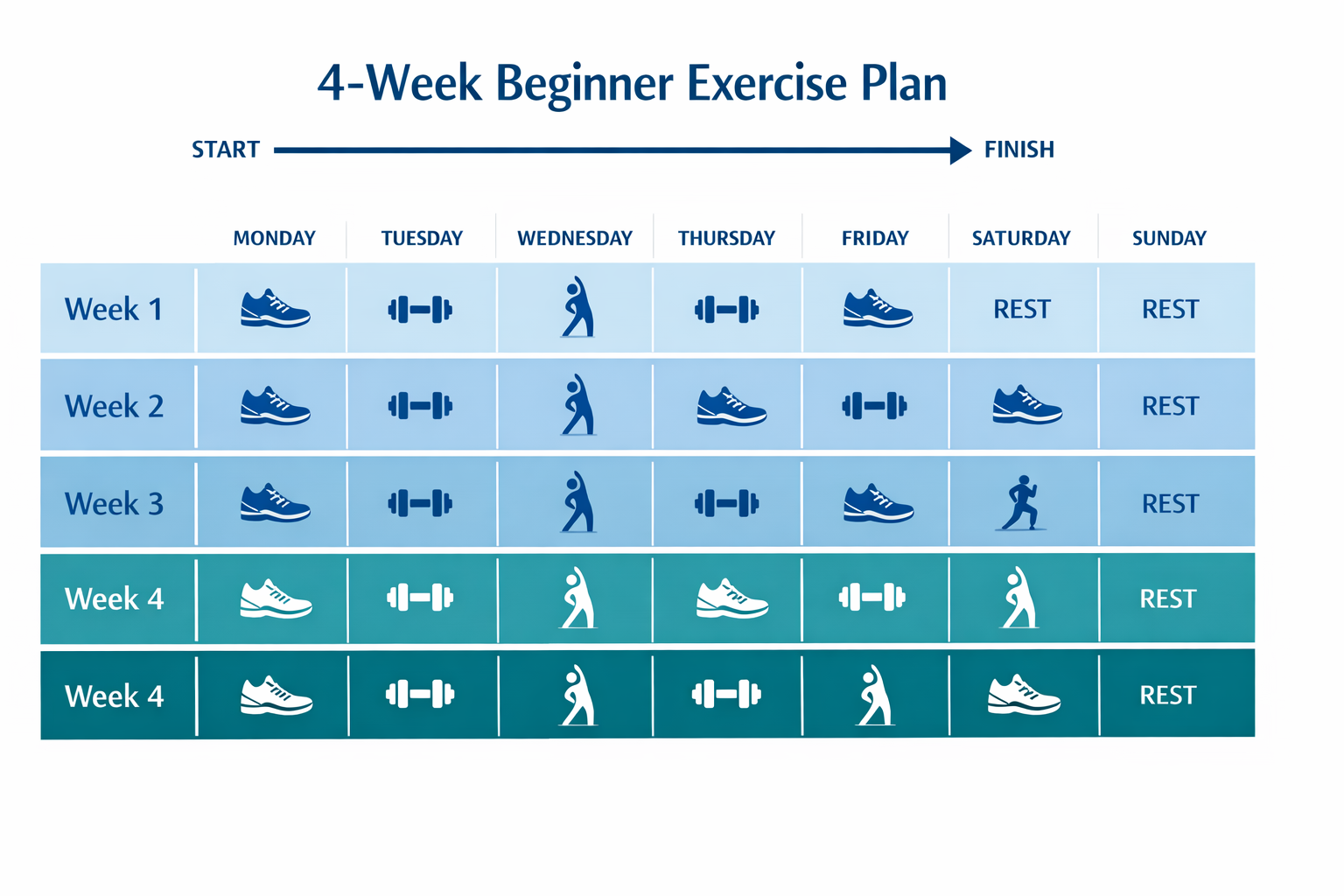
A sample week that stays flexible
This is an example, not a prescription. It shows how walking and cardio can sit at the center while strength, mobility, and recovery remain part of the picture.
- Day 1: Purposeful walk, 20–40 minutes.
- Day 2: Whole-body strength session.
- Day 3: Easy walk, swim, or cycle; add a few mobility movements if useful.
- Day 4: Whole-body strength session.
- Day 5: Longer easy walk or another chosen cardio activity.
- Optional: one interval session after a base is established, or simply another easy activity session.
The best adjustment is usually small: a few more minutes, one extra walk, a slightly brisker segment, or a little more resistance when form remains controlled. Do not turn every session into a test.
How to make the habit last
Plans fail more often from friction than from lack of information. Make the next session easy to begin: choose a default route, leave the shoes by the door, put walking time in the calendar, or keep a simple strength routine ready at home. Track completion rather than trying to judge every session as good or bad.
When a week goes off course, resume with the next normal session. There is no need to double up missed workouts or make up for food with exercise. A sustainable routine has room for work, family, travel, illness, and ordinary low-energy days.
When to get individual advice
Most healthy adults can begin with ordinary, manageable activity and build from there. A clinician or qualified exercise professional can help tailor the starting point for people with a recent cardiac event, uncontrolled symptoms, major mobility limitation, a new or worsening injury, or uncertainty about exercise after surgery. Stop and seek urgent assessment for chest pressure or pain, fainting, severe unexplained shortness of breath, or other concerning symptoms during activity.
Frequently asked questions
Is walking enough exercise?
Walking can be a meaningful form of cardio and a good foundation for a healthier week. Whether it is “enough” depends on the person’s aims and current capacity. Adding strength work and some mobility or balance practice makes the overall routine more complete.
Do I need HIIT to get fit?
No. HIIT is one way to organize harder and easier efforts. Walking, steady cycling, swimming, hiking, and strength training can all improve fitness when done consistently. HIIT is useful for people who enjoy it and can recover from it; it is not a requirement.
Is walking or running better for weight loss?
Neither wins automatically. Running can cover more work in less time, while walking is often easier to repeat and recover from. The better choice is the one that supports a sustainable weekly activity pattern. See Walking vs. Running for Weight Loss for a fuller comparison.
Can I split activity into short sessions?
Yes. Short sessions count toward the weekly total. A short walk after meals, a brief home strength routine, and a longer weekend activity can be a practical way to accumulate movement.
What should I do first if I am returning after a long break?
Start with walking or another easy cardio option at a repeatable level. Add time and intensity gradually, then introduce strength work. The detailed starting route is How to Start Walking for Exercise.
The bottom line
The durable exercise plan is not the most dramatic one. It is a week people can repeat: regular walking or another preferred cardio activity, two strength sessions, a little mobility and balance, and optional intervals when they fit. Start with the route that feels realistic, then make one small progression at a time.
References
- World Health Organization. WHO guidelines on physical activity and sedentary behaviour (2020).
- Fekete M, et al. Physical activity trajectories and accumulation over adulthood and their associations with mortality: a systematic review and meta-analysis. British Journal of Sports Medicine (2025).
- McLeod JC, et al. The influence of resistance exercise training prescription variables on skeletal muscle mass, strength, and physical function in healthy adults: an umbrella review. Journal of Sport and Health Science (2024).
- Murphy MH, et al. The effect of walking on fitness, fatness and resting blood pressure: a meta-analysis of randomized, controlled trials. Preventive Medicine (2007).
- Oja P, et al. Effects of frequency, intensity, duration and volume of walking interventions on cardiovascular risk factors: a systematic review and meta-regression analysis. British Journal of Sports Medicine (2018).

About Dave James
Dave is the founder of All Perfect Health. He focuses on practical, evidence-aware health guidance that people can use in real life without turning fitness into a full-time project.
📂 Exercise Guide for Better Health
This article is part of the APH cluster. Use the links below to move between the pillar and child articles.
- YOU ARE HEREPillar: Exercise Guide for Better Health
- → Body Mass Index (BMI) Chart
- → How to Start Walking for Exercise
- → HIIT Workouts
- → Walking vs. Running for Weight Loss
- → Fat Burn Heart Rate
- → Zone 2 Cardio: A Practical Beginner’s Guide to Steady Aerobic Training
- → Health Benefits of Swimming
- → Explore all Exercise guides