
Home Workout Routines: A Complete Guide
Created: September 29, 2026 • Last updated: September 30, 2026
Quick Answer
Home workout routines work well for building strength, improving mobility, and supporting general health when they follow the same core principles as any structured training program: progressive overload, consistency, and adequate recovery. For a beginner, a short routine built around controllable movements can be a legitimate starting point; the appropriate session length and frequency depend on current capacity, symptoms, and recovery. What home workout routines cannot replace is individualized medical guidance, heavy-load strength sport training, or a fixed timeline for visible results.
Key Takeaways
- Home workout routines can build real strength and improve function, but they cannot guarantee a specific timeline or fix problems that need medical evaluation.
- A manageable schedule can start with a small number of familiar movements and be adjusted around recovery, symptoms, and available time.
- Bodyweight exercise can challenge some muscles and movements; the suitable variation and available resistance depend on the person and goal.
- Progressive overload, not endless variety, is what drives results over time; more sets are not always better.
- A resistance band, adjustable dumbbells, or a kettlebell can cover many common home-training needs without a dedicated gym room.
- Recovery and a manageable schedule can help people continue training without treating every session as a test.
- Stop exercise for concerning symptoms such as chest pressure, fainting, severe or unusual breathlessness, or unexplained dizziness; seek urgent help when symptoms could indicate an emergency.
What Home Workout Routines Can, and Cannot, Do
A consistent, appropriately progressed home routine can improve strength and physical function [2]. Resistance training can also improve range of motion in some contexts, although that is narrower than a promise of broad mobility for every routine [5]. More vigorous movement can contribute to aerobic activity when the intensity and accumulated activity are sufficient [1]. A home routine cannot substitute for a medical diagnosis, guarantee a specific body shape, or reproduce every load and equipment option available for advanced strength goals.
Let’s keep this practical. A home routine is a delivery method, not a different form of exercise physiology. The body responds to the same signals whether the resistance comes from a barbell in a gym or a resistance band in a spare bedroom: tension applied to a muscle, progressively increased over time, with enough recovery between sessions to adapt. What changes at home is the ceiling on how much load you can apply and how much variety is built in without extra equipment.
What a structured home program can realistically deliver, based on general exercise science and public health guidance:
- Measurable strength gains in major muscle groups, particularly for beginners and intermediate exercisers
- Selected strength, balance, or function improvements, depending on the person and program
- Aerobic activity when the session genuinely includes enough sustained activity or separate cardio work
- Meaningful support for weight management when paired with dietary habits, though exercise alone is a modest lever for weight loss
- A sustainable habit that does not depend on travel time, gym hours, or weather
What it typically cannot deliver:
- A fixed number of pounds lost or muscle gained by a specific date, individual response varies too much for universal promises
- Reliable control over where body fat is lost by training one specific area [7]
- Correction of an existing injury, structural issue, or diagnosed condition without professional guidance
- The very heaviest end of strength training, where barbell-based progressive overload with hundreds of pounds is difficult to replicate at home
Home Workout Routines vs. Gym Training: Which Is Better
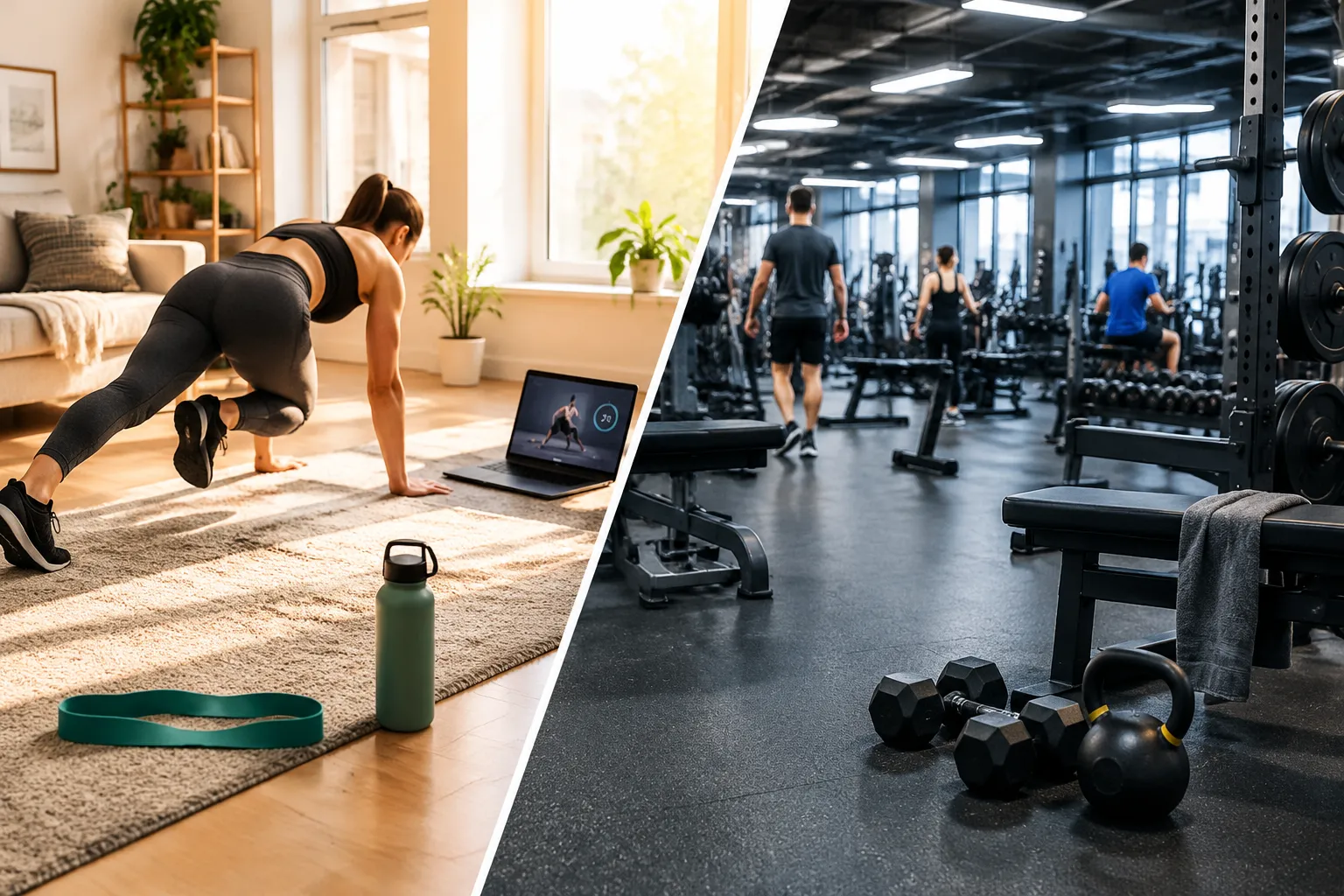
Neither is universally better; the right choice depends on your goals, budget, available space, and how you respond to structure and social accountability. Home routines may suit people who value convenience or privacy. Gyms may suit people who want greater load capacity, equipment variety, or a training environment that helps them stay consistent.
In real-world terms, here is a simple way to decide:
- Choose home workout routines if you value flexibility, want to avoid commute time, prefer privacy, or are just starting out and want to build confidence before training around others.
- Choose a gym if your goal is advanced strength or physique training that requires heavy barbell work, or if you know you need the structure of a scheduled class to stay consistent.
- Choose a hybrid approach if you want the convenience of home training most days with occasional gym access for heavier compound lifts.
The setting matters less than choosing a program that fits the person’s goals, equipment, available time, and ability to follow it consistently.
Can You Build Muscle With Just Home Workouts and No Equipment
A bodyweight exercise can contribute to strength and muscle adaptation under a defined training plan; for example, a small supervised push-up trial in young men found changes after eight weeks. That single exercise study does not prove that every whole-body, no-equipment routine will produce the same result for every reader [6]. Bodyweight variations, repetitions, range, and external resistance can all be adjusted according to the movement and the person.
The catch is one of diminishing returns. A beginner doing push-ups against a wall, then on the floor, then with feet elevated, then with one arm assisted, can keep progressing for a long time. As a movement becomes easy to control, a person may choose a different variation, more resistance, or a different exercise to keep it appropriately challenging. A resistance band, dumbbell, or kettlebell is one option, not a compulsory next step at a particular repetition count.
How to Choose Your Starting Point
The right starting point for home workout routines depends on current activity level, any existing joint or health concerns, and how much time you can realistically commit each week, not on what a program promises. A sensible starting point is almost always more conservative than people expect, especially in the first two to three weeks.
Before choosing a routine, answer three honest questions:
- How active have you been in the last three months? Sedentary, lightly active, or regularly active changes where you start.
- Do you have joint pain, a recent injury, or a diagnosed condition that affects movement? These factors may call for individual medical or exercise guidance before changing a routine.
- How much time can you commit on a normal week, not an ideal one? Twenty minutes done consistently beats sixty minutes planned but skipped.
What’s the Best Home Workout Routine for Beginners
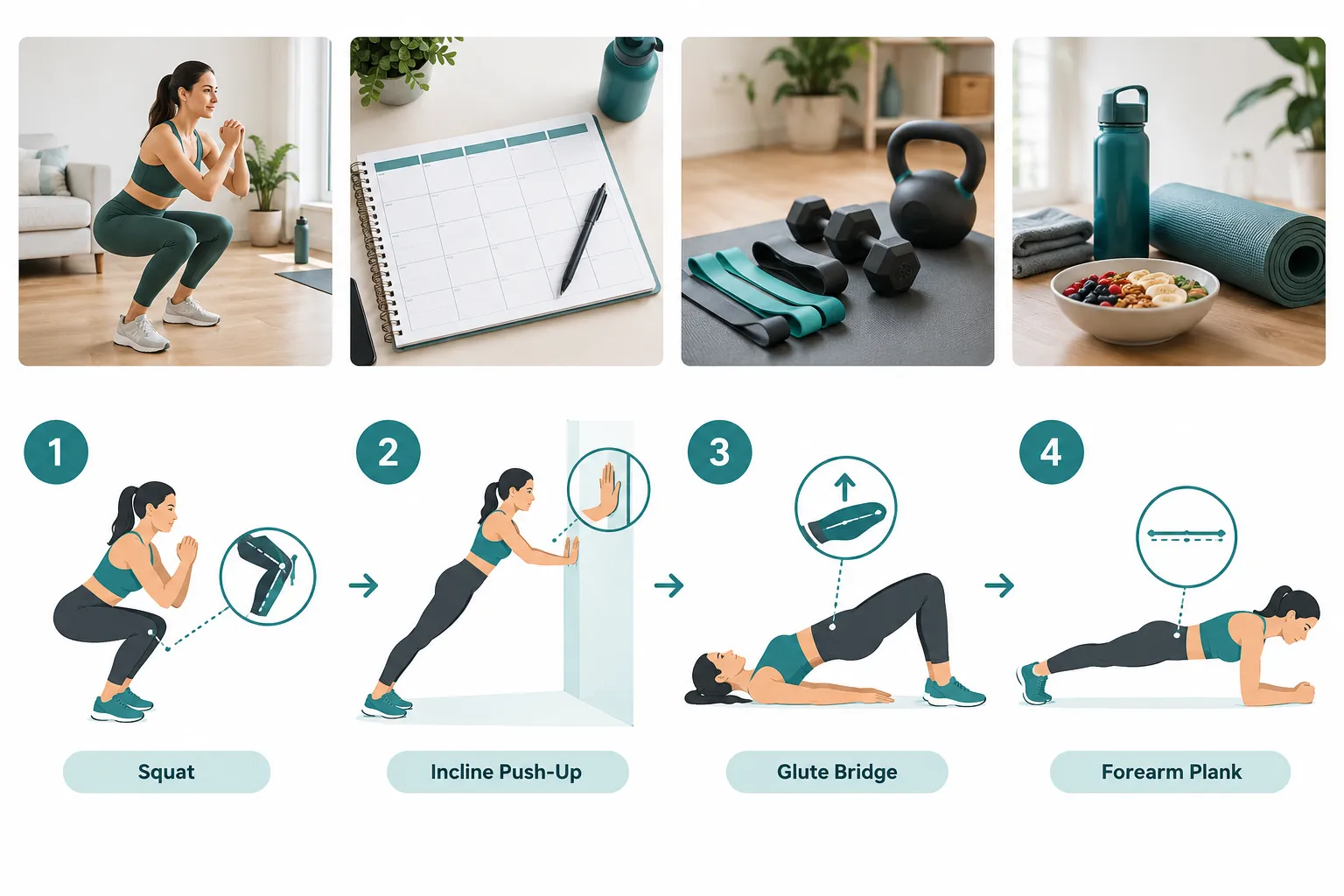
A beginner routine can use a small number of familiar movements and a manageable schedule. Public-health guidance recommends muscle-strengthening activity on two or more days a week; frequency, effort, and volume should be adjusted to the person rather than treated as one fixed prescription [1][2]. In plain English, a squat pattern, a push, a hip-extension movement such as a glute bridge, and a trunk-control exercise can be a practical starting framework.
A simple beginner structure looks like this:
- Warm-up: a gradual five-to-ten-minute transition from easy movement to the planned exercise, adjusted to the person and session [9]
- Main circuit: four exercises, two to three sets each, eight to twelve reps or 20 to 30 seconds per exercise
- Cool-down: two to three minutes of slow breathing and light stretching
Keep it simple and consistent for the first three to four weeks before adding complexity. The goal early on is building the habit and the movement pattern, not maximizing intensity.
Home Workout Routine for Over 50 or Seniors
For adults over 50, strength and balance activity can be valuable parts of an overall routine, but the suitable movements, load, and pace depend on health status, experience, symptoms, and confidence. Public guidance includes strength and balance activity for older adults, while home-resistance evidence in community-dwelling adults aged 60 and older reports selected, outcome-specific benefits rather than a universal result [1][3].
Practical adjustments that matter:
- Choose a range and variation that can be controlled comfortably; support or a reduced range may be useful for some people, not an age-based requirement
- Consider a balance component when it suits the person, using an environment and support that are genuinely stable
- Use a gradual warm-up and allow more time when it helps the person feel ready; there is no age-only warm-up duration that fits everyone
- Build a schedule that remains manageable rather than treating exhaustion as a sign of a better session
Context matters here. A 55-year-old with well-managed joints and no diagnosed conditions can often follow a program close to a general beginner routine. A 62-year-old recovering from a knee procedure needs an individually adjusted plan, ideally reviewed with a physical therapist or physician first.
Bodyweight Home Workout Routines
Bodyweight home workout routines use the body’s own weight as resistance and require no equipment, making them an accessible entry point for many people. They can remain useful beyond the beginner stage when reps, tempo, range of motion, and single-limb variations are adjusted. For complete session options, see Best Home Workouts Without Equipment; for progression ideas, see Bodyweight Strength Training.
A core bodyweight routine typically rotates through five movement patterns:
| Movement pattern | Example exercise | What it trains |
|---|---|---|
| Squat | Bodyweight squat, chair squat | Quads, glutes, hips |
| Push | Push-up (wall, knee, or full) | Chest, shoulders, triceps |
| Hip extension | Glute bridge | Glutes and hamstrings |
| Pull | A pulling variation using purpose-designed equipment and a verified setup | Back and arms, when suitable equipment is available |
| Core | Plank, dead bug | Trunk-control exercise |
Home Workout Routines That Don’t Need Equipment
Home workout routines that skip equipment can be a useful starting method for many people. Pulling movements are the main constraint because rows and pull-ups normally require external resistance or a bar; use purpose-designed equipment only when its setup and instructions are suitable, and do not improvise with unstable furniture, doors, or unknown anchors.
A no-equipment session for a typical week might combine:
- 3 sets of 10-15 bodyweight squats
- 3 sets of push-ups at whatever depth is currently achievable (wall, incline, or floor)
- 3 sets of 10-15 glute bridges
- a controlled pulling movement only where suitable equipment and setup are available
- 2 sets of 20-30 second planks
The main takeaway is this: equipment expands options, but it does not create a floor below which exercise “doesn’t count.” A well-executed bodyweight circuit can be a practical way to practice familiar movements and build capacity; its usefulness depends on the exercise, progression, goals, and individual response.
How to Build a Balanced Weekly Home Routine
A balanced weekly home routine can combine muscle-strengthening activity with other movement such as walking or aerobic exercise. Public-health guidance recommends muscle-strengthening activity on two or more days each week [1]. The suitable arrangement depends on available time, recovery, experience, goals, and how hard the sessions are; a repeating full-body schedule does not need a universal rest-day rule.
A simple weekly template:
- Monday: Full-body strength (squat, push, hinge, core), 25 to 35 minutes
- Tuesday: Light cardio or a walk, optional mobility work
- Wednesday: Full-body strength, slightly different exercise variations
- Thursday: Rest or gentle stretching
- Friday: Full-body strength or a shorter circuit
- Weekend: One active day (walk, hike, recreational activity), one full rest day
How Often Should You Do Home Workouts Per Week
For many adults, two or three resistance-focused sessions a week is a practical starting point, with walking or other activity on other days if it fits. Frequency should rise only when recovery, technique, and real-life adherence are holding up.
Choose a schedule that is realistic enough to repeat while technique, recovery, and daily life remain manageable.
How Long Should a Home Workout Be to See Results
A home session may be short or longer depending on the movements, rest periods, experience, and goals. Duration alone does not establish whether a strength session is adequate; use a schedule and exercise selection that can be performed with controlled technique.
“Results” need a realistic frame: strength, skill, confidence, and body composition can change at different rates, and there is no fixed timeline that applies to every person. Nutrition, starting point, training history, recovery, and consistency all influence what someone notices.
Is 20 Minutes of Home Workout Enough
A twenty-minute session can be a practical option when it uses familiar movements and a manageable level of effort. There is no universal minimum session duration, and a small amount of suitably challenging resistance work can still be useful [1][11]. Allow enough transition and rest time to keep repetitions controlled.
A well-used 20-minute session might include:
- A gradual warm-up suited to the planned movements
- A small circuit of squat, push, hip-extension, and trunk-control movements, with a pulling variation only when suitable equipment is available
- Enough rest between efforts to maintain control
- A brief transition out of the session if it feels useful
Home Workout Routines for Busy People Short on Time
For people with limited and unpredictable time, the most sustainable approach is a shorter, non-negotiable session length rather than an ambitious plan that gets skipped on busy days. A short full-body session that is repeated consistently is generally more useful than an ambitious plan that is repeatedly skipped. See Quick Home Workouts for Busy Adults for a focused shorter-session branch.
Practical strategies that work well for busy schedules:
- Keep a single default circuit memorized so there’s no decision fatigue about what to do
- Break sessions into two 10-minute blocks on days when one continuous block isn’t possible
- Treat the workout as fixed on the calendar, the same as a meeting
Best Home Workout Routine for Weight Loss
There is no single best home routine for weight loss. Regular movement, resistance exercise, and dietary patterns can all matter; resistance training is associated with modest average improvements in body-fat outcomes in healthy adults [1][4]. During dietary weight loss in adults with overweight or obesity, adding resistance exercise may attenuate fat-free-mass loss compared with diet alone; that does not guarantee muscle preservation for every person [8].
A sensible structure can combine regular resistance sessions with walking or other activity, rather than relying on one workout type alone. It is not that simple to isolate “the best” routine for fat loss from diet and total daily activity; all three interact, and no single at-home routine overrides the rest of a person’s context. For a focused discussion of training and body composition, see Body Composition Exercises.
How to Progress Without Guesswork
Progression in home workout routines means adjusting training demand over time when a familiar movement becomes manageable. The suitable adjustment can involve repetitions, sets, load, exercise choice, or range, and maintenance can also be a valid goal rather than a failure to progress [2].
The main levers for progressive overload at home, roughly ordered by ease of use:
- Add reps, increase from 10 to 12 to 15 reps before changing anything else
- Add sets, go from two sets to three sets of the same exercise
- Slow the tempo, a 3-second lowering phase on a squat or push-up increases time under tension
- Adjust rest when useful, keeping enough rest to maintain controlled repetitions rather than treating shorter rest as automatically better
- Change leverage or range, a push-up with feet elevated, a single-leg glute bridge
- Add external load, a band, dumbbell, or kettlebell when it suits the movement, goal, and available equipment
Change one variable at a time when possible and choose the option that keeps the movement controlled. Adding repetitions, sets, load, or a different variation can all be appropriate depending on the exercise and person.
Common Mistakes People Make With Home Workouts
The most common mistakes are skipping progression entirely, doing too much too soon, and treating rest days as optional. I would be careful with any plan that either never changes or changes every single session, both patterns undermine the adaptation process.
Frequent mistakes worth naming directly:
- No progression plan. Repeating identical workouts indefinitely with no plan to add difficulty
- Ignoring form under fatigue. Letting technique break down in the last few reps, especially on squats and hinges
- Skipping warm-ups. Going straight into working sets, particularly common in short home sessions
- All intensity, no recovery. Training hard every day with no lower-effort or rest days
- Comparing to someone else’s program. Copying an advanced routine before building a base level of strength and movement control
More is not always better. Monitor technique, symptoms, recovery, and fatigue, then reduce, maintain, or adjust training when the current plan no longer fits.
Bands, Dumbbells, and Kettlebells: When Each Helps
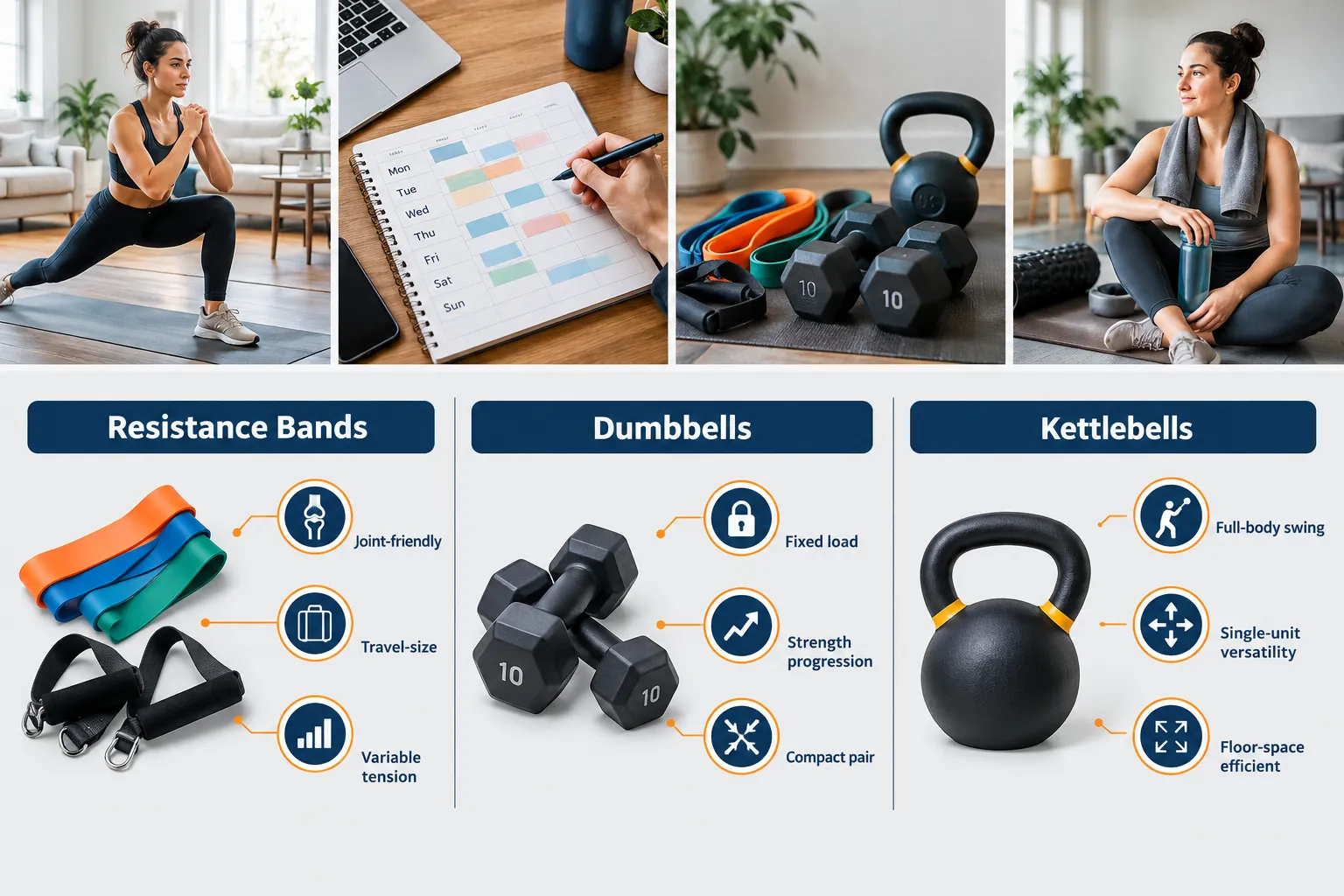
Resistance bands, dumbbells, and kettlebells each solve a different practical problem in a home routine, and choosing between them depends on available space, experience, movement tolerance, and how much load progression you eventually need. None is universally superior; each has a specific role.
| Equipment | Best for | Limitations |
|---|---|---|
| Resistance bands | Compact resistance, lower-load variations, and warm-ups | Resistance is harder to measure precisely; tension varies through the range of motion |
| Dumbbells | Precise, progressive loading for most strength exercises | Fixed loads can become limiting for some exercises; adjustable weights make smaller load changes convenient |
| Kettlebells | Compact single-unit strength work, carries, and ballistic movements such as swings when appropriate | Swings and cleans are technique-dependent; learn a suitable movement and load before treating them as a default |
For setup and progression detail, see Resistance Band Workouts for Building Real Strength at Home. A sensible decision rule:
- Choose bands if you want a compact, portable option or a way to add controlled resistance; inspect the band and anchor before every session
- Choose dumbbells if your main goal is straightforward strength progression across pressing, rowing, and squatting patterns
- Choose a kettlebell if you want a single compact tool for full-body conditioning and are willing to learn proper hip-hinge technique first, ideally from a qualified instructor or reliable instructional resource
Choose equipment only when it solves a real limitation in the exercises you want to do. A small setup can be useful, but no three-item kit is compulsory for every home program.
When a Small Home Setup Is Worth It
A small home setup may be worth considering when the available exercises no longer provide a suitable challenge for a person’s goals, or when equipment would make a preferred movement more practical. There is no universal repetition threshold for that decision.
What Equipment Do You Actually Need for Home Workouts
Many people can begin with little or no equipment. A resistance band, a pair of dumbbells or adjustable option, and a stable non-slip mat are practical additions when they solve a real limitation. Everything beyond that, benches, racks, cardio machines, adds convenience or variety rather than being strictly necessary for general fitness.
A minimal, sensible equipment list for most home exercisers:
- One or two resistance bands (light and medium tension)
- A pair of dumbbells, adjustable if space is limited
- A non-slip exercise mat
- Optional purpose-designed equipment that fits the movement and available space; avoid treating household furniture as exercise equipment
We need to separate fact from hype here: elaborate multi-station home gyms are not required for a useful resistance routine. The evidence for basic, progressive resistance work does not depend on specialized machines. For a practical equipment-decision guide, see Home Gym Equipment for Strength Training.
Home Workout Routines for Small Spaces and Apartments
Apartment living can still allow a useful strength and mobility routine when the exercises, body size, movement path, ceiling height, available floor space, noise, and building rules are considered. Check that there is enough clear space for the actual movement rather than relying on one universal footprint.
Practical space-saving choices:
- Favor compact, foldable, or single-unit equipment (one kettlebell instead of a full dumbbell rack)
- Store equipment securely and low enough to reduce the chance of a falling item, while keeping the floor clear between sessions
- Choose exercises that don’t require jumping or heavy floor impact if downstairs neighbors are a consideration; substitute a fast step-up or a controlled tempo squat for a jump squat
Recovery, Expectations, and Staying Consistent
Recovery is part of training. Sleep, food intake, stress, training history, and the rest of a person’s week all influence how they respond; a routine should leave room to recover rather than treating every day as a test.
The basics still do the heavy lifting when it comes to recovery:
- Sleep: consistent sleep supports recovery and overall health
- Protein intake: adequate protein intake can support adaptation to resistance training; the review evidence does not establish one ideal meal distribution [10]
- Rest days: rest or lower-effort days when fatigue, soreness, or life demands call for them
- Active recovery: light walking or gentle stretching can be an optional comfort or activity choice on non-training days
On realistic expectations: there is no universal timeline for strength, skill, confidence, or body-composition changes. Track whether a movement feels more controlled and whether the schedule remains manageable rather than expecting a fixed deadline.
A manageable routine is often easier to continue than one that regularly leaves the person exhausted; adjust the plan from real feedback rather than using intensity alone as a measure of quality.
Safety and When to Seek Individual Advice
Home workouts can be a practical option for many adults when introduced gradually, with attention to technique and recovery. Acute symptoms during exercise and existing conditions or recent injuries require different decisions; neither should be dismissed.
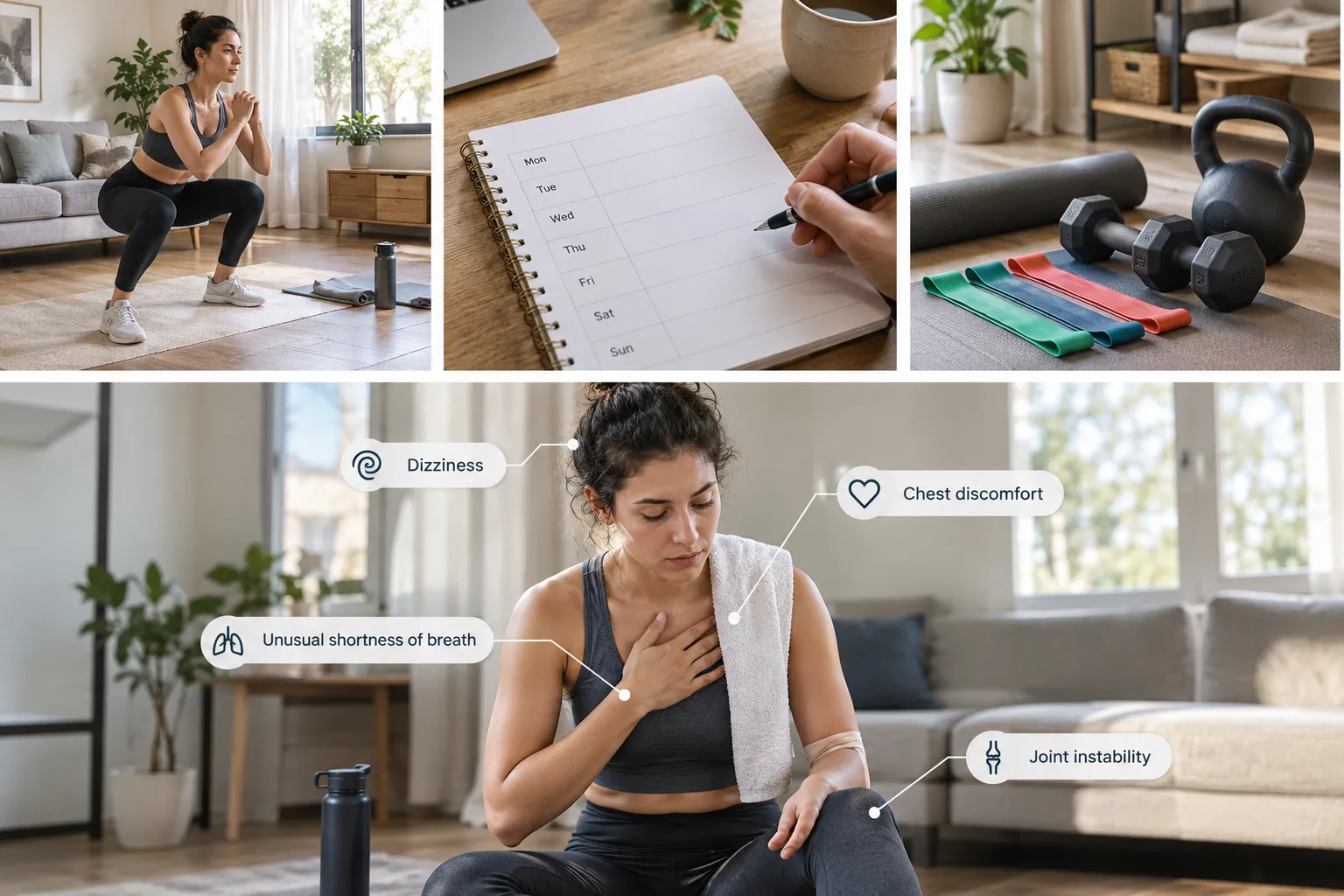
Stop the session and seek prompt medical assessment for concerning exertional symptoms such as chest pain, pressure, or tightness; fainting or a strong feeling of about to faint; severe or unusual breathlessness; or unexplained dizziness or lightheadedness [11]. If symptoms could indicate a heart attack, call 911 or local emergency services rather than driving yourself [12].
Seek individual guidance before starting or changing a program when recent surgery, an injury, a diagnosed condition, or persistent joint symptoms affect what exercise may be suitable. Sudden worsening pain, new instability, or a joint that feels as though it may give way are reasons to stop and obtain assessment rather than push through.
Home Workout Routines for People With Bad Knees or Back
Knee or back symptoms can have different causes and may need individual assessment. A general article cannot determine which movement, range, or load is appropriate for a particular diagnosis or new symptom.
Practical adjustments:
- For knee or back symptoms: stop or reduce a movement that causes concerning symptoms, avoid forcing range or load, and use individual clinical or qualified exercise guidance for an appropriate variation.
- For general exercise selection: bird dog, dead bug, glute bridge, squat, hinge, and carry variations serve different purposes; do not treat one generic menu as rehabilitation for every knee or back problem.
For a diagnosed condition, recent injury or surgery, or symptoms affecting exercise suitability, a licensed clinician can advise on medical restrictions or assessment. An appropriately qualified exercise professional can help select and progress movements within that advice. This article remains general education, not an individualized assessment.
A sensible starting point, summarized
Start with a manageable schedule and a small number of familiar movements. Adjust repetitions, sets, load, range, or exercise choice only when control and recovery support it. Stop for concerning exertional symptoms; seek urgent help for possible emergency symptoms and individual advice for conditions, recent injury, or persistent concerns.
FAQ
Do home workout routines work as well as gym workouts?
Home routines can support general strength and fitness goals when the exercises, resistance, progression, and schedule fit the person. A gym may offer more load and equipment options for some advanced strength goals; neither setting is automatically the better choice for every person.
How many days a week should a beginner do home workouts?
A beginner can start with a manageable schedule that includes muscle-strengthening activity on two or more days each week, then adjust around technique, symptoms, and recovery [1].
Can I lose weight with home workout routines alone?
Exercise alone typically produces modest weight loss; the most reliable approach pairs a home resistance and movement routine with sustainable dietary habits, since diet and activity both influence body weight.
What is the minimum equipment needed to start?
Many people can begin with little or no equipment. A band, dumbbells, or a non-slip mat can be useful when they solve a real limitation, but no fixed kit is required for every person or goal.
Is it normal to feel sore after starting a new home routine?
Delayed muscle soreness can occur after unfamiliar or harder exercise. Severe pain, swelling, loss of function, or symptoms that persist or raise concern deserve assessment rather than being treated as a normal sign of progress [13].
How do I know if I need to see a professional before starting?
New unexplained exertional symptoms require prompt medical assessment. For a diagnosed condition, recent injury or surgery, or uncertainty about exercise suitability, seek individual advice from an appropriate licensed clinician; a qualified exercise professional can help within any medical guidance.
Conclusion
The main takeaway is this: a home routine can be legitimate training when it uses movements, resistance, and a schedule that fit the person. Start with a small number of familiar movements, keep the schedule realistic for an actual week, and adjust one variable at a time as control, recovery, and goals allow.
Evidence first, hype second. There is no magic program, no single “best” routine, and no universal timeline for results. A sensible next step is to choose a small routine that fits the equipment, space, symptoms, and time actually available, then adjust from real feedback about control, recovery, and comfort.
For a complete no-equipment session, see Best Home Workouts Without Equipment. For exercise progressions, see Bodyweight Strength Training. For a compact resistance option, see Resistance Band Workouts for Building Real Strength at Home.
References
- U.S. Department of Health and Human Services. Physical Activity Guidelines for Americans. 2nd edition. Washington, DC: U.S. Department of Health and Human Services; 2018.
- Currier BS, D’Souza AC, Fiatarone Singh MA, Lowisz CV, Rawson ES, Schoenfeld BJ, et al. American College of Sports Medicine Position Stand. Resistance Training Prescription for Muscle Function, Hypertrophy, and Physical Performance in Healthy Adults: An Overview of Reviews. Medicine & Science in Sports & Exercise. 2026;58(4):851–872. doi:10.1249/MSS.0000000000003897. PMID:41843416. PMCID:PMC12965823.
- Mañas A, Gómez-Redondo P, Valenzuela PL, Morales JS, Lucía A, Ara I. Unsupervised home-based resistance training for community-dwelling older adults: A systematic review and meta-analysis of randomized controlled trials. Ageing Research Reviews. 2021;69:101368. doi:10.1016/j.arr.2021.101368. PMID:34022464.
- Wewege MA, Desai I, Honey C, Coorie B, Jones MD, Clifford BK, et al. The Effect of Resistance Training in Healthy Adults on Body Fat Percentage, Fat Mass and Visceral Fat: A Systematic Review and Meta-Analysis. Sports Medicine. 2022;52(2):287–300. doi:10.1007/s40279-021-01562-2. PMID:34536199.
- Alizadeh S, Daneshjoo A, Zahiri A, Anvar SH, Goudini R, Hicks JP, et al. Resistance Training Induces Improvements in Range of Motion: A Systematic Review and Meta-Analysis. Sports Medicine. 2023;53(3):707–722. doi:10.1007/s40279-022-01804-x. PMID:36622555. PMCID:PMC9935664.
- Kikuchi N, Nakazato K. Low-load bench press and push-up induce similar muscle hypertrophy and strength gain. Journal of Exercise Science & Fitness. 2017;15(1):37–42. doi:10.1016/j.jesf.2017.06.003. PMID:29541130. PMCID:PMC5812864.
- Ramirez-Campillo R, Andrade DC, Clemente FM, Afonso J, Pérez-Castilla A, Gentil P. A proposed model to test the hypothesis of exercise-induced localized fat reduction (spot reduction), including a systematic review with meta-analysis. Human Movement. 2022;23(3):1–14. doi:10.5114/hm.2022.110373.
- Binmahfoz A, Dighriri A, Gray C, Gray SR. Effect of resistance exercise on body composition, muscle strength and cardiometabolic health during dietary weight loss in people living with overweight or obesity: a systematic review and meta-analysis. BMJ Open Sport & Exercise Medicine. 2025;11(3):e002363. doi:10.1136/bmjsem-2024-002363. PMID:40909191. PMCID:PMC12406911.
- American Heart Association. Warm Up, Cool Down. American Heart Association. Last reviewed January 16, 2024.
- Morton RW, Murphy KT, McKellar SR, Schoenfeld BJ, Henselmans M, Helms E, et al. A systematic review, meta-analysis and meta-regression of the effect of protein supplementation on resistance training-induced gains in muscle mass and strength in healthy adults. British Journal of Sports Medicine. 2018;52(6):376–384. doi:10.1136/bjsports-2017-097608. PMID:28698222. PMCID:PMC5867436.
- Paluch AE, Boyer WR, Franklin BA, Laddu D, Lobelo F, Lee DC, et al. Resistance Exercise Training in Individuals With and Without Cardiovascular Disease: 2023 Update: A Scientific Statement From the American Heart Association. Circulation. 2024;149(3):e217–e231. doi:10.1161/CIR.0000000000001189. PMID:38059362. PMCID:PMC11209834.
- American Heart Association. Warning Signs of a Heart Attack. American Heart Association. Last reviewed December 12, 2024.
- Cleveland Clinic. Delayed Onset Muscle Soreness (DOMS). Cleveland Clinic Health Library. Medically reviewed; updated December 19, 2025.
Disclaimer
This guide is for general education and is not medical advice. For unexplained symptoms, recent injury or surgery, or a condition that may affect exercise suitability, seek advice from an appropriate licensed clinician. A qualified exercise professional can help select and progress exercises within any medical guidance.

About the author
Dave James is the writer and editor behind All Perfect Health. He is not a doctor; this guide is designed to help readers start conservatively, ask better questions, and avoid fitness hype.