
Bodyweight Squats: Proper Form and Beginner Progressions
Created: September 30, 2026 • Last updated: September 30, 2026
A bodyweight squat is ordinary for a reason: it trains a useful pattern without requiring a gym. Sit down, stand up, get lower to reach something, climb a step—your legs and hips do versions of this work every day. The goal is not to chase a perfect-looking depth. It is to build a controlled version that you can repeat.
Quick answer: Stand with a comfortable stance, let the knees and hips bend together, keep your whole foot connected to the floor, and lower only as far as you can control. Stand by pressing the floor away through the mid-foot. For a beginner, two or three sets of 6–12 tidy repetitions on two or more days a week is a sensible starting place—then adjust the range, pace, or volume to suit your current capacity.
Key Takeaways
- Bodyweight squats are a lower-body strength movement, not a magic fat-loss exercise. They can train the legs and hips without equipment, but one exercise cannot choose where fat comes off.
- There is no universal squat depth. Use the deepest range you can control without sharp pain, loss of balance, or a big collapse through the trunk.
- Start with a manageable dose. The federal guidelines recommend muscle-strengthening activity involving all major muscle groups on two or more days a week; squats can be one part of that broader pattern.[1]
- Progress is earned by control. More reps, more depth, slower lowering, or a harder variation all count—but change one thing at a time.
Table of Contents
What Bodyweight Squats Train—and Their Realistic Limits
A squat asks the hips, knees, and ankles to bend as the body lowers, then straighten as you stand. Your quadriceps and glutes do much of the work. The trunk, feet, and lower legs help you stay balanced and transfer force. It is a useful pattern, but it is not a complete lower-body program on its own: a balanced week can also include a hip-hinge movement, a single-leg pattern, calf work, and walking or other aerobic activity.
Bodyweight work can be effective, particularly for people who are new to resistance training or returning after a break. But it is worth reading the evidence honestly. A four-month home bodyweight-squat study in community-dwelling adults aged 66–86 found changes in motor-unit firing characteristics, but it did not find significant improvements in muscle mass, strength, or the physical-performance tests used in that small sample.[2] That does not mean squats “do nothing”; it means a high-repetition squat habit is not a guaranteed shortcut to major gains, especially in people who are already active.
A different randomized trial in healthy older adults used a slow bodyweight-resistance program with squats, tabletop push-ups, and sit-ups. It reported improvements in muscle mass and strength after 12 weeks, but that was a multi-exercise program—not proof that squats alone create every benefit claimed online.[3] The useful conclusion is simple: bodyweight squats can be a good foundation. They work best when they are part of consistent whole-body training, not when they are sold as a one-move transformation.
For a full-body structure around this movement, see our Bodyweight Strength Training guide. The wider Home Workout Routines guide shows how strength, cardio, recovery, and realistic scheduling fit together.
How to Do a Bodyweight Squat
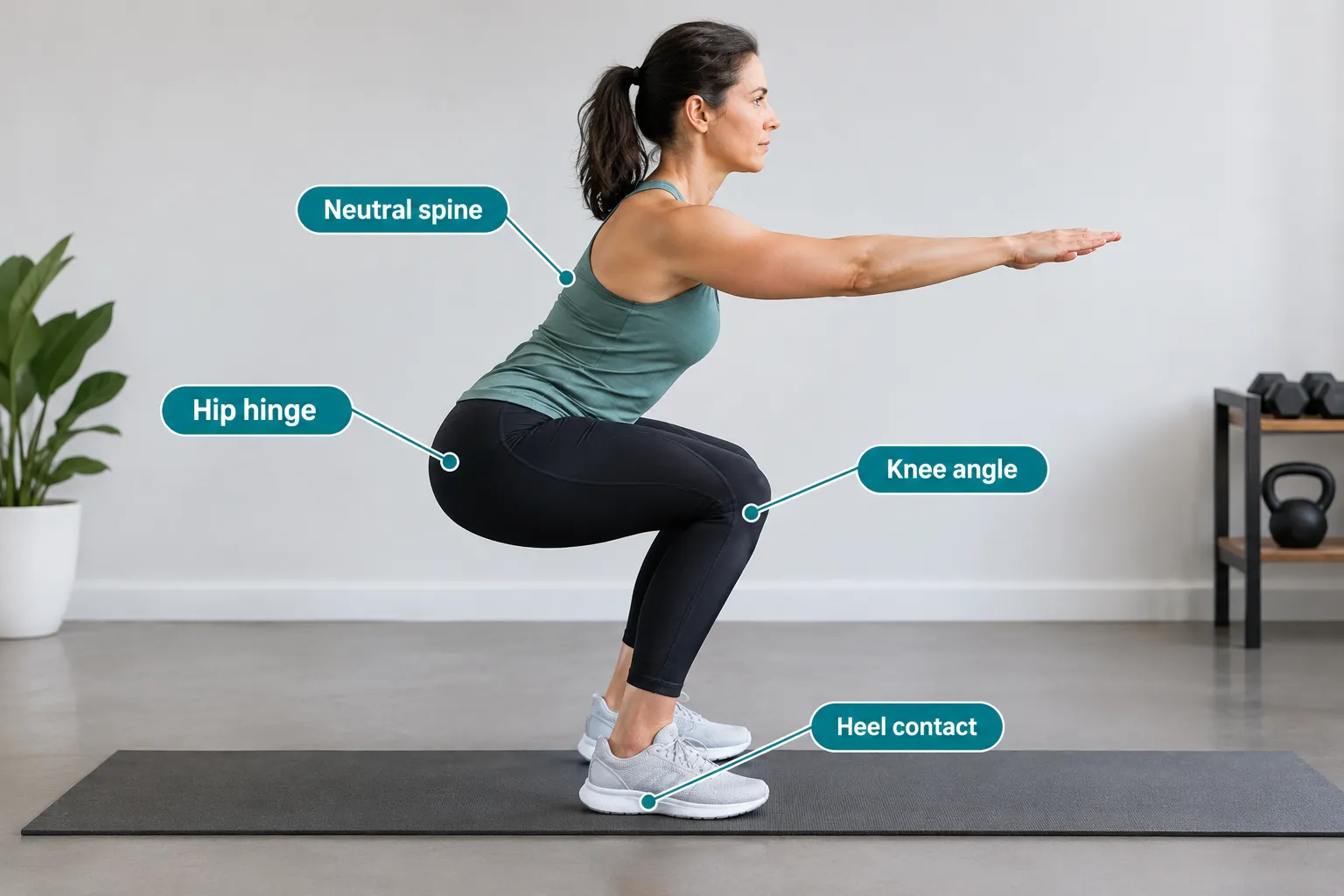
Good squat form is less about copying a frozen screenshot and more about learning a steady movement you can own. Use these cues as a starting point, then make small adjustments rather than forcing your body into someone else’s stance.
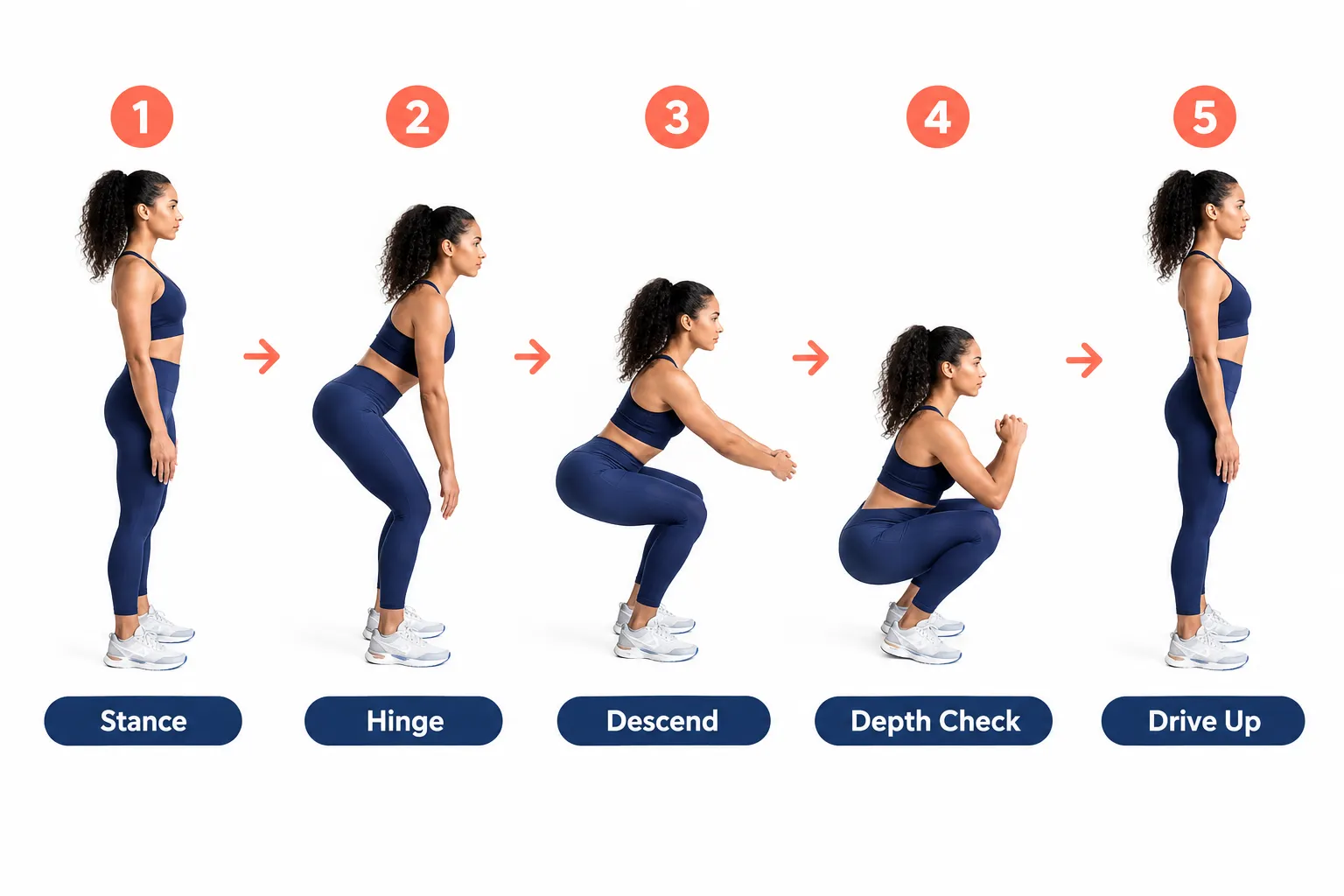
- Set your feet. Stand about hip- to shoulder-width apart. Let the toes turn out a little if that feels more natural. You are looking for a stable stance, not a mandated angle.
- Find your balance. Feel the whole foot: heel, big-toe side, and little-toe side. Keep the floor clear and wear footwear that does not slide—or train barefoot only if that is familiar and comfortable for you.
- Lower under control. Let the hips move back and down as the knees bend. The knees can travel forward as you squat; the practical point is that they follow the general direction of the toes rather than suddenly folding inward.
- Choose your depth. Stop at the deepest point you can control without sharp pain, a loss of balance, or a big rounding/collapsing of the trunk. A partial squat is a legitimate training version.
- Stand smoothly. Press the floor away through the mid-foot and heel, allowing the hips and knees to straighten together. Finish tall without leaning back.
- Reset. Take a breath, find your footing again, and repeat. A short pause between reps is fine, especially while you learn.
A simple cue: “Sit between your feet, then push the floor away.” It often works better than trying to think about every muscle at once.
Depth, Stance, and Range of Motion
“Below parallel” is not a health requirement. Some people can comfortably squat deep with an upright torso; others do better with a shallower range, a slightly wider stance, or a heel-elevated setup. Hip anatomy, ankle mobility, previous training, and what feels stable all influence the shape of a squat.
Start with a range that looks and feels controlled. You can expand it gradually if you want to and if the movement stays comfortable. On the other hand, you do not need to chase depth just because a video says it is the “real” version. A repeatable partial squat can be far more useful than a deep rep that feels wobbly or provokes symptoms.
If your heels pop up, you might simply be moving faster or lower than your current control allows. Reduce the depth, slow down, or experiment with a slightly wider stance. Do not force the feet to stay perfectly still at the cost of a painful or awkward position. If a persistent knee, hip, or back issue limits the movement, individual assessment is more useful than generic internet cues.
Beginner Options and Sensible Progressions
Progression should make the exercise a little more demanding while keeping it recognizable. You do not need fancy gear or a heroic daily total. Begin with the version that lets you move with confidence.
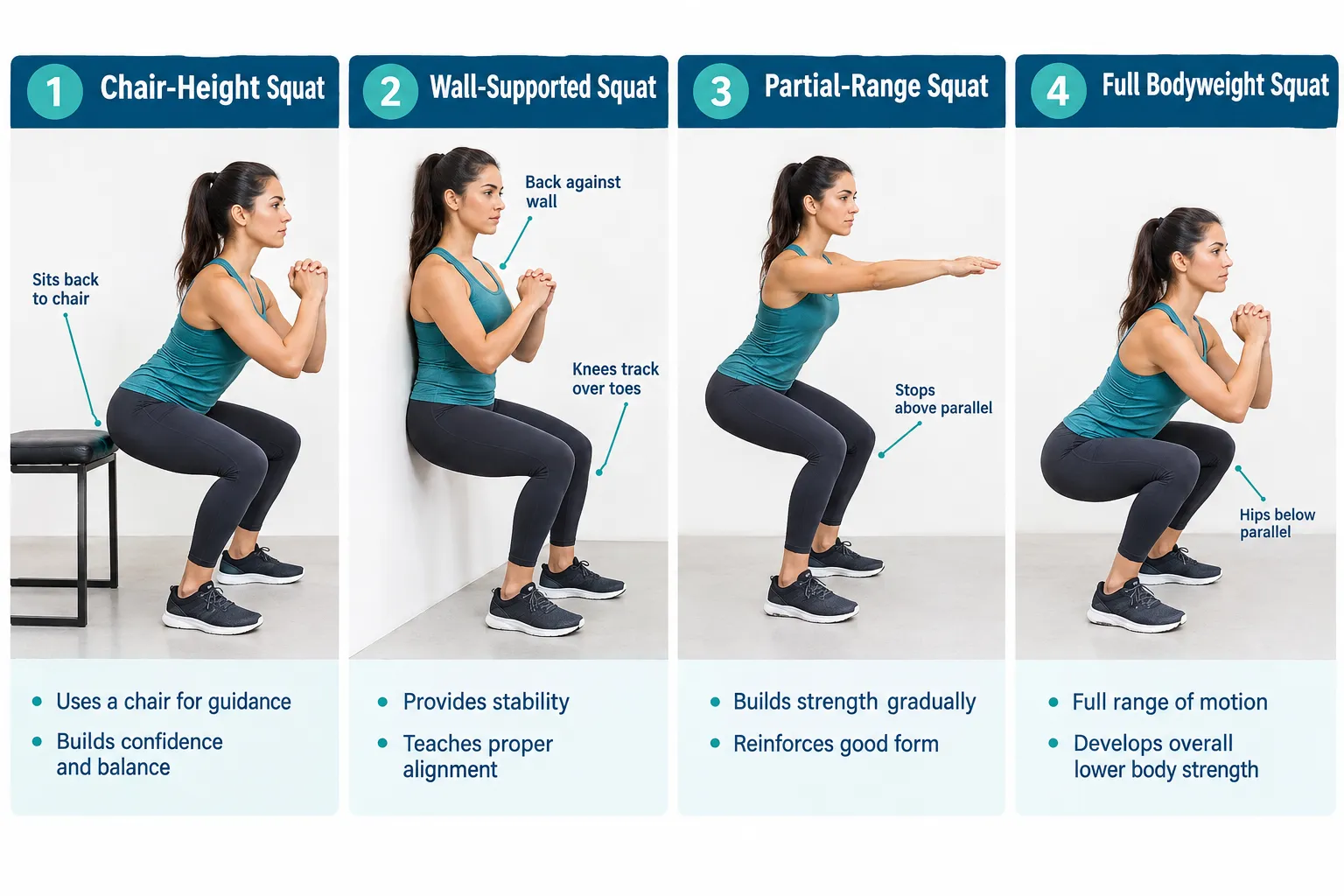
- Chair-height squat: Lightly touch a stable chair or bench behind you as a depth cue, then stand. Do not collapse onto it or use a wheeled chair.
- Wall-supported squat: A short, controlled wall squat can help some beginners find a comfortable range. It is an option, not “perfect alignment” in a box.
- Partial-range free squat: Work in a shallow range without support. This is often the most transferable bridge to a standard squat.
- Fuller range or a slower lowering phase: Add range or make the way down slower once the current version is stable.
- More challenging leg work: When a plain squat no longer feels demanding, add repetitions, an extra set, a pause, a split-squat pattern, or external load under appropriate instruction. The ACSM’s recent evidence review supports progressive resistance training, while also finding that no single prescription is required for healthy adults to make progress.[4]
Common Bodyweight Squat Mistakes
| What happens | A useful response |
|---|---|
| You rush the bottom and bounce up. | Make the range smaller and use a slower lowering phase. Speed can come later if you want it. |
| The knees collapse sharply inward. | Lower the difficulty, slow down, and aim the knees in the same broad direction as the toes. A small wobble is information, not a personal failure. |
| The heels lift or you tip forward. | Use a shorter range and a stance that feels more stable. Build the pattern before insisting on more depth. |
| You stop breathing and brace hard. | Use a gentle breath in before the descent and let air out as you stand. There is no need to turn a bodyweight set into a maximal lift. |
| Each rep gets messier. | End the set earlier. The aim is to practice the movement you want to keep, not the version you can only manage while exhausted. |
A Simple Bodyweight Squat Session
For a healthy beginner, try two or three sessions a week. Start with two sets of 6–12 repetitions. Rest long enough that the next set is still controlled. If the last few repetitions look the same as the first, add one or two repetitions next time, an extra set after a few sessions, or a slightly larger range. One small change is plenty.
Bodyweight squats are strengthening work, not a substitute for aerobic activity. The U.S. physical-activity guidelines list aerobic and muscle-strengthening activity as separate parts of an active week. That is why 10 squats are not equal to a 30-minute walk: they have different demands and contribute differently to a routine.[1] A short walk, cycling session, or other cardio can sit beside your squat practice rather than compete with it.
If you want a simple companion movement, see Leg Lifts for a core-focused option. For the lower body, alternating squats with a hip-hinge pattern and calf raises is another practical way to avoid making one movement carry the whole session.
Frequently Asked Questions
Are Bodyweight Squats Actually Effective?
They can be, especially as an accessible starting point for lower-body strength and movement practice. Their effectiveness depends on your current training level, the challenge of the variation, and what else you do across the week. They are not a lifetime maximum-strength stimulus for everyone, and they work better inside a varied routine than as the only exercise you perform.
What Will 100 Bodyweight Squats a Day Do?
It may build familiarity and muscular endurance if it is a manageable amount for you, but 100 is not a magic number. In the small older-adult study mentioned above, daily squats for four months did not significantly improve the measured strength, muscle-mass, or physical-performance outcomes.[2] Start with a dose that stays controlled. Add volume only if it serves a goal and you recover well.
Is 10 Squats Equal to a 30-Minute Walk?
No. Ten squats are a brief strength movement; a 30-minute walk is sustained aerobic activity. Both can be useful, but they are not interchangeable units. A healthy routine can include both.
Do Bodyweight Squats Burn Belly Fat?
Squats use energy and can be part of an active life, but they do not reliably direct fat loss from the belly. In a small trial, six weeks of targeted abdominal exercises improved abdominal endurance without reducing the measured abdominal-fat outcomes.[5] Think in terms of the whole routine, food intake, sleep, and consistency rather than a body-part promise.
When Should I Stop or Get Individual Advice?
Ordinary muscle effort and short-lived soreness are different from sharp joint pain, locking, a new sense of instability, numbness or tingling, chest discomfort, dizziness, or unusual breathlessness. Stop the set if those occur. A recent injury, surgery, persistent pain, or diagnosed condition is a good reason to seek individual guidance before building volume around squats.
References
- U.S. Department of Health and Human Services. Physical Activity Guidelines for Americans, 2nd edition (2018).
- Kojima A, et al. Effects of home-based bodyweight squat training on neuromuscular properties in community-dwelling older adults. European Review of Aging and Physical Activity (2023).
- Watanabe Y, et al. Slow movement resistance training using body weight improves muscle mass in the elderly: a randomized controlled trial. Scandinavian Journal of Medicine & Science in Sports (2018).
- American College of Sports Medicine. Position stand: Resistance training prescription for muscle function, hypertrophy, and physical performance in healthy adults. Medicine & Science in Sports & Exercise (2026).
- Vispute SS, et al. The effect of abdominal exercise on abdominal fat. Journal of Strength and Conditioning Research (2011).
Medical disclaimer: This guide is general education, not personal medical advice, diagnosis, or treatment. Exercise needs vary with injury history, symptoms, medications, and health conditions. If you have persistent pain, a recent injury or surgery, a diagnosed condition, or uncertainty about starting, seek guidance from an appropriately qualified clinician or exercise professional.

About the author
Dave James is the founder of All Perfect Health. He writes practical guides that help readers cut through fitness noise, keep useful basics, and build habits they can actually repeat.