
How to Do Crunches: Proper Form, Common Mistakes, and Beginner Options

Created: September 30, 2026 • Last updated: September 30, 2026
Crunches aren’t a miracle exercise, and they aren’t a forbidden one either. They are a simple way to train the front of the trunk when the movement feels controlled and agrees with you. The useful skill is not forcing a huge range or chasing a burn; it is learning a short, repeatable curl that your abs—not your hands or momentum—produce.
Quick answer: Lie on your back with bent knees and feet planted. Put your hands lightly at your temples or cross your arms over your chest. Breathe out as you curl your shoulders off the floor, then lower under control. Start with a range and rep count that stays tidy; a crunch is not meant to become a full sit-up.
Key Takeaways
- A crunch is a short trunk-flexion exercise. It trains the abdominal wall; it is different from sitting all the way up.
- Light hands, a short range, and steady breathing beat dramatic form cues. You should not need to yank your head or fling your torso.
- Crunches can build abdominal endurance and strength, but they do not choose where body fat comes off. In a small six-week trial, abdominal exercise improved endurance without reducing abdominal-fat measures.[2]
- Variations are tools, not status symbols. Choose the version you can control, then change it when it becomes easy.
Table of Contents
What Crunches Train—and What They Cannot Do
A standard crunch is a controlled curl through the upper trunk. The rectus abdominis—the long muscle running down the front of the abdomen—does most of the visible work, while the obliques help stabilize and contribute depending on the variation. EMG studies show the exercise produces abdominal-muscle activity; that is useful context, but it is not a promise of a six-pack or a better-looking waist by itself.[3]
The distinction matters because fitness marketing has muddied it for years. Training your abs is not the same as directing fat loss to your stomach. In the trial most often cited on this question, 24 sedentary adults completed six weeks of abdominal exercise while maintaining their usual calorie intake. Their abdominal endurance improved, but the study did not find a significant reduction in body weight, waist circumference, abdominal skinfolds, or the measured abdominal-fat outcomes.[2] Crunches train muscle; they do not offer reliable local control over fat loss.
That does not make them pointless. A short crunch can be an accessible piece of a broader routine built around walking or other cardio, whole-body strength work, and a food pattern that supports the goal. For the full framework, see our Home Workout Routines guide. If the goal is a sturdier body rather than a larger exercise menu, a simple bodyweight strength routine matters more than doing endless ab work.
How to Do Crunches Properly
There is no prize for turning a crunch into a dramatic sit-up. Set up in a way that lets you feel the front of the abdomen working and keeps the movement repeatable from the first rep to the last.
- Set up on your back. Use a mat, carpet, or another comfortable floor surface. Bend the knees, plant the feet, and allow enough space that you are not sliding around.
- Choose a hand position. Cross your arms over your chest, or rest fingertips beside the head. The hands are there for light support, not leverage. If you keep pulling your head forward, use the arms-crossed version for a while.
- Start relaxed, then brace. Let your shoulders settle. Before you move, lightly tighten the abdominal wall as if you are preparing to laugh or take a gentle poke to the stomach. There is no need to flatten your back aggressively into the floor.
- Exhale and curl. Think about bringing the lower ribs slightly toward the pelvis. Lift the head and shoulders only as far as you can without swinging, straining the neck, or turning the rep into a sit-up.
- Lower smoothly. Return to the mat without dropping. The lowering portion is part of the repetition, not dead space between reps.
- Stop the set when form turns into negotiation. A clean set of eight is more useful than twenty reps made with momentum.
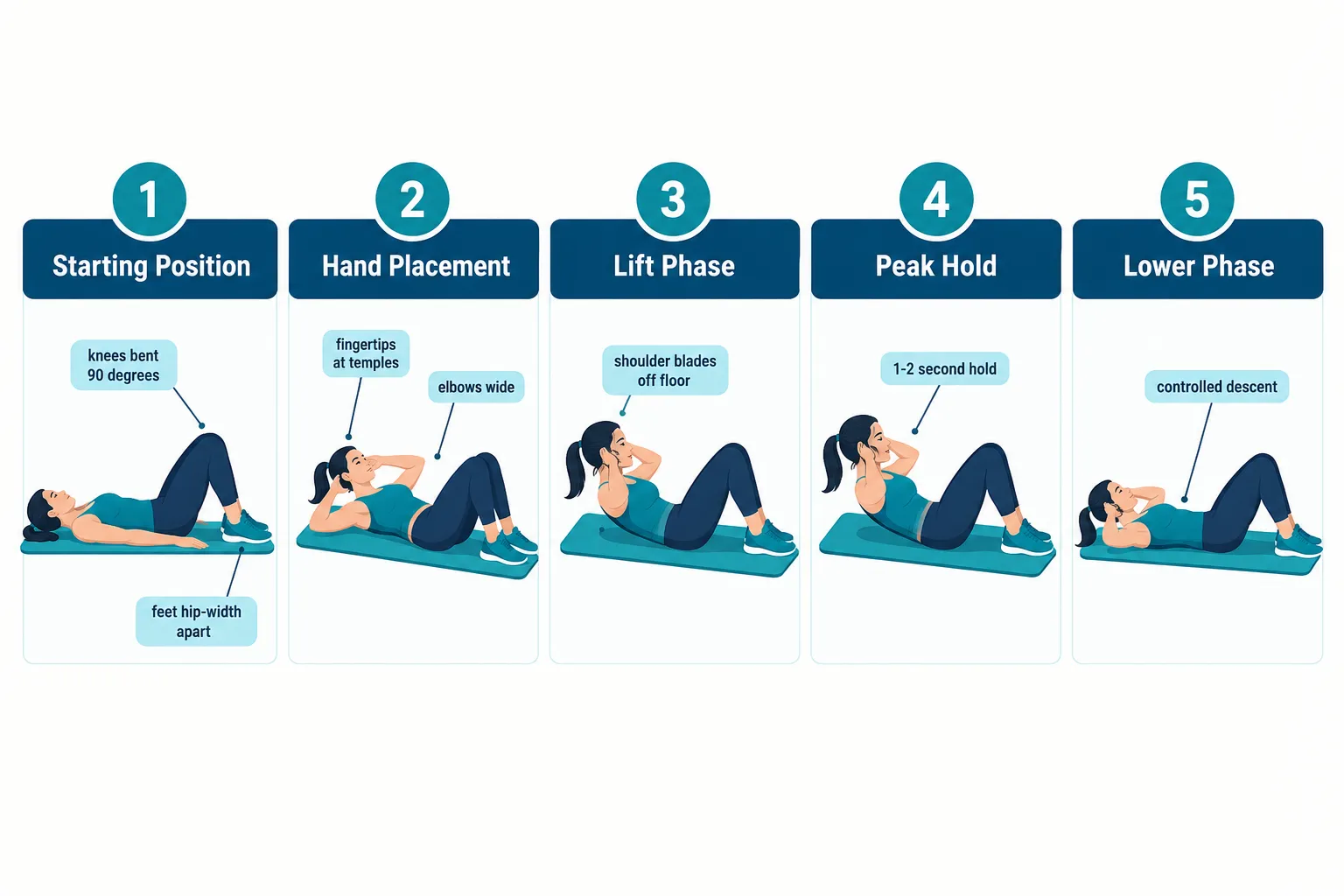
Use the image as a general visual cue, not as a ruler. Feet do not need to land at one magic distance, and a pause is optional rather than a test of character. A controlled rhythm is enough. The main job is to avoid rushing through the part where the abdominal muscles are actually doing the work.
A practical cue: Imagine your chest moving toward your belt buckle—not your chin crashing toward your chest. That one thought often cleans up the rep better than a dozen anatomical instructions.
Common Crunch Mistakes—and the Simple Fix
Most people do not need a completely different exercise. They need one better cue. Work on the error you actually make, rather than trying to micromanage every joint at once.
| What goes wrong | What it usually means | Try this instead |
|---|---|---|
| Pulling on the neck | The arms are doing the job. | Use fingertips at the temples or cross the arms. Keep the jaw and shoulders as relaxed as possible. |
| Flying upward | Momentum has replaced control. | Make the lift smaller and the lower slower. Count quietly if it helps. |
| Trying to sit all the way up | You have changed the exercise into a sit-up. | Lift the shoulder blades, then stop. The rep can be short and still count. |
| Holding the breath | You are bracing too hard or rushing. | Let air out on the curl and breathe back in on the way down. |
| Lower-back discomfort | The range, setup, or exercise choice may not suit you that day. | Use a smaller range, switch to a different core movement, or leave crunches out for the session. |
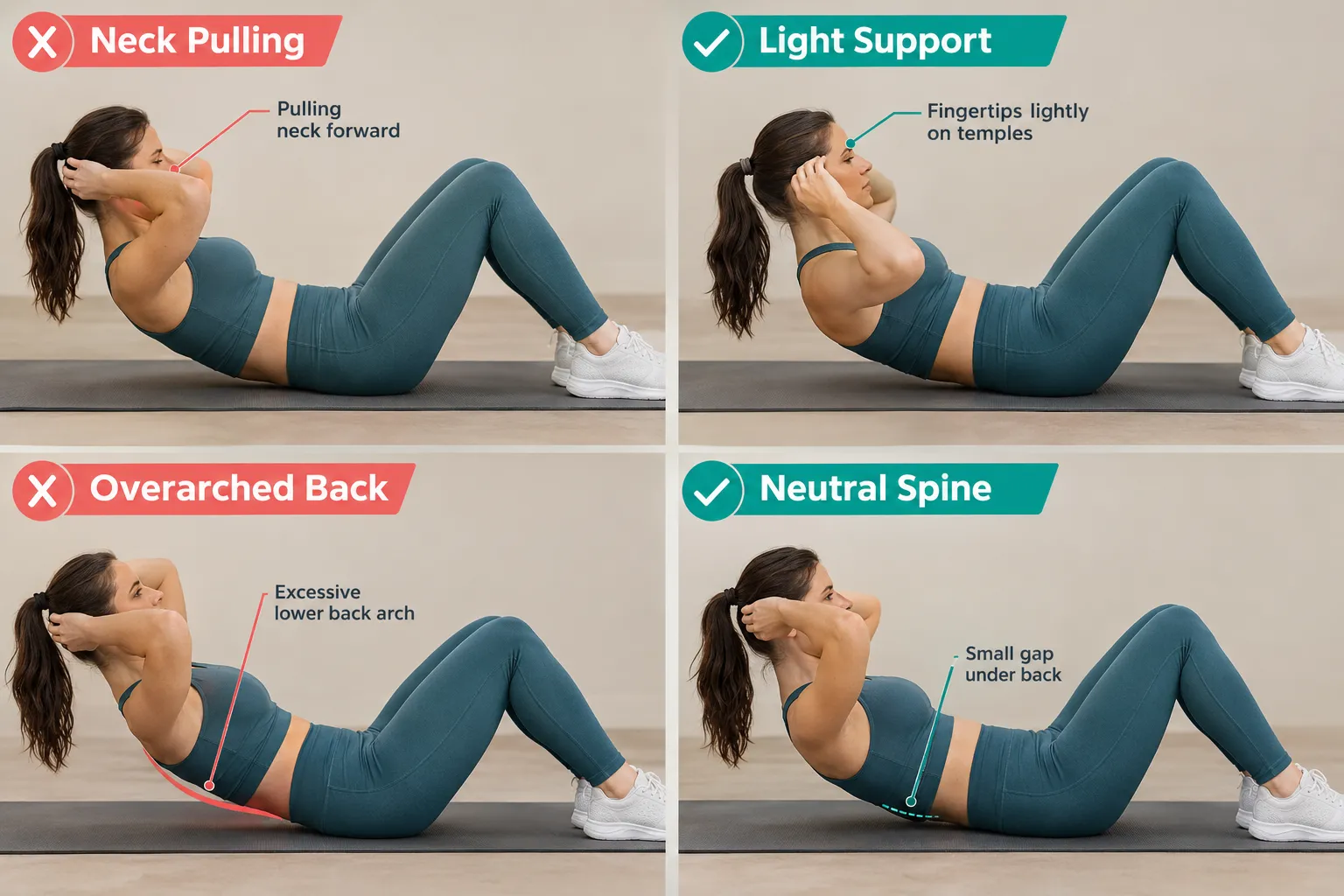
Do not obsess over holding one supposedly perfect spinal position. Bodies are not IKEA furniture. You are looking for a position that feels controlled, does not provoke symptoms, and can be repeated without using the neck or a big swing. The graphic is a useful reminder to avoid extremes, not a diagnosis tool.
Crunches vs. Sit-Ups: What Is the Difference?
A crunch is a partial curl: the shoulders and upper back come away from the floor, then return. A sit-up travels farther, bringing the torso much closer to the knees. Neither movement has moral superiority. They simply ask for different amounts of range and involve the hip flexors differently.
If you are learning to control trunk flexion, the crunch is usually the simpler place to start because the range is shorter. If you enjoy sit-ups and they feel good, they are not automatically wrong. The problem starts when someone calls a flung, neck-led sit-up a crunch and then wonders why it feels rough.
For another lower-body-and-core option, Leg Lifts explains a different way to challenge the trunk. It is not a substitute you must graduate to; it is simply another tool for a different movement pattern.
Crunch Variations: Reverse, Bicycle, Side, and Tabletop Options
A standard crunch is the baseline, not the finish line. Once you can perform it without rushing, small changes can keep the exercise interesting. Choose variations because they suit the session, not because the internet has declared them advanced.
Arms-Crossed Crunch
Cross the arms over the chest and perform the same small curl. This is often the cleanest option for someone who keeps using the hands to haul the head forward. It is not a watered-down version; it simply takes away an easy way to cheat.
Tabletop Crunch
Lift the legs so the knees are bent and the shins are roughly parallel with the floor, then use a short curl. This changes the setup and may feel more comfortable for some people. It also requires more control to keep the legs steady, so start with fewer reps rather than treating it as a mandatory upgrade.
Reverse Crunch
A reverse crunch starts with the legs bent and focuses on a small pelvic curl rather than lifting the upper body. Avoid throwing the knees toward the face. Think small: a controlled tilt and a gentle lift of the hips are enough. If the movement turns into a full-body swing, reduce the range.
Bicycle and Side Crunches
Bicycle crunches add rotation and alternating legs; side crunches bias a side-bending pattern. Both can be useful variations, but neither melts side fat or reveals the obliques by magic. Slow them down, keep the range honest, and return to the basic crunch if coordination takes over from control.
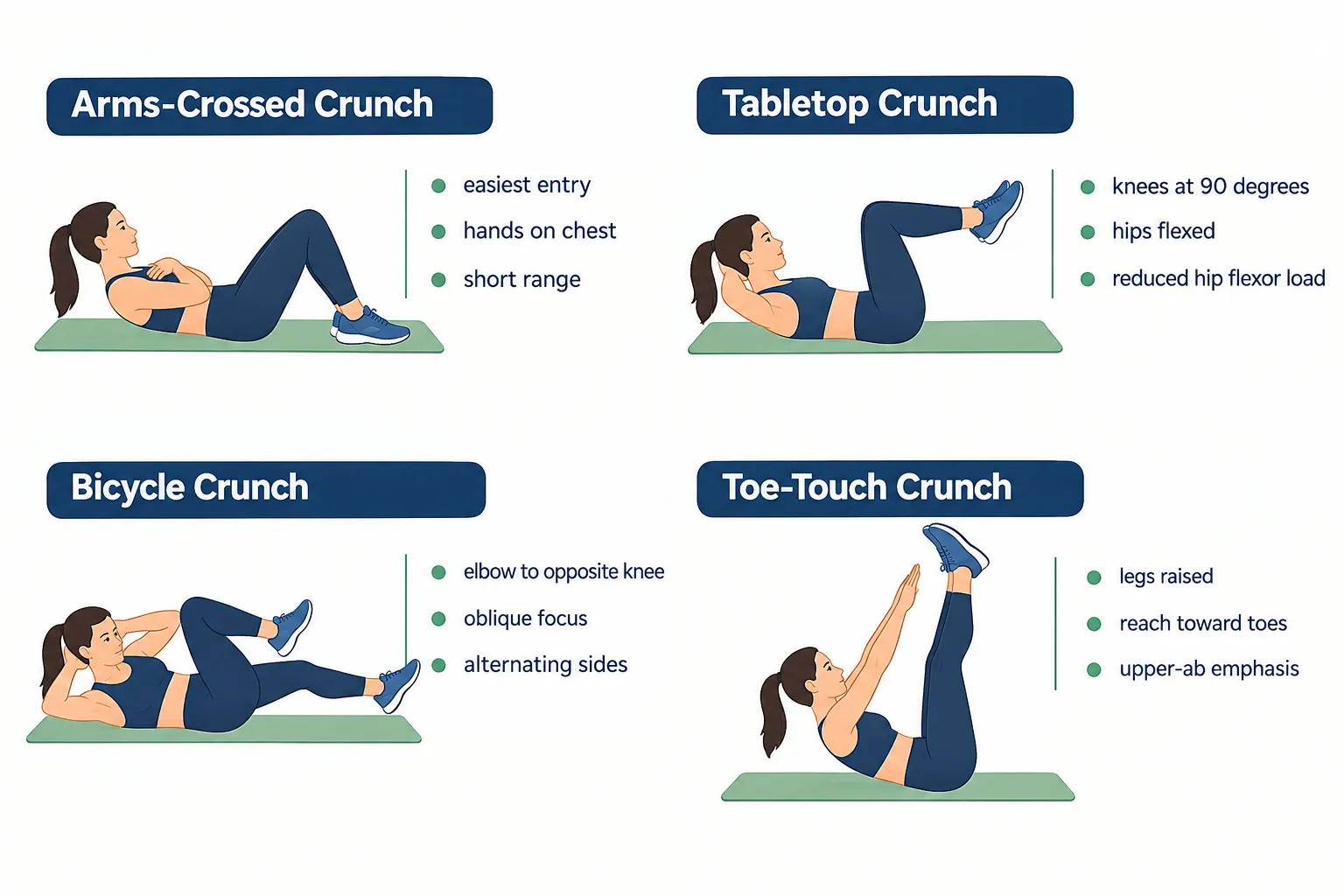
A toe-touch crunch with the legs raised is another option for readers who enjoy it. Like the other variations, it is a way to create a different challenge—not a special “upper-ab” trick. The rectus abdominis is one continuous muscle, even though different positions can feel different.
How to Program Crunches Without Making Them Your Whole Workout
Think of crunches as accessory work. They fit well after the larger movements in a session or as a brief finish to a home workout. The broader U.S. activity guidance is to train all major muscle groups on two or more days each week; it does not tell people to turn abdominal work into a daily punishment ritual.[1]
For a healthy beginner, one or two sets of roughly 8 to 15 controlled repetitions can be a perfectly sensible starting experiment. If you can do more while keeping the rep clean, do more. If eight starts to look like a wrestling match, stop there and build gradually. Exact rep ranges are tools, not laws.
- Start: Choose a version that lets you keep the neck relaxed and the range controlled.
- Progress: Add a few repetitions, another set, or a harder variation only when the existing work feels stable.
- Pair: Combine crunches with whole-body training: squats, presses, rows, hinges, carries, walking, or the movements in a quick home workout.
- Recover: You do not need to train to failure every time. Leave a little in the tank and come back consistently.
The current ACSM overview supports progressive resistance training with flexible prescription rather than one magic tempo, rest period, or rep scheme for every healthy adult.[4] That is the useful principle here. If an extra set helps you get stronger and you recover well, fine. If it turns the exercise into something you avoid, it is not automatically better.
Will 100 Crunches a Day Give You Abs?
It can make you very practiced at doing crunches. It does not guarantee visible abs. The muscle may become more conditioned, but definition also depends on the amount and distribution of body fat, total training, food intake, genetics, and time. The small abdominal-exercise trial above is a useful reality check: six weeks of frequent ab training alone did not produce the measured abdominal-fat changes people expect from “spot reduction.”[2]
A better question is whether the work is adding something useful to a balanced routine. If 100 daily crunches are painless, enjoyable, and do not crowd out training you need more, they are not forbidden. But it is not the only route, and it is not necessary for results. A couple of sensible sets several times a week, combined with regular full-body activity, is plenty for many people.
A Simple Crunch Session to Start With
Here is a deliberately ordinary way to put the exercise into a home workout. Start with one easy set of a few reps to find a comfortable range. Rest for a minute or two, then do one or two working sets where every rep stays controlled. Stop before the movement turns into a neck-pulling contest. That is enough direct abdominal work for a lot of people, especially when the rest of the session already includes squats, carries, presses, rows, or walking.
If you are returning after time away, start lower than your ego wants. A first session might be two sets of six to ten controlled crunches. If that feels almost comically easy, good—you have room to repeat it next time and build from there. Add a few repetitions when the existing dose feels stable. Once you can do a set smoothly, change one thing at a time: add a small amount of volume, choose a tabletop version, or use a slightly slower lowering phase. There is no need to turn every session into a test of exhaustion.
For a simple full-body pairing: do a lower-body movement, an upper-body push, an upper-body pull, and a short core exercise. That gives the crunch a sensible role instead of pretending it can carry the whole workout. The broader evidence around resistance training supports progressive work with a flexible prescription; it does not require one specific tempo, rep target, or complicated plan for every healthy adult.[4]
Example: a 10-Minute Core Finish
- Round 1: 6–12 controlled crunches, then rest and breathe normally.
- Round 2: 6–12 crunches again, or use a shorter range if the neck starts helping too much.
- Optional round 3: a plank, dead bug, or a few slow reverse crunches if you want another pattern.
This is an example, not a prescription. A person with a strong training background may use more load or volume. A person who has not trained in years may use fewer reps or choose a different core movement. The useful test is whether the exercise leaves you feeling worked, capable, and willing to train again—not wrecked for the sake of a number.
How to Progress Crunches Without Overthinking It
Progression is often made unnecessarily complicated. If you can complete your current set with the same controlled form from first rep to last, you have options. Add one or two reps. Add another set. Make the lowering phase slightly slower. Or choose a variation that demands more control. Pick one change and give it a few sessions before changing something else.
Do not assume you have to reach failure before anything counts. The goal is a productive training signal, not a dramatic face in the mirror. A 2026 ACSM evidence overview notes that healthy adults can use variable resistance-training prescriptions; more volume can help, but there is no single exact prescription that is required for progress.[4] That applies nicely to a simple exercise like the crunch. Consistency beats a perfect spreadsheet.
External load is optional. A light plate held on the chest can make a crunch harder for someone who already owns the movement, but it is not a beginner requirement. The more direct question is whether bodyweight repetitions still challenge the muscles without sacrificing control. If not, choose a variation or add small resistance gradually. Do not rush to stack a heavy object on your torso because a social-media clip made it look advanced.
Crunches Are One Core Tool, Not the Whole Core
The trunk does more than curl forward. It also resists extension, rotation, and side-bending while you walk, lift, carry, and play sport. A balanced routine can include crunches alongside planks, side planks, bird dogs, loaded carries, rows, squats, hinges, and ordinary walking. You do not need every exercise in every session; you do need enough variety across the week that one tiny movement does not become your whole training identity.
That is why bodyweight work remains useful. It is easy to scale, requires little equipment, and can be arranged around your life. If you want a broader plan, the Bodyweight Strength Training guide shows how core work fits beside pushing, pulling, leg training, and practical progression. Crunches are the supporting actor. They do not need to carry the film.
For people who dislike crunches, there is no need for a fitness identity crisis. Choose a core exercise that you can perform well and return to regularly. The best option is not the one with the fanciest name. It is the one you can execute with enough effort, enough control, and enough consistency to keep it in your routine.
Choose the Range You Can Own
Range of motion is not an all-or-nothing test. A small curl can be useful when it is clearly driven by the abdominal muscles; a larger curl is not automatically superior just because it looks more dramatic. The right range is the one you can control on the way up and the way down without using a hard neck pull, a big leg drive, or a sudden drop to the floor.
On any given day, the comfortable range may be different. A long car trip, a poor night of sleep, a hard lower-body session, or simple stiffness can change what feels natural. That does not mean the exercise has failed. Reduce the range, keep the repetitions smooth, or use another movement. Training is meant to build capacity over time, not prove that every session is identical.
Keep the standard simple: a few well-owned repetitions are training. Repeated sloppy reps are just rehearsal for sloppy reps. Learn the version you can own, then earn the next progression. A mat, a clear patch of floor, and ten focused minutes are enough to make useful work happen; no complicated gadget is required. Good training is usually more repeatable than glamorous, more useful than a heroic session you never want to repeat.
When to Pause, Modify, or Get Individual Advice
Do not be afraid of ordinary muscular effort. The abs working and getting tired is the point. A sharp, shooting, escalating, or radiating pain is different. Stop that session, change the movement, and do not try to out-tough a signal that is getting worse.
People recovering from a recent abdominal or spinal operation, dealing with a known or suspected hernia, or managing persistent neck or back symptoms may need a tailored choice of exercise. Pregnancy is also a time when the most useful core training can be individual and stage-specific rather than borrowed from a generic article. That is not a reason to stop moving; it is a reason to choose the right version of movement.
If an ordinary adjustment—smaller range, arms-crossed position, fewer reps, or a different core exercise—settles the problem, use it. If symptoms persist, worsen, or include numbness, tingling, weakness, or a new bulge, get individual medical or qualified exercise guidance rather than improvising harder.
Crunches FAQ
Do Crunches Burn Belly Fat?
No reliable evidence shows that training the abdominal muscles controls fat loss specifically from the stomach. Crunches may improve abdominal endurance, but body-fat changes are a whole-body outcome.[2]
How Many Crunches Should a Beginner Do?
Start with a number you can perform with a calm neck, controlled range, and no swinging. For many people that might be one or two sets of 8 to 15 repetitions. Treat that as a starting range, not a test you have failed if your number is different.
Should Your Lower Back Stay on the Floor?
Do not force it flat and do not deliberately create a large arch. A comfortable, controlled position is the practical target. If the setup reliably irritates your back, shorten the range or use another core exercise.
Why Does My Neck Hurt During Crunches?
Often the hands are pulling the head forward or the range is too ambitious. Try crossing the arms, making the curl smaller, and slowing down. Persistent pain is a reason to choose a different exercise or get individual advice.
Are Crunches Safe After 40?
Age alone does not make crunches off-limits. If the movement is comfortable and controlled, it can be a normal part of training. Existing symptoms, recent surgery, a hernia, pregnancy, or a specific health issue matter more than the number on a birthday cake.
References
- U.S. Department of Health and Human Services. Physical Activity Guidelines for Americans, 2nd edition. Open source.
- Vispute SS, Smith JD, LeCheminant JD, Hurley KS. The effect of abdominal exercise on abdominal fat. Journal of Strength and Conditioning Research. 2011;25(9):2559–2564. PubMed.
- da Silva RA, et al. EMG activation of abdominal muscles in the crunch exercise performed with different external loads. Journal of Sports Science and Medicine. 2009. PubMed.
- American College of Sports Medicine. Resistance Training Prescription for Muscle Function, Hypertrophy, and Physical Performance in Healthy Adults: an overview of reviews. 2026. Open access.
Medical disclaimer: This article is for general education, not personal medical diagnosis or treatment. Choose movements that fit your current ability and history. Seek individual advice for persistent or concerning symptoms, recent surgery, a known or suspected hernia, or questions specific to pregnancy or another medical condition.

About the author
Dave James is the founder of All Perfect Health. He writes practical guides that help readers cut through fitness noise, keep useful basics, and build habits they can actually repeat.