
Quick Home Workouts: 15-Minute Routines for Busy Adults Over 40
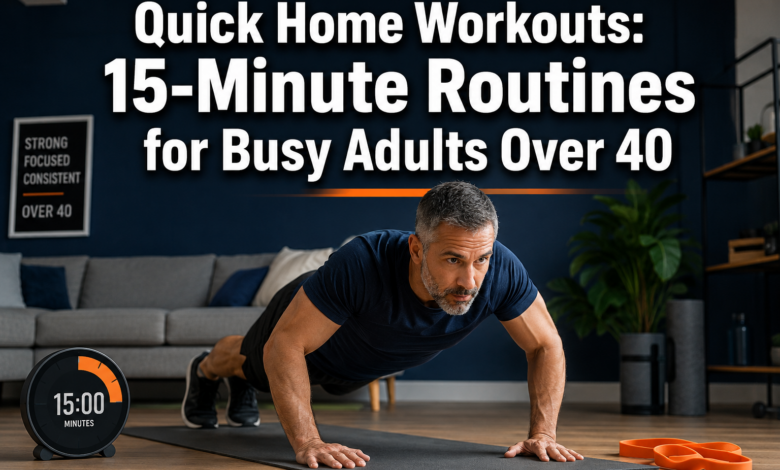
Short home sessions can make room for movement on a busy day. The routines below have separate circuit times; preparation, equipment setup, recovery, and cool-down add to the total. Choose a manageable version rather than rushing to finish.
Quick home workouts for busy adults represent a practical solution to the time constraints that derail most fitness plans. In plain English, you don’t need hours of exercise to maintain strength and health — you need consistency with the right movements. Short sessions can contribute to a weekly activity plan. What they achieve depends on the movements, effort, starting point, recovery, and the rest of a person’s routine. This article is part of our Home Workouts & Strength cluster, where we focus on practical, time-efficient strength training at home.
Let’s keep this practical: three complete routines that require minimal equipment, fit into any schedule, and target the movement patterns that matter most for adults over 40.
In this article
Key Takeaways
- Energy use can remain temporarily raised after some harder sessions, but its size and duration vary.
- A routine you can repeat is usually more useful than an ambitious plan that does not fit your week.
- Three equipment levels accommodate different budgets and space constraints: bodyweight only, resistance bands, or mixed equipment
- Allow preparation and recovery time rather than compressing the session to meet the clock
- Scheduling around existing commitments may make a routine easier to repeat.
Why Short Workouts Work: The Science of Brief, Intense Exercise
The evidence suggests that workout duration matters less than intensity and consistency for adults over 40. Here’s the real issue: traditional hour-long gym sessions often become unsustainable when work deadlines pile up or family obligations increase.
EPOC: The Afterburn Effect
Energy use may remain raised after exercise, but its size and duration depend on the session and the person. These routines have not been tested for a fixed afterburn effect.
Muscle Protein Synthesis
A short session can contribute to a weekly activity plan, but these routines have not been shown to match longer workouts. Build the amount of work gradually and use movements you can control.
Cardiovascular Benefits
HIIT can improve cardiorespiratory fitness for some people, but it is not automatically the right starting point. A sustainable routine should match your experience, health, and available time.
Context matters: these benefits require genuine intensity. A leisurely 15-minute session won’t trigger the same physiological responses as focused, challenging exercise.
The Warm-Up (2 Minutes)
A brief gradual warm-up can help you assess how you feel before moving faster or adding resistance, especially after a long period of sitting.
Dynamic Movement Sequence (30 seconds each):
- Arm circles: Forward and backward, gradually increasing range
- Leg swings: Front-to-back, then side-to-side, holding wall for balance
- Torso twists: Standing rotation with arms extended
- Marching in place: High knees, engaging core
This is not about forcing a hard effort. Use a few easy movements to ease into the session; if time is tight, shorten the routine or choose a simpler version rather than rushing.
Routine A: Bodyweight Only (12 Minutes)
This bodyweight routine requires zero equipment and minimal space. Perfect for hotel rooms, small apartments, or when you’re getting started.
Circuit format: choose any three blocks, about 4 minutes each.
- 45 seconds work, 15 seconds rest per exercise
- 4 exercises per round
Block 1: Lower Body
- Bodyweight squats: Focus on controlled descent, explosive rise
- Reverse lunges: Alternate legs, emphasize balance
- Single-leg glute bridges: 45 seconds total, switch legs halfway
- Wall sits: Back against wall, thighs parallel to floor
Round 2: Upper Body Strength
- Push-ups: Modify on knees if needed, maintain straight line
- Incline push-ups: Hands on a stable wall, counter, or purpose-built bench; choose an angle you can control.
- Wall push-ups: Keep the body in a comfortable straight line and use a range you can control.
- Plank: Hold position, engage entire core
Round 3: Full-Body Integration
- Burpees: Scale intensity to maintain form
- Mountain climbers: Fast feet, stable shoulders
- Jumping jacks: Classic cardio movement
- High knees: Running in place, drive knees up
Round 4: Core and Stability
- Dead bugs: Lying on back, opposite arm/leg extensions
- Bird dogs: On hands/knees, opposite arm/leg holds
- Side planks: 22.5 seconds each side
- Bicycle crunches: Controlled rotation, no neck strain
This routine targets all major muscle groups while elevating heart rate. The simplest way to look at it is full-body conditioning in minimal time.
Routine B: Resistance Band Circuit (12 Minutes)
Resistance bands add variable resistance and expand exercise options significantly. They are portable and can expand exercise options, but the exercise, setup, and resistance still need to suit the reader.
Equipment needed: A band in good condition. Do not improvise an anchor; use only a purpose-built anchor that is rated and installed for the exercise, or choose an unanchored variation.
Circuit Format: 3 rounds, 4 minutes each
- 50 seconds work, 10 seconds transition
- 4 exercises per round
Round 1: Upper Body Pull
- Seated rows: Loop a band around the feet only if you can keep it secure; pull smoothly without rounding the back.
- Band pull-aparts: Hold the band at chest height and move through a controlled, comfortable range.
- Bicep curls: Stand on band center, controlled movement
- Standing reverse fly: Use a light band and keep the shoulders comfortable; skip it if it does not feel controlled.
Round 2: Upper Body Push
- Wall or incline push-ups: Choose a stable surface and a range that you can control.
- Overhead press: Stand on band, press overhead
- Overhead triceps extensions: Stand on the band only if it is secure and the movement feels comfortable.
- Lateral raises: Stand on band, raise arms to sides
Round 3: Lower Body and Core
- Banded squats: Band around thighs, adds glute activation
- Romanian deadlifts: Stand on band, hinge at hips
- Lateral walks: Band around ankles, step sideways
- Dead bugs: Move slowly and stop the range when you cannot keep the trunk controlled.
Band tension typically changes through the range of motion. Bands can be a useful option, but they are not automatically safer or better for joints than other forms of resistance.
For those interested in exercise safety over 50, bands offer another way to add resistance; they are not automatically safer than weights.
Routine C: Mixed Equipment (12 Minutes)
This routine combines bodyweight movements with basic equipment for maximum variety and progression potential.
Equipment needed: Weights you can handle for familiar exercises; adjustable dumbbells are optional
Circuit format: choose any three blocks, about 4 minutes each.
- 40 seconds work, 20 seconds rest/transition
- 3 exercises per round
Round 1: Lower Body Strength
- Goblet squats: Hold dumbbell at chest, deep squat
- Sit-to-stand: Use a secure chair that will not slide or tip, without added weight
- Hip-hinge practice: Use a controlled two-leg movement without added weight until familiar
Round 2: Upper Body Power
- Dumbbell thrusters: Squat to overhead press combination
- Renegade rows: Plank position, alternate dumbbell rows
- Push-up to T: Push-up, rotate to side plank with arm up
Round 3: Metabolic Conditioning
- Standing march: Move at a controlled pace
- Step jacks: Move at a controlled pace
- Mountain climber to push-up: 4 mountain climbers, 1 push-up
Round 4: Core Integration
- Dead-bug variation: Move only as far as you can maintain control
- Dumbbell windmills: Side bend with weight overhead
- Plank pulls: Plank position, pull dumbbell under body
This routine provides the most progression potential. As strength improves, increase dumbbell weight or add complexity to movements.
The Cool-Down (1 Minute)
Use a brief cool-down if it feels useful, or finish with easy movement. Recovery needs vary; a cool-down is not a guarantee against stiffness or injury.
Static Stretches (15 seconds each):
- Forward fold: Gentle hamstring and back stretch
- Chest doorway stretch: Open tight chest muscles
- Hip flexor stretch: Counter hours of sitting
- Shoulder cross-body stretch: Release shoulder tension
The goal isn’t deep stretching — it’s transitioning your nervous system from high intensity back to normal function. Keep it simple and consistent.
How to Fit Workouts Into a Busy Day
Let’s call it what it is: finding 15 minutes isn’t about time availability — it’s about priority and planning. Here’s what actually works for busy adults:
Morning Strategy
- Set alarm 20 minutes earlier
- Lay out workout clothes the night before
- Complete routine before checking email/phone
- Shower and start day with accomplished feeling
Lunch Break Approach
- Block 30 minutes on calendar (15 workout + 15 cleanup)
- Keep resistance bands in desk drawer
- Use conference room or private office
- Pack baby wipes for quick cleanup
Evening Routine
- Schedule immediately after work, before dinner
- Change clothes as soon as you get home
- Involve family — kids can exercise alongside
- Use as transition from work to home mindset
Weekend Maintenance
- Longer sessions (20-30 minutes) when time allows
- Focus on movements you enjoy most
- Outdoor variations: park workouts, hiking preparation
The main takeaway is this: consistency beats perfection. Choose a repeatable schedule that allows recovery. A short session can contribute to a weekly plan but does not, by itself, establish that all fitness goals or activity recommendations are met.
Scheduling Tips That Work:
- Habit stacking: Attach workouts to existing routines
- Non-negotiable time blocks: Treat exercise like important meetings
- Backup plans: Have 5-minute routines for extremely busy days
- Progress tracking: Simple log of completed sessions
Recovery matters. Choose a frequency you can recover from and adjust it if sleep, soreness, pain, or day-to-day function are deteriorating.
For additional guidance on comprehensive exercise approaches, consider how these quick sessions fit into your broader health strategy.
FAQ
How often should I do these 15-minute routines?
Start with a frequency that leaves you feeling recovered and able to use good technique. Many people begin with two or three sessions a week, then adjust based on comfort, goals, and the rest of their activity.
Can I really get fit with just 15 minutes of exercise?
A short session can be worthwhile, especially when it helps you build consistency. It is not a universal substitute for the total activity, strength work, skill practice, or progression required for every goal.
What if I can’t complete the full intensity?
Start where you are and progress gradually. Reduce work intervals to 30 seconds or extend rest periods to 20 seconds initially. The key is maintaining consistency while building capacity. Something is always better than nothing.
Should I do the same routine every day?
You can repeat a familiar routine or rotate options. Change the session when you need a different challenge or when a movement no longer feels comfortable; novelty is not required for progress.
What about nutrition and these quick workouts?
Regular meals containing protein and other nutrients can support training. Individual needs vary; a short workout does not require a special eating protocol.
How do I know if I’m working hard enough?
Choose work you can repeat with control. Finish the set or rest when technique or control deteriorates. Breathlessness is not the only sign of a useful strength session.
Conclusion
Quick home workouts can make regular movement more realistic on busy days. Their value is in providing a manageable way to practice strength and conditioning; results vary with the overall plan and the individual.
These three 15-minute routines provide scalable options regardless of equipment availability or fitness level. The bodyweight routine requires nothing but floor space. Resistance bands add variety and progression for minimal investment. Mixed equipment routines offer maximum challenge and advancement potential.
Start with one routine at a level you can control. Track completed sessions and how the movements feel, then adjust the frequency, resistance, or complexity gradually.
The basics still do the heavy lifting — consistent effort, progressive challenge, and adequate recovery. In real-world terms, a manageable routine is often easier to sustain than an ambitious plan that does not fit your schedule.
Choose one routine, schedule it at a realistic time, and begin with a version you can control. If a movement causes pain or you are unsure whether it suits you, stop and seek individual guidance.
For those ready to expand beyond these quick sessions, explore our guides on strength training at home and joint-friendly exercises for additional progression options.
References
- Gibala MJ, Little JP, MacDonald MJ, Hawley JA. Physiological adaptations to low-volume, high-intensity interval training in health and disease. Journal of Physiology. 2012;590(5):1077–1084.
- Westcott WL. Resistance training is medicine: Effects of strength training on health. Current Sports Medicine Reports. 2012;11(4):209–216.
- Schoenfeld BJ, Ogborn D, Krieger JW. Effects of resistance training frequency on measures of muscle hypertrophy: A systematic review and meta-analysis. Sports Medicine. 2016;46(11):1689–1697.
- Mañas A, Gómez-Redondo P, Valenzuela PL, et al. Unsupervised home-based resistance training for community-dwelling older adults: A systematic review and meta-analysis. Ageing Research Reviews. 2021;69:101368.
- Lopes JSS, Machado AF, Micheletti JK, et al. Effects of training with elastic resistance versus conventional resistance on muscular strength: A systematic review and meta-analysis. SAGE Open Medicine. 2019;7:2050312119831116.
About the author
Dave James is the writer and editor behind All Perfect Health. He is not a doctor; this guide is designed to help readers start conservatively, ask better questions, and avoid fitness hype.