
Bodyweight Strength Training: How to Build Muscle Without Weights
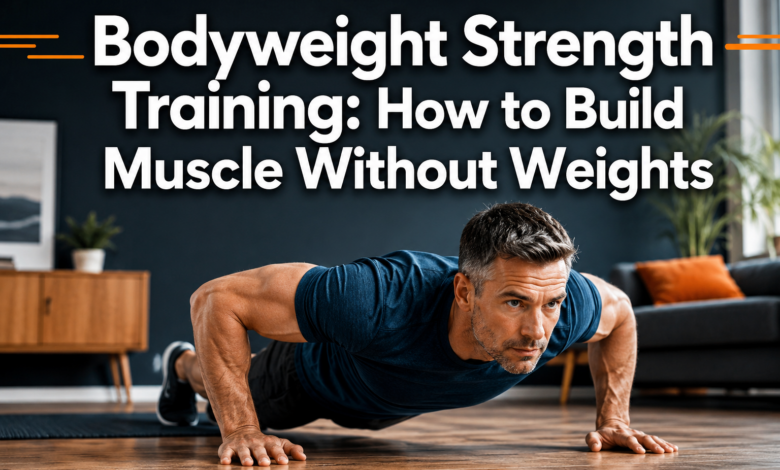
After age 45, maintaining muscle mass becomes more challenging, but bodyweight strength training offers a practical solution that requires no gym membership, no equipment purchases, and no complicated schedules. The evidence suggests that resistance training using your own body weight can be just as effective as traditional weight training for building and maintaining muscle strength, particularly when you understand the principles of progressive overload.
Let’s keep this practical: bodyweight strength training works because your muscles respond to resistance, not to the source of that resistance. Whether you’re pushing against a barbell or pushing your body up from the floor, the mechanical stress that drives muscle adaptation remains fundamentally the same. This article is part of our Home Workouts & Strength cluster, where we cover everything from bodyweight exercises to resistance band training.
In this article
Key Takeaways
- Bodyweight exercises can build significant muscle strength when performed with proper progression techniques
- A controlled tempo can help readers practice a movement; slower lowering is not proven superior for every exercise or reader
- The examples cover pressing, lower-body, and trunk work; add a suitable pulling movement if a fuller program is needed
- Progressive overload through time, repetitions, and movement complexity replaces adding external weight
- Choose manageable exercise versions and seek individual guidance when an injury or condition affects exercise choices
Why Bodyweight Training Still Works After 40
The stronger evidence points to bodyweight training being particularly well-suited for adults in their 40s, 50s, and 60s. Here’s the real issue: as we age, our recovery capacity changes, joint health becomes more important, and the risk-to-benefit ratio of heavy weight training shifts.
Muscle Protein Synthesis Remains Responsive
Research shows that muscle protein synthesis—the process that builds new muscle tissue—responds effectively to bodyweight resistance training in older adults. A 2019 study in the Journal of Strength and Conditioning Research found that bodyweight exercises produced similar muscle activation patterns to weighted exercises when performed at appropriate intensities.
What matters most is this: your muscles cannot distinguish between lifting a 50-pound dumbbell and supporting 50 pounds of your body weight during a single-leg squat. The mechanical tension that stimulates muscle growth comes from the resistance itself, not its source.
Joint-Friendly Progressive Loading
Bodyweight training can be adapted, but it is not automatically easier on every joint than weight training. The closed-chain nature of most bodyweight exercises—where your hands or feet remain in contact with a surface—promotes better joint stability and functional movement patterns.
This becomes increasingly important after age 40, when joint health and injury prevention should take priority over maximum strength gains. How to exercise when you’re over 50 provides additional context on age-appropriate training modifications.
Functional Strength Transfer
Bodyweight exercises closely mirror real-world movement patterns. Push-ups translate directly to pushing heavy doors or getting up from the floor. Squats improve your ability to rise from chairs and climb stairs. This functional strength transfer makes bodyweight training particularly valuable for maintaining independence and quality of life as we age.
The 6 Essential Bodyweight Exercises for Full-Body Strength
A sensible starting point is mastering six fundamental movement patterns that target every major muscle group. These exercises form the foundation of effective bodyweight strength training.
1. Push-Ups (Chest, Shoulders, Triceps)
The push-up remains the gold standard for upper body pressing strength. Start with wall push-ups if needed, progress to incline push-ups on a sturdy surface, then advance to standard push-ups from the knees or toes.
Progression technique: Focus on the eccentric (lowering) phase. Take 3-4 seconds to lower yourself down, then push up at normal speed. This eccentric emphasis dramatically increases strength gains without requiring additional resistance.
2. Squats (Quadriceps, Glutes, Core)
Bodyweight squats build lower body strength and improve functional mobility. Begin with chair-assisted squats, progress to full-range bodyweight squats, then advance to single-leg variations.
Key form points: Keep your chest up, knees tracking over toes, and weight distributed evenly across your feet. Descend until your thighs are parallel to the floor or as low as comfortable.
3. Lunges (Legs, Glutes, Balance)
Lunges address muscle imbalances and build unilateral strength. Start with stationary lunges, progress to walking lunges, then advance to reverse or lateral variations.
4. Planks (Core, Shoulders, Back)
Planks build isometric core strength and spinal stability. Begin with wall planks, progress to incline planks, then advance to standard planks from knees or toes.
Progression focus: Increase hold time gradually, aiming for 30-60 seconds with perfect form rather than longer holds with poor alignment.
5. Glute Bridges (Glutes, Hamstrings, Core)
Glute bridges counter the effects of prolonged sitting and build posterior chain strength. Start with double-leg bridges, progress to single-leg variations, then add pauses or pulses.
6. Tricep Dips (Triceps, Shoulders, Core)
Using a sturdy chair or bench, dips target the triceps effectively. Begin with feet on the ground and knees bent, progress to straight legs, then elevate feet on another surface.
For additional exercise variations and progressions, see our guide to home workouts without equipment.
How to Progress When You Can’t Add Weight
The main takeaway is that progressive overload—the gradual increase in training stress—can be achieved through multiple variables beyond adding external weight.
Time Under Tension
Slow down the eccentric (lowering) phase of each exercise. Research consistently shows that eccentric contractions produce greater muscle damage and subsequent adaptation than concentric (lifting) contractions. Aim for 3-4 seconds on the lowering phase while maintaining normal lifting speed.
Volume Progression
Increase total training volume through:
- Adding repetitions per set
- Adding additional sets
- Increasing training frequency
- Adjusting rest periods while maintaining control
Movement Complexity
Progress from bilateral (two-limb) to unilateral (single-limb) variations:
- Standard squats → Single-leg squats (pistol squats)
- Regular push-ups → Single-arm push-ups
- Double-leg glute bridges → Single-leg glute bridges
Range of Motion Manipulation
Increase difficulty by:
- Adding pauses at the bottom of movements
- Performing partial repetitions at the most challenging portion
- Combining full and partial repetitions in the same set
Leverage Changes
Modify body position to increase resistance:
- Decline push-ups (feet elevated)
- Single-leg Romanian deadlifts
- Archer squats (shifting weight to one leg)
This approach aligns with principles used in strength training for runners, where progressive overload must be carefully managed to support performance goals.
Sample Bodyweight Routine for Strength
Keep it simple and consistent. Here’s a practical three-day routine that targets all major muscle groups:
Day 1: Upper Body Focus
- Push-ups: 3 sets of 8-15 repetitions
- Tricep dips: 3 sets of 8-12 repetitions
- Pike push-ups: 3 sets of 5-10 repetitions
- Plank: 3 sets of 30-60 seconds
- Rest: 60-90 seconds between sets
Day 2: Lower Body Focus
- Squats: 3 sets of 12-20 repetitions
- Lunges: 3 sets of 10-15 per leg
- Glute bridges: 3 sets of 15-25 repetitions
- Single-leg calf raises: 3 sets of 10-15 per leg
- Wall sit: 3 sets of 30-45 seconds
Day 3: Full Body Integration
- Burpees: 3 sets of 5-10 repetitions
- Mountain climbers: 3 sets of 20-30 total
- Jump squats: 3 sets of 8-12 repetitions
- Push-up to T: 3 sets of 6-10 per side
- Bear crawl: 3 sets of 10-15 steps forward and back
Weekly Structure: Perform this routine every other day (Monday/Wednesday/Friday or Tuesday/Thursday/Saturday) with rest days for recovery. Active recovery activities like walking or gentle stretching work well on off days.
Progression Timeline: Increase repetitions by 1-2 per week until you reach the upper end of the range, then advance to a more challenging variation of the exercise.
Common Mistakes and How to Avoid Them
Truth over hype: most people make predictable errors that limit their progress with bodyweight training.
Mistake 1: Rushing Through Repetitions
The evidence suggests that controlled movement tempo produces superior strength gains compared to rapid repetitions. Focus on 2-3 seconds down, brief pause, 1-2 seconds up.
Solution: Count your tempo out loud during the first few weeks to establish proper rhythm.
Mistake 2: Ignoring Progressive Overload
More is not always better, but progression is essential. Many people perform the same routine indefinitely without increasing difficulty.
Solution: Track your workouts and systematically increase repetitions, sets, or exercise difficulty every 1-2 weeks.
Mistake 3: Poor Form for Higher Numbers
I would be careful with prioritizing repetition count over movement quality. Partial range of motion and compensatory movement patterns reduce effectiveness and increase injury risk.
Solution: Master perfect form at easier variations before progressing to harder exercises.
Mistake 4: Neglecting Recovery
Context matters: bodyweight training still creates muscle damage that requires recovery time. Training daily without rest impairs adaptation.
Solution: Schedule at least one full rest day between intense sessions. Listen to your body and add extra recovery when needed.
Mistake 5: Expecting Rapid Results
I’d rather be accurate than impressive: progress varies with starting point, training, and recovery. The basics still do the heavy lifting when it comes to building muscle.
Solution: Focus on consistency over intensity. Small, regular improvements compound over time.
For those combining bodyweight training with other activities, our guide on sport-specific training offers additional programming considerations.
FAQ
How long does it take to see results from bodyweight strength training?
Based on current evidence, noticeable strength improvements typically occur within 4-6 weeks of consistent training. Visible muscle changes usually take 8-12 weeks. The key is consistency—training 3 times per week produces better results than sporadic intense sessions.
Can bodyweight exercises build as much muscle as weight training?
The research shows that bodyweight training can produce similar muscle strength gains to weight training when performed with appropriate progression and intensity. However, maximum muscle size (hypertrophy) may be somewhat limited compared to heavy weight training, particularly for advanced trainees.
What if I can’t do a single push-up?
Start with wall push-ups, then progress to incline push-ups using a secure support that will not slide or tip. Gradually decrease the incline angle as you get stronger. Progress when the current variation is consistently manageable with good control.
How often should I train with bodyweight exercises?
Three times per week on non-consecutive days works well for most people over 45. This allows adequate recovery while providing sufficient stimulus for strength gains. You can add light activity like walking on rest days.
Is bodyweight training safe for people with joint problems?
Generally yes, but it depends on the specific condition. Bodyweight exercises typically involve more natural movement patterns and lower impact forces than heavy weight training. However, consult with a healthcare provider if you have significant joint issues or previous injuries.
Should I combine bodyweight training with other forms of exercise?
Absolutely. Bodyweight strength training pairs well with cardiovascular activities like walking for exercise or cycling fitness programs. The combination provides comprehensive fitness benefits while supporting overall health goals.
Conclusion
Bodyweight strength training offers a practical, effective solution for building and maintaining muscle strength after age 45. The evidence clearly supports its effectiveness when proper progression principles are applied, particularly the use of slow eccentric movements and systematic increases in training difficulty.
The simplest way to look at it is this: consistency beats intensity, and progression beats perfection. Start with the six essential exercises outlined above, focus on proper form, and gradually increase the challenge through the progression methods discussed.
Your next steps are straightforward: choose three non-consecutive days this week to begin your bodyweight routine. Start with the basic versions of each exercise, perform 2-3 sets of each, and focus on controlled movement quality over repetition count. Track your progress and increase difficulty systematically as you adapt.
Remember that building strength is a long-term investment in your health and independence. The habits you establish now will serve you well for decades to come, and bodyweight training provides a sustainable approach that you can maintain regardless of circumstances.
References
- Featured video: Dr. Gains. All-Natural Hormone Hacks for Muscle Growth & Fat Loss: T, HGH, Cortisol, IGF-1, Insulin, T3 & More! (YouTube, 2025).
- Schoenfeld BJ, Contreras B, Vigotsky AD, et al. Upper body muscle activation during low-versus high-load resistance exercise in the bench press. Isokinetics and Exercise Science. 2016;24(3):217–224. doi:10.3233/IES-160620.
- Douglas J, Pearson S, Ross A, McGuigan M. Chronic Adaptations to Eccentric Training: A Systematic Review. Sports Medicine. 2017;47:917–941. doi:10.1007/s40279-016-0628-4.
- Fiatarone MA, Marks EC, Ryan ND, et al. High-intensity strength training in nonagenarians: Effects on skeletal muscle. JAMA. 1990;263(22):3029–3034. doi:10.1001/jama.1990.03440220053029.
- Balachandran AT, Steele JR, Angielczyk D, et al. Comparison of Power Training vs Traditional Strength Training on Physical Function in Older Adults: A Systematic Review and Meta-analysis. JAMA Network Open. 2022;5(5):e2211623. doi:10.1001/jamanetworkopen.2022.11623.
About the author
Dave James is the writer and editor behind All Perfect Health. He is not a doctor; this guide is designed to help readers start conservatively, ask better questions, and avoid fitness hype.