
Strength Training for Runners: Prevent Injury and Build Speed

Last updated: October 4, 2026
Roughly half of all recreational runners experience an injury serious enough to interrupt their training each year. That is not a fringe statistic — it is a consistent finding across running research, and it applies whether you are logging 20 kilometres a week or 60. The good news is that strength training for runners is one of the most practical, evidence-supported tools available to reduce that risk and run more efficiently at the same time.
This is not about becoming a gym person. It is about doing enough targeted work — two sessions a week, 20 to 35 minutes each — to make your muscles, tendons, and joints more capable of handling what running demands of them. Done well, a runner strength workout can help you handle hills more easily, finish runs feeling stronger, and get more speed from the same effort.
A note before you start: If you are currently dealing with sharp pain, swelling, a limp, worsening Achilles pain, or persistent knee pain that does not settle within a day or two of rest, please see a physiotherapist or sports medicine doctor before adding load. Strength work is supportive, not a substitute for proper assessment when something is already wrong.
Key Takeaways
- Strength training for runners can improve running economy by roughly 2 to 8 percent, meaning less energy used at the same pace.
- The evidence for broad injury prevention is mixed, but targeted strength work for common running injuries — particularly runner’s knee, IT band syndrome, and Achilles issues — is well supported.
- Two sessions per week of 20 to 35 minutes is enough for most recreational runners to see meaningful benefit.
- Single-leg exercises, calf loading, and hip strengthening give the biggest return for the time invested.
- Start easier than you think you need to, and build gradually — the goal is consistency over months, not soreness after one session.
Table of Contents
- Why Strength Training Matters for Runners
- The Running Injuries Strength Training Can Help Support
- The Best Strength Exercises for Runners
- A Simple Weekly Strength Plan for Beginner and Returning Runners
- How to Progress Without Getting Sore, Hurt, or Overwhelmed
- Strength Training Mistakes Runners Should Avoid
- Strength Training for Runners FAQ
- Final Takeaway: Run More Strongly Before You Run More Miles
Why Strength Training Matters for Runners
Stronger muscles help your body handle running load
Every kilometre you run, each leg absorbs roughly two to three times your body weight in force with every stride. Over a 5-kilometre run, that adds up to tens of thousands of individual load cycles. Muscles, tendons, and connective tissue need to be strong enough to absorb and redirect that force without breaking down.
When any part of that system is underprepared — weak glutes, stiff ankles, underdeveloped calves — other structures compensate. That compensation is often where injuries begin. Strength training builds the capacity of those tissues so they can handle the work running asks of them.
Strength training can improve running economy
Running economy is simply how much energy you use to run at a given pace. The lower the cost, the faster or longer you can run on the same fuel.
The evidence here is reasonably strong. Studies consistently show that structured strength training — particularly heavy resistance training and plyometric work — can improve running economy by approximately 2 to 8 percent. In real-world terms, that is the difference between finishing a run feeling spent and finishing it with something left. For runners over 45, where muscle mass and tendon stiffness naturally decline with age, this kind of running economy strength training becomes even more relevant.
The mechanism is partly neuromuscular — your muscles learn to fire more efficiently — and partly structural, as tendons become stiffer and return energy more effectively with each stride.
Strength work helps runners stay consistent
Here is the real issue with running injuries: they do not just hurt. They interrupt training, erode fitness, and are discouraging. The biggest predictor of running progress is not any single session — it is the ability to keep showing up week after week.
Strength work supports that consistency. It does not guarantee you will never get injured — the evidence for broad exercise-based injury prevention in runners is genuinely mixed, and it would be misleading to claim otherwise. But the stronger evidence points to targeted strength work reducing the impact of specific vulnerabilities, particularly in the hips, knees, calves, and Achilles. That is worth acting on.
If you are also comparing running with other forms of exercise, our guide on walking vs running for weight loss covers how these two approaches differ and where each one fits.
The Running Injuries Strength Training Can Help Support
IT band syndrome: focus on hip control, glutes, and single-leg stability
IT band syndrome is one of the most common running injuries, particularly in newer runners and those returning after a break. The IT band itself is not the problem — it is a thick band of connective tissue that cannot be meaningfully stretched. The real issue is usually poor hip control causing the knee to track inward under load.
IT band exercises for runners focus on the glutes, hip abductors, and single-leg stability. Exercises like clamshells, side-lying hip abductions, single-leg glute bridges, and lateral band walks address the root cause rather than the symptom. Aggressive stretching of the IT band is not recommended as a primary fix — the tissue is not designed to lengthen that way.
Runner’s knee: strengthen the hips, quads, and knees together
Runner’s knee — patellofemoral pain — involves discomfort around or behind the kneecap. It is often related to a combination of weak hip abductors, underdeveloped quads, and poor single-leg control.
Strength exercises for runner’s knee target all three areas together. Split squats, step-downs, terminal knee extensions, and single-leg press work are commonly used in rehabilitation and prehab for this condition. The evidence for hip and quad strengthening in patellofemoral pain is among the more consistent in running injury research.
For more on managing this condition, our guide on the best exercise bike for knee issues covers low-impact options that keep you moving while knee pain settles.
Calf and Achilles issues: build calf capacity before speed work
Achilles tendinopathy is common in runners over 40, and it is almost always a load management issue. The Achilles tendon responds well to progressive loading — but it responds poorly to sudden increases in speed work, hill running, or weekly mileage without adequate preparation.
Calf strengthening for runners and Achilles prehab for runners both centre on the same exercise: the slow, heavy calf raise. Specifically, the single-leg heel raise performed through a full range of motion — including the lowering phase — is the most evidence-supported exercise for Achilles tendon loading. The soleus (the deeper calf muscle) is best targeted with a bent-knee version of the same movement.
Do not wait for Achilles pain to start this work. Build calf capacity before you add speed sessions or hill repeats.
The Best Strength Exercises for Runners
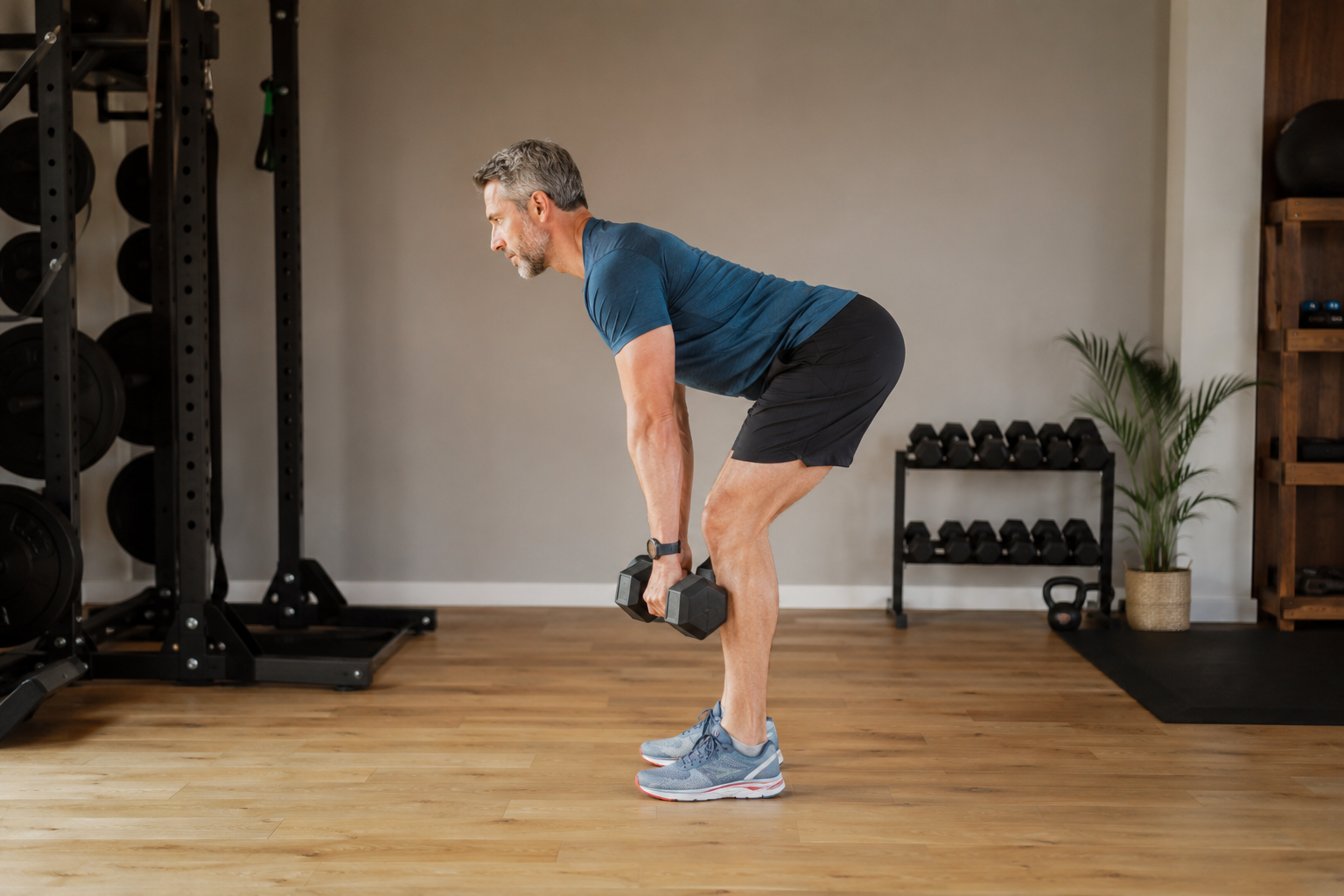
Let’s keep this practical. The best strength exercises for runners are not complicated. They are movements that mirror what running demands: single-leg stability, hip extension, knee control, and calf push-off. You do not need a full gym to do most of them.
Glute and hip exercises for knee and IT band support
| Exercise | Sets x Reps | Notes |
|---|---|---|
| Single-leg glute bridge | 3 x 10–12 each | Slow and controlled |
| Clamshell with band | 3 x 15 each | Light resistance band |
| Lateral band walk | 3 x 12 steps each way | Short steps, stay low |
| Romanian deadlift (dumbbells) | 3 x 8–10 | Hip hinge, not squat |
Quad and single-leg exercises for runner’s knee resilience
| Exercise | Sets x Reps | Notes |
|---|---|---|
| Split squat | 3 x 8–10 each | Front foot elevated optional |
| Step-down (slow) | 3 x 8 each | Lower slowly, 3-4 seconds |
| Wall sit | 3 x 30–45 seconds | Knees at 90 degrees |
| Reverse lunge | 3 x 10 each | Control the knee position |
Calf, soleus, and Achilles exercises for better push-off

| Exercise | Sets x Reps | Notes |
|---|---|---|
| Single-leg calf raise (straight knee) | 3 x 12–15 | Slow lower, full range |
| Single-leg calf raise (bent knee) | 3 x 12–15 | Targets soleus specifically |
| Seated calf raise with load | 3 x 12 | Use a weight plate on knee |
The lowering phase of the calf raise is where most of the tendon benefit comes from. Do not rush it. Three seconds down is a sensible starting point.
Core exercises that actually matter for running
The core work that helps runners is not about crunches. It is about resisting rotation and maintaining a stable pelvis while one leg is in the air. Dead bugs, side planks, and single-leg standing exercises are more relevant than sit-ups.
| Exercise | Sets x Duration |
|---|---|
| Dead bug | 3 x 8 each side |
| Side plank | 3 x 20–30 seconds each |
| Single-leg balance with arm reach | 3 x 10 each |
Optional power exercises once the basics feel easy
Once you have built a solid base over 8 to 12 weeks, you can add low-volume plyometric work. Squat jumps, broad jumps, and single-leg hops build the kind of reactive stiffness that improves running economy further. Start with just 2 to 3 sets of 5 to 8 repetitions and treat these as a complement to your existing routine, not a replacement.
For a broader overview of how to structure exercise as you get older, the guide on how to exercise when you’re over 50 covers the key principles well.
A Simple Weekly Strength Plan for Beginner and Returning Runners
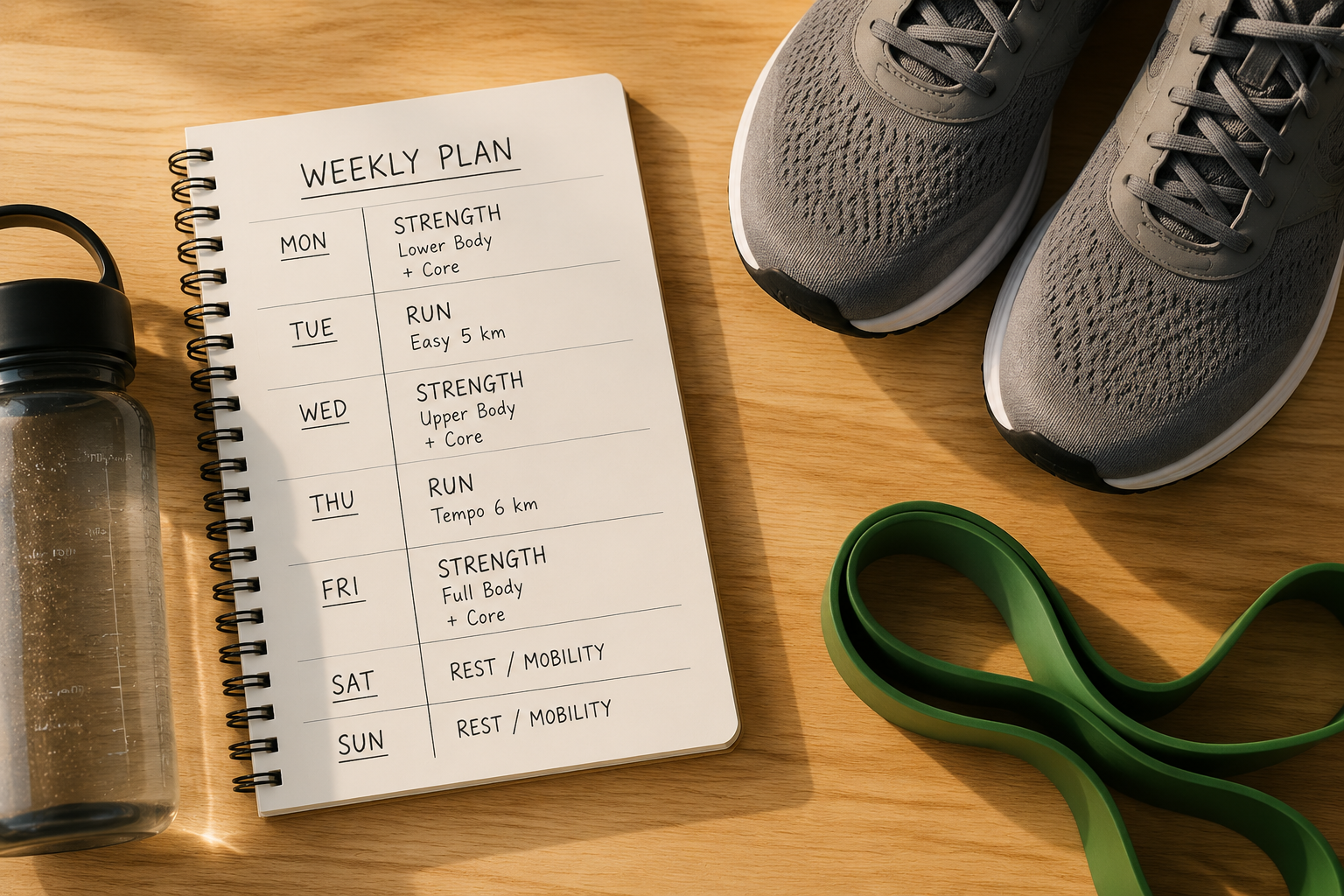
How often should runners strength train?
Two sessions per week is the practical answer for most recreational runners. Three sessions is appropriate if you are in an off-season or building phase with lower running volume. One session is better than none, particularly during peak training blocks.
More is not always better. The goal is to add enough stimulus to build capacity without accumulating fatigue that bleeds into your runs.
Where to place strength workouts in a running week
The simplest way to look at it is this: place strength sessions on the same day as a run (ideally after, not before), or on a dedicated day with at least 24 hours between a hard run and a hard strength session. Avoid heavy lower-body strength work the day before a long run or a quality speed session.
A sensible structure for a runner doing three runs per week might look like this:
| Day | Activity |
|---|---|
| Monday | Easy run + strength (20–35 min) |
| Tuesday | Rest or walk |
| Wednesday | Moderate run |
| Thursday | Strength (20–35 min) |
| Friday | Rest |
| Saturday | Long run |
| Sunday | Rest or light walk |
20-minute beginner runner strength routine
This routine requires no equipment and is suitable for strength training for beginner runners or anyone returning after time off.
- Single-leg glute bridge: 3 x 10 each side
- Reverse lunge: 3 x 8 each side
- Single-leg calf raise: 3 x 12 each (slow lower)
- Dead bug: 3 x 8 each side
- Side plank: 2 x 20 seconds each
Rest 45 to 60 seconds between sets. The whole routine takes 18 to 22 minutes.
35-minute gym routine for runners
For runners with access to a gym and a bit more time:
- Romanian deadlift (dumbbells): 3 x 10
- Split squat: 3 x 8 each
- Lateral band walk: 3 x 12 steps each way
- Seated calf raise with load: 3 x 12
- Step-down (slow): 3 x 8 each
- Dead bug: 3 x 8 each side
- Side plank: 3 x 25 seconds each
This runner strength workout covers all the key areas in a logical order without requiring a full hour in the gym.
For home-based options that do not require equipment, the home workouts for strength section at All Perfect Health has practical routines worth exploring.
How to Progress Without Getting Sore, Hurt, or Overwhelmed
Start easier than you think
This is where most people go wrong. They do a full session on day one, feel fine the next day, and then spend day three unable to walk downstairs. Delayed onset muscle soreness (DOMS) from new strength exercises can peak 48 hours after the session.
For the first two weeks, do half the volume listed above. Two sets instead of three. Fewer reps. Lighter load. Let your tendons and connective tissue adapt before you push the muscles harder.
Progress one variable at a time
When you are ready to progress, change one thing at a time: add one more set, slow the tempo, add a small amount of load, or increase reps. Do not add more load and more volume in the same week. The basics still do the heavy lifting here — consistency and gradual progression beat any clever programming.
A reasonable progression timeline for a beginner runner is:
- Weeks 1–2: Half volume, bodyweight only, focus on form
- Weeks 3–6: Full volume, add light resistance where appropriate
- Weeks 7–12: Add load progressively, introduce single-leg calf raises with full range
- Week 12+: Consider adding low-volume plyometrics if all else feels solid
Know the difference between effort and warning pain
Muscle fatigue and mild soreness are normal. Sharp pain, joint pain, pain that worsens during an exercise, or pain that persists more than 48 hours after a session is not. Stop the exercise, rest, and seek advice if it does not settle quickly.
This is especially relevant for Achilles and knee work. Mild tendon discomfort during loading can be acceptable in a supervised rehabilitation context, but if you are working independently and pain is increasing, back off.
Strength Training Mistakes Runners Should Avoid
Only doing squats and ignoring calves
The calf and Achilles complex is one of the most loaded structures in running, and it is consistently undertrained. Squats and lunges are valuable, but they do not load the calf through the range of motion that running demands. Add dedicated calf work every session.
Skipping single-leg exercises
Running is entirely a single-leg activity. Bilateral exercises like squats and deadlifts build a useful base, but they do not replicate the stability demands of running. Single-leg squats, step-downs, and single-leg calf raises are non-negotiable for runners.
Going too hard during race training
The weeks leading up to a goal race are not the time to start a new strength programme or increase training load. During peak training blocks, reduce strength volume by 30 to 50 percent and focus on maintenance rather than progression.
Treating foam rolling as a replacement for strength
Foam rolling has a place in recovery and can reduce perceived tightness. It is not a substitute for building muscle capacity. A runner who foam rolls their IT band daily but never does hip strengthening is managing a symptom without addressing the cause.
Waiting until pain starts
This is the most common mistake. Strength training for runners to prevent injury works best as an ongoing practice, not a reactive one. By the time pain appears, tissue tolerance has already been exceeded. The time to build capacity is before you need it.
The exercise guide for better health at All Perfect Health covers the broader principles of building sustainable exercise habits, which applies directly here.
Strength Training for Runners FAQ
Does strength training make runners faster?
The evidence suggests yes, particularly through improvements in running economy. Runners who add structured strength work — especially heavy resistance training and plyometrics — tend to use less energy at the same pace over time. This translates to faster race times or the ability to run longer at the same effort. The effect is more pronounced in endurance running than in sprinting, and it appears to be meaningful even with relatively modest training volumes.
How many days a week should runners strength train?
Two sessions per week is the practical recommendation for most recreational runners. That is enough to build and maintain meaningful strength without creating excessive fatigue. Three sessions per week works well in lower-mileage or off-season phases. One session is worth doing if time is limited. The key is consistency over months, not frequency in any single week.
Should runners lift heavy or use bodyweight exercises?
Both have a place, and the answer depends on your current level. Bodyweight exercises are a sensible starting point for strength training for beginner runners — they build the movement patterns and tissue tolerance needed before adding load. Once bodyweight movements feel controlled and easy, adding resistance (dumbbells, bands, a barbell) increases the training stimulus. The research on running economy improvements tends to favour heavier loading over time, but only once the basics are solid.
Should I strength train before or after running?
After running, in most cases. Strength training before a run can pre-fatigue the muscles you need for running, which reduces the quality of the run and increases injury risk. If you are doing a dedicated strength-only session on a separate day, timing matters less — just ensure there is adequate recovery between a hard run and a hard strength session.
What muscles should runners strengthen most?
In order of priority for most recreational runners: glutes and hip abductors (for knee and IT band control), calves and soleus (for Achilles and push-off), quads and single-leg stability (for runner’s knee resilience), and deep core (for pelvic stability). Upper body strength is less critical for most runners, though it contributes to posture and arm drive over longer distances.
Can strength training help runner’s knee, IT band pain, or Achilles pain?
It can support recovery and reduce the likelihood of recurrence, but the answer depends on the conditions. For runner’s knee and IT band issues, hip and glute strengthening is well supported by the evidence and is a standard component of physiotherapy management. For Achilles tendinopathy, progressive calf loading — particularly slow, heavy single-leg calf raises — is the most evidence-supported conservative treatment available. That said, if you are currently in pain, get a proper assessment first. Strength work applied incorrectly to an irritated tendon or inflamed knee can make things worse before they get better.
Final Takeaway: Run More Strongly Before You Run More Miles

The main takeaway is this: strength training for runners does not need to be complicated, time-consuming, or gym-heavy to be effective. Two sessions per week, built around single-leg exercises, calf loading, hip strengthening, and basic core work, gives most recreational runners a meaningful return on a modest investment of time.
The evidence for running economy improvements is reasonably strong. The evidence for targeted injury support — particularly for runner’s knee, IT band syndrome, and Achilles issues — is worth acting on. The evidence for broad injury prevention across all running injuries is more mixed, and it would be misleading to promise that strength work eliminates risk entirely.
What it does do, reliably, is make you a more capable runner. Stronger muscles handle load better. Better-loaded tendons are more resilient. A more stable hip means a more controlled knee. None of that is hype — it is just the mechanics of how running works.
Start with what gives the biggest return: single-leg calf raises, split squats, glute bridges, and dead bugs. Do them consistently for 8 to 12 weeks before adding complexity. Keep it simple and consistent, and let the adaptation come to you.
If you are just starting out or returning after time off, the sport-specific training guide at All Perfect Health covers how to structure training around a specific goal — which is exactly the mindset that makes strength work for runners effective.
Run more strongly before you run more miles. That is the order that works.
Medical Disclaimer: This article is for general informational purposes only and does not constitute medical advice. If you are experiencing pain, swelling, or any injury, consult a qualified healthcare professional before beginning or modifying any exercise programme. See our full disclaimer for details.
References
| Use for | Citation |
|---|---|
| Running economy and performance | Blagrove, R. C., Howatson, G., & Hayes, P. R. (2018). Effects of strength training on the physiological determinants of middle- and long-distance running performance: A systematic review. Sports Medicine. https://doi.org/10.1007/s40279-017-0835-7 |
| Strength training and running economy | Denadai, B. S., de Aguiar, R. A., de Lima, L. C. R., Greco, C. C., & Caputo, F. (2017). Explosive training and heavy weight training are effective for improving running economy in endurance athletes: A systematic review and meta-analysis. Sports Medicine. https://doi.org/10.1007/s40279-016-0604-z |
| Running injury rates and common injury burden | Videbæk, S., Bueno, A. M., Nielsen, R. O., & Rasmussen, S. (2015). Incidence of running-related injuries per 1000 h of running in different types of runners: A systematic review and meta-analysis. Sports Medicine. https://doi.org/10.1007/s40279-015-0333-8 |
| Runner’s knee, hip and knee strengthening | Willy, R. W., Hoglund, L. T., Barton, C. J., et al. (2019). Patellofemoral pain: Clinical practice guidelines linked to the International Classification of Functioning, Disability and Health. Journal of Orthopaedic & Sports Physical Therapy. https://doi.org/10.2519/jospt.2019.0302 |
| Achilles tendon loading and rehab | Martin, R. L., Chimenti, R., Cuddeford, T., et al. (2018). Achilles pain, stiffness, and muscle power deficits: Midportion Achilles tendinopathy revision 2018 clinical practice guidelines. Journal of Orthopaedic & Sports Physical Therapy. https://doi.org/10.2519/jospt.2018.0302 |
Medical Disclaimer
This article is for general educational purposes only and is not medical advice. Exercise needs vary. Stop if a movement causes sharp or worsening pain, and seek individual advice from a qualified clinician or exercise professional when returning after injury, managing a condition, or unsure how to progress.

Dave James is a health researcher and writer specialising in evidence-based nutrition, exercise, and longevity. He founded All Perfect Health to provide clear, practical health guidance rooted in current research and real-world experience.
📂 The Complete Guide to Sport-Specific Training
This article is part of the APH cluster. Use the links below to move between the pillar and child articles.
- Read the pillar: The Complete Guide to Sport-Specific Training: How to Prepare Your Body for Any Activity (2026)
- → Hiking and Backpacking Fitness: Build Leg Endurance and Protect Your Joints on the Trail
- → Tennis and Pickleball Conditioning for Adults 50+: Agility, Shoulder Health, and Reaction Speed
- → Cycling Fitness: Build Leg Power, Core Stability, and Endurance on the Bike
- YOU ARE HERE Strength Training for Runners: Prevent Injury and Build Speed
- → Best Exercises for Golf: Rotation, Power, and Back Protection
- → 10 Best Exercises for Skiing: Build Strength, Balance, and Endurance Before You Hit the Slopes