
Walking vs Running for Weight Loss: Which Is Better for Beginners?
Originally published: April 2026 | Updated: September 30, 2026
If you have been wondering whether to lace up for a walk or push yourself into a jog, you are not alone. It is one of the most common questions I hear from people who are just getting started with exercise for weight loss. The honest answer is that both work, both have real evidence behind them, and the right choice depends almost entirely on where you are starting from. This guide walks through what the research actually shows, without the hype, so you can make a decision that fits your body, your schedule, and your life.
Key takeaways
- Running usually uses more energy per minute. That can matter when time is limited, but it is not a guarantee of greater long-term fat loss.
- Walking can be the better weekly tool when it is easier to repeat, recover from, and fit around real life.
- Neither activity can target belly fat on command. Body-fat change reflects the broader energy balance, time, and the routine a person sustains.
- Running is not automatically wrong for people over 50, and walking is not a consolation prize. Start from current capacity and progress with control.
- Walk-run intervals offer a genuine middle route. They can be used long-term, not merely as a test to “graduate” from walking.
- Choose the activity you will keep doing for months. That is the practical advantage that matters most.
The Quick Answer: Walking vs Running for Weight Loss
Running typically uses more energy per minute than walking, so it can be time-efficient. But that does not make running automatically better for long-term weight loss: total weekly activity, food intake, recovery, and whether the person can keep going matter more than a single workout comparison.
Further viewing: This video is supplementary commentary. The research links at the end of this article support the factual claims on this page.
That said, walking is far from ineffective. If you walk longer, walk faster, add hills, or simply walk more days per week, the cumulative calorie burn adds up in a meaningful way. Many people who start a consistent walking program lose weight steadily over time, especially when they were previously sedentary.
The deeper question is not which burns more calories in a controlled comparison. It is which one you can do regularly, without injury, for the next six months. If running breaks you down in week three and you stop entirely, it produces less weight loss than walking four days a week for six months straight.
If you are new to structured exercise and want a solid foundation before deciding, the exercise guide for better health on this site is a good place to build context around how different types of movement contribute to overall fitness and weight management.
For most beginners, a practical answer is: start with walking, progress to walk-run intervals once you have a base of fitness, and graduate to running if your body tolerates it well. Nothing about that path is slow or unambitious. It is just how durable progress works.
How Walking and Running Burn Calories Differently
Calories: why the comparison is not fixed
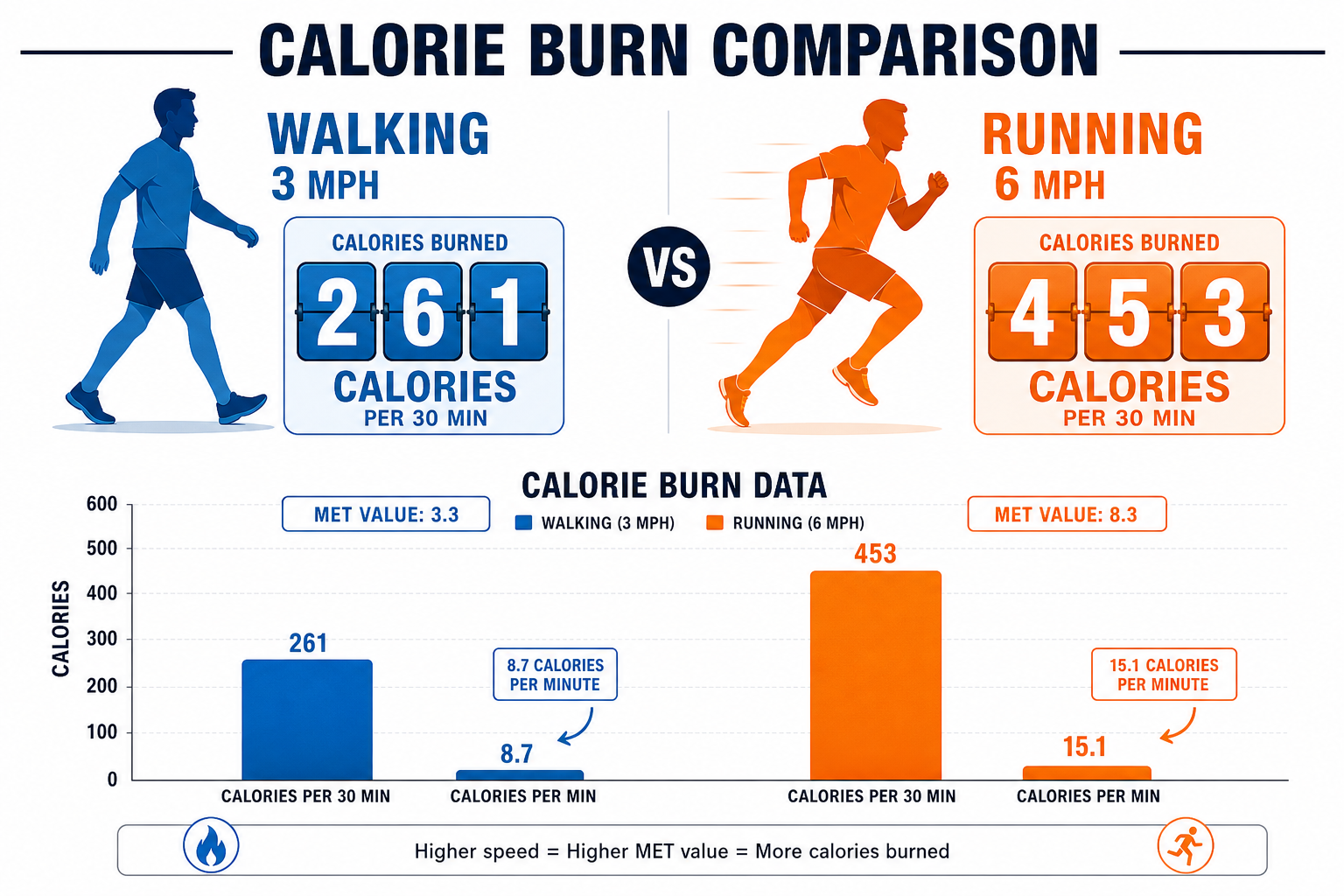
Running usually uses more energy in the same amount of time because it is more intense. Actual expenditure varies materially with body size, pace, terrain, fitness, and measurement method, so a chart or watch estimate is best treated as a rough planning tool—not a promise of fat loss.
Walking can close much of the practical gap when it happens more often, lasts longer, includes hills, or simply replaces sedentary time. The useful comparison is the week a person can repeat, not two isolated thirty-minute sessions.
MET Values: Measuring Exercise Intensity
A MET, or Metabolic Equivalent of Task, expresses how hard your body is working relative to sitting still. Sitting at rest equals 1 MET.
- Walking at a brisk pace of around 3 mph falls in the range of 3 to 5 METs, classified as moderate intensity exercise
- Running at 6 mph or faster reaches 6 METs or more, placing it firmly in the vigorous category
- Hiking on hills or climbing stairs can bring walking up toward the lower end of the running range
This is why a hilly walk is more demanding than a flat one, and why incline walking is a practical way to push the heart rate into a more productive zone without running. The MET framework also explains why the Williams 2013 study used MET-hours as its comparison unit rather than simply counting minutes of exercise.
The Afterburn Effect
After intense exercise, the body continues burning calories at an elevated rate during recovery, a phenomenon called excess post-exercise oxygen consumption (EPOC). Research in the Journal of Strength and Conditioning Research found the afterburn lasts roughly five minutes longer for runners than walkers. The effect from steady-state running is real but modest, and should not be weighted heavily in the walking versus running decision for beginners.
What the Research Actually Says
The most substantial direct comparison of walking and running for weight loss is the National Runners’ and Walkers’ Health Study, published in 2013 by Paul T. Williams in Medicine and Science in Sports and Exercise. It is worth spending some time on because it is a genuinely large, long-term piece of evidence rather than a short laboratory study.
The study followed 32,216 runners from the National Runners’ Health Study alongside 15,237 walkers from the National Walkers’ Health Study over an average of 6.2 years. That is roughly 47,000 people, prospectively tracked in free-living conditions, which means researchers were observing what people actually did in their daily lives rather than in a controlled lab setting. The exposure variable was change in exercise energy expenditure measured in MET-hours per day.
The headline finding: running produced approximately 90% more weight loss per MET-hour expended than walking, particularly in participants in the highest BMI quartile. In practical terms, for every unit of metabolic work performed, runners lost significantly more weight than walkers matched for the same energy expenditure.
The BMI quartile finding is worth understanding in context. The effect was not uniform across all body types. In men, running outperformed walking across all four BMI quartiles, but the advantage grew progressively larger as starting BMI increased. In women, the advantage was most pronounced in the fourth (highest) BMI quartile, where running produced 18 times more BMI reduction per MET-hour than walking. For women in the lower three quartiles, the difference was less dramatic. The study authors suggest this may relate to the way heavier individuals respond to higher mechanical loading during vigorous exercise, though the mechanisms are not fully worked out.
What the study does not tell us is equally important. Participants self-selected into running or walking groups. Runners may have had other lifestyle differences that contributed to their outcomes. The study does not establish that a sedentary person who starts running will necessarily outperform someone who starts walking by 90%. It tells us that among people already committed to either activity over years, runners ended up leaner.
For a beginner weighing the choice, the evidence is directionally clear: if you can run consistently without injury, you will likely lose more weight than if you walk for the same time investment. But “if you can run consistently without injury” is doing a lot of work in that sentence.
Belly Fat: What Exercise Can and Can’t Do
Neither walking nor running can selectively remove fat from the abdomen. Changes in waist size and visceral fat come from the broader pattern of activity, food intake, sleep, stress, and time—not from choosing a single “fat-burning” workout.
Exercise can still make a worthwhile contribution. Reviews of controlled trials find aerobic training is associated with modest improvements in body weight, waist circumference, and body-fat measures in adults with overweight or obesity. At matched energy expenditure, high-intensity interval training and moderate continuous training have not shown a consistent winner for fat loss. The best option is usually the one a person can perform and recover from consistently.
For heart-rate language and its limits, see Fat Burn Heart Rate. For interval options, see HIIT Workouts.
The Joint-Impact Trade-off
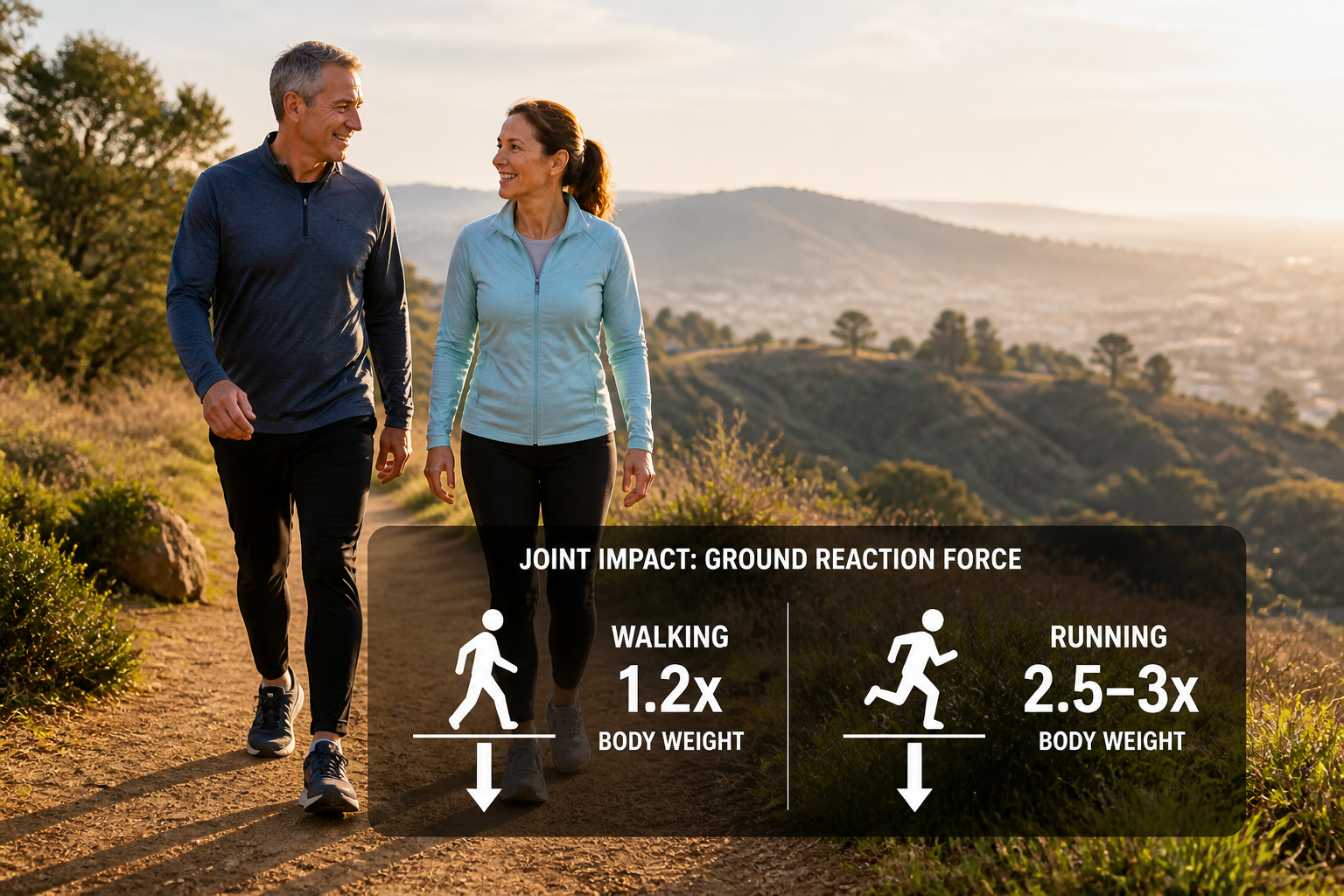
Walking and running create different mechanical demands. Running involves repeated impact and a flight phase; walking is usually a lower-impact choice. That does not make running inherently harmful, nor does it make walking universally problem-free. Surface, shoes, pace, prior injury, recovery, strength, and sudden changes in training can all matter.
The evidence does not support one universal progression rule that prevents running injuries. A 2022 systematic review found running-related injuries are multifactorial and the relationship with simple training numbers is inconsistent. The sensible move is to progress in a controlled way, keep technique comfortable, and step back if a specific pain is worsening rather than trying to force a fixed schedule.
Which Should You Choose? A Decision Framework
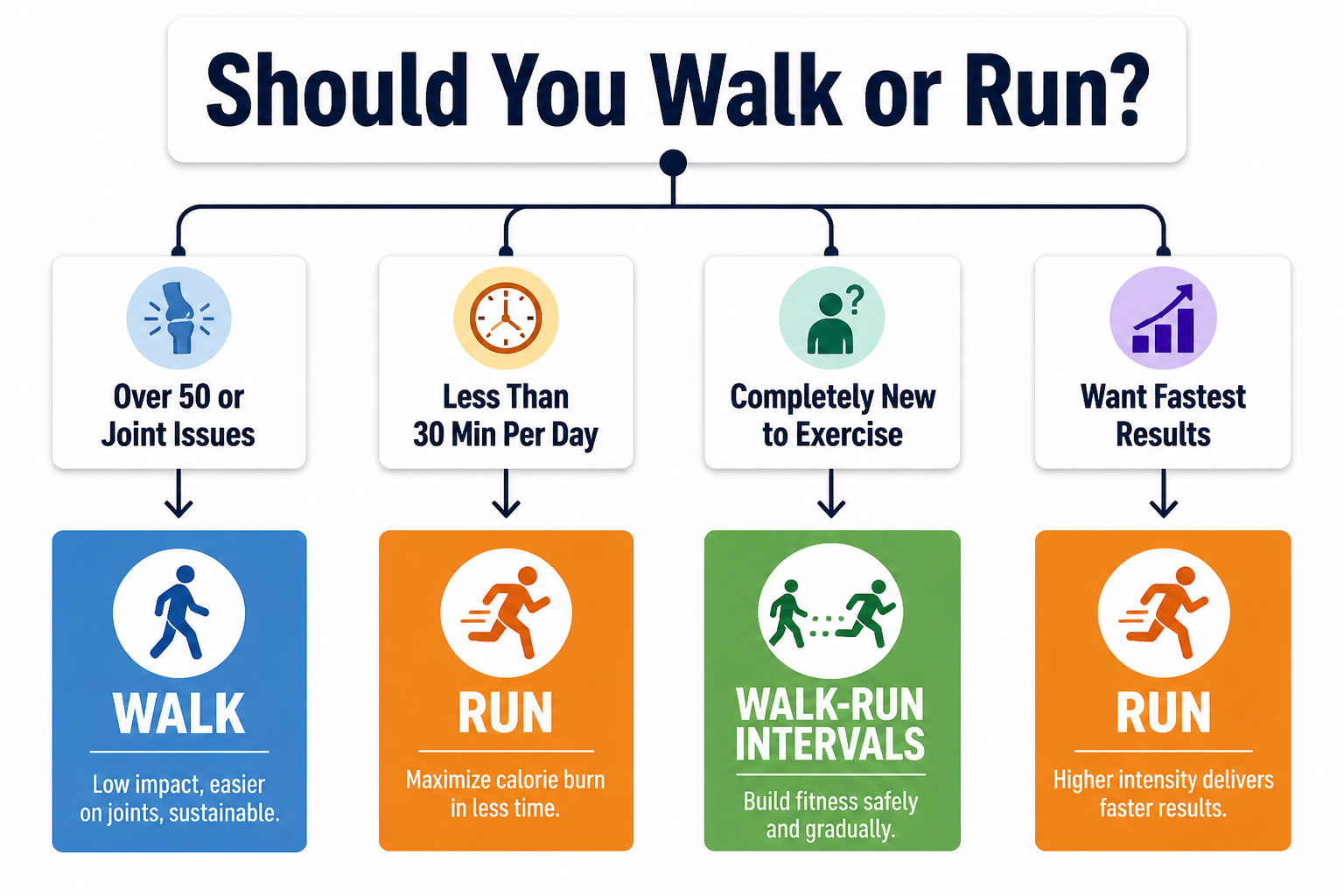
Choose walking first if you are returning after a break, want the simplest repeatable route, or prefer lower-impact cardio. Use How to Start Walking for Exercise for the practical plan.
Choose running if you enjoy it, can currently tolerate it, and want a more time-efficient cardio option. Build gradually rather than treating hard running as the entry fee for getting fit.
Choose walk-run intervals if you want a bridge between the two. They are a legitimate long-term training style, not a failure to become a “real” runner.
Age alone does not decide the answer. A fit 60-year-old may enjoy running, while a 30-year-old may be better served by walking for now. Start from the body and schedule you have, not the identity you think you should have.
How to Start Walking for Weight Loss
Walking for weight loss is more effective when it is structured rather than casual. There is a difference between moving around throughout the day and engaging in a dedicated walking session at a pace that elevates your heart rate into a productive zone. The former is valuable for overall health; the latter is what drives meaningful calorie expenditure and cardiovascular adaptation.
The fundamentals: aim for at least 30 minutes of brisk walking most days of the week, where brisk means a pace that makes conversation slightly challenging but not impossible. Start with three days per week if you are coming from a low-activity baseline, and build toward five or six days over four to six weeks. Add inclines where possible, as even a modest hill significantly increases calorie burn at the same walking speed.
For a structured beginner plan and detailed guidance on building a walking habit that produces real results, the full guide to how to start walking for exercise covers everything from pacing to progression to footwear in much more depth than this section can.
How to Start Running for Weight Loss
The biggest mistake beginners make with running is doing too much too soon. Your cardiovascular system adapts to running stress within a few weeks. Your connective tissue, tendons, ligaments, and bones take much longer. Many running injuries occur not because someone is unfit aerobically but because their joints and tendons have not had time to adapt to the mechanical load.
The Couch-to-5K Framework
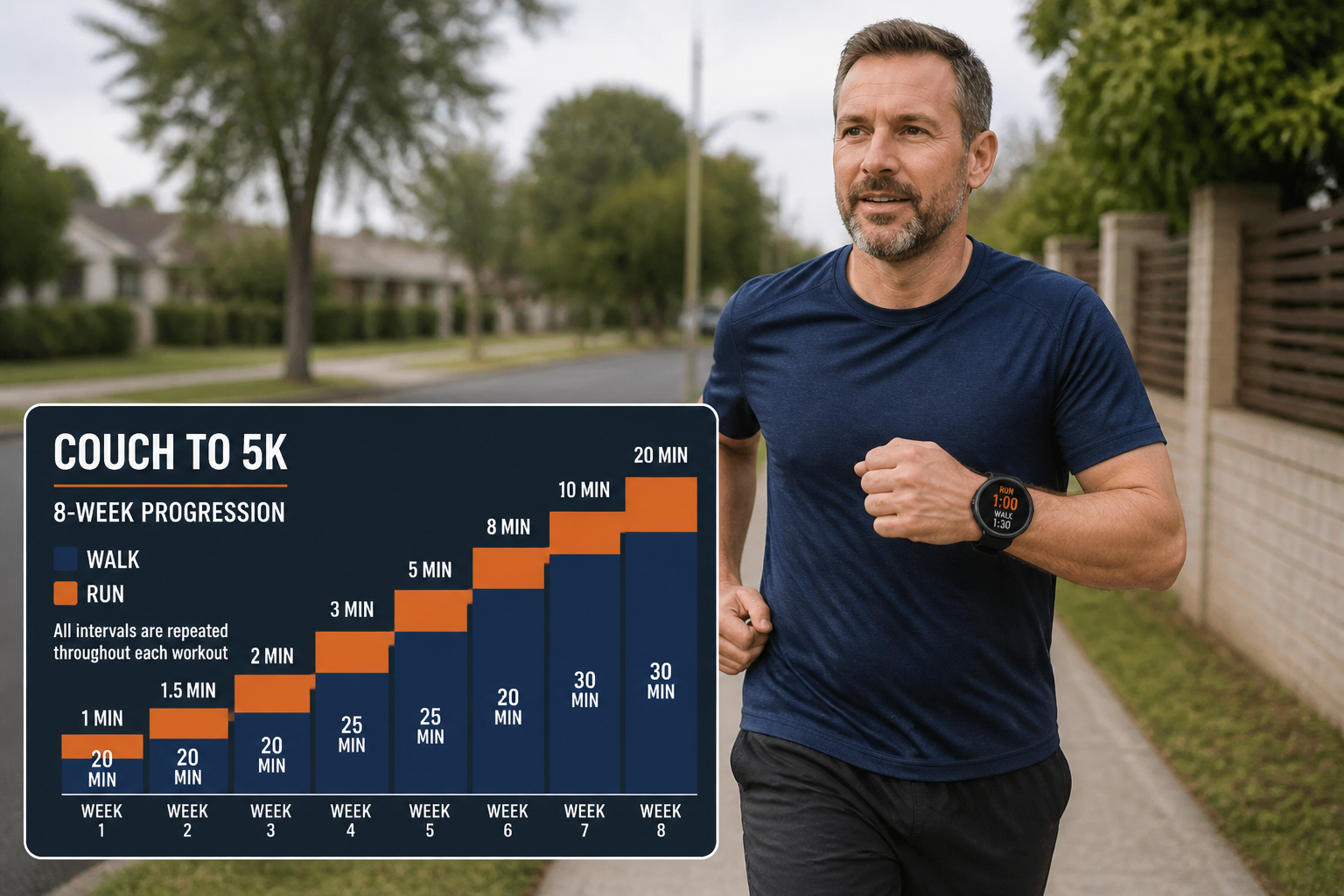
The Couch-to-5K structure, developed in the late 1990s and now one of the most widely used beginner running programs in the world, addresses this problem by alternating running and walking intervals and increasing the running proportion gradually over 8 to 9 weeks. A simplified overview of the progression:
- Weeks 1 to 2: Alternate 60 seconds running with 90 seconds walking, repeated for 20 to 25 minutes total. Three sessions per week.
- Weeks 3 to 4: Running intervals extend to 3 to 5 minutes, walking intervals shorten to 90 seconds to 2 minutes.
- Weeks 5 to 6: Running intervals reach 8 to 20 minutes, with shorter walking breaks. You begin running longer continuous stretches.
- Weeks 7 to 8: Running intervals of 25 to 30 minutes continuous, with the goal of completing a full 5K without stopping.
The beauty of this structure is not just the gradual physical adaptation. It also builds psychological confidence. Completing a 60-second run feels manageable on day one. By week eight, you have accumulated enough small wins that a 30-minute continuous run feels like a natural extension rather than an impossible goal.
The Talk Test
A practical and widely recommended way to gauge running intensity for beginners is the talk test. If you can speak in full sentences without gasping, you are likely at a manageable aerobic intensity. If you can only get out a few words at a time, you are probably going too hard for sustained beginner running. If you can sing comfortably, you may be going too easy to drive meaningful cardiovascular adaptation.
The talk test corresponds roughly to the moderate-to-vigorous zone where most aerobic training benefits occur. It is a simple tool that requires no heart rate monitor or fitness tracker. For a more precise understanding of heart rate zones and how they relate to fat burning during exercise, the piece on fat burn heart rate provides a useful breakdown.
A Note on Footwear
Running in worn-out or poorly fitted shoes is one of the most preventable causes of beginner running injuries. Unlike walking, where almost any supportive shoe will serve adequately, running generates the 2.5 to 3 times body-weight impact we discussed earlier, and inadequate cushioning or support amplifies stress on the ankle, knee, and hip. If you are transitioning to running, it is worth visiting a specialty running store for a basic gait assessment and fitting. You do not need an expensive shoe. You need the right shoe for your foot shape and gait pattern.
The Hybrid Approach: Walk-Run Intervals
Walk-run intervals sit between walking and running as a permanent training strategy, not merely a stepping stone to pure running. The approach was popularized by American Olympian Jeff Galloway, who developed the run-walk-run method in the 1970s based on his experience coaching recreational runners. Galloway found that strategic walking breaks within a run did not just reduce injury risk. They also allowed runners to cover more total distance and maintain better form than if they ran continuously to the point of breakdown.
The core principle is simple: insert brief, planned walking intervals throughout your run rather than running until you feel forced to stop and then stumbling through a recovery walk. By taking the walk breaks early and on a schedule, before fatigue accumulates, you stay in control of your effort level and your joints never reach the kind of cumulative load that triggers overuse injuries.
Why It Works for Beginners
For beginners, the walk-run approach offers several genuine advantages. First, it dramatically reduces injury risk by limiting the continuous mechanical stress on knees and ankles. Second, it allows you to sustain a higher average intensity across a session than you could manage if you tried to run the whole time at a pace that would eventually require stopping. Third, it keeps most people exercising longer per session than pure running would allow, which matters for total calorie burn.
A typical beginner walk-run structure might be 1 minute running followed by 2 minutes walking, repeated for 30 minutes. As fitness improves, the ratio shifts toward more running: 2 minutes running to 1 minute walking, then 3 to 1, and so on. Some runners use the Galloway method indefinitely, finding that a 30-second walk break every 4 to 5 minutes allows them to run faster and farther than they could running continuously.
The evidence supports this approach. Studies comparing walk-run interval training with continuous running in recreational runners have found comparable or better long-term adherence in the interval group, with significantly fewer overuse injuries. For someone new to running who wants to manage risk while still capturing the higher calorie burn of vigorous exercise, walk-run intervals are a well-supported and practical strategy.
Common Mistakes to Avoid
- Doing too much too fast. This is the single most common cause of early injury and early dropout in both walking and running programs. Progress gradually, but do not mistake the popular “10% rule” for a proven universal injury-prevention formula. Sudden changes can be unhelpful; the right progression depends on the individual.
- Ignoring nutrition. Exercise creates a calorie deficit only when it is not compensated by eating more. Research consistently shows that many people unconsciously increase their food intake after starting an exercise program, partially or fully offsetting the calories burned. Paying attention to what and how much you eat remains essential for weight loss outcomes regardless of whether you walk or run.
- Comparing your progress to others. Social media and fitness apps make it easy to see other people’s distances, paces, and weight loss numbers. Individual metabolic responses to exercise vary considerably based on genetics, starting weight, age, sleep quality, stress levels, and dozens of other factors. Someone else’s experience on the same program tells you very little about what yours will look like.
- Skipping rest days. Rest is when adaptation happens. Your muscles, tendons, and bones rebuild and strengthen during recovery, not during the exercise session itself. Beginners who exercise every single day without rest frequently plateau or get injured within the first month. Two to three rest or low-activity days per week is not laziness. It is sound training practice.
- Treating exercise as a standalone solution. Walking or running supports weight loss most effectively as part of a broader lifestyle that includes reasonable diet, adequate sleep, and stress management. A good comprehensive guide to modern diets can help you understand how food choices interact with exercise to drive the calorie deficit that weight loss requires.
- Neglecting strength training. Cardio exercise burns calories during the session. Strength training builds muscle, which raises resting metabolic rate and improves body composition over time. Adding two sessions per week of basic resistance exercise, even bodyweight movements at home, complements walking or running in a way that produces better long-term results than cardio alone. The guide to body composition exercises covers which movements are most effective for this purpose.
Frequently Asked Questions
How many calories does walking vs running burn?
Running generally uses more energy per minute than brisk walking, but exact calorie numbers vary too much by body size, speed, terrain, and device error to use as a promise. An incline and a longer walk can raise the work done without requiring running.
Is walking 10,000 steps a day enough for weight loss?
10,000 steps per day, roughly 5 miles for most people, is a useful benchmark but not a universal threshold. For someone previously sedentary, reaching that target consistently represents a meaningful increase in activity that will contribute to weight loss. For someone already active, it may not create enough additional expenditure to drive fat loss. Quality matters too: a brisk 30-minute walk burns more than 10,000 casual steps scattered across a low-activity day. Steps are a reasonable proxy for volume but not a precise weight loss formula.
Can you lose weight just by walking?
Walking can contribute meaningfully to weight management, especially when it replaces sedentary time and becomes a consistent part of the week. It is not a guaranteed stand-alone weight-loss method; food intake and the broader routine still matter. A practical starting point is a pace and duration that can be repeated, then a gradual build from there.
How fast do you need to walk to lose weight?
Use the talk test rather than a universal speed. A purposeful moderate walk usually allows sentences but not singing; a harder pace shortens speech. Heart-rate zones are estimates, not fat-loss guarantees, and are explained in the Fat Burn Heart Rate guide.
Does running burn belly fat faster than walking?
Not reliably. Running may use more energy in less time, but neither activity directs fat loss to the abdomen. Controlled-trial reviews suggest total aerobic work and sustained adherence matter more than assigning a special “belly-fat” status to running or walking.
Which is better for over 50: walking or running?
Walking is often a practical starting point after 50, especially after a long break, but age itself does not rule running in or out. Progress from current capacity, build strength and volume patiently, and get individual advice for significant symptoms, a recent injury, or a condition that changes how you should exercise.
How long until I see weight loss from walking or running?
There is no reliable timetable for visible change. Body weight can move for reasons unrelated to fat mass, including fluid and digestion. Look for a routine that can be sustained, track more than one signal if useful, and avoid turning a short plateau into a reason to abandon the habit.
The Bottom Line
Running wins the per-minute comparison; walking often wins the consistency comparison. Either can contribute to a calorie deficit and better fitness. Neither guarantees a particular number on the scale or selectively burns belly fat.
For many beginners, walking is the sensible first move. For people who enjoy running and tolerate it well, running can be a time-efficient choice. Walk-run intervals are the middle path, and they can stay that way indefinitely.
Pick the activity you can repeat next week. Then build slowly enough to keep the habit alive.
References
- World Health Organization. WHO guidelines on physical activity and sedentary behaviour (2020).
- Williams PT. Greater weight loss from running than walking during a 6.2-year prospective follow-up. Medicine & Science in Sports & Exercise (2013).
- Bellicha A, et al. Effect of exercise training on weight loss, body composition changes, and weight maintenance in adults with overweight or obesity: an overview of systematic reviews. Obesity Reviews (2021).
- Cheng L, et al. Aerobic exercise and weight loss in adults: a systematic review and dose-response meta-analysis (2024).
- Fredette A, et al. The association between running injuries and training parameters: a systematic review. Journal of Athletic Training (2022).
- Further viewing: Thomas DeLauer’s discussion of walking and running for weight loss. This is supplementary commentary, not the article’s evidence base.

About Dave James
Dave is the founder of All Perfect Health. He focuses on practical, evidence-aware health guidance that people can use in real life without turning fitness into a full-time project.
📂 Exercise Guide for Better Health
This article is part of the APH cluster. Use the links below to move between the pillar and child articles.
- Read the pillar: Exercise Guide for Better Health
- → Body Mass Index (BMI) Chart
- → How to Start Walking for Exercise
- → HIIT Workouts
- YOU ARE HEREWalking vs. Running for Weight Loss
- → Fat Burn Heart Rate
- → Zone 2 Cardio: A Practical Beginner’s Guide to Steady Aerobic Training
- → Health Benefits of Swimming
- → Explore all Exercise guides