
Best Exercises for Golf: Rotation, Power, and Back Protection
Last updated: October 4, 2026
Most recreational golfers walk between four and eight kilometres per round and repeat a high-speed rotational movement more than 80 times. That is not a casual afternoon stroll. For golfers over 45, the body needs to be prepared for that demand — and the best exercises for golf address exactly that: better rotation, better sequencing, and less compensation through the lower back.
Golf looks low-impact from the outside. The reality is different. The swing generates significant force through the hips, thoracic spine, and core, and when any of those links are stiff or weak, the lower back tends to absorb what they cannot produce. That is where most golf-related pain begins.
This guide covers the exercises that actually matter — not generic gym work, not swing coaching, and not hype. Just practical, evidence-aware training for golfers who want to play better, stay healthier, and keep playing for years to come.
Medical note: This article is for general information only. If you have an existing back, hip, knee, or shoulder condition, check with a physiotherapist or sports medicine doctor before starting a new exercise programme. Exercise can reduce injury risk and improve readiness, but it cannot guarantee injury prevention.
Key Takeaways
- Golf power comes from better sequencing — hips, thoracic spine, core, then club — not from forcing more effort through the lower back.
- The lumbar spine is one of the most common injury sites in golf, and the risk is higher with older age, prior back pain, and reduced hip or thoracic mobility.
- The 10 exercises in this guide target the specific movement qualities golf demands: hip rotation, thoracic mobility, core stability, glute strength, and rotational power.
- A two or three-day weekly routine is enough for most recreational golfers to see meaningful improvements in swing quality and joint comfort.
- A five-minute dynamic warm-up before every round matters more than most golfers realise.
Table of Contents
- Why Golfers Need Specific Exercise Training
- Why the Lower Back Gets Stressed in Golf
- The 10 Best Exercises for Golf
- Best Golf Warm-Up Before a Round
- How to Build a Simple Weekly Golf Exercise Routine
- Best Exercises for Golfers with Stiff Hips
- Best Core Exercises for Golf and Back Protection
- Common Golf Exercise Mistakes to Avoid
- Frequently Asked Questions
- Final Takeaway
Why Golfers Need Specific Exercise Training
There is a principle in sports science called SAID — Specific Adaptation to Imposed Demands. In plain English, the body adapts to the specific stresses placed on it. If you train for the demands of golf, you get better at golf. If you train generically, you get generally fitter, but the carry-over to the course is limited.
Golf requires a specific combination of qualities: hip mobility, thoracic rotation, core stability, glute strength, single-leg balance, shoulder and scapular stability, grip and forearm endurance, and the cardiovascular base to walk a full round without fatigue affecting your mechanics in the back nine.
For a deeper look at how targeted preparation works across different sports, the sport-specific training guide at All Perfect Health covers the SAID principle in practical detail.
The research supports this approach. A 2024 systematic review found that physical training programmes — combining strength, power, and flexibility work — produced a moderate, consistent improvement in clubhead speed across golfers of different ages and abilities. The correlation between lower-body power and clubhead speed was particularly strong. That is not a coincidence. The golf swing is a ground-up movement. Power starts at the feet and hips, transfers through the core, and arrives at the clubhead. Training that chain produces real results.
What matters most is this: golf exercises should not try to mimic the swing with added resistance. They should build the physical qualities that allow the swing to happen well.
Why the Lower Back Gets Stressed in Golf
The lumbar spine is consistently among the most common injury sites in golf. A 2024 systematic review confirmed this, and also noted that back pain risk is higher in older golfers, those with a higher BMI, and those with a prior history of back pain. That is a useful piece of context for anyone over 45 returning to the game or playing regularly.
Here is the real issue: the lower back is often not the cause of the problem. It is the victim of it.
When the hips are stiff and cannot rotate freely, the lumbar spine compensates. When the thoracic spine is restricted and cannot rotate well, the lower back compensates again. When the glutes are weak and the core is not doing its job, the lower back picks up the slack on every swing. Multiply that across 80 or more swings in a round, add a few practice sessions, and the cumulative load becomes significant.
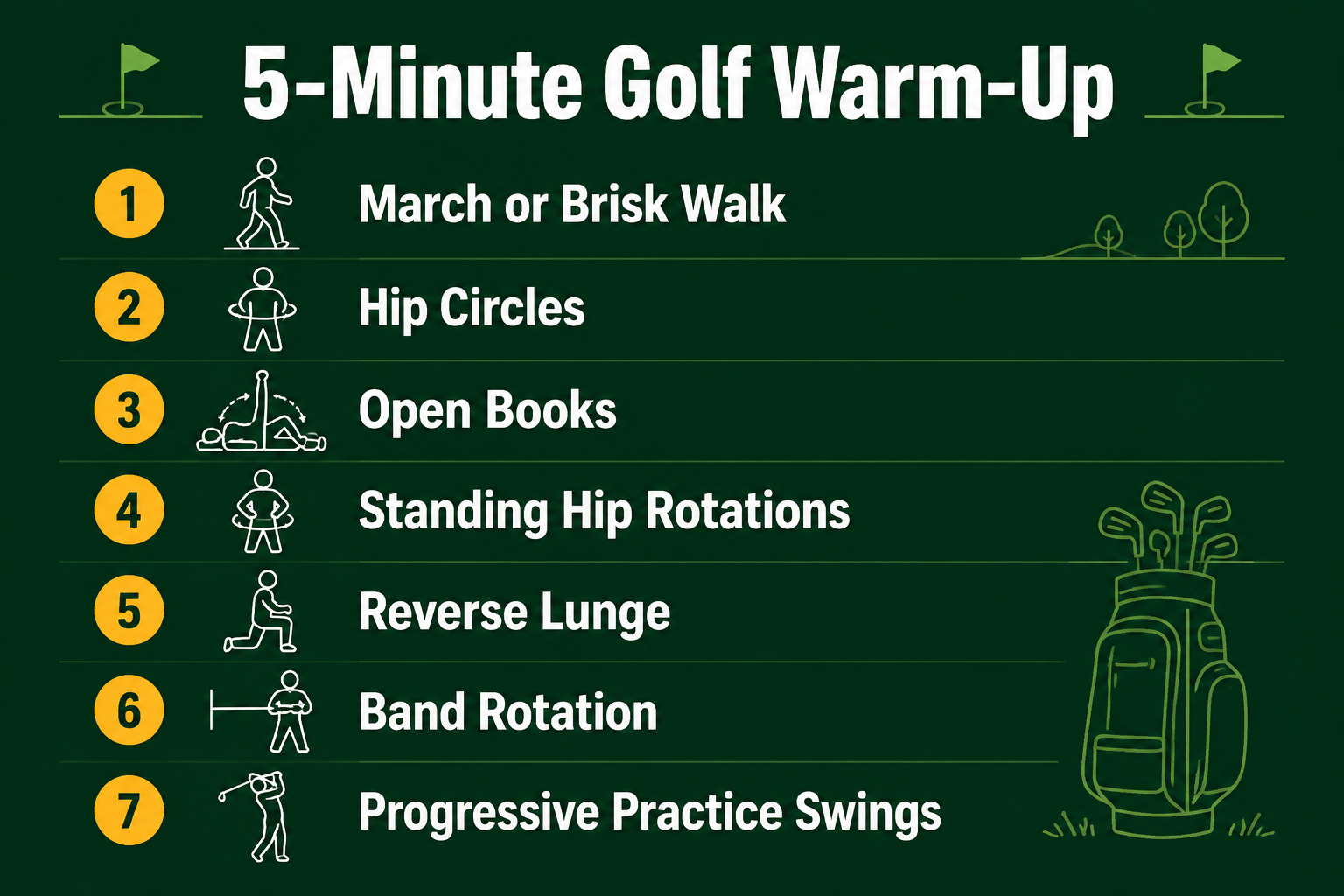
The Simple Rule: Rotate Above and Below the Lower Back
The most useful mental model for golfers is this: the hips and thoracic spine are meant to rotate. The lumbar spine is not designed for large rotational loads — it is built for stability and load transfer.
A well-trained golfer rotates through the hips and upper back, and the lower back stays relatively controlled in the middle. That is the goal. Not a rigid lower back, but a supported one that is not being forced to do the job the hips and thoracic spine should be doing.
Hip mobility and thoracic mobility are likely the two most important contributors to reducing lumbar compensation in the golf swing. The exercises in this guide are built around that idea.
When to Get Professional Help
If you have persistent lower back pain during or after golf — particularly pain that radiates into the leg, pain that wakes you at night, or pain that has not improved after two to three weeks of rest and sensible activity modification — see a physiotherapist or sports medicine doctor. Do not try to train through it. Get a proper assessment first.
The 10 Best Exercises for Golf
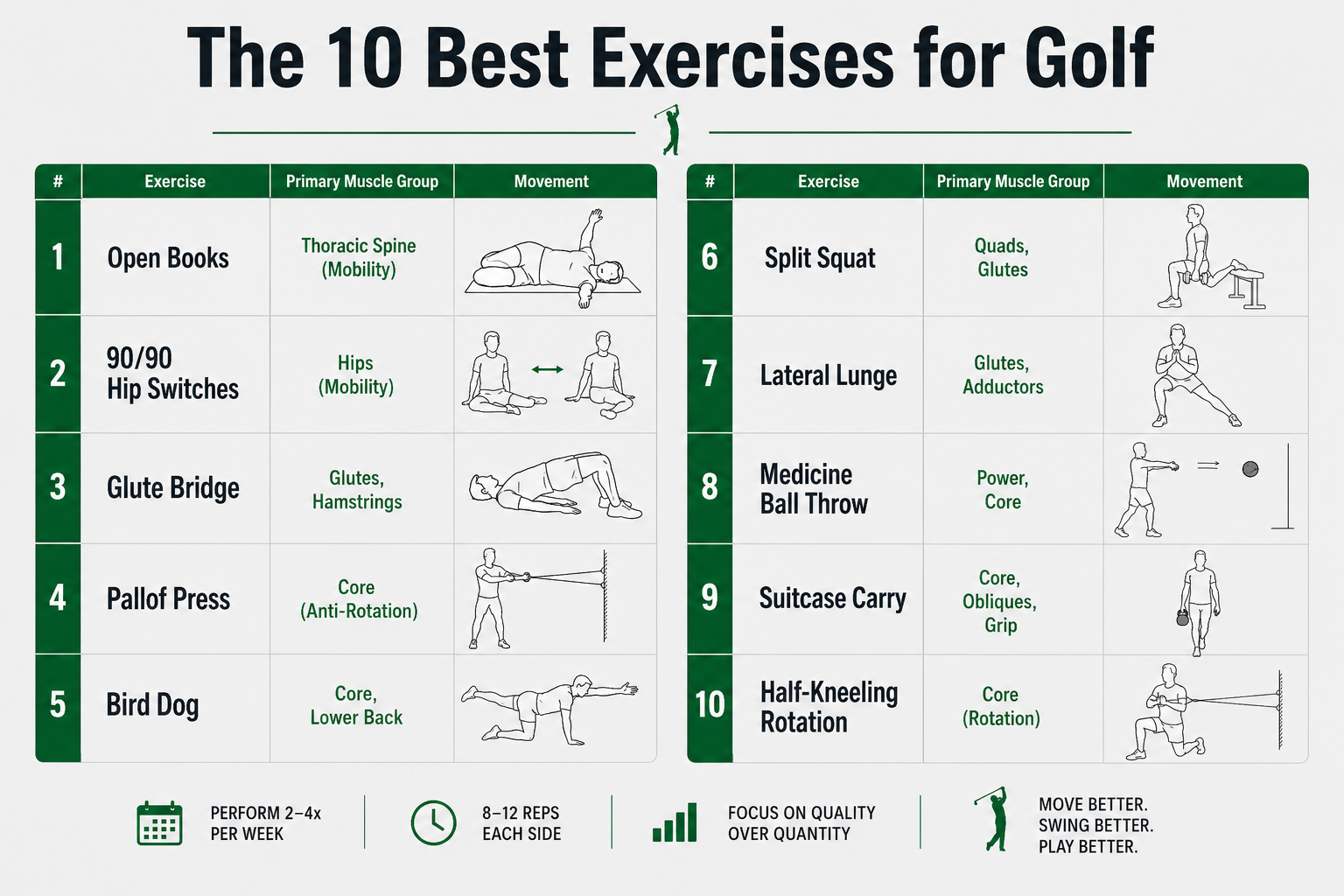
These 10 exercises represent the best exercises for golf when the goal is rotation, power, and back protection. They are ordered from mobility and stability foundations through to power development. For golfers over 45, that sequence matters — build the base before adding load or speed.
1. Open Books for Thoracic Rotation
What it trains: Thoracic spine rotation, chest opening, shoulder mobility.
Why it helps golf: Restricted upper-back rotation is one of the most common physical limitations in recreational golfers. Open books directly address this without loading the lower back.
How to do it: Lie on your side with knees bent to 90 degrees, arms extended in front of you. Keeping the knees stacked and still, slowly rotate the top arm open toward the floor behind you, following with your eyes. Hold two to three seconds. Return slowly.
Beginner modification: Place a foam roller or pillow between the knees to keep the hips stable.
Common mistake: Letting the hips roll back as the arm opens. The movement should come entirely from the upper back.
Sets and reps: 2 to 3 sets of 8 to 10 per side.
Joint-friendly note: No load, no impact. Suitable for most golfers over 45, including those with mild lower back sensitivity.
2. 90/90 Hip Switches for Hip Rotation
What it trains: Hip internal and external rotation, hip flexor length, glute engagement.
Why it helps golf: Hip rotation is the engine of the golf swing. Restricted hip rotation forces the lower back to compensate. The 90/90 position trains both internal and external rotation simultaneously.
How to do it: Sit on the floor with both legs bent to 90 degrees — one leg in front, one to the side. Keeping the torso tall, rotate both legs to switch sides, moving through the hips rather than collapsing at the waist.
Beginner modification: Use hands on the floor for support. Reduce the range of motion if there is hip discomfort.
Common mistake: Leaning the torso heavily to one side instead of rotating through the hips.
Sets and reps: 2 to 3 sets of 6 to 8 switches per side.
Joint-friendly note: Move within a comfortable range. If there is sharp hip discomfort, reduce range or consult a physiotherapist.
3. Half-Kneeling Thoracic Rotation
What it trains: Thoracic rotation under mild load, hip flexor length, core control.
Why it helps golf: The half-kneeling position locks out the lower back and forces the rotation to come from the thoracic spine. This is one of the most golf-specific mobility exercises available.
How to do it: Kneel on one knee, front foot flat on the floor. Place both hands behind your head. Rotate the upper body toward the front knee, then back. Keep the hips square and the lower back still.
Beginner modification: Hold a dowel rod or golf club across the shoulders to make the rotation more visible.
Common mistake: Rotating from the lower back or leaning forward. The hips should stay square throughout.
Sets and reps: 2 to 3 sets of 8 to 10 per side.
Joint-friendly note: Low load, high value. Well-tolerated by most golfers over 45.
4. Glute Bridges for Hip Extension and Back Support
What it trains: Glutes, hamstrings, posterior chain, lumbar stability.
Why it helps golf: Weak glutes are a common finding in golfers with lower back pain. Strong glutes support the pelvis during the swing and reduce the load on the lumbar spine. Glute exercises for golfers are often undervalued.
How to do it: Lie on your back, knees bent, feet flat on the floor. Press through the heels to lift the hips until the body forms a straight line from knees to shoulders. Squeeze the glutes at the top. Lower slowly.
Beginner modification: Reduce range of motion. Focus on the glute squeeze rather than height.
Common mistake: Pushing through the lower back rather than the glutes. If the lower back cramps, reduce the range.
Sets and reps: 2 to 3 sets of 10 to 15 reps.
Joint-friendly note: No spinal load. Excellent for golfers with lower back sensitivity.
5. Split Squats for Single-Leg Strength
What it trains: Quadriceps, glutes, hip flexors, single-leg stability.
Why it helps golf: The golf swing is a single-leg dominant movement at key points — particularly at impact. Single-leg strength and balance directly support swing stability and reduce knee and hip compensation.
How to do it: Stand in a staggered stance, one foot forward and one back. Lower the back knee toward the floor, keeping the front shin relatively vertical. Press back up through the front heel.
Beginner modification: Hold a wall or chair for balance. Reduce the depth of the lunge.
Common mistake: Letting the front knee collapse inward. Keep the knee tracking over the second toe.
Sets and reps: 2 to 3 sets of 8 to 10 per side.
Joint-friendly note: If there is knee pain, reduce depth and avoid pushing through discomfort. Consider a joint-friendly exercise approach if knee sensitivity is a concern.
6. Lateral Lunges for Hip Strength and Side-to-Side Control
What it trains: Hip abductors, adductors, glutes, inner thigh, frontal plane stability.
Why it helps golf: Most golf training focuses on the sagittal plane (forward and back). The lateral lunge trains the side-to-side hip control that supports the weight shift in the golf swing.
How to do it: Stand with feet together. Step one foot wide to the side, bend that knee, and sit the hips back and to the side. Keep the opposite leg straight. Push back to the start.
Beginner modification: Reduce the step width and depth. Hold a wall for balance.
Common mistake: Letting the torso collapse forward. Keep the chest up and the hips back.
Sets and reps: 2 to 3 sets of 8 to 10 per side.
Joint-friendly note: Move within a comfortable range. Avoid forcing the hip into a range that causes sharp discomfort.
7. Pallof Press for Anti-Rotation Core Stability
What it trains: Core stability, anti-rotation, obliques, transverse abdominis.
Why it helps golf: The Pallof press for golf is one of the most underused exercises in recreational golf fitness. The core’s primary job in the golf swing is not to rotate — it is to resist unwanted rotation and transfer force efficiently between the hips and upper body.
How to do it: Attach a resistance band to a fixed point at chest height. Stand side-on to the anchor, feet shoulder-width apart. Hold the band at your chest, then press it straight out in front of you. Hold two to three seconds. Return. The goal is to resist the band pulling you sideways.
Beginner modification: Stand closer to the anchor point to reduce resistance.
Common mistake: Rotating the torso toward the band. The goal is to stay completely square.
Sets and reps: 2 to 3 sets of 8 to 10 per side.
Joint-friendly note: No spinal compression. Suitable for most golfers over 45.
8. Bird Dog for Spinal Control
What it trains: Lumbar stability, glutes, shoulder stability, coordination.
Why it helps golf: The bird dog trains the ability to extend the hip and shoulder simultaneously while keeping the spine completely neutral. This mirrors the demand placed on the spine during the golf swing.
How to do it: Start on all fours, hands under shoulders, knees under hips. Extend one arm forward and the opposite leg back simultaneously, keeping the spine flat. Hold two to three seconds. Return slowly. Alternate sides.
Beginner modification: Extend the leg only, without the arm. Progress to the full movement when stable.
Common mistake: Rotating the hips or arching the lower back to reach higher. Keep the movement controlled and the spine neutral.
Sets and reps: 2 to 3 sets of 8 to 10 per side.
Joint-friendly note: Low load, high control. One of the most recommended lower back exercises for golfers.
9. Medicine Ball Rotational Throw for Golf Power
What it trains: Rotational power, hip-to-shoulder sequencing, explosive core engagement.
Why it helps golf: This is where the training shifts from building capacity to expressing it. Medicine ball exercises for golf are among the most direct ways to train the rotational power sequence that drives clubhead speed. The evidence is clear: combining strength work with golf-specific power drills produces greater gains in clubhead speed than strength training alone.
How to do it: Stand side-on to a solid wall, holding a light medicine ball (3 to 5 kg). Rotate away from the wall, loading the hips. Then drive the hips back toward the wall, let the torso follow, and throw the ball against the wall with controlled force. Catch and repeat.
Beginner modification: Use a lighter ball or perform the rotation without throwing — just practise the hip-first sequencing.
Common mistake: Throwing with the arms only. The power should come from the hip rotation, with the arms following.
Sets and reps: 2 to 3 sets of 5 to 8 per side. Quality over quantity.
Joint-friendly note: Start light. This is a power exercise, not a strength exercise — effort should be high but controlled.
10. Suitcase Carry for Core, Grip, and Posture
What it trains: Lateral core stability, grip strength, shoulder stability, postural endurance.
Why it helps golf: Carrying a weight in one hand forces the core to resist lateral bending — the same demand placed on the core during the follow-through of the golf swing. It also builds grip and forearm endurance relevant to club control.
How to do it: Hold a dumbbell or kettlebell in one hand at your side. Walk 20 to 30 metres with the torso tall, shoulders level, and core engaged. Do not let the loaded side drop or the torso lean.
Beginner modification: Use a lighter weight or a shorter distance.
Common mistake: Leaning away from the weight. The goal is to stay completely upright.
Sets and reps: 2 to 3 sets of 20 to 30 metres per side.
Joint-friendly note: Low impact, high value. Suitable for most ages and fitness levels.
Best Golf Warm-Up Before a Round
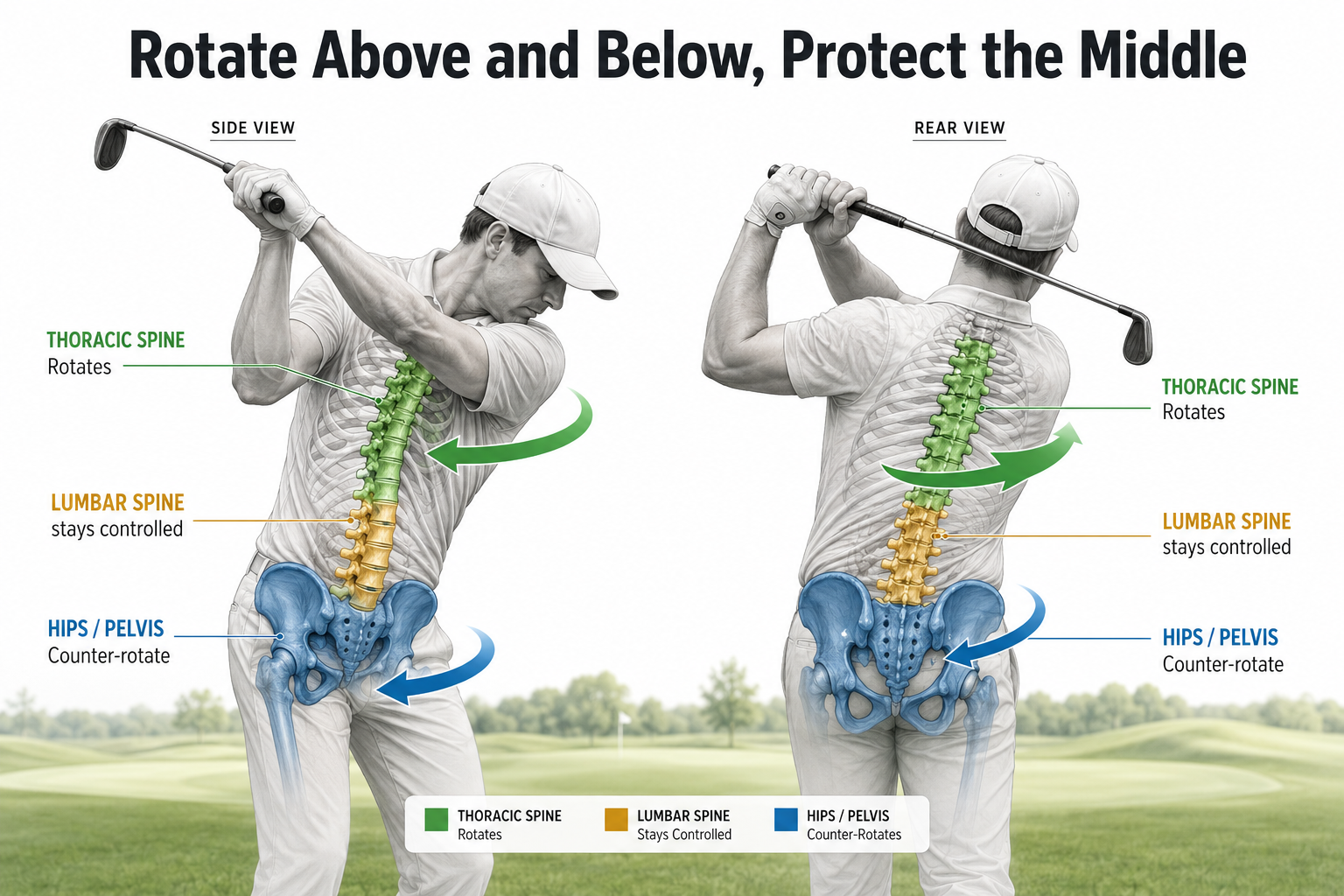
A five-minute dynamic warm-up before a round does more for your first-hole performance — and your back — than any amount of static stretching on the putting green. Golf warm-up exercises should raise tissue temperature, activate the glutes and core, and rehearse the rotation pattern before the first swing.
5-Minute Golf Warm-Up
| Step | Exercise | Duration |
|---|---|---|
| 1 | March in place or brisk walk | 60 seconds |
| 2 | Hip circles — both directions | 30 seconds each side |
| 3 | Open books or standing thoracic rotations | 8 to 10 reps per side |
| 4 | 90/90 hip switches or standing hip rotations | 6 to 8 per side |
| 5 | Bodyweight split squat or reverse lunge | 8 per side |
| 6 | Band Pallof press or light band rotation | 8 per side |
| 7 | Progressive practice swings — slow to full speed | 10 to 15 swings |
The key principle here is progression. Start slow, build range of motion, then build speed. Do not go from the car park to a full driver swing in two minutes. The lower back will notice.
How to Build a Simple Weekly Golf Exercise Routine
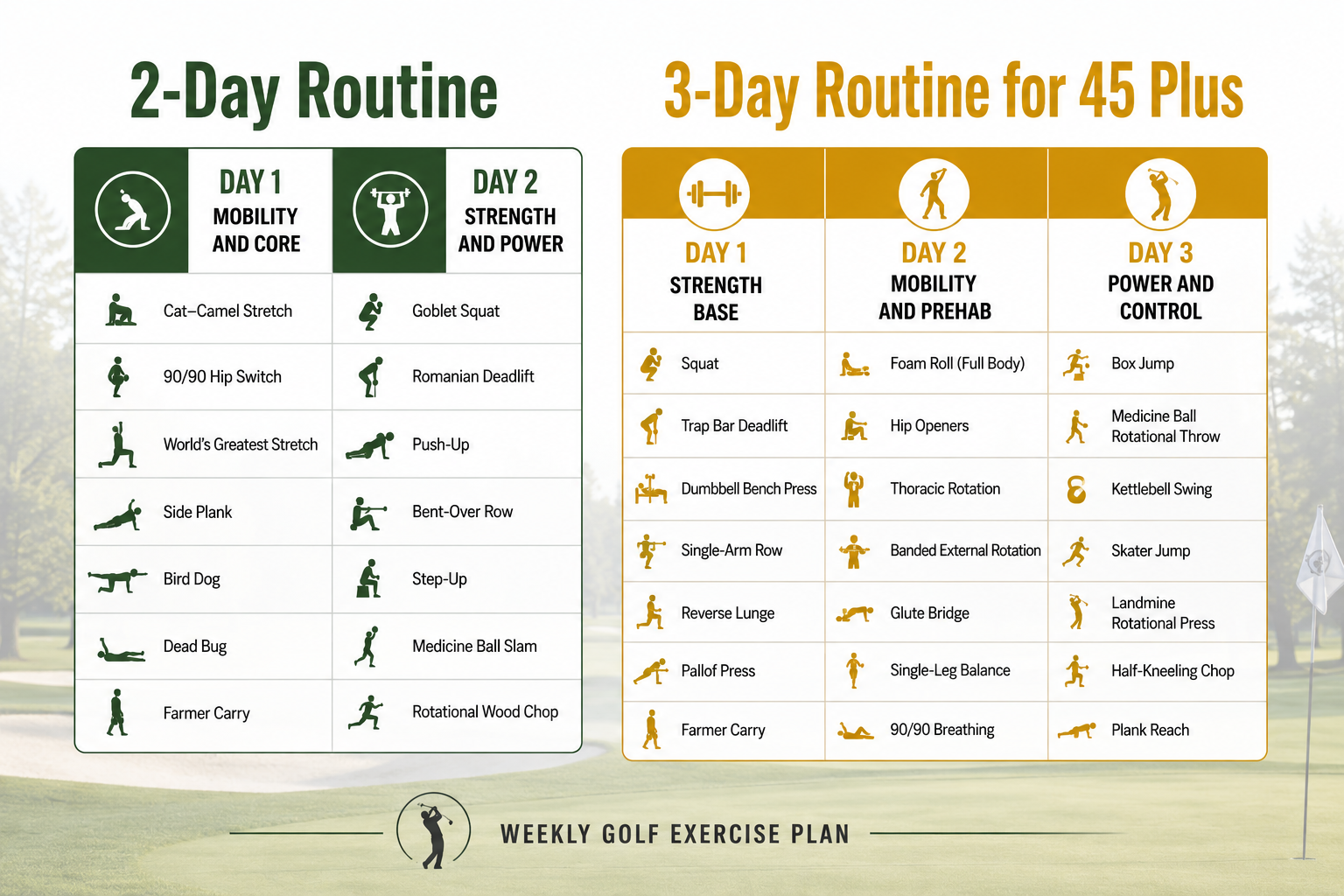
The evidence suggests that two to three sessions per week is the practical sweet spot for recreational golfers. More is not always better — recovery matters, particularly for golfers over 45.
Beginner-Friendly 2-Day Routine
Day 1 — Mobility and Core
- Open books: 3 x 10 per side
- 90/90 hip switches: 3 x 8 per side
- Glute bridge: 3 x 12
- Bird dog: 3 x 10 per side
- Pallof press: 2 x 10 per side
Day 2 — Strength and Power
- Split squat: 3 x 8 per side
- Lateral lunge: 3 x 8 per side
- Half-kneeling thoracic rotation: 2 x 10 per side
- Medicine ball rotational throw: 3 x 6 per side
- Suitcase carry: 2 x 25 metres per side
Better 3-Day Routine for Golfers Over 45
Day 1 — Strength Base
- Glute bridge or hip thrust: 3 x 12
- Split squat: 3 x 8 per side
- Lateral lunge: 3 x 10 per side
- Suitcase carry: 3 x 25 metres per side
Day 2 — Mobility and Prehab
- Open books: 3 x 10 per side
- 90/90 hip switches: 3 x 8 per side
- Half-kneeling thoracic rotation: 3 x 10 per side
- Bird dog: 3 x 10 per side
- Hip flexor stretch with glute squeeze: 2 x 30 seconds per side
Day 3 — Power and Control
- Medicine ball rotational throw: 3 x 6 per side
- Pallof press: 3 x 10 per side
- Split squat with added load: 3 x 8 per side
- Suitcase carry: 2 x 30 metres per side
For golfers who are newer to structured exercise, the guide to exercising safely over 50 provides a sensible starting framework before adding golf-specific work.
How Often Should Golfers Do These Exercises?
A sensible starting point is two sessions per week for the first four to six weeks. Add a third session once the movements feel comfortable and recovery is not an issue. During the playing season, one to two sessions per week is enough to maintain the gains built in the off-season.
Best Exercises for Golfers with Stiff Hips
Stiff hips are one of the most common physical findings in recreational golfers over 45. The result is predictable: the lower back compensates, the swing loses width, and the follow-through becomes restricted.
The exercises that help most are not passive stretches held for 30 seconds. Hip mobility for golf requires a combination of mobility work, strength in the new range, and motor control.
Most useful exercises for stiff hips:
- 90/90 hip switches — trains both internal and external rotation actively
- Hip flexor stretch with glute squeeze — lengthens the front of the hip while activating the glute
- Lateral lunge — builds strength through the side-to-side range
- Glute bridge — activates the posterior chain and supports hip extension
- Split squat — builds single-leg strength through the hip range
- Standing hip CARs (Controlled Articular Rotations) — slow, full-range hip circles that build joint awareness and active range
The key point is this: mobility without strength is not stable. If the hips can move into a new range but the muscles around them cannot control it, the nervous system will restrict that range during the swing anyway. Train mobility and strength together.
Best Core Exercises for Golf and Back Protection
Golf core exercises are frequently misunderstood. The core’s job in the golf swing is primarily to transfer force and resist unwanted movement — not to generate rotation. That distinction matters for how you train it.
Anti-Rotation Exercises
These train the core to resist being twisted — the most important core quality for back protection in golf.
- Pallof press — resists lateral pull through the core
- Suitcase carry — resists lateral bending under load
- Plank row — resists rotation while maintaining a plank position
Anti-Extension Exercises
These train the core to prevent the lower back from arching under load.
- Dead bug — arms and legs extend while the lower back stays flat on the floor
- Front plank — basic but effective when performed with full tension
- Stir-the-pot (advanced) — forearm plank on a stability ball with small circular movements
Controlled Rotation Exercises
These train the core to produce and manage rotation in a controlled pattern.
- Band chop — diagonal pulling movement from high to low
- Cable lift — diagonal pulling movement from low to high
- Medicine ball rotational throw — the most golf-specific of the three
A well-structured programme includes all three categories. Most recreational golfers over-rely on crunches and sit-ups, which do not train any of these qualities effectively for golf. For a broader look at effective exercise approaches, the exercise guide for better health covers the evidence on what actually works across different training goals.
Common Golf Exercise Mistakes to Avoid
Mistake 1 — Forcing Lower-Back Rotation
Trying to increase swing rotation by forcing the lower back to twist more is counterproductive and risky. The goal is more thoracic and hip rotation, not more lumbar rotation. Train the right joints.
Mistake 2 — Doing Only Stretches and No Strength Work
Stretching alone does not build the strength needed to use new ranges of motion under the load of a golf swing. Mobility work needs to be paired with strength training in the new range.
Mistake 3 — Chasing Swing Speed Before Control
There is no magic in adding speed to a movement pattern that is already compensating. Build control first — hip mobility, thoracic rotation, core stability — then add power training on top of that base.
Mistake 4 — Copying the Golf Swing with Heavy Bands or Cables
Heavy resistance band rotations that mimic the golf swing can reinforce poor mechanics and load the lower back in a compromised position. Rotational power exercises for golf should develop the physical qualities, not replicate the swing under load.
Mistake 5 — Ignoring the Lead Side
Most golfers train their trail side (right side for right-handers) because that is the side that feels dominant. The lead hip, lead glute, and lead shoulder are equally important for swing control and follow-through. Programme both sides equally.
Mistake 6 — Warming Up with Only a Few Practice Swings
Going from the car park to a full driver swing with two half-hearted practice swings is a common pattern and a common cause of early-round back tightness. The five-minute warm-up outlined above is not optional — it is the minimum.
Frequently Asked Questions
What are the best exercises for golf?
The best exercises for golf target hip rotation, thoracic spine mobility, core stability, glute strength, single-leg balance, and rotational power. The 10 exercises in this guide — including open books, 90/90 hip switches, glute bridges, Pallof press, bird dog, and medicine ball rotational throws — cover the key physical qualities golf demands.
What is the best exercise for golf rotation?
For thoracic rotation, open books and half-kneeling thoracic rotations are among the most effective. For hip rotation, 90/90 hip switches and lateral lunges are the most practical starting points. For combining both into power, the medicine ball rotational throw is the most golf-specific option.
What exercises help protect a golfer’s lower back?
Glute bridges, bird dog, Pallof press, suitcase carry, and dead bug are the most useful back exercises for golf. The goal is to build the strength and stability around the lower back so it does not have to compensate for restricted hips or a stiff upper back.
Are golf exercises good for seniors?
Yes. Senior golf fitness exercises are particularly important because hip mobility, thoracic rotation, and glute strength all tend to decline with age. The exercises in this guide are appropriate for most golfers over 50 and 60, with modifications available for those with joint sensitivity. Golf exercises for seniors should prioritise control and range of motion before adding load.
How many days per week should golfers exercise?
Two to three sessions per week is the practical recommendation for most recreational golfers. Two days is enough to build and maintain the key physical qualities. Three days allows for a more structured separation of mobility, strength, and power work.
Should golfers lift weights?
The evidence is clear on this. Strength training — including compound lifts, single-leg work, and loaded carries — improves clubhead speed, swing stability, and injury resilience. Golfers do not need to train like powerlifters, but progressive resistance training is a legitimate and well-supported part of golf fitness at any age.
Should golfers stretch before or after playing?
Dynamic mobility work — open books, hip rotations, split squats, progressive swings — belongs before a round. Static stretching, held for 30 or more seconds, is better suited to after a round or on recovery days. Static stretching before play does not improve performance and may temporarily reduce power output.
Can exercise prevent golf injuries?
Exercise can meaningfully reduce injury risk and improve the body’s readiness for the demands of golf. However, it cannot guarantee injury prevention. The 2024 systematic review data confirms that back pain risk in golf is associated with older age, prior back pain, and higher BMI — factors that exercise can partially address but not eliminate entirely.
Final Takeaway: Train Your Body to Rotate, Not Compensate
The main takeaway is this: golf power does not come from forcing more effort through the lower back. It comes from better sequencing — hips that can rotate freely, an upper back that can turn through its full range, a core that transfers force without leaking it, and a lower back that stays supported rather than strained.
The best exercises for golf are not complicated. They are consistent, progressive, and targeted at the physical qualities the swing actually demands. Open books, 90/90 hip switches, glute bridges, Pallof press, bird dog, split squats, lateral lunges, medicine ball throws, and suitcase carries — done two to three times per week — give most recreational golfers everything they need to move better, swing more efficiently, and stay on the course for longer.
Start with what gives the biggest return: hip mobility and thoracic rotation. Build the glute strength and core stability to support them. Then add rotational power on top of that base. Keep it simple and consistent, and the results will follow.
For a broader understanding of how sport-specific training principles apply across different activities, the complete guide to sport-specific training is a practical next step.
References
- Gosheger G, Liem D, Ludwig K, Greskötter B, Winkelmann W. Injuries and overuse syndromes in golf. American Journal of Sports Medicine. 2003;31(3):438–443. https://doi.org/10.1177/03635465030310032101
- Meira EP, Brumitt J. Minimizing injuries and enhancing performance in golf through training programs. Sports Health. 2012;4(6):465–470. PubMed record
- Gordon B, Moir G. Resistance training for performance and injury prevention in golf. Journal of the Canadian Chiropractic Association. 2005;49(3):162–172. Full article
Medical Disclaimer
This article is for general educational purposes only and is not medical advice. Exercise needs vary. Stop if a movement causes sharp or worsening pain, and seek individual advice from a qualified clinician or exercise professional when returning after injury, managing a condition, or unsure how to progress.

Dave James is a health researcher and writer specialising in evidence-based nutrition, exercise, and longevity. He founded All Perfect Health to provide clear, practical health guidance rooted in current research and real-world experience.
📂 The Complete Guide to Sport-Specific Training
This article is part of the APH cluster. Use the links below to move between the pillar and child articles.
- Read the pillar: The Complete Guide to Sport-Specific Training: How to Prepare Your Body for Any Activity (2026)
- → Hiking and Backpacking Fitness: Build Leg Endurance and Protect Your Joints on the Trail
- → Tennis and Pickleball Conditioning for Adults 50+: Agility, Shoulder Health, and Reaction Speed
- → Cycling Fitness: Build Leg Power, Core Stability, and Endurance on the Bike
- → Strength Training for Runners: Prevent Injury and Build Speed
- YOU ARE HERE Best Exercises for Golf: Rotation, Power, and Back Protection
- → 10 Best Exercises for Skiing: Build Strength, Balance, and Endurance Before You Hit the Slopes