
Dumbbell Exercises at Home: A Beginner Full-Body Workout
Last updated: September 2026
A pair of dumbbells and about twenty minutes, twice a week, is enough to meet the resistance-training guidance that major health bodies now recommend for adults of every age . That is the practical starting point. No machines, no gym membership, and no complicated program required. If you are over 40 and wondering whether dumbbell exercises at home can genuinely build useful strength, the answer is yes, provided you keep the approach simple, consistent, and matched to what your body can currently do.
This guide gives you a beginner full-body dumbbell workout built from a small number of well-supported moves. It is not a fat-loss plan, a body-transformation promise, or a substitute for individual medical advice. It is a sensible starting point for building strength safely at home, with reps and sets framed as adaptable guidance rather than a fixed prescription.
Readers who are starting without weights can begin with bodyweight strength training. If you are deciding what equipment to buy, see our home gym equipment guide; the broader Home Workout Routines guide explains how the pieces fit into a complete plan.
Quick Answer
Key Takeaways
- Two to three short sessions a week, covering all major muscle groups, aligns with current resistance-training guidance for adults .
- A single pair of adjustable dumbbells can cover a full-body routine without machines or a commercial gym .
- Reps and sets in this guide are adaptable starting points, not guarantees of a specific outcome or timeline.
- Controlled technique, steady breathing, and stopping short of pain matter more than lifting heavy early on .
- More volume is not automatically better; moderate, consistent training has produced meaningful results in research on older adults .
In this guide
Choosing a manageable starting load
Let’s keep this practical. The question people ask most often is not which exercises to do, but how heavy the dumbbells should be. In plain English, there is no single correct number in pounds or kilograms that fits everyone. What matters most is this: the weight should feel manageable for the first several repetitions and noticeably harder, without breaking form, by the last one or two .
This is sometimes called auto-regulated loading, and it has become the more common recommendation over fixed weight charts. Harvard Health’s summary of updated resistance-training guidance describes training with “as much effort as possible” within a set, typically for 2-3 sets of 8-10 repetitions, and capping most exercises at around four sets . That effort level is relative to you, not to a chart.
A sensible starting point for most beginners is a light-to-moderate pair of dumbbells for pressing and curling movements, and a slightly heavier pair for squat-pattern and hip-hinge movements, since the legs and hips are generally stronger than the arms and shoulders. If you only own one set of dumbbells, that is fine. The Everyday Health program for adults over 50 is built around a single pair used across the whole workout, with the load chosen so the last couple of repetitions feel genuinely challenging while form holds up .
A few practical checks:
- If you cannot complete eight repetitions with reasonable control, the weight is too heavy for that exercise today.
- If the exercise feels very easy, consider changing only one variable gradually after you can maintain consistent, controlled repetitions.
- If your back rounds, your knees cave inward, or you find yourself holding your breath, the weight is too heavy regardless of the rep count.
I would be careful with the instinct to grab the heaviest dumbbells in the house on day one. Context matters here. A person returning to exercise after years of inactivity, or managing joint discomfort, needs a different starting load than someone who lifted regularly a decade ago. Start conservatively. You can always reassess a load later; do not force a progression when technique, pain, balance, or recovery is a concern.
Warm-up and setup basics
The basics still do the heavy lifting, and a proper warm-up is one of the basics people skip most often. Five to ten minutes of easy movement before you touch a dumbbell prepares the joints and raises core temperature without tiring you out.
A simple warm-up sequence:
- March in place or step side to side for two minutes.
- Perform ten bodyweight squats at a comfortable depth.
- Do ten arm circles forward and ten backward.
- Perform ten standing hip hinges (hands on thighs, pushing hips back) without weight.
Setup matters just as much as warm-up. The British Heart Foundation’s home strength-training guidance highlights a few details that are easy to overlook: wear sturdy, flat shoes rather than socks or slippers for better balance, clear enough floor space to move your arms and legs freely in every direction, and keep water nearby, since dehydration can affect coordination and perceived effort . If you plan to do floor-based moves, an exercise mat adds comfort but is optional.
Breathing technique deserves specific mention. The recommended pattern is to exhale during the hardest part of the movement, the “effort phase,” and inhale as you return to the starting position. Holding your breath during a lift, sometimes called the Valsalva pattern, can spike blood pressure temporarily, which is a particular consideration for people with cardiovascular risk factors . If breathing, balance, or control becomes difficult, pause and reduce the effort rather than pushing through.
The beginner full-body dumbbell workout
Here’s the real issue with most home workout plans: they include too many exercises, so people either quit halfway through or rush the form to finish. This routine keeps the number of moves small and deliberately covers the major muscle groups your body uses every day, following the pattern reflected in reputable dumbbell exercise guides .
A sensible starting structure: 2-3 sets of 8-12 repetitions per exercise, resting 60-90 seconds between sets, two to three times per week on non-consecutive days. These numbers are adaptable starting points based on general guidance, not a guarantee of any particular outcome or timeline .
| Exercise | Primary area worked | Starting sets x reps |
|---|---|---|
| Goblet squat | Legs, hips, core | 2-3 x 8-12 |
| Bent-over row | Upper back, biceps | 2-3 x 8-12 |
| Standing overhead press | Shoulders, upper arms | 2-3 x 8-10 |
| Standing biceps curl | Front of upper arm | 2 x 10-12 |
| Standing overhead triceps extension | Back of upper arm | 2 x 10-12 |
| Glute bridge (dumbbell on hips, optional) | Glutes, lower back, core | 2-3 x 10-15 |
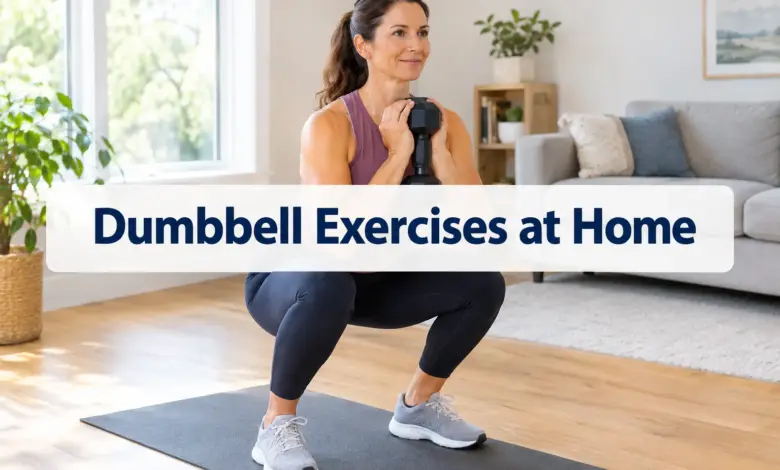
Goblet squat. Hold one dumbbell vertically against your chest with both hands. Stand with feet slightly wider than hip width, toes turned slightly out. Push your hips back and bend your knees to lower into a squat, keeping your chest tall, then push through your heels to stand.
Bent-over row. Holding a dumbbell in each hand, hinge forward from the hips with a soft bend in the knees and a flat back. Pull both dumbbells toward your ribs, squeezing your shoulder blades together, then lower with control.
Standing overhead press. Hold a dumbbell in each hand at shoulder height, palms facing forward. Press both dumbbells overhead without arching your lower back excessively, then lower back to shoulder height.
Standing biceps curl. Arms at your sides, palms facing forward, curl the dumbbells toward your shoulders without swinging your torso, then lower slowly.
Standing overhead triceps extension. Hold one dumbbell with both hands overhead, lower it behind your head by bending the elbows, then extend back to straight. Use a triceps variation only if the shoulder position and load are comfortable and controlled. It is not essential to include every arm exercise in a beginner session.
Glute bridge. Lie on your back, knees bent, feet flat. Rest a single dumbbell across your hip crease if comfortable, or start without weight. Push through your heels to lift your hips, squeeze the glutes at the top, then lower with control.
A session may be brief or longer depending on the movements, rest, experience, and recovery. A shorter, controlled session can be a practical way to start.
Exercise form notes and lower-impact substitutions
It is not that simple to say one exercise suits everyone, so here are adjustments for common limitations.
Knee discomfort during squats. Reduce the squat depth to a range that feels comfortable, or choose a non-loaded lower-body variation you can perform with control. Seek individual guidance for persistent knee pain.
Shoulder discomfort during overhead pressing. Substitute a front raise to shoulder height, or press only to the point where discomfort begins, rather than full lockout overhead.
Lower back sensitivity during bent-over rows. Reduce the range, load, or choose another familiar pulling variation if a bent-over position is uncomfortable. Avoid using household furniture as exercise equipment.
Balance concerns during standing exercises. Choose a lower-risk variation or seek individual guidance if balance is a concern. Do not rely on unstable furniture or improvised supports.
Wrist discomfort holding dumbbells. Try a neutral grip, where palms face each other, for pressing and curling movements, which is often more comfortable for people with wrist or elbow sensitivity.
Different equipment and movement variations can suit different people. Choose a variation you can control; a substitution is not automatically safer or equally effective for every goal or person.
How to progress safely over time
The main takeaway is this: progression should be gradual, and it does not need to be complicated. Once you can complete all prescribed sets and reps with good form and the final repetitions feel only moderately challenging, it is reasonable to make one small change, not several at once.
Options for progressing, applied one at a time:
- Add one more repetition per set until you reach the top of the range.
- Once at the top of the rep range comfortably, increase the load by the smallest available increment.
- Add a small amount of work only when it improves a familiar movement and your recovery supports it; more sets are not automatically better.
- Use a controlled tempo when it helps you maintain position; a slower lowering phase is one option, not a required progression.
More is not always better here. A 2024 analysis referenced by Harvard Health, looking at nearly 400 physically active older adults with an average age of 71, found that increasing training volume substantially did not produce proportionally greater strength or functional benefits compared with more moderate programs . The stronger evidence points toward consistency and gradual, modest increases rather than chasing higher volume for its own sake.
There is also a functional angle worth understanding. A 2024 randomized trial in older adults compared traditional resistance training with functional, task-specific training and found both produced meaningful strength gains, with the functional approach offering some advantage for everyday movement performance . Squats, rows, presses, and hip hinges, the core of this routine, mirror movements used in daily life, such as standing from a chair, carrying groceries, and reaching overhead.
Recovery, scheduling and realistic expectations
Build a schedule around how you recover, rather than applying a fixed number of hours or sessions to every person. A full-body routine can simplify planning, but its frequency and volume should be adjusted to the person and the movements involved.
Sleep, hydration, and basic protein intake through normal meals support recovery, though this article will not make specific claims about supplements, macros, or hormonal effects, since the evidence on individual variation in these areas is considerably more mixed than the evidence for the training itself.
On realistic expectations: strength, confidence, and comfort with a movement can change over time, but there is no reliable timeline for any individual. This article does not promise a specific pace of results, changes in body composition, or any effect on fat levels, hormones, or injury risk. That is a strong claim and needs strong proof that individual studies on general populations cannot responsibly provide for any one reader. Based on current evidence, what can be said with reasonable confidence is that consistent, moderate resistance training two to three times weekly is associated with meaningful strength and functional benefits across age groups .
When to stop, modify or seek individual advice
Clear beats clever, so here is the direct version: stop the exercise, not just the set, if you experience sharp or sudden pain, chest pain, unusual shortness of breath, dizziness, or joint pain that feels different from normal muscle fatigue. These are signals to pause and, depending on severity, seek medical evaluation rather than push through.
Modify rather than force a movement if you notice:
- Pain that lingers for more than a day or two after a session, rather than typical mild muscle soreness that fades within 24 to 72 hours.
- Numbness or tingling in an arm or leg during or after exercise.
- A noticeable loss of balance during standing exercises, even with support nearby.
- Joint clicking accompanied by pain, swelling, or reduced range of motion.
A sensible starting point before beginning any new resistance program is a conversation with a physician or physical therapist if you have a diagnosed cardiovascular condition, a recent surgery, uncontrolled blood pressure, osteoporosis, a joint replacement, or any condition where sudden exertion or increased blood pressure carries specific risk. This guide is educational and cannot account for your individual medical history, current medications, or physical limitations. Evidence first, always: general population research is useful for setting reasonable expectations, but it is not a substitute for advice tailored to your specific situation.
FAQ
How many dumbbell exercises should a beginner do at home?
A small number of familiar exercises can be enough for a full-body session. Choose only movements that fit your current ability, equipment, and available time.
What weight of dumbbells should I start with at home?
There is no universal number. A sensible approach is to pick a weight that feels manageable for the first several repetitions and noticeably challenging by the last one or two, adjusting separately for upper-body and lower-body movements .
How often should I do dumbbell exercises at home each week?
The suitable frequency varies with a person’s experience, health, other activity, and recovery. Begin with a manageable schedule and change it gradually when technique and recovery support that change.
Can dumbbell exercises at home replace gym training?
Dumbbells can support a range of beginner and intermediate strength work at home. Whether they meet a person’s needs depends on the movements, available load range, goals, and ability to use them safely.
Is it normal to feel sore after starting dumbbell exercises at home?
New activity can feel different from familiar activity, but sharp pain, joint pain, worsening symptoms, or concerns about a response to exercise are reasons to stop and seek individual guidance.
Do I need a bench for dumbbell exercises at home?
No. This routine uses standing and floor-based positions, so a bench is not required. A purpose-built bench may be useful for some exercises, but do not substitute unstable furniture.
Conclusion
The main takeaway is this: dumbbell exercises at home do not need to be complicated to be worthwhile. A small set of well-chosen moves, performed with reasonable effort two to three times a week, reflects the same core guidance that leading health organizations recommend for adults of nearly every age and fitness level . There is no magic in it, and there is no need to chase higher volumes, heavier loads, or faster timelines than your body is ready for.
A practical next step: pick one pair of dumbbells you already have or can borrow, set aside twenty minutes twice this week, and run through the six exercises above using the lighter end of the suggested rep ranges. Pay closer attention to form and breathing than to the number on the dumbbell. Once that feels manageable, apply one of the progression options described above, and only one, before your next check-in with yourself two to four weeks later. If you have a diagnosed health condition or specific concerns about pain or balance, bring this routine to a physician or physical therapist first and ask them to review it against your individual situation.
References
- Currier BS, D’Souza AC, Singh MAF, et al. American College of Sports Medicine Position Stand: Resistance Training Prescription for Muscle Function, Hypertrophy, and Physical Performance in Healthy Adults. Medicine & Science in Sports & Exercise. 2026;58(4):851–872.
- Garber CE, Blissmer B, Deschenes MR, et al. American College of Sports Medicine position stand: Quantity and quality of exercise for developing and maintaining fitness in apparently healthy adults. Medicine & Science in Sports & Exercise. 2011;43(7):1334–1359.
- Radaelli R, Rech A, Molinari T, et al. Effects of Resistance Training Volume on Physical Function, Lean Body Mass and Lower-Body Muscle Hypertrophy and Strength in Older Adults: A Systematic Review and Network Meta-analysis. Sports Medicine. 2025.
- Wewege MA, Desai I, Honey C, et al. The Effect of Resistance Training in Healthy Adults on Body Fat Percentage, Fat Mass and Visceral Fat: A Systematic Review and Meta-Analysis. Sports Medicine. 2022;52:287–300.
- Pelland JC, Remmert JF, Robinson ZP, et al. The Resistance Training Dose Response: Meta-Regressions Exploring the Effects of Weekly Volume and Frequency on Muscle Hypertrophy and Strength Gains. Sports Medicine. 2026;56:481–505.

About the author
Dave James is the writer and editor behind All Perfect Health. He is not a doctor; this guide is designed to help readers start conservatively, ask better questions, and avoid fitness hype.