
The Best Home Gym Equipment for Strength Training on Any Budget
Last updated: July 2026
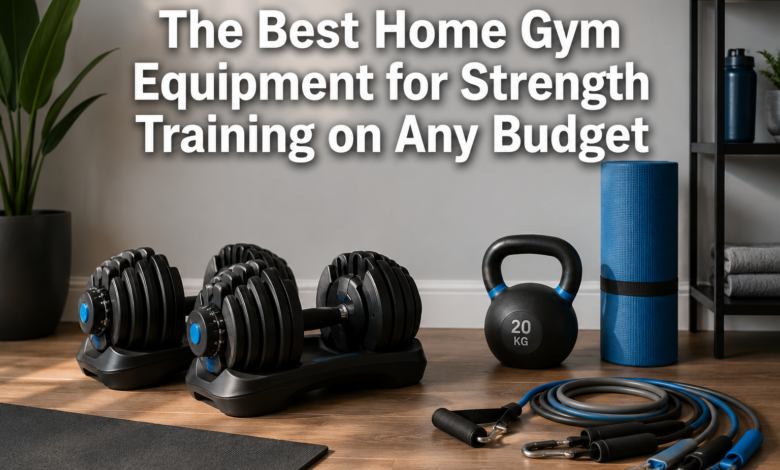
Start with the exercises you want to do, the space you can use, and a budget you can maintain. Some readers can begin with bodyweight training; others may benefit from one adjustable source of resistance. No fixed equipment bundle is necessary for everyone.
The real issue is not having the fanciest gear—it’s having the right tools that you’ll actually use consistently. Adults can choose equipment around real-world constraints: available space, budget, storage, prior experience, and movements they can perform with control. This article is part of our Home Workouts & Strength cluster, where we help you build an effective home workout space.
Different equipment serves different training needs. Consider which movements, loads, storage limits, and instructions fit the routine you actually plan to follow.
Key Takeaways
- Adjustable dumbbells can offer several load options in a compact footprint.
- Resistance bands are portable, but their setup and resistance need to suit the movement.
- A single kettlebell can support several familiar movements when its load and technique suit the reader.
- Start with the smallest setup that supports the movements you can perform safely and consistently.
- Choose equipment that solves a clear training or storage need rather than buying every possible tool.
In this guide
- Featured Video: Best Home Gym Equipment Strength
- What You Actually Need (And What You Don’t)
- Adjustable Dumbbells: When They Fit Your Routine
- Resistance Bands: Space, Setup, and Resistance
- Kettlebells: Exercise Goals and Load Selection
- Beyond the Basics: Pull-Up Bars, Benches, and Mats
- How to Start With Under $100
Expert insight: This video demonstrates proper form for exercises covered in this article, helping you get the most from every rep while avoiding common mistakes.
What You Actually Need (And What You Don’t)
Many home-gym plans assume more space and budget than readers have. You can begin with a smaller setup, then add equipment only when it solves a genuine training need.
Compound movements can be one useful part of a strength routine. The movement, range, load, and progression need to match the person and the equipment they can control.
Essential Equipment Categories:
- Primary resistance tools: Adjustable dumbbells or resistance bands
- Secondary tools: Kettlebell for dynamic movements
- Support equipment: Exercise mat, possibly a pull-up bar
What you can skip initially:
- Adjustable benches (floor exercises work fine)
- Multiple kettlebell weights (one moderate weight handles most needs)
- Specialized machines, unless they solve a clear need in your plan
- Olympic barbells (space and cost inefficient for most home setups)
Based on current evidence from exercise physiology research, muscle growth and strength gains depend more on consistent training with adequate resistance than on equipment variety. A sensible starting point is choosing tools that allow you to progressively challenge all major muscle groups.
Adjustable Dumbbells: When They Fit Your Routine
Adjustable dumbbells can be a compact option when you want multiple load settings. Check the stated load range, adjustment mechanism, storage needs, and the exercises you actually plan to do.
Why adjustable dumbbells work:
- Load options: A way to adjust resistance gradually for familiar movements
- Exercise variety: Upper body, lower body, and core training
- Unilateral training: A way to train one side at a time when it suits the movement
- Adjustability: Choose a load and range you can control
Lower-cost options:
Plate-loading dumbbells can be a simpler option. Check that collars, handles, and plates are compatible and secure before each use; consider floor protection and storage.
Quick-adjustment options:
Some systems change loads faster. Compare their stated load range, locking mechanism, warranty, replacement parts, and storage before choosing one.
Higher-capacity options:
A larger load range may suit an established program, but it is not necessary for every home setup. Choose based on your planned movements and available space.
Adjustable and fixed dumbbells each have trade-offs. Start with an option that fits the movements, loads, storage, and budget you can realistically maintain, then reassess as your routine develops.
Resistance Bands: Space, Setup, and Resistance
Resistance bands are a compact way to add resistance. Their tension changes through a movement, but that does not make them superior to free weights for every exercise or person.
The science behind bands:
Band tension generally increases as a band stretches. The challenge also depends on the exercise, leverage, and setup; bands are not automatically better for joints or muscle activation.
What a complete band system includes:
- Light, medium, and heavy resistance tubes
- Manufacturer-approved components for the exercises you plan to perform
- Ankle straps for lower body exercises
- Handles with comfortable grips
Exercise capabilities:
Bands can be used for a range of upper- and lower-body movements. Choose exercises and resistance you can perform with control, and avoid treating one setup as a replacement for every exercise.
Practical advantages:
- Travel-friendly: Maintain routines anywhere
- Setup: Check the intended exercises, compatible attachments, stretch limits, and replacement guidance
- Use: Choose resistance you can control; bands are not automatically suitable for a painful joint or rehabilitation program
Studies have found similar average strength improvements from elastic and conventional resistance in some settings. This does not mean bands are automatically gentler for a painful joint or suitable for every reader.
For more band-specific setup and programming ideas, see our resistance band workouts for strength guide.
Kettlebells: Exercise Goals and Load Selection
A kettlebell can be useful for some dynamic, full-body movements. It is not required for every home routine, and techniques such as swings or get-ups are best learned gradually with a manageable load.
Why kettlebells work differently:
Its off-center load changes how a movement feels and may require additional control. That does not guarantee greater overall strength development.
Essential kettlebell exercises:
- Kettlebell swings: Posterior chain power and cardio conditioning
- Goblet squats: A squat variation when the load and range are comfortable
- Turkish get-ups: Total-body coordination and stability
- Overhead presses: Shoulder strength and core stability
- Rows: A pulling variation when you can keep a controlled position
Weight selection:
Choose a load for the specific movement, not a sex-based chart. Begin with a range you can control and seek coaching before attempting technical or ballistic exercises with a heavier kettlebell.
If you choose a kettlebell, begin with one load that you can control for the movements you already know. The appropriate load varies substantially with the exercise, experience, and person.
Selection considerations:
Check the handle, base stability, finish, stated weight, and return policy. Choose a piece that can be stored safely and that suits movements you can already control.
Kettlebell training integrates perfectly with best home workouts without equipment for days when you want bodyweight-only sessions.
Beyond the Basics: Pull-Up Bars, Benches, and Mats
Once you’ve established a foundation with dumbbells, bands, or kettlebells, certain accessories can expand your exercise options significantly. The key is adding tools that fill genuine gaps rather than duplicating existing capabilities.
Pull-Up Bars: Essential for Back Development
A pull-up bar can add pulling options, but it is not essential for every home routine. Use only a bar rated for the installation surface and your intended use, installed exactly to its instructions; do not improvise a doorway, wall, or ceiling setup.
If a pull-up bar is not appropriate, choose a familiar pulling variation that does not require an external anchor.
Exercise Mats: Comfort and Safety
An exercise mat can make floor work more comfortable. Check that it lies flat, does not slide, and suits the exercises you plan to perform.
Adjustable Benches: Nice But Not Necessary
An adjustable bench can support some pressing and rowing variations, but it is optional. Use a purpose-built bench only if it is rated, stable, and appropriate for the exercise; many movements can also be performed standing or on the floor.
Storage Solutions
Safe storage keeps equipment accessible and reduces avoidable trip or handling risks. Choose storage that is stable, appropriately rated, and suited to the floor and wall surface.
The simplest way to look at accessories is this: buy them to solve specific problems, not because they seem useful. If you’re consistently doing floor exercises and experiencing discomfort, buy a mat. If you need additional pulling options, consider equipment only after confirming it can be installed and used safely.
How to Start With Under $100
A smaller home setup works best when it prioritizes a few movements you can perform well over a long list of purchases. These examples are criteria-led starting points, not price promises.
Option 1: Band-Based Start
- A band in good condition, used within its stated stretch limits
- An exercise mat if floor work is part of your plan
This option can support a limited set of familiar exercises when the band, anchor, and movement setup are appropriate. Add equipment only when it solves a training need your current setup does not meet.
Option 2: Kettlebell Start
- One kettlebell you can control for familiar movements
- An exercise mat if floor work is part of your plan
- One light band only if it serves a specific familiar exercise
This option combines a kettlebell with a light band for different familiar movements. Do not treat bands as rehabilitation equipment; choose exercises based on control, comfort, and appropriate guidance.
Option 3: Dumbbell Start
- One pair of dumbbells or an adjustable option with a secure mechanism
- An exercise mat if floor work is part of your plan
Focuses on traditional strength training with the most familiar equipment type. Dumbbells provide clear progression paths and exercise variety that most people understand intuitively.
Progression strategy:
Start with one approach and learn the movements before adding equipment. Reassess after several consistent sessions rather than buying more gear to solve a problem that technique, scheduling, or recovery may explain.
Buying checks: Compare the stated load rating, dimensions, assembly requirements, warranty, replacement parts, return terms, and whether the product can be stored safely in your space. Inspect used equipment for wear, instability, missing parts, or damage.
A basic setup can be enough to begin. Upgrade when a specific training need, load limit, or storage constraint makes the next piece useful.
FAQ
How much space do I need for a home gym?
The space you need depends on the movement, equipment, ceiling height, and clear path around you. Measure the actual exercise area and keep it free of furniture, pets, and trip hazards before using weights or moving dynamically.
Can I build muscle effectively with just resistance bands?
Elastic resistance can contribute to strength training, and studies have found similar average strength improvements to conventional resistance in some settings. Results depend on the exercise, resistance, total training, and person; do not assume one band setup suits every goal.
What’s the minimum effective dose for strength training at home?
The useful amount of strength work varies with a person’s starting point, health, goals, and the rest of their activity. Begin with a manageable schedule that allows good technique and recovery, then adjust gradually.
Should I buy used or new equipment?
Used equipment often provides excellent value, especially for basic items like kettlebells and weight plates. Inspect used items for wear, rust, or damage before purchasing. Resistance bands and mats are better purchased new for hygiene and reliability reasons.
How do I progress without adding more weight?
Progression occurs through multiple variables: increasing repetitions, adding sets, slowing movement tempo, reducing rest periods, or advancing to more challenging exercise variations. Single-leg exercises change balance, leverage, and loading demands; they do not precisely double the challenge.
What if I live in an apartment with noise restrictions?
Focus on rubber-coated equipment and exercise mats to minimize noise. Resistance bands are virtually silent. Avoid dropping weights or high-impact exercises during quiet hours. Most strength training exercises can be performed quietly with proper control.
Conclusion
A home setup does not need to be elaborate to support regular strength practice. Basic tools can be useful when the equipment, exercise choice, and progression fit the reader; they are not identical to every commercial gym setup.
Start with your budget and space constraints, then choose equipment that serves multiple functions. Whether you begin with bands, dumbbells, or bodyweight movements, prioritize a setup you can use consistently and safely.
Focus on compound movements that work multiple muscle groups, prioritize progressive overload through various methods, and remember that the best home gym equipment for strength training is the equipment you’ll actually use regularly. Progress depends on training, recovery, health, and the individual—not only on the tools you own.
Begin with one piece of equipment, master its applications, and expand based on actual needs rather than perceived limitations. The basics still do the heavy lifting when it comes to building strength at home.
References
- Featured video: Best Home Gym Equipment Strength. YouTube.
- Currier BS, D’Souza AC, Singh MAF, et al. American College of Sports Medicine Position Stand. Medicine & Science in Sports & Exercise. 2026;58(4):851–872.
- Schoenfeld BJ, Ogborn D, Krieger JW. Effects of resistance training frequency on measures of muscle hypertrophy: A systematic review and meta-analysis. Sports Medicine. 2016;46(11):1689–1697.
- Mañas A, Gómez-Redondo P, Valenzuela PL, et al. Unsupervised home-based resistance training for community-dwelling older adults: A systematic review and meta-analysis. Ageing Research Reviews. 2021;69:101368.
- U.S. Department of Health and Human Services. Physical Activity Guidelines for Americans, 2nd edition. 2018.
About the author
Dave James is the writer and editor behind All Perfect Health. He is not a doctor; this guide is designed to help readers start conservatively, ask better questions, and avoid fitness hype.