
Rowing Machine vs. Stationary Bike for Bad Knees: Joint Load & Zone 2 Comparison
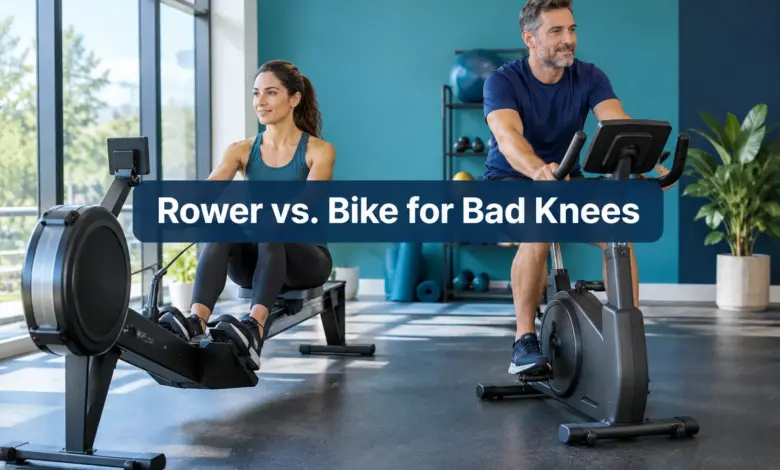
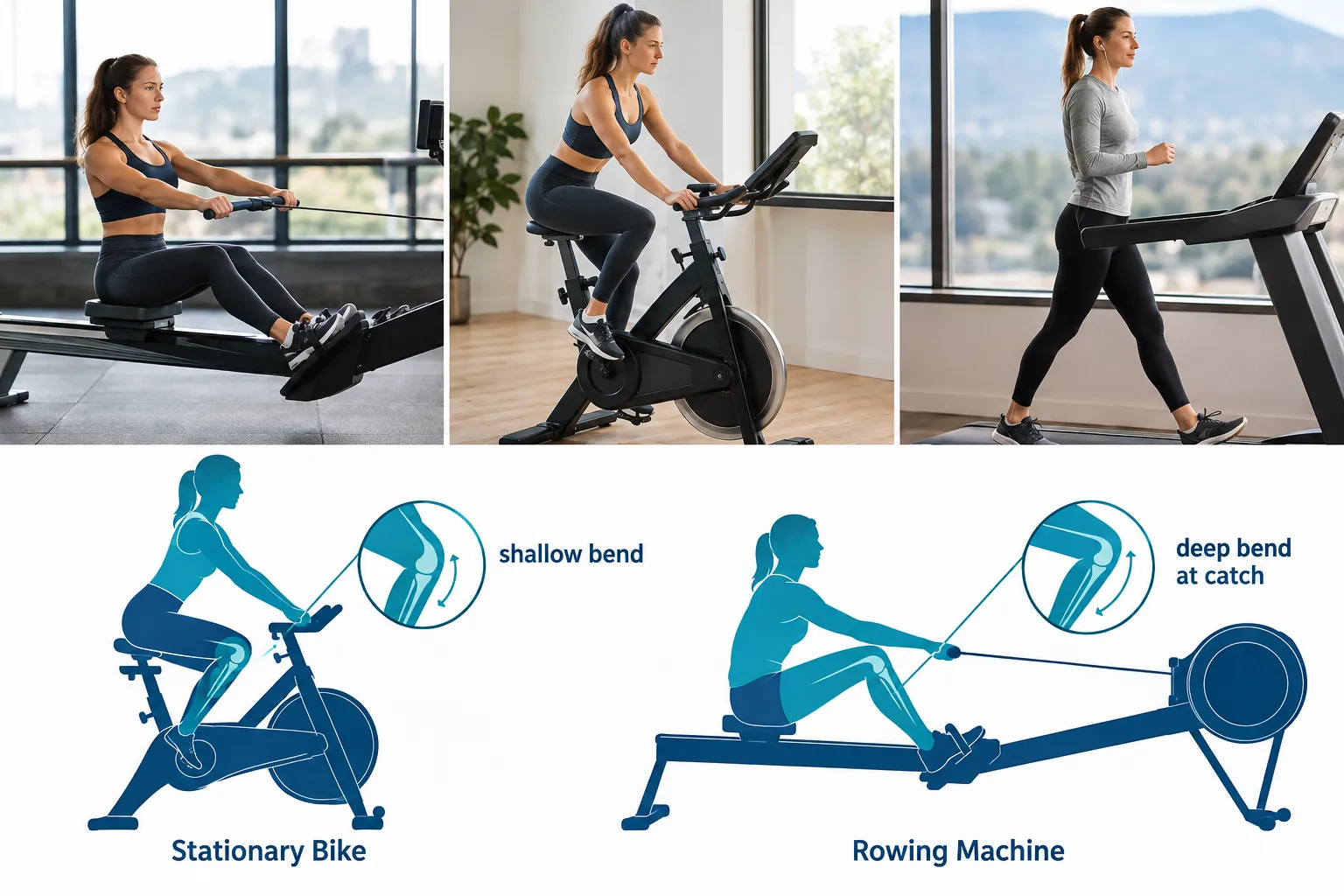
A rowing stroke can take a knee through roughly 90 to 130 degrees of bend. A pedal stroke on a stationary bike usually asks for something closer to 15 to 30 degrees.[1][2] That single number explains more about comfort than almost anything else in this comparison, and it is the real issue most people are trying to get at when they type “rowing machine vs stationary bike for bad knees” into a search bar.
Let’s keep this practical. Neither machine is a magic fix, and neither is guaranteed to feel good on a cranky knee. But both can be useful tools, and understanding why they load the knee differently will help you make a sensible, low-stakes decision rather than a guess.
Quick Answer
For most people with sensitive knees, a stationary bike is the easier machine to scale down and tolerate because it keeps knee bend shallow and lets you dial in resistance gradually. A rowing machine is also low-impact and can be a strong option for whole-body conditioning, but its deeper knee flexion means technique, pace, and individual tolerance matter more. Neither machine suits everyone, and the right pick depends on your knee, not a universal rule.
Key Takeaways
- Low impact is not the same as low load. Both machines avoid the ground-strike forces of running, but each still puts real, measurable force through the knee.[3][4]
- A stationary bike generally asks for a shallower knee bend, which makes it easier to tolerate for many people with front-of-knee sensitivity.[1][2]
- A rowing machine moves the knee through a deeper range and demands more technique awareness, but some measurements suggest it can produce slightly lower peak knee force than cycling when the stroke is controlled.[3][4]
- Zone 2 heart rate estimates like 60 to 70 percent of max are only rough starting points. Individual thresholds vary and should never be treated as a fixed prescription.
- There is no universal winner. The sensible approach is to test both, watch how your knee responds over several sessions, and adjust technique before swapping machines entirely.
Table of Contents
- What “Low Impact” Actually Means for Sensitive Knees
- Rowing vs. Cycling: The Practical Knee-Load Differences
- Which Is Easier for Sustainable Zone 2 Cardio?
- Setup and Technique Checks That May Improve Comfort
- Author Field Note: Why I Use Short Air-Rower HIIT Before Weights
- Choosing by Goal, Not by Self-Diagnosis
- When to Stop and Get Individual Guidance
- FAQ
What “Low Impact” Actually Means for Sensitive Knees
In plain English, “low impact” describes the absence of repeated ground-strike force. Running, jumping, and stair climbing send a jolt through the knee and ankle every time your foot lands. Cycling and rowing do not do that. Your body weight is supported by a seat, not slammed into a floor with every stride.
But here is where hype gets in the way. Low impact does not mean low load. Load is the ongoing compressive and shearing force moving through the joint while you pedal or row, even without any impact at all. A 2026 practical analysis measuring knee forces found a peak knee load around 85 percent of body weight on a rowing machine compared to about 103 percent on a stationary bike at 60 to 90 rpm, and roughly 205 percent during treadmill walking.[3] That tells us two things: both machines are considerably easier on the knee than walking, and the gap between rowing and cycling is smaller than most people assume.
We need to separate fact from hype here. A separate biomechanical comparison, originally run in 2013 and referenced in a 2026 update, found rowing produced the least mechanical stress on the knee among several common exercise modes, with cycling close behind.[4] That is a mechanism-level finding, not a guarantee of comfort for any individual knee. Laboratory averages describe groups. Your knee is not an average.
The practical takeaway: low impact machines reduce one kind of stress almost entirely, but they do not eliminate joint load, and individual anatomy, old injuries, and current inflammation all change how that load is experienced.
Rowing vs. Cycling: The Practical Knee-Load Differences
The simplest way to look at it is this: cycling asks for a small, repeated bend. Rowing asks for a bigger bend, repeated at a pace you control.
Range of motion, technique, and workload control
On a bike, the knee moves through a narrow arc with every pedal revolution. You can increase resistance or cadence without changing that arc much. On a rower, the knee folds deeply at the “catch” position, then extends fully as you drive the legs. That deeper flexion is where discomfort tends to show up for people with anterior knee pain, patellar sensitivity, or limited range of motion, even though the overall movement is still classified as low-impact.[1][4]
Why the bike can be simpler to scale
A stationary bike gives you several easy levers: saddle height, saddle fore-aft position, resistance level, and cadence. From a practical point of view, these are all small adjustments that change comfort without changing the fundamental movement pattern. Raising the seat slightly, for example, is a personal comfort adjustment that some people find reduces the feeling of deep knee bend. It is not a clinical fix, and fit varies from person to person, but the bike’s design makes experimentation low-risk and quick.[1][5]
Why rowing requires more technique awareness
Rowing is a more technical movement. Stroke length, catch depth, drag or resistance setting, and the sequencing of legs, hips, and arms all affect how much stress reaches the knee. A lower or moderate damper setting is sometimes described as a comfort adjustment some rowers prefer, but it should be understood as exactly that, a personal preference, not a protective setting that prevents injury.[1][4] Rowing technique also fatigues faster than pedaling technique, and fatigue often shows up as sloppier form, which can increase strain right when you are least likely to notice it.
In real-world terms, if you already row well and enjoy it, deeper flexion may not be a problem at all. If you are new to rowing or have a history of front-of-knee discomfort, that same range of motion is worth approaching cautiously and gradually.[2][4]
Which Is Easier for Sustainable Zone 2 Cardio?
Zone 2 cardio refers to a moderate, conversational intensity that most people can sustain for a longer period, often used to build aerobic base. The question of stationary bike vs rowing machine for zone 2 cardio comes up often, and the honest answer is: both can work, but they feel different to sustain.
Cycling’s steady, repetitive, low-amplitude movement makes it easy to settle into a consistent pace for 30 to 45 minutes. Rowing’s full-body demand means your arms, back, and core are working alongside your legs, which can raise your heart rate faster relative to perceived effort. That is not a flaw, it is simply a different kind of conditioning, and it is one reason rowing is often framed as a strong calorie-burning, whole-body option once a person’s knee tolerates the movement well.[4][6]
A practical, non-diagnostic way to judge intensity
The 60 to 70 percent of heart rate max formula is a common starting estimate for Zone 2, but I would be careful with that number. It is a population-level approximation, not an individual prescription. Some people’s genuine aerobic base sits closer to 55 percent, others closer to 75 percent, depending on fitness history, medications, and how the heart rate max was estimated in the first place.
A simpler, non-diagnostic gauge: you should be able to hold a conversation in short sentences without gasping. If you cannot speak in phrases, you are probably working harder than Zone 2. This talk-test approach works on either machine and does not require a heart rate strap or a formula that may not apply to you.
Setup and Technique Checks That May Improve Comfort
The basics still do the heavy lifting here, and most of them are inexpensive adjustments rather than new equipment.
On a stationary bike:
- Seat height so your knee has a slight bend at the bottom of the pedal stroke, adjusted by feel rather than a fixed formula
- Moderate resistance rather than high resistance at low cadence, which can increase joint stress
- A steady cadence you can hold for the full session without straining
On a rowing machine:
- A controlled catch position rather than forcing extra depth
- A hip-hinge that shares load with the back and legs, not just the knees
- A damper or resistance setting that feels sustainable for your current conditioning, understood purely as a comfort choice
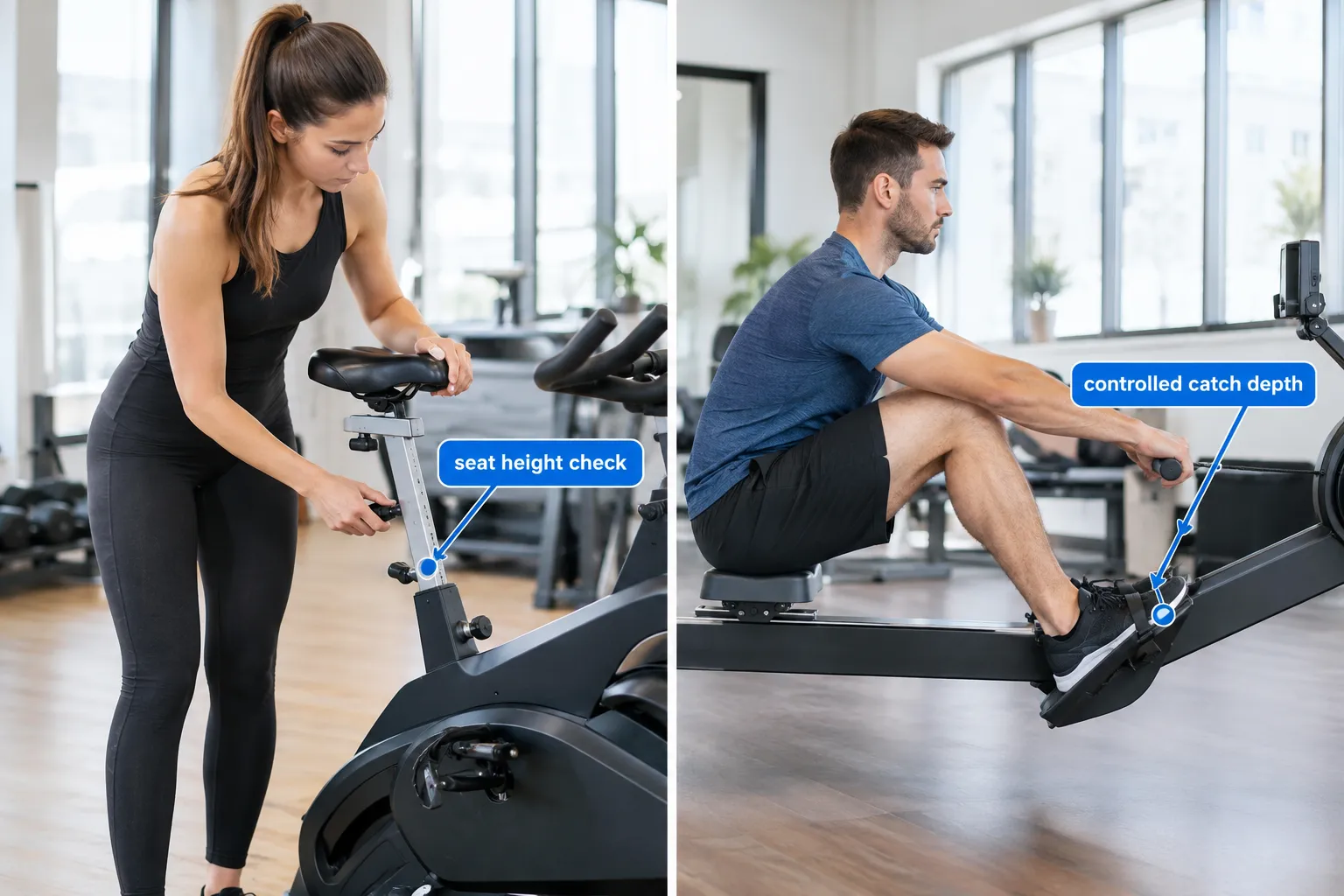
Keep it simple and consistent. Small, deliberate changes over several sessions tell you far more than switching machines every other day. If a specific adjustment consistently reduces discomfort, that is useful personal data. If nothing helps after a reasonable trial, that is also useful data, and it may be time for professional input rather than more self-experimentation.
Author Field Note: Why I Use Short Air-Rower HIIT Before Weights
I prefer short air-rower HIIT bursts before weights because they give me hard conditioning without the repeated ground impact of running, and they have felt kinder on my knees. That is one person’s experience, not medical advice, and it is not proof that rowing is safe or appropriate for every knee. My setup, technique, training history, and knee anatomy are specific to me. If you have knee pain, swelling, or a history of injury, your response to the same routine could be completely different, and that difference matters more than my personal preference.
Choosing by Goal, Not by Self-Diagnosis
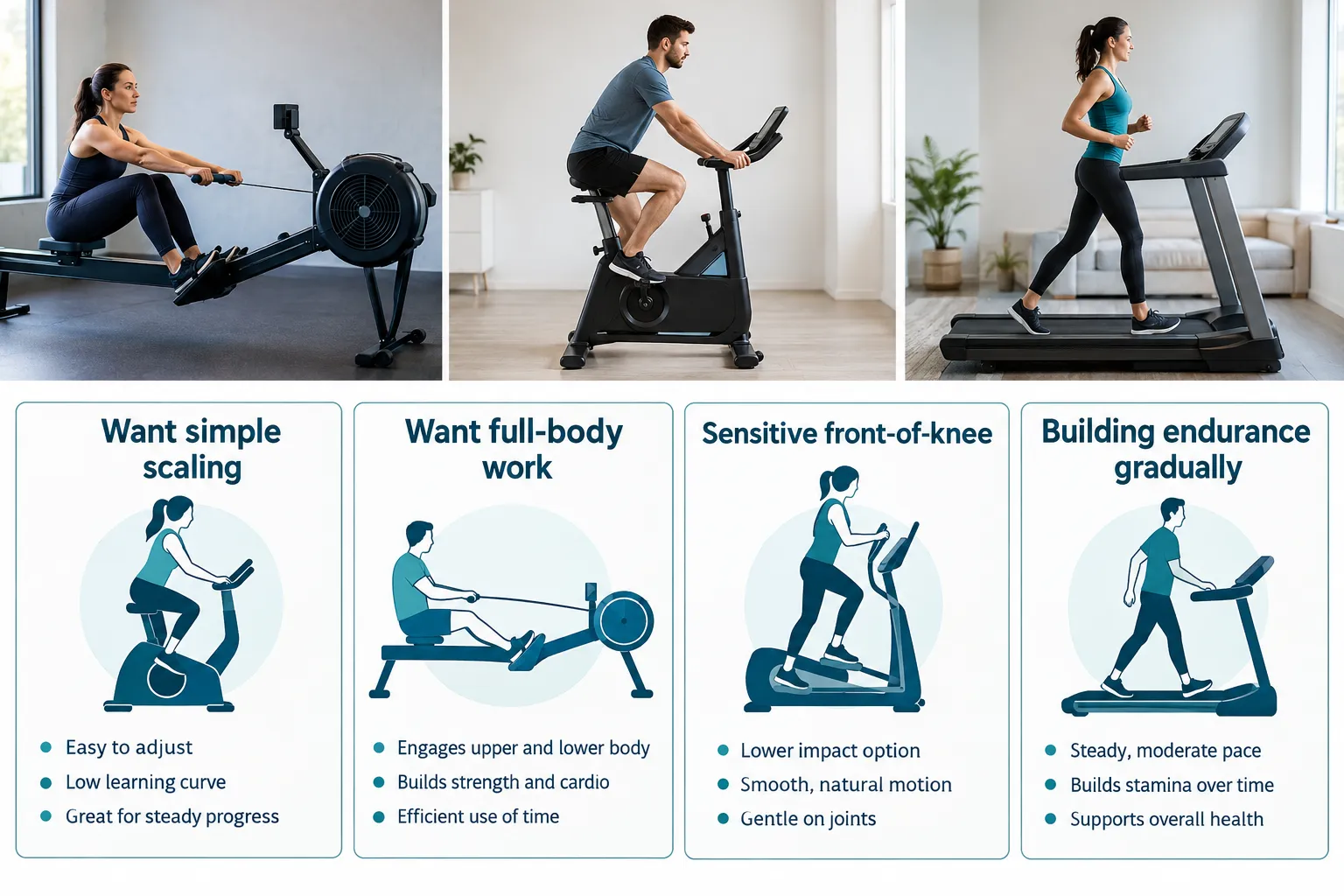
A sensible starting point is to think about your goal rather than guessing at what might be “wrong” with your knee. This is not a diagnostic tool, just a practical way to frame the decision.
| If your main goal is… | A reasonable starting point might be |
|---|---|
| Building aerobic base gradually, minimal joint stress | Stationary bike, moderate resistance, steady cadence |
| Whole-body conditioning alongside cardio | Rowing machine, controlled stroke, shorter sessions initially |
| Returning to exercise after time off | Stationary bike first, given its shallower range of motion and easier scaling |
| High-intensity interval work in short bursts | Either, depending on which movement you already tolerate well |
| Comfort is the main priority right now | Stationary or recumbent bike is commonly the more forgiving default[2][3] |
Context matters. None of these rows are a prescription. They are starting points to test, one variable at a time, while paying attention to how your knee actually responds, not how it is supposed to respond according to a chart.
Patient preference research backs up the general pattern here. A 2025 study in ACR Open Rheumatology, summarized in a 2026 review, found that among 349 people with knee osteoarthritis, indoor cycling was rated the most knee-friendly aerobic activity by 82 percent of respondents, with water exercise second.[3] That is a preference finding, not a biomechanical ranking, but it reflects something real: comfort and confidence matter as much as raw numbers.
When to Stop and Get Individual Guidance
The evidence suggests both machines are reasonable low-impact options for many people, but that does not mean either is safe to push through pain. Stop and speak with a qualified clinician or physical therapist if you notice:
- Sharp or sudden pain during or after a session
- Swelling that develops within hours of exercise
- A knee that locks, catches, or feels unstable
- A sensation of the knee “giving way”
- Any post-operative restriction that has not been specifically cleared for cycling or rowing by your surgical team
This article cannot tell you which machine to use after knee surgery, and it will not try to. That decision depends on the specific procedure, healing stage, and your surgeon or physical therapist’s direct assessment of your knee.[7][8]
FAQ
Is a rowing machine or stationary bike better for bad knees?
Neither is universally better. A stationary bike usually involves shallower knee flexion, which many people find easier to tolerate, while a rowing machine offers full-body conditioning but requires more technique and range of motion. The better option depends on your specific knee and comfort level.[1][2]
What is Zone 2 cardio, and does it matter which machine I use?
Zone 2 is a moderate, sustainable aerobic intensity, often estimated at 60 to 70 percent of heart rate max, though that figure is only a rough starting point. Both machines can support Zone 2 work; the better fit depends on which one you can sustain comfortably for 30 minutes or more.
Can a lower damper setting on a rowing machine protect my knees?
A lower or moderate damper is a personal comfort adjustment, not a clinical protection against injury. It may make the stroke feel easier to control, but it does not prevent patellar shear or guarantee pain relief.
Should I avoid rowing entirely if I have knee pain?
Not necessarily. Some people with knee sensitivity tolerate rowing well, especially with controlled technique and a shorter range of motion at the catch. Others find the deeper flexion uncomfortable. This is individual, and testing a short, cautious session is more informative than avoiding it outright without trying.[2][4]
Does low impact mean a machine is completely safe for arthritic knees?
No. Low impact reduces ground-strike force, but it does not eliminate joint load, and it does not treat arthritis or any other knee condition. Major health organizations list cycling and rowing as reasonable low-impact cardio options, not treatments.[7][8]
How long should I trial a machine before deciding it does not work for my knee?
There is no fixed number, but a sensible approach is several sessions over one to two weeks with consistent setup and technique, tracking how your knee feels during, immediately after, and the following day.
References
- Best Cardio Machine for Bad Knees. nordictrack.com.
- Best Exercise Machine for Bad Knees. techfitnesslab.com.
- Rowing Machine vs. Bike Bad Knee. dadstrengthdaily.com.
- Low Impact Cardio for Bad Knees. movetogetherfitness.com.
- Is Riding a Stationary Bike Bad for Knees. gymhike.com.
- Best Cardio Machine for Bad Knees. walkingpad.com.
- Low Impact Cardio. health.clevelandclinic.org.
- News Detail. hartfordhospital.org.
Medical Disclaimer
This article is for general informational purposes only and does not constitute medical advice, diagnosis, or treatment. It is not a substitute for individualized assessment by a qualified physician, physical therapist, or other healthcare provider. Always consult a qualified clinician before starting a new exercise program, especially if you have an existing knee condition, recent surgery, or persistent pain. Use of the information in this article is at your own discretion and risk.

About the author
Dave James has spent 30+ years reading health and longevity research and has run All Perfect Health for the past five. His background is in Australian mining and industrial engineering—disciplines built on questioning claims, measuring outcomes, and respecting evidence. He writes about what the research actually says, including where experts disagree. Dave is not a physician.
📂 Exercise & Mobility
This article is part of the APH exercise and mobility cluster. Use the links below to move between the pillar and related practical guides.
- Read the pillar: Exercise Guide for Better Health
- YOU ARE HERE Rowing Machine vs. Stationary Bike for Bad Knees: Joint Load & Zone 2 Comparison
- → Low Impact Cardio for Bad Knees and Hips: What Actually Works
- → Zone 2 Cardio: A Practical Beginner’s Guide to Steady Aerobic Training
- → Cycling Fitness: Build Leg Power, Core Stability, and Endurance on the Bike
- → HIIT Workouts: A Practical Guide to Short Intervals for Fitness
- → Best Exercise Bike for Knee Issues: A Complete 2026 Buying Guide