
Low Impact Cardio for Bad Knees and Hips: What Actually Works
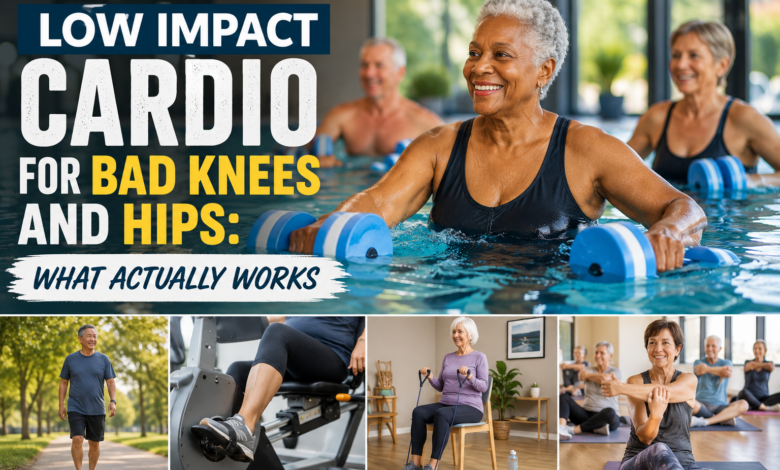
Roughly one in four adults over 50 lives with persistent knee or hip pain — yet most standard cardio advice is built for people with joints that still work without complaint. That gap matters. Because stopping cardio entirely is not the answer, and pushing through pain without a plan is not either. The good news is that low impact cardio for bad knees and hips is not a compromise. Done right, it is a legitimate, evidence-aware strategy that keeps your cardiovascular system working, supports healthy weight, and may actually reduce joint pain over time — not worsen it.
Let’s keep this practical from the start.
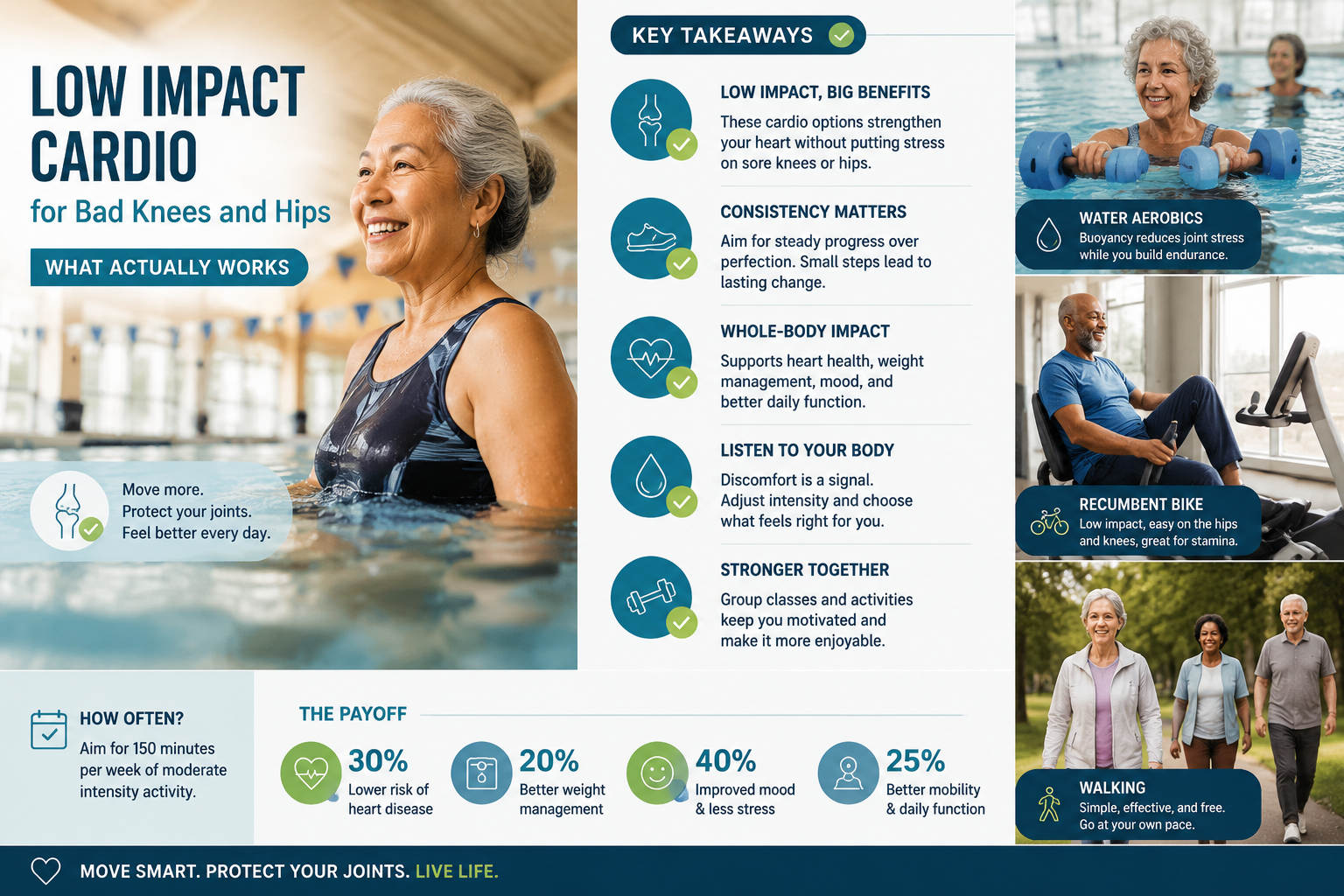
Table of Contents
Key Takeaways
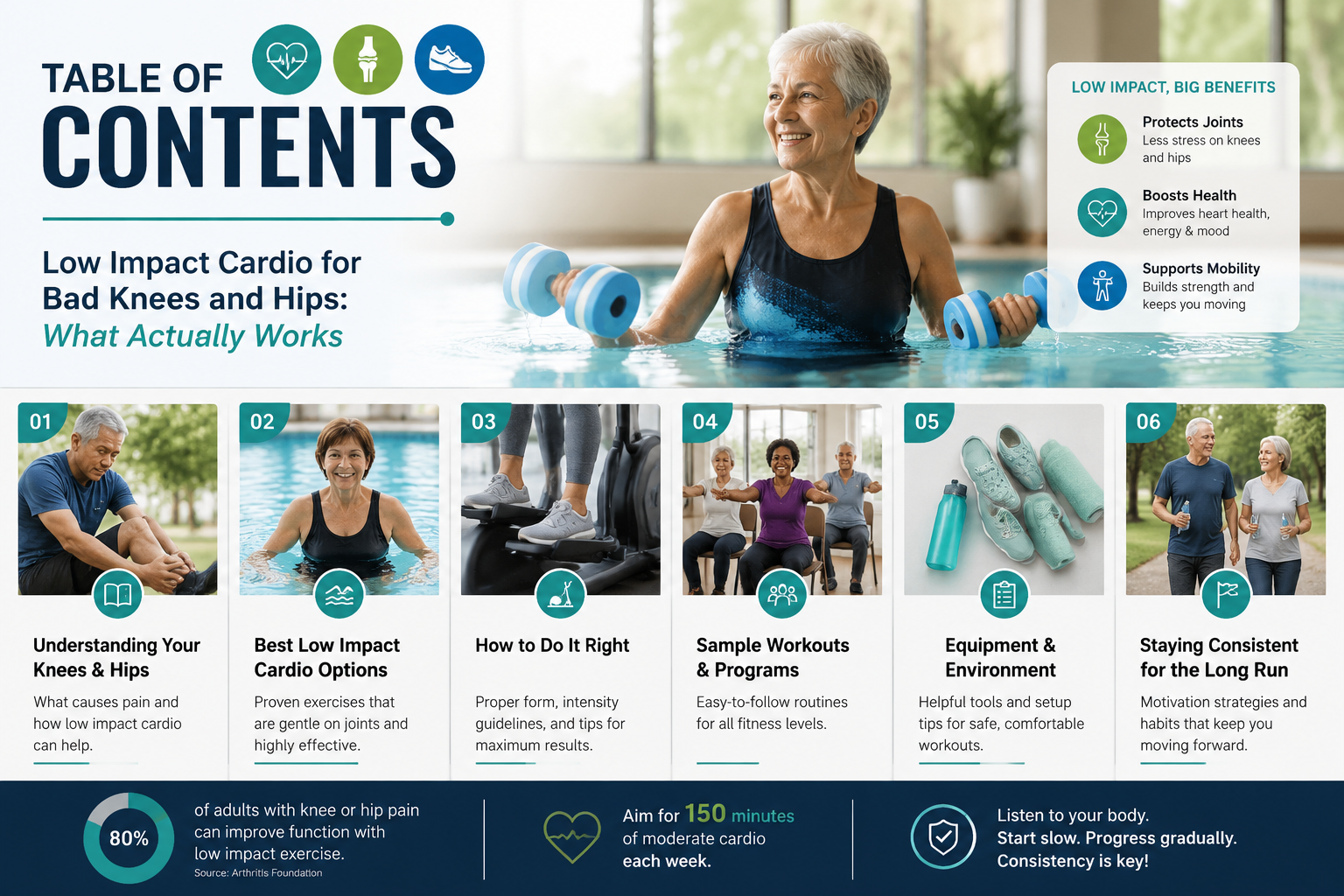
- Low impact cardio for bad knees and hips protects joints by reducing ground reaction forces while still delivering meaningful cardiovascular benefit.
- Swimming, cycling, water walking, and elliptical training are among the most evidence-supported options for people with knee or hip issues.
- Consistency matters more than intensity — short, regular sessions outperform occasional hard efforts for joint health and cardiovascular fitness.
- Warming up properly and avoiding sudden increases in duration or resistance reduces the risk of flare-ups.
- If pain increases during or after exercise, that is a signal worth taking seriously — consult a healthcare provider before continuing.
Why Joint-Friendly Cardio Is Not a Lesser Option
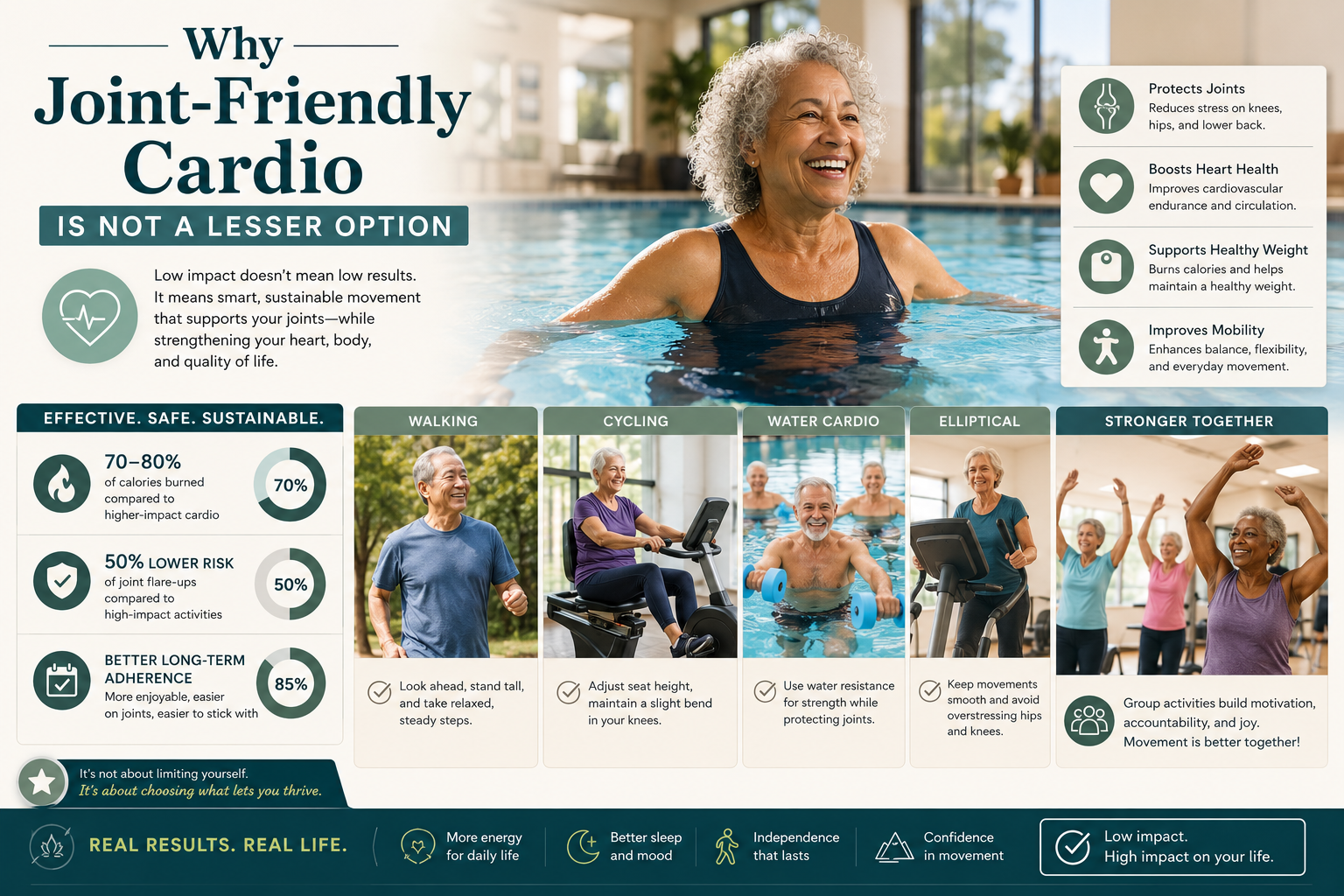
Here is the real issue with how most people think about exercise and joint pain: they treat low impact as low value. That is wrong, and the evidence says so clearly.
Impact, in exercise terms, refers to the force transmitted through your joints when your foot contacts the ground. Running, jumping, and even fast walking on hard surfaces generate forces two to five times your body weight through the knee and hip joints. For joints that are already inflamed, arthritic, or structurally compromised, that repeated loading is not neutral — it accelerates wear and increases pain signaling.
Low impact cardio reduces that force without eliminating movement. And movement, it turns out, is exactly what joints need. Cartilage in the knee and hip has no direct blood supply. It gets its nutrients through the compression and release of movement — a process called synovial fluid circulation. Staying sedentary starves cartilage. Gentle, consistent movement feeds it.
The evidence suggests that moderate aerobic exercise in people with knee osteoarthritis reduces pain scores, improves function, and supports weight management — all without accelerating joint damage. That is a strong finding, and it holds up across multiple independent reviews.
In plain English: moving less to protect your joints often makes things worse, not better. The goal is to find the right kind of movement.
“The strongest evidence for joint health in adults over 50 points not to rest, but to consistent, appropriately loaded movement.”
What matters most is this — low impact does not mean low effort or low benefit. It means smart loading. Your heart, lungs, and muscles respond to the cardiovascular demand regardless of whether your feet are pounding pavement or gliding on an elliptical.
The Best Low Impact Cardio Exercises for Bad Knees and Hips
Not all low impact options are equal. Some are better suited to specific conditions, body weights, or fitness levels. Here is a clear breakdown of what the stronger evidence points to.
Swimming and Water-Based Exercise
Water is the most joint-friendly environment you can exercise in. Buoyancy offloads up to 90% of your body weight, which means your knees and hips move through a full range of motion with almost no compressive load.
Swimming laps, water walking, and water aerobics all qualify. The resistance of water also provides enough muscular demand to build strength in the muscles surrounding the knee and hip — which matters, because stronger surrounding muscles reduce the load the joint itself has to absorb.
Who it suits best: People with moderate to severe joint pain, those recovering from joint replacement surgery (with medical clearance), and anyone carrying excess body weight that makes land-based exercise painful.
Practical note: You do not need to be a strong swimmer. Water walking in a chest-deep pool is effective and accessible. Many community pools offer structured aqua aerobics classes specifically for older adults.
Cycling (Stationary or Outdoor)
Stationary cycling is one of the most studied forms of low impact cardio for bad knees and hips. It provides consistent cardiovascular load with minimal joint impact, and the circular pedalling motion keeps the knee moving through a controlled range without the jarring of foot strike.
A few things matter with cycling:
- Seat height is critical. If the seat is too low, knee flexion at the top of the pedal stroke increases stress on the patellofemoral joint (the kneecap). A sensible starting point is to set the seat so your knee has a slight bend — around 25 to 30 degrees — at the bottom of the stroke.
- Resistance level should start low and increase gradually. High resistance with a slow cadence puts more torque through the knee than moderate resistance at a faster cadence.
- Recumbent bikes (where you sit back in a supported position) reduce hip flexor strain and may be more comfortable for people with hip pain or lower back issues.
Outdoor cycling is also effective, but road surface, hills, and traffic introduce variables that stationary cycling avoids. For people just starting out, a stationary bike is the more controllable option.
Elliptical Training
The elliptical trainer mimics the motion of walking and running but keeps your feet in contact with the pedals throughout — eliminating the impact of foot strike entirely. Research comparing treadmill walking to elliptical use consistently shows lower joint reaction forces on the elliptical, with comparable cardiovascular output.
The elliptical also engages the upper body if you use the handles actively, which increases total calorie burn without adding joint stress.
Caution: Some people with hip pain find the elliptical’s stride length uncomfortable. If it causes hip pinching or groin discomfort, adjust the stride length or try a different machine. Not every tool fits every body.
Walking on Soft Surfaces
Standard walking is not always low impact enough for people with significant knee or hip arthritis. But walking on grass, a rubberized track, or a treadmill with cushioning reduces ground reaction forces compared to concrete or tarmac.
Walking remains one of the most accessible and sustainable forms of cardio. The key is surface, footwear, and pace. Supportive footwear with adequate cushioning is not optional — it is functional. A physiotherapist or podiatrist can advise on orthotics if needed.
Short walks, done consistently, beat long walks done occasionally. A 20-minute walk five days per week delivers more joint-friendly benefit than a 60-minute walk once a week that leaves you sore for three days.
Rowing Machine
Rowing is underused by people with joint pain, partly because it looks intense. In reality, the rowing machine is almost entirely non-weight-bearing — your body is seated throughout, and the movement is a push-pull pattern that loads the hips in a controlled, supported way.
It is not ideal for people with acute hip pain or limited hip flexion, but for those with primarily knee issues, rowing is an excellent full-body cardiovascular option with very low knee joint stress.
| Exercise | Knee Impact | Hip Impact | Cardiovascular Load | Accessibility |
|---|---|---|---|---|
| Swimming | Very Low | Very Low | High | Moderate |
| Water Walking | Very Low | Very Low | Moderate | Moderate |
| Stationary Cycling | Low | Low-Moderate | High | High |
| Elliptical | Low | Low | High | High |
| Cushioned Walking | Low-Moderate | Low-Moderate | Moderate | Very High |
| Rowing Machine | Very Low | Moderate | High | Moderate |
How to Structure a Weekly Routine That Protects Your Joints
Context matters here. There is no single weekly structure that works for everyone. Age, current fitness level, severity of joint symptoms, and other health conditions all affect what is appropriate. That said, some general principles hold up well across the evidence.
Start Lower Than You Think You Need To
This is where most people go wrong. They feel motivated, start at a level that feels manageable in the moment, and then experience a pain flare two days later that sets them back a week. The numbers matter: a 10% increase in weekly exercise volume per week is a commonly used guideline for reducing overuse injury risk. That applies to people with joint pain too.
A sensible starting point for someone returning to cardio with knee or hip issues:
- Week 1-2: 15 to 20 minutes of low impact activity, 3 days per week, at a conversational pace
- Week 3-4: Increase to 25 minutes per session, or add a fourth day — not both
- Week 5 onward: Progress gradually toward 30 minutes, five days per week, as tolerated
Warm Up Before Every Session
Cold joints are less tolerant of load. A five-minute warm-up — gentle marching on the spot, slow cycling at zero resistance, or warm water immersion before pool exercise — increases synovial fluid viscosity and prepares the surrounding muscles to absorb load more effectively.
This is not optional. It is one of the highest-return habits in joint-friendly exercise.
Alternate Exercise Types
Doing the same motion every day can overload specific structures. Alternating between cycling, swimming, and walking, for example, distributes load across different movement patterns and reduces cumulative stress on any single joint surface.
Monitor the 24-Hour Rule
A useful practical rule: if your pain level is noticeably higher 24 hours after a session than it was before, the session was too intense or too long. That is not failure — it is information. Reduce duration or intensity at the next session and progress more slowly.
If pain consistently increases with any exercise, that is a signal to consult a physiotherapist or your healthcare provider before continuing.
Common Mistakes That Make Knee and Hip Pain Worse
Even well-intentioned exercise can backfire if a few key errors are made. These come up repeatedly in practice.
Skipping strength work entirely. Cardio alone does not build the muscle support that joints need. Gentle resistance exercises — particularly for the quadriceps, glutes, and hip abductors — reduce the load the joint itself absorbs during movement. This does not need to be heavy lifting. Bodyweight squats to a chair, resistance band clamshells, and seated leg extensions are enough to make a meaningful difference.
Choosing high-resistance cycling too early. High resistance at slow cadence increases torque through the knee significantly. Start with low resistance and a comfortable cadence (around 70-80 RPM) before adding any resistance.
Ignoring footwear. Worn-out shoes with no cushioning or support are a genuine problem for people with knee and hip pain on land-based exercise. Replace training shoes regularly — every 400 to 500 miles of use is a commonly cited guideline.
Exercising through sharp or worsening pain. There is a difference between mild muscle fatigue and joint pain. Mild discomfort that fades during warm-up is generally acceptable. Sharp, worsening, or swelling-associated pain is not. More is not always better — and pushing through joint pain is one of the clearest ways to make a manageable condition significantly worse.
Doing too much too soon. This is the most common mistake. Motivation is high at the start, discipline is low, and the result is a flare that kills momentum. Keep it simple and consistent. That beats heroic starts followed by forced rest every time.
FAQ
Can low impact cardio actually improve knee and hip pain, or does it just avoid making it worse?
The evidence suggests it can do both. Consistent, appropriately dosed low impact exercise has been shown to reduce pain and improve function in people with knee osteoarthritis. The mechanism includes improved muscle support around the joint, better synovial fluid circulation, and weight management — all of which reduce the load and inflammation in the joint. It is not that simple for every individual, but the overall direction of the evidence is positive.
How long before I notice improvement in joint pain from low impact cardio?
Most studies that show pain reduction in knee and hip conditions use intervention periods of six to twelve weeks. In real-world terms, many people notice some improvement in stiffness and function within three to four weeks of consistent exercise — but meaningful pain reduction typically takes longer. Patience and consistency matter more than intensity here.
Is swimming better than cycling for bad knees and hips?
Both are excellent options. Swimming has a slight edge for people with severe pain or significant body weight because buoyancy offloads the joint almost entirely. Cycling is more accessible for most people and easier to fit into a daily routine. From a practical point of view, the best option is the one you will actually do consistently.
Should I exercise on days when my joints are particularly painful?
It depends on the conditions. Mild background pain is generally not a reason to skip exercise — gentle movement often helps. But if you are experiencing a flare with significant swelling, heat, or sharp pain, rest is appropriate. A physiotherapist can help you establish a clear personal threshold. When in doubt, consult your healthcare provider.
Do I need special equipment to start low impact cardio for bad knees and hips?
Not necessarily. Cushioned walking shoes and access to a flat surface or a pool are enough to start. A stationary bike or elliptical trainer adds options but is not required. The basics still do the heavy lifting — consistency and appropriate progression matter far more than equipment.
Is it safe to do low impact cardio after a hip or knee replacement?
Many people return to low impact cardio after joint replacement, but timing and type of activity depend on the surgery, the surgeon’s guidance, and individual recovery. Swimming and cycling are commonly recommended post-replacement activities, but always follow your surgical team’s specific advice and get clearance before resuming exercise.
Conclusion
Low impact cardio for bad knees and hips is not a consolation prize. It is a well-supported, practical approach to staying cardiovascularly fit, managing weight, and — importantly — supporting joint health rather than undermining it. The evidence is consistent: appropriate movement helps, and inactivity tends to make things worse over time.
The main takeaway is straightforward. Choose activities that reduce joint loading — swimming, water walking, cycling, elliptical training — and build up gradually. Warm up every time. Monitor how your joints respond in the 24 hours after exercise. Add some basic strength work for the muscles around your knees and hips. And keep it simple and consistent rather than intense and sporadic.
If you are managing a diagnosed joint condition, recovering from surgery, or experiencing pain that is getting worse rather than better, work with a physiotherapist or your healthcare provider to build a plan that fits your specific situation. General guidance only goes so far — individual context matters.
For a broader look at how to build a sustainable fitness routine as you get older, the guide on how to exercise when you’re over 50 covers the full picture in practical, evidence-aware terms.
Looking for joint-friendly movement beyond cardio? The companion guide Yoga Modifications for Arthritis and Joint Pain covers adapted poses, props, and a gentle sequence.
Start where you are. Move within your tolerance. Progress slowly. There is no magic in it — just consistent effort applied in the right direction.
Back to cluster: Explore the full Joint-Friendly & Age-Specific Exercise hub for more practical guides, or browse all exercise articles.
References
These sources represent independent peer-reviewed research on low-impact exercise, joint health, and osteoarthritis management. PubMed and PMC links are provided where available.
- Bartels EM, et al. Aquatic exercise for the treatment of knee and hip osteoarthritis. Cochrane Database Syst Rev. 2016;(3):CD005523.
- Uthman OA, et al. Exercise for lower limb osteoarthritis: systematic review incorporating trial sequential analysis and network meta-analysis. BMJ. 2013;347:f5555.
- Fernandes L, et al. Efficacy of patient education and supervised exercise vs patient education alone in patients with hip dysplasia: a randomised clinical trial protocol. BMJ Open. 2020;10(10):e038753.
- Bennell KL, Hinman RS. A review of the clinical evidence for exercise in hip osteoarthritis. J Sci Med Sport. 2011;14(4):298-300.
- Wang SY, et al. Comparative efficacy of exercise therapy and oral non-steroidal anti-inflammatory drugs and paracetamol for knee or hip osteoarthritis: a network meta-analysis. Sports Med. 2021;51(8):1669-1679.
📂 Joint-Friendly & Age-Specific Exercise
A practical reader path through the over-50 exercise cluster.
- Pillar: How to Exercise When You’re Over 50
- → Strength Training for Women Over 50: A Beginner Plan for Home or Gym
- → Weight-Bearing Exercises for Bone Health
- → What Is Tai Chi? A Beginner’s Guide to the Practice and How to Start
- YOU ARE HERE Low Impact Cardio for Bad Knees and Hips: What Actually Works
- → Yoga Modifications for Arthritis and Joint Pain: A Practical Guide That Actually Works
- → Resistance Band Training for Joint Health: What the Evidence Actually Shows
- → Returning to Exercise After Joint Surgery: A Practical, Evidence-Aware Guide
- → Balance and Fall Prevention Exercises for Seniors: A Practical, Evidence-Aware Guide
- → Best Exercise Bike for Knee Issues: A Complete 2026 Buying Guide