
Returning to Exercise After Joint Surgery: A Practical, Evidence-Aware Guide
Most people who undergo joint surgery are given a discharge sheet, a follow-up appointment date, and a vague instruction to “take it easy.” What they rarely get is a clear, honest answer to the question that matters most: when and how do I actually start moving again?
Returning to exercise after joint surgery is one of the most important — and most mismanaged — parts of the recovery process. Done too soon or too aggressively, it risks setbacks that can set you back months. Done too slowly or with too much caution, it allows muscle loss, joint stiffness, and loss of confidence to take hold. Neither outcome serves you well.
This guide is written for adults who want a grounded, practical understanding of how post-surgical rehabilitation actually works, what the evidence supports, and how to build back physical capacity without making costly mistakes.
Table of Contents
- Why the Recovery Window Matters More Than Most People Think
- What Actually Happens to Your Body After Joint Surgery
- The Phases of Returning to Exercise After Joint Surgery
- Building Strength Without Overloading the Joint
- Nutrition and Lifestyle Factors That Support Recovery
- Common Mistakes When Returning to Exercise After Joint Surgery
- When to Push, When to Rest, and When to Ask for Help
- FAQ
- Conclusion
Key Takeaways
- There is no universal timeline for returning to exercise after joint surgery — the right pace depends on the type of surgery, your pre-surgical fitness, age, and how your body responds.
- Muscle loss begins within days of surgery and immobility; early, gentle movement is generally protective, not harmful.
- Pain is a useful signal but not always a reliable guide — working with a physiotherapist matters more than self-managing by feel alone.
- Nutrition, sleep, and stress management are not secondary concerns — they directly influence how fast tissue heals.
- The goal is not to return to exercise as quickly as possible, but to return in a way that holds.
Why the Recovery Window Matters More Than Most People Think
The period immediately following joint surgery is not simply a waiting room before real life resumes. It is an active biological process — one that responds directly to the inputs you give it.
Here is the real issue: most people either underestimate how much their body needs structured support during this window, or they overestimate how quickly they can return to normal activity. Both errors are understandable. Neither is harmless.
Joint surgeries — whether that is a total knee replacement, hip replacement, shoulder reconstruction, or arthroscopic repair — all involve deliberate disruption of tissue. Bone, cartilage, tendon, and muscle are cut, repositioned, or removed. The body’s repair response is predictable in its phases but variable in its pace. That pace is influenced by age, pre-surgical fitness, the complexity of the procedure, and how well the recovery period is managed.
For adults over 45, this matters more than it does for younger patients. Muscle protein synthesis — the process by which the body rebuilds muscle tissue — slows with age. The anabolic response to exercise and nutrition is blunted compared to a 25-year-old. That does not mean recovery is impossible or even dramatically slower, but it does mean that the basics need to be in place and consistent.
The evidence suggests that structured rehabilitation, started early and progressed carefully, produces better long-term outcomes than either extended rest or premature return to full activity. This is not a controversial claim. It is the foundation of modern orthopaedic rehabilitation.
Let’s keep this practical: the goal of this guide is not to replace your physiotherapist or surgeon. It is to help you understand the process well enough to engage with it actively, ask better questions, and make more informed decisions.
What Actually Happens to Your Body After Joint Surgery
Understanding the biology of recovery makes the rehabilitation process less mysterious and easier to follow.
Inflammation phase (Days 1-5 approximately)
Immediately after surgery, the body mounts an inflammatory response. This is not a problem to suppress entirely — it is the first stage of healing. Swelling, warmth, and pain are normal signals. The goal here is to manage inflammation, not eliminate it. Excessive anti-inflammatory medication use in this phase may actually slow tissue repair, though this is an area where you should follow your surgeon’s specific guidance.
Proliferation phase (Days 5 to approximately 6 weeks)
New tissue begins to form. Collagen is laid down. Capillaries regrow. This is the phase where gentle movement becomes valuable — it helps orient new collagen fibres along lines of mechanical stress, which improves the functional quality of the healing tissue. Immobility during this phase can lead to disorganised scar tissue and reduced joint mobility.
Remodelling phase (6 weeks to 12+ months)
The new tissue matures and strengthens in response to load. This is the longest phase and the one most people underestimate. The joint may feel functional well before it is fully remodelled. This is why premature return to high-impact activity is risky even when pain has largely resolved.
In plain English: the absence of pain does not mean the tissue is ready for full load. The remodelling phase takes time regardless of how good you feel.
The Phases of Returning to Exercise After Joint Surgery
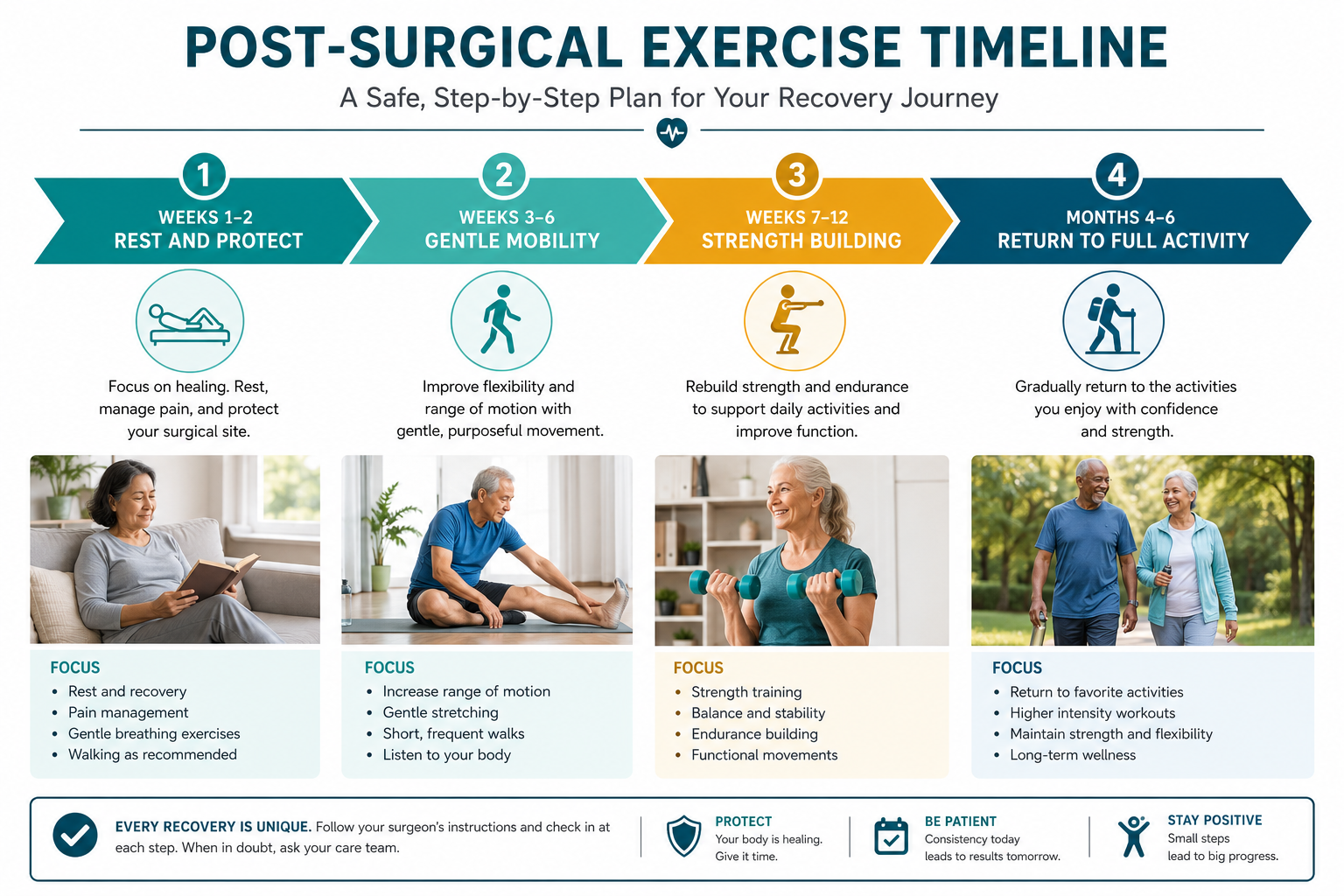
There is no single timeline that applies to every surgery or every person. What follows is a general framework based on common orthopaedic rehabilitation principles. Always work within the specific guidance provided by your surgical and physiotherapy team.
Phase 1: Protection and Early Mobility (Weeks 1-2)
The primary goal here is to protect the surgical repair while preventing the worst effects of immobility.
- Gentle range-of-motion exercises as directed by your physiotherapist
- Isometric contractions (muscle activation without joint movement) to slow muscle loss
- Circulation exercises to reduce clot risk
- Ice, elevation, and compression as directed to manage swelling
What to avoid: Any loading or movement that strains the surgical repair. This varies significantly by procedure — a hip replacement has very different restrictions than a shoulder reconstruction.
Phase 2: Controlled Loading and Range of Motion (Weeks 3-6)
As healing progresses, the focus shifts to restoring joint mobility and beginning gentle loading.
- Progressive range-of-motion work
- Partial weight-bearing exercises (for lower limb surgery)
- Light resistance work targeting muscles around the joint
- Hydrotherapy or pool-based exercise where appropriate — water reduces load while allowing movement
Phase 3: Strength and Functional Movement (Weeks 6-12)
This is where structured strength training becomes central. The muscles surrounding the joint need to be rebuilt to protect and support it.
- Resistance training targeting the major muscle groups around the affected joint
- Balance and proprioception exercises — often overlooked but critical for joint stability
- Gradual return to daily functional movements: stairs, walking on uneven ground, carrying moderate loads
Phase 4: Return to Activity (Months 3-6 and Beyond)
For most adults, this is where returning to exercise after joint surgery means resuming the activities they actually care about — walking, swimming, cycling, gym work, or recreational sport.
The stronger evidence points to a gradual, progressive return rather than a sudden resumption. A sensible starting point is to begin at roughly 50-60% of your pre-surgical activity level and increase by no more than 10% per week.
| Activity Type | Typical Return Timeline | Notes |
|---|---|---|
| Walking (flat surfaces) | 2-6 weeks | Varies by surgery type |
| Swimming | 6-10 weeks | Once wound fully healed |
| Cycling (stationary) | 4-8 weeks | Low-impact, good early option |
| Resistance training | 6-12 weeks | Start with low load, high supervision |
| Running | 3-6 months | Hip/knee surgery — longer timeline |
| High-impact sport | 6-12 months | Requires full clearance |
Building Strength Without Overloading the Joint
One of the most common errors in post-surgical recovery is the assumption that strength training must wait until the joint is fully healed. The evidence does not support this. Controlled, progressive resistance exercise — started at appropriate loads and progressed carefully — is one of the most effective tools available for restoring function after joint surgery.
The key word is controlled. More is not always better. The goal is to apply enough mechanical stimulus to drive adaptation without exceeding what the healing tissue can tolerate.
Practical principles for strength work during recovery:
- Start with isometric exercises (no joint movement) and progress to isotonic (through range) as the joint tolerates
- Use pain as a rough guide — discomfort during exercise that resolves within 24 hours is generally acceptable; pain that persists or worsens is a signal to reduce load
- Prioritise the muscles that directly support the joint: quadriceps and glutes for knee and hip surgery, rotator cuff and scapular stabilisers for shoulder surgery
- Do not neglect the unaffected limbs — maintaining strength on the other side reduces compensatory movement patterns that can create secondary problems
Context matters here. A 58-year-old who was lifting weights regularly before surgery will have a different baseline and a different recovery trajectory than someone who was largely sedentary. Neither is better or worse — they simply require different starting points.
For broader guidance on building and maintaining physical capacity as an adult over 50, the article How to Exercise When You’re Over 50 provides a useful evidence-aware framework that complements post-surgical rehabilitation well.
Nutrition and Lifestyle Factors That Support Recovery
Exercise is only one part of the recovery equation. The biological environment in which healing occurs is shaped by what you eat, how you sleep, and how well you manage physiological stress.
Protein
Muscle repair and collagen synthesis both require adequate protein. The evidence suggests that adults over 50 benefit from higher protein intakes than younger adults — in the range of 1.6 to 2.0 grams per kilogram of body weight per day during active recovery. Spreading protein intake across three to four meals appears more effective than consuming it in one or two large servings.
Vitamin C and collagen synthesis
Vitamin C is a required cofactor for collagen production. Adequate intake from whole food sources — citrus, kiwi, bell peppers, leafy greens — supports the quality of healing tissue. This is not a case for megadose supplementation; adequate intake is the goal.
Omega-3 fatty acids
The evidence for omega-3s in reducing excessive inflammation and supporting muscle protein synthesis is reasonably consistent. Oily fish, walnuts, and flaxseed are practical dietary sources.
Sleep
Growth hormone — which plays a central role in tissue repair — is primarily released during deep sleep. Disrupted or insufficient sleep directly impairs recovery. This is not a peripheral concern. It is a central one.
Alcohol
Worth stating plainly: alcohol impairs sleep quality, suppresses protein synthesis, and interferes with the inflammatory resolution process. Reducing or eliminating alcohol during the active recovery period is a straightforward way to support healing.
Common Mistakes When Returning to Exercise After Joint Surgery
The basics still do the heavy lifting here. Most setbacks in post-surgical recovery come from a small number of predictable errors.
1. Returning too soon to high-impact activity
The joint may feel ready before the tissue is ready. Feeling good is not the same as being structurally prepared for load.
2. Skipping the physiotherapy process
Self-managed recovery based on internet searches and general fitness advice is a poor substitute for individualised, supervised rehabilitation. This is one area where professional input genuinely changes outcomes.
3. Ignoring compensatory movement patterns
After surgery, the body naturally protects the affected joint by shifting load elsewhere. These compensatory patterns can persist long after the original injury has healed, creating secondary problems in the hip, lower back, or opposite limb. A good physiotherapist will identify and address these.
4. Neglecting proprioception and balance work
Strength is important. Balance and joint position sense — proprioception — are equally important and far more commonly neglected. Joint surgery disrupts the sensory nerve endings within the joint capsule. Rebuilding proprioception is a specific training task, not an automatic consequence of getting stronger.
5. Comparing timelines with others
Recovery is individual. Someone who had the same surgery at the same age may have a very different timeline based on pre-surgical fitness, tissue quality, surgical complexity, and adherence to rehabilitation. Comparison is rarely useful and often discouraging.
When to Push, When to Rest, and When to Ask for Help

This is where hype gets in the way. There is a persistent narrative in fitness culture that pain is weakness leaving the body, that pushing through discomfort is always virtuous, and that rest is for people who lack commitment. In the context of post-surgical recovery, that narrative is not just unhelpful — it is dangerous.
That said, the opposite error — treating all discomfort as a warning sign and avoiding any challenge — is equally counterproductive. The evidence suggests that some degree of discomfort during rehabilitation is normal and acceptable. The question is what kind of discomfort, and how it behaves.
A practical framework:
- Acceptable: Mild muscle soreness 24-48 hours after exercise. Fatigue during exercise that resolves with rest. Mild joint discomfort during movement that does not worsen during the session.
- Not acceptable: Sharp or sudden pain during exercise. Pain that worsens as the session continues. Significant swelling or heat in the joint after exercise. Pain that persists for more than 24-48 hours after activity.
When to contact your physiotherapist or surgeon:
- Sudden increase in pain or swelling
- Fever or signs of infection at the surgical site
- Loss of range of motion that was previously achieved
- Any concern that feels outside the expected pattern of recovery
I would be careful with the tendency to self-diagnose based on online resources alone. The nuances of post-surgical recovery — distinguishing normal healing discomfort from a genuine setback — require professional assessment. That is not a disclaimer for legal reasons. It is the practical reality.
FAQ
How long does it typically take to return to exercise after joint surgery?
It depends on the type of surgery, the joint involved, and the individual’s baseline fitness. For a total knee or hip replacement, most people can return to low-impact exercise within 6-12 weeks and more demanding activity within 3-6 months. High-impact sport may take 9-12 months or longer. These are general ranges, not guarantees.
Is it safe to strength train after joint replacement surgery?
Yes, with appropriate progression and professional supervision. Resistance training is one of the most effective tools for rebuilding the muscle support around a replaced joint. The key is starting at low loads, progressing gradually, and working within the guidance of a physiotherapist.
Can I swim after joint surgery?
Swimming is generally one of the earlier exercise options available after lower limb joint surgery because it reduces load on the joint while allowing movement. However, you must wait until the surgical wound is fully closed and healed before entering a pool — typically around 6-10 weeks, depending on the procedure.
What should I eat to support recovery from joint surgery?
Prioritise adequate protein (roughly 1.6-2.0 grams per kilogram of body weight per day), plenty of whole food sources of vitamin C, omega-3 rich foods, and sufficient total calories to support tissue repair. Avoid alcohol during the active recovery period. Consult a registered dietitian if you have specific nutritional concerns or conditions that affect your dietary requirements.
How do I know if I am progressing too fast in my recovery?
Signs of progressing too quickly include persistent joint swelling after exercise, pain that does not resolve within 24-48 hours, increasing rather than decreasing discomfort over time, and loss of range of motion. If any of these occur, reduce activity and consult your physiotherapist.
Is walking enough exercise during the early recovery period?
For many people, walking is an excellent foundation in early recovery — it promotes circulation, maintains basic functional capacity, and supports mental wellbeing. However, it is not sufficient on its own to rebuild the muscle strength and joint stability needed for full recovery. Targeted rehabilitation exercises are necessary alongside walking.
Conclusion
Returning to exercise after joint surgery is not a single event — it is a process that unfolds over months, shaped by biology, behaviour, and the quality of support around you.
The main takeaway is this: the recovery window is an active opportunity, not a passive waiting period. The inputs you provide — structured movement, adequate protein, quality sleep, professional guidance, and patience — directly influence the outcome. The basics still do the heavy lifting.
Actionable next steps:
- If you have not already, request a formal physiotherapy referral from your surgical team and commit to the programme
- Track your progress in simple terms: range of motion, pain levels after activity, and functional milestones like stair climbing or walking distance
- Review your nutrition with a focus on protein intake and whole food quality
- Prioritise sleep as a non-negotiable part of recovery, not an afterthought
- Read the broader guide on How to Exercise When You’re Over 50 to understand how post-surgical rehabilitation fits into long-term physical capacity
Recovery is not linear. Some days will feel like progress; others will not. That is normal. What matters most is that the overall trajectory — measured over weeks, not days — is moving in the right direction.
Back to cluster: Explore the full Joint-Friendly & Age-Specific Exercise hub for more practical guides, or browse all exercise articles.
References
These sources represent independent peer-reviewed evidence on post-surgical rehabilitation, progressive loading, and return-to-activity timelines after joint surgery. PubMed and PMC links are provided where available.
- Bade MJ, Kohrt WM, Stevens-Lapsley JE. Outcomes before and after total knee arthroplasty compared to healthy adults. J Orthop Sports Phys Ther. 2010;40(9):559-67.
- Khan M, et al. Effectiveness of preoperative and postoperative rehabilitation interventions on patient-reported outcomes after total knee arthroplasty: a systematic review and meta-analysis. PM R. 2016;8(11):1148-1165.
- Pua YH, et al. Predictors of physical function following total knee replacement: results from a prospective cohort study. Arthritis Care Res. 2013;65(12):1935-44.
- Packel LJ, Stevens-Lapsley JE. Treadmill walking exercise: an effective adjunctive intervention to improve functional mobility after total knee arthroplasty. Top Geriatr Rehabil. 2007;23(4):321-33.
- Herowitz DL, et al. Postoperative rehabilitation after total hip and knee arthroplasty: an evidence-based review. J Arthroplasty. 2022;37(8):1653-1663.e1.
📂 Joint-Friendly & Age-Specific Exercise
A practical reader path through the over-50 exercise cluster.
- Pillar: How to Exercise When You’re Over 50
- → Strength Training for Women Over 50: A Beginner Plan for Home or Gym
- → Weight-Bearing Exercises for Bone Health
- → What Is Tai Chi? A Beginner’s Guide to the Practice and How to Start
- → Low Impact Cardio for Bad Knees and Hips: What Actually Works
- → Yoga Modifications for Arthritis and Joint Pain: A Practical Guide That Actually Works
- → Resistance Band Training for Joint Health: What the Evidence Actually Shows
- YOU ARE HERE Returning to Exercise After Joint Surgery: A Practical, Evidence-Aware Guide
- → Balance and Fall Prevention Exercises for Seniors: A Practical, Evidence-Aware Guide
- → Best Exercise Bike for Knee Issues: A Complete 2026 Buying Guide