
Yoga Modifications for Arthritis and Joint Pain: A Practical Guide That Actually Works

Roughly 350 million people worldwide live with some form of arthritis, and a significant portion of them have been told — directly or indirectly — that yoga is either a cure-all or completely off-limits. Neither of those positions holds up. The reality is more useful: with the right yoga modifications for arthritis and joint pain, most adults can practice safely, reduce stiffness, and genuinely improve their quality of movement. The key is knowing what to change, why it matters, and where to draw the line.
This guide is built around that practical middle ground.
Table of Contents
Key Takeaways
- Yoga can be beneficial for arthritis and joint pain when poses are properly adapted — the standard version of a pose is not always the safest or most effective version.
- Props, chair support, and reduced range of motion are not signs of weakness; they are evidence-based tools for joint protection.
- Certain poses carry more risk for specific joints — knowing which ones matters more than following a generic routine.
- Consistency at a manageable intensity produces better long-term results than occasional high-effort sessions.
- Always consult a qualified healthcare provider or physiotherapist before starting a new yoga practice if you have diagnosed arthritis or significant joint disease.
Why Yoga and Arthritis Are Not Opposites
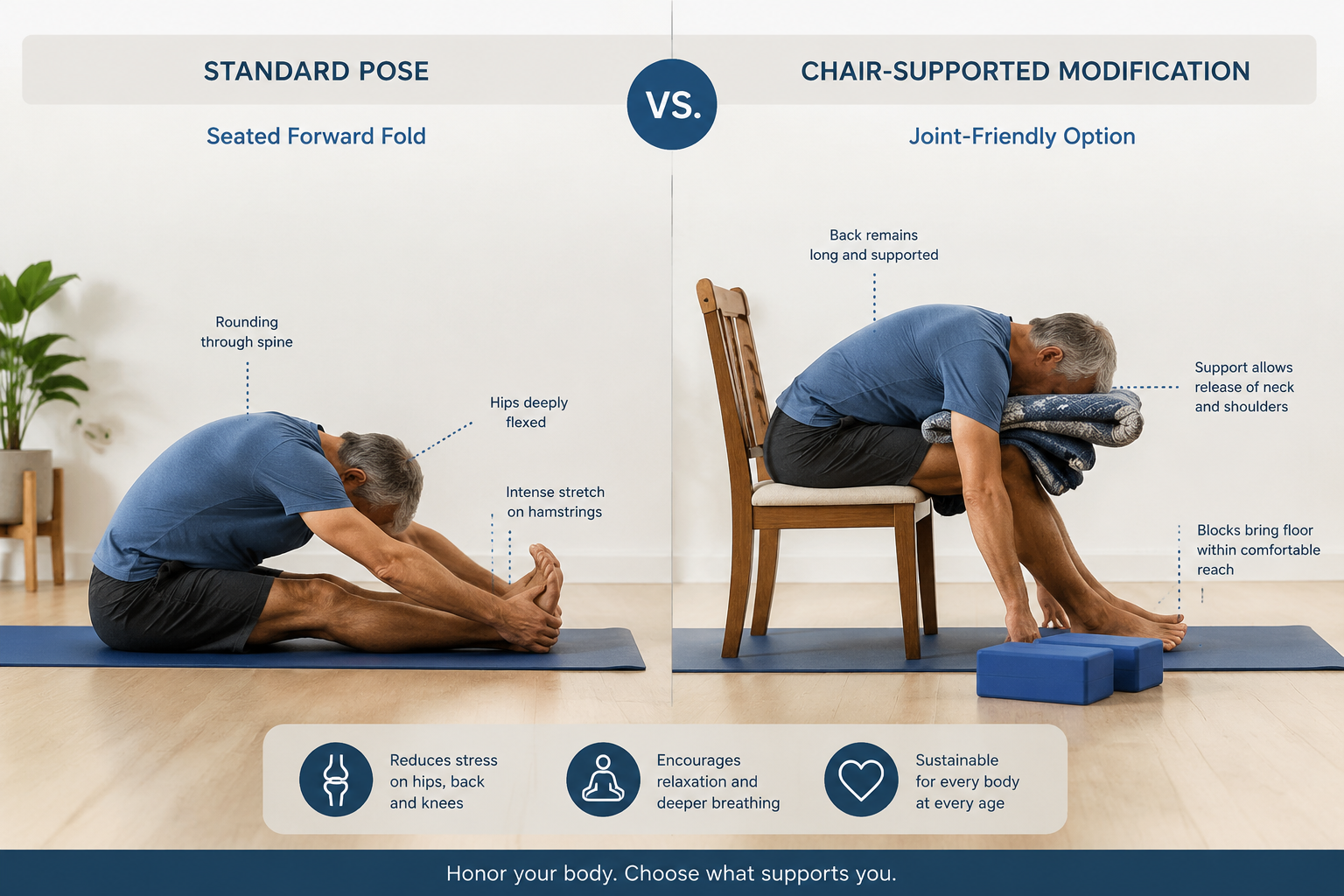
There is a common assumption that arthritis means rest, and that rest means less pain. The evidence does not fully support that. Prolonged inactivity tends to worsen joint stiffness, weaken the muscles that support affected joints, and reduce the range of motion that makes daily tasks manageable.
The stronger evidence points to gentle, consistent movement as a meaningful part of managing both osteoarthritis and rheumatoid arthritis. Yoga, specifically adapted yoga, fits that profile well. It combines low-impact movement, breathing awareness, and gradual flexibility work — all of which can support joint health without placing excessive load on already compromised tissue.
The Arthritis Foundation has noted that yoga can help reduce pain and improve physical function in people with arthritis. Several independent clinical trials, including work published in peer-reviewed rheumatology journals, have found statistically significant improvements in pain scores and self-reported function among arthritis patients who followed adapted yoga programs over eight to twelve weeks.
Let’s keep this practical: the goal is not to become a yoga practitioner in the traditional sense. The goal is to use yoga’s tools — breath, controlled movement, and progressive stretching — to reduce pain, maintain mobility, and protect joint function over time.
The Core Principles Behind Yoga Modifications for Arthritis and Joint Pain
Before getting into specific poses and adjustments, it helps to understand the reasoning behind modifications. This is not about making yoga easier for the sake of it. It is about applying the right load to the right tissue at the right time.
Work Within a Pain-Free Range
Pain is a signal, not a target. In plain English: if a movement hurts, the joint is telling you something. That does not always mean stop completely, but it does mean do not push through sharp, acute, or worsening pain. A mild sensation of stretch is different from joint pain. Learning to distinguish between the two is one of the most important skills in an arthritis-adapted practice.
Prioritise Stability Over Depth
Standard yoga often rewards depth — how far you can fold, how low you can sink into a pose. For joints affected by arthritis, stability is more valuable than range. A shallow, well-supported warrior pose does more good than a deep, unstable one that strains the knee or hip.
Load Management Matters
The evidence suggests that joints with arthritis respond poorly to sudden increases in load or range. Gradual progression — adding a few degrees of movement or a few seconds of hold over weeks — is safer and more effective than trying to match a class’s pace from day one. More is not always better. That applies here directly.
Warm Up Properly
Cold joints are stiffer joints. A five to ten minute warm-up — gentle walking, seated joint circles, or light breath work — before any yoga practice reduces injury risk and makes movement more comfortable. This is not optional for people with arthritis; it is foundational.
Joint-by-Joint Breakdown: What to Modify and How
Not all arthritis affects the same joints, and not all modifications are relevant to every person. Here is a practical breakdown by joint area.
Knees
The knee is one of the most commonly affected joints in osteoarthritis. Standard yoga poses that load the knee in deep flexion — full squat, hero pose (virasana), or deep lunges — can compress already damaged cartilage.
Modifications:
- Use a folded blanket behind the knee in any seated bend to reduce compression
- In warrior poses, keep the front knee directly over the ankle, not past it
- Avoid full kneeling on a hard floor — use a doubled mat or a thick folded blanket under the knee
- Replace deep squats with a supported chair squat or a partial squat with hands on a wall
Hips
Hip arthritis often limits internal rotation and deep flexion. Pigeon pose, in its full version, demands both — making it a high-risk choice for many people with hip OA.
Modifications:
- Replace floor pigeon with a supine figure-four stretch (lying on your back, crossing one ankle over the opposite thigh)
- In seated hip openers, use a bolster or block under the thigh to reduce the angle of hip flexion
- Avoid forcing external rotation — work only to where the hip moves comfortably
Wrists and Hands
Rheumatoid arthritis frequently affects the small joints of the hands and wrists. Weight-bearing on the palms — as in downward dog, plank, or cat-cow — can be problematic during flares.
Modifications:
- Use fists instead of flat palms to reduce wrist extension
- Place forearms on the mat (dolphin pose instead of downward dog)
- Use yoga wedges under the heels of the hands to reduce the angle of extension
- During flares, avoid all weight-bearing on the hands entirely
Spine and Neck
Spinal arthritis (spondylosis) and neck arthritis require care with deep backbends and extreme neck positions.
Modifications:
- Keep backbends gentle and supported — a rolled blanket under the thoracic spine works well
- Avoid dropping the head back sharply in poses like fish or cobra
- In forward folds, keep a neutral spine rather than rounding aggressively through the lumbar region
- Use a folded blanket under the head in savasana to keep the neck in a neutral position
Essential Props and How to Use Them
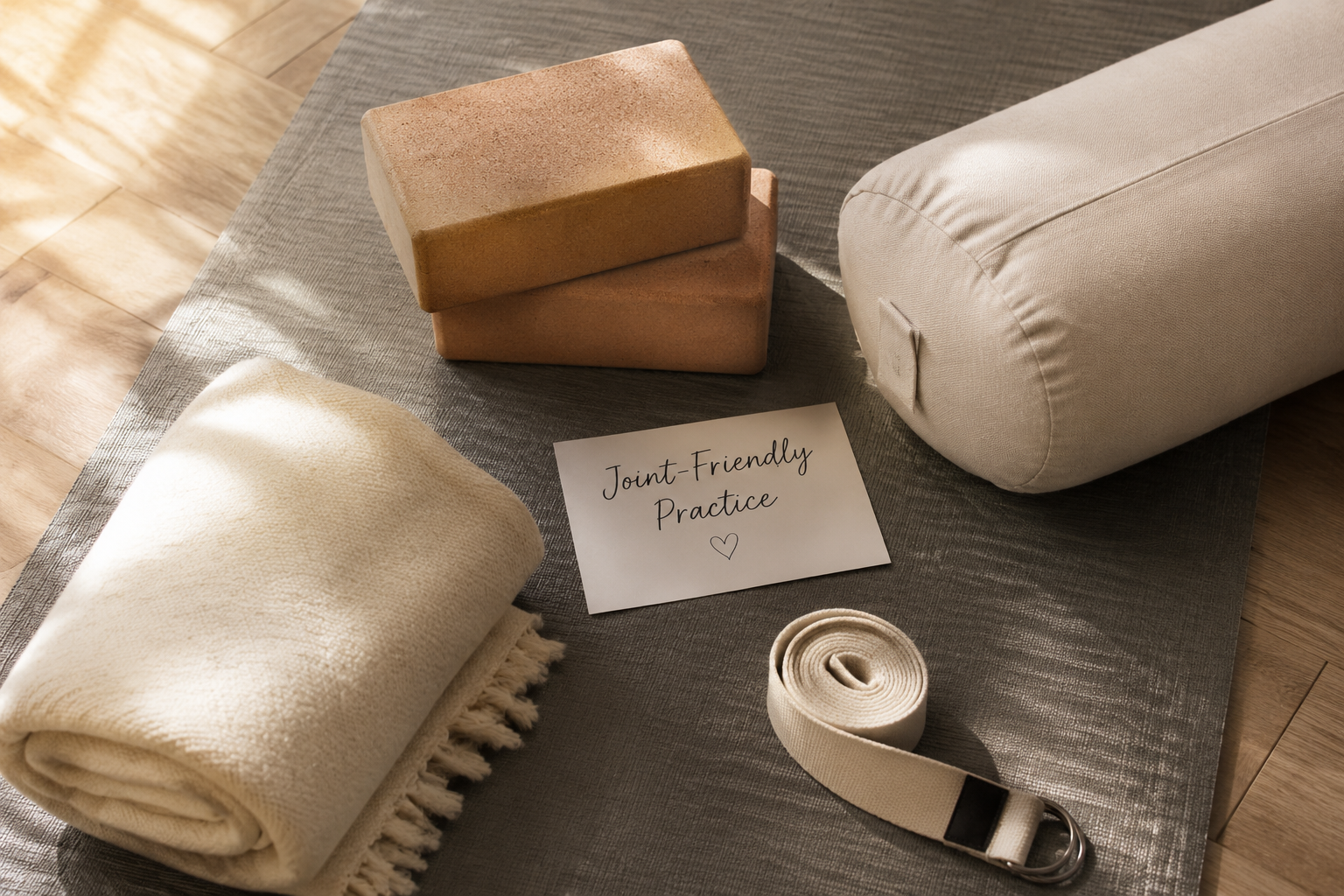
Props are not training wheels. They are precision tools. Here is what matters most:
| Prop | Best Use for Arthritis |
|---|---|
| Yoga blocks (foam or cork) | Raise the floor to reduce range demands in standing and seated poses |
| Blankets (folded firm) | Cushion knees, support hips, pad under the head |
| Yoga strap | Extend reach without straining shoulders or hamstrings |
| Bolster | Support the spine in restorative poses, reduce hip angle in seated work |
| Chair (sturdy, armless) | Provide full support for standing poses, balance work, and seated sequences |
| Yoga wedge | Reduce wrist extension angle in weight-bearing poses |
A sensible starting point is to have at least two blocks, one strap, and one firm blanket before beginning a home practice. If budget is a concern, a stack of firm books works for blocks, and a tightly rolled bath towel substitutes well for a blanket roll.
Chair Yoga: The Most Underrated Modification
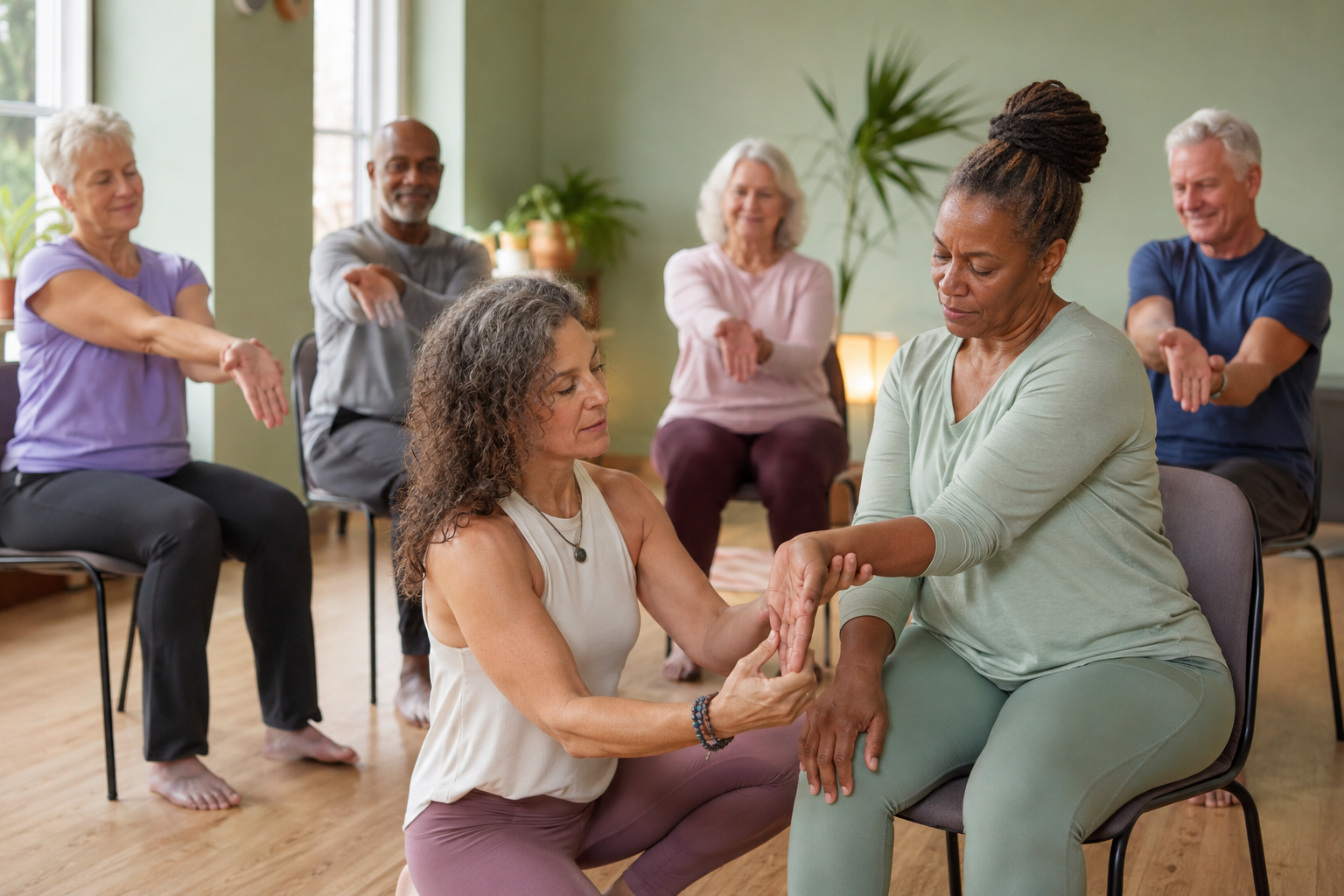
Chair yoga deserves specific attention. It is not a lesser form of yoga. For adults with significant hip, knee, or balance concerns, a sturdy chair transforms what is accessible. Nearly every standing pose can be adapted to a chair-supported version, and seated poses on a chair often allow better spinal alignment than floor-based versions for people with tight hips.
From a practical point of view, chair yoga is also one of the most evidence-supported formats for older adults with arthritis. Studies have found improvements in pain, balance, and self-reported quality of life in participants who followed structured chair yoga programs.
A Sample Gentle Yoga Sequence With Modifications
This sequence is designed as a starting point — not a prescription. It targets the most commonly affected areas in arthritis and uses modifications throughout.
Duration: 20 to 30 minutes
Equipment needed: Chair, two blocks, one blanket, one strap
Seated Breath Awareness (2 minutes)
Sit in a chair with feet flat on the floor. Rest hands on thighs. Breathe in for four counts, out for six. This activates the parasympathetic nervous system and begins to reduce muscle guarding around affected joints.
Seated Neck Rolls (2 minutes)
Slowly drop the right ear toward the right shoulder. Hold for three breaths. Return to centre. Repeat left. Avoid full circles if there is cervical arthritis — work in half-arcs only.
Seated Cat-Cow (3 minutes)
Hands on knees. Inhale and arch the spine gently (cow). Exhale and round gently (cat). Keep the range small and controlled. This mobilises the thoracic and lumbar spine without loading the wrists.
Chair-Supported Warrior One (3 minutes each side)
Stand behind the chair, hands on the back. Step the right foot back. Bend the front knee to a comfortable angle — not necessarily 90 degrees. Hold for five breaths. Switch sides. This builds hip flexor length and quad strength without overloading the knee.
Supine Figure-Four Hip Stretch (3 minutes each side)
Lie on your back. Cross the right ankle over the left thigh. Flex the right foot. Either stay here or gently draw the left thigh toward the chest using a strap. This replaces pigeon pose for hip arthritis.
Supported Bridge Pose (3 minutes)
Lie on your back, knees bent, feet flat. Place a block under the sacrum at its lowest height. Let the hips rest on the block. This is a gentle spinal extension that decompresses the lumbar region without active effort.
Savasana with Props (5 minutes)
Lie flat with a folded blanket under the head and a rolled blanket under the knees. Allow complete rest. This is not optional — it is where the nervous system integrates the session.
What to Avoid and When to Stop
Here is the real issue with many general yoga classes: they are not designed with arthritis in mind, and instructors without specific training may not know when to offer alternatives. That is not a criticism — it is context. It means the responsibility for self-monitoring matters.
Stop and rest if you experience:
- Sharp or sudden joint pain during a pose
- Swelling that increases during or after practice
- A grinding or locking sensation in a joint
- Significant pain that persists more than two hours after practice
Poses to approach with caution or avoid entirely:
- Full lotus (extreme hip and knee rotation)
- Headstand or shoulderstand (cervical spine loading)
- Deep backbends without support (cobra, wheel)
- Full squat (deep knee flexion under load)
- Rapid vinyasa flows (too much speed, too little control)
During a flare: Rest the affected joint. Gentle breath work and non-affected joint movement can continue, but do not push through an active inflammatory episode. This is where hype gets in the way — some sources suggest yoga can “push through” a flare. That is a strong claim and needs strong proof, and the evidence does not support it.
FAQ
Can yoga make arthritis worse?
It can, if the wrong poses are used without modification, if practice happens during an active flare, or if intensity increases too quickly. With proper yoga modifications for arthritis and joint pain, the risk is low and the potential benefit is meaningful. The key is starting slowly and working with a qualified instructor or physiotherapist.
How often should someone with arthritis practice yoga?
The evidence suggests two to three sessions per week of 20 to 30 minutes each is a reasonable starting point. Daily gentle movement — even ten minutes of seated joint mobility — is also beneficial. Consistency matters more than duration.
Is hot yoga safe for arthritis?
It depends on the conditions. Heat can temporarily relieve stiffness, but hot yoga classes are typically fast-paced and high-intensity. For most people with arthritis, a gentle or restorative class in a normal-temperature room is safer and more appropriate.
What type of yoga is best for joint pain?
Gentle yoga, restorative yoga, and chair yoga are the formats most consistently supported by evidence for people with arthritis. Yin yoga can be useful for some but requires care around hypermobility. Avoid power yoga, ashtanga, or hot yoga without medical clearance.
Do I need a special instructor?
Not necessarily, but it helps significantly. Look for instructors with training in therapeutic yoga, yoga for seniors, or yoga for arthritis. The Yoga Alliance and similar bodies list certified instructors with these specialisations. If in doubt, a session with a physiotherapist who uses yoga-based movement can be a useful starting point.
Can yoga replace medication for arthritis?
No. Yoga is a complementary approach, not a replacement for medical treatment. It can reduce pain and improve function alongside medication, but it does not address the underlying disease process. Always discuss any changes to your management plan with your healthcare provider.
Conclusion
The main takeaway is straightforward: yoga modifications for arthritis and joint pain are not a workaround or a compromise. They are the correct approach for anyone whose joints need a different entry point into movement. The basics still do the heavy lifting here — breath awareness, controlled range, consistent practice, and good use of props.
Start with what gives the biggest return: a chair, two blocks, and a 20-minute gentle sequence two to three times per week. Track how your joints respond over four to six weeks. Adjust based on what you observe, not what a class expects of you.
If you are over 50 and looking to build a broader movement foundation alongside a yoga practice, the article How to Exercise When You’re Over 50 covers the evidence-based principles for functional fitness at this life stage — it pairs well with an adapted yoga routine.
Looking for low-impact cardio options? The companion guide Low Impact Cardio for Bad Knees and Hips covers swimming, cycling, elliptical training, and weekly routine design.
Keep it simple and consistent. That is where the real benefit lives.
Back to cluster: Explore the full Joint-Friendly & Age-Specific Exercise hub for more practical guides, or browse all exercise articles.
References
These sources represent independent peer-reviewed research on yoga for arthritis, joint pain management, and mind-body interventions. PubMed and PMC links are provided where available.
- Cramer H, et al. A systematic review of yoga for fibromyalgia syndrome. Deutsche Zeitschrift für Akupunktur. 2013;56(1):17-18.
- Moonaz SH, et al. Yoga in sedentary adults with arthritis: effects of a randomized controlled pragmatic trial. J Rheumatol. 2015;42(7):1194-202.
- Ward L, et al. Establishing key components of yoga interventions for musculoskeletal conditions: a modified Delphi survey. BMC Complement Altern Med. 2014;14:196.
- Sutcliffe KJ, et al. Effectiveness and cost-effectiveness of yoga for rheumatoid arthritis: systematic review and meta-analysis. MedRxiv. 2020.
- Haaz S, Bartlett SJ. Yoga for arthritis: a scoping review. Rheum Dis Clin North Am. 2011;37(1):33-46.
📂 Joint-Friendly & Age-Specific Exercise
A practical reader path through the over-50 exercise cluster.
- Pillar: How to Exercise When You’re Over 50
- → Strength Training for Women Over 50: A Beginner Plan for Home or Gym
- → Weight-Bearing Exercises for Bone Health
- → What Is Tai Chi? A Beginner’s Guide to the Practice and How to Start
- → Low Impact Cardio for Bad Knees and Hips: What Actually Works
- YOU ARE HERE Yoga Modifications for Arthritis and Joint Pain: A Practical Guide That Actually Works
- → Resistance Band Training for Joint Health: What the Evidence Actually Shows
- → Returning to Exercise After Joint Surgery: A Practical, Evidence-Aware Guide
- → Balance and Fall Prevention Exercises for Seniors: A Practical, Evidence-Aware Guide
- → Best Exercise Bike for Knee Issues: A Complete 2026 Buying Guide