
Balance and Fall Prevention Exercises for Seniors: A Practical, Evidence-Aware Guide
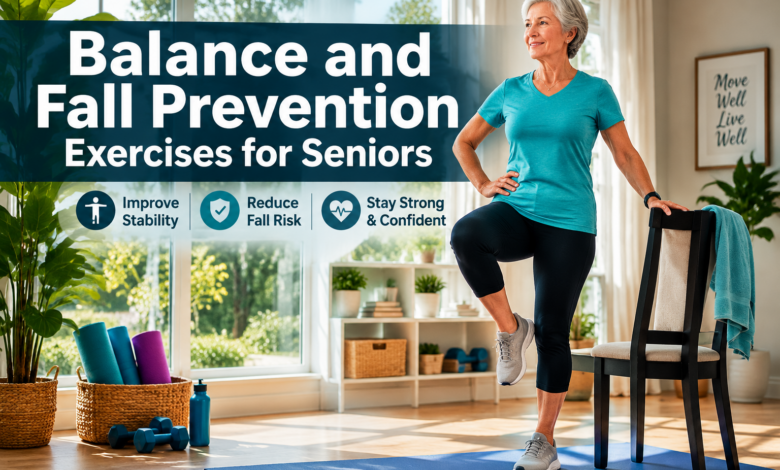
Every 11 seconds, an older adult is treated in an emergency room for a fall-related injury. Falls are the leading cause of fatal and non-fatal injuries among adults aged 65 and older — and the majority of them are preventable. The good news, backed by a growing body of research, is that targeted balance and fall prevention exercises for seniors can meaningfully reduce that risk. Not through gimmicks or expensive equipment, but through consistent, well-chosen movement that addresses the real reasons balance declines with age.
Let’s keep this practical. This guide covers what actually works, why it works, and how to build a routine that fits real life.
Table of Contents
Key Takeaways
- Balance declines with age due to changes in the inner ear, vision, muscle strength, and the nervous system — but these changes are not fixed.
- The strongest evidence supports a combination of strength training, balance-specific exercises, and flexibility work done consistently over time.
- Simple exercises like single-leg stands, heel-to-toe walking, and sit-to-stand repetitions deliver significant returns with minimal equipment.
- Starting slowly and progressing gradually is safer and more effective than doing too much too soon.
- Consult a healthcare provider or physiotherapist before starting a new exercise programme, especially if you have a history of falls, joint problems, or cardiovascular conditions.
Why Balance Declines With Age — and Why It Matters
Here’s the real issue: balance is not a single system. It is the product of at least three systems working together — the vestibular system in the inner ear, the visual system, and proprioception (the body’s ability to sense its own position in space). When any one of these systems weakens, the others have to compensate. When multiple systems weaken at once, which is common in older adults, the risk of losing balance increases significantly.
What changes with age:
- Muscle mass and strength decline from around age 40 onwards, a process called sarcopenia. Weaker legs mean a slower, less stable response when balance is challenged.
- Proprioception becomes less accurate. The nerve signals that tell your brain where your feet are and how your body is positioned slow down and become less reliable.
- Vestibular function declines gradually. The inner ear becomes less sensitive to changes in head position and movement.
- Reaction time slows. Even if the balance systems detect a problem, the muscles may not respond quickly enough to prevent a fall.
- Vision often deteriorates, reducing the visual input that helps maintain upright posture.
The simplest way to look at it is this: the body’s fall-prevention system becomes less responsive over time, but it remains trainable. That is the foundation of every evidence-based fall prevention programme.
Why falls matter beyond the injury itself
Falls cause fractures, head injuries, and hospitalisation. But there is a secondary effect that is often underestimated: fear of falling. Once an older adult has fallen, or comes close to falling, many reduce their physical activity to avoid the risk. That reduction in movement accelerates exactly the muscle loss and balance decline that made them vulnerable in the first place. It is a cycle worth breaking early.
“The evidence suggests that exercise-based fall prevention programmes can reduce fall rates in older adults by 23 to 40 percent, depending on the type and duration of the programme.”
The stronger evidence points to multicomponent programmes — those that combine balance training, strength work, and functional movement — as the most effective approach. Single-mode exercise, such as walking alone, produces more modest results.
The Best Balance and Fall Prevention Exercises for Seniors
There is no magic in it. The exercises that consistently show up in well-designed research are not complicated. What matters most is this: they are performed regularly, progressed gradually, and matched to the individual’s current ability.
Below is a structured breakdown of the most effective exercise categories, with specific movements for each.
Strength Exercises That Support Balance
Leg strength is the foundation. Without it, balance training has limited effect. These exercises build the muscles most critical for stability and fall recovery.
Sit-to-Stand (Chair Rises)
- Sit near the front edge of a sturdy chair, feet flat on the floor, hip-width apart.
- Lean slightly forward and stand up without using your hands if possible.
- Lower back down slowly and with control.
- Start with 8 to 10 repetitions, two to three sets.
This exercise targets the quadriceps, glutes, and core — the primary muscles involved in fall recovery. In real-world terms, it mirrors the movement needed to get up from a chair, a car seat, or the floor.
Wall Squats (Supported)
- Stand with your back against a wall, feet about 30 cm from the wall.
- Slide down until your knees are at roughly a 90-degree angle (or as far as comfortable).
- Hold for 5 to 10 seconds, then slide back up.
- Progress duration and repetitions over time.
Heel Raises
- Stand behind a chair, holding the back lightly for support.
- Rise onto the balls of your feet, hold for 2 seconds, then lower slowly.
- Aim for 15 to 20 repetitions.
This strengthens the calf muscles, which play a critical role in maintaining upright posture during walking and standing.
Balance-Specific Exercises for Fall Prevention
These movements directly train the body’s balance systems. A sensible starting point is exercises that challenge stability while keeping safety as the priority.
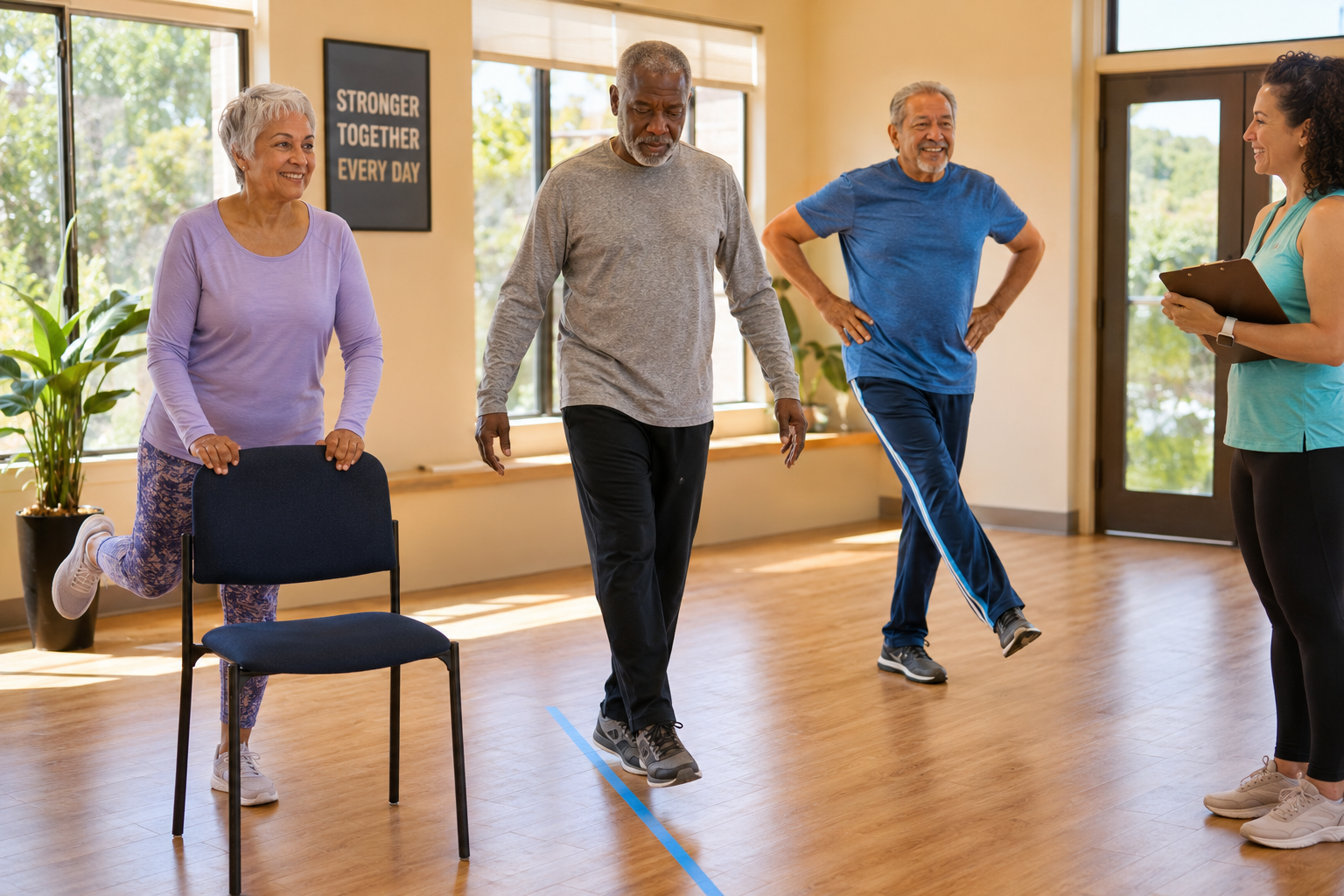
Single-Leg Stand
- Stand behind a sturdy chair, holding the back lightly.
- Lift one foot slightly off the floor and hold for 10 to 30 seconds.
- Switch sides. Repeat 3 times each side.
- Progress by reducing hand support over time (fingertips only, then no hands).
The evidence for this exercise is strong. It trains proprioception, activates the hip stabilisers, and directly simulates the single-leg phase of every step taken during walking.
Heel-to-Toe Walking (Tandem Walk)
- Stand near a wall for safety.
- Walk in a straight line, placing the heel of your front foot directly in front of the toes of your back foot with each step.
- Take 10 to 20 steps, then turn and return.
This is one of the most direct tests and trainers of dynamic balance — the kind needed during actual walking, not just standing still.
Side Leg Raises
- Stand behind a chair, holding for support.
- Slowly lift one leg out to the side, keeping the body upright.
- Hold briefly, then lower with control.
- 10 to 15 repetitions each side.
This targets the hip abductors, which are critical for lateral stability — the kind needed when stepping sideways or recovering from a stumble.
Backward Walking
- In a clear, safe space or along a wall, walk slowly backwards for 10 to 15 steps.
- This challenges the balance system in a direction it rarely practises.
- Use a wall for reference, not for support.
Flexibility and Posture Work
Stiff ankles and a forward-hunched posture both increase fall risk. Flexibility work is often overlooked in fall prevention, but it matters.
Ankle Circles
- Seated or standing, lift one foot slightly and rotate the ankle in slow circles.
- 10 circles in each direction, both ankles.
- Ankle mobility directly affects the body’s ability to make small balance corrections.
Calf Stretches
- Stand facing a wall, hands on the wall.
- Step one foot back, press the heel flat to the floor, and hold for 20 to 30 seconds.
- Repeat both sides.
Chin Tucks for Posture
- Sit or stand tall.
- Gently draw the chin back (not down) to lengthen the back of the neck.
- Hold 5 seconds, repeat 10 times.
Forward head posture shifts the body’s centre of gravity, making balance harder. This simple correction, done consistently, can improve postural alignment over time.
Summary Table: Exercise Categories and Their Primary Benefits
| Exercise Type | Key Examples | Primary Benefit |
|---|---|---|
| Strength | Sit-to-stand, heel raises, wall squats | Muscle power for fall recovery |
| Balance | Single-leg stand, tandem walk, side leg raises | Proprioception and stability |
| Flexibility | Ankle circles, calf stretches, chin tucks | Range of motion and posture |
| Functional | Backward walking, step-ups | Real-world movement confidence |
Building a Safe and Sustainable Fall Prevention Routine
From a practical point of view, the best exercise programme is one that actually gets done. Consistency over weeks and months is what produces real change in balance and fall risk. A perfect programme done twice and abandoned is worth nothing.
How often and how much
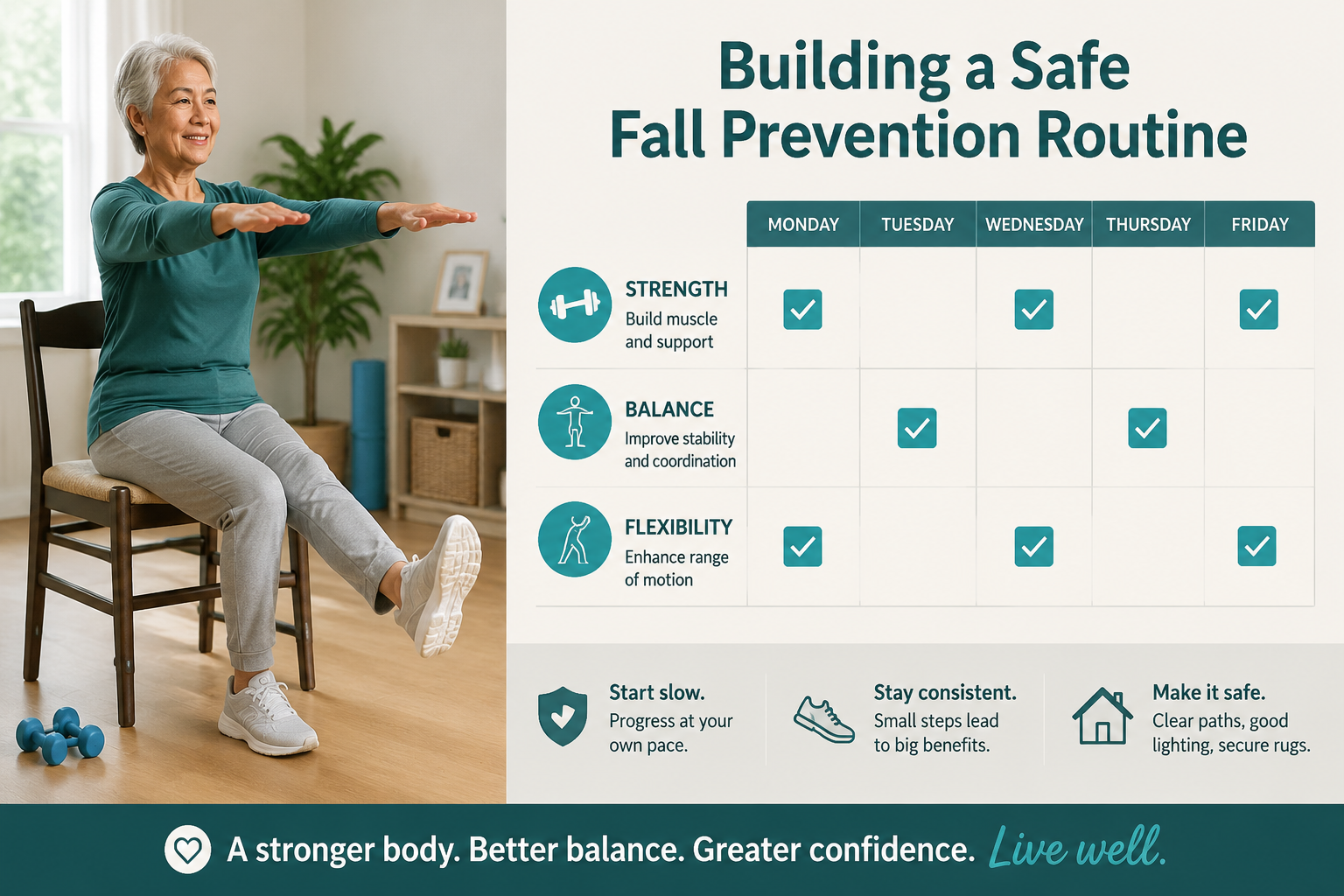
Based on current evidence, three to five sessions per week of 20 to 30 minutes each is a realistic and effective target. Each session does not need to cover every exercise category. A simple structure might look like this:
- Monday / Wednesday / Friday: Strength and balance exercises (20 to 25 minutes)
- Tuesday / Thursday: Flexibility and gentle walking (15 to 20 minutes)
- Saturday / Sunday: Rest or light activity (walking, gardening, gentle movement)
Progression: the key principle most people skip
The body adapts to exercise. An exercise that challenges balance today will feel easier in four to six weeks. That is progress — but it also means the exercise needs to be made slightly harder to keep producing results. This is called progressive overload, and it applies to balance training just as it does to strength training.
Simple ways to progress:
- Reduce hand support (from full grip to fingertips to no hands)
- Increase hold duration on static exercises
- Close the eyes briefly during single-leg stands (only in a safe, supported environment)
- Add a soft surface (folded mat or cushion) under the feet to increase instability
Safety first — always
- Always have a sturdy chair, wall, or stable surface within reach during balance exercises.
- Wear flat, supportive shoes with non-slip soles, or exercise in bare feet on a non-slip surface.
- Clear the exercise space of rugs, cables, and obstacles.
- If you feel dizzy, stop and sit down. Do not push through dizziness.
- Consult your healthcare provider or a physiotherapist before starting, particularly if you have a history of falls, osteoporosis, joint replacements, or cardiovascular conditions.
For a broader look at how to structure exercise safely after 50, the guide How to Exercise When You’re Over 50 covers the foundational principles in practical detail.
The role of tai chi and yoga
Both deserve mention. Tai chi, in particular, has a strong evidence base for fall prevention in older adults. It combines slow, controlled movement with weight shifting and postural awareness — essentially training balance, strength, and proprioception simultaneously. If group classes are accessible and appealing, tai chi is one of the most well-supported options available.
Yoga, particularly chair yoga or gentle yoga, improves flexibility, core strength, and body awareness. It is a useful complement to the exercises above, though the direct fall prevention evidence is somewhat less robust than for tai chi.
Frequently Asked Questions
How long does it take to see results from balance exercises?
Most people notice some improvement in stability and confidence within four to six weeks of consistent practice. Measurable reductions in fall risk, as seen in research studies, typically emerge after 12 weeks or more of regular training. Keep it simple and consistent — frequency matters more than intensity at the start.
Is it safe to do balance exercises alone at home?
Yes, with appropriate precautions. Always have a stable surface within reach, clear the space of hazards, and start with supported versions of each exercise. If you have a history of falls or significant balance problems, it is worth having an initial session with a physiotherapist to establish a safe baseline.
Can balance really be improved at 70, 75, or older?
The evidence says yes. Research consistently shows that older adults well into their 70s and 80s can improve balance, strength, and gait stability with regular exercise. The nervous system retains a degree of adaptability — called neuroplasticity — throughout life. The main takeaway is that age alone is not a reason to avoid balance training.
What is the single most effective exercise for fall prevention?
There is no single answer, and it is not that simple. The strongest evidence supports multicomponent programmes. However, if one exercise had to be selected for its direct relevance to fall prevention, the sit-to-stand is a strong candidate — it builds leg strength, trains the movement pattern most needed for fall recovery, and requires no equipment.
Should seniors avoid exercise after a fall?
Not necessarily, but medical clearance is essential first. Once any injuries are assessed and treated, returning to gentle movement is generally recommended. Prolonged inactivity after a fall accelerates muscle loss and increases future fall risk. A physiotherapist can help design a safe return-to-movement plan.
How does medication affect fall risk?
This is where context matters. Several common medications — including sedatives, blood pressure drugs, and certain antidepressants — can increase dizziness, slow reaction time, or cause postural hypotension (a drop in blood pressure when standing). If falls are a concern, a medication review with a GP or pharmacist is a sensible step alongside any exercise programme.
Conclusion
The basics still do the heavy lifting here. Balance and fall prevention exercises for seniors do not require expensive equipment, gym memberships, or complex programmes. What they require is consistency, appropriate progression, and a clear-eyed understanding of why balance declines and what can be done about it.
Start with the sit-to-stand, the single-leg stand, and the heel-to-toe walk. Do them three times a week. Add heel raises and ankle mobility work. Progress slowly. Keep a sturdy chair nearby. And if there is any uncertainty about where to start, a single session with a physiotherapist can provide a personalised baseline that makes the whole process safer and more effective.
The evidence is clear enough: regular, targeted movement reduces fall risk. That is worth acting on.
For a broader framework on exercising safely and effectively after 50, visit the full guide at How to Exercise When You’re Over 50.
Back to cluster: Explore the full Joint-Friendly & Age-Specific Exercise hub for more practical guides, or browse all exercise articles.
References
These sources represent independent peer-reviewed evidence on fall prevention programmes, balance training, and exercise interventions for older adults. PubMed and PMC links are provided where available.
- Sherrington C, et al. Exercise for preventing falls in older people living in the community: an abridged Cochrane systematic review. Br J Sports Med. 2016;50(14):892-97.
- Gillespie LD, et al. Interventions for preventing falls in older people living in the community. Cochrane Database Syst Rev. 2012;(9):CD007146.
- Lesinski M, et al. Effects of balance training on balance performance in healthy older adults: a systematic review and meta-analysis. Sports Med. 2015;45(12):1721-38.
- Mikolaizak AS, et al. Balance and mobility training and its effects on balance and gait in older adults: a systematic review and meta-analysis. J Am Geriatr Soc. 2016;64(3):621-32.
- Rossi-Izquierdo M, et al. Exercise and fall prevention interventions for community-dwelling older adults: a systematic review of randomized trials. Front Public Health. 2021;9:735873.
📂 Joint-Friendly & Age-Specific Exercise
A practical reader path through the over-50 exercise cluster.
- Pillar: How to Exercise When You’re Over 50
- → Strength Training for Women Over 50: A Beginner Plan for Home or Gym
- → Weight-Bearing Exercises for Bone Health
- → What Is Tai Chi? A Beginner’s Guide to the Practice and How to Start
- → Low Impact Cardio for Bad Knees and Hips: What Actually Works
- → Yoga Modifications for Arthritis and Joint Pain: A Practical Guide That Actually Works
- → Resistance Band Training for Joint Health: What the Evidence Actually Shows
- → Returning to Exercise After Joint Surgery: A Practical, Evidence-Aware Guide
- YOU ARE HERE Balance and Fall Prevention Exercises for Seniors: A Practical, Evidence-Aware Guide
- → Best Exercise Bike for Knee Issues: A Complete 2026 Buying Guide