
HIIT Workouts: A Practical Guide to Short Intervals for Fitness
Created: September 30, 2026 • Last updated: September 30, 2026
HIIT works when the hard parts are genuinely hard for you—and the recovery is long enough for you to do the next one well. That doesn’t mean every HIIT workout needs jumping, sprinting, or lying on the floor in a puddle. Walking intervals, quiet home circuits, a bike, and a rower can all work. The smart choice is the format you can control, recover from, and do again next week.
Quick answer: HIIT—high-intensity interval training—alternates short hard efforts with easier recovery. A practical starting session might use 20–30 seconds of strong but controlled effort followed by 60–90 seconds easy, for 10–20 minutes after a warm-up. Choose walking intervals, low-impact home moves, a stationary bike, or a rower based on your experience and comfort. You don’t need to go all-out to make the session useful.
Key Takeaways
- HIIT is a structure, not one exercise. It can be done by walking hills, cycling, rowing, or using bodyweight movements.
- Start with the option you can pace. For many people, that means walking or a bike before hard jumping drills.
- More suffering isn’t automatically better. Keep the recovery long enough that your technique and effort don’t fall apart.
- HIIT can improve cardiorespiratory fitness, but it doesn’t replace ordinary walking, strength work, or a consistent weekly activity pattern.[1][2]
- Tabata is not a synonym for HIIT. It is a particularly demanding protocol, not the default way to begin.
Table of Contents
What HIIT Is—and What It Isn’t
HIIT is built from repeated work-and-recovery intervals. The work interval is hard relative to your current fitness; the recovery interval lets you regain enough control to repeat the effort with decent form. That is the point. It isn’t a random pile of exercises done quickly, and it isn’t automatically better because it leaves you wrecked.
Research syntheses find that HIIT can improve cardiorespiratory fitness in adults, including in home-based formats. But protocols, participants, and comparison programs vary a lot, so there is no single “best” workout or magic work-to-rest ratio.[1][3] Use the evidence for what it says: intervals are a legitimate, time-efficient training option. Don’t stretch it into a promise about your body shape, metabolism, or a particular number of calories.
First, warm up. Give yourself at least five to ten minutes of easy movement in the same mode you plan to use: an easy walk before walking intervals, light pedaling before bike intervals, or a gentle rehearsal of the home movements. Then make the hard intervals hard for you, not hard by someone else’s stopwatch.
Walking HIIT: Japanese Interval Walking and Other Brisk-Walk Options
Walking HIIT is the most underappreciated option in this guide. You don’t need a treadmill, a gym, or a heroic running pace. A hill, a set of stairs you already use safely, or a flat route where you can change pace will do.
The Japanese interval-walking research often cited online used alternating three-minute lower- and higher-intensity walking periods. In the original study, the harder walking was individualized and substantial—not simply an easy stroll labelled HIIT.[4] That makes it a useful model, not a rule you need to copy on day one.
Try this first: walk easily for three minutes, then walk briskly for one minute—fast enough that conversation becomes brief, but not so fast that you lose posture or feel panicked. Repeat 4–6 times, then cool down. When that feels repeatable, make the brisk portions longer before making them harder.
A walking interval is still useful even if it isn’t “true” HIIT yet. That’s not failure; it’s an appropriate entry point. The aim is to make steady walking more structured while giving your legs, breathing, and confidence time to catch up.
Home HIIT: Low-Impact First, Then Standard Bodyweight Work
Home HIIT doesn’t need burpees. In fact, jumping is a poor default for anyone who’s restarting exercise, managing cranky joints, or simply training upstairs while other people sleep. Begin with a low-impact circuit and earn the noisier version later if you want it.
Low-Impact, No-Jump Home HIIT
After a warm-up, choose three or four movements you can do in a clear space: brisk marching with active arms, a controlled chair-height squat, a step-back lunge or split-stance sit-to-stand, wall push-ups, and a fast but steady shadow-boxing pattern. Work for 20–30 seconds; move easily or rest for 60–90 seconds. Complete 2–4 rounds.
The test is simple: you should be able to keep your feet quiet, your balance under control, and the movement recognizable. If the squat gets sloppy, reduce the range or use the bodyweight version in our Bodyweight Squats guide instead of forcing speed.
Standard Bodyweight HIIT
Once the low-impact version feels familiar, you can use faster options such as squat-to-reach, alternating reverse lunges, mountain climbers on a stable floor, or a short shuttle walk/jog if you have safe space. Keep the work interval short enough that your form doesn’t become a shrugging, collapsing rush. Bodyweight HIIT can raise your heart rate, but it isn’t a replacement for strength training; your Home Workout Routines guide helps put both into a sensible week.
HIIT With Equipment: Stationary Bike or Rowing Machine
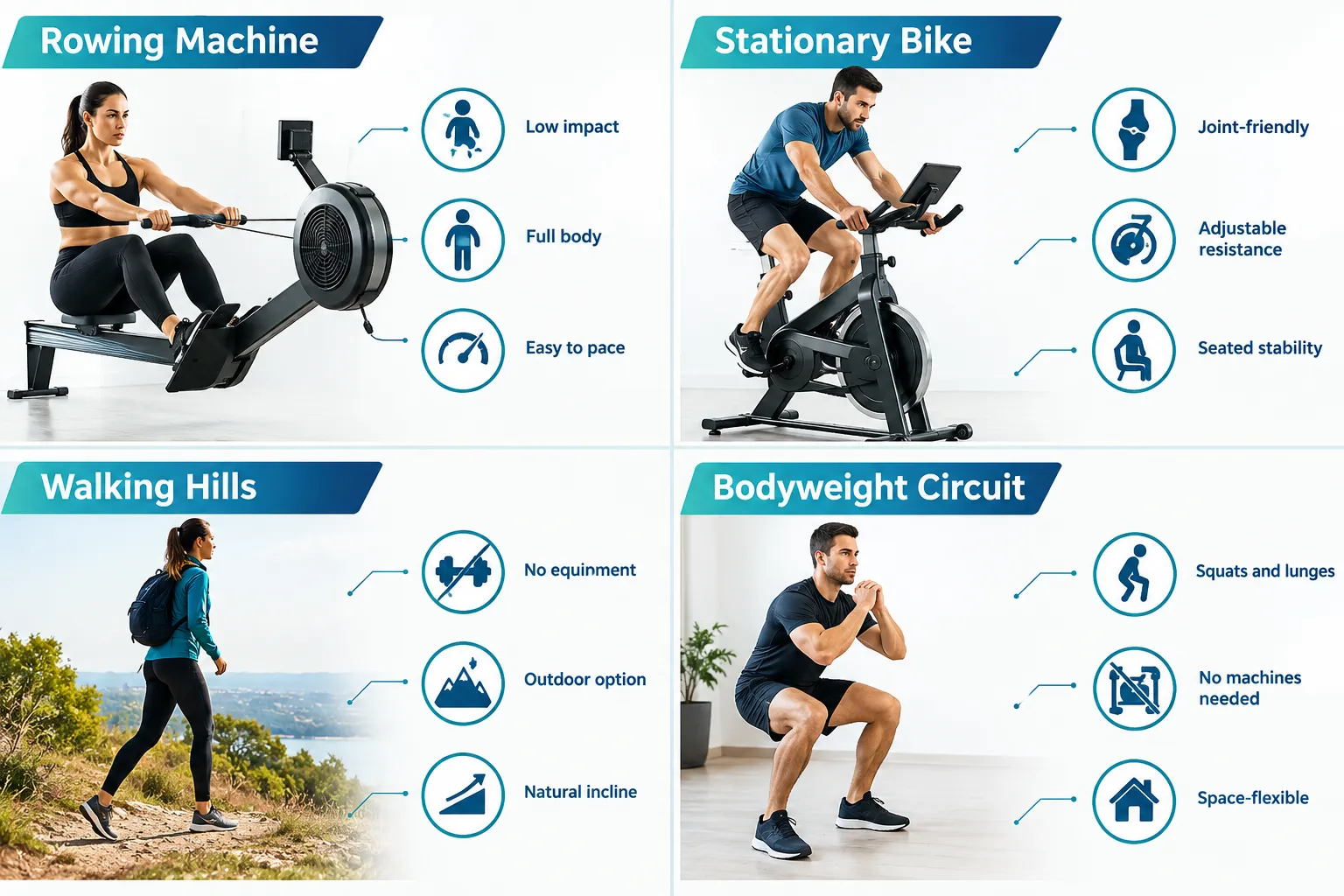
A stationary bike or rower gives you a simple way to change effort without changing direction or landing from a jump. That can make intervals easier to pace, but lower impact does not mean low effort. A bike can still fry your legs; a rower can punish poor timing and a rushed back position.
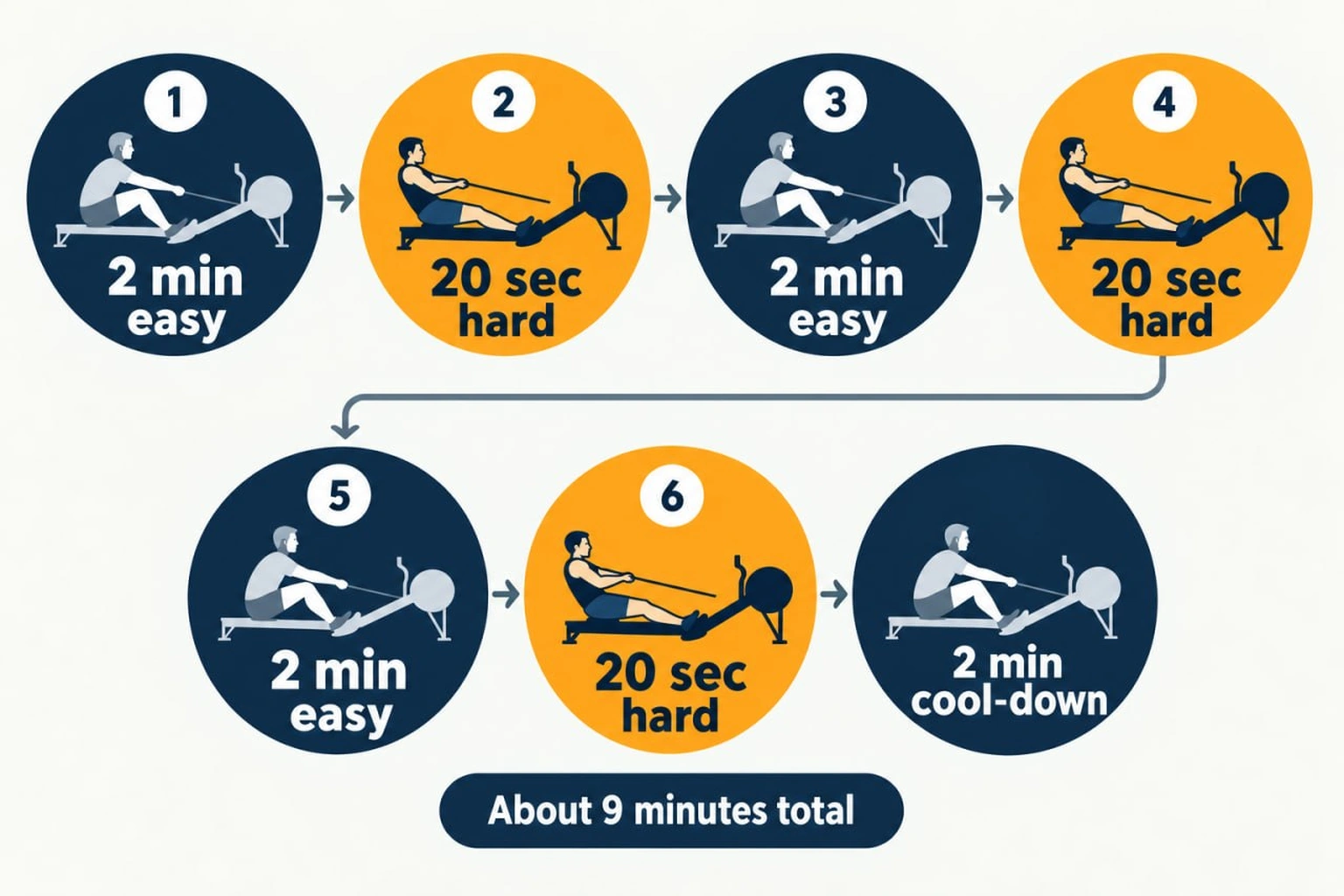
For either machine, begin with an easy pedal or row. Then try 20 seconds strong, 100 seconds easy, repeated 4–6 times. Keep the hard intervals at a controlled effort rather than a maximal sprint. If your cadence, posture, or stroke gets ragged, extend the recovery or end the set. On a rower, technique is the gatekeeper: push with the legs, then let the body and arms follow; don’t yank yourself through the stroke with the shoulders.
A bike is often the simpler first choice if balance or rowing technique is unfamiliar. A rower is a good choice for people who already know the movement and can keep the stroke smooth. Neither machine is compulsory, and neither is automatically the “best” HIIT exercise.
A Practical 30-Minute HIIT Option
If you want a longer session, don’t fill 30 minutes with relentless hard work. Use the time for a proper warm-up, clear recovery, and a cooldown.
| Part | What to do | Time |
|---|---|---|
| Warm-up | Easy walking, pedaling, rowing, or a calm movement rehearsal. | 8 minutes |
| Intervals | 30 seconds strong, 90 seconds easy. Repeat 8 times in your chosen mode. | 16 minutes |
| Cool-down | Move gently until breathing settles. | 6 minutes |
Total: 30 minutes. The hard work adds up to four minutes, which is plenty for a genuine session. If eight rounds turn the final reps into a mess, stop at five or six. The purpose is repeatable quality, not proving toughness.
HIIT vs. Tabata: Similar Family, Different Demand
HIIT is the broad family: hard efforts plus recovery, using a range of interval lengths and exercise modes. Tabata is a specific, far more demanding protocol that became famous for eight 20-second work periods separated by 10-second rests. The original research used cycling at an intensity designed to exhaust participants around the seventh or eighth bout.[5]
That matters because a casual “20 seconds on, 10 seconds off” bodyweight circuit is not automatically authentic Tabata, and it may not be a wise first session. Use the word HIIT for most practical home, walking, bike, and rowing intervals. Save Tabata for a protocol you understand and are ready to pace.
HIIT and Weight Loss: Useful, Not Magical
HIIT can be part of a weight-loss plan because it adds physical activity and can improve fitness. It does not selectively burn belly fat, erase the role of food intake, or guarantee a faster result than every other form of exercise. In an umbrella review, interval training was a viable approach for reducing adiposity in healthy adults, but the underlying review quality varied and the outcomes reflect repeated training over time—not one punishing workout.[6]
The best route is the one you can sustain. If short bike intervals help you become more active, great. If a brisk daily walk is the habit you actually keep, that matters too. Combine activity with strength work, sleep, food habits you can live with, and patience rather than chasing a “fat-burning” trick.
How Often to Do HIIT—and How to Recover
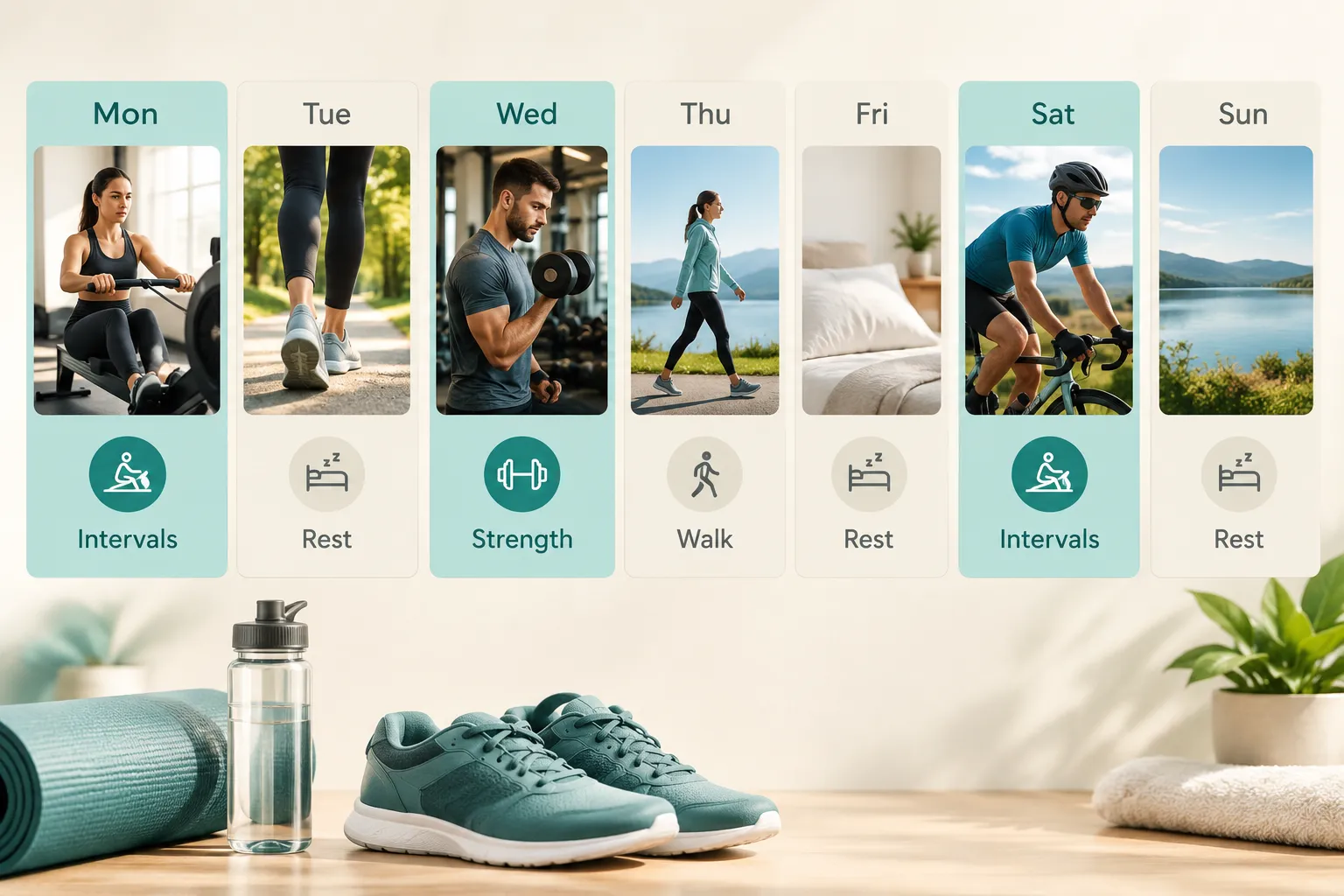
For a beginner, one hard interval session a week may be plenty. Many people can eventually use two non-consecutive sessions if they are recovering well, while others prefer one interval day plus more walking or steady cardio. The U.S. activity guidelines focus on a weekly mix of aerobic and muscle-strengthening work, not an obligation to squeeze HIIT into every week.[2]
Use this weekly schedule image as an illustration, not a prescription. Your work, sleep, stress, joints, other training, and chosen mode all matter. The recovery days can be a walk, easy cycling, strength work, or actual rest—whatever lets you show up for the next demanding session with reasonable energy.
Stop and get individual advice if needed: chest discomfort, fainting, unusual breathlessness, or a new concerning symptom is a reason to stop rather than push through. People with known cardiovascular or metabolic disease, uncontrolled blood pressure, a recent injury or surgery, persistent pain, or uncertainty about vigorous exercise should get individualized clinical or qualified exercise guidance before starting HIIT.
Frequently Asked Questions
What Are HIIT Workouts?
They are workouts built around short hard efforts and easier recovery intervals. The exercise can be walking, cycling, rowing, or bodyweight work. What matters is the alternation between effort and recovery, not the label on the class.
Is 20 Minutes of HIIT Cardio a Day Enough?
Twenty minutes can be a useful session, but it doesn’t answer the whole-week question. A session also needs a warm-up and cooldown, and your broader activity pattern matters. If 20 minutes every day leaves you worn down or makes the hard intervals mediocre, fewer higher-quality sessions plus ordinary walking may be the better fit.
Can HIIT Lose Belly Fat?
HIIT can contribute to overall fat loss as part of a sustained routine, but it can’t direct fat loss from one body area. Avoid anyone selling a particular interval as a belly-fat fix.
What Is the Best HIIT Exercise?
The best option is the one you can perform hard enough to create a training effect while staying in control. For one person that is a hill walk; for another, a stationary bike, rower, or bodyweight circuit. A “best” exercise that hurts, scares you, or forces bad form is not the best choice for you.
References
- Poon ETC, et al. High-intensity interval training and cardiorespiratory fitness in adults: an umbrella review of systematic reviews and meta-analyses. Scandinavian Journal of Medicine & Science in Sports (2024).
- U.S. Department of Health and Human Services. Physical Activity Guidelines for Americans, 2nd edition (2018).
- Tsuji K, et al. Home-based high-intensity interval training improves cardiorespiratory fitness: a systematic review and meta-analysis. BMC Sports Science, Medicine and Rehabilitation (2023).
- Nemoto K, et al. Effects of high-intensity interval walking training on physical fitness and blood pressure in middle-aged and older people. Mayo Clinic Proceedings (2007).
- Tabata I, et al. Effects of moderate-intensity endurance and high-intensity intermittent training on anaerobic capacity and VO2max. Medicine & Science in Sports & Exercise (1996).
- Poon ETC, et al. Efficacy of interval training in improving body composition and adiposity in apparently healthy adults: an umbrella review with meta-analysis. Sports Medicine (2024).
Medical disclaimer: This guide is general education, not personal medical advice, diagnosis, or treatment. Exercise needs vary with symptoms, injury history, medications, and health conditions. If you have a diagnosed condition, recent injury or surgery, persistent pain, or uncertainty about starting vigorous exercise, seek guidance from an appropriately qualified clinician or exercise professional.

About the author
Dave James is the founder of All Perfect Health. He writes practical guides that help readers cut through fitness noise, keep useful basics, and build habits they can repeat.
📂 Exercise Guide for Better Health
This article is part of the APH cluster. Use the links below to move between the pillar and child articles.
- Read the pillar: Exercise Guide for Better Health
- → Body Mass Index (BMI) Chart
- → How to Start Walking for Exercise
- YOU ARE HEREHIIT Workouts
- → Walking vs. Running for Weight Loss
- → Fat Burn Heart Rate
- → Zone 2 Cardio: A Practical Beginner’s Guide to Steady Aerobic Training
- → Health Benefits of Swimming
- → Explore all Exercise guides