
Functional Strength Training: What It Is, Why It Matters, and 6 Beginner Movements
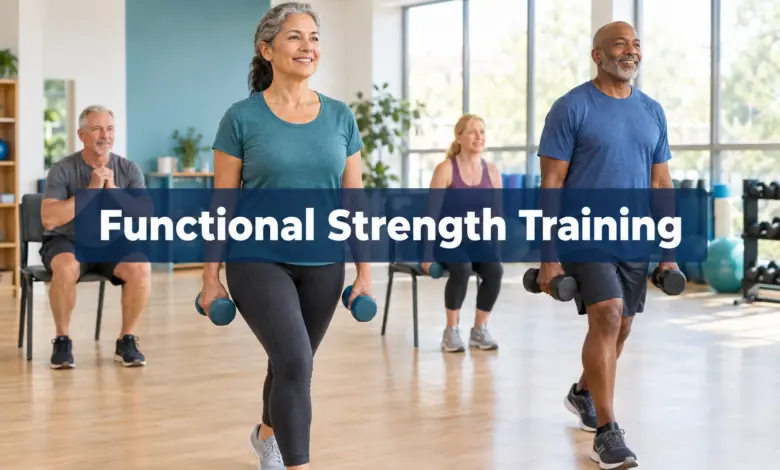
Quick Answer: Functional strength training is ordinary resistance training organized around movements that show up in daily life: standing from a chair, bending, pushing, pulling, carrying, and staying steady. It is not a separate science and it is not automatically better than every other style of strength work. Its practical value is that it gives people a simple way to build strength while paying attention to the movements they want to keep doing well.
Key Takeaways
- Functional strength training focuses on movement patterns rather than a single piece of equipment or a fixed “functional” workout.
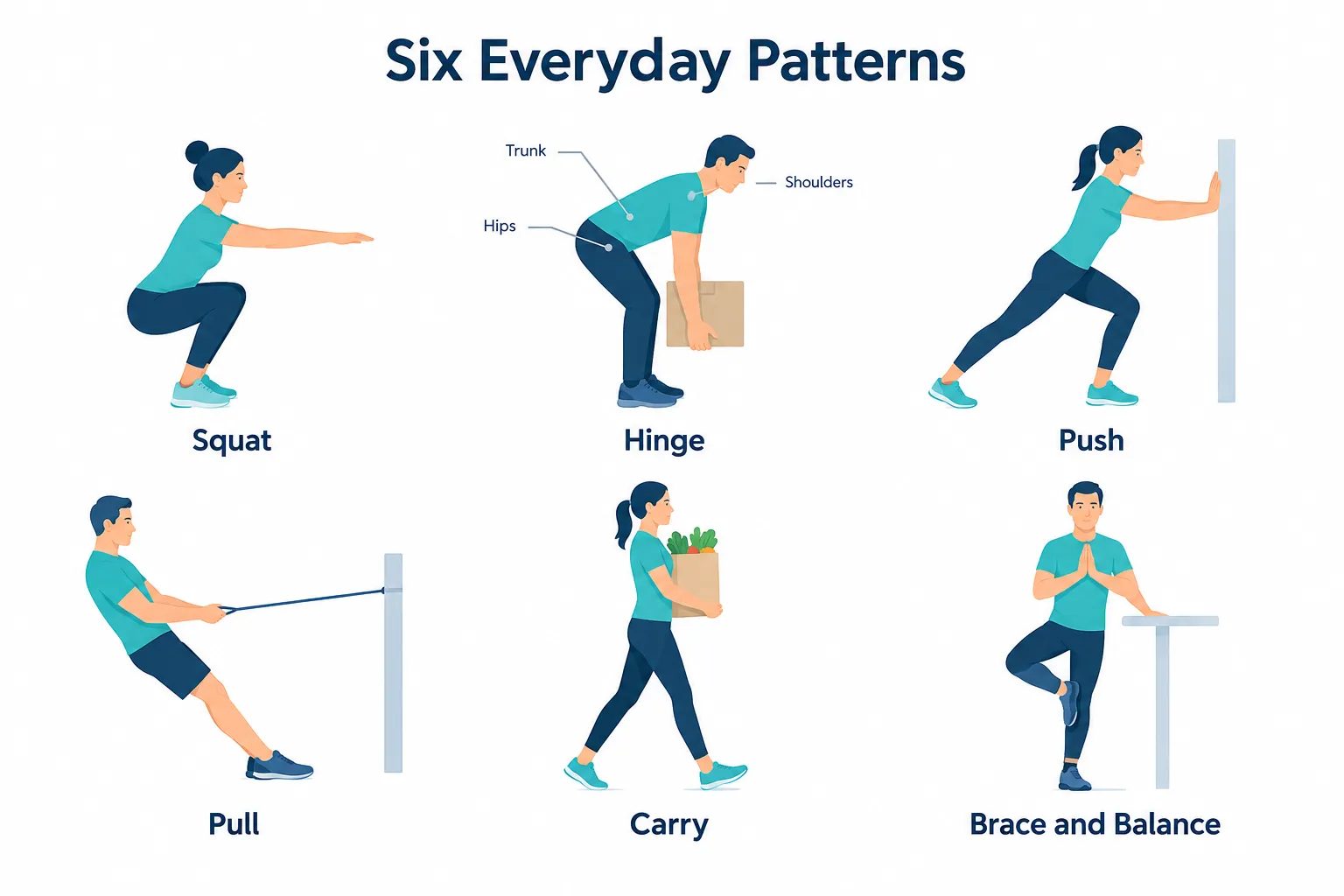
- Squat, hinge, push, pull, carry, and brace/balance patterns cover many everyday actions.
- The broader evidence supports regular resistance training for strength and physical function; it does not show that one branded style or gadget is universally best.
- Bodyweight, bands, dumbbells, machines, and ordinary household objects can all have a place when the movement and load are manageable.
- Exercise is general education here, not diagnosis, rehabilitation, or a substitute for individualized guidance when pain, instability, illness, or a clinician restriction is involved.
What Functional Strength Training Means
Functional strength training is strength work chosen with everyday tasks in mind. The name usually points to movements such as rising from a chair, picking something up, placing an object on a shelf, carrying bags, or keeping balance while changing direction.
That does not mean a movement has to copy a household chore exactly to be useful. A leg press, a squat, a row, a carry, or a sit-to-stand can all build strength that a person may use outside the gym. The important distinction is practical, not magical: the goal is to build a body that can still push, pull, hinge, carry, and get up with confidence.
It also helps to keep the label in perspective. “Functional” is not a patented method. Most sensible strength training already overlaps with it. A barbell deadlift is a hinge. A dumbbell row is a pull. A chair stand is a squat pattern. The useful question is not whether an exercise earns the label; it is whether the exercise is appropriate for the person, repeatable, and worth doing consistently.
What functional strength training is not
- It is not a replacement for medical care, rehabilitation, or individualized exercise advice.
- It is not automatically safer than other training. Load, technique, environment, recovery, and individual health context still matter.
- It is not a guaranteed solution for pain, falls, disability, weight loss, or any diagnosis.
- It does not require unstable equipment, complicated circuits, or a gym membership.
Why Everyday Patterns Matter
Everyday life asks for more than one isolated muscle at a time. Standing up uses the legs, hips, and trunk together. Carrying groceries requires grip, posture, and the ability to walk under a load. Opening a heavy door combines balance, a pulling pattern, and control through the shoulder.
That is why movement patterns can be a useful organizing tool. They help prevent a routine from becoming a random list of exercises and make it easier to notice what is missing. A program built around only pushing movements, for example, may leave pulling, carrying, and lower-body strength underdeveloped.
The idea should remain modest. Daily tasks are varied, and no short exercise list can reproduce every challenge life throws at someone. The point is to build general capacity, not to rehearse every possible household movement.
The Six Core Patterns
These six patterns are a practical way to think about functional strength. They are not a mandatory workout, and the best variation depends on experience, equipment, comfort, and any individual advice already received.
1. Sit-to-Stand or Comfortable Squat
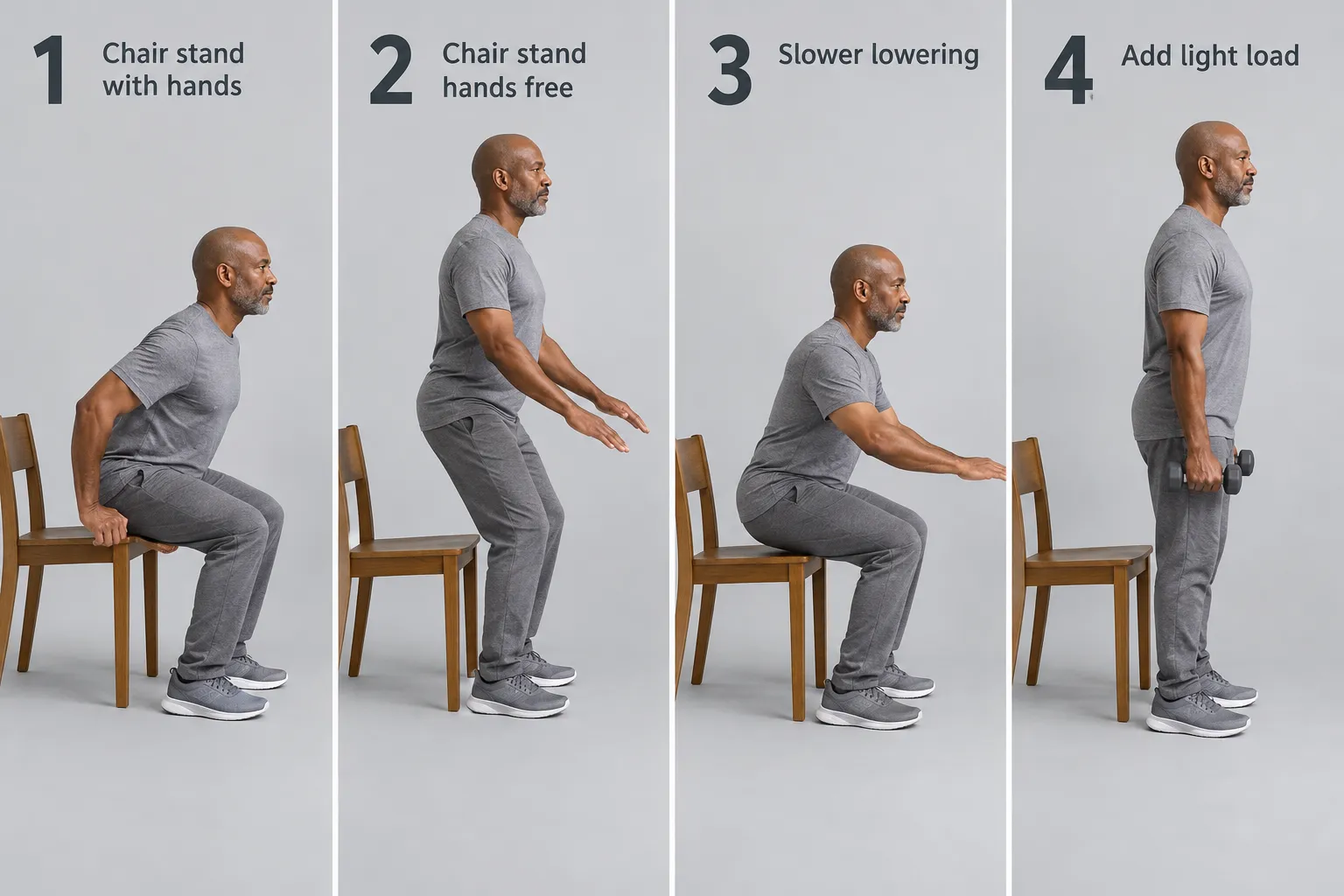
This pattern shows up whenever a person rises from a chair, toilet, car seat, or low sofa. A beginner might start with a controlled chair stand using a stable chair. Someone with more training experience may use a bodyweight squat, goblet squat, or machine-based option.
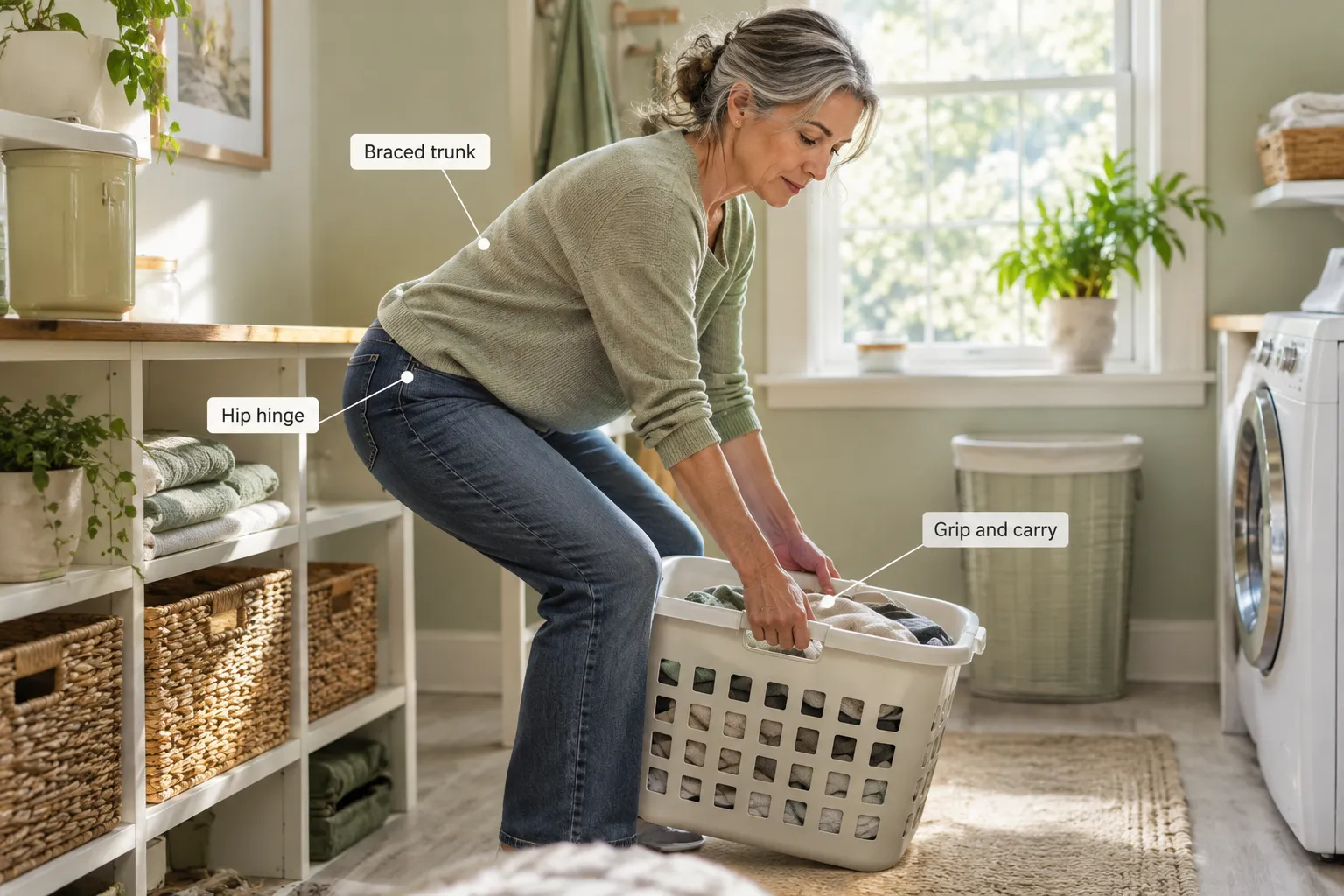
2. Supported Hip Hinge
A hinge is the pattern used to move the hips back while the torso inclines forward. It matters when reaching toward a lower shelf or lifting an object from near the floor. A light hip-hinge drill with hands on the thighs can teach the pattern before any external load is added.
3. Wall or Incline Push
Pushing patterns can relate to tasks such as moving a door, getting up from the floor, or placing something overhead. A wall push-up or incline push-up on a stable counter is often easier to control than beginning on the floor.
4. Controlled Row or Pulling Pattern
Pulling works the upper back and arms and is relevant whenever a person pulls a door, moves something closer, or steadies an object. A band row, cable row, or supported dumbbell row can all train the same broad pattern. Equipment should be stable and purpose-made for the load being used.
5. Carrying Pattern
Carrying is ordinary strength in plain sight: groceries, laundry, a suitcase, or a full watering can. A carry can be as simple as walking a short distance with a manageable object held close to the body. It is not a reason to push through hand, back, balance, or joint discomfort.
6. Bracing and Balance Practice
Bracing means creating enough trunk control to move without feeling loose or unstable. Balance practice can be as ordinary as a supported single-leg stand, a controlled step-up, or walking on a sensible surface. For a fuller discussion of balance-specific work, see balance and fall-prevention exercises for seniors.
Choosing a Starting Version
The best starting version is the one a person can control. A chair stand can come before a free squat. A wall push-up can come before a floor push-up. A light bag carried for a short distance can come before heavier carries. Small, repeatable progressions are more useful than choosing the most difficult version on day one.
Public-health guidance recommends muscle-strengthening activity on two or more days each week for adults, working all major muscle groups. That is a useful reference point, not a test a beginner must pass immediately. Starting below that level and building a steady habit is still movement in the right direction.1
A practical way to keep the idea useful
Functional training becomes less useful when it turns into an endless list of clever exercises. A better starting question is: which ordinary movement feels limited, awkward, or less confident than it used to? Getting out of a chair points toward a squat or sit-to-stand pattern. Avoiding a low shelf may point toward a hinge. Struggling with bags, laundry, or a suitcase may point toward a carry.
That question does not diagnose a weakness or prescribe a solution. It simply gives training a practical direction. Someone who is already walking regularly but has done little strength work may begin with a controlled lower-body movement, an upper-body push or pull, and a carrying pattern. Someone who already lifts may use the same movement map as a check that their routine is not all pressing and no pulling, all lower body and no trunk control, or all gym work with no attention to balance.
The useful standard is repeatability. A person should be able to finish a session feeling that they could return to it, rather than treating soreness, exhaustion, or an intimidating exercise list as proof that the session was worthwhile. The 2026 ACSM review is helpful here: many resistance-training approaches produced benefits, while consistency and gradual progression mattered more than chasing a perfect formula.2
For readers who like structure, the broad Exercise Guide for Better Health shows how strength, walking or other cardio, mobility, and balance can fit together. Functional strength is one useful part of that larger picture, not the entire plan.
Use effort and control, not a fixed weight chart
There is no universal dumbbell weight, repetition count, or progression schedule that fits every reader. A manageable load is one that allows controlled movement and normal breathing without sharp pain, dizziness, loss of balance, or a sense that technique is coming apart. When a current version feels consistently easy and controlled, a modest change—slightly more range, a little more load, another repetition, or another set—may be more sensible than changing everything at once.
Where Walking, Home Training, Bands, and Dumbbells Fit
Functional strength training does not replace walking, cardio, mobility work, or a standard gym routine. It is a way of organizing strength work around movements that have an obvious day-to-day purpose.
- Walking builds aerobic capacity and is often the simplest starting point for regular movement. It complements strength work but does not replace it.
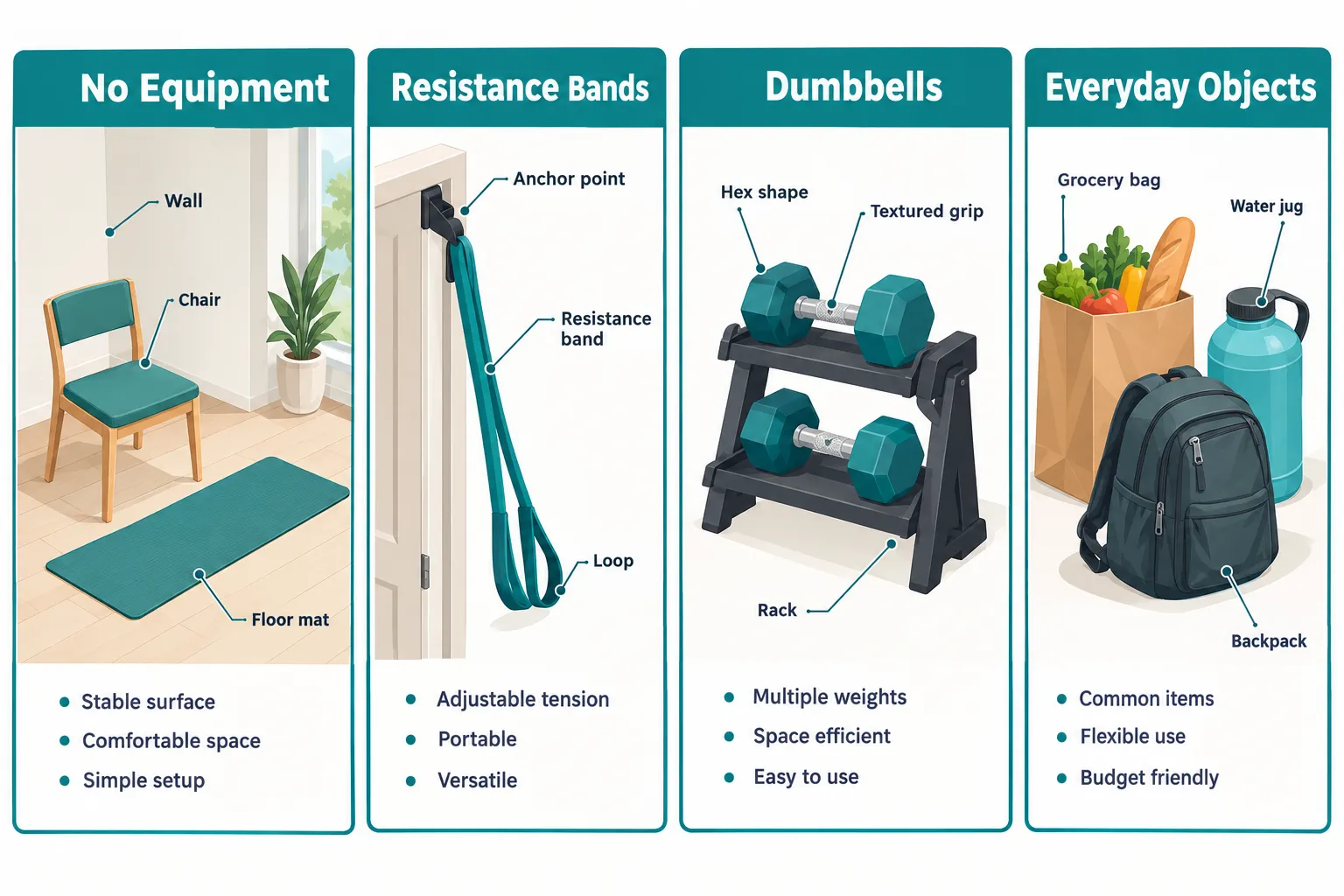
- Home bodyweight training can provide a useful base when equipment or time is limited. The home workouts without equipment guide and bodyweight strength training guide cover that route in more depth.
- Resistance bands are one practical option for rows, presses, and lower-body work, provided the band and anchor are in good condition. See resistance-band workouts for strength.
- Dumbbells make it easier to add resistance in small, trackable steps. The dumbbell exercises at home guide covers beginner-friendly options.
- Age- and life-stage context can change how someone starts, recovers, and chooses support. Women looking for a beginner plan designed around that context can use Strength Training for Women Over 50.
For the broader picture of cardio, strength, mobility, balance, and progression across a week, start with the Exercise Guide for Better Health.
What the Evidence Can—and Cannot—Say
The evidence is strongest for the broad point: resistance training can improve strength, muscle function, and several measures of physical performance in healthy adults. A 2026 American College of Sports Medicine overview synthesized 137 systematic reviews involving more than 30,000 participants. It found that resistance training improved strength, muscle size, power, endurance, and several physical-function measures compared with no exercise. It also found that many prescription details were less important than simply doing progressive resistance work consistently.2
That is useful, but it is not a license to claim that any functional-style circuit is superior to every conventional strength program. The same ACSM review found that home-based, elastic-band, circuit, and other approaches can work. The method still needs to fit the person and the goal.
Functional-task training has also been studied in older adults. A 2024 systematic review found that single-component functional training could improve activities of daily living in community-dwelling older adults, while the evidence did not show a clear advantage over other exercise programs for balance and mobility. That distinction matters: a task-focused approach can be useful without being the only valid approach.3
One 2026 randomized trial provides a narrow example rather than a universal prescription. It studied 97 inactive adults aged 65 and older with pre-existing walking difficulty. A coached, brief home program improved several function tests over 12 weeks compared with delayed treatment. Those findings are promising for that population and program; they do not prove that every reader should use a daily four-minute routine or expect the same result.4
The practical takeaway is simple: choose a manageable strength approach, cover the major patterns over time, and make progress gradually. There is no need to confuse “functional” with “complicated.”
Safety, Limits, and When Individual Guidance Makes Sense
Most healthy adults can begin with ordinary, manageable movement and build from there. Individual guidance is more important before changing a program if a person has a recent surgery or injury, a clinician-imposed restriction, substantial balance difficulty, a diagnosed condition that affects exercise tolerance, or uncertainty about how to perform a movement safely.
Stop the session and seek prompt medical assessment for chest pressure or pain, fainting, new severe shortness of breath, or other concerning symptoms during activity. Sharp or worsening pain is not a normal marker of productive training. This article is not a rehabilitation plan for knee, back, shoulder, neurological, or balance conditions.
Frequently Asked Questions
Do I need a gym for functional strength training?
No. A stable chair, clear floor space, wall, bodyweight, bands, or a pair of dumbbells can all be enough to begin. The useful choice is the one a person can use safely and consistently.
Is functional strength training different from regular strength training?
There is substantial overlap. Functional strength training puts movement patterns and everyday tasks at the center; regular strength training may be organized around muscles, lifts, or equipment. Both can include squats, hinges, pushes, pulls, and carries.
How often should a beginner do strength work?
Adults are generally advised to include muscle-strengthening activity on two or more days a week. For someone starting from little or no exercise, a lower, repeatable starting point can still be sensible while confidence and recovery are assessed.1
Will functional strength training prevent falls or fix back pain?
No general article can promise either outcome. Research on exercise can inform a sensible discussion of strength and function, but pain, falls, and balance problems need individual context and may need clinical assessment.
References
- Centers for Disease Control and Prevention. Adult Activity: An Overview.
- Currier BS, et al. American College of Sports Medicine Position Stand: Resistance Training Prescription for Muscle Function, Hypertrophy, and Physical Performance in Healthy Adults: An Overview of Reviews. Medicine & Science in Sports & Exercise. 2026.
- Liu CJ, et al. Is functional training functional? A systematic review of its effects in community-dwelling older adults. 2024.
- Dandekar S, et al. Brief daily functional strength training to improve functional performance in older adults with mobility disability: A randomized trial. PLOS One. 2026.
Informational Disclaimer
This article is for informational purposes only and is not medical advice. Always consult a qualified healthcare professional before making changes to your diet, exercise, supplements, or medications.

About the author
Dave James is the founder of All Perfect Health and writes practical, evidence-aware health guides for adults who want to stay strong, mobile and independent without hype or complicated routines. He is not a doctor; this guide is educational and does not replace individual advice from a qualified health professional.