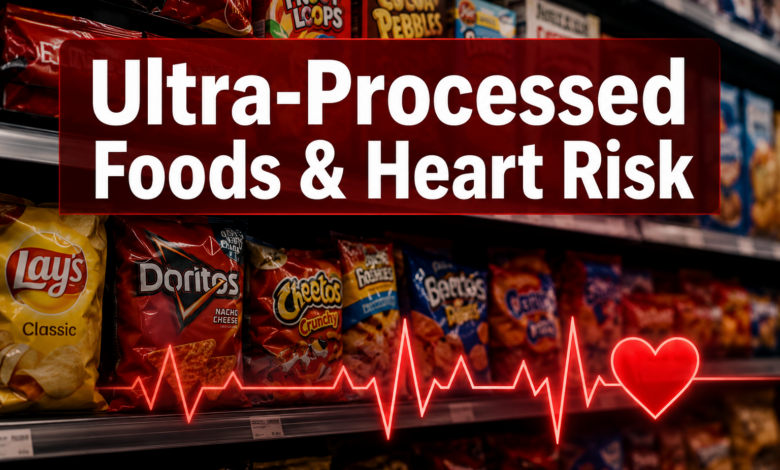
Major US Study Links Ultra-Processed Foods to Heart Attack Risk in July 2026
Last updated: July 11, 2026
Quick Answer: A major US study published in 2026 found that adults who eat the most ultra-processed foods face up to a 67% higher risk of heart attack and stroke compared to those who eat the least. The research, involving nearly 5,000 US adults, adds strong evidence to a growing body of work showing that what you eat every day has direct, measurable consequences for your heart.
Key Takeaways
- 67% higher risk of major cardiac events was found in people eating more than nine servings of ultra-processed foods (UPFs) daily, compared to those eating around one serving [1]
- Each additional daily serving of UPFs was linked to a more than 5% increase in heart attack, stroke, or cardiovascular death risk [1]
- The study tracked 4,787 US adults and found those with the highest UPF intake had a 47% higher risk of heart attack or stroke [2]
- Black Americans showed a stronger association, a 6.1% risk increase per additional serving, compared to 3.2% for non-Black participants [3]
- Ultra-processed foods currently make up roughly 58% of total energy intake in the average American diet [4]
- Processed food is not the same as ultra-processed food, the distinction matters and changes the risk picture significantly
- Frozen vegetables, plain canned beans, and minimally processed foods do not fall into the high-risk UPF category
- The evidence suggests that reducing UPF intake gradually is more practical and sustainable than trying to eliminate it entirely overnight
Table of Contents
- What Is Ultra-Processed Food? A Clear Definition
- Which Foods Count as Ultra-Processed?
- Is Processed Food the Same as Ultra-Processed Food?
- What Did the July 2026 US Study Actually Find?
- What Makes Ultra-Processed Food Bad for Your Heart?
- The Electrolyte Trap: Why “Cut Salt” Is Only Half the Story
- How Much Does Ultra-Processed Food Increase Heart Attack Risk?
- Are Frozen Vegetables Ultra-Processed?
- Do Organic or “Natural” Processed Foods Carry the Same Risks?
- How Long Does It Take for Ultra-Processed Food to Damage Your Heart?
- How Can I Avoid Ultra-Processed Foods? Practical Steps
- What Are Healthy Alternatives to Ultra-Processed Snacks?
- Can You Eat Some Ultra-Processed Foods Safely?
- FAQ
- Conclusion
- References
What Is Ultra-Processed Food? A Clear Definition
Ultra-processed foods are industrial formulations made mostly or entirely from substances extracted from foods, things like refined oils, fats, added sugars, starches, and isolated proteins, combined with additives such as artificial flavours, synthetic colours, emulsifiers, and preservatives [5]. In plain English, they are products that go far beyond simple cooking or preservation. They are engineered in a factory, not prepared in a kitchen.
The NOVA classification system, developed by researchers at the University of São Paulo, is the most widely used framework for categorising foods by their level of processing. Under NOVA, ultra-processed foods sit in Group 4, the furthest removed from whole food.
What makes a food ultra-processed under NOVA Group 4:
- Contains five or more ingredients, many of which you would not find in a home kitchen
- Includes at least one additive used to imitate or enhance flavour, colour, or texture
- Is designed primarily for convenience, palatability, and long shelf life
- Has undergone industrial processes that cannot be replicated at home (extrusion, moulding, pre-frying)
Which Foods Count as Ultra-Processed?
Ultra-processed foods are not just junk food. That is where a lot of people get caught off guard. Many products that appear healthy on the surface, certain breakfast cereals, flavoured yoghurts, plant-based meat alternatives, and protein bars, qualify as UPFs under NOVA criteria [5].
Common ultra-processed foods:
| Category | Examples |
|---|---|
| Snack foods | Crisps, crackers, flavoured popcorn, rice cakes with coatings |
| Sugary drinks | Soft drinks, energy drinks, flavoured milks, fruit-flavoured waters |
| Packaged meals | Frozen pizzas, ready meals, instant noodles, microwaveable pasta dishes |
| Processed meats | Hot dogs, chicken nuggets, reformed deli meats, sausage rolls |
| Baked goods | Mass-produced bread, packaged cakes, doughnuts, pastries |
| Breakfast items | Most commercial cereals, flavoured instant oats, breakfast bars |
| Condiments | Many bottled sauces, flavoured spreads, commercial salad dressings |
The simplest way to look at it is this: if the ingredient list reads like a chemistry textbook and the product could not be made in a normal kitchen, it is almost certainly ultra-processed.
Is Processed Food the Same as Ultra-Processed Food?
No, and this distinction matters more than most people realise. Processed food and ultra-processed food are not the same thing, and conflating them leads to unnecessary anxiety about perfectly reasonable foods.
The four NOVA processing levels:
- Group 1, Unprocessed or minimally processed: Fresh fruit, vegetables, plain meat, eggs, plain milk, dried legumes, plain nuts
- Group 2, Processed culinary ingredients: Oils, butter, flour, sugar, salt, used in cooking but not eaten alone
- Group 3, Processed foods: Canned fish, cured meats, cheese, freshly baked bread, tinned tomatoes, simple jams, foods altered to preserve or enhance them, but still recognisable
- Group 4, Ultra-processed foods: Industrial formulations with multiple additives, engineered for convenience and palatability
A tin of sardines in olive oil is processed. A fish finger made from reformed fish with flavour enhancers, stabilisers, and modified starch is ultra-processed. The risk profile is very different.
Common mistake: Avoiding all processed food is both impractical and unnecessary. The evidence targets Group 4 specifically. Canned vegetables, plain yoghurt, and traditionally made cheese are not the problem.
What Did the July 2026 US Study Actually Find?

The major US study links ultra-processed foods to heart attack risk in July 2026 with some of the clearest numbers seen in this area of research to date. Published in early 2026 and widely reported by July 2026, the study analysed data from 4,787 US adults and produced findings that cardiologists described as a significant public health signal [2].
The headline numbers:
- Adults with the highest UPF consumption had a 47% higher risk of heart attack or stroke compared to those with the lowest intake [2]
- Those eating more than nine servings per day faced a 67% higher likelihood of experiencing a major cardiac event compared to those eating around one serving daily [1]
- Every additional serving of UPFs per day was associated with a more than 5% increase in the combined risk of heart attack, stroke, or death from cardiovascular disease [1]
The racial disparity finding:
One of the more striking results was the difference in risk by racial group. Black American participants showed a 6.1% increase in cardiovascular risk per additional UPF serving, compared to 3.2% for non-Black participants [3]. Researchers noted this may reflect differences in diet composition, food access, baseline cardiovascular risk, or metabolic response, though the exact mechanisms need further study.
What the researchers said:
The research team drew a direct parallel to the public health response to tobacco, arguing that reducing UPF consumption should be treated as a population-level priority, not just an individual lifestyle choice [2].
That is a strong claim and needs strong proof, and the evidence here is building steadily.
What Makes Ultra-Processed Food Bad for Your Heart?
The mechanisms are not fully settled, but the evidence suggests several overlapping pathways that connect high UPF intake to cardiovascular damage [1][5].
The main biological pathways:
- Chronic inflammation: Many UPF additives, particularly emulsifiers and certain preservatives, appear to disrupt gut microbiome balance, which drives low-grade systemic inflammation, a known driver of arterial damage
- Visceral fat accumulation: The high energy density and low satiety of UPFs promote overeating and preferential storage of fat around internal organs, which is more metabolically harmful than subcutaneous fat
- Blood sugar dysregulation: Rapidly digested refined carbohydrates in UPFs cause repeated blood glucose spikes, stressing the pancreas and promoting insulin resistance over time
- Electrolyte imbalance — not just salt: Most UPFs are high in sodium and simultaneously low in potassium and magnesium. The sodium-to-potassium ratio has been shown to be a stronger predictor of blood pressure and heart disease than sodium alone across multiple large studies [6][7][8]. Magnesium is the essential cofactor for the cellular pump that regulates this balance, yet subclinical magnesium deficiency affects an estimated 10–30% of the population and is missed by standard blood tests [9]. Processing strips potassium and magnesium while adding sodium — a triple hit that the “cut salt” message completely misses.
- Displacement of protective foods: People eating nine-plus servings of UPFs daily are almost certainly eating fewer vegetables, legumes, whole grains, and other foods with demonstrated cardiovascular benefits
Here’s the real issue: it is probably not one single ingredient or additive doing the damage. It is the overall dietary pattern, high UPF, low whole food, that creates the conditions for cardiovascular disease to develop over years and decades.
Dave James says:
Here is what most coverage of this study gets wrong. They tell you to cut salt. That is easy and comfortable for them to say. The more honest truth is that your body needs a precise balance of three electrolytes — sodium, potassium, and magnesium — to keep your blood vessels relaxed and your heart pumping properly.
Ultra-processed foods do not just add salt. They strip out the potassium and magnesium that your body needs to counterbalance it. And because these foods now make up nearly 60% of what the average American eats, your electrolyte ratio gets pushed further out of whack with every meal.
This is not about fear. It is about understanding what is actually happening so you can do something that actually works.
The Electrolyte Trap: Why “Cut Salt” Is Only Half the Story
The standard public health message about salt and blood pressure is not wrong — it is just incomplete. The emerging evidence, from decades of research, points to something more specific: the real problem is the ratio of sodium to potassium to magnesium in your diet, not sodium alone.
What the INTERSALT Study Found
One of the largest studies ever conducted on diet and blood pressure, INTERSALT (1988, n=10,079 across 52 countries), found that the sodium-to-potassium ratio was a stronger predictor of blood pressure than either sodium or potassium alone. People with a favorable Na:K ratio had blood pressure readings 6.5 to 9.3 mmHg lower than those with poor ratios [6]. That is a bigger difference than most single blood pressure medications achieve.
TOHP and NIPPON DATA80 Confirmed It
The TOHP I and II trials (2009, n=2,974) found the same pattern: the Na:K ratio was a stronger predictor of cardiovascular disease than sodium alone [7]. In Japan, the NIPPON DATA80 study (2016, n=9,000) showed that a higher sodium-to-potassium ratio was significantly associated with increased risk of stroke, cardiovascular disease, and all-cause mortality [8]. A 2025 meta-analysis and a 2026 review both concluded that the Na:K ratio is a “more robust predictor” of cardiovascular risk than sodium intake alone.
Magnesium: The Missing Piece
Magnesium is the essential cofactor for the Na+/K+-ATPase pump — the cellular machinery that moves sodium out of your cells and potassium in. Without enough magnesium, this pump slows down. Sodium accumulates inside your cells, potassium leaks out, calcium rushes in, and your blood vessels constrict. The result is higher blood pressure [9].
Here is the problem: 48% of Americans consume below the Estimated Average Requirement (EAR) for magnesium [9]. Refined grains — which make up a large portion of the UPF-heavy American diet — lose up to 80% of their magnesium content during milling. And standard blood tests miss subclinical magnesium deficiency because serum magnesium reflects less than 1% of total body stores.
The DASH Diet: The Solution Is Already Proven
The DASH (Dietary Approaches to Stop Hypertension) diet, developed by the National Institutes of Health, is essentially the antidote to the UPF electrolyte problem. It targets 4,700 mg of potassium, 1,500–2,300 mg of sodium, and is rich in magnesium from whole foods. The original DASH trial (1997, n=459) lowered systolic blood pressure by 5.5 mmHg overall — and 11.4 mmHg in people with hypertension [11]. When combined with sodium reduction, the effects were additive [12].
That is a blood pressure reduction comparable to what many people get from medication. Not bad for a diet built around vegetables, fruit, legumes, nuts, and plain dairy.
How Much Does Ultra-Processed Food Increase Heart Attack Risk?
Based on current evidence from the 2026 US study and prior research, the dose-response relationship is fairly consistent: more UPFs, more risk [1][2].
Risk summary by intake level:
- Low intake (around 1 serving/day): Used as the reference group in the study; lowest observed cardiovascular risk
- Moderate intake: Risk increases progressively with each additional daily serving, roughly 5% per serving [1]
- High intake (9+ servings/day): 67% higher risk of major cardiac events compared to the low-intake group [1]
The numbers matter here. A 67% relative risk increase sounds alarming, and it should prompt attention. But context matters too. If your baseline 10-year cardiovascular risk is 5%, a 67% relative increase brings it to roughly 8.4%. If your baseline risk is 20%, that same relative increase takes it to around 33%. The absolute numbers depend on your individual starting point.
A sensible starting point is to speak with your GP or cardiologist about your personal cardiovascular risk before drawing conclusions about what these population-level statistics mean for you specifically.
Are Frozen Vegetables Ultra-Processed?
No. Plain frozen vegetables are not ultra-processed. This is one of the most common misconceptions around UPFs, and it puts people off affordable, nutritious food for no good reason.
Plain frozen vegetables, peas, broccoli, spinach, mixed vegetables without sauces or seasoning, fall into NOVA Group 1 (minimally processed). Freezing is a preservation method, not an industrial reformulation. The nutritional profile of plain frozen vegetables is comparable to fresh, and in some cases better due to faster processing after harvest.
What to check on frozen food labels:
- ✅ Ingredients list: just the vegetable itself (e.g., “peas”)
- ✅ No added sauces, flavourings, or emulsifiers
- ⚠️ Frozen meals with sauces, seasoning packets, or multiple additives, these are a different matter
The same logic applies to plain canned tomatoes, tinned fish in water or oil, and plain canned legumes. These are processed, not ultra-processed, and the evidence does not flag them as cardiovascular risks.
Do Organic or “Natural” Processed Foods Carry the Same Risks?
Largely, yes, if they meet the criteria for ultra-processing. The organic label addresses how ingredients were grown, not how the final product was manufactured. An organic breakfast bar with 12 ingredients including emulsifiers, natural flavours, and glucose syrup is still an ultra-processed food under NOVA classification.
This is where hype gets in the way of practical decision-making. “Natural,” “organic,” “non-GMO,” and “clean label” are marketing terms. They do not automatically indicate a lower level of processing or a lower cardiovascular risk.
The test is the same regardless of the organic label:
- How many ingredients does it have?
- Are there additives you would not use in home cooking?
- Has it been industrially reformulated?
If the answer to those questions points to Group 4, the organic certification does not change the risk picture meaningfully based on current evidence.
How Long Does It Take for Ultra-Processed Food to Damage Your Heart?
It is not that simple, cardiovascular disease develops over years, not days. There is no single threshold moment where UPF consumption tips into damage. The process is gradual and cumulative.
What the research shows is that the risk is associated with habitual, long-term dietary patterns rather than occasional consumption. The studies tracking cardiovascular outcomes follow participants over years and decades, not weeks [1][2][5].
What we know about the timeline:
- Inflammation markers can rise within weeks of a high-UPF diet
- Metabolic changes (insulin resistance, blood pressure shifts) can develop over months
- Structural cardiovascular damage, arterial stiffening, plaque buildup, accumulates over years
- The 2026 study population reflects decades of dietary habits, not short-term exposure
The practical implication is that the earlier you reduce UPF intake, the more time your body has to benefit. But it also means that gradual, sustained change is more relevant than short-term dietary experiments.
How Can I Avoid Ultra-Processed Foods? Practical Steps
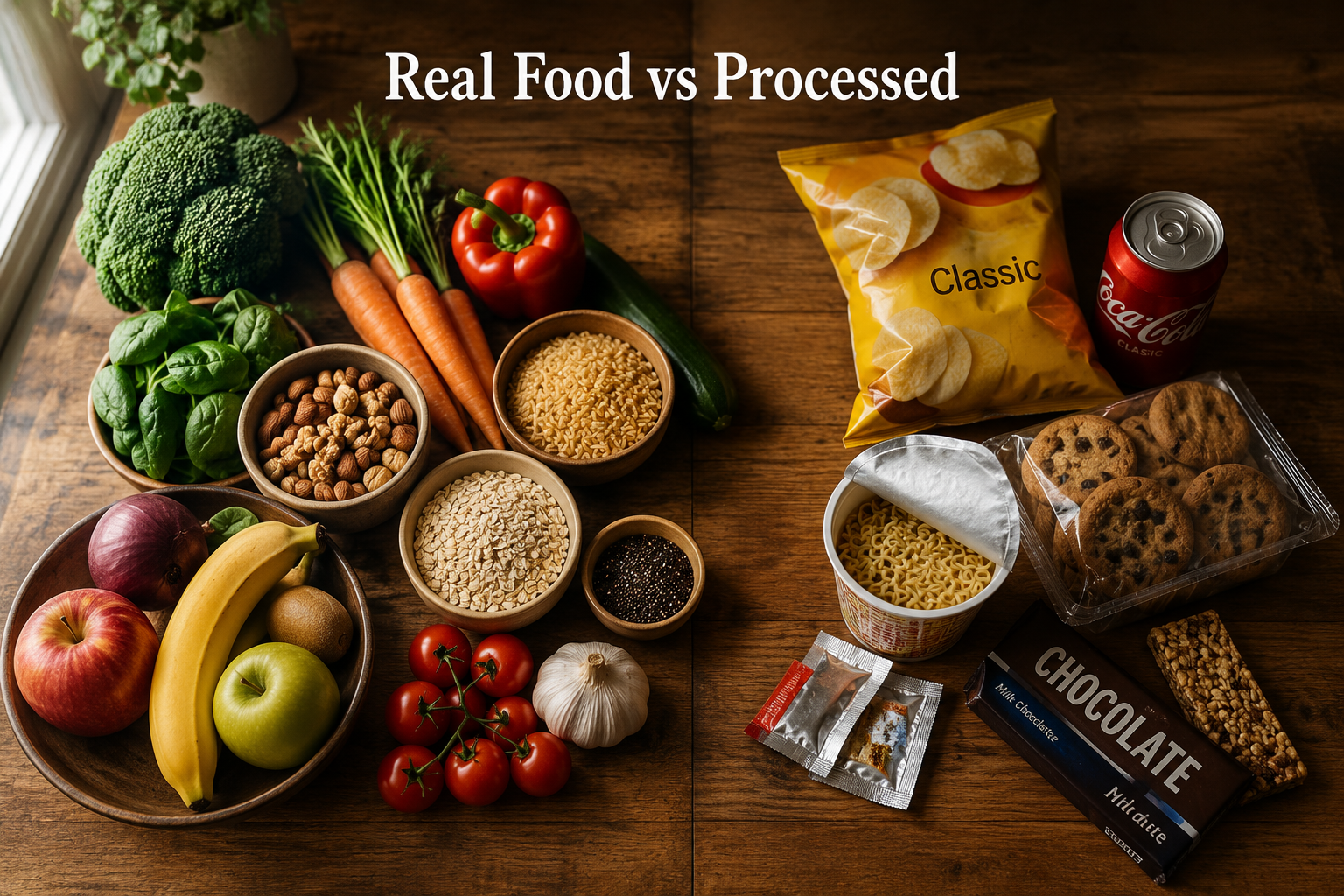
The major US study links ultra-processed foods to heart attack risk in July 2026 in a way that makes practical dietary change more urgent, but let’s keep this practical. Eliminating UPFs entirely is neither realistic nor necessary for most people. The goal is meaningful reduction, not perfection.
A realistic reduction framework:
Step 1, Audit your current intake
Keep a two-day food diary and count how many packaged, industrially produced items you eat. Most people underestimate this significantly. Ultra-processed foods currently account for roughly 58% of energy intake in the average US diet [4].
Step 2, Identify your highest-volume UPF habits
For most people, the biggest sources are: sugary drinks, packaged snacks, breakfast cereals, and convenience meals. Start with what gives the biggest return, replacing a daily sugary drink with water or plain sparkling water is a high-impact, low-effort change.
Step 3, Build a simple swap list
| Instead of this | Try this |
|---|---|
| Packaged breakfast cereal | Plain rolled oats with fruit and nuts |
| Flavoured yoghurt | Plain full-fat yoghurt with fresh fruit |
| Processed deli meat | Plain cooked chicken or tinned fish |
| Packaged snack bars | A small handful of unsalted nuts |
| Instant noodles | Wholegrain pasta with olive oil and vegetables |
| Soft drinks | Water, sparkling water, or unsweetened tea |
| Ready-made frozen pizza | Homemade flatbread with tomato and cheese |
Step 4, Cook more from Group 1 and Group 3 ingredients
You do not need elaborate recipes. A meal of grilled fish, roasted vegetables, and brown rice takes 30 minutes and contains zero ultra-processed ingredients.
Step 5, Read ingredient lists, not just nutrition panels
The nutrition panel tells you about macros. The ingredient list tells you about processing level. If it has more than five ingredients and includes things like “modified starch,” “sodium stearoyl lactylate,” or “acesulfame K,” it is almost certainly ultra-processed.
What Are Healthy Alternatives to Ultra-Processed Snacks?
The snacking category is where most people’s UPF intake is highest and where small changes have the biggest practical impact.
Evidence-based snack alternatives:
- A small handful of mixed nuts, linked to reduced cardiovascular risk in multiple large studies; no processing, no additives
- Fresh fruit, portable, naturally sweet, high in fibre and polyphenols
- Plain yoghurt with berries, Group 3 food, high in protein, no industrial additives
- Hummus with vegetable sticks, minimally processed, high in fibre and plant protein
- Hard-boiled eggs, convenient, protein-dense, zero additives
- Tinned fish on plain crackers, look for crackers with three or fewer ingredients
- Sliced avocado on wholegrain toast, healthy fats, fibre, minimal processing
The basics still do the heavy lifting here. There is no magic in it, whole foods eaten regularly over time is what the evidence consistently supports.
Can You Eat Some Ultra-Processed Foods Safely?
Yes, in moderation. The research does not suggest that eating a packet of crisps once a week will meaningfully raise your cardiovascular risk. The harm is associated with high habitual intake, particularly nine or more servings per day [1].
Based on current evidence, the stronger evidence points to overall dietary pattern as the key variable. A diet that is predominantly whole foods, vegetables, legumes, fish, and minimally processed ingredients, with occasional UPFs, is consistent with good cardiovascular health outcomes.
A practical position:
- Aim for UPFs to represent no more than 20% of your daily food intake by volume or servings
- Treat them as occasional convenience items, not dietary staples
- Prioritise reducing the highest-risk UPFs first: sugary drinks, processed meats, and high-sodium packaged snacks
I would be careful with any advice that says a specific number of servings per day is universally “safe”, individual cardiovascular risk varies considerably, and what matters most is the overall dietary pattern over time.
FAQ
Q: What exactly counts as one serving of ultra-processed food?
A serving size varies by product, but researchers typically use standard portion sizes, one can of soft drink, one packet of crisps, one serving of breakfast cereal, or one frozen meal. In practice, many people consume multiple servings in a single sitting without realising it.
Q: Is wholegrain bread ultra-processed?
Most commercial wholegrain breads are ultra-processed because they contain emulsifiers, preservatives, and added flavours. Traditionally made sourdough or bread with three to five simple ingredients (flour, water, salt, yeast) is not. Check the ingredient list.
Q: Does cooking at home automatically mean avoiding ultra-processed foods?
Not automatically. If you cook with packaged sauces, seasoning mixes, or processed ingredients, the meal may still contain UPF components. Cooking from whole ingredients is the cleaner approach.
Q: Are protein shakes and meal replacement drinks ultra-processed?
Most are. They typically contain multiple isolated proteins, emulsifiers, artificial sweeteners, and flavourings, a clear Group 4 formulation. Some may be nutritionally adequate, but they are still ultra-processed by NOVA criteria.
Q: Does the 67% risk increase apply to everyone equally?
No. The 2026 study found the risk was more pronounced in Black Americans (6.1% per additional serving vs 3.2% for non-Black participants) [3]. Individual baseline cardiovascular risk also modifies the absolute impact of the relative risk increase.
Q: Should I stop eating ultra-processed foods entirely?
The evidence does not require elimination, it supports meaningful reduction. Focus on reducing the highest-volume and highest-risk UPFs in your diet first, and build from there.
Q: Are diet soft drinks safer than regular soft drinks?
Diet drinks avoid the blood sugar impact of regular soft drinks, but they still qualify as ultra-processed and some research suggests artificial sweeteners may have their own metabolic effects. Water, plain sparkling water, and unsweetened tea remain the clearest low-risk alternatives.
Q: How does this study compare to earlier research?
It is consistent with and strengthens prior findings. Earlier ACC research had already flagged the UPF-cardiovascular link [4], and the NIH had been exploring the mechanisms [5]. The 2026 study adds a larger US-specific dataset and clearer dose-response data.
Conclusion
The major US study links ultra-processed foods to heart attack risk in July 2026 with numbers that are hard to ignore: a 67% higher risk of major cardiac events for high consumers, and a measurable 5% risk increase with every additional daily serving [1][2]. These are not marginal findings.
The main takeaway is this: the average American diet, where ultra-processed foods account for roughly 58% of total energy intake [4], represents a significant and largely modifiable cardiovascular risk. The good news is that modification does not require perfection. It requires consistent, practical choices made more often than not.
Actionable next steps:
- Audit your diet for two days and count your UPF servings honestly
- Identify your top three UPF habits and find one realistic swap for each
- Replace sugary drinks first, this single change often has the highest impact
- Read ingredient lists on packaged foods before buying
- Build meals around whole foods, vegetables, legumes, fish, eggs, plain grains, and treat UPFs as occasional items
- Talk to your GP if you have existing cardiovascular risk factors; this research adds context to a conversation worth having
Keep it simple and consistent. The evidence is clear enough to act on, and the actions required are well within reach for most people.
📂 Modern Food Processing & Gut Chemistry
This article is part of the APH cluster. Use the links below to move between the pillar and child articles.
- Read the pillar: Modern Food Processing and Gut Health: How Processed Food Affects Gut Chemistry
- → Ultra-Processed Foods, Emulsifiers, and Microplastics: What They Really Do to Your Gut
- → Fermented Foods vs Probiotics vs Postbiotics: What Actually Survives Digestion?
- → Resistant Starch and Prebiotic Fiber: How Carbs Feed Your Gut Microbiome
- → The Hidden Dangers of Reusing Cooking Oil: What You Need to Know This August 2026
- → Beef Tallow vs. Seed Oil: Which is Healthier for Cooking in 2026?
- → Industrial Seed Oil Processing: What Happens Before It Hits the Shelf
- → How Food Additives Affect Your Gut Microbiome Health
- → What Modern Processing Does to Food Proteins and Starches
- → Food Preservatives Health Effects: What’s Really in Your Food and Why It Matters
- YOU ARE HERE Major US Study Links Ultra-Processed Foods to Heart Attack Risk in July 2026