
Resistant Starch and Prebiotic Fiber: How Carbs Feed Your Gut Microbiome

Last updated: May 17, 2026
Quick Answer: What Is Resistant Starch?
Resistant starch is a type of starch that escapes digestion in the small intestine and travels to the large intestine, where gut bacteria ferment it. That fermentation produces short-chain fatty acids, particularly butyrate, which plays a role in fueling colon cells and supporting the gut barrier. Because it feeds beneficial gut microbes, resistant starch behaves more like a prebiotic fiber than a regular digestible carbohydrate.
In plain English: not every carb behaves the same after you eat it. Some starch gets broken down into glucose and absorbed early. Some of it doesn’t, and what happens to that undigested portion is what makes resistant starch and prebiotic fiber worth understanding.
Key Takeaways
- Resistant starch escapes the small intestine and reaches the colon, where gut bacteria ferment it into short-chain fatty acids (SCFAs) including butyrate, acetate, and propionate.
- It acts like a prebiotic fiber because it selectively feeds beneficial gut microbes, but it is not identical to all other dietary fibers.
- The best everyday sources are legumes, cooked-and-cooled potatoes, rice, pasta, oats, green bananas, and barley.
- Cooling cooked starches does increase resistant starch content through a process called retrogradation, but the effect varies by food and method.
- Reheating cooked-and-cooled carbs doesn’t necessarily eliminate all the resistant starch, though amounts vary.
- There is no official daily target for resistant starch specifically. Focus on total fiber diversity and include resistant-starch-rich foods regularly.
- Increase intake gradually to avoid gas and bloating, especially if you currently eat a low-fiber diet.
- Supplements are not the default starting point. Food-first is the more practical and evidence-supported approach.
- People with IBS, IBD, SIBO, or other digestive conditions should individualize changes and seek professional guidance.
- The main takeaway: resistant starch is not a carb loophole. Its value comes from what it delivers to the colon and what gut bacteria do with it.
Is Resistant Starch the Same as Prebiotic Fiber?
Not exactly, but there is significant overlap. Understanding the distinction helps you make better food choices without getting lost in terminology.
Expert insight: Thomas DeLauer. Thomas DeLauer is a metabolic health researcher and educator who translates complex metabolic science into practical, evidence-based nutrition and lifestyle protocols.
Expert insight: Thomas DeLauer. Thomas DeLauer is a metabolic health researcher and educator who translates complex metabolic science into practical, evidence-based nutrition and lifestyle protocols.
What “prebiotic” actually means
The International Scientific Association for Probiotics and Prebiotics (ISAPP) defines a prebiotic as a substrate that is selectively used by host microorganisms and confers a health benefit. That is the technical version. In plain English: a prebiotic is food for certain beneficial microbes in your gut, not just any fiber that passes through.
This matters because not every fiber automatically qualifies as a prebiotic under that definition. The selectivity part is important. Some fibers are fermented broadly; others preferentially feed specific bacterial groups. The health-benefit requirement also means the evidence bar is higher than simply “this reaches the colon.”
How resistant starch fits into the fiber family
Resistant starch is widely discussed as a form of dietary fiber because it resists digestion and is fermented by gut microbes. The FDA’s definition of dietary fiber includes intrinsic intact plant fibers and certain non-digestible carbohydrates shown to have beneficial physiological effects.
Here’s the real issue with the terminology: “fiber” is a broad category. It includes:
- Soluble fiber (dissolves in water, forms a gel, found in oats and legumes)
- Insoluble fiber (adds bulk, found in wheat bran and vegetable skins)
- Fermentable fibers (broken down by gut bacteria, which includes many soluble fibers and resistant starch)
- Prebiotic fibers (fermentable fibers that selectively benefit specific microbes, such as inulin, FOS, and beta-glucan)
- Resistant starch (a starch-based fermentable carbohydrate that overlaps with the prebiotic category)
These categories overlap but are not identical. Resistant starch can function as a prebiotic, and it is a type of dietary fiber, but calling it simply “fiber” misses what makes it distinct.
The simple reader takeaway
Think of fiber as the broad category, prebiotic fiber as the microbe-feeding subcategory, and resistant starch as one important starch-based member of that conversation. Different fibers feed different microbes and produce different fermentation patterns. That is why fiber diversity matters more than chasing any single type.
Why Resistant Starch Matters for Gut Chemistry
The core reason resistant starch and prebiotic fiber matter is straightforward: what reaches the colon changes what gut microbes can do. Modern diets, particularly those heavy in ultra-processed foods, often deliver far less fermentable material to the large intestine than traditional whole-food diets did. Resistant starch helps address that gap.
It gives gut bacteria something to ferment
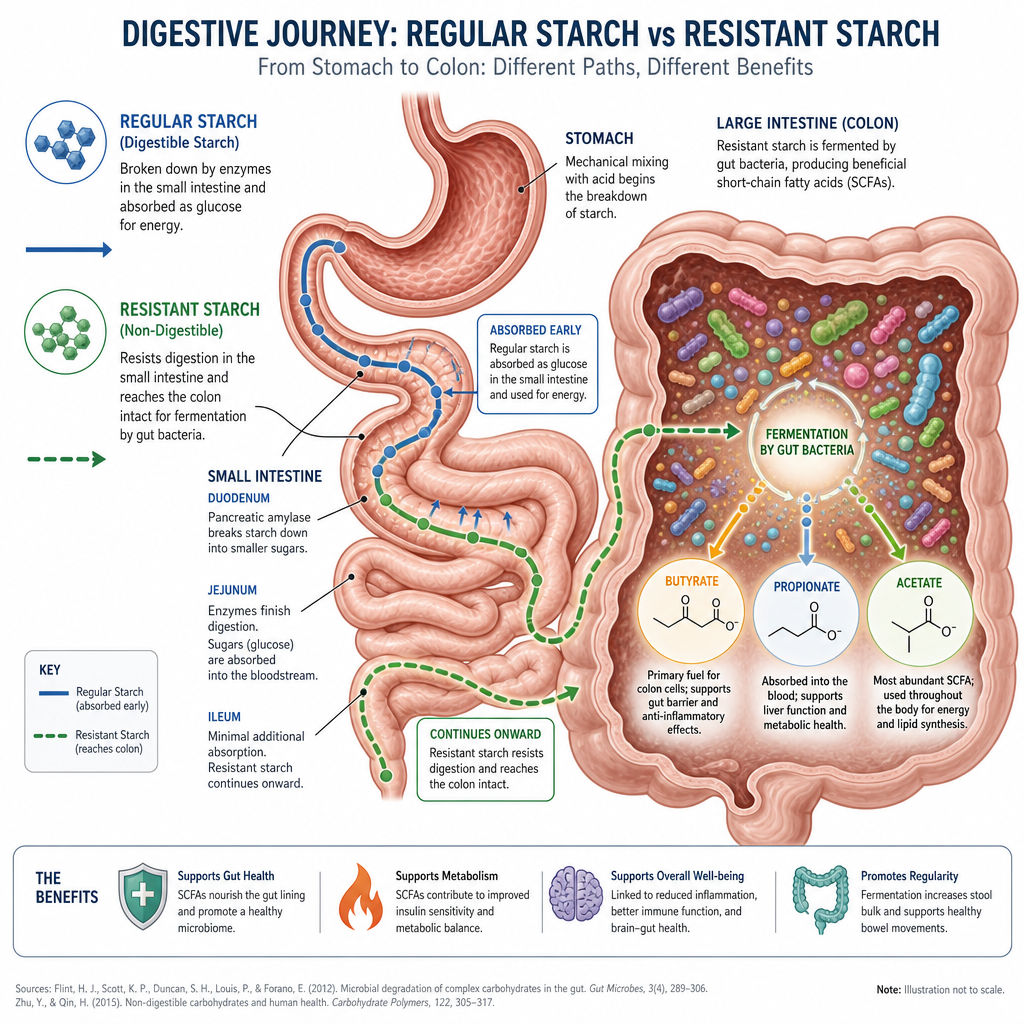
In the small intestine, digestive enzymes break down most regular starch into glucose, which is absorbed into the bloodstream. Resistant starch bypasses that process. It arrives in the large intestine largely intact, where the resident microbial community can use it as a fermentation substrate.
This is the angle that connects resistant starch directly to the broader question of gut health and modern food processing. It is not just about what ultra-processed foods add to your diet; it is also about what fiber-rich whole foods they displace. When the colon receives less fermentable material, the microbial community has less to work with.
It can increase short-chain fatty acid production
Fermentation of resistant starch produces short-chain fatty acids. The three main ones are:
- Butyrate: Commonly discussed as the primary fuel source for colonocytes (colon lining cells) and a compound with a role in gut barrier function.
- Propionate: Involved in signaling pathways related to glucose metabolism and appetite regulation.
- Acetate: The most abundant SCFA; involved in broader metabolic processes and may influence immune function.
Nature Reviews Immunology describes SCFAs such as butyrate, propionate, and acetate as microbial metabolites shaped by diet and microbiota, with roles in epithelial barrier function and immune regulation.
I would be careful with that framing, though. More butyrate does not automatically fix gut problems. The relationship between SCFAs and gut health is real and well-supported, but it is not a simple input-output switch. Context matters, as does the overall microbial community, diet quality, and individual variation.
It may support metabolic health, but claims need caution
Research on resistant starch includes outcomes related to glucose response, insulin sensitivity, and appetite. A 2024 trial published in Nature Metabolism found that 40 g per day of resistant starch type 2 for 8 weeks, alongside a controlled diet, was associated with reduced body weight and improved insulin sensitivity in people with excess body weight. That is interesting research. It is not a reason to start taking 40 g of resistant starch supplements daily without clinical guidance.
The evidence suggests a food-first approach is both safer and more practical. Whole foods bring resistant starch alongside fiber, polyphenols, protein, and minerals. Supplements isolate one variable. The stronger evidence points to dietary patterns rather than single-ingredient interventions.
The Main Types of Resistant Starch
Understanding the types helps explain why green bananas, legumes, and cooled potatoes are not the same source, even though all three contain resistant starch.
RS1: Physically trapped starch
RS1 is starch that is physically enclosed within intact cell walls in whole or partly milled grains, seeds, and legumes. The starch is present, but the food structure limits how well digestive enzymes can reach it. This connects directly to the food matrix concept: the physical form of food changes how it is digested, not just its nutrient content.
RS2: Naturally resistant starch granules
RS2 is found in foods where the starch granule itself is resistant to digestion in its raw or uncooked form. Green (unripe) bananas and raw potato starch are the most commonly cited examples. Some high-amylose corn starch also falls here.
Cooking can reduce RS2 content in many foods because heat causes the granule structure to break down. This is why ripe, cooked bananas have much less resistant starch than firm, green ones. And to be clear: this is not a reason to eat raw potatoes. Raw potatoes carry food safety concerns and are not a practical or comfortable source of resistant starch.
RS3: Retrograded starch from cooking and cooling
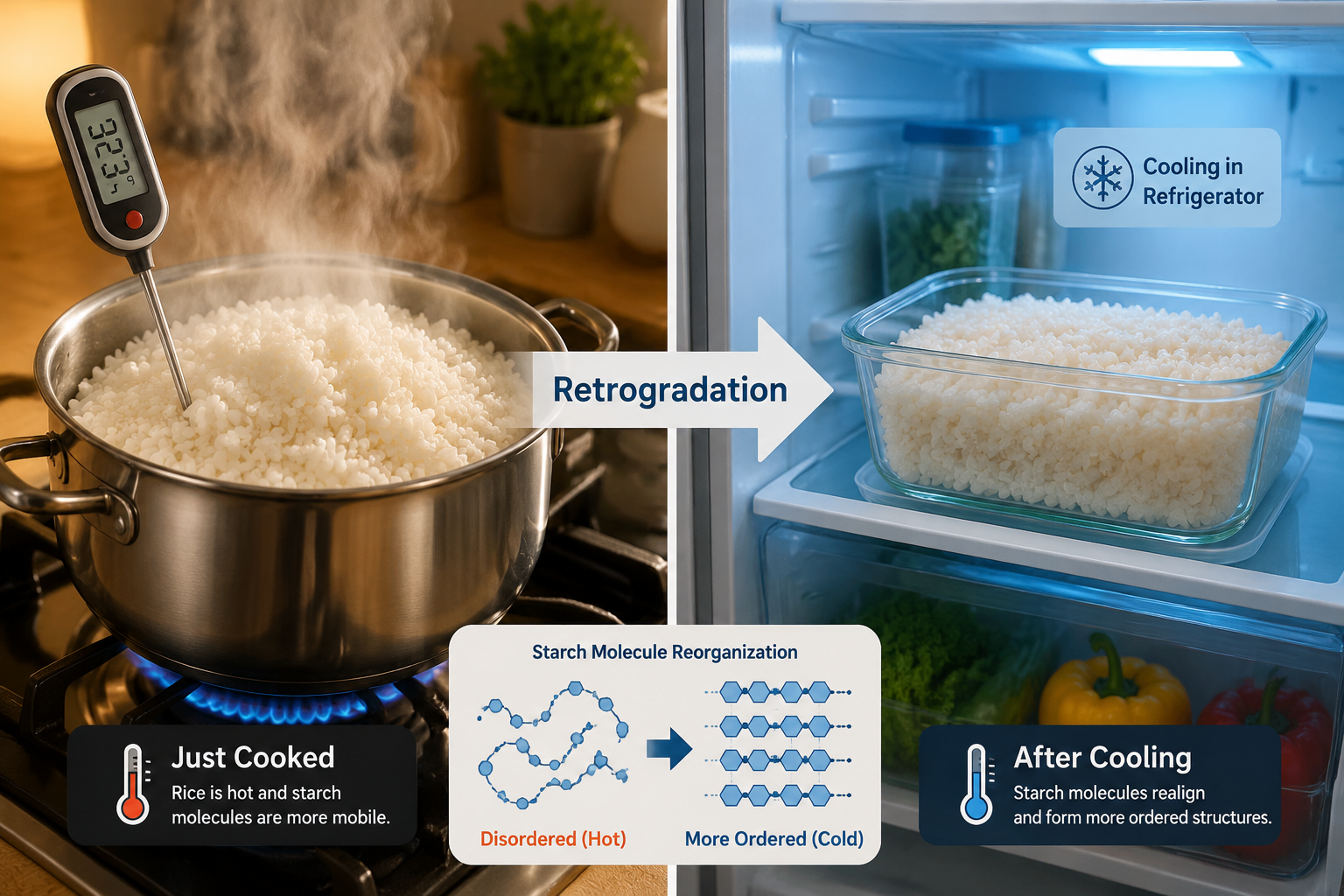
This is the type most readers are curious about, and for good reason. RS3 forms when cooked starches are cooled. As the temperature drops, some starch molecules reorganize into a more tightly packed, crystalline structure that digestive enzymes cannot break down as efficiently.
Foods where this matters in practice: potatoes, rice, pasta, oats, and legumes. CSIRO notes that repeated cooking and cooling can modestly raise resistant starch in foods like rice, pasta, and potatoes. Johns Hopkins notes that cooked rice that has been cooled contains more resistant starch than rice that was cooked but not cooled.
The increases are real but not dramatic. This is a useful dietary habit, not a transformation of the food’s entire character.
RS4 and RS5: Modified or complexed starches
RS4 is chemically modified starch used in some processed food products. RS5 involves starch-lipid complexes. Both are worth knowing exist, but neither is relevant to everyday food choices. Most readers will get their resistant starch from the first three types.
Best Food Sources of Resistant Starch and Prebiotic Fiber
A sensible starting point is to think about which foods deliver resistant starch alongside other useful nutrients, rather than which food has the single highest resistant starch content.
Legumes: beans, lentils, chickpeas, peas
Legumes are the strongest everyday option. They provide resistant starch, total dietary fiber, plant protein, minerals, and affordability. Lentils, black beans, pinto beans, navy beans, and chickpeas all appear consistently in dietary guidelines as meaningful fiber sources.
Practical options: lentil soup, bean salads, chickpeas in grain bowls, black beans with cooled rice, hummus as a snack base. These are not exotic or difficult additions.
Cooked-and-cooled potatoes, rice, and pasta
Cooling is the important step for RS3 formation. Refrigerating cooked potatoes, rice, or pasta overnight increases their resistant starch content compared to eating them hot. Reheating may retain some of that resistant starch, though the amount varies by food and method.
Practical examples: potato salad made with chilled boiled potatoes, rice bowls assembled from refrigerated cooked rice, pasta salad, or cooled roasted potatoes reheated as a dinner side. These are meal-prep habits that happen to support gut chemistry.
Oats, barley, and whole grains
Overnight oats are a practical example of RS3 formation at breakfast. Oats soaked in liquid overnight and eaten cold or gently warmed retain more resistant starch than instant oats cooked with boiling water. Barley contributes beta-glucan (a well-studied prebiotic fiber) alongside fermentable carbohydrate. Whole grains generally provide more resistant starch than their refined counterparts because the physical structure remains more intact.
Green bananas and plantains
Firm, less-ripe bananas contain significantly more resistant starch than ripe, yellow bananas. As bananas ripen, starch converts progressively to simpler sugars. A banana that is still slightly green at the tips has more RS2 than a fully yellow or spotted one.
Realistic use: add slices of a slightly green banana to yogurt or a smoothie. This is a small, practical change, not a dramatic dietary overhaul.
Nuts, seeds, and mixed plant foods
Nuts and seeds contribute to overall fiber diversity and provide some fermentable carbohydrate, though they are not primary resistant starch sources. Their value is in the variety they add to the overall plant-food intake. The broader point is this: the goal is a variety of plants, not optimization of one nutrient.
Does Cooking and Cooling Carbs Really Make Them Healthier?
The short answer is: it can increase resistant starch content, which has some gut-health relevance, but it does not transform a food’s overall nutritional character.
What happens during cooling
After cooking, starch molecules are in a loosely organized, gelatinized state. As the food cools, some of those molecules reorganize into a more ordered, crystalline structure through a process called retrogradation. That reorganized starch is harder for digestive enzymes to break down, so more of it reaches the colon intact.
The simplest way to look at it is this: the starch changes shape in a way that makes it harder for your digestive enzymes to process it in the small intestine. That is not a flaw; it is a feature from a gut-microbiome perspective.
Which foods work best?
Potatoes, rice, pasta, oats, and legumes all show measurable retrogradation. The exact resistant starch content varies by food variety, cooking method, cooling time, and reheating approach. CSIRO notes that resistant starch content varies by preparation, cooking, and reheating. The numbers in food databases are estimates and should be treated as such.
Does reheating destroy resistant starch?
Not entirely. Some resistant starch survives reheating, particularly in legumes and potatoes. Johns Hopkins notes it is generally acceptable to reheat cooked-and-cooled starches before eating, while acknowledging that amounts vary by food and method. Gentle reheating (steaming, low-heat warming) is likely to preserve more than aggressive high-heat cooking.
Food safety matters more than the resistant starch effect
Here is something the “cold carbs are healthier” conversation often skips: food safety. Cooked rice, pasta, and potatoes should not sit at room temperature for hours just to cool down for resistant starch purposes.
The CDC advises refrigerating perishable foods and cooked leftovers within 2 hours of cooking, or within 1 hour if the temperature is above 90°F. Warm foods can be portioned into shallow containers to speed cooling before refrigeration. Cool your food safely first. The resistant starch benefit is secondary to not getting food poisoning.
Resistant Starch vs Regular Starch: What Changes in the Body?
The same food can behave differently depending on its structure and how it was prepared. This is not a reason to fear regular starch. It is a reason to understand what changes digestion.
Regular starch is mostly digested earlier
Regular digestible starch is broken down into glucose by amylase enzymes in the mouth and small intestine. That glucose is absorbed into the bloodstream and used for energy. This is normal physiology and not inherently a problem. Avoiding carbohydrates entirely is not the lesson here.
Resistant starch reaches the colon
The gut-health relevance of resistant starch comes entirely from where it goes. Because it resists enzymatic breakdown in the small intestine, it arrives in the large intestine where microbial fermentation can occur. The mental model worth keeping is this: what reaches the colon changes what microbes can do.
The food matrix changes digestion speed
Whole oats digest more slowly than instant sweetened oats. Whole legumes behave differently from refined crackers made from legume flour. Potato salad made from chilled boiled potatoes delivers more resistant starch than hot mashed potatoes. These are not dramatic differences in isolation, but they accumulate across a day’s worth of eating.
The food matrix, meaning the physical structure of the food, not just its nutrient content, shapes how quickly and completely digestion occurs. This connects directly to the broader theme of how modern food processing affects what reaches the colon.
How Much Resistant Starch Should You Eat?
There is no simple universal daily target, and I would be careful about any source that gives you one with high confidence.
There is no official daily value for resistant starch
Unlike total dietary fiber, resistant starch does not have a clearly established daily value that appears on food labels. CSIRO notes that accurate population-level estimates of resistant starch intake are difficult because food databases for resistant starch are limited and inconsistent. The numbers you see in articles vary widely depending on which database was used and how the food was prepared.
Start with total fiber first
For practical purposes, improving total fiber intake and fiber diversity is the more useful starting point. The FDA uses 28 g per day as the Daily Value for total fiber based on a 2,000-calorie diet. Most adults in Western countries fall well short of that. The Dietary Guidelines list beans, lentils, berries, whole grains, vegetables, nuts, and seeds as the primary fiber sources.
Start with what gives the biggest return: adding more whole plant foods to your regular meals. Resistant starch will follow naturally.
Practical starting targets
| Goal | Practical Step |
|---|---|
| General gut health | Add ¼–½ cup of beans or lentils most days |
| Meal prep | Cook and refrigerate potatoes, rice, or pasta for use in next-day meals |
| Breakfast | Overnight oats with berries and plain yogurt |
| Sensitive gut | Start with 2–3 tablespoons of legumes per meal and increase over 2–4 weeks |
| Supplement consideration | Discuss with a clinician or dietitian before using concentrated resistant starch supplements |
Do not recommend high-dose potato starch supplements as a starting point. If you are considering concentrated supplements, that is a conversation for a clinician or registered dietitian, particularly if you have IBS, IBD, diabetes, or any digestive condition.
How to Add Resistant Starch Without Bloating
Sudden increases in fermentable fiber can cause gas, bloating, and loose stools. This is not dangerous for most people, but it is uncomfortable enough to make people give up. The solution is simple: go slowly.
Increase slowly
Increase your intake of resistant starch and prebiotic fiber over 2 to 4 weeks rather than all at once. Johns Hopkins advises increasing fiber gradually and drinking plenty of water to reduce gastrointestinal side effects. If you currently eat very little fiber, even a modest addition can cause temporary symptoms. That is normal. It typically settles as your gut microbiome adjusts.
Combine resistant starch with protein, fat, and other plants
Eating resistant starch as part of a balanced meal reduces the likelihood of digestive discomfort and improves the overall nutritional value of what you are eating. Some practical combinations:
- Lentils with roasted vegetables and olive oil
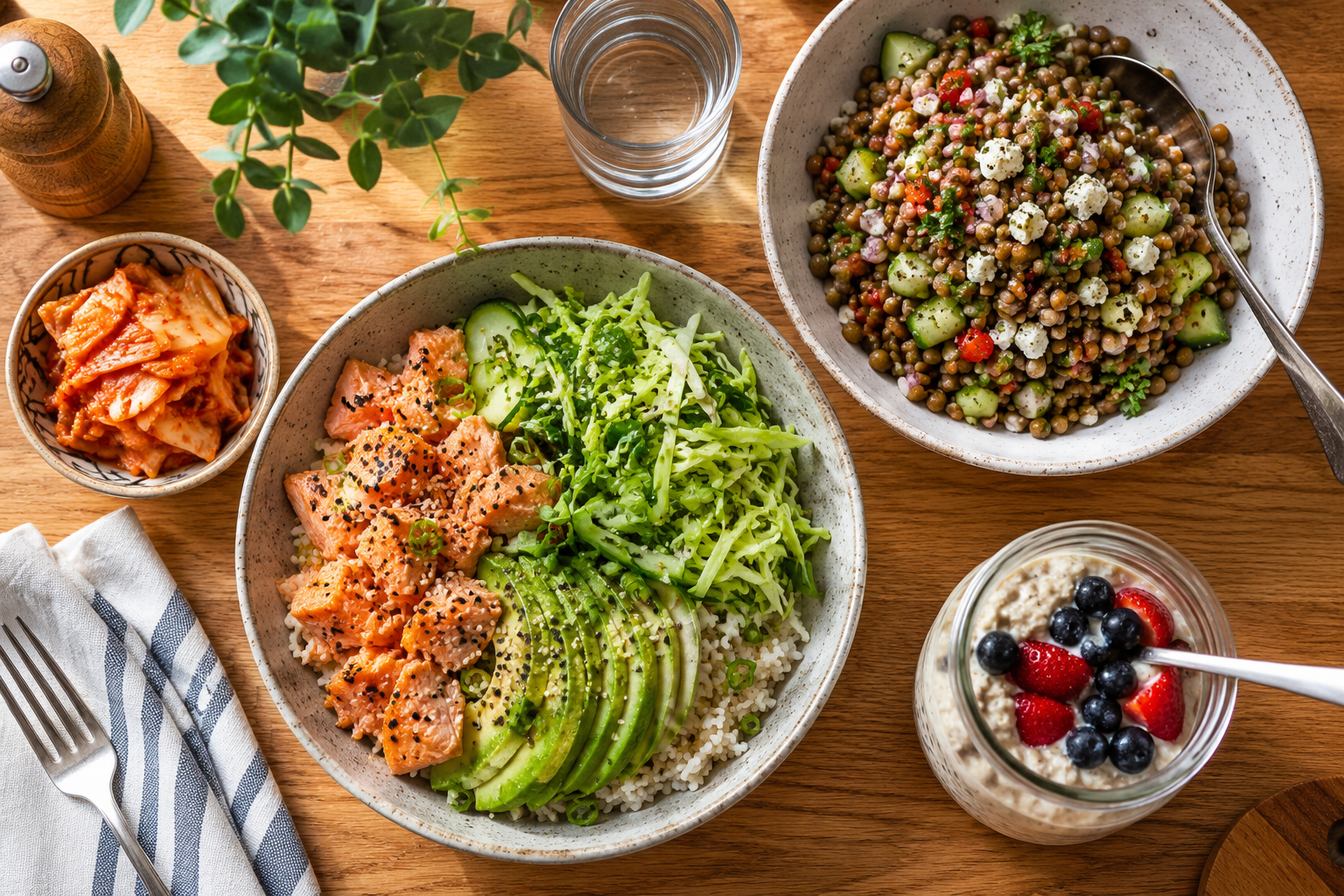
- Chilled rice bowl with salmon, avocado, leafy greens, and a spoonful of kimchi
- Potato salad with hard-boiled eggs, herbs, and Greek yogurt dressing
- Overnight oats with berries, chia seeds, and plain yogurt
The kimchi example is not accidental. Fermented foods and resistant starch work on different sides of the same equation: fermented foods may contribute microbial activity, while resistant starch provides substrate for those microbes to work with. They complement each other well.
Know when to be cautious
If you have IBS, active IBD, SIBO concerns, severe or persistent bloating, diabetes requiring medication, kidney disease, or a medically prescribed low-fiber diet, please individualize any dietary changes with professional guidance. This article is educational information, not medical advice. Persistent or worsening digestive symptoms are worth discussing with a clinician, not troubleshooting through dietary experiments alone.
Resistant Starch, Fermented Foods, and Probiotics: How They Work Together
Resistant starch and prebiotic fiber are the substrate side of the gut-health equation. Fermented foods and probiotics are the microbial side. Both matter, and they work better together than either does alone.
Fermented foods may bring microbes or microbial metabolites
Fermented foods such as yogurt, kefir, kimchi, sauerkraut, and miso contain live microorganisms or the metabolites they produce. Whether those microbes survive digestion and colonize the gut is a separate question, covered in more depth in the companion article on fermented foods, probiotics, and postbiotics. The short version: survival through digestion varies considerably by product and individual.
Resistant starch gives microbes substrate
Even if fermented foods deliver beneficial microbes, those microbes still need something to eat. Resistant starch and prebiotic fibers provide that substrate. Think of it this way: microbes are the chefs, and fermentable carbohydrates are the ingredients. You can have excellent chefs, but without ingredients, there is nothing to cook.
Best everyday approach
Keep it simple and consistent:
- Eat fiber-rich plants regularly, with variety across the week
- Include fermented foods if you tolerate them
- Reduce the degree to which ultra-processed, low-fiber foods displace whole plant foods in your diet
- Think of this as additive, not restrictive
The goal is not to eliminate food groups or follow a rigid protocol. It is to give your gut microbiome more to work with, consistently, over time.
Common Myths About Resistant Starch
We need to separate fact from hype here. The science on resistant starch is genuinely interesting, but it has attracted some overclaiming.
Myth 1: “Cold carbs are automatically healthy”
Reality: Cooling cooked starches increases resistant starch content, which has gut-health relevance. But portion size, food safety, overall diet quality, and what you eat alongside the starch all still matter. A large serving of cold pasta salad drowning in processed dressing is not a gut-health intervention.
Myth 2: “Resistant starch cancels out blood sugar from carbs”
Reality: Resistant starch may reduce the digestible starch load in some foods and can influence glucose response. It does not make unlimited refined carbohydrates metabolically neutral. That is a strong claim and needs strong proof, which does not currently exist.
Myth 3: “All prebiotic fibers do the same thing”
Reality: Different fibers feed different microbial communities and produce different fermentation patterns. Inulin, beta-glucan, pectin, and resistant starch each interact with the microbiome differently. This is why fiber diversity matters more than maximizing any single type.
Myth 4: “Supplements are better than food”
Reality: Supplements can be useful in specific contexts, particularly when whole-food intake is genuinely insufficient or when a clinician recommends them. But whole foods bring fiber alongside polyphenols, protein, minerals, and food structure. There is no magic in a supplement that replicates the full package of a legume or a whole grain.
Myth 5: “More is always better”
Reality: More is not always better. Fermentable fibers can cause significant discomfort if increased too quickly, particularly for people with sensitive digestive systems. A gradual, consistent increase is more effective and more sustainable than a dramatic overhaul.
Practical Meal Ideas That Include Resistant Starch
Let’s keep this practical. These are not recipes; they are starting points.
Breakfast ideas
- Overnight oats with berries and plain yogurt (RS3 from cooled oats, plus prebiotic fiber from oats and berries)
- Slightly green banana with nut butter (RS2 from the banana)
- Chia-oat bowl with kefir, if tolerated (combines prebiotic fiber with fermented food)
Lunch ideas
- Lentil salad with herbs, olive oil, and roasted vegetables
- Chilled rice bowl with beans, leafy greens, and fermented vegetables
- Potato salad with eggs, fresh herbs, and Greek yogurt dressing
Dinner ideas
- Bean chili with a variety of legumes
- Cooked-and-cooled potatoes reheated gently as a side dish
- Pasta salad with chickpeas and seasonal vegetables
- Black beans with cooled rice and fresh salsa
Snack ideas
- Hummus with raw vegetables (legume base plus fiber from vegetables)
- Roasted chickpeas (crunchy, portable, and a meaningful fiber source)
- Plain yogurt with rolled oats and berries
These are not exotic or expensive. The basics still do the heavy lifting here.
Who Should Be Careful With Resistant Starch?
Most healthy adults can increase resistant starch intake gradually without problems. But some people need to be more careful.
Be cautious if you have:
- IBS (irritable bowel syndrome): Fermentable carbohydrates, including resistant starch, can trigger symptoms in some IBS subtypes. A low-FODMAP approach may conflict with high-resistant-starch eating. Work with a dietitian.
- Active IBD (Crohn’s disease or ulcerative colitis): Dietary changes during flares need clinical guidance.
- SIBO (small intestinal bacterial overgrowth) concerns: Fermentable fibers can worsen symptoms if SIBO is present and untreated.
- Diabetes with medication: Dietary changes that affect glucose response should be coordinated with your prescribing clinician.
- Kidney disease: Some high-resistant-starch foods are also high in potassium or phosphorus. Individualize with a renal dietitian.
- Medically prescribed low-fiber diets: Follow clinical guidance first.
Red flags that need professional attention, not dietary experiments:
- Blood in stool
- Unexplained weight loss
- Severe or persistent abdominal pain
- Ongoing diarrhea or significant change in bowel habits
- New digestive symptoms appearing after age 50
These symptoms warrant a conversation with a clinician, not a change in fiber intake.
Conclusion: Resistant Starch Is About Feeding the Colon
Resistant starch is not a carb loophole, a diet trick, or a superfood. Its value is straightforward: it delivers fermentable material to the colon, where gut bacteria can use it to produce short-chain fatty acids and support the microbial environment that influences gut barrier function, immune signaling, and broader metabolic health.
The best strategy is not to obsess over exact grams of resistant starch or to cool every meal before eating it. It is to regularly include legumes, whole grains, cooked-and-cooled starches when practical, oats, and a diverse range of plant foods. Do that consistently, increase gradually if your current fiber intake is low, and pay attention to how your body responds.
Modern food processing often removes or dilutes the fermentable material that gut microbes depend on. Resistant starch and prebiotic fiber are part of how you put some of that chemistry back, through everyday food choices rather than supplements or strict protocols.
Actionable next steps:
- Add ¼ cup of legumes to at least one meal per day this week
- Try overnight oats or a chilled rice bowl as a meal-prep option
- If you eat rice or potatoes regularly, cook a larger batch and refrigerate it for next-day use
- Increase slowly over 2 to 4 weeks if you are not used to high-fiber eating
- If you have a digestive condition, talk to a clinician or registered dietitian before making significant changes
For the bigger picture on how modern food processing affects what reaches your gut, the companion pillar on Modern Food Processing and Gut Health covers the broader mechanisms. The related guides on ultra-processed foods and fermented foods round out the picture from different angles.
The main takeaway is this: your gut microbiome needs something to ferment. Resistant starch and prebiotic fiber are a reliable, practical way to provide it.
Evidence and further reading
Frequently Asked Questions
Q: What is resistant starch, in simple terms?
Resistant starch is a type of starch that your small intestine cannot fully digest. It passes to the large intestine, where gut bacteria ferment it and produce short-chain fatty acids, particularly butyrate.
Q: Is resistant starch a type of fiber?
Yes, it is widely classified as a form of dietary fiber because it resists digestion and is fermented by gut microbes. It overlaps with the prebiotic fiber category but is starch-based rather than cellulose- or fructan-based.
Q: Is resistant starch a prebiotic?
It functions as a prebiotic because it selectively feeds beneficial gut microbes. Whether it meets the formal ISAPP definition depends on the specific context and evidence, but in practical terms, yes, it feeds gut bacteria in a way that supports the microbiome.
Q: What foods are highest in resistant starch?
Legumes (beans, lentils, chickpeas), cooked-and-cooled potatoes, cooked-and-cooled rice, green bananas, oats, barley, and pasta are the most practical everyday sources.
Q: Does cooling rice or potatoes really increase resistant starch?
Yes. Cooling cooked starches causes retrogradation, a process where starch molecules reorganize into a more resistant structure. The increase is real but not dramatic. It is a useful habit, not a transformation of the food.
Q: Can you reheat cooked-and-cooled carbs and still get resistant starch?
Some resistant starch survives reheating. The amount varies by food and method. Gentle reheating preserves more than aggressive high-heat cooking. The benefit is reduced but not eliminated.
Q: How much resistant starch should I eat per day?
There is no official daily value for resistant starch specifically. A practical approach is to focus on total fiber diversity and include resistant-starch-rich foods regularly. Start with legumes and whole grains as your foundation.
Q: Can resistant starch cause bloating?
Yes, particularly if you increase your intake quickly. Fermentable fibers produce gas as a byproduct of bacterial fermentation. Increasing intake gradually over 2 to 4 weeks and staying well hydrated reduces this effect for most people.
Q: What is the difference between resistant starch and prebiotic fiber?
Resistant starch is a specific type of starch that resists digestion. Prebiotic fiber is a broader category of substrates that selectively feed beneficial gut microbes. Resistant starch can function as a prebiotic fiber, but not all prebiotic fibers are resistant starch.
Q: Should I take resistant starch supplements?
Whole foods are the better starting point for most people. Supplements may have a role in specific clinical contexts, but they should be discussed with a clinician or registered dietitian, especially if you have a digestive condition or take medication.
Q: Who should avoid or limit resistant starch?
People with IBS, active IBD, SIBO, kidney disease, diabetes requiring medication, or medically prescribed low-fiber diets should individualize their approach with professional guidance rather than following general recommendations.
Q: Does resistant starch lower blood sugar?
It may reduce the digestible starch load in some foods and can influence glucose response, but it does not neutralize the effect of refined carbohydrates or function as a blood sugar fix. The evidence is interesting but should not be overstated.

Dave James has spent 30+ years reading health and longevity research, and has run All Perfect Health for the past five. His background is in Australian mining and industrial engineering — disciplines built on questioning claims, measuring outcomes, and respecting evidence. He writes about what the research actually says, including where the experts disagree.
More about Dave & this site →
📂 Modern Food Processing & Gut Chemistry
This article is part of the APH cluster. Use the links below to move between the pillar and child articles.
- Read the pillar: Modern Food Processing and Gut Health: How Processed Food Affects Gut Chemistry
- → Ultra-Processed Foods, Emulsifiers, and Microplastics: What They Really Do to Your Gut
- → Fermented Foods vs Probiotics vs Postbiotics: What Actually Survives Digestion?
- YOU ARE HERE Resistant Starch and Prebiotic Fiber: How Carbs Feed Your Gut Microbiome
- → The Hidden Dangers of Reusing Cooking Oil: What You Need to Know This August 2026
- → Beef Tallow vs. Seed Oil: Which is Healthier for Cooking in 2026?
- → Industrial Seed Oil Processing: What Happens Before It Hits the Shelf
- → How Food Additives Affect Your Gut Microbiome Health
- → What Modern Processing Does to Food Proteins and Starches
- → Food Preservatives Health Effects: What’s Really in Your Food and Why It Matters
- → Major US Study Links Ultra-Processed Foods to Heart Attack Risk in July 2026
References
- [Video] Thomas DeLauer. YouTube. https://www.youtube.com/watch?v=6v3K3E_EGOs