
Kettlebell Exercises at Home: A Beginner Guide to Form and Workouts
Last updated: November 28, 2026
A single kettlebell can be a practical home-strength tool: it is compact, adaptable, and useful for learning controlled pulling, squatting, pressing and carrying patterns. Its centre of mass sits below the handle, though, so the bell behaves differently from a dumbbell. Good setup, a manageable load and patient progression matter more than trying to copy fast movements seen online.
This beginner guide is for people building or returning to strength training at home. Start with grounded, controlled movements and treat the first sessions as technique practice. Swings, snatches and other fast kettlebell drills can come later, after you have a reliable hip hinge and enough instruction to use them with control.
Quick Answer
Kettlebell exercises at home work well for beginners when you start with grounded, controlled movements, deadlifts, goblet squats, rows, floor presses, and carries, using a light-to-moderate load, on a clear, non-slip surface, for two to three sessions per week. Ballistic movements like swings and snatches offer real benefits but need separate instruction and should come later, after basic strength, balance, and hip-hinge technique are solid. Based on current evidence, kettlebell training can improve strength, power, and functional balance, with the strongest data supporting supervised or well-structured progressive programs rather than unsupervised heavy loading.[9][4]
Key Takeaways
- Kettlebells move differently than dumbbells because their mass hangs below and off-center from the handle, which changes balance demands even in simple exercises.
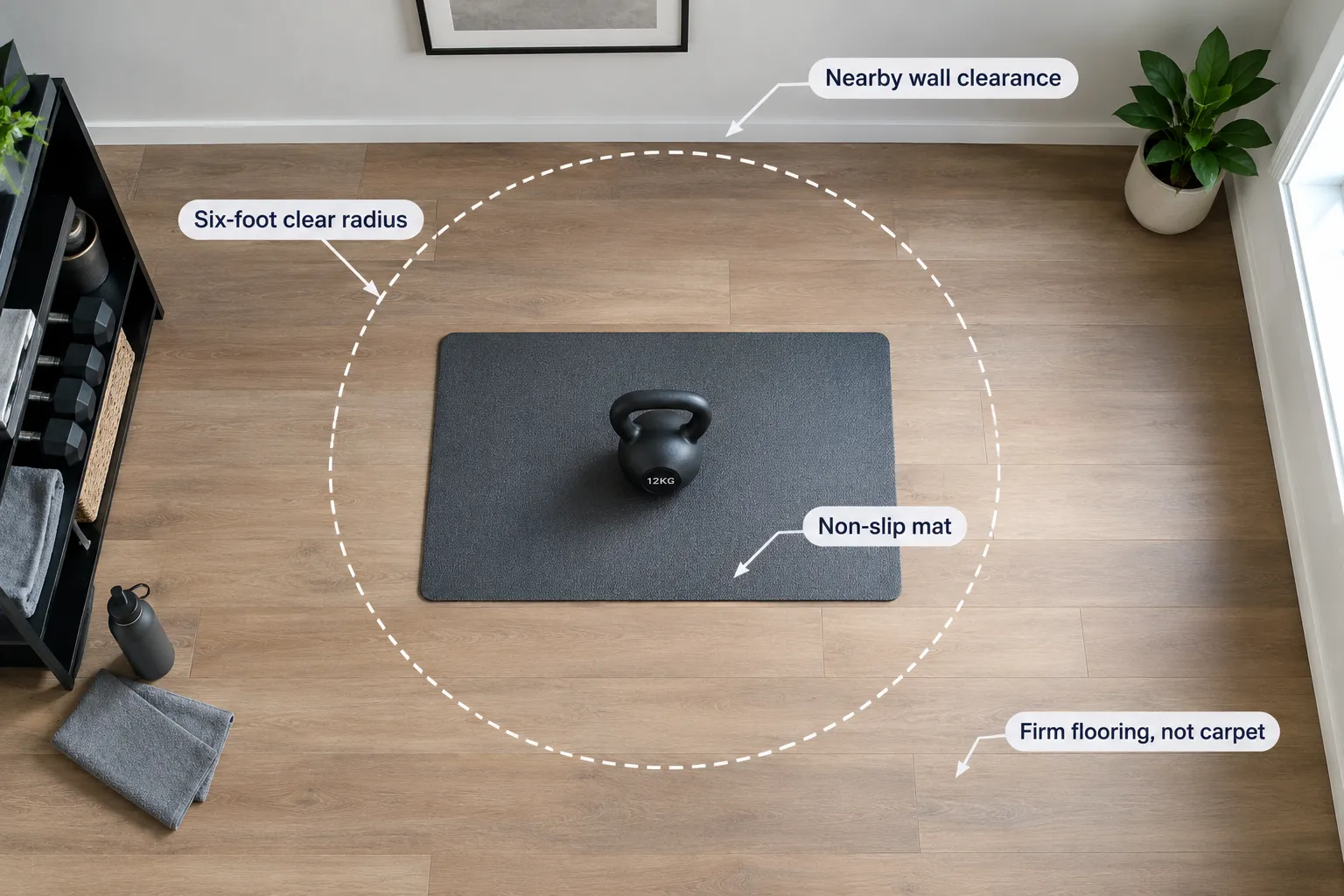
- A sensible starting point is one light-to-moderate kettlebell and a clear, six-foot workout space, not a full rack of weights.
- Beginner-appropriate kettlebell exercises at home include the deadlift, goblet squat, supported row, floor press, and carry; swings and snatches are later-stage skills.
- The evidence suggests real gains in strength, power, and dynamic balance from structured kettlebell programs, though effects on aerobic fitness and body composition are more mixed.[10][5]
- Stop or modify any exercise that produces sharp pain, joint pain, or loss of balance, and get individualized guidance if pain persists beyond typical muscle soreness.
Table of Contents
Why kettlebells are different from dumbbells
In plain English, a dumbbell balances evenly around a straight bar. A kettlebell does not. Its mass sits below and slightly forward of the handle, which means your grip, wrist, and shoulder have to manage a load that wants to swing, tip, and rotate even when you are standing still. This is not a minor detail, it is the entire reason kettlebell training feels different from the first rep.
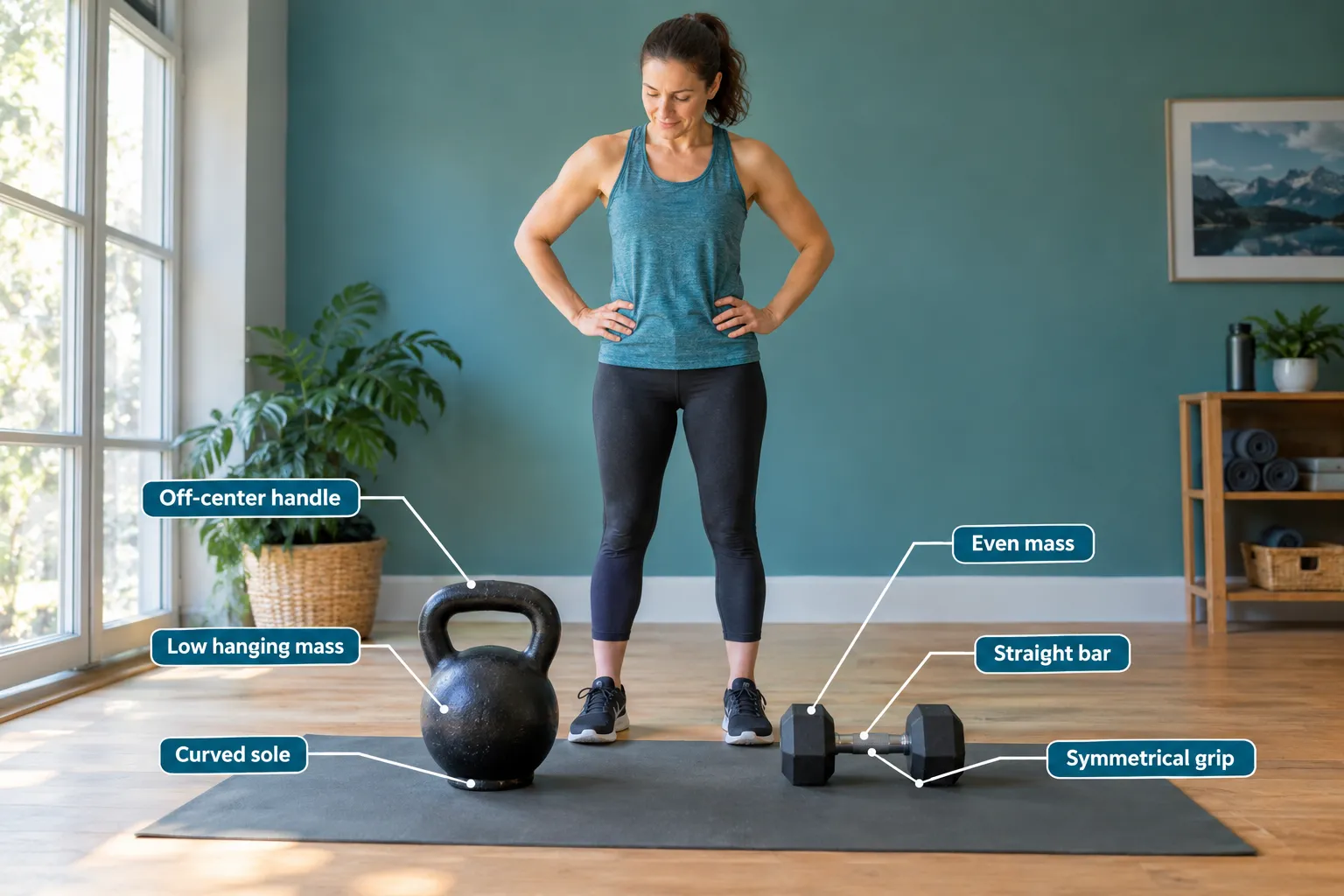
Kettlebell and dumbbell comparison for home trainingThat off-center mass is also the source of the tool’s value. It forces your forearm, shoulder stabilizers, and core to work harder to keep the bell under control, which is part of why kettlebell circuits have been linked to meaningful gains in grip strength and core strength in controlled research, alongside improvements in leg-press strength and dynamic balance.[10] It is also why a beginner should not simply swap a dumbbell routine for a kettlebell one and expect the same experience.
We need to separate fact from hype here: kettlebells are not a shortcut to faster results, and they are not inherently more dangerous than dumbbells. They are a different shape, and different shapes demand different handling. A sensible starting point is treating your first few sessions as technique sessions, not workouts, the goal is learning how the bell moves before you ask your body to move it quickly.
If you are deciding which tool fits your space and experience, compare this approach with our beginner dumbbell exercises at home guide. Both can build a useful base; the best choice is the one you can handle with control and repeat consistently.
Three handling differences matter most for home training:
- Grip and rack position. The handle is thicker than most dumbbell grips, and holding the bell against your forearm (the “rack” position) takes practice before it feels stable.
- Center of gravity. Because the weight hangs below your hand, tipping the bell even slightly changes the demand on your wrist and shoulder, this is amplified during transitions like lifting it off the floor or bringing it to your chest.
- Momentum. Even slow kettlebell movements build a small amount of swing. Dumbbells rarely do this unless you move carelessly; with kettlebells, managing that swing is part of the skill from day one.
Choosing a manageable starting load and clear training area
Here’s the real issue with most home kettlebell setups: people focus on the exercise list and skip the environment. A cluttered room, a slick floor, or a kettlebell that is too heavy for controlled technique will undermine even a well-designed program.
Guidance summarized in ACSM’s Health & Fitness Journal suggests that already physically active adult women commonly start in the 4 to 8 kilogram range, and active men in the 12 to 16 kilogram range, progressing to heavier bells as strength and technique improve.[9] These are reasonable starting anchors, not universal rules, a sedentary 55-year-old returning to exercise after a long break may reasonably start lighter than an active 30-year-old, regardless of sex. In real-world terms, the right starting weight is the one that lets you complete every rep with clean form and a small margin of control left over.
For the training area itself, a sensible starting point is this checklist:
| Setup element | What to check |
|---|---|
| Floor surface | Firm and level; avoid thick carpet or slick tile without a mat |
| Clear radius | At least six feet of open space in every direction |
| Footwear | Flat, stable shoes or bare feet on a non-slip surface |
| Nearby hazards | No furniture edges, glass, or pets in the immediate area |
| Mat | A dense exercise mat helps protect the floor and reduce slipping |
It is not that simple to give one universal weight recommendation, because body size, joint history, and prior training all change the picture. If you are unsure, the more conservative choice is always the safer one for the first two to three weeks.
Beginner foundational movements: deadlift, goblet squat, supported row, floor press and carry
The stronger evidence points to structured, progressive kettlebell programs producing real gains, not to any single “magic” exercise.[13][6] For a beginner, five movements cover most of what a home program needs, and none of them require the bell to leave the ground quickly.
These movement patterns are part of a broader functional strength training approach: practising strength that carries over to everyday lifting, carrying, getting up and moving with confidence.
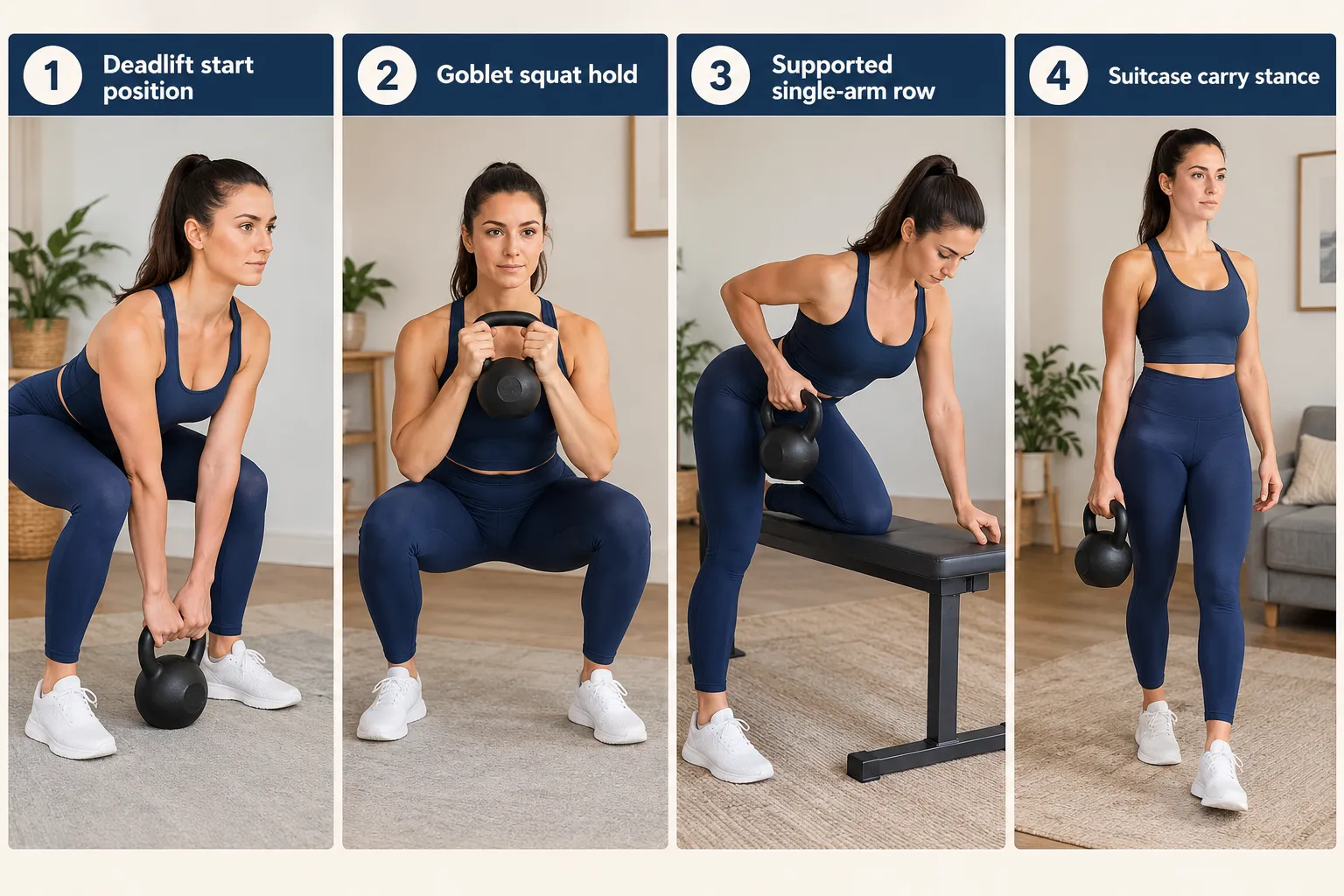
Clear home workout space with a kettlebellKettlebell deadlift. Stand with feet hip-width apart, kettlebell on the floor between your feet. Hinge at the hips, keep a flat back, grip the handle, and stand up by driving through your heels, not by yanking with your arms. This is the foundation for almost every other kettlebell lift, including the swing you may eventually learn.
Goblet squat. Hold the kettlebell close to your chest with both hands cupping the horns (the sides of the handle). Squat down keeping your chest tall and knees tracking over your toes, then stand back up. Holding the weight in front naturally encourages a more upright torso than many beginners manage with a bodyweight squat alone.
Supported single-arm row. Place one hand and knee on a sturdy chair or bench, kettlebell on the floor beneath your shoulder. Pull the bell up toward your ribs, keeping your elbow close to your body, then lower with control. The support point removes rotational stress from your lower back.
Floor press. Lying on your back with knees bent, hold the kettlebell in one hand at chest height. Press it straight up, then lower slowly until your upper arm touches the floor. The floor limits your range of motion, which is a built-in safety feature for shoulder beginners.
Suitcase carry. Simply hold the kettlebell in one hand at your side and walk 20 to 30 feet, keeping your torso upright and resisting the urge to lean away from the weight. This looks simple and is genuinely useful, it trains the same core stability that shows up in more advanced kettlebell work.
The main takeaway is that these five movements build the grip strength, hip control, and shoulder stability that make later, more dynamic kettlebell exercises at home realistic and safer to learn.
Why swings and more ballistic movements need separate progression
I would be careful with the assumption that a beginner should start with kettlebell swings just because they are the most visible kettlebell exercise online. Swings, snatches, cleans, and Turkish get-ups are ballistic or multi-stage movements, they involve speed, hip power, and precise timing that a hinge pattern learned in a single session usually cannot support safely.
Research on isolated swing training does show real benefits: several weeks of focused swing work has improved both maximal and explosive strength in trained participants.[11] That is a genuinely useful finding, but notice the detail, the participants were performing a specific, coached movement pattern, not learning it from scratch alongside four other new exercises. This is where hype gets in the way of good decision-making. A video showing an experienced lifter swinging a kettlebell smoothly does not show you the months of hinge practice that made that movement look easy.
The clearest expert guidance on this point comes from ACE-sponsored research, which specifically recommends at least two to three sessions with a certified instructor, or careful use of high-quality instructional video, before training these movements independently.[4] That recommendation exists precisely because the home environment removes the real-time correction a coach would normally provide.
A sensible starting point is this sequence:
- Master the kettlebell deadlift hinge pattern for several sessions.
- Build basic goblet squat and carry competence.
- Only then consider structured instruction, in person or through a vetted program, for the swing.
- Treat snatches, cleans, and Turkish get-ups as later-stage skills that follow, not accompany, swing competence.
That is a strong claim to make about sequencing, and it needs strong proof, but it is also simply how most reputable kettlebell certification programs structure their own curricula, for the same reason cited above: technique and supervision are the primary safety variables in kettlebell training.[9][4]
A simple beginner workout
Keep it simple and consistent. A beginner kettlebell circuit does not need to be long or complicated to be effective, the ACE-sponsored research that documented a 13.8 percent improvement in aerobic capacity and a 70 percent increase in core strength used structured, moderate-intensity circuits, not maximal-effort sessions.[10]
Beginner kettlebell movements for a home workoutA reasonable starting template, performed two to three times per week with a rest day between sessions:
| Exercise | Sets | Reps or time | Rest |
|---|---|---|---|
| Kettlebell deadlift | 3 | 8 to 10 reps | 60 to 90 seconds |
| Goblet squat | 3 | 8 to 10 reps | 60 to 90 seconds |
| Supported single-arm row | 2 | 8 to 10 reps per side | 45 to 60 seconds |
| Floor press | 2 | 6 to 8 reps per side | 45 to 60 seconds |
| Suitcase carry | 2 | 20 to 30 feet per side | 45 to 60 seconds |
Circuit-style training with kettlebells is often built around short work-to-rest intervals, commonly around 20 seconds of work to 10 seconds of rest, repeated for roughly four and a half minutes per bout, once technique is solid enough to sustain under mild fatigue.[9] For a true beginner, straight sets with full rest, as shown above, are the more sensible starting format; interval-style circuits are worth introducing later, once each movement feels automatic.
In real-world terms, two focused 25-minute sessions per week, done consistently for a month, will teach you more about kettlebell handling than a single 60-minute session done once.
For more ways to organise a simple week of training, see our complete guide to home workout routines.
How to progress safely over time
More is not always better, and this is especially true with kettlebell loading. A 10-week program evaluation found meaningful improvements in both strength and cardiovascular fitness specifically when weight, repetitions, and sets were increased gradually over the course of the program, not when the starting load was simply heavy from day one.[13]
A sensible progression model looks like this:
- Weeks 1 to 2: Focus entirely on form at a light load. Reps should feel easy to control.
- Weeks 3 to 4: Add one or two reps per set, or a small amount of weight, once every rep looks like your first rep.
- Weeks 5 to 8: Introduce alternating tempo, a slightly slower controlled phase on some sets, a bit more purposeful drive on others, as suggested by research linking varied contraction speed to continued strength and aerobic adaptation.[13]
- Beyond week 8: Consider adding a second kettlebell size, extending carry distances, or exploring instructor-led ballistic movements if that is a goal.
Context matters here. A 2024 review found that kettlebell training in athletic populations produced meaningful gains in maximal strength, power output, and muscular endurance when programs were structured and progressive.[6] Separate work in obese adult populations found that either kettlebell-based resistance training or bodyweight resistance training supported improvements in body composition and fitness markers, with kettlebells offering a practical, low-space option for home settings.[14] The common thread across these different populations is structure and gradual load increase, not intensity for its own sake.
It is worth being honest about the limits of the evidence too. Most kettlebell studies still use relatively low-to-moderate loads, generally up to around 32 kilograms, and many interventions run for a matter of weeks rather than years.[8] A 2015 controlled trial found moderate evidence for improvements in strength, power, and postural control, but no significant change in VO2max, suggesting kettlebell training alone may not be the most efficient route to aerobic fitness gains, pairing it with walking, cycling, or another cardio modality is a reasonable approach if that is a specific goal.[5] The evidence suggests kettlebells are particularly effective for power development, with more mixed support for large maximal-strength or aerobic gains on their own.[8]
When to stop, modify or seek individual advice
The basics still do the heavy lifting when it comes to safety: clear space, appropriate load, and attention to how your body responds. That said, a few situations call for caution rather than pushing through.
Stop the exercise and reassess if you notice:
- Sharp, sudden, or localized pain in a joint, as opposed to general muscle fatigue.
- Pain that worsens across a set rather than staying steady.
- Loss of balance or a sense that the kettlebell is controlling your movement rather than the other way around.
- Numbness, tingling, or a feeling of instability in the wrist, shoulder, or lower back.
- Dizziness, chest discomfort, or unusual shortness of breath during or after a session.
This is not a diagnostic list, and it is not a substitute for a conversation with a clinician who knows your history. If you have an existing joint condition, a recent injury, a balance disorder, or a cardiovascular condition, it is reasonable to check with a physician or physical therapist before starting a kettlebell program, particularly regarding load selection and which movements to avoid initially.
There is a genuinely encouraging side to this too. A 2025 clinical and public-health perspective describes kettlebell training as a promising, low-cost, and scalable rehabilitation approach that can improve pain, strength, and functional mobility, which is one reason it is increasingly discussed as a home-based option for musculoskeletal rehab under appropriate guidance.[1] A related scoping review found small-to-moderate physiological benefits in generally healthy adults, and clinically meaningful moderate-to-large effects in specific older-adult populations, including people with Parkinson’s disease and sarcopenia.[3] The main takeaway from this body of work is that kettlebells are not inherently unsuitable for older adults or people managing a health condition, but the successful programs in this research were structured, progressive, and appropriately supervised, which is the standard a home program should aim to match.
FAQ
Do I need more than one kettlebell to start at home?
No. A sensible starting point is a single kettlebell in a light-to-moderate range for your current fitness level. Most beginner routines, including the one in this guide, can be completed with one bell for the first several weeks.
Is kettlebell training better than dumbbell training for beginners over 40?
Neither is universally better. The evidence suggests both tools can build strength and stability when used with good form and gradual progression. Kettlebells add a balance and grip challenge that some people over 40 specifically want, but a dumbbell routine is an equally valid starting point, particularly if balance is a current concern.
Can kettlebell exercises at home help with weight loss?
Kettlebell sessions can burn a meaningful amount of energy, one commonly cited estimate is around 375 kilocalories per session, which can contribute to overall energy expenditure as part of a broader approach that includes diet.[12] It is not that simple to promise weight loss from exercise alone, though, since body composition depends on many factors beyond any single workout type.
When can I try kettlebell swings?
Once the deadlift hinge pattern, goblet squat, and carry all feel automatic and pain-free, and ideally after some direct instruction, either in person or through a well-vetted program. ACE-sponsored guidance specifically recommends two to three sessions with a certified instructor before training ballistic kettlebell movements independently.[4]
How often should a beginner train with kettlebells?
Two to three sessions per week, with at least one rest day between sessions, is a reasonable starting frequency. This allows enough repetition to build technique without accumulating fatigue that compromises form.
Is it normal to feel unsteady with a kettlebell at first?
Some initial unsteadiness is expected, since the off-center weight distribution is different from anything most beginners have handled before. Persistent loss of balance, however, is a signal to reduce the load, slow down, or revisit basic technique before continuing.
Conclusion
The main takeaway is straightforward: kettlebell exercises at home are a genuinely useful, evidence-aware option for building strength, stability, and functional capacity, but the tool’s off-center weight means setup, load selection, and sequencing matter more than they do with dumbbells. Start with a clear space, one manageable kettlebell, and the five foundational movements covered here, deadlift, goblet squat, supported row, floor press, and carry. Give yourself several weeks of clean technique before considering swings or other ballistic lifts, and treat those as skills that deserve dedicated instruction, not shortcuts to skip toward. Clear beats clever. Build the basics first, progress the load gradually, and let the simple movements do the heavy lifting while your body adapts.
References
[1] academic.oup – https://academic.oup.com/eurpub/article/35/Supplement_4/ckaf161.1511/8301862[2] Ace Sponsored Research Study Kettlebell Training Kicks Butt – https://www.acefitness.org/continuing-education/prosource/equipment-special-issue/4992/ace-sponsored-research-study-kettlebell-training-kicks-butt/
[3] S13102 019 0130 Z – https://link.springer.com/article/10.1186/s13102-019-0130-z?error=cookies_not_supported&code=d89cdeca-60b0-408c-9d13-af05925bb367
[4] Ace Sponsored Research Study Kettlebells Kick Butt – https://www.acefitness.org/certifiednewsarticle/3172/ace-sponsored-research-study-kettlebells-kick-butt/
[5] 1743288x14y – https://www.tandfonline.com/doi/abs/10.1179/1743288X14Y.0000000163?journalCode=yptr20
[6] Pmc10910645 – https://pmc.ncbi.nlm.nih.gov/articles/PMC10910645/
[7] Transference Of Kettlebell Training To Strength,.26 – https://journals.lww.com/nsca-jscr/fulltext/2013/02000/transference_of_kettlebell_training_to_strength,.26.aspx
[8] The Role Of Kettlebells In Strength And.7 – https://journals.lww.com/nsca-scj/fulltext/2014/06000/the_role_of_kettlebells_in_strength_and.7.aspx
[9] Managing Risks Of Training With Kettlebells To.6 – https://journals.lww.com/acsm-healthfitness/Fulltext/2017/03000/MANAGING_RISKS_OF_TRAINING_WITH_KETTLEBELLS_TO.6.aspx
[10] Ace Study Finds Kettlebell Training Effective For Improving More Than Strength – https://www.acefitness.org/about-ace/press-room/press-releases/3238/ace-study-finds-kettlebell-training-effective-for-improving-more-than-strength/
Medical & movement safety note
This article is for general educational purposes and does not replace individualized medical or professional fitness advice. If you have a pre-existing health condition, chronic pain, a balance disorder, or a cardiovascular condition, or if you are recovering from an injury, talk with a physician or licensed physical therapist before starting kettlebell exercises at home. Evidence strength varies across the studies referenced below: several findings come from structured, supervised, or short-duration trials, and the authors of these reviews note that larger, longer, and more strictly home-based studies are still needed. Based on current evidence, kettlebell training appears to be a reasonable and often beneficial addition to a home fitness routine when introduced gradually and with attention to technique.

About the author
Dave James is the founder of All Perfect Health. He writes practical, evidence-aware guides designed to help readers make sensible health and fitness decisions without hype.