
Beef Tallow vs. Seed Oil: Which is Healthier for Cooking in 2026?
Last updated: August 10, 2026
Quick Answer: Beef tallow vs seed oil: Beef tallow is more stable at high heat, contains a more balanced fatty acid profile, and avoids the oxidative risks associated with polyunsaturated seed oils. However, seed oils are not universally harmful, and context matters enormously, the type of oil, how it’s processed, and how you cook with it all shape the outcome. For high-heat cooking, beef tallow has a clear practical edge. For everyday moderate-heat use, the picture is more nuanced.
Part of the Modern Food Processing & Gut Chemistry cluster →
Key Takeaways
- Beef tallow is roughly 50% saturated fat and 40-45% monounsaturated fat, making it highly stable at cooking temperatures.
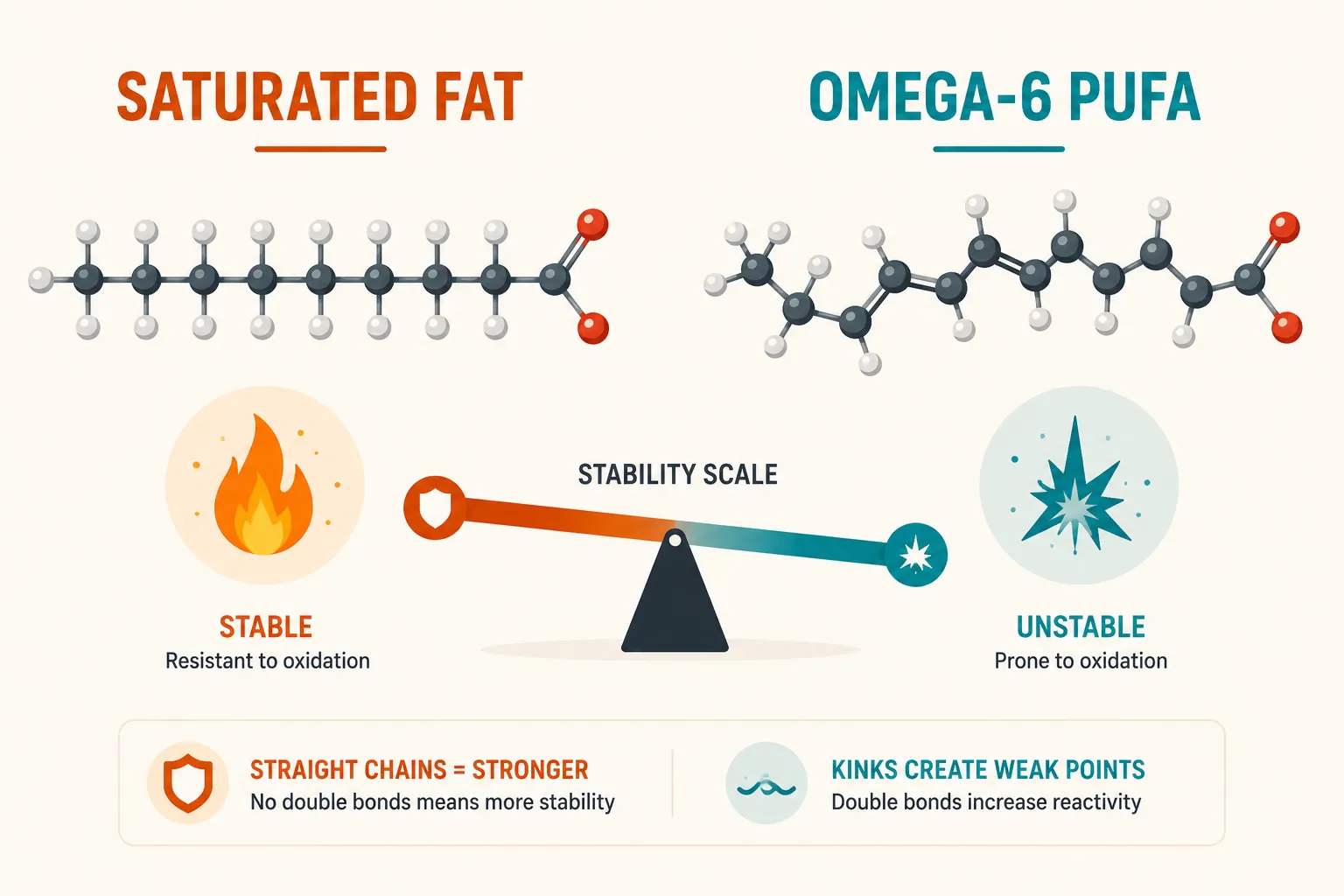
- Common seed oils (sunflower, corn, soybean) contain 50-75% omega-6 polyunsaturated fatty acids (PUFAs), which oxidise more easily under heat.
- The omega-6 to omega-3 ratio in most seed oils is heavily skewed, often 10:1 or higher, compared to beef tallow’s more moderate ratio.
- Oxidative stability is a key factor in cooking fat safety; beef tallow outperforms most seed oils here.
- The evidence on seed oils and inflammation is real but not as simple as the online narrative suggests, dose, diet context, and processing matter.
- Grass-fed beef tallow contains small amounts of conjugated linoleic acid (CLA) and fat-soluble vitamins A, D, E, and K2.
- Canola oil has a better fatty acid profile than most seed oils, but its industrial processing raises legitimate questions.
- For keto, paleo, or carnivore diets, beef tallow is a natural, practical fit.
- Neither fat is a magic solution. The quality of your overall diet matters far more than any single cooking fat.
- A sensible starting point is: use beef tallow or olive oil for most cooking, and limit highly refined seed oils where possible.
What Is Beef Tallow and How Is It Made?
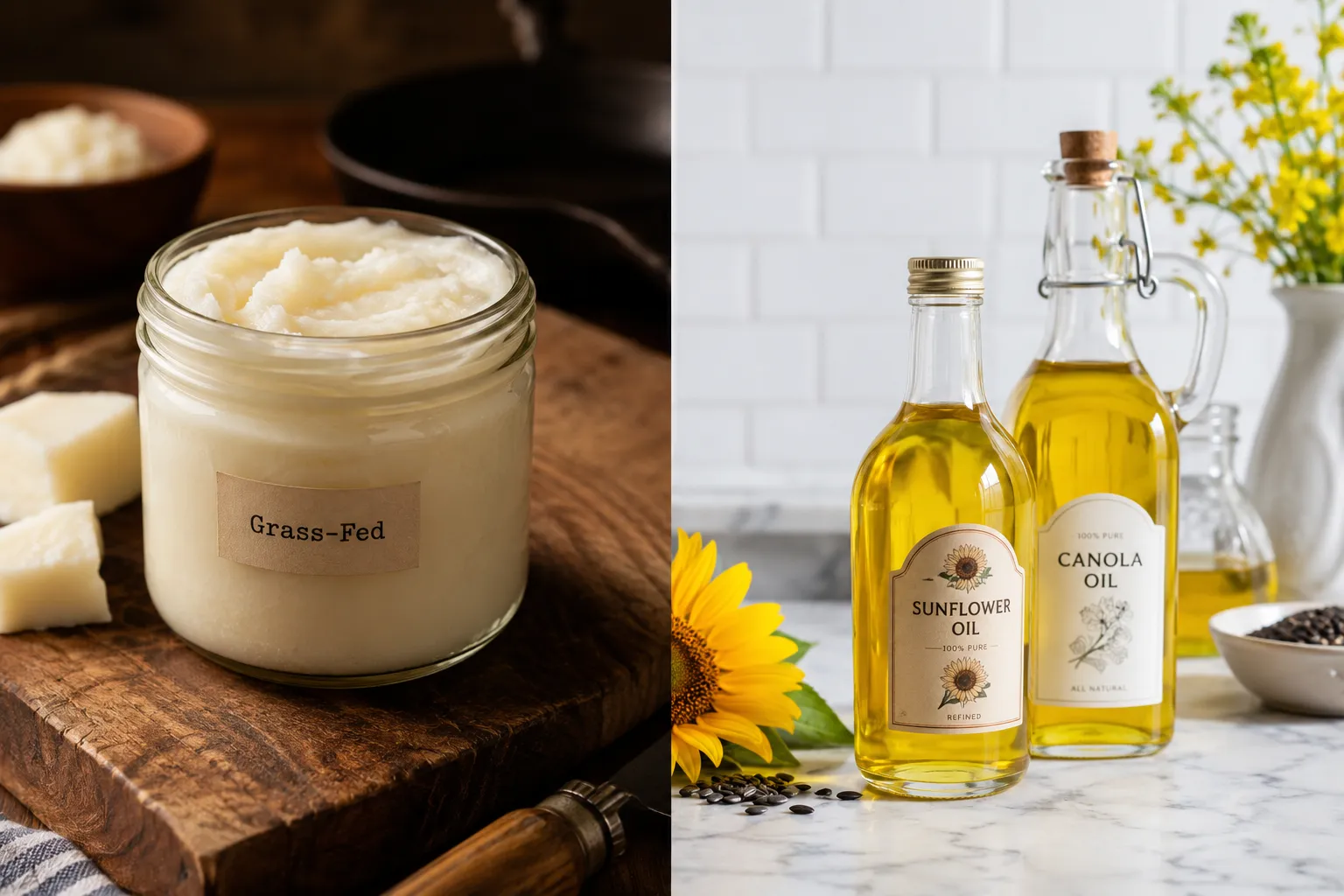
Beef tallow is rendered fat from cattle, typically sourced from the area around the kidneys (known as suet) or from trimmed fat off the carcass. It is solid at room temperature, ivory to pale yellow in colour, and has a mild, slightly beefy flavour.
How it’s made:
- Raw beef fat (suet or trim) is cut into small pieces or minced.
- It is slowly heated, either dry-rendered in an oven or wet-rendered with water, to melt the fat away from connective tissue and impurities.
- The liquid fat is strained through cheesecloth or a fine sieve.
- It is poured into jars and allowed to cool and solidify.
The result is a clean, stable cooking fat that has been used in kitchens for centuries, long before industrial vegetable oils existed. Grass-fed beef tallow goes one step further: because the cattle eat a natural diet, the resulting fat contains higher levels of CLA (conjugated linoleic acid), omega-3 fatty acids, and fat-soluble vitamins compared to grain-fed tallow.
Nutritional snapshot per tablespoon (approximately 13g):
| Nutrient | Amount |
|---|---|
| Total fat | 12.8g |
| Saturated fat | ~6.4g (50%) |
| Monounsaturated fat | ~5.4g (42%) |
| Polyunsaturated fat | ~0.5g (4%) |
| Omega-6 fatty acids | ~0.4g |
| Cholesterol | ~14mg |
The low polyunsaturated fat content is the key point here. It is what makes tallow so resistant to oxidation under heat.
What Are Seed Oils and Which Ones Are Most Common?
Seed oils are vegetable oils extracted from the seeds of plants. They are the dominant cooking fats in most Western kitchens and processed food supply chains.
The most commonly used seed oils include:
- Sunflower oil, 65-75% linoleic acid (omega-6)
- Corn oil, 54-60% linoleic acid
- Soybean oil, 50-55% linoleic acid
- Cottonseed oil, 50-55% linoleic acid
- Canola oil, 18-22% linoleic acid (lower than most)
- Safflower oil, up to 75% linoleic acid (one of the highest)
- Grapeseed oil, 70-76% linoleic acid
The common thread is a high concentration of linoleic acid, which is an omega-6 polyunsaturated fatty acid. This is not inherently toxic, but it does have implications for how the oil behaves under heat and how it fits into the broader dietary omega-6 to omega-3 balance.
For a deeper look at how these oils are produced before they reach the shelf, the article on industrial seed oil processing covers the extraction and refining steps in practical detail.
Beef Tallow vs. Seed Oil Smoking Point Comparison
Beef tallow has a smoke point of approximately 400°F (205°C), which is suitable for most frying, roasting, and sautéing tasks. Most common seed oils have smoke points in a similar or slightly higher range, but smoke point alone is not the most useful measure of a cooking fat’s safety.
Here is the issue: a high smoke point does not mean an oil is stable under heat. Refined seed oils can have smoke points above 400°F, yet their polyunsaturated fats begin breaking down and forming oxidation by-products, including aldehydes and lipid peroxides, well before they visibly smoke.
Smoke points for common cooking fats (approximate):
| Fat | Smoke Point |
|---|---|
| Beef tallow | ~400°F / 205°C |
| Refined sunflower oil | ~450°F / 232°C |
| Refined canola oil | ~400°F / 204°C |
| Refined corn oil | ~450°F / 232°C |
| Extra virgin olive oil | ~375°F / 191°C |
| Coconut oil (refined) | ~400°F / 204°C |
| Butter | ~300°F / 149°C |
The practical point: Beef tallow’s saturated fat structure means it does not oxidise readily at cooking temperatures, even when used repeatedly. Many refined seed oils, despite their high smoke points, produce significantly more oxidation by-products during cooking, particularly when reused, as is common in commercial frying.
Is Beef Tallow Healthier Than Vegetable Oil for Cooking?
For high-heat cooking specifically, the evidence suggests beef tallow is the more stable and arguably safer choice. For everyday moderate-heat cooking, the answer depends on the oil in question and how it is used.
Where beef tallow has a clear advantage:
- Oxidative stability at high temperatures
- No industrial chemical processing (hexane extraction, deodorisation)
- Contains fat-soluble vitamins (A, D, E, K2) in grass-fed varieties
- Minimal polyunsaturated fat content reduces aldehyde formation during cooking
Where seed oils are not automatically the villain:
- Extra virgin olive oil, while technically a fruit oil, is often grouped with seed oils in public debate, it has a strong evidence base for cardiovascular benefit
- Canola oil has a relatively low omega-6 content compared to sunflower or corn oil
- The harm from seed oils in research is often linked to excessive consumption and highly processed food contexts, not moderate home cooking use
Let’s keep this practical: if someone is cooking a steak in a cast iron pan or roasting vegetables at 400°F, beef tallow is a sound choice. If someone is drizzling oil over a salad or making a light stir-fry, the risk profile of a moderate-quality seed oil is much lower.
This connects to a broader point about how food additives affect gut microbiome health, the cumulative effect of processed ingredients matters more than any single swap.
Beef Tallow Omega-6 to Omega-3 Ratio vs. Seed Oils
This is where the health argument for beef tallow becomes most compelling. The modern Western diet already contains far too much omega-6 relative to omega-3, most estimates put the average ratio at somewhere between 15:1 and 20:1, against an ancestral baseline closer to 4:1 or lower.
Omega-6 linoleic acid content by fat source:
| Fat | Omega-6 Content |
|---|---|
| Safflower oil | ~75% |
| Sunflower oil | ~65% |
| Corn oil | ~55% |
| Soybean oil | ~52% |
| Canola oil | ~19% |
| Beef tallow | ~3-4% |
| Butter | ~2-3% |
| Coconut oil | ~2% |
Grass-fed beef tallow also contains small but meaningful amounts of omega-3 fatty acids and CLA, which are largely absent from seed oils. The omega-6 to omega-3 ratio in grass-fed tallow is estimated at roughly 2:1 to 3:1, considerably better than most seed oils.
Here’s the real issue: It is not that omega-6 is toxic. Linoleic acid is an essential fatty acid. The concern is chronic, high-level consumption in a diet already low in omega-3s, combined with the oxidation products generated when these oils are heated repeatedly. That combination, not occasional use, is what the more credible research flags.
Seed Oil Inflammation Risk: What the Health Studies Show
The claim that seed oils cause inflammation is widespread online. The evidence is real but more conditional than the loudest voices suggest. We need to separate fact from hype here.
What the evidence actually shows:
- High dietary omega-6 intake, particularly from linoleic acid, can shift the body’s eicosanoid balance toward more pro-inflammatory pathways, but this is dose-dependent and diet-context-dependent.
- Oxidised linoleic acid metabolites (OXLAMs) have been associated with markers of oxidative stress and inflammation in some human studies.
- Replacing saturated fat with polyunsaturated fat (the standard dietary advice since the 1970s) has produced mixed results in clinical trials, some showing cardiovascular benefit, others showing neutral or negative outcomes depending on the specific oil used.
- The Minnesota Coronary Experiment and Sydney Diet Heart Study, both recovered and reanalysed in recent years, found that replacing saturated fat with linoleic-acid-rich oils did not reduce cardiovascular mortality and in some cases increased it.
What the evidence does not clearly show:
- That moderate consumption of seed oils in a whole-food diet causes measurable harm in healthy adults
- That all seed oils behave identically, canola and olive oil have meaningfully different profiles from sunflower or corn oil
- That switching to beef tallow alone will produce significant health improvements without other dietary changes
The stronger evidence points to this: the problem is not seed oils in isolation. It is the combination of high seed oil consumption, low omega-3 intake, ultra-processed food diets, and repeated high-heat use of unstable oils. For more on how ultra-processed foods interact with these mechanisms, see ultra-processed foods, emulsifiers, and gut health.
How Much Does Beef Tallow Cost vs. Canola Oil?
Beef tallow costs more than most seed oils, and that gap is meaningful for everyday household budgets.
General price comparison (2026, approximate US retail):
- Canola oil: $0.05-0.10 per fluid ounce (large bottle)
- Sunflower oil: $0.08-0.15 per fluid ounce
- Conventional beef tallow: $0.30-0.60 per ounce (jarred, retail)
- Grass-fed beef tallow: $0.60-1.20 per ounce (premium brands)
From a practical point of view, beef tallow is 4-10 times more expensive than canola oil per unit volume. However, tallow is used in smaller quantities for high-heat cooking, has a long shelf life, and can be reused more times than seed oils without significant degradation, which partially offsets the cost difference.
For budget-conscious households, rendering your own tallow from beef suet (available cheaply from most butchers) is a straightforward way to cut costs significantly.
Where to Buy Grass-Fed Beef Tallow
Grass-fed beef tallow is available through several channels, with quality and price varying considerably.
Where to find it:
- Online retailers (Amazon, Thrive Market, US Wellness Meats), widest selection, competitive pricing, convenient
- Health food stores (Whole Foods, Natural Grocers, independent health shops), typically stock 1-2 brands
- Local butchers, often sell raw suet cheaply; you render it yourself
- Farmers markets, grass-fed tallow from local producers, often the freshest option
- Farm direct, some regenerative farms sell direct via their websites
What to look for on the label:
- “100% grass-fed and grass-finished” (not just “grass-fed,” which can include grain finishing)
- Minimal ingredients, ideally just beef fat
- No added preservatives or hydrogenated oils
- Packaged in glass jars rather than plastic where possible
Beef Tallow: Best for Frying or Baking?
Beef tallow performs well in both applications, though it has a distinct character in each.
For frying: Tallow is excellent. Its high saturated fat content means it holds up to repeated high-heat use without significant oxidation. Traditional fish and chip shops in the UK used beef tallow for decades for exactly this reason. It produces a crisp exterior and does not impart off-flavours when fresh.
For baking: Tallow works well in savoury pastry (think traditional pie crusts and biscuits), roasted potatoes, and Yorkshire puddings. It is less suited to sweet baking where a neutral or buttery flavour is needed, though some bakers use it in combination with butter.
Choose beef tallow if:
- You are deep frying or pan frying at high heat
- You want a fat that can be reused without quick degradation
- You are making savoury pastry or roasted root vegetables
- You follow a keto, paleo, or carnivore eating pattern
Consider alternatives if:
- You are baking sweet goods (butter or coconut oil are better fits)
- You want a neutral flavour for delicate dishes
- You are cooking at moderate temperatures where a quality olive oil would serve equally well
Can I Substitute Beef Tallow for Seed Oil in Recipes?
Yes, in most savoury cooking applications, beef tallow can substitute for seed oil at a 1:1 ratio by volume. There are a few practical points worth knowing.
Substitution works well for:
- Frying eggs, meat, and vegetables
- Roasting potatoes and root vegetables
- Sautéing aromatics (onions, garlic, peppers)
- Deep frying
- Greasing baking tins for savoury dishes
Substitution requires adjustment for:
- Salad dressings and cold applications, tallow solidifies at room temperature and is not suitable as a liquid dressing
- Baked goods with a light texture, tallow can make the result denser
- Dishes where a neutral flavour is essential, tallow has a mild but perceptible beefy note
Practical tip: If a recipe calls for 2 tablespoons of vegetable oil for pan frying, use 2 tablespoons of tallow. Melt it in the pan over medium heat before adding your ingredients. It behaves very similarly to butter or lard in most savoury applications.
Beef Tallow Storage: How Long Does It Last?
Beef tallow has an impressive shelf life compared to seed oils, which is one of its practical advantages.
- At room temperature: 1-2 months in a sealed, airtight container away from direct light and heat
- Refrigerated: 6-12 months, maintaining quality well
- Frozen: Up to 2 years without significant quality loss
Signs that tallow has gone rancid include a sharp, unpleasant smell (distinct from its normal mild beefy scent), a yellowed or discoloured appearance, or an off taste. Properly stored tallow rarely goes rancid quickly because its low polyunsaturated fat content gives it natural oxidative stability.
By comparison, opened bottles of sunflower or corn oil can begin to oxidise within weeks, particularly if stored near heat or light, a common kitchen habit that accelerates degradation.
Seed Oil Alternatives for Keto or Paleo Diets
For anyone following a keto, paleo, or carnivore eating pattern, seed oils are typically avoided in favour of more stable, traditional fats. Beef tallow is one of the most practical replacements, but it is not the only option.
Best seed oil alternatives for keto and paleo:
| Fat | Best Use | Notes |
|---|---|---|
| Beef tallow | High-heat frying, roasting | Excellent stability, savoury flavour |
| Lard (pork fat) | Frying, baking | Similar profile to tallow, milder flavour |
| Butter / ghee | Sautéing, baking, finishing | Ghee has higher smoke point than butter |
| Coconut oil | Medium-heat cooking, baking | High saturated fat, mild coconut flavour |
| Extra virgin olive oil | Low-to-medium heat, dressings | Strong evidence base, not ideal for high heat |
| Duck fat | Roasting, frying | Premium option, excellent flavour |
| Avocado oil (cold-pressed) | High-heat cooking | High monounsaturated, more stable than seed oils |
For those exploring the broader nutritional picture of whole-food fats, the guide to the most nutrient-dense foods provides useful context on how animal fats fit into a nutrient-complete diet.
Beef Tallow Taste and Flavour: What to Expect
Beef tallow has a mild, savoury flavour that most people describe as subtly beefy or meaty. It is far less pronounced than cooking with butter and does not dominate the flavour of a dish the way, say, sesame oil would.
In practice:
- When used to fry vegetables, the flavour is barely detectable
- When used to fry beef or lamb, it complements the meat naturally
- In pastry, it produces a flaky, savoury crust with a clean finish
- In deep frying, it imparts a classic, slightly rich flavour reminiscent of traditional chip shop chips
Seed oils, particularly refined versions, are deliberately processed to be flavour-neutral. If a completely neutral cooking fat is the priority, refined avocado oil or a high-quality light olive oil may be preferable to tallow for some dishes.

Are Seed Oils Bad for You? What New Research Shows
The straightforward answer is: seed oils are not universally bad, but the evidence for caution, particularly around highly refined, high-linoleic oils used at high heat or consumed in large quantities, is growing and deserves honest attention.
What 2026-era research and expert consensus supports:
- Replacing saturated fat with omega-6-rich polyunsaturated fats does not produce the cardiovascular benefit that was assumed in the 1970s, 1990s dietary guidelines
- Oxidised linoleic acid metabolites (OXLAMs) are biologically active and have been detected in human tissue; their role in metabolic and inflammatory disease is an active area of research
- Ultra-processed foods, which are the primary vehicle for seed oil consumption in Western diets, are consistently associated with poor health outcomes, though separating the oil from the food matrix is methodologically difficult
- Extra virgin olive oil remains one of the most evidence-backed dietary fats for cardiovascular and metabolic health, despite being a plant-derived oil
What the evidence does not support:
- The claim that a single tablespoon of canola oil in a home-cooked meal causes measurable harm
- That all seed oils are identical in their health effects
- That beef tallow is a cure-all or that switching to it alone will produce significant health benefits
That is a strong claim and needs strong proof, and the proof for dramatic seed oil harm in moderate, whole-food dietary contexts is not yet there. The stronger case is against the cumulative, high-dose consumption embedded in ultra-processed food patterns.
For more on how inflammation and diet interact, the best anti-inflammatory foods for gut health article provides a grounded overview.
FAQ: Beef Tallow vs. Seed Oil
Q: Is beef tallow better than olive oil for cooking?
For high-heat cooking, beef tallow and refined avocado oil are more stable than extra virgin olive oil. For moderate heat and flavour, quality olive oil remains one of the best-evidenced cooking fats available. They serve different purposes well. See also: health benefits of olive oil.
Q: Does beef tallow raise cholesterol?
Beef tallow is high in saturated fat, which can raise LDL cholesterol in some individuals. The relationship between dietary saturated fat, LDL particle type, and cardiovascular risk is more complex than older guidelines suggested. People with existing cardiovascular conditions should discuss dietary fat changes with their doctor.
Q: Is beef tallow safe to eat every day?
For most healthy adults, moderate daily use of beef tallow as a cooking fat is unlikely to cause harm. As with any fat, quantity and overall dietary context matter more than the fat source alone.
Q: Which seed oil is least harmful?
Canola oil has the lowest omega-6 content of the common seed oils and a reasonable monounsaturated fat content. Cold-pressed or expeller-pressed versions avoid the most aggressive industrial processing steps. That said, avocado oil (technically a fruit oil) has a better profile than most seed oils for cooking.
Q: Can beef tallow help with weight loss?
There is no direct evidence that beef tallow promotes weight loss. It is calorie-dense like all fats (approximately 115 calories per tablespoon). Its role in satiety within low-carbohydrate diets is a plausible but not well-established benefit.
Q: Is tallow good for people with heart disease?
This is not a simple yes or no. People with established cardiovascular disease should follow personalised dietary advice from their healthcare provider. The blanket advice to avoid all saturated fat is being revised, but that does not mean high saturated fat intake is risk-free for everyone.
Q: Why did seed oils replace beef tallow historically?
Largely for economic and logistical reasons, seed oils are cheaper to produce at scale, have longer shelf lives in processed foods, and were actively promoted as “heart-healthy” alternatives following mid-20th-century dietary guidelines. Those guidelines are now being revisited.
Q: Does grass-fed tallow taste different from conventional tallow?
Slightly. Grass-fed tallow tends to have a cleaner, more neutral flavour with less of a pronounced beefy note. The nutritional difference (more CLA, better omega-3 ratio) is more meaningful than the flavour difference for most cooks.
Q: Can I use beef tallow in an air fryer?
Yes. Melt a small amount and use it to coat food before air frying. It works well for potatoes, chicken, and vegetables. Its stability at high heat makes it a good fit for air fryer temperatures.
Q: Are seed oils in restaurants a concern?
Commercial frying operations often use partially hydrogenated or repeatedly heated seed oils, which significantly increases oxidation by-products. This is a more legitimate concern than occasional home use of fresh seed oil.
Conclusion: What Actually Matters Here
The debate between beef tallow and seed oils is real, but it has been distorted by both sides. Let’s call it what it is: a nuanced question that does not have a single clean answer for every person or every kitchen.
The main takeaway is this:
- For high-heat cooking, frying, roasting, searing, beef tallow is a stable, practical, and nutritionally reasonable choice with a long track record.
- For moderate-heat cooking and dressings, quality olive oil remains one of the best-supported options in the evidence base.
- Highly refined, high-linoleic seed oils (sunflower, corn, soybean) used repeatedly at high heat or consumed in large quantities through ultra-processed foods represent a legitimate area of concern, not because they are poison, but because the cumulative exposure in modern diets is high and the oxidation by-products are biologically active.
- Canola oil occupies a middle ground, better omega-6 profile than most seed oils, but still industrially processed.
Actionable next steps:
- Swap in beef tallow or ghee for your highest-heat cooking tasks (frying, roasting above 375°F).
- Use extra virgin olive oil for moderate heat, dressings, and finishing.
- Reduce ultra-processed food consumption, this is where seed oil exposure is highest and most problematic.
- Render your own tallow from grass-fed suet if cost is a barrier, it is straightforward and inexpensive.
- Do not obsess over a single fat source. The basics still do the heavy lifting: a diet built around whole foods, adequate protein, vegetables, and minimal ultra-processed ingredients will outperform any single cooking fat swap.
Keep it simple and consistent. Start with what gives the biggest return, reducing ultra-processed food intake, and let the cooking fat choice follow naturally from there.
For related reading, explore how modern food processing affects proteins and starches and the complete guide to nutrient-dense foods to build a fuller picture of evidence-based eating.