
Sleep Trackers Explained: What Wearables Can—and Cannot—Tell You About Your Sleep
Last updated: September 4, 2026
Quick Answer: A sleep tracker is a wearable or bedside device that uses sensors, primarily accelerometers and optical heart-rate monitors, to estimate when you fall asleep, when you wake, and how long you sleep. What it measures directly is movement and heart rate. What it estimates, sleep stages, sleep scores, readiness, and blood oxygen, is produced by algorithms, not by the brain-wave measurements used in clinical sleep labs. The central limitation is this: a consumer sleep tracker is a pattern-recognition tool, not a medical diagnostic device.
Key Takeaways
- Sleep trackers measure movement and heart rate directly; sleep stages and scores are algorithmic estimates.
- Accuracy is strongest for total sleep duration and timing, and weakest for individual sleep-stage classification.
- Validation varies significantly by device and by outcome measured, there is no single accuracy figure that applies to all trackers.
- No consumer sleep tracker diagnoses, rules out, or replaces clinical testing for sleep apnea or other sleep disorders.
- The most useful data from a tracker is multi-week patterns in bedtime consistency, total sleep time, and resting heart rate trends.
- Smart rings, fitness bands, smartwatches, phone apps, and bedside sensors each suit different needs and budgets.
- Subscription costs and data privacy policies vary widely and deserve as much attention as the hardware.
- Obsessing over nightly scores can worsen sleep anxiety, a condition researchers have called orthosomnia.
- If you have persistent fatigue, loud snoring, or witnessed breathing pauses during sleep, speak to a physician rather than relying on a tracker.
Table of Contents
- What Is a Sleep Tracker and How Does It Work?
- How Accurate Are Sleep Trackers Really?
- Best Sleep Trackers: Rings, Watches, Bands, Apps and Bedside Devices
- Sleep Tracker vs Smartwatch: Which Is Better?
- Sleep Tracker Price Comparison: Affordable and No-Subscription Options
- Best Sleep Tracker Type for Side Sleepers, Couples and Different Needs
- Alternatives to an Oura Ring
- Why Is My Sleep Tracker Not Working?
- Common Sleep Tracker Mistakes
- Do Sleep Trackers Actually Improve Sleep?
- Can Sleep Trackers Cause Anxiety or Obsession?
- Sleep Tracker Data Privacy: What to Check
- How to Use Sleep Data Without Overreacting
- Safety, Limitations and When to Talk to a Doctor
- Frequently Asked Questions
- Sources and Further Reading
What Is a Sleep Tracker and How Does It Work?
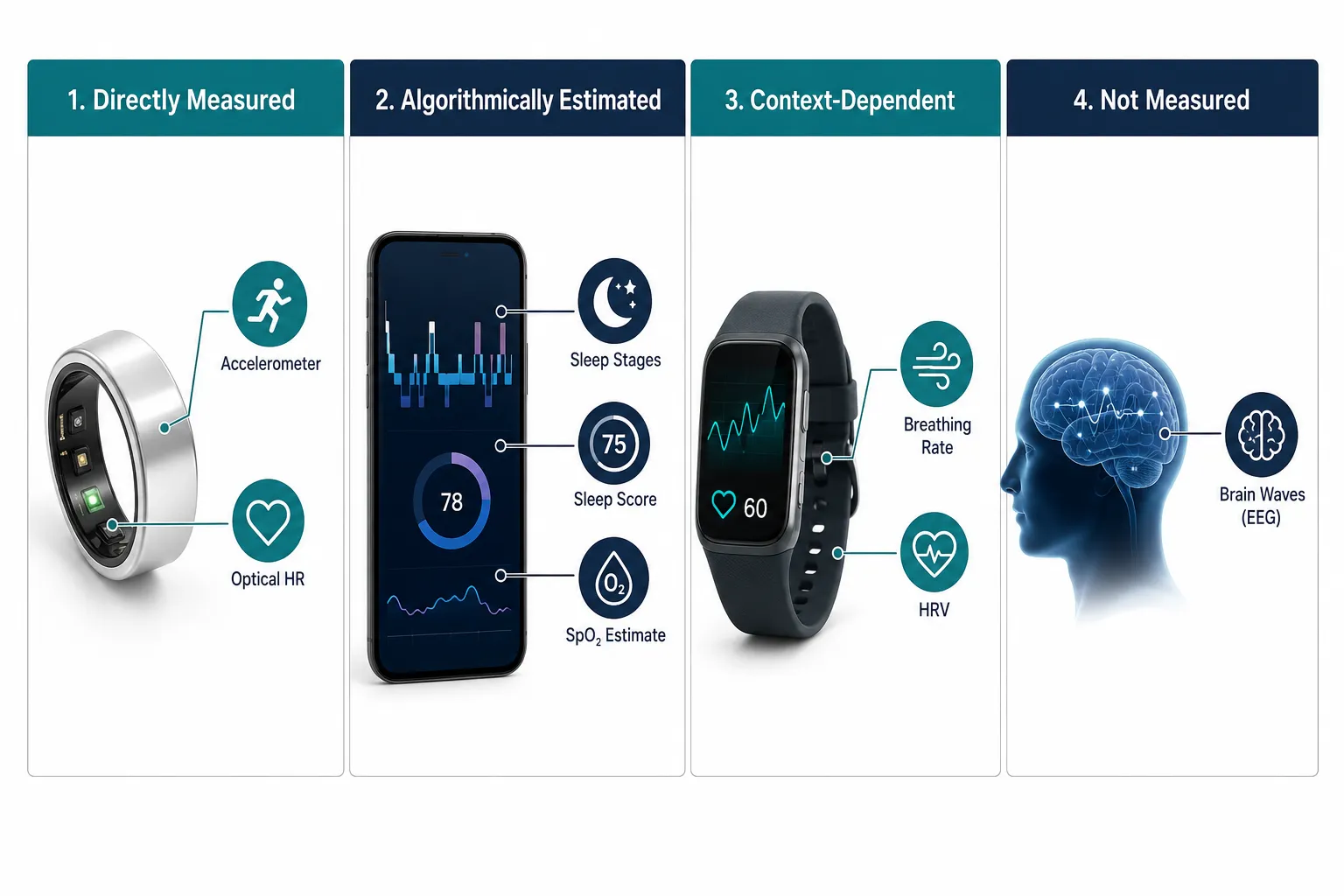
A sleep tracker is any device or application that monitors physiological signals during sleep to estimate sleep timing, duration, and quality. Most consumer sleep trackers work by combining accelerometer data (movement) with optical heart-rate data (photoplethysmography, or PPG) and then applying proprietary algorithms to classify what your body was doing at each point in the night. [1]
What consumer sleep trackers measure directly
- Movement: An accelerometer detects stillness, tossing, and turning. This is the most reliable raw signal.
- Heart rate: An optical sensor shines light into the skin and reads blood-volume pulses. Most modern wearables do this continuously overnight.
- Skin temperature: Some devices track relative changes in wrist or finger temperature across the night.
- Heart rate variability (HRV): Derived from the heart-rate signal, this reflects autonomic nervous system activity and is increasingly used in recovery and readiness calculations.
What sleep trackers estimate
- Sleep stages: Light, deep (slow-wave), and REM sleep are estimated from movement and heart-rate patterns. Clinical staging requires EEG (electroencephalography), which no consumer wearable currently performs. Algorithms approximate what stage you are likely in, they do not measure it directly.
- Sleep scores: A composite number calculated from multiple signals using each manufacturer’s proprietary formula. Two devices worn simultaneously on the same wrist can produce different scores for the same night.
- Breathing rate and SpO2: Optical sensors can estimate respiratory rate and blood oxygen saturation, but accuracy varies by device, skin tone, sensor placement, and movement. These are not equivalent to clinical pulse oximetry.
- Readiness or recovery scores: Composite indices that combine sleep data with activity history and HRV. Useful as a directional guide, not a precise measurement. [2]
The simplest way to look at it is this: the raw signals (movement, heart rate) are measured; everything built on top of those signals is an educated algorithmic estimate.
How Accurate Are Sleep Trackers?
The honest answer is: it depends on what you are measuring, which device you are using, and how you define accuracy. The evidence suggests that consumer trackers perform reasonably well on some metrics and poorly on others. [3]
Sleep duration and timing
Total sleep duration and sleep/wake timing are the metrics where consumer sleep trackers perform best. Compared to polysomnography (PSG), the clinical gold standard, wearables generally detect total sleep time within a reasonable margin for most users, though they tend to overestimate sleep in people who lie still while awake. [1]
Bedtime consistency and wake-time patterns tracked over weeks are genuinely useful data points. A multi-week trend showing that your average sleep time has drifted 45 minutes later is real information worth acting on.
Sleep stages and sleep scores
Here is the real issue: sleep-stage classification is where consumer trackers are weakest. Research comparing wearable devices to PSG has consistently found that individual sleep-stage accuracy, particularly distinguishing light from deep sleep, is limited. [3]
A few important caveats:
- Accuracy varies significantly between devices and between individuals.
- Validation studies are often funded or conducted by manufacturers, which introduces bias.
- Independent validation is available for some devices but not all.
- Avoid treating a single night’s sleep-stage breakdown as clinically meaningful.
Sleep scores are proprietary composites. They can be useful for spotting trends, but a score of 72 versus 78 on consecutive nights does not carry clinical meaning.
Heart rate, breathing and blood oxygen estimates
Resting heart rate measured overnight by a well-fitted wearable is generally reliable for most users. HRV trends over time can be informative, though single-night HRV readings are noisy.
Breathing rate estimates and SpO2 readings are more context-dependent. Sensor fit, skin tone, and movement all affect accuracy. The evidence does not support using consumer SpO2 readings to screen for or rule out sleep apnea. [1] A device that flags low overnight SpO2 may prompt a useful conversation with a doctor, but it is not a diagnosis.
Best Sleep Tracker Types for Different Users
Let’s keep this practical. Rather than presenting a ranked list tied to a specific year, which becomes outdated as devices update and new models launch, the more useful approach is to understand what each category offers, then match it to your needs. Searches for “best sleep trackers 2024” will return results that may already be stale; what matters most is current device support, comfort, measurement quality, subscription model, and privacy policy at the time you buy. [9]
Smart rings
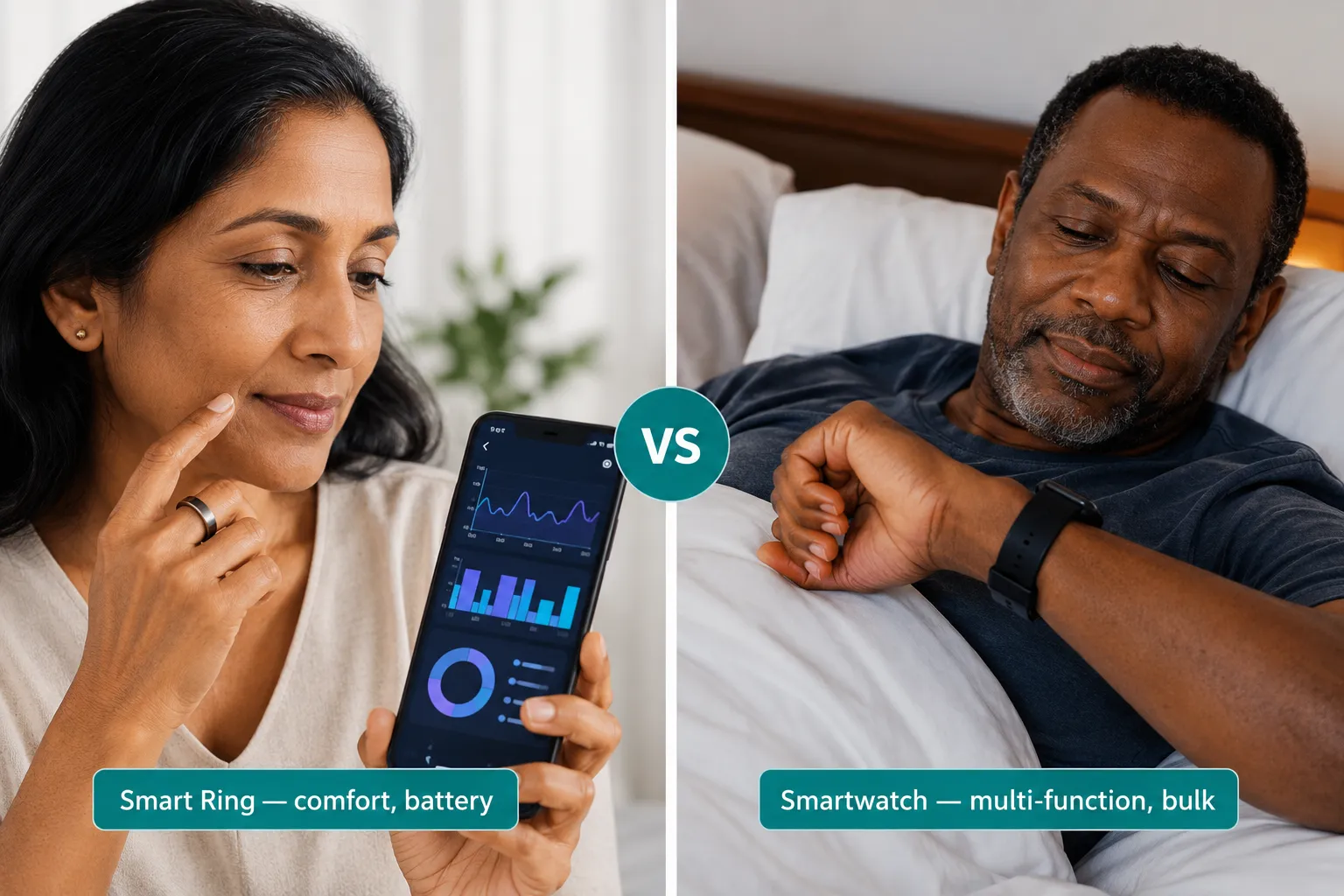
Smart rings (such as the Oura Ring and similar competitors) sit on a finger, which provides a stronger optical signal than a wrist because the finger has less movement artifact and better blood-flow proximity. They are discreet, lightweight, and well-suited for overnight wear. Battery life typically ranges from four to seven days depending on the model and use. Most smart rings require a companion app and some require an ongoing subscription to access full data. [6]
Choose a smart ring if: you want a comfortable, unobtrusive form factor, you prioritize overnight sensor quality, and you are comfortable with a subscription model.
Smartwatches and fitness bands
Smartwatches (Apple Watch, Fitbit, Garmin, Samsung Galaxy Watch, and similar) and dedicated fitness bands offer sleep tracking as part of a broader feature set. Wrist placement is less ideal than a finger for optical sensing, but modern devices have improved significantly. Battery life is the main constraint, many smartwatches require daily charging, which competes directly with overnight tracking. [7]
Choose a smartwatch or band if: you want a single device for activity, notifications, and sleep; you already own one; or you prefer not to pay a separate sleep-tracker subscription.
Phone apps
Software-only sleep tracking apps (such as Sleep Cycle and similar) use a phone’s microphone or accelerometer to detect movement and sound during sleep. No additional hardware is required. Accuracy is lower than wearable sensors, but these apps can still detect rough sleep timing and some patterns. [4]
Choose a phone app if: you want to start tracking without buying hardware, or you want a no-subscription option to test whether tracking is useful for you before investing in a device.
Mattress and bedside trackers
Devices like the Withings Sleep Analyzer sit under the mattress or on a bedside table and use pressure sensors or radar to detect movement, breathing, and heart rate without anything worn on the body. These suit people who find wearables uncomfortable or disruptive. Accuracy for breathing pattern detection varies, and some devices have received regulatory clearance for specific features. [5]
Choose a bedside or under-mattress tracker if: you dislike wearing devices to bed, you share a bed and want individual tracking, or comfort is the overriding priority.
Sleep Tracker vs Smartwatch: Which Is Better?
A dedicated sleep tracker is not always better than a smartwatch, it depends on what you need. The comparison comes down to form factor, battery life, data depth, and cost.
| Factor | Dedicated Sleep Tracker | Smartwatch |
|---|---|---|
| Primary purpose | Sleep and recovery | Activity, notifications, health |
| Overnight comfort | Generally higher (ring/band) | Varies; some are bulky |
| Battery life | Often multi-day | Often requires daily charging |
| Sleep data depth | Typically more detailed | Varies by brand |
| Cost | Hardware plus possible subscription | Hardware; some subscriptions |
| Daytime utility | Limited | High |
From a practical point of view: if you already own a modern smartwatch and charge it during a consistent daytime window, it may track sleep adequately without any additional purchase. If overnight comfort, battery life, or detailed recovery metrics are priorities, a dedicated ring or band is worth considering. [8]
The strongest evidence for sleep tracking value is in consistent, multi-week patterns, not in the granular nightly detail that more expensive devices emphasize.
Sleep Tracker Price and Subscription Costs
Prices change, and any specific figure here would be outdated within months. What is more useful is understanding the cost structure.
Hardware cost: Entry-level fitness bands with basic sleep tracking are available at a lower price point than premium smart rings or advanced smartwatches. Mid-range options from established brands offer a reasonable balance of features and cost.
Subscription cost: This is where the real long-term cost lives. Some devices require a monthly or annual subscription to access full sleep data, trend analysis, and coaching features. Others provide full data access with no ongoing fee. Before buying, check whether the core sleep data you want requires a subscription or is included with the hardware.
No-subscription options: Several devices from Garmin, Samsung (Galaxy Watch), and Fitbit (basic tier) offer sleep tracking without a mandatory ongoing subscription, though features may vary. Phone apps are the lowest-cost entry point, often free or low-cost, with no hardware required. [4]
The practical question to ask: What is the total two-year cost, hardware plus subscription, and does that match the value you expect to get?
Best Sleep Trackers for Side Sleepers and Different Needs
The best sleep tracker for side sleepers is one that stays comfortable and maintains sensor contact throughout the night. Side sleeping puts pressure on a wrist-worn device, which can cause discomfort and reduce sensor accuracy if the band is displaced.
For side sleepers:
- Smart rings are generally the most comfortable option for side sleepers because finger placement is less affected by lying on one side.
- Thin, flexible fitness bands with a small sensor module may also work well.
- Avoid thick smartwatches if you find wrist pressure uncomfortable during sleep.
For couples sharing a bed:
- Most wearable trackers track the individual wearing the device, so each partner needs their own device for individual data.
- Under-mattress trackers vary in their ability to separate two people’s signals. Some models claim dual-user detection, but accuracy for separating two sleepers’ data is not uniformly validated. Check current manufacturer claims carefully before purchasing on this basis. [5]
- Phone apps placed on a bedside table will pick up sound from the whole room, not just one person.
For people with larger or smaller wrists: Band sizing matters for sensor contact. Check sizing options before buying.
For people sensitive to light: Some optical sensors emit a visible green or red light. If light sensitivity affects your sleep, look for devices that allow you to reduce sensor frequency or use infrared-only modes.
Sleep Tracker Alternatives If You Do Not Want to Wear One
The Oura Ring is one of the most recognized names in consumer sleep tracking, but it is not the only option in the smart ring or dedicated sleep tracker category. If you are looking for alternatives, consider these categories:
- Other smart rings: The Samsung Galaxy Ring and similar competitors have entered the market with comparable sensor sets. Features, subscription models, and app ecosystems differ, so compare current specifications at the time of purchase.
- Wrist-based dedicated trackers: Whoop (a subscription-first band with no screen) focuses on recovery and strain metrics. Garmin wearables offer detailed sleep data without a mandatory subscription.
- Under-mattress devices: Withings Sleep Analyzer provides sleep tracking without wearing anything, which suits users who find rings or bands uncomfortable.
- Phone apps: For users who want to test sleep tracking before committing to hardware, a software-only app is a low-cost starting point. [4]
The main takeaway is that the right alternative depends on your priorities: comfort, cost, subscription preference, and which ecosystem (Apple, Android, or standalone) you already use.
Why Is My Sleep Tracker Not Working?
When sleep tracker data looks wrong or implausible, there are usually a few common causes. Let’s call it what it is: most “inaccurate” readings are not device failures, they are the expected output of a sensor in suboptimal conditions.
Common reasons for poor or missing data:
- Poor fit: The sensor needs consistent skin contact. A loose band or ring that shifts during sleep will produce unreliable data.
- Charging conflicts: If the device runs out of battery during the night, data will be missing or truncated. Establish a consistent charging window during the day.
- Algorithm limitations: If you lie very still while awake (reading, watching television before sleep), the device may classify that time as sleep.
- Skin tone and sensor placement: Some optical sensors have shown reduced accuracy in people with darker skin tones. This is a documented limitation in the research literature and an active area of device development.
- Alcohol and illness: Both significantly affect heart rate and movement patterns, which can skew sleep-stage estimates for that night.
- App sync failures: Data sometimes fails to sync between device and app. Check Bluetooth connection and app permissions.
- Software updates: Manufacturers periodically update algorithms, which can cause apparent changes in your sleep data even when your actual sleep has not changed. [9]
If data is consistently implausible across multiple nights with good device fit, contact the manufacturer’s support before concluding the device is broken.
Common Sleep Tracker Mistakes
These are the patterns that reduce the value of sleep tracking, and some of them are easy to fix.
- Judging sleep by a single night’s score. One poor score after a late night or stressful day is noise, not a trend. Look at rolling averages over two to four weeks.
- Treating sleep-stage percentages as clinical facts. The REM percentage on your app is an estimate. It is directionally useful over time, not a precise measurement.
- Changing too many variables at once. If you start a new supplement, change your bedtime, and buy a new mattress in the same week, you cannot attribute any change in your data to a single cause.
- Ignoring how you actually feel. A tracker score of 85 on a morning when you feel exhausted is a sign to trust your body, not the algorithm.
- Wearing the device incorrectly. Too loose, too high on the wrist, or on the wrong finger, fit matters for data quality.
- Comparing your data to others. Sleep needs and patterns vary between individuals. Your baseline is what matters, not someone else’s score.
- Skipping the basics while chasing better scores. Consistent bedtime, a cool dark room, and limiting alcohol do more for sleep quality than any tracker feature. See our complete guide to sleep hygiene and better sleep for the evidence-based fundamentals.
Are Sleep Trackers Worth It?
For some people, yes—but only when the data answers a useful question. A tracker may be worth the cost if you want to observe bedtime consistency, total sleep time or the effect of one lifestyle change over several weeks. It is less worthwhile if you expect a nightly score to explain exactly why you feel tired, or if wearing and charging the device adds stress. Comfort, privacy, total cost and your ability to interpret estimates cautiously matter more than a long feature list.
This is the question that matters most, and the honest answer is: maybe, for some people, under some conditions. The evidence is limited and mixed.
The theoretical mechanism is sound: tracking creates awareness, awareness enables behavior change, and behavior change can improve sleep. Some users report that seeing consistent data about irregular bedtimes motivated them to set a more consistent schedule, and sleep consistency is one of the better-supported targets for improving sleep quality.
However, the evidence for direct improvement from tracking alone is not strong. A tracker does not improve sleep by existing on your wrist. It provides data. What you do with that data determines whether it helps. [10]
Where trackers are most likely to add value:
- Identifying chronically short sleep duration you had not noticed.
- Spotting irregular bedtime patterns across weeks.
- Motivating consistent sleep and wake times.
- Tracking the effect of lifestyle changes (exercise timing, alcohol, caffeine cutoff) over time.
Where trackers are unlikely to help:
- Diagnosing sleep disorders.
- Replacing good sleep habits.
- Providing meaningful nightly feedback on sleep stages.
The basics still do the heavy lifting. Managing stress, maintaining a consistent schedule, and addressing sleep environment factors will do more for most people than any device feature. For more on managing the stress-sleep connection, see our stress management guide.
Can Sleep Trackers Cause Anxiety or Obsession?
Yes, and this is a documented concern, not a hypothetical one. Researchers have described a pattern called orthosomnia: a preoccupation with achieving a perfect sleep tracker score that itself disrupts sleep. [1]
The pattern tends to develop when someone:
- Checks their sleep score immediately upon waking and lets it set the emotional tone for the day.
- Adjusts behavior based on nightly scores rather than weekly trends.
- Feels anxious or distressed when scores are lower than expected.
- Spends significant time researching how to improve their score rather than their sleep.
This is where hype gets in the way. Sleep trackers are marketed with language that implies precision and control. The reality is that sleep is a biological process with natural night-to-night variability, and no algorithm captures it perfectly.
If tracking is increasing your sleep anxiety:
- Consider turning off nightly score notifications.
- Review data weekly rather than daily.
- Take a two-week break from tracking and note whether your sleep and mood improve.
- Speak to a physician or mental health professional if sleep anxiety is persistent.
For people with existing health anxiety or a history of obsessive health monitoring, sleep trackers may not be appropriate without professional guidance.
Sleep Trackers for Couples Sharing a Bed
Wearables generally identify the person wearing them, so each partner needs their own device for individual sleep data. A mattress pad or bedside sensor may attempt to separate two sleepers, but movement, position and partner disturbance can make attribution uncertain. Phone apps that listen from a bedside table record the room rather than reliably identifying one person. Treat shared-bed results as approximate unless the manufacturer provides convincing, independent validation for two-person use.
Sleep Tracker Battery Life Comparison
Battery life is a practical measurement issue, not just a convenience feature. A device that needs charging overnight can create missing nights and distort your trend.
- Smart rings: commonly offer several days between charges, but exact endurance varies with sensors and features.
- Fitness bands: often last longer than full smartwatches and may suit people who want uninterrupted overnight tracking.
- Smartwatches: may need more frequent charging, so establish a daytime charging routine before relying on them for sleep data.
- Under-mattress and bedside devices: usually remain connected to mains power, although app or internet outages can still interrupt syncing.
Compare the manufacturer’s current battery estimate with the features you will use. Do not treat a published maximum as a guaranteed result, and remember that frequent charging is a common reason for incomplete records.
Can Sleep Trackers Detect Sleep Apnea?
Short answer: no consumer sleep tracker can diagnose or rule out sleep apnea. Some devices may flag patterns such as repeated movement, breathing-rate changes or low overnight oxygen readings. Those signals can be a reason to discuss symptoms with a physician, but they are not equivalent to a clinical sleep study and a reassuring app result should not be used to dismiss symptoms.
Speak with a physician or qualified sleep professional if you have loud habitual snoring, witnessed breathing pauses, gasping or choking during sleep, persistent unexplained fatigue or excessive daytime sleepiness. Difficulty staying awake while driving requires particular caution. Clinical assessment, which may include a medically supervised home sleep test or polysomnography, is the appropriate route.
Sleep Tracker Data Privacy: What to Check
Sleep data is personal health data. Before committing to a device and its ecosystem, it is worth spending ten minutes on the manufacturer’s privacy policy.
Key questions to ask:
- Where is your data stored? On-device, on the manufacturer’s servers, or third-party cloud infrastructure?
- Is your data sold or shared with third parties? Some free apps monetize user data. Check the privacy policy, not just the marketing copy.
- Can you export your data? If the company closes or discontinues the product, can you retrieve your historical data?
- What happens if you cancel a subscription? Do you lose access to historical data?
- Is the data encrypted in transit and at rest?
- Does the app comply with applicable health data regulations in your region (such as HIPAA in the US or GDPR in Europe)?
The main takeaway: treat sleep tracker data with the same caution you would apply to any personal health record. Read the privacy policy before you buy, not after.
How to Use Sleep Tracker Data Without Becoming Obsessed
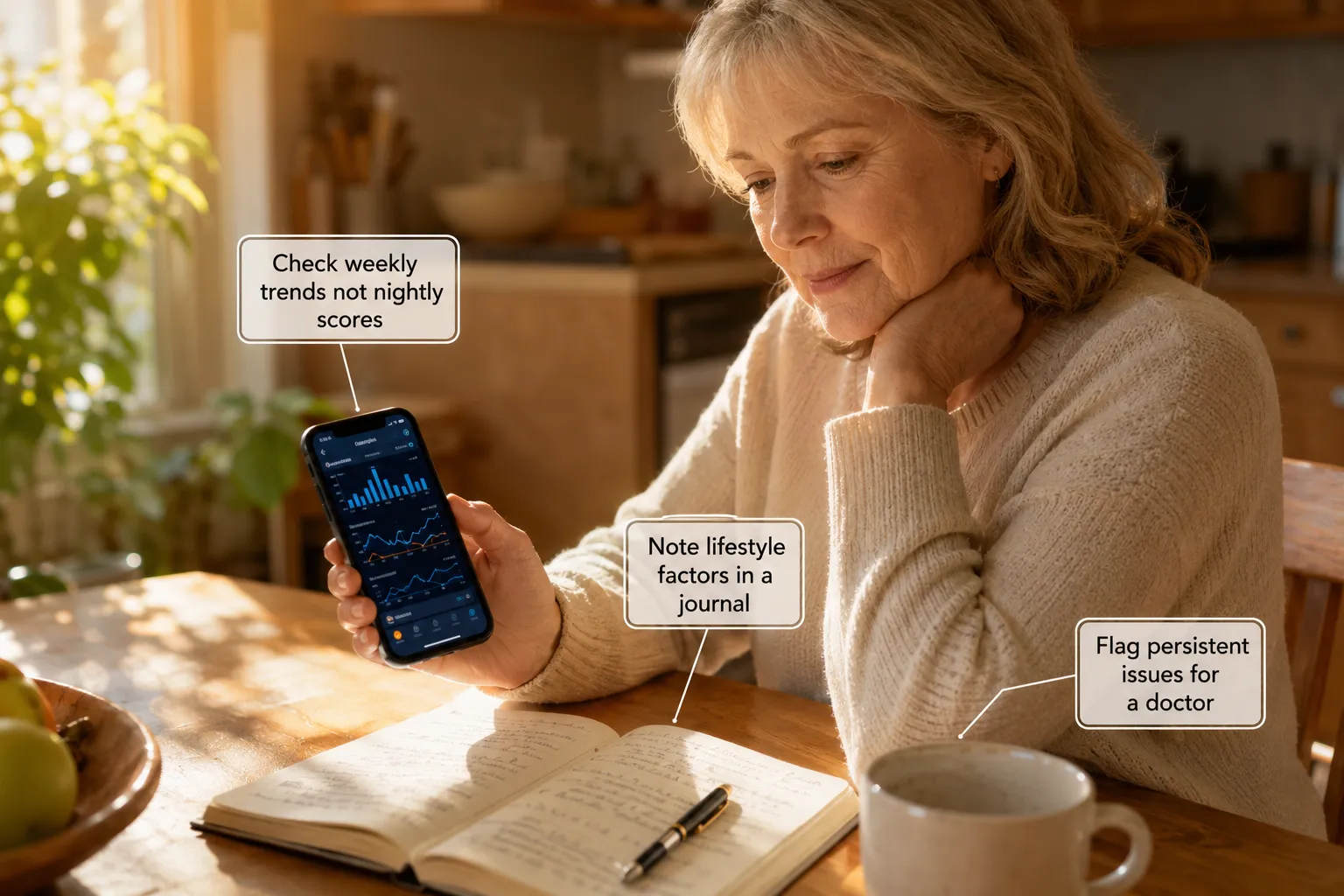
The most productive way to use a sleep tracker is to treat it as a long-term journal, not a nightly report card.
A sensible starting point:
- Wear the device consistently for at least two to four weeks before drawing any conclusions.
- Look at weekly averages for total sleep time and bedtime consistency, these are the most reliable and actionable metrics.
- Note lifestyle factors alongside tracker data: alcohol, exercise timing, stress, travel, illness. Context matters.
- Use the data to test one change at a time. If you move your caffeine cutoff earlier, track whether average sleep duration changes over the following two weeks.
- Do not adjust your behavior based on a single night’s reading.
- If your tracker shows a consistently low sleep duration (under six hours per night on average), take that seriously, not because the tracker is perfectly accurate, but because the pattern is worth investigating.
Supporting good sleep with adequate magnesium intake is one area where lifestyle and sleep intersect. Our guide to magnesium-rich foods for sleep and recovery covers the evidence on dietary magnesium and its role in sleep quality. Similarly, if stress is affecting your sleep patterns, adaptogenic herbs for stress may be worth reading alongside your tracker data.
Safety, Limitations and When to Speak With a Doctor
Important disclaimer: Nothing in this article constitutes medical advice. Sleep trackers are consumer wellness devices, not medical diagnostic instruments. The information here is for general educational purposes only.
Core limitations to keep in mind:
- Consumer sleep trackers are not FDA-cleared or CE-marked as medical diagnostic devices for sleep disorders (though some specific features on some devices have received regulatory clearance for limited purposes, check current status for any specific device).
- No consumer tracker diagnoses sleep apnea, insomnia, restless leg syndrome, narcolepsy, or any other sleep disorder.
- Validation studies vary in quality, independence, and applicability to different populations.
- Accuracy for SpO2 and breathing rate is not equivalent to clinical measurement.
Speak to a physician or qualified sleep professional if:
- You regularly feel unrefreshed after what should be adequate sleep.
- You snore loudly, or a partner has witnessed you stop breathing during sleep.
- You experience excessive daytime sleepiness that affects daily function.
- You have difficulty staying awake while driving.
- Your tracker consistently shows very low or very irregular SpO2 readings, but understand this is a prompt for a clinical conversation, not a diagnosis.
- You have been using a tracker for several weeks and your sleep data shows a persistent pattern of very short sleep duration despite adequate time in bed.
- Tracking is causing significant anxiety or distress.
A home sleep test or attended polysomnography ordered by a physician is the appropriate path for diagnosing sleep disorders, not a consumer wearable.
Frequently Asked Questions
Do sleep trackers work without internet or Wi-Fi?
Most wearable sleep trackers store data on the device itself and sync to an app via Bluetooth. They do not require an active internet connection to record data overnight. However, syncing data to the app and accessing cloud-based analysis typically requires an internet connection. Phone apps that rely on cloud processing may need connectivity to generate reports.
How long should I wear a sleep tracker before the data is useful?
A minimum of two to four weeks of consistent data gives you a meaningful baseline. Single nights are too noisy to act on. Multi-week averages for total sleep time and bedtime consistency are where the actionable patterns emerge.
Can a sleep tracker detect sleep apnea?
No consumer sleep tracker diagnoses sleep apnea. Some devices can flag patterns consistent with disrupted breathing or low SpO2, which may prompt a clinical conversation. But a clinical diagnosis requires a physician-ordered sleep study. Do not use tracker data to rule out or confirm sleep apnea. [1]
What is the battery life of most sleep trackers?
Battery life varies significantly by device type. Smart rings typically last four to seven days. Fitness bands range from three to ten days. Smartwatches often require daily or every-other-day charging, which is the main practical barrier to consistent overnight tracking. Bedside and under-mattress devices are mains-powered and have no battery constraint.
Is a sleep tracker worth buying if I already have a smartwatch?
If your smartwatch has a multi-day battery or a charging schedule that allows overnight wear, it may already provide adequate sleep tracking without an additional purchase. Check what sleep metrics your current device supports and whether a subscription is required for full access before buying a separate tracker.
Can two people in the same bed use one sleep tracker?
Wearable trackers are individual devices, each person needs their own. Some under-mattress trackers claim dual-user detection, but the accuracy of separating two sleepers’ data is not uniformly validated. For reliable individual data, each partner should use a separate device.
What does a sleep score actually mean?
A sleep score is a proprietary composite number calculated by each manufacturer using their own algorithm. It typically combines sleep duration, estimated sleep stages, heart rate, and HRV data. Scores are useful for spotting trends over time, but they are not standardized across devices and should not be interpreted as a clinical measurement.
Are sleep trackers safe to wear every night?
For most healthy adults, wearing a sleep tracker nightly is safe. The optical sensors use low-level light. The main risks are skin irritation from a tight band, and the psychological risk of orthosomnia (sleep anxiety driven by score obsession). If tracking is increasing your anxiety about sleep, reduce your engagement with the data or take a break.
Conclusion
Sleep trackers are most useful as pattern-observation tools. They can help you notice changes in sleep timing, time in bed, movement and selected heart-rate trends, but their sleep stages, scores, readiness, breathing and oxygen outputs are estimates that depend on the device, fit and context.
Use the data over several weeks, compare it with how you actually feel and change one important variable at a time. If tracking makes you anxious, pause it. If persistent fatigue, loud snoring, witnessed breathing pauses, gasping or excessive daytime sleepiness are present, seek clinical assessment rather than buying a more sophisticated tracker.
References
[1] Sleep Foundation, Best Sleep Trackers: https://www.sleepfoundation.org/best-sleep-trackers [2] Wareable, Best Sleep Trackers and Monitors: https://www.wareable.com/health-and-wellbeing/best-sleep-trackers-and-monitors [3] TechRadar, Best Sleep Tracker: https://www.techradar.com/best/best-sleep-tracker [4] Livity App, Best Sleep Trackers 2026 No Hardware: https://livity-app.com/en/blog/best-sleep-trackers-2026-no-hardware [5] Yahoo Health, Best Sleep Tracker: https://health.yahoo.com/wellness/sleep/sleep-products/article/best-sleep-tracker-110301542.html [6] CNET, Best Sleep Tracker: https://www.cnet.com/health/sleep/best-sleep-tracker/ [7] Mashable, Best Sleep Trackers 2026: https://mashable.com/roundup/best-sleep-trackers-2026 [8] The Independent, Best Sleep Trackers: https://www.the-independent.com/extras/indybest/us/best-sleep-trackers-b2923814.html [9] Tom’s Guide, Best Sleep Tracker: https://www.tomsguide.com/wellness/sleep-tech/best-sleep-tracker [10] New York Times Wirecutter, Best Sleep Trackers: https://www.nytimes.com/wirecutter/reviews/best-sleep-trackers/

About the author
Dave James is a health researcher and writer specialising in evidence-based nutrition, exercise, sleep and longevity. He founded All Perfect Health to provide clear, practical health guidance rooted in current research and real-world experience.
📂 Sleep Optimization
This article is part of the APH sleep optimization cluster. Use the links below to move between the pillar and supporting guides.
- Pillar: Sleep Hygiene: The Complete Guide to Better Sleep for Health and Longevity
- YOU ARE HERE Sleep Trackers Explained: What Wearables Can—and Cannot—Tell You About Your Sleep
- → Best Sleep Optimization Gear for Hot, Light and Noise-Sensitive Sleepers
- → Magnesium Glycinate for Sleep: Benefits, Safety, and How to Choose a Supplement