
Morning Sunlight for Sleep: How Light Timing Affects Your Body Clock
Last updated: October 16, 2026
Morning sunlight is not a miracle sleep cure. It is a useful timing signal: bright outdoor light early in the day helps tell the body clock that the day has started. That may support an earlier, more regular sleep schedule when it sits alongside the basics—consistent wake times, dimmer evenings, and a bedroom that is dark enough to sleep in.
Quick Answer
Morning outdoor light can help support circadian timing, but it does not guarantee better sleep or treat insomnia. The practical idea is simple: get some ordinary daylight reasonably early when it fits your day, avoid looking at the sun, and protect skin and eyes when UV exposure calls for it. The strongest point is the pattern across the full day: brighter days and darker nights, not a rigid sunrise ritual.
Key Takeaways
- Light is a timing cue. It helps regulate when the body expects to be awake and when it begins preparing for sleep.
- Outdoor daylight is usually much brighter than indoor lighting, even on many overcast days.
- Morning light and vitamin D are different questions. Circadian effects relate mainly to visible light reaching the eyes; vitamin D production depends on UVB reaching skin.
- The evidence is promising but not a prescription. Studies link earlier or more regular daytime light with sleep timing, but individual responses vary and much real-world evidence is observational.
- Never stare at the sun. Direct sun viewing is not needed for circadian light exposure and can injure the eyes.
- Persistent sleep problems need more than a daylight habit. Loud snoring, witnessed breathing pauses, marked daytime sleepiness, or ongoing insomnia deserve professional assessment.
What Morning Sunlight Means for the Body Clock
Your circadian rhythm is an internal timing system that helps coordinate sleepiness, alertness, temperature, and hormone rhythms over roughly 24 hours. The central clock in the brain uses light reaching the eyes as its strongest daily time cue. In plain English: bright daytime light says “daytime,” while dim evenings and darkness say “nighttime.”
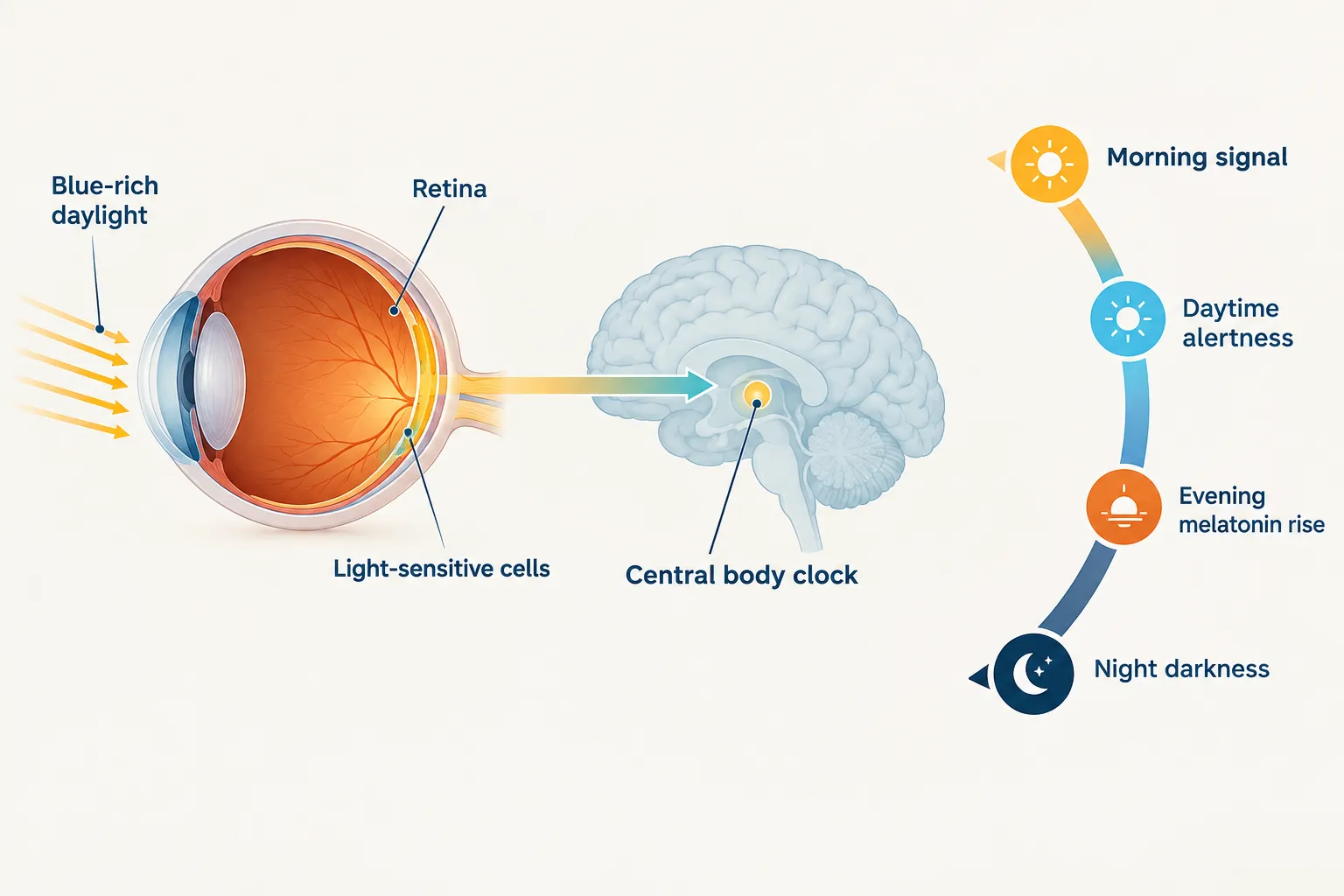
That does not mean light is the only factor. Sleep timing also reflects work, family routines, exercise, meals, stress, illness, medications, and how much sleep a person has been getting. But light is unusually important because it is a signal the brain can use every day to keep the clock aligned with the outside world.
A 2019 systematic review found that both the amount and timing of light were associated with sleep outcomes in community-dwelling adults, while also noting that the evidence was heterogeneous and did not identify one universal best routine.[1] A separate systematic review reached a similar conclusion: timing, intensity, spectrum, prior light exposure, and the person’s age all influence circadian responses.[2]
That is why a sensible plan is better than chasing a precise number of minutes. Sleep hygiene works best when the whole day sends a reasonably consistent signal, rather than when one habit is treated as a standalone fix.
Morning Light Is Not the Same as Vitamin D
Morning light, sunlight, UV exposure, and vitamin D are often bundled together online. They are related only in the broad sense that they involve being outdoors.
For circadian timing, the relevant stimulus is visible light reaching the eyes. For vitamin D synthesis, UVB needs to reach the skin. UVB varies substantially with season, latitude, time of day, cloud cover, altitude, and the local UV Index. Early daylight can be useful for a body-clock routine without being a meaningful vitamin D strategy, and seeking midday UV exposure is not a sleep recommendation.
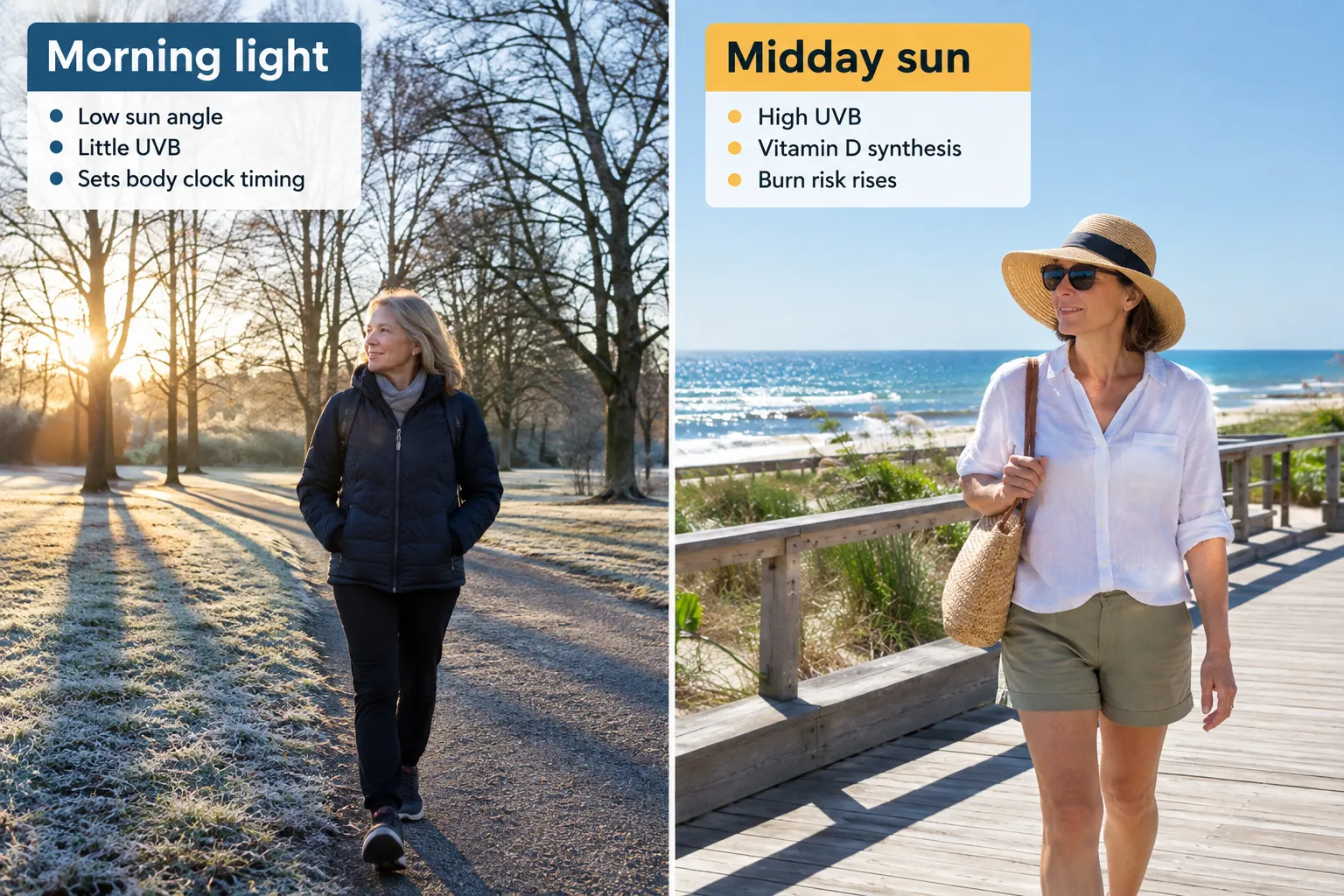
The practical takeaway is not to avoid daylight. It is to separate the jobs. Enjoying ordinary outdoor light does not require a tan, a burn, or direct sun viewing. Check the UV Index and use normal sun protection when conditions call for it.[5]
What the Human Evidence Actually Shows
The best-supported claim is about timing and regularity, not a guaranteed improvement in every sleep measure. Laboratory research shows that light can shift circadian timing, particularly when its timing is deliberately controlled. Real life is messier: people choose their own schedules, weather changes, and sleep is influenced by many things at once.
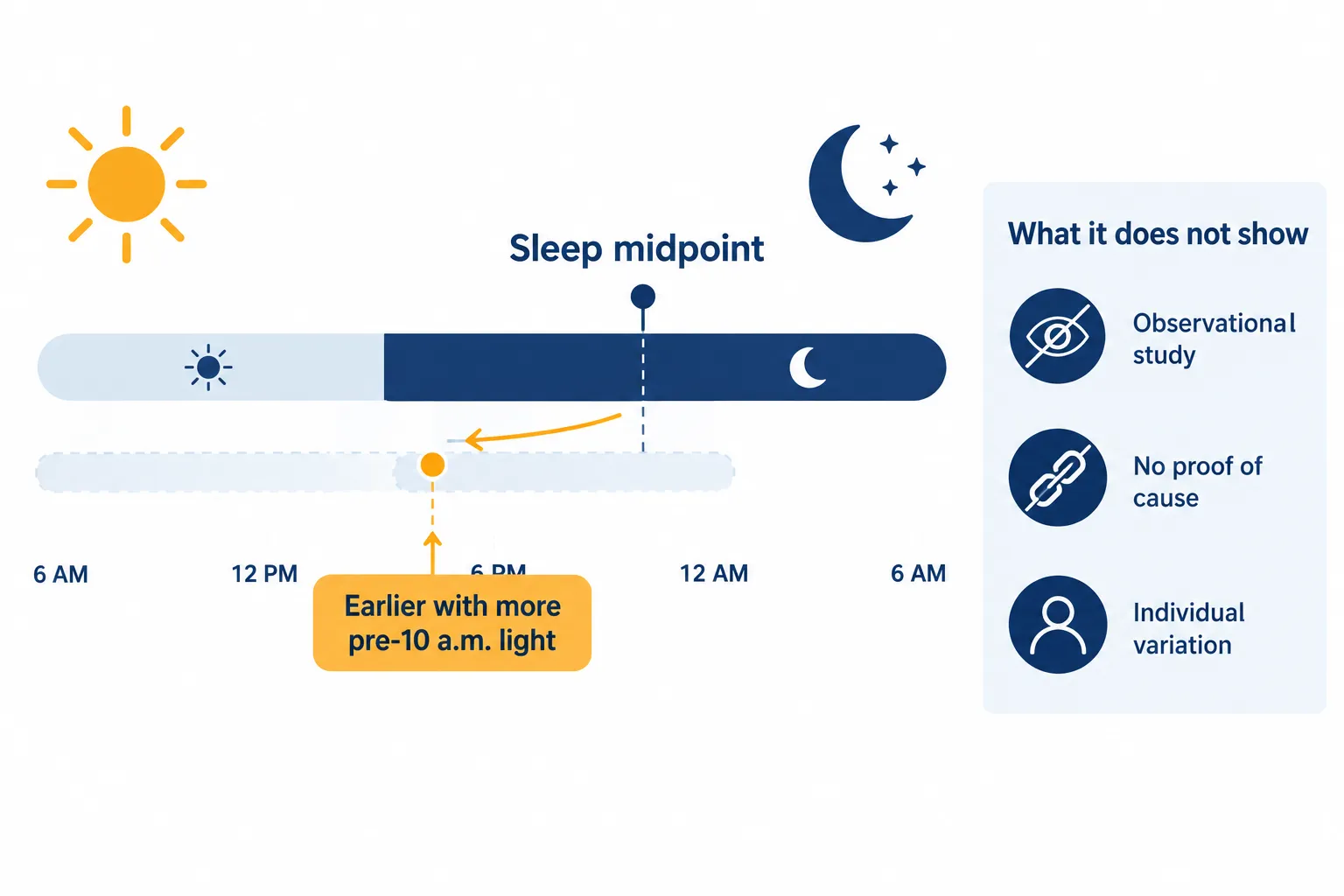
A 2025 cross-sectional study of 1,762 adults in Brazil found that more self-reported sunlight before 10 a.m. was associated with an earlier sleep midpoint and a slightly lower sleep-quality score. That is a worthwhile signal, but it cannot prove that the morning sunlight caused the difference. People with earlier schedules may also have different jobs, routines, activity patterns, or health behaviors.[3]
A 2026 real-world study used light sensors and sleep trackers in 89 UK adults for seven days. Longer daytime light exposure and more regular light patterns were associated with earlier sleep and wake timing; the authors also emphasized that real-world evidence remains limited.[4] These findings fit the broader circadian science, but they are not a reason to promise treatment results.
So the honest answer is modest: daylight habits may be one useful lever for people who want a steadier routine. They are not a substitute for diagnosing why someone cannot sleep.
Practical Daylight Habits Without a Rigid Protocol
There is no single number of minutes that fits every season, latitude, schedule, or person. A better starting point is to make daylight easier to encounter on days when it is practical and safe.
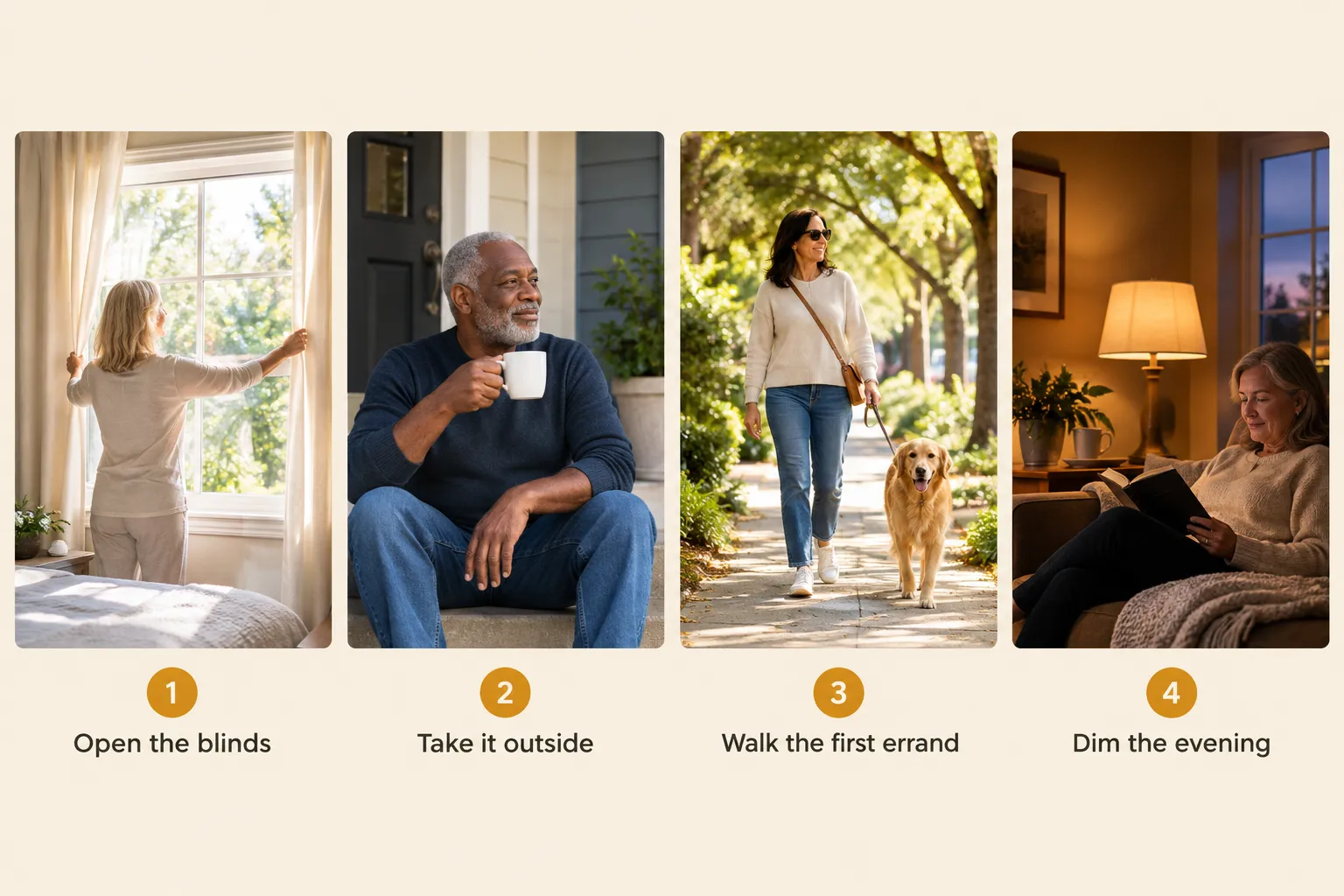
- Open curtains or blinds after getting up instead of staying in a dim room.
- Have a morning drink, breakfast, or a short walk near daylight when that fits the day.
- Use an outdoor errand, dog walk, commute, or time on a balcony or porch as an ordinary opportunity to see daylight.
- Keep evenings noticeably dimmer than daytime where possible, especially close to bedtime.
- Return to a consistent wake time more often than trying to force a perfect bedtime.
For some readers, the more useful next step is fixing the bedroom rather than adding another morning task. If light, heat, or noise is the main issue, start with the specific problem in the room; this sleep-environment guide explains how to do that without treating gear as a cure.
Why Timing Matters More Than a Perfect Number
Online advice often turns this into a stopwatch: get a certain number of minutes at an exact time, every day. That is more precision than the evidence can support for everyday life. The effective brightness of daylight changes with season, clouds, geography, surrounding buildings, and whether someone is actually outdoors. So do a person’s sleep schedule and light sensitivity.
It is more useful to notice the overall pattern. A person who gets up at a broadly consistent time, sees daylight after starting the day, and avoids making every evening as bright as midday is sending a clearer signal to the body clock than someone chasing a perfect exposure target once and ignoring the rest of the routine. Consistency is the principle; a rigid protocol is not.
Daytime Light and Evening Light Work Together
Morning light gets most of the attention because it is easy to understand, but the contrast across the day matters too. Bright light late in the evening can delay circadian timing for some people, especially when it is close to bedtime. That does not mean every screen ruins sleep or that blue-blocking products are a cure. It means that a very bright, stimulating evening can work against an earlier, calmer schedule.
A simple approach is to make daytime reasonably bright when possible and let the home environment become calmer later in the day. That might mean closing out work before bed, lowering unnecessary room brightness, and keeping the bedroom dark enough for sleep. The goal is not to live in darkness after sunset; it is to avoid treating late night like another workday.
Cloudy Days, Seasons, Indoor Work, and Shift Work
Cloudy days still provide outdoor daylight, even though they are dimmer than bright sun. An ordinary outdoor walk can therefore be more meaningful for daylight exposure than sitting beside a window in a typical office. Windows are still useful for a view and a brighter room, but glass changes the light that reaches you and indoor daylight is often far weaker than being outside.
Winter, high latitudes, dense cities, mobility limits, and long indoor workdays can all make a simple outdoor routine less practical. That does not make the day a failure. Regular wake times, a brighter daytime environment when available, and quieter evenings still give the body clock useful structure.
Shift work is different. A strategy meant to reinforce a daytime schedule may be unhelpful for someone trying to sleep after a night shift. People with rotating shifts, a diagnosed circadian rhythm disorder, or persistent difficulty sleeping at the wrong time should get individualized guidance rather than copying a generic morning-light routine.
Sun and Eye Safety
You do not need to look at the sun to use daylight as a timing cue. Looking directly at the sun can damage the retina. Normal outdoor activity, looking at the surroundings, and daylight entering the eyes indirectly are enough for this article’s purpose.
Sun protection is still relevant in the morning and on cloudy days because UV exposure is affected by much more than temperature. The CDC advises using the UV Index to guide protection and notes that UV can reach people on cool or cloudy days and reflect from water, sand, snow, and concrete.[5]
Anyone with an eye condition, a photosensitizing medication, a history of skin cancer, or a clinician-provided sun-exposure plan should follow individualized medical advice. This is also not a reason to use a tanning bed.
When Sleep Problems Need More Than Light Habits
A daylight habit is reasonable general wellness support. It is not enough on its own when sleep problems are persistent, severe, or paired with warning signs. Speak with a qualified clinician about ongoing insomnia, loud snoring or witnessed breathing pauses, severe daytime sleepiness, a major new change in mood, or sleep problems that interfere with safe driving or daily life.
Magnesium is sometimes discussed alongside sleep routines, but it is a separate question with its own evidence and safety considerations. Readers considering a supplement can review Magnesium Glycinate for Sleep; it should not replace assessment for persistent sleep trouble.
Frequently Asked Questions
Does morning sunlight help with sleep?
It may help support circadian timing and a more regular sleep schedule, particularly when it is part of a wider pattern of brighter days and dimmer evenings. It does not reliably cure insomnia or guarantee better sleep for everyone.
Do I need direct sun on my face or eyes?
No. Never stare at the sun. Ordinary outdoor daylight, with attention directed at the environment rather than the sun itself, is the safer approach.
Does light through a window count?
It may make a room brighter and provide a useful view, but outdoor light is generally far more intense. Windows also filter portions of sunlight, including most UVB, so window light should not be treated as a vitamin D strategy.
What if it is cloudy or dark when I wake up?
Outdoor light on cloudy days can still be brighter than normal indoor lighting. If daylight is limited, focus on a consistent wake time and the broader sleep routine instead of trying to force an exact exposure target.
Is this advice the same for shift workers?
No. Light timing can be used differently when someone works nights or rotates shifts. A generic morning-light routine may not fit that schedule, so individualized advice is more appropriate when sleep timing is a persistent problem.
References
- Dautovich ND, et al. A systematic review of the amount and timing of light in association with objective and subjective sleep outcomes in community-dwelling adults. Sleep Health. 2019.
- Tähkämö L, Partonen T, Pesonen AK. Systematic review of light exposure impact on human circadian rhythm. Chronobiology International. 2019.
- Menezes-Júnior LAA, et al. The role of sunlight in sleep regulation: analysis of morning, evening and late exposure. BMC Public Health. 2025.
- Akgun SG, et al. Light exposure and sleep architecture in real-world settings. NPJ Biological Timing and Sleep. 2026.
- Centers for Disease Control and Prevention. Reducing Risk for Skin Cancer. Updated June 17, 2026.
Medical disclaimer: This article is for informational purposes only and is not medical advice. It does not diagnose or treat sleep disorders, eye conditions, skin conditions, or mood disorders. Speak with a qualified healthcare professional about persistent symptoms or individualized medical advice.

About the author
Dave James writes practical, evidence-aware health information for thoughtful adults who want clear guidance without hype. He is not a doctor; All Perfect Health content is educational and should be discussed with a qualified healthcare professional where appropriate.
📂 Sleep Optimization
This article is part of the APH sleep optimization cluster. Use the links below to move between the pillar and supporting guides.
- Pillar: Sleep Hygiene: The Complete Guide to Better Sleep for Health and Longevity
- YOU ARE HERE Morning Sunlight for Sleep: How Light Timing Affects Your Body Clock
- → Best Sleep Optimization Gear for Hot, Light and Noise-Sensitive Sleepers
- → Sleep Trackers Explained: What Wearables Can—and Cannot—Tell You About Your Sleep
- → Magnesium Glycinate for Sleep: Benefits, Safety, and How to Choose a Supplement