
Strength Training for Women Over 50: A Beginner Plan for Home or Gym
Last updated: October 1, 2026
Quick Answer
Women can build strength after 50. A recent systematic review and meta-analysis found no meaningful difference in strength response between premenopausal and postmenopausal women. A practical beginner start is two full-body sessions a week covering squat, hinge, push, pull, and carry patterns, using a load you can control with comfortable form. The plan below works at home with bands or dumbbells and in a gym.
Key Takeaways
- Women can gain strength after 50; menopause is not a reason to assume training will not work.
- The federal activity guidelines include muscle-strengthening work for all major muscle groups on two or more days each week.
- Beginners usually do best by starting with bodyweight or light loads and building consistency before adding weight.
- Home and gym training can both work; the useful choice is the setting a person can use consistently.
- Arthritis flare-ups, diagnosed osteoporosis, recent surgery, unstable symptoms, or a clinician-imposed restriction call for individual guidance before starting or progressing.
- Strength work, walking or other cardio, and balance practice can complement one another; they are not interchangeable.
Table of Contents
- Why strength training matters after 50
- Who this beginner plan is for
- How to start if you are out of shape
- Best exercises for women over 50
- A simple progression plan
- Common mistakes
- Strength training after 60
- Walking, cardio, and balance work
- FAQ
- References
- Medical disclaimer
Why strength training matters after 50
Strength training can make everyday tasks such as carrying groceries, climbing stairs, and rising from the floor feel more manageable. A September 2026 systematic review and meta-analysis of 126 studies and more than 4,000 women found strength improved in both premenopausal and postmenopausal participants, without a meaningful difference between the two groups. In plain English: menopause is not a reason to assume strength training cannot help.
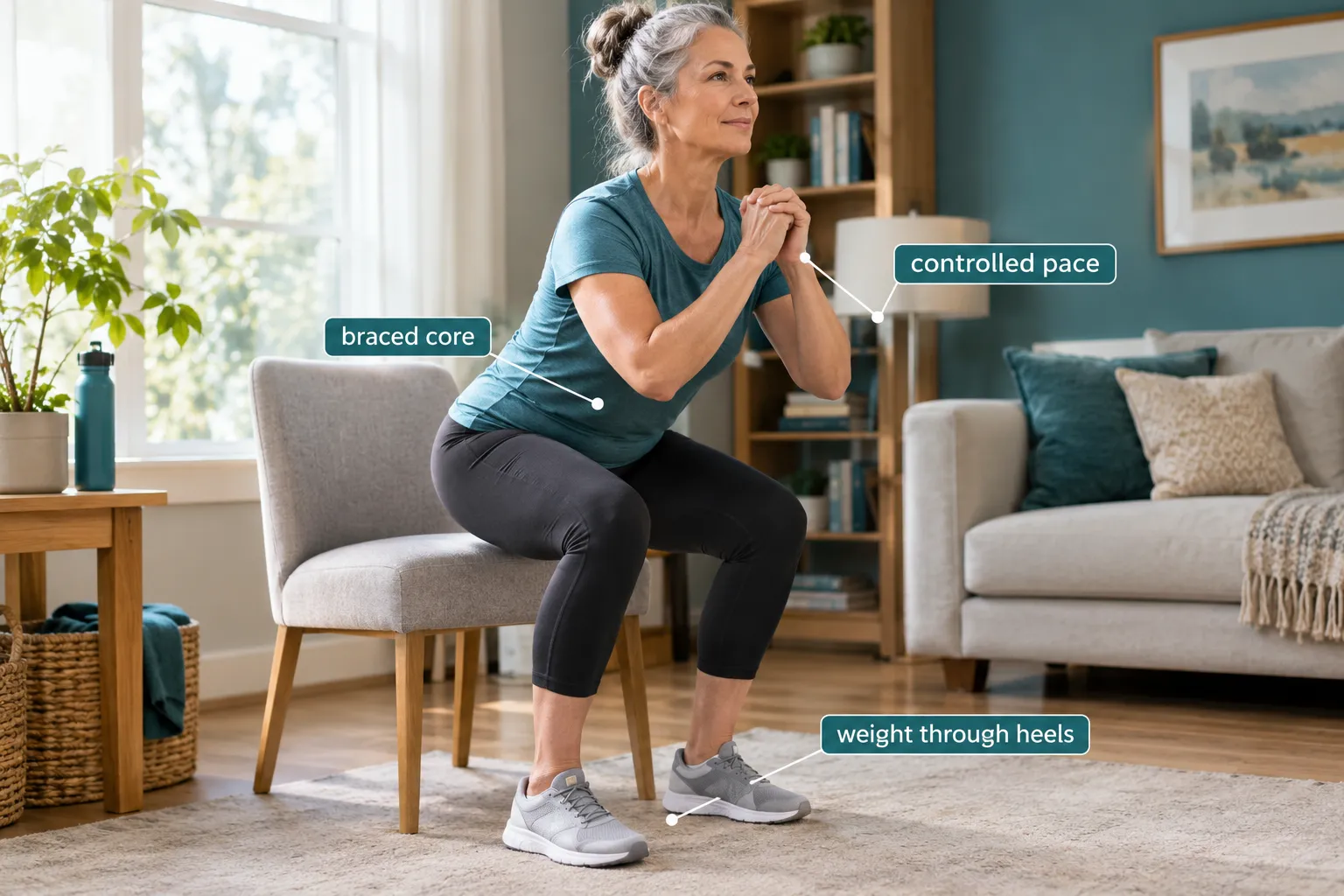
Individual results still vary with starting fitness, the exercises chosen, technique, sleep, nutrition, health conditions, and whether the plan is sustainable. A beginner does not need to chase a perfect program. The useful next step is a simple routine that can be repeated and adjusted gradually.
Can women over 50 build muscle mass?
Yes, but it is more nuanced than “lift weights, build muscle fast.” The 2026 women’s review found strength improved across the included studies, while body-composition changes varied. Better strength and easier day-to-day movement can be worthwhile even when visible changes are slow or modest. For a beginner, progress is better judged by controlled reps, confidence, and everyday tasks than by a scan or a mirror alone.
Who this beginner plan is for, and when you need individual guidance
This plan is written for women roughly 50 to 70 who are new to structured strength training or returning after a long break, and who do not have an acute injury, recent surgery, or a clinician-imposed restriction on exercise. If any of those apply, general education like this is not a substitute for personalized medical or rehabilitation guidance, see a physical therapist, physician, or qualified exercise professional first.
Context matters here. A woman managing well-controlled joint stiffness is in a very different position than one recovering from a hip replacement six weeks ago. Both can likely benefit from structured strength work eventually, but the starting point, pace, and supervision needs differ substantially.
Is strength training safe for women over 50 with arthritis?
Some women with stable, well-managed arthritis can include strength work, but the joint involved, current symptoms, and prior advice all matter. Flare-ups, sharp pain, swelling, or joint instability are reasons to reduce or pause the movement and check with a clinician rather than push through. Supported movements and a smaller, comfortable range may be sensible ways to begin when a joint is reactive.
Strength training for women over 50 with osteoporosis: what to know
Women with diagnosed osteoporosis or significant bone density loss should get individualized guidance from a physician or physical therapist before starting a new strength program, particularly around movements involving spinal flexion or rotation under load. This article provides general education, not personalized clinical direction, and osteoporosis is exactly the kind of condition where exercise selection genuinely needs to be tailored to the individual. That said, being told to avoid certain movement patterns is not the same as being told to avoid strength training altogether, a knowledgeable clinician can usually help identify which patterns are appropriate.
How to start strength training if you’re over 50 and out of shape
Start with bodyweight movements or very light resistance and two full-body sessions each week. That fits the US activity guidelines while leaving room to learn the movements and recover. Judge effort by how a set feels rather than by a fixed number on a bar or dumbbell: it should feel like work, but still leave a few controlled repetitions in reserve. There is no need to test a one-repetition maximum before building a foundation.
Home or gym both work. The evidence suggests the setting matters less than consistency: structured programs using resistance bands, bodyweight, or light dumbbells at home produce real strength gains, and so do gym-based machines and free weights. Choose home if convenience and comfort will keep you consistent; choose a gym if structure, equipment variety, or in-person coaching motivates you to show up. For a closer look at building a foundation with no equipment at all, see this guide to bodyweight strength training.
Do you need equipment for strength training over 50?
No. Bodyweight movements, resistance bands, and household items like a sturdy chair or a filled water jug can deliver a complete beginner program. Equipment becomes useful later for adding load in small, controlled increments once bodyweight versions feel genuinely easy. If joint comfort or grip is a concern, resistance bands are a practical bridge between bodyweight and free weights, they allow fine adjustments in tension and tend to be gentler through a joint’s full range of motion; this guide to resistance band training for joint health covers that approach in detail.
How much weight should women over 50 lift?
There is no single correct number, and any article that gives you one fixed figure for every woman is oversimplifying. From a practical point of view, the right starting load is whatever lets you complete 8 to 12 repetitions with good form while the last two or three reps feel genuinely effortful, not easy and not grinding. As that set starts to feel easy across two consecutive sessions, add a small amount of load or a few more repetitions. More is not always better here, chasing heavy weight before form and tolerance are established is one of the most common reasons beginners get discouraged or sore in a way that derails consistency.
Best exercises for women over 50 to build muscle
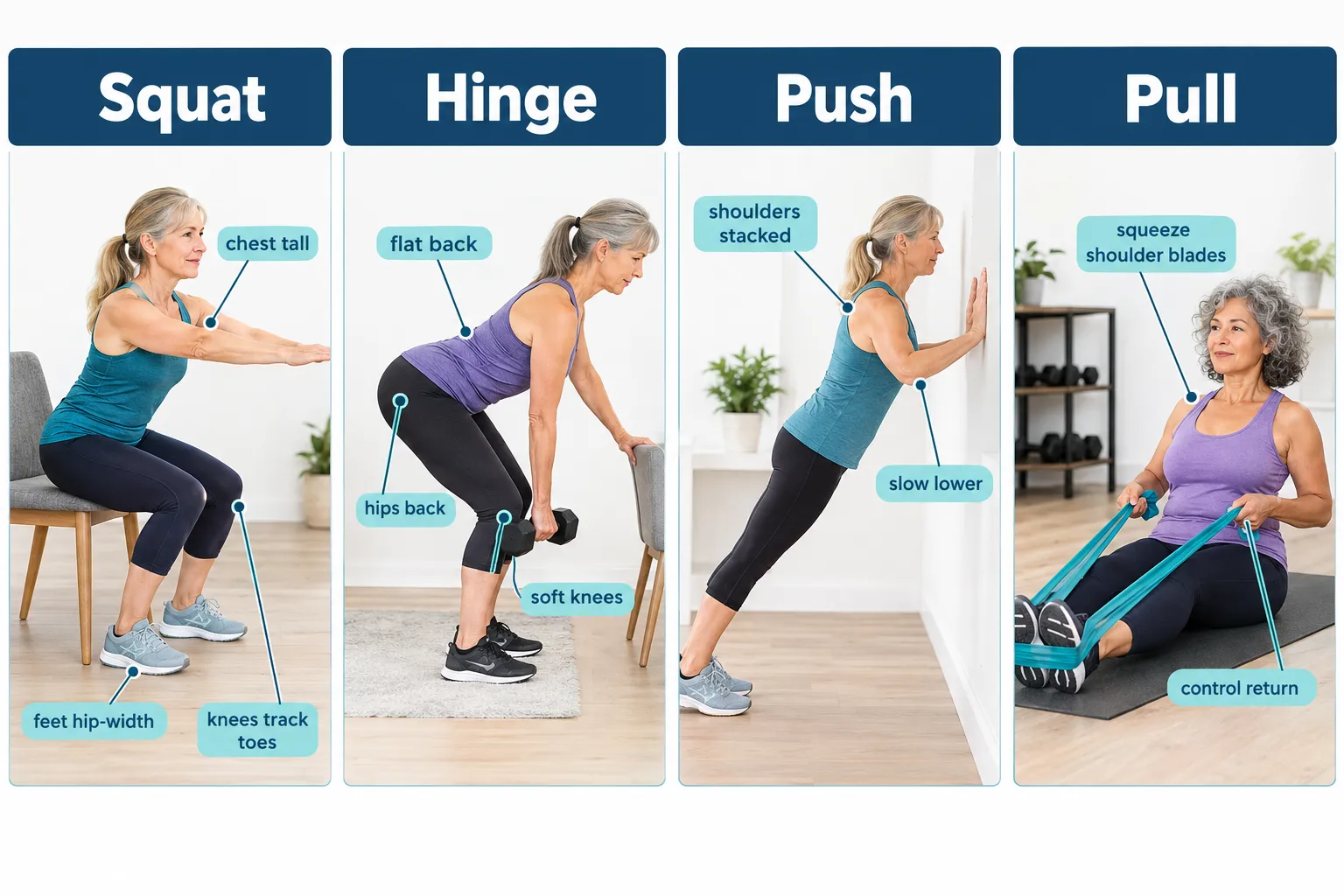
A well-built beginner routine for strength training for women over 50 covers five movement patterns: squat, hinge, push, pull, and a carry or core-bracing movement. Training all of them across a week, rather than isolating single muscles, is the simplest way to look at it and matches how the body actually moves through daily life.
| Movement pattern | Home version | Gym version |
|---|---|---|
| Squat (sit-to-stand) | Chair-assisted squat, holding counter if needed | Leg press or goblet squat with light dumbbell |
| Hinge | Supported hip hinge, hands on thighs | Cable hip hinge or light kettlebell deadlift |
| Push | Wall push-up or incline push-up on counter | Chest press machine or dumbbell bench press |
| Pull | Resistance-band row using an inspected band and a secure purpose-made anchor point | Seated cable row or lat pulldown |
| Carry or brace | Farmer’s carry with light bags or dumbbells | Loaded carry with dumbbells or kettlebells |
Choose the home or gym version based on what’s available and what feels comfortable in your joints that day, both columns target the same pattern, and switching between them as circumstances change is completely reasonable. If dumbbells are part of your setup, this guide to dumbbell exercises at home walks through loading progressions for each of these patterns in more depth.
A common mistake at this stage is picking exercises that isolate small muscles (bicep curls, leg extensions) before establishing the larger patterns above. Isolation work has its place later, but the basics still do the heavy lifting for a beginner building general strength and function.
Strength training routines for women over 50: a simple progression plan
This six-to-eight-week example starts with two sessions a week, adds a third only when the first two feel manageable, and increases load in small steps once form is controlled. It is a framework rather than a rigid prescription: adjust the pace to recovery, confidence, and any advice already given by a clinician or therapist.
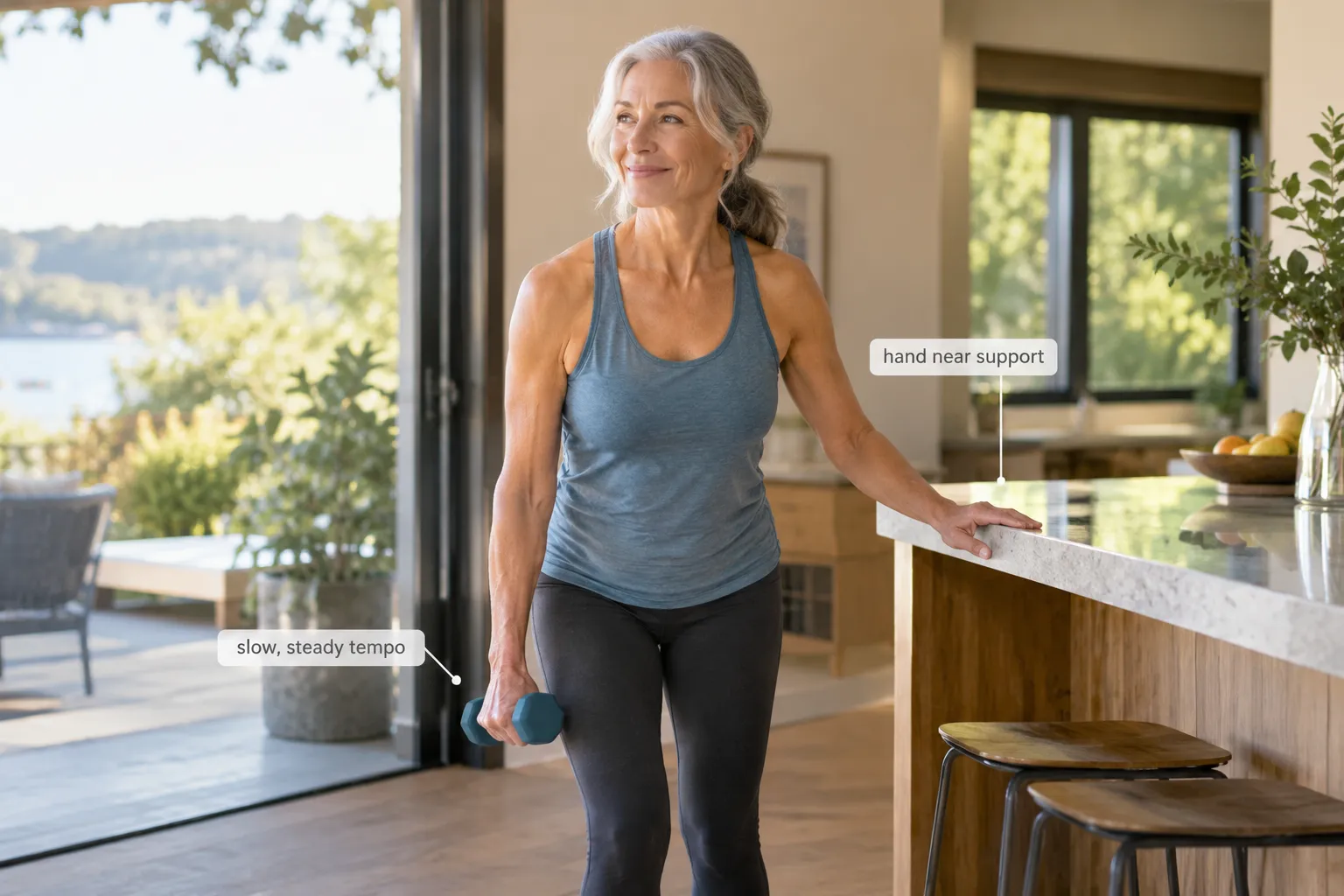
Weeks 1-2: Two full-body sessions per week, one set of 8-12 reps per movement pattern, focusing entirely on form and comfortable range of motion.
Weeks 3-4: Two to three sessions per week, two sets per pattern, still at a moderate effort level (around 5-6 out of 10).
Weeks 5-6: Three sessions per week if recovery allows, two to three sets per pattern, effort increasing toward 6-7 out of 10 on the last set.
Weeks 7-8: Small load increases on movements that now feel easy; reassess any movement that consistently causes discomfort rather than normal muscle fatigue.
If a movement feels uncomfortable, not the expected muscular fatigue, but joint pain, sharp discomfort, or pain that lingers the next day, drop back to an easier variation or skip it and substitute a different pattern rather than pushing through.
How often should women over 50 do strength training?
For most beginners, two full-body sessions a week is a practical starting point. The US activity guidelines recommend muscle-strengthening activity for all major muscle groups on two or more days a week. A third session can make sense once the first two feel manageable, but it is not a requirement for getting started.
How long does it take to see results from strength training over 50?
Early progress is often noticed as more controlled repetitions, greater confidence, or daily tasks feeling less demanding. The pace varies from person to person, and visible body-composition changes may take longer or be modest. Keep the focus on a repeatable routine and function first, rather than expecting a fixed calendar deadline.
Common mistakes women over 50 make when lifting weights
The most common error is doing too much too soon, adding sessions, sets, and load all at once because early enthusiasm outpaces recovery capacity. Here’s the real issue: soreness is not a scoreboard. Chasing it as a sign of a “good workout” tends to backfire, leading to burnout, missed sessions, or minor overuse injuries that stall progress rather than accelerate it.
Other frequent mistakes include:
- Skipping technique to add weight faster. Form should be comfortable and controlled before load increases; rushed form under heavier load raises injury risk without adding real benefit.
- Copying advanced workouts from social media. Programs built for younger, experienced lifters often include volume and intensity that are not appropriate for a true beginner, regardless of age.
- Neglecting recovery. Muscles adapt during rest, not during the workout itself. Training the same muscle groups hard every single day, with no lighter days, usually slows progress.
- Avoiding all discomfort, including normal fatigue. Some muscular fatigue during and after a set is expected and is not the same as joint pain or injury.
- Treating one bad day as failure. A missed session or an off week does not erase prior progress; the main takeaway is to return to the plan rather than restart from scratch out of frustration.
That is a strong claim and needs strong proof, so it is worth repeating: no single mistake on this list guarantees injury or failure, but combining several of them, heavy load, poor form, no rest days, ignoring joint feedback, stacks risk in a way that is avoidable with a slower, steadier approach.
Strength training for women over 60 and beyond
Strength training after 60 follows the same basic principles, with more attention to pace, balance support, recovery, and individual health context. Age alone is not a reason to assume incapacity: women can still improve strength, while the best starting point and rate of progression vary from person to person.
Reasonable adjustments for women in their 60s and 70s include:
- Balance support during standing exercises. Holding a sturdy chair or counter during squats, single-leg work, or carries reduces fall risk during the exercise itself without changing the muscle-building intent of the movement.
- Slightly longer warm-up time. A few extra minutes of easy movement before loaded work tends to make joints feel more prepared, particularly first thing in the morning.
- More recovery between hard sessions. This does not mean training less often overall, it can mean alternating harder and easier sessions across the week rather than going hard every time.
- Seated or supported variations as a starting point, with standing versions introduced once balance and confidence improve.
What’s the difference between strength training and weight training for older women? In practice, the terms overlap heavily. “Weight training” usually refers specifically to training with external weights (dumbbells, barbells, machines), while “strength training” is the broader category that also includes bodyweight work, resistance bands, and bodyweight-plus-band combinations. For a woman starting out, the label matters far less than the principle: progressive, appropriately loaded movement across the major patterns.
How strength training fits with walking, cardio, and balance work
Strength training and cardio are not competing options for women over 50, they address different physical qualities and work best as complements rather than substitutes. Strength training builds the capacity to produce force (useful for carrying, rising, climbing), while cardio work like walking builds endurance and cardiovascular capacity. Neither replaces the other.
Strength training vs cardio for women over 50
Choose strength training as the priority if daily tasks feel physically harder than they used to (stairs, carrying bags, getting off the floor), that is a strength and function signal. Choose to prioritize cardio if breathlessness or stamina on walks is the more pressing limitation. From a practical point of view, most women benefit from both: a simple weekly structure might include two to three strength sessions and several days of walking or other low-impact cardio, with walking also serving as useful active recovery on non-strength days. For a broader view of weekly structure across all these elements, the pillar guide on how to exercise when you’re over 50 covers how strength, cardio, and mobility fit together across a full week.
Strength training, balance, and everyday steadiness
Strength training can be one part of staying capable in daily life, alongside walking or other cardio, specific balance practice, and a safe home environment. It is not a guaranteed fall-prevention program, and a general routine cannot substitute for individualized assessment when someone has had falls, marked unsteadiness, or a new change in balance.
FAQ
Is strength training safe to start at 55, 60, or 70 with no prior lifting experience?
Generally yes, for women without acute injury, recent surgery, or unstable symptoms. Start with bodyweight or very light resistance, build gradually, and get individual clearance from a clinician if there is uncertainty about a specific condition.
Can strength training alone build significant muscle mass after menopause?
The evidence suggests strength and function can improve, while measurable muscle-mass changes may be smaller and more variable.
How many days a week should a beginner start with?
Two sessions per week for the first few weeks is a sensible starting point, progressing to three once those sessions feel manageable and recovery is good.
What if a joint hurts during an exercise?
Stop that movement, try an easier variation or different pattern, and if pain persists or worsens, get it assessed by a clinician rather than pushing through.
Do resistance bands work as well as dumbbells?
For many beginner goals, bands can be a useful option. Use an undamaged band and a secure anchor point designed for the load; if the setup feels uncertain, choose a simpler variation or ask a qualified professional to show you a safe setup.
Is it too late to start strength training in your late 60s or 70s?
No. Women can begin later in life, provided the starting exercise, load, and progression suit their health and current ability.
Conclusion
Strength training for women over 50 does not require a gym membership, a complicated program, or a tolerance for soreness as proof of progress. The evidence points to something simpler: consistent, moderate-effort training across the major movement patterns, squat, hinge, push, pull, and carry, two to three times a week, is enough to drive meaningful improvements in strength and daily function. Clear beats clever here. Start with bodyweight or light resistance, track how exercises feel rather than chasing a number, and build gradually across six to eight weeks before adding meaningful load.
If arthritis, osteoporosis, a recent surgery, or any unstable symptom applies, treat this article as general education and get individualized direction before starting. For everyone else, a sensible next step is picking two days this week to try the five-pattern beginner routine above, using the home or gym version that fits your life, and building from there.
References
These sources support the broad exercise and training-context statements in this article. They do not replace individualized medical or rehabilitation advice.
- Isenmann E, Geisler S, Havers T, et al. It’s never too late: The impact of resistance training on strength and body composition in females across the lifespan — a systematic review and meta-analysis. Journal of Science and Medicine in Sport. 2026. PubMed PMID 41963141.
- U.S. Department of Health and Human Services. Physical Activity Guidelines for Americans, 2nd edition. Read the guideline.
- American College of Sports Medicine; Chodzko-Zajko WJ, Proctor DN, Fiatarone Singh MA, et al. Exercise and physical activity for older adults. Medicine & Science in Sports & Exercise. 2009;41(7):1510–1530. PubMed PMID 19516148.
Medical disclaimer
This article is general education, not personalized medical, physical-therapy, or rehabilitation advice. Stop and seek prompt medical advice for chest pain, fainting, new neurological symptoms, severe or unusual shortness of breath, or a loss of balance. Seek individual guidance before beginning or changing a program if you have recent surgery, an acute injury, diagnosed osteoporosis, an arthritis flare-up, unstable symptoms, or a clinician-imposed exercise restriction.

Dave James is the founder of All Perfect Health and a long-time health researcher focused on practical, evidence-aware guidance for adults over 50. This guide is educational only and should not replace advice from a physician, physiotherapist, or qualified healthcare professional.
📂 Joint-Friendly & Age-Specific Exercise
A practical reader path through the over-50 exercise cluster.
- Pillar: How to Exercise When You’re Over 50
- YOU ARE HERE Strength Training for Women Over 50: A Beginner Plan for Home or Gym
- → Low Impact Cardio for Bad Knees and Hips
- → Yoga Modifications for Arthritis and Joint Pain
- → Resistance Band Training for Joint Health
- → Returning to Exercise After Joint Surgery
- → Balance and Fall Prevention Exercises for Seniors
- → Best Exercise Bike for Knee Issues