
What Is Tai Chi? A Beginner’s Guide to the Practice and How to Start
Last updated: October 3, 2026
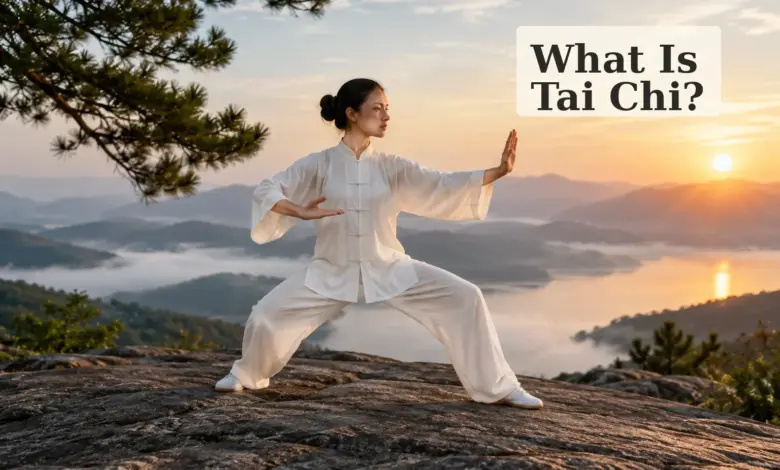
Tai chi can look deceptively simple from the outside. In practice, it asks the body to coordinate slow movement, shifting weight, posture, breathing, and attention—and it has attracted a substantial, though uneven, research literature.
Quick Answer
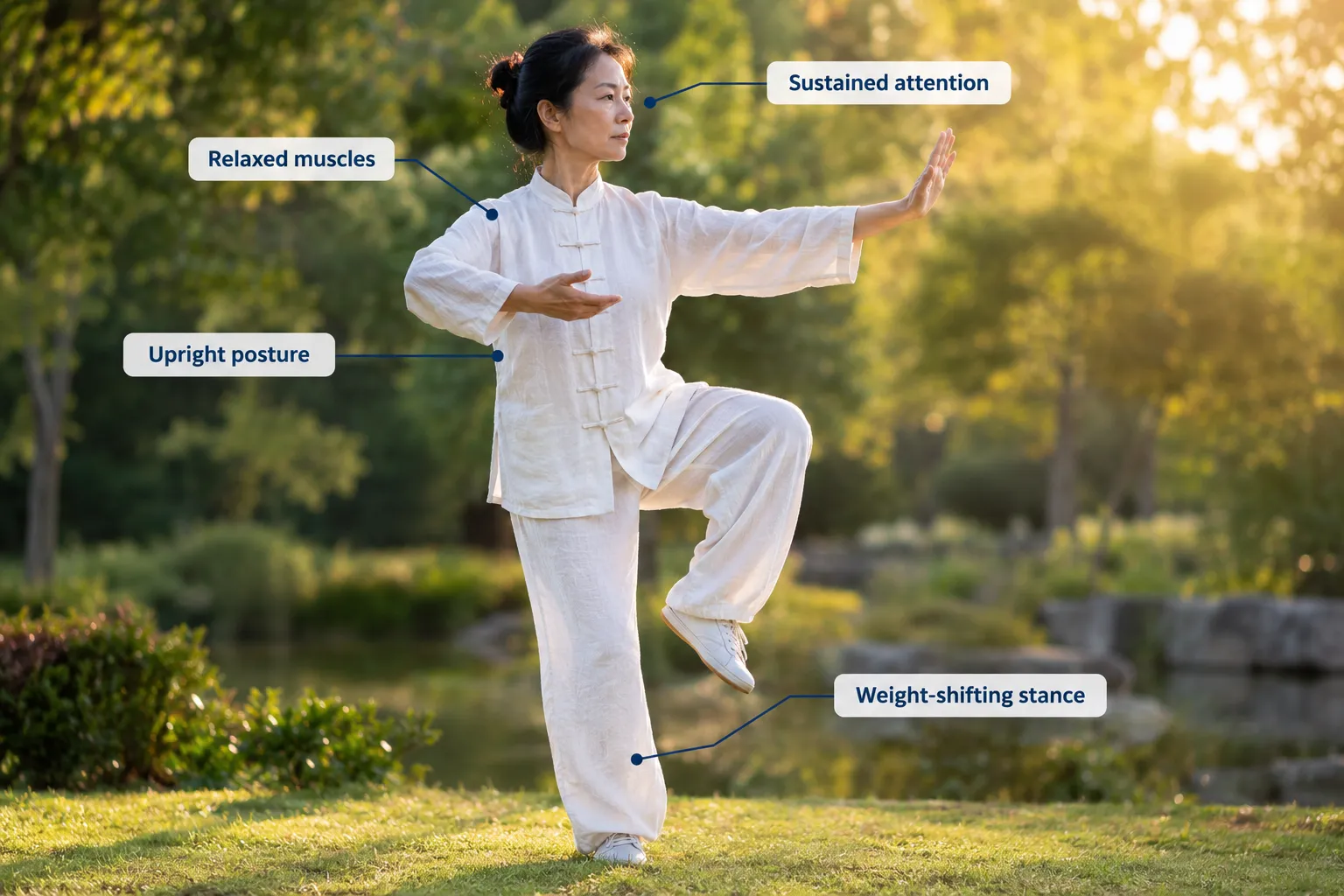
Tai chi is a Chinese mind-and-body practice built from slow, continuous, weight-shifting movements performed with upright posture, relaxed muscles, steady breathing, and sustained attention. It began as a martial art and is now most often taught for health. For most healthy beginners, a first class involves standing, simple stepping, and a handful of repeated arm-and-body movements rather than any athletic test. The benefits of tai chi that research supports most clearly relate to physical function, balance-related control, and some cardiovascular markers, with evidence quality varying a lot by condition and population.
Key Takeaways
- In plain English: Tai chi is a Chinese martial art and mind-body practice built around slow, linked movement, shifting weight, posture, breathing, and attention.
- It is exercise, but not a replacement for everything else. It can add low-impact movement and coordination to a week, while strength training and aerobic work remain useful for their own purposes.
- The evidence is promising but specific. Reviews suggest potential benefits for balance and physical function in some older-adult populations; results depend on the program, the outcome measured, and the people studied.
- A gentle start is sensible. Beginners can use smaller steps, a higher stance, and stable support nearby rather than copying the depth of an experienced practitioner.
- Choose a reliable teaching route. A good beginner class is usually the clearest way to learn the first movements; a video can be useful for reviewing material already taught.
- Health limits still matter. Tai chi is not a treatment or a cure. People with recent surgery, unstable symptoms, major balance limitations, or individual movement restrictions should seek appropriate guidance first.
Table of Contents
- What Is Tai Chi?
- What a Tai Chi Practice Actually Involves
- The Main Styles of Tai Chi: A Brief, Useful Orientation
- Is Tai Chi Exercise?
- What Research Can, and Cannot, Say About Tai Chi
- A Practical First Step for Beginners
- Starting Tai Chi After 50: Sensible Modifications and Expectations
- Learning From a Class, Video, or Home Practice
- Safety, Limits, and When to Seek Individual Advice
- Frequently Asked Questions
- References
What Is Tai Chi?
Tai chi is a traditional Chinese practice in which a person moves through a set sequence of slow, linked postures while keeping the spine upright, the joints soft, the breath unforced, and the attention on what the body is doing. Short name: moving meditation with real mechanical demands.
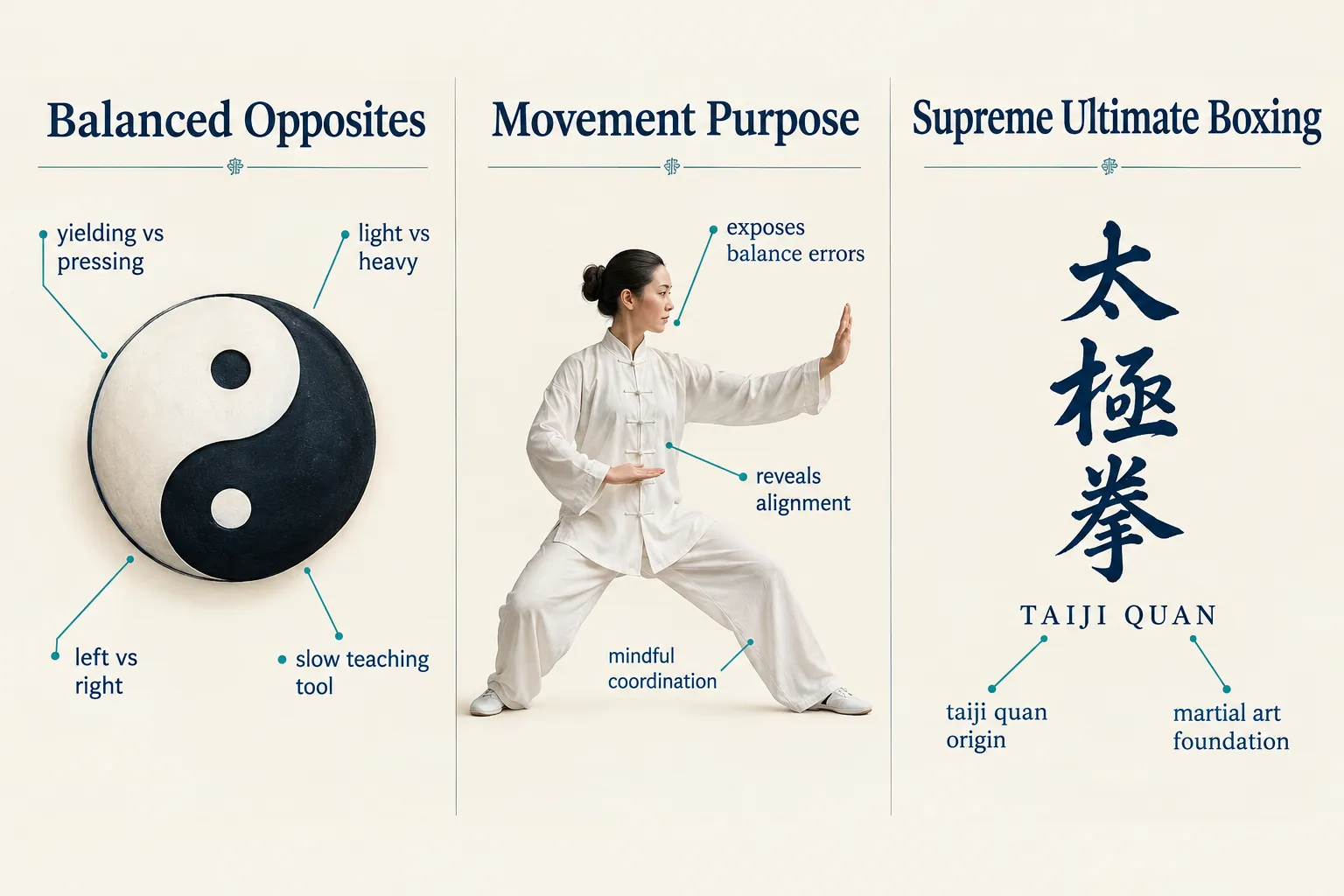
The full term is taiji quan (also written tai chi chuan). Taiji refers to the classical idea of complementary opposites in constant exchange; quan means fist or boxing. So the tai chi meaning most often given in English is “supreme ultimate boxing”, a reminder that this began as a martial art, not a relaxation class [5].
Tai chi has roots as a Chinese martial art and is now commonly taught as a health-oriented movement practice. Historical accounts and lineage traditions differ, so this guide focuses on what a modern beginner is likely to encounter rather than trying to settle a disputed origin story.
How does tai chi work?
Mechanically, tai chi works by making you control your own body weight slowly through a continuous path. Three things happen at once:
- Continuous weight transfer. You are almost always shifting from one leg to the other, which loads each leg alternately and keeps the hip, knee, and ankle working together.
- Narrow or single-leg support. Many postures reduce your base of support, which challenges the balance system in a predictable, controlled way.
- Coordinated trunk and limb movement. Arms, torso, and legs move as one unit, which trains sequencing rather than isolated muscles.
Add sustained attention and slow breathing, and you get a practice that loads the body lightly while demanding a lot of coordination. That combination is unusual, and it is probably why tai chi has attracted more clinical research than most traditional movement arts.
Tai chi vs qigong: what’s the difference?
Qigong is a broader family of Chinese health exercises, often made of short, repeated movements or static postures, while tai chi is a specific martial art with set sequences, or “forms.” When tai chi is taught for health rather than combat, the two overlap heavily, many tai chi classes open with qigong warm-ups.
A decision rule: choose qigong if you want something short, repetitive, and easy to memorize. Choose tai chi if you want a sequence to learn, a tradition to study, and more balance challenge.
What a Tai Chi Practice Actually Involves
Many beginner classes include standing warm-ups, weight-shifting drills, simple stepping, and a few movements repeated at a manageable pace. The format varies by teacher and style, but most introductory classes avoid treating the first session as an athletic test.
A common structure looks like this:
- Standing and settling (5 minutes). Feet about hip-width, knees soft, spine tall, shoulders dropped.
- Warm-ups or qigong (10 minutes). Gentle joint circles, arm raises, simple rocking from heel to toe.
- Fundamentals (10-15 minutes). Shifting weight side to side, stepping forward and back, turning from the waist.
- Form work (15-20 minutes). Two to five movements, broken down, repeated, corrected.
- Closing (5 minutes). Slow standing, quiet breathing, sometimes a brief seated rest.
The first month of tai chi is mostly about learning to stand and shift weight well. The pretty arm movements come later, and they come easier once the legs understand their job.
Why is tai chi so slow?
Tai chi is slow because slowness is the training method. At low speed you cannot use momentum to hide a balance error, so the body has to solve each position honestly, and you have time to notice and fix alignment while it is happening.
Three practical reasons the pace matters:
- Error detection. Moving slowly makes small wobbles obvious. Moving fast lets you fall through them.
- Continuous loading. A slow weight shift keeps the supporting leg working for several seconds rather than a fraction of one.
- Attention. Speed crowds out awareness. Slowness gives the nervous system room to track position, pressure, and breath.
More is not always better here, and faster is definitely not better. Speeding up a form you have not learned properly just builds a sloppier version of it.
Tai chi breathing techniques explained
Beginners should breathe naturally through the nose, without forcing a pattern onto the movement. Most traditions eventually coordinate breath with motion, generally inhaling as the body opens, gathers, or rises, and exhaling as it closes, sinks, or extends, but this is taught after the movement is familiar, not on day one.
Two points worth knowing:
- Abdominal breathing is common in tai chi: the belly expands gently on the inhale rather than the chest lifting and shoulders rising.
- Holding the breath is the mistake to avoid. New students often hold their breath while concentrating. If you notice it, pause, exhale, and restart the movement slower.
What should you wear to a tai chi class?
Choose loose, comfortable clothing and stable footwear with a non-slip sole. The goal is simply to feel steady and able to move; avoid shoes or surfaces that make you feel unbalanced. No uniform is needed to begin.
Avoid thick cushioned running shoes, which blur the foot feedback the practice depends on. Avoid tight jeans and restrictive waistbands. Many practitioners use simple canvas or martial arts slippers; others practice in socks on a non-slip floor or barefoot on grass. No uniform is needed to start, and no studio worth attending will insist on one for a first class.
The Main Styles of Tai Chi: A Brief, Useful Orientation
The five traditional family styles are Chen, Yang, Wu, Wu/Hao, and Sun [5]. For a beginner in the US, three of those cover almost everything you will actually encounter in health-oriented classes.
| Style | How it usually feels | Often suits | Worth knowing |
|---|---|---|---|
| Yang | Even, broad, flowing; medium stances; steady pace throughout | Most beginners; general health classes | The most widely taught style in Western settings [5] |
| Chen | Alternating slow and quick; spiraling movement; lower stances; occasional explosive release | People wanting a more athletic, martial feel | More demanding on knees and hips; later entry point for many |
| Sun | Higher, narrower stances; compact steps; a following step that keeps the feet close | People who prefer less deep knee bend | Often chosen where stance depth is a limiting factor |
No style is universally best. The useful comparison is not Chen versus Yang on paper, it is this teacher, in this room, at this time, versus that one. Instructor quality, class size, and schedule reliability affect your outcome far more than the family name on the door.
Is Tai Chi Exercise?
Yes. Tai chi is a form of physical activity built around standing movement, controlled weight transfer, coordination, and attention. Its intensity varies with the form, pace, and stance. It can be a useful part of an active week, particularly for people who want a lower-impact way to practise movement quality.
Tai chi may complement strength and aerobic training, but people whose main goals are substantial muscle gain or aerobic conditioning will usually need more targeted training as well. Our guide on How to Exercise When You’re Over 50 shows how different forms of activity can fit together.
Tai chi and yoga: different starting points
Tai chi usually uses continuous standing transitions, while many yoga classes include held positions and may use the floor. Neither is automatically better; the practical choice depends on the class, the teacher, the person’s movement tolerance, and what they enjoy enough to keep doing. Readers managing joint pain may find our Yoga Modifications for Arthritis and Joint Pain guide useful for comparison.
What about weight loss?
Tai chi is not a reliable standalone weight-loss plan. Its energy demand varies by form and pace, while body-weight change reflects the wider pattern of activity, eating, sleep, and health factors. Its practical value for many beginners is that it can be a sustainable, low-impact way to add movement—not that it promises a particular result on the scale.
What Research Can, and Cannot, Say About Tai Chi
The research base is substantial, but it is not one single answer. Tai chi programs differ in style, duration, instructor support, and the people enrolled. A result in an older adult with knee osteoarthritis, for example, should not be treated as a promise for every healthy beginner.
Where the evidence is more encouraging
Systematic reviews in older adults report improvements in several balance and physical-function measures, although not every test moves in the same direction. A 2024 meta-analysis of 22 trials found improvements in some balance and mobility measures, while other outcomes were not clearly different. An earlier overview of systematic reviews also concluded that the evidence was mixed in places and that larger, higher-quality studies were still needed.
For people with knee osteoarthritis or hypertension, some reviews report improvements in selected symptoms, function, or blood-pressure measures during structured programs. These findings are useful context, not a reason to treat tai chi as a substitute for clinician-directed care, prescribed medication, or a wider exercise plan.
What the research does not establish
- Tai chi does not cure or reverse disease.
- It does not guarantee pain relief, fall prevention, better sleep, cognitive improvement, or weight loss for an individual.
- Most trials examine organized programs over weeks or months; an occasional unsupervised video session is not the same intervention.
- Blinding is difficult in movement studies, and study quality, follow-up, and comparison groups vary.
The practical conclusion is modest and useful: tai chi is a low-impact movement practice that may improve selected outcomes for some people, particularly when it is taught consistently and adapted to the individual. It is not magic, and it does not need to be to be worthwhile.
A Practical First Step for Beginners
A simple first step is to observe or try a true beginner class, then decide whether the teaching style and pace feel manageable. Community centers, parks and recreation departments, senior centers, hospital wellness programs, and martial-arts schools can all offer classes; the quality of instruction matters more than the sign over the door.
- Ask whether the class is designed for complete beginners and whether movements can be scaled.
- Tell the instructor about any important limitation before class, then work within a comfortable, stable range.
- Start with the movements actually taught rather than combining several unrelated online forms.
- Use short, repeatable practice between lessons if it feels comfortable; consistency matters more than an ambitious schedule.
Common mistakes beginners make
- Chasing the arm positions before the feet and weight shift feel stable.
- Dropping into a stance that is deeper or wider than the knees and hips tolerate.
- Holding the breath while trying to remember a new sequence.
- Trying to learn a long form too quickly instead of repeating a few movements well.
Starting Tai Chi After 50: Sensible Modifications and Expectations
Starting tai chi after 50 is common. The practical adjustments are simple: use a higher stance, take shorter steps, reduce the arm range if a shoulder is irritated, and keep a chair back, countertop, or wall within easy reach when confidence is still building. Support is a sensible option, not a failure.
- Raise the stance: less knee bend and shorter steps are often more comfortable at first.
- Keep the range manageable: there is no prize for reaching farther or moving lower than feels stable.
- Break practice into short pieces: a few calm minutes can be easier to repeat than one long session.
- Pay attention to the signal: ordinary muscle effort can happen when learning a new activity; sharp, worsening, or persistent pain is a reason to stop and get individual advice.
If balance is the main goal, see our Balance and Fall Prevention Exercises for Seniors guide for a broader look at targeted balance work. For the wider exercise picture, see How to Exercise When You’re Over 50.
Learning From a Class, Video, or Home Practice
In-person classes are the better starting point because tai chi depends on alignment details you cannot see in yourself. Video is a reasonable supplement, and a workable fallback if no local class exists, but it cannot correct what you are doing wrong.
| Option | Best for | Main limitation |
|---|---|---|
| In-person class | Learning fundamentals correctly, staying consistent | Schedule and location constraints |
| Live online class | Real-time feedback when travel is hard | Instructor’s view of you is limited |
| Recorded video | Reinforcing material already taught | No correction; easy to build bad habits |
| Home solo practice | Building the habit between classes | Only as good as what you’ve been taught |
A practical hybrid that works well: in-person class once or twice a week for instruction, short home practice on other days using only what the instructor has already shown you. Review videos should match your class’s style and form, or you will end up learning two slightly different versions of the same movement and remembering neither.
Safety, Limits, and When to Seek Individual Advice
Tai chi is generally low impact, but low impact does not mean every movement suits every person. Reported trials suggest serious adverse events are uncommon, although adverse-event reporting is not always complete and minor musculoskeletal aches or pain can occur. Healthy beginners can usually begin gently, keep stances high, and build familiarity over time. Stop a movement that causes sharp, worsening, or persistent pain rather than trying to push through it.
Individual guidance is sensible before starting if a person has recent surgery, major balance impairment, a recent fall, or has been told to avoid particular movements or exertion levels. People with complex medical conditions or a rehabilitation plan should follow the advice of the clinician managing that care.
Do not start a new exercise program if there is chest pain, fainting, or new unexplained shortness of breath. Seek prompt medical assessment; seek emergency care for severe or sudden symptoms.
When comparing other mind-body movement options, our Yoga Modifications for Arthritis and Joint Pain guide explains a different set of practical considerations.
Frequently Asked Questions
Can tai chi help with arthritis or pain?
Some trials and reviews in knee osteoarthritis report improvement in pain or physical function during structured tai chi programs. Results vary, and tai chi is not a replacement for diagnosis, treatment, or a rehabilitation plan. A clinician or qualified instructor can help decide whether and how to adapt it.
Is tai chi safe for older adults?
It is commonly used by older adults because movements can be made smaller, slower, and more supported. A person with a recent fall, major balance limitation, recent surgery, or unstable medical symptoms should seek individual advice before joining a general class.
How often should a beginner practise tai chi?
Start with an amount that can be repeated comfortably. Research programs often use regular guided sessions for weeks or months, but that does not create a universal prescription. A sustainable class routine plus short review practice can be a sensible way to learn.
Do you need to be flexible or fit to start tai chi?
No specific flexibility level is required. The movement can be scaled by shortening steps, raising the stance, and reducing the range of the arms. The key is stable, comfortable practice rather than copying an advanced position.
Is tai chi a religion or spiritual practice?
Tai chi is a martial art with roots in Chinese philosophy and culture. Health-oriented classes may include focused breathing and attention, but participating does not require religious belief or commitment.
What is the difference between tai chi and taijiquan?
They refer to the same art in different romanization systems. “Tai chi” is the familiar English spelling; “taijiquan” is the pinyin spelling. “Tai chi chuan” is another common rendering.
Conclusion
Tai chi is a slow, standing movement practice with martial roots. It can be a practical entry point for people who want to build movement quality, attention, and confidence without jumping straight into a high-impact program. The evidence supports cautious interest in selected outcomes for some populations, not dramatic promises.
A sensible next step is to watch or try a beginner class, start within a comfortable range, and give the learning process time. Keep it simple and consistent.
References
- National Center for Complementary and Integrative Health. Tai Chi: What You Need To Know.
- Li L, Guo S, Ding B, Zhang J. Effectiveness of Tai Chi exercise on balance, falls, and motor function in older adults: a meta-analysis. Frontiers in Medicine. 2024.
- Leung LYL, Tam HL, Ho JKM. Effectiveness of Tai Chi on older adults: a systematic review of systematic reviews with re-meta-analysis. Archives of Gerontology and Geriatrics. 2022.
- Zhang P, Zhang D, Lu D. The efficacy of Tai Chi for essential hypertension: a systematic review and meta-analysis. International Journal of Nursing Practice. 2023.

About the author
Dave James is the founder of All Perfect Health. He writes practical, evidence-aware guides designed to help readers separate useful health information from hype.
📂 Joint-Friendly & Age-Specific Exercise
A practical reader path through the over-50 exercise cluster.
- Pillar: How to Exercise When You’re Over 50
- → Strength Training for Women Over 50: A Beginner Plan for Home or Gym
- → Weight-Bearing Exercises for Bone Health
- YOU ARE HERE What Is Tai Chi? A Beginner’s Guide to the Practice and How to Start
- → Low Impact Cardio for Bad Knees and Hips: What Actually Works
- → Yoga Modifications for Arthritis and Joint Pain: A Practical Guide That Actually Works
- → Resistance Band Training for Joint Health: What the Evidence Actually Shows
- → Returning to Exercise After Joint Surgery: A Practical, Evidence-Aware Guide
- → Balance and Fall Prevention Exercises for Seniors: A Practical, Evidence-Aware Guide
- → Best Exercise Bike for Knee Issues: A Complete 2026 Buying Guide