
The Carnivore Diet: A Complete Evidence-Based Guide
Roughly 2 million Americans now identify as carnivore diet followers, according to survey data cited in mainstream nutrition reporting — yet the formal clinical research on this eating pattern can be counted on two hands. That gap between popularity and evidence is exactly where clear thinking matters most.
The carnivore diet is simple to describe: eat only animal products, eliminate everything else. Meat, fish, eggs, and some dairy. No vegetables, no fruit, no grains, no legumes, no nuts. Nothing from a plant. For some people, that sounds extreme. For others, it sounds like the answer to years of digestive misery. The truth, as usual, sits somewhere in between — and it depends heavily on why you are doing it and for how long.
Let’s keep this practical. This guide covers what the carnivore diet actually is, what the evidence says about short-term benefits, what the real risks are over time, how to approach it sensibly if you choose to try it, and when to stop.
Key Takeaways
- The carnivore diet eliminates all plant foods and is used by some as a short-term elimination protocol to identify food triggers, not necessarily as a permanent lifestyle.
- Short-term reports of weight loss, reduced bloating, and blood sugar stability exist, but robust long-term clinical trials are largely absent.
- The main documented risks include elevated LDL cholesterol, reduced gut microbiome diversity, fiber absence, and potential nutrient gaps — particularly vitamin C and certain phytonutrients.
- Organ meats, fatty fish, bone broth, and quality sourcing significantly affect the nutritional adequacy of the diet.
- Anyone with cardiovascular risk factors, kidney disease, or a history of disordered eating should speak with a healthcare professional before starting.
Table of Contents
- What Is the Carnivore Diet?
- What You Actually Eat
- Short-Term Benefits: What the Evidence and Experience Suggest
- The Real Risks: What You Need to Take Seriously
- The Carnivore Diet as an Elimination Protocol
- Practical Transition Guidance
- Signs You Should Stop or Seek Help
- Frequently Asked Questions
- Conclusion
What Is the Carnivore Diet?
In plain English, the carnivore diet is a zero-carbohydrate, animal-foods-only eating pattern [1]. It sits at the far end of the low-carbohydrate spectrum — further than ketogenic, further than paleo. There are no cheat meals built in, no plant-based exceptions, and no fibre from any source.
The diet has roots in historical and anthropological arguments. Proponents point to ancestral eating patterns, the nutrient density of animal foods, and the idea that many plant compounds — lectins, oxalates, phytates — cause harm in susceptible individuals. Critics point to the absence of long-term safety data and the well-established benefits of plant diversity for gut health and cardiovascular protection [2].
Both positions contain something real. That is the honest starting point.
How It Differs from Keto and Paleo
| Feature | Carnivore | Ketogenic | Paleo |
|---|---|---|---|
| Carbohydrates | Zero | Very low (<50g) | Moderate |
| Plant foods | None | Some vegetables | Yes |
| Dairy | Often included | Often included | Usually excluded |
| Fibre intake | Zero | Low | Moderate |
| Primary goal | Elimination / simplicity | Ketosis / fat adaptation | Ancestral alignment |
What You Actually Eat on the Carnivore Diet
The food list is short. That is either the appeal or the problem, depending on your perspective.
Core foods:
- Beef, lamb, pork, venison, bison
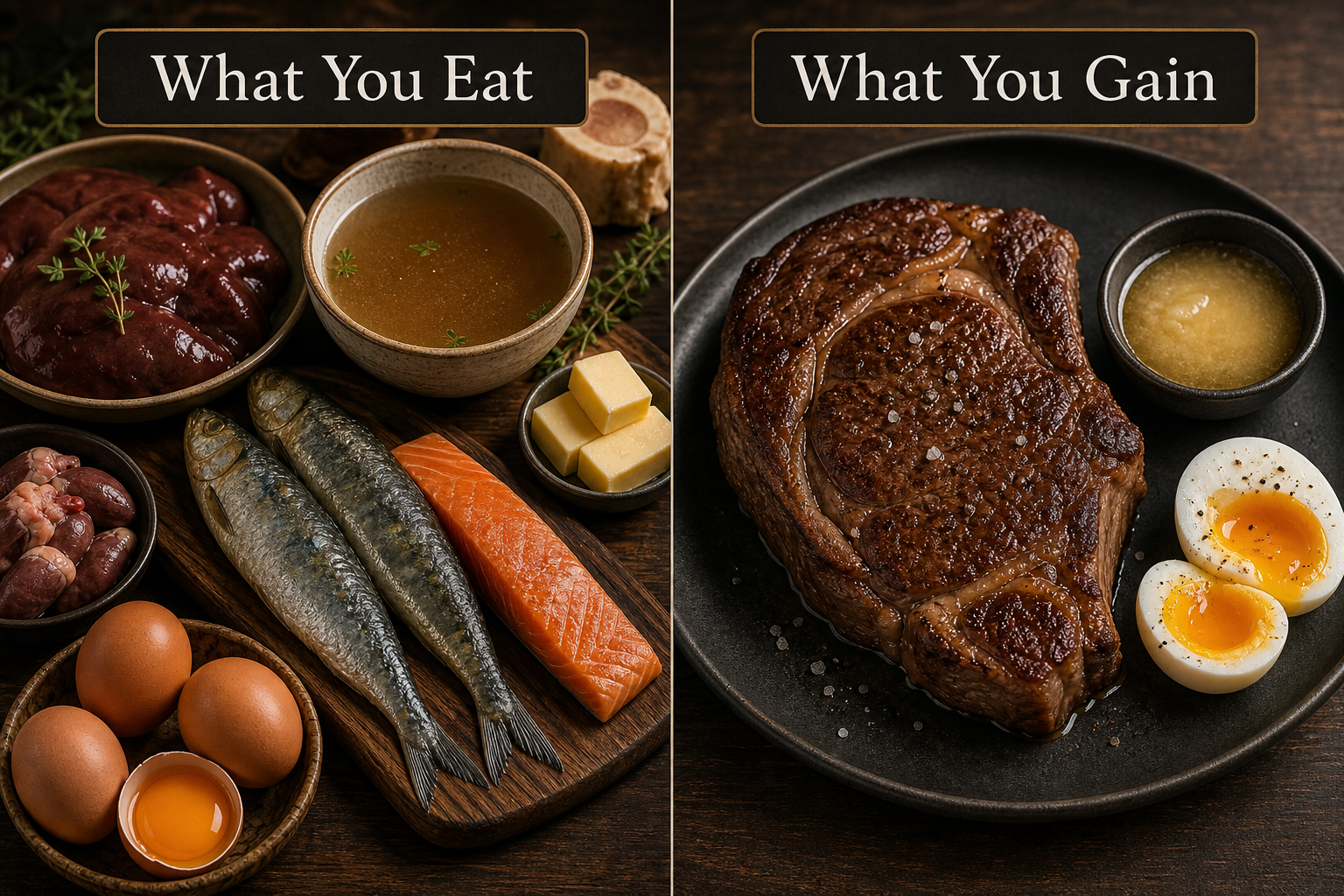
- Organ meats: liver, kidney, heart, bone marrow
- Fatty fish: salmon, sardines, mackerel, herring
- Eggs (pasture-raised where possible)
- Bone broth
- Butter, tallow, lard
- Hard cheeses and heavy cream (optional — some practitioners exclude dairy)
Quality matters more here than on most diets. When animal products are your only food source, the nutritional profile of those products becomes the whole story. Grass-fed beef contains meaningfully higher omega-3 fatty acids and conjugated linoleic acid than grain-fed equivalents. Pasture-raised eggs carry more vitamin D and choline. Wild-caught fatty fish provides EPA and DHA at levels that farmed fish often cannot match.
For a broader look at how nutrient density varies across food sources, the most nutrient-dense foods evidence-based guide is worth reading alongside this one.
The Organ Meat Question
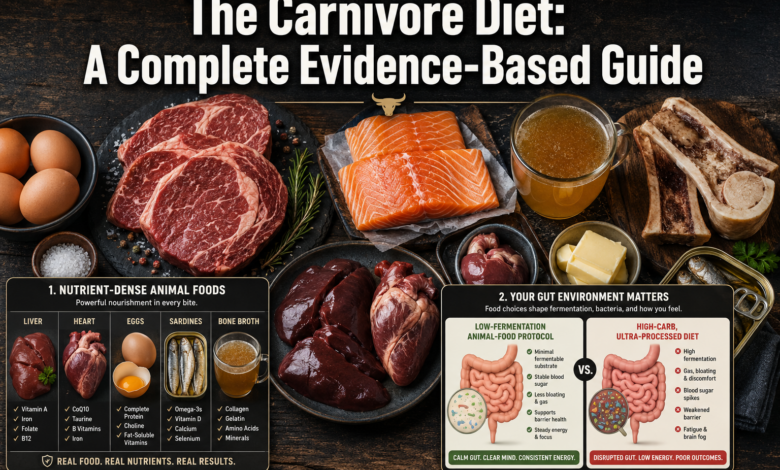
Most carnivore advocates treat organ meats as non-negotiable. Beef liver, in particular, is one of the most nutrient-dense foods known — rich in vitamin A, B12, folate, iron, copper, and CoQ10. A single 100g serving of beef liver provides more than a day’s worth of B12 and retinol.
This matters because the carnivore diet’s nutritional adequacy depends heavily on whether you include organ meats. A ribeye-only approach leaves meaningful gaps. A nose-to-tail approach closes most of them.
Vitamin C is the most cited concern. Liver and fresh meat contain small amounts of vitamin C — enough, some researchers argue, to prevent scurvy when carbohydrate intake is very low (since glucose and vitamin C compete for cellular uptake). The evidence here is preliminary. It is not a reason to dismiss the concern entirely.
Short-Term Benefits: What the Evidence and Experience Suggest
The evidence suggests that short-term carnivore eating can produce real, measurable changes for some people — though the mechanisms are not always what advocates claim [2].
Weight loss is the most commonly reported benefit. This is not surprising. Eliminating all processed food, refined carbohydrates, seed oils, and sugar creates a significant calorie and insulin reduction for most people. High protein intake also increases satiety and reduces overall food intake. These are well-understood mechanisms, not carnivore-specific magic. There is no magic in it.
Reduced digestive symptoms are frequently reported, particularly by people with irritable bowel syndrome, inflammatory bowel conditions, or chronic bloating. The upper gastrointestinal tract — the stomach and small intestine — is largely sterile and low-fermentation. Animal proteins and fats are digested efficiently in this environment, with minimal fermentation or gas production. For people whose symptoms are driven by fermentable plant compounds (FODMAPs, lectins, oxalates), removing all plant foods removes all those triggers simultaneously.
Blood sugar stability is another consistent report. Zero dietary carbohydrate means zero postprandial glucose spikes. For people managing insulin resistance or type 2 diabetes, this can produce rapid improvements in fasting glucose and HbA1c — though this should always be managed with medical supervision given medication interactions.
Reduced ultra-processed food exposure may be the most underrated benefit. By definition, the carnivore diet eliminates every ultra-processed product. For many people, this alone drives meaningful health improvements.
For context on how different dietary approaches compare, the comprehensive guide to modern diets provides useful background.
The Real Risks: What You Need to Take Seriously
Here is the real issue: the short-term experience of many carnivore dieters is positive, but the long-term picture is genuinely uncertain — and some of the risks are not trivial [1] [2].
Cardiovascular Risk
The carnivore diet is high in saturated fat. Saturated fat raises LDL cholesterol in most people [1]. Elevated LDL is an established risk factor for cardiovascular disease. That is a strong claim and needs strong proof — and in this case, the mechanistic evidence is solid even if long-term carnivore-specific outcome data does not yet exist.
Some individuals show a dramatic LDL increase on carnivore eating, sometimes called the “lean mass hyper-responder” pattern. Whether this represents genuine cardiovascular risk or a benign metabolic adaptation is actively debated. The honest answer is: we do not know yet.
A sensible starting point is baseline and follow-up blood work — full lipid panel, ApoB, fasting glucose, and inflammatory markers — before and after any extended carnivore trial.
Gut Microbiome and Fibre
The absence of dietary fibre is the most significant structural concern with long-term carnivore eating [2]. The gut microbiome depends on fermentable fibre to produce short-chain fatty acids — particularly butyrate — which feed colonocytes, maintain gut barrier integrity, and regulate immune function.
Research consistently links fibre-rich diets to lower colorectal cancer risk, better mood, and reduced depression risk [2]. Removing fibre entirely removes the substrate that most beneficial gut bacteria require to survive.
Some long-term carnivore practitioners have reported developing food sensitivities — including to eggs — after extended periods on the diet. This pattern is consistent with reduced gut barrier function over time, though individual variation is significant. For more on gut barrier health, the article on leaky gut and what the science actually says covers this in detail.
For gut health support during any dietary transition, understanding the role of probiotics versus prebiotics is worth your time.
Electrolyte and Sleep Issues
During the first two to four weeks, many people experience what is commonly called the “adaptation phase” — fatigue, headaches, muscle cramps, and disrupted sleep. This is largely driven by electrolyte shifts. Low insulin means the kidneys excrete more sodium, which pulls potassium and magnesium with it.
Supplementing sodium (salt food generously), potassium (from meat and bone broth), and magnesium is standard advice during this period. Sleep disruption, particularly reduced REM sleep, has been reported by some long-term carnivore practitioners and may relate to tryptophan metabolism changes without dietary carbohydrate.
Histamine Sensitivity
Aged meats, cured meats, smoked fish, and hard cheeses are high in histamine. People with histamine intolerance can experience headaches, flushing, and digestive symptoms on a carnivore diet — particularly if they rely on these foods for variety. Fresh-cooked meat is low in histamine; leftovers and deli products are not.
Oxalate Dumping
This is less discussed but worth noting. People transitioning from a high-oxalate plant-based diet to carnivore sometimes experience a temporary increase in oxalate-related symptoms — joint pain, skin issues, urinary discomfort — as stored oxalates are mobilised. This typically resolves within weeks but can be uncomfortable.
The Carnivore Diet as an Elimination Protocol
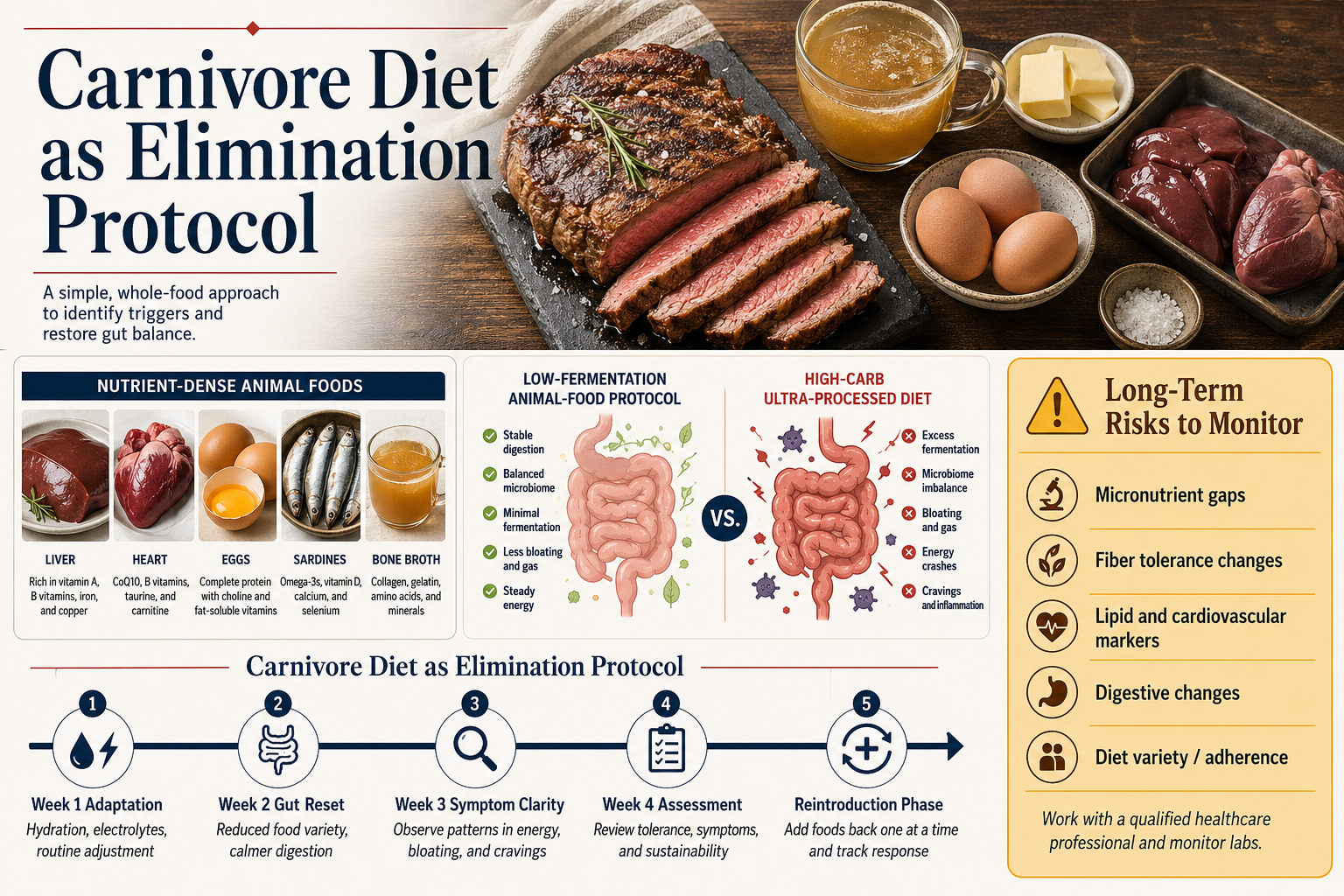
This is where the most sensible use case sits. Many people use the carnivore diet as a structured two-to-four-week elimination protocol — not a permanent lifestyle — to identify food triggers, reset gut symptoms, and establish a clean baseline before systematically reintroducing foods.
This approach has practical logic behind it. It is harder to identify which plant food is causing a problem when you are eating fifty of them. Removing everything and reintroducing one category at a time gives you clear signal.
The reintroduction phase matters as much as the elimination phase. Common reintroduction order: well-cooked low-FODMAP vegetables first, then fruits, then legumes, then grains. Each food group gets five to seven days before the next is added.
This protocol shares structural similarities with approaches used in functional medicine for gut repair, and it sits alongside other evidence-aware strategies covered in our guide to anti-inflammatory foods for gut health.
If weight management is a parallel goal, the high-protein diet for weight loss guide provides complementary context on protein’s role in satiety and body composition.
Practical Transition Guidance
Week 1: Expect adaptation symptoms. Salt food heavily. Drink bone broth. Prioritise fatty cuts over lean — lean meat alone can cause nausea and digestive distress (sometimes called “rabbit starvation” or protein poisoning). Eat to satiety; do not restrict calories.
Weeks 2 to 4: Symptoms typically resolve. Include liver at least twice per week. Add fatty fish three times per week for omega-3 balance. If dairy is included, monitor for bloating — casein and lactose can be problematic for some.
What to monitor: Energy levels, sleep quality, bowel regularity, skin, and mood. Get blood work done at baseline and at the four-week mark if extending beyond that.
What to avoid: Relying solely on processed meats, skipping organ meats, and ignoring electrolytes. These are the three most common reasons people feel unwell on this diet and blame the protocol rather than the execution.
Signs You Should Stop or Seek Help
I would be careful with that framing that the carnivore diet is universally safe for everyone. Stop and seek professional advice if you experience:
- Persistent heart palpitations or chest discomfort
- Severe constipation lasting more than two weeks
- Significant mood deterioration or anxiety worsening
- Rapid unexplained weight loss beyond the first two weeks
- Existing kidney disease or a history of kidney stones (high protein load increases uric acid and calcium oxalate risk)
- Disordered eating history — the extreme restriction of carnivore can reinforce unhealthy relationships with food
The common health symptoms guide is a useful reference for distinguishing normal adaptation from symptoms that warrant medical attention.
Frequently Asked Questions
Is the carnivore diet safe long-term?
The honest answer is that we do not have sufficient long-term clinical data to say definitively [2]. Short-term use (two to four weeks) carries lower risk for most healthy adults. Extended use beyond three to six months, particularly without organ meats, raises legitimate concerns around microbiome diversity, fibre absence, and cardiovascular markers. Context matters — individual variation is significant.
Will the carnivore diet help me lose weight?
Many people do lose weight, primarily due to reduced calorie intake, higher satiety from protein, and elimination of ultra-processed foods [2]. It is not a uniquely superior weight-loss method — the mechanisms are shared with other low-carbohydrate approaches. For comparison, the vegan diet weight loss evidence guide shows that multiple dietary patterns can produce similar outcomes when adherence is matched.
Do I need supplements on the carnivore diet?
If you include liver, fatty fish, eggs, and bone broth regularly, the diet covers most micronutrient needs reasonably well. Electrolytes — sodium, potassium, magnesium — are the most important practical supplement during the adaptation phase. Vitamin C remains a theoretical concern; fresh liver and meat contain small amounts, but monitoring is sensible on extended protocols.
What about fibre and gut health?
This is the most legitimate long-term concern. Fibre feeds beneficial gut bacteria and supports short-chain fatty acid production. Removing it entirely changes the gut microbiome significantly [2]. The gut health and digestive wellness guide explains why microbiome diversity matters and what happens when it is disrupted.
Can I do carnivore if I have high cholesterol?
Not without medical supervision. The diet reliably raises LDL in many people [1]. If your cardiovascular risk is already elevated, this is not a protocol to self-experiment with. Get baseline bloods, involve your doctor, and monitor closely.
How is carnivore different from just eating a lot of meat?
The structure matters. A carnivore diet is a deliberate, complete elimination of plant foods — not simply a high-meat diet. The elimination aspect is what drives the gut reset and food-trigger identification that many people find useful. Eating more meat while keeping everything else the same is a different thing entirely.
Conclusion
The carnivore diet is not a miracle and it is not a disaster. It is a highly restrictive eating pattern with a plausible short-term use case — particularly as a structured elimination protocol for people with persistent digestive symptoms, food sensitivities, or autoimmune conditions — and a genuinely uncertain long-term profile.
The stronger evidence points to real short-term benefits for specific individuals: reduced gut symptoms, improved blood sugar stability, and significant reduction in ultra-processed food exposure. The evidence also points to real risks: elevated LDL cholesterol, reduced microbiome diversity, fibre absence, and electrolyte disruption [1] [2].
The main takeaway is this: if you are considering the carnivore diet, treat it as a two-to-four-week protocol with a clear purpose, not a permanent lifestyle. Include organ meats. Prioritise fatty cuts and wild-caught fish. Get blood work done before and after. Have a reintroduction plan ready. And if you have any existing health conditions, speak with a healthcare professional first.
The basics still do the heavy lifting. Quality animal foods, eaten mindfully, with a clear goal and an exit strategy, is a very different thing from indefinite elimination of half the food supply. Start with what gives the biggest return, monitor the results, and make decisions based on what you actually observe — not what the loudest voices online are claiming.
References
[1] What Is The Carnivore Diet – https://www.health.harvard.edu/diet-and-nutrition/what-is-the-carnivore-diet?utm_source=openai
[2] Carnivore Diet Health Risks – https://www.nationalgeographic.com/health/article/carnivore-diet-health-risks?utm_source=openai📂 Diet Frameworks
This article is part of the APH cluster. Use the links below to move between the pillar and child articles.
- Read the pillar: The Comprehensive Guide to Modern Diets: What Actually Works in 2026
- YOU ARE HERE The Carnivore Diet: A Complete Evidence-Based Guide
- → Elimination Diet: A Step-by-Step Guide to Identifying Food Sensitivities
- → Intermittent Fasting for Beginners: A Practical Evidence-Based Guide
- → Metabolic Flexibility: Train Your Body to Burn Fat for Fuel — A Practical Guide to the Metabolic Flexibility Diet
- → Vegan Diet Weight Loss: What the Evidence Actually Shows
- → The Complete Guide to Mediterranean Food: Dishes, Health Benefits, and What to Eat
- → Low Carb Diet for Weight Loss
- → The Ultimate Seasonal Eating Guide: Nourish Your Body Naturally Year-Round
- → The Ultimate Guide to the Liver Shrinking Diet (2026)