High Fiber Foods: The Complete List, Benefits and How Much You Need (2026)
Last updated: April 4, 2026
Quick Answer
The highest-fiber foods are legumes (beans, lentils, chickpeas), vegetables (artichoke, broccoli, peas), fruits (raspberries, pears, avocado), whole grains (oats, quinoa, barley), and nuts and seeds (chia seeds, flaxseed, almonds). Adults need 25–38g of fiber daily depending on age and sex. Most people only get around 15g. Closing that gap by incorporating high fiber foods is one of the highest-return dietary changes you can make for long-term health.
Key Takeaways
- Legumes lead the pack: Split peas (16g/cup), lentils (15.5g/cup), and black beans (15g/cup) are the most fiber-dense foods available [2]
- Two types matter: Soluble fiber manages blood sugar and cholesterol; insoluble fiber keeps digestion regular — you need both
- The gap is real: The average American gets roughly 15g of fiber daily, well below the 25–38g target [9]
- Chia seeds are the most concentrated source: 10g of fiber per ounce, more than almost any other single food [2]
- 64% of Americans are now actively trying to eat more fiber, according to a 2025 poll — fiber has overtaken protein as the dominant wellness focus of 2026 [3]
- Go slow: Jumping from 15g to 38g overnight causes bloating and discomfort — increase by 5g per week
- Drink more water: Fiber needs fluid to work properly; without it, constipation gets worse, not better
- Fortified products are not the same as whole foods: Fiber added to processed foods behaves differently from naturally occurring fiber
- The evidence is strong for fiber’s role in heart health, blood sugar control, weight management, and colorectal cancer prevention
- A sensible starting point is simple: Add one high-fiber food to each meal and build from there
Including high fiber foods in your diet can significantly improve your overall health and digestion.
What Is Dietary Fiber? (Soluble vs. Insoluble Explained Simply)
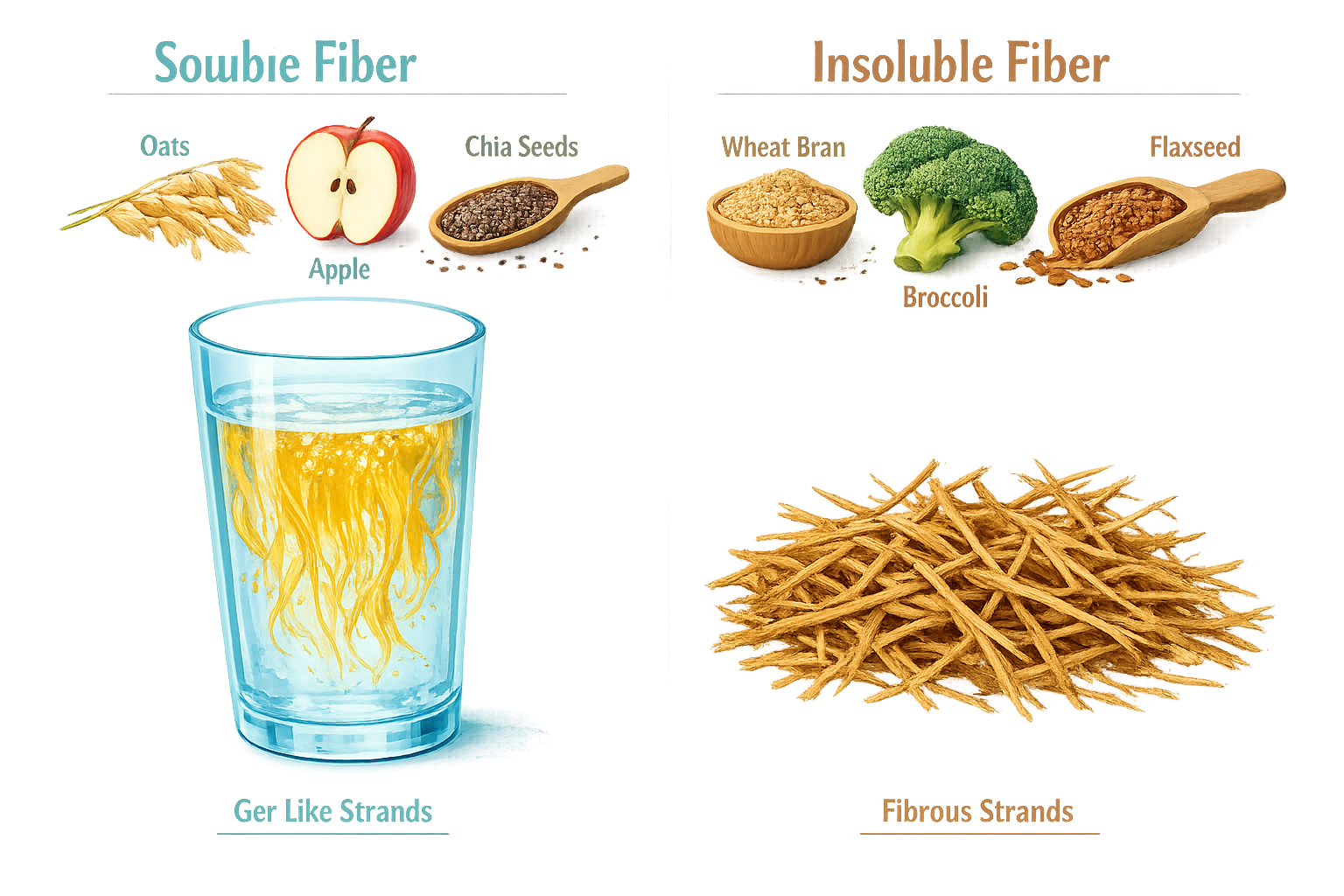
Dietary fiber is the part of plant foods your body cannot fully digest. Unlike carbohydrates, protein, or fat, fiber passes through your digestive system largely intact — and that is exactly what makes it useful.
There are two main types, and they work differently:
Soluble Fiber
Soluble fiber dissolves in water and forms a gel-like substance in your gut. This slows digestion, which helps manage blood sugar levels and reduces LDL (“bad”) cholesterol. It also feeds beneficial gut bacteria. Good sources include oats, apples, avocados, bananas, beans, chia seeds, citrus fruits, and psyllium husk [3].
Insoluble Fiber
Insoluble fiber does not dissolve in water. Instead, it adds bulk to your stool and speeds transit through the intestines. This prevents constipation, reduces the risk of hemorrhoids, and lowers the risk of diverticular disease. Key sources include wheat bran, brown rice, quinoa, broccoli, cauliflower, green beans, berries, and the edible skins of fruits and vegetables [3].
In plain English: Think of soluble fiber as a sponge that slows things down and absorbs cholesterol, and insoluble fiber as a broom that keeps things moving.
Most high-fiber foods contain both types in varying ratios. You don’t need to track them separately — eating a wide variety of whole plant foods covers both automatically.
Why Fiber Is the #1 Nutrient of 2026
Fiber has quietly become the most talked-about nutrient in nutrition science and consumer health circles. A 9,500% increase in page views for fiber-related articles has been documented, and 64% of Americans are now intentionally adding more fiber to their diets, according to a 2025 poll [3][4].
This is not hype for its own sake. The evidence base for dietary fiber is genuinely strong — stronger, in many respects, than for many supplements that get far more attention. Fiber affects gut microbiome diversity, cardiovascular risk, blood glucose regulation, body weight, and long-term mortality. The research on all of these is consistent and substantial [9].
The Johns Hopkins Center for Livable Futures has flagged fiber as one of the defining food trends of 2026, noting that “fiber maxxing” — the deliberate effort to maximize daily fiber intake — is becoming a mainstream consumer behavior [4]. Whole Foods has predicted that fiber-forward labeling will be the next major marketing focus in packaged foods [4].
“We need to separate fact from hype here. Fiber’s rise in popularity is backed by decades of solid research — this is not a trend built on weak evidence.”
That said, I would be careful with one thing: fiber-fortified processed foods are not equivalent to naturally fiber-rich whole foods. The food industry will capitalize on this trend, and “high fiber” on a label does not automatically mean the product is healthy overall. More on that below.
The Master High Fiber Foods Table (40+ Foods)
The table below covers the most significant high fiber foods across all major food groups. Fiber values are per standard serving size, based on data from Mayo Clinic [2] and Nutrition.gov [9].
| Food | Serving Size | Fiber (g) | Primary Type | Best For |
|---|---|---|---|---|
| LEGUMES | ||||
| Split peas (cooked) | 1 cup | 16.0 | Both | Gut health, satiety |
| Lentils (cooked) | 1 cup | 15.5 | Both | Blood sugar, protein |
| Black beans (cooked) | 1 cup | 15.0 | Both | Heart health, weight |
| Chickpeas (cooked) | 1 cup | 12.5 | Both | Satiety, blood sugar |
| Kidney beans (cooked) | 1 cup | 11.0 | Both | Heart health |
| Navy beans (cooked) | 1 cup | 10.5 | Soluble | Cholesterol |
| Edamame (cooked) | 1 cup | 8.0 | Both | Protein + fiber combo |
| SEEDS & NUTS | ||||
| Chia seeds | 1 oz | 10.0 | Soluble | Gut, blood sugar |
| Flaxseed (ground) | 1 oz | 7.6 | Both | Cholesterol, gut |
| Almonds | 1 oz | 3.5 | Insoluble | Snacking, satiety |
| Sunflower seeds | 1 oz | 3.0 | Insoluble | Snacking |
| Pistachios | 1 oz | 2.9 | Both | Heart health |
| Walnuts | 1 oz | 1.9 | Insoluble | Brain + fiber |
| VEGETABLES | ||||
| Green peas (boiled) | 1 cup | 9.0 | Both | Gut, satiety |
| Artichoke (cooked) | 1 medium | 6.5 | Soluble | Liver, gut |
| Broccoli (boiled) | 1 cup | 5.0 | Both | Cancer risk reduction |
| Turnip greens (boiled) | 1 cup | 5.0 | Insoluble | Digestion |
| Brussels sprouts (boiled) | 1 cup | 4.5 | Both | Gut, immunity |
| Sweet corn (boiled) | 1 cup | 4.2 | Insoluble | Energy, digestion |
| Cauliflower (raw) | 1 cup | 2.1 | Insoluble | Low-calorie fiber |
| Carrot (raw) | 1 medium | 1.7 | Soluble | Blood sugar |
| Spinach (cooked) | 1 cup | 4.3 | Insoluble | Iron + fiber |
| Kale (cooked) | 1 cup | 2.6 | Both | Antioxidants + fiber |
| FRUITS | ||||
| Raspberries | 1 cup | 8.0 | Both | Antioxidants, gut |
| Pear (with skin) | 1 medium | 5.5 | Both | Cholesterol, satiety |
| Apple (with skin) | 1 medium | 4.5 | Soluble | Blood sugar, cholesterol |
| Avocado | ½ fruit | 5.0 | Both | Heart health, satiety |
| Banana | 1 medium | 3.1 | Soluble | Gut bacteria, energy |
| Blueberries | 1 cup | 3.6 | Both | Antioxidants + fiber |
| Strawberries | 1 cup | 3.0 | Both | Low-calorie fiber |
| Orange | 1 medium | 3.1 | Soluble | Immunity, cholesterol |
| WHOLE GRAINS | ||||
| Whole-wheat spaghetti (cooked) | 1 cup | 6.0 | Insoluble | Sustained energy |
| Pearled barley (cooked) | 1 cup | 6.0 | Both | Cholesterol, gut |
| Bran flakes | ¾ cup | 5.5 | Insoluble | Morning regularity |
| Quinoa (cooked) | 1 cup | 5.0 | Insoluble | Protein + fiber |
| Oatmeal (cooked) | 1 cup | 4.0 | Soluble | Cholesterol, blood sugar |
| Popcorn (air-popped) | 3 cups | 3.5 | Insoluble | Low-calorie snacking |
| Brown rice (cooked) | 1 cup | 3.5 | Insoluble | Everyday staple |
| Whole-wheat bread | 1 slice | 2.0 | Insoluble | Daily staple |
| HIGH FIBER SNACKS | ||||
| Dark chocolate (70–85%) | 1 oz | 3.1 | Insoluble | Antioxidants + fiber |
| Hummus | ½ cup | 6.0 | Both | Protein + fiber |
| Mixed nuts | 1 oz | 2.5 | Insoluble | Convenient snacking |
Top 10 Highest Fiber Foods (Ranked)
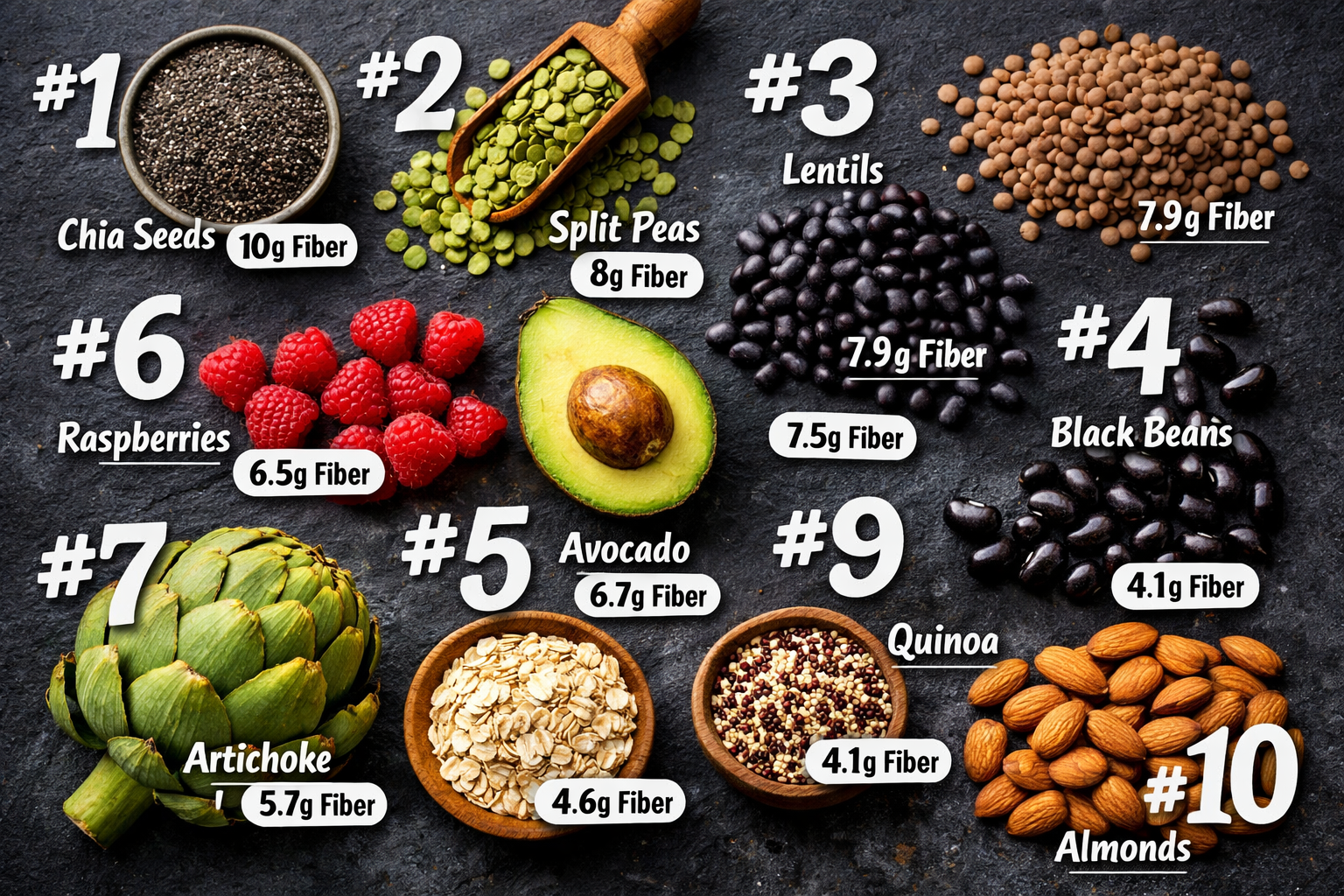
Here are the ten foods that deliver the most fiber per standard serving, with practical notes on how to use each one.
1. Split Peas — 16.0g per cooked cup [2] Type: Both soluble and insoluble. Split pea soup is one of the most fiber-dense meals you can make. They also provide plant protein and folate. Add to soups, stews, or blend into a thick dal.
2. Lentils — 15.5g per cooked cup [2] Type: Both. Lentils cook faster than most legumes (no soaking required), making them practical for weeknight meals. Red lentils blend into soups; green and black lentils hold their shape in salads.
3. Black Beans — 15.0g per cooked cup [2] Type: Both. Versatile and widely available. Use in tacos, grain bowls, soups, or as a side. Canned versions are nearly as nutritious as dried — just rinse them.
4. Chickpeas — 12.5g per cooked cup
Type: Both. Roast them for a crunchy snack, blend into hummus, or add to curries. One of the most flexible legumes in any kitchen.
5. Chia Seeds — 10.0g per ounce [2] Type: Primarily soluble. The most fiber-dense food by weight. Stir into yogurt, make overnight chia pudding, or add to smoothies. They absorb water and expand, which adds to satiety.
6. Green Peas — 9.0g per boiled cup [2] Type: Both. Often underrated. Frozen peas are just as nutritious as fresh and are one of the most affordable high-fiber vegetables. Add to pasta, rice dishes, or eat as a side.
7. Raspberries — 8.0g per cup
Type: Both. The highest-fiber fruit by volume. Eat fresh, frozen, or stirred into oatmeal. Also rich in antioxidants and low in sugar relative to their fiber content.
8. Edamame — 8.0g per cooked cup
Type: Both. Young soybeans that deliver fiber and complete protein together. Steam from frozen and eat as a snack or add to salads and grain bowls.
9. Artichoke — 6.5g per medium cooked artichoke
Type: Primarily soluble. One of the richest sources of inulin, a prebiotic fiber that feeds beneficial gut bacteria. Steamed artichoke with olive oil is a simple, satisfying preparation.
10. Avocado — 5.0g per half fruit
Type: Both. Unusual for a fruit in that it’s also rich in healthy monounsaturated fat, which makes it filling. Spread on whole-grain toast, slice into salads, or blend into smoothies. You can read more about avocado’s broader health benefits here.
High Fiber Foods by Category
🍎 Fruits High in Fiber
The best fruit choices for fiber are those you eat with the skin on. Raspberries, pears, apples, and avocados lead the list. Bananas provide a modest 3.1g and also contain resistant starch when slightly underripe, which acts as a prebiotic. For more on banana nutrition, see our detailed breakdown.
Top fruit picks: Raspberries (8g), pear with skin (5.5g), avocado (5g/half), apple with skin (4.5g), blueberries (3.6g), banana (3.1g), orange (3.1g), strawberries (3g).
🥦 Vegetables High in Fiber
Green peas are the standout vegetable for fiber content at 9g per cup. Artichoke, broccoli, Brussels sprouts, and spinach follow. As a general rule, keep the skins on where edible — that’s where much of the fiber is concentrated [3].
Top vegetable picks: Green peas (9g), artichoke (6.5g), broccoli (5g), turnip greens (5g), Brussels sprouts (4.5g), spinach (4.3g), sweet corn (4.2g).
These foods also appear on our list of anti-inflammatory foods for health, which is worth reading alongside this guide.
🫘 Legumes High in Fiber
Legumes are the undisputed champions of dietary fiber. If you’re serious about hitting your daily fiber target, legumes are the most efficient way to get there. One cup of cooked lentils covers roughly 40–60% of your daily fiber needs in a single serving.
Practical tip: If you’re new to legumes, start with half a cup per day and build up. The oligosaccharides in beans can cause gas initially — your gut bacteria adapt within a few weeks.
🌾 Grains High in Fiber
At least half of your daily grain intake should come from whole grains [3]. Whole-wheat spaghetti and pearled barley both deliver 6g per cooked cup. Bran flakes (5.5g per ¾ cup) are one of the easiest breakfast upgrades. Quinoa provides 5g and also offers complete protein.
Explore diverse whole-grain options: stone-ground grits, farro, teff, red rice, and wild rice are all worth rotating in [3].
🌰 Nuts and Seeds High in Fiber
Chia seeds (10g/oz) and ground flaxseed (7.6g/oz) are the most fiber-dense options in this category. Almonds, pistachios, and sunflower seeds are solid snack choices that contribute meaningful fiber without much effort.
Note: Flaxseed should be ground, not whole. Whole flaxseeds often pass through undigested.
🍫 High Fiber Snacks
- Hummus with raw vegetables (6g+ per ½ cup hummus)
- Air-popped popcorn (3.5g per 3 cups)
- Dark chocolate, 70–85% cacao (3.1g per oz) — see our piece on dark chocolate health benefits
- A small handful of mixed nuts (2.5g per oz)
- Apple with almond butter (5g+ combined)
Health Benefits of a High Fiber Diet
The evidence for dietary fiber is among the most consistent in nutritional science. Here is what the stronger evidence actually shows:
Heart Disease Risk Reduction
Soluble fiber reduces LDL cholesterol by binding to bile acids in the gut and removing them from circulation. The evidence here is solid and has been replicated across multiple study designs [9].
Blood Sugar and Diabetes Control
Soluble fiber slows glucose absorption, which flattens post-meal blood sugar spikes. This is particularly relevant for people managing type 2 diabetes or insulin resistance. For more on recognizing early warning signs, see our guide on diabetes early signs.
Weight Management and Satiety
Fiber adds bulk without calories, slows gastric emptying, and promotes the release of satiety hormones. High-fiber meals keep you fuller for longer, which naturally reduces overall calorie intake [5][6].
Gut Microbiome Support
Prebiotic fibers (particularly inulin from artichokes, garlic, and onions, and beta-glucan from oats) feed beneficial bacteria in the colon. A diverse microbiome is linked to better immune function, mood regulation, and reduced systemic inflammation. Our gut health and digestive wellness guide covers this in more depth.
Colorectal Cancer Risk Reduction
The evidence linking higher fiber intake to reduced colorectal cancer risk is consistent across large observational studies. The mechanism involves faster transit time (less exposure to carcinogens), production of short-chain fatty acids, and improved gut bacteria composition [9].
Longevity
Large-scale studies have associated high dietary fiber intake with meaningfully reduced all-cause mortality. The numbers matter here — the effect size is not trivial. This is one area where the basics genuinely do the heavy lifting.
How Much Fiber Do You Need Per Day?
Most adults need significantly more fiber than they currently eat. The recommended daily intake varies by age and sex [9]:
| Group | Daily Fiber Target |
|---|---|
| Women under 50 | 25g |
| Women over 50 | 21g |
| Men under 50 | 38g |
| Men over 50 | 30g |
| Children (4–8 years) | 25g |
| Adolescent girls (9–18) | 26g |
| Adolescent boys (9–13) | 31g |
| Adolescent boys (14–18) | 38g |
The average American currently gets around 15g per day [9]. That gap — 10 to 23g depending on your demographic — is where most of the health opportunity lies.
A sensible starting point: If you’re currently at 15g, don’t try to reach 38g in a week. Add 5g per week until you reach your target. This gives your gut microbiome time to adapt and minimizes bloating and discomfort.
How to read food labels: Look for products with at least 3–5g of dietary fiber per serving as a baseline for “high fiber” [3]. Anything under 1g per serving contributes very little.
Soluble vs. Insoluble Fiber — Complete Food Lists
Soluble Fiber Sources
| Food | Serving | Fiber (g) |
|---|---|---|
| Chia seeds | 1 oz | 10.0 |
| Black beans | 1 cup cooked | 5.4 |
| Oatmeal | 1 cup cooked | 4.0 |
| Avocado | ½ fruit | 3.4 |
| Apple (with skin) | 1 medium | 2.8 |
| Banana | 1 medium | 1.8 |
| Carrot | 1 medium | 1.1 |
| Psyllium husk | 1 tbsp | 5.0 |
| Citrus fruits (orange) | 1 medium | 2.2 |
Insoluble Fiber Sources
| Food | Serving | Fiber (g) |
|---|---|---|
| Wheat bran | ¼ cup | 6.0 |
| Broccoli (boiled) | 1 cup | 3.5 |
| Green beans | 1 cup | 3.4 |
| Brown rice | 1 cup cooked | 3.5 |
| Quinoa | 1 cup cooked | 3.5 |
| Ground flaxseed | 1 oz | 5.4 |
| Popcorn (air-popped) | 3 cups | 3.5 |
| Celery | 1 cup | 1.6 |
| Cauliflower | 1 cup | 2.1 |
Most whole plant foods contain a mix of both types. The lists above highlight foods that are particularly dominant in one type.
7-Day High Fiber Meal Plan
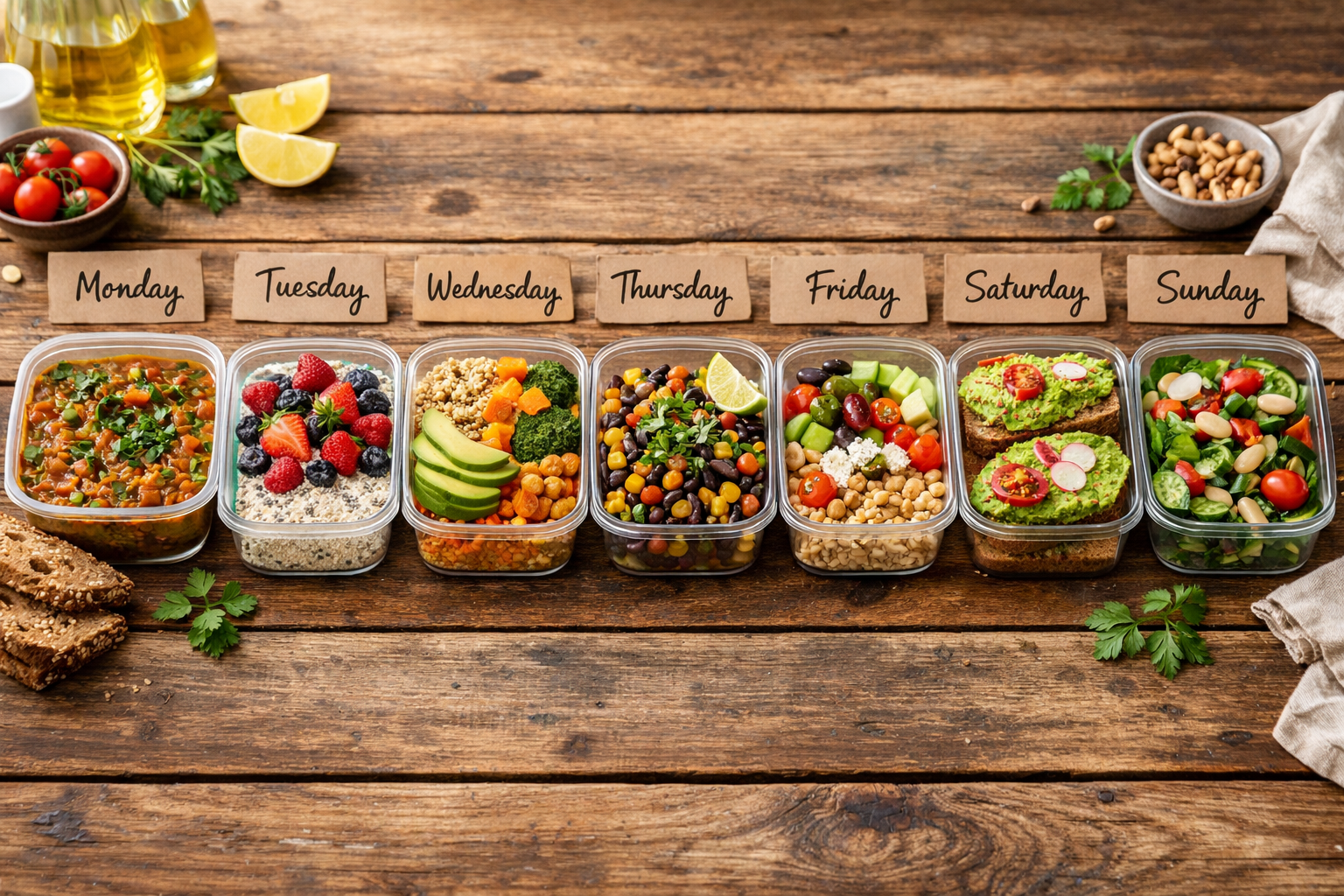
This is a practical example, not a rigid prescription. Adjust portions and food choices to fit your preferences and calorie needs. Each day targets approximately 30–35g of fiber.
Monday
- Breakfast: Overnight oats with chia seeds and raspberries (~13g fiber)
- Lunch: Lentil soup with whole-grain bread (~18g fiber)
- Dinner: Stir-fried broccoli and edamame over brown rice (~10g fiber)
- Snack: Apple with almond butter (~5g fiber)
Tuesday
- Breakfast: Bran flakes with banana and milk (~8g fiber)
- Lunch: Black bean and avocado wrap in whole-wheat tortilla (~15g fiber)
- Dinner: Chickpea curry with quinoa (~17g fiber)
- Snack: Hummus with carrot sticks (~8g fiber)
Wednesday
- Breakfast: Smoothie with banana, frozen berries, ground flaxseed, and oats (~12g fiber)
- Lunch: Quinoa salad with roasted vegetables and chickpeas (~14g fiber)
- Dinner: Whole-wheat spaghetti with lentil bolognese (~21g fiber)
- Snack: Pear with skin (~5.5g fiber)
Thursday
- Breakfast: Avocado on whole-grain toast with chia seeds (~10g fiber)
- Lunch: Split pea soup with a side salad (~18g fiber)
- Dinner: Salmon with roasted Brussels sprouts and sweet potato (~9g fiber)
- Snack: Air-popped popcorn (~3.5g fiber)
Friday
- Breakfast: Greek yogurt with raspberries and walnuts (~9g fiber)
- Lunch: Edamame and brown rice bowl with steamed broccoli (~14g fiber)
- Dinner: Black bean tacos with cabbage slaw and salsa (~16g fiber)
- Snack: Dark chocolate (70%+) and mixed nuts (~5g fiber)
Saturday
- Breakfast: Whole-wheat pancakes with blueberries and flaxseed (~11g fiber)
- Lunch: Mediterranean-style plate with hummus, falafel, and tabbouleh (~16g fiber) — see our Mediterranean food guide for more ideas
- Dinner: Barley and vegetable stew (~12g fiber)
- Snack: Orange and pistachios (~6g fiber)
Sunday
- Breakfast: Oatmeal with apple, cinnamon, and chia seeds (~14g fiber)
- Lunch: Kidney bean and vegetable chili (~18g fiber)
- Dinner: Roasted artichoke with olive oil, grilled chicken, and green peas (~16g fiber)
- Snack: Banana with almond butter (~5g fiber)
How to Increase Fiber Without Bloating

Here’s the real issue with jumping into a high-fiber diet: doing it too fast almost always causes bloating, gas, and discomfort. This puts people off and they abandon the effort entirely.
The solution is straightforward:
1. Go slow. Increase your fiber intake by no more than 5g per week. Your gut microbiome needs time to adjust. The bacteria that ferment fiber need to multiply — and that takes weeks, not days.
2. Drink more water. Fiber absorbs water. Without adequate fluid intake, fiber can actually worsen constipation. Aim for at least 6–8 glasses of water daily when increasing fiber.
3. Spread fiber across meals. Don’t eat 30g of fiber at one sitting. Distribute it across breakfast, lunch, dinner, and snacks. This is easier on your digestive system and more effective overall.
4. Start with easier foods. Oats, bananas, and cooked vegetables are gentler on the gut than raw beans or bran supplements. Build up to legumes and bran gradually.
5. Cook your legumes thoroughly. Undercooked beans are harder to digest and more likely to cause gas. Soaking dried beans overnight and rinsing canned beans reduces the oligosaccharide content that causes fermentation.
6. Keep it simple and consistent. You don’t need a complicated system. Add one high-fiber food to each meal and you’ll be surprised how quickly the numbers add up.
If you’re managing a sensitive digestive system, our guide to bland food diets may also be helpful context before making significant dietary changes.
FAQ: High Fiber Foods — Common Questions Answered
What food is highest in fiber?
Split peas are the highest-fiber food by standard serving size, delivering 16g of fiber per cooked cup. Chia seeds deliver 10g per ounce, making them the most fiber-dense food by weight [2].
How do I get 30g of fiber a day?
A practical approach: ½ cup oats at breakfast (4g) + an apple mid-morning (4.5g) + lentil soup at lunch (15g) + a cup of broccoli at dinner (5g) + a handful of almonds as a snack (3.5g) = 32g total. No supplements needed.
Are bananas high in fiber?
Bananas provide a moderate 3.1g of fiber per medium fruit. They’re not a top-tier fiber source, but they contribute meaningfully, especially when combined with other foods. Slightly underripe bananas also contain resistant starch, which acts as a prebiotic [3].
What are high fiber low calorie foods?
Raspberries (8g fiber, ~65 calories per cup), broccoli (5g fiber, ~55 calories per cup), and green peas (9g fiber, ~134 calories per cup) are strong options. Vegetables in general offer the best fiber-to-calorie ratio.
What happens when you suddenly eat more fiber?
Bloating, gas, and changes in bowel habits are common when increasing fiber intake rapidly. This happens because gut bacteria ferment the fiber and produce gas as a byproduct. Symptoms typically resolve within 2–4 weeks as your microbiome adapts. Increase gradually and drink more water to minimize discomfort.
Is fiber good for weight loss?
Yes, and the evidence is reasonably strong. Fiber increases satiety, slows gastric emptying, and reduces overall calorie intake without requiring calorie counting. It’s not a magic solution, but it is a reliable tool [5][6]. For a broader look at weight management, see our weight loss guide.
What is the difference between soluble and insoluble fiber?
Soluble fiber dissolves in water, forms a gel, slows digestion, and helps manage blood sugar and cholesterol. Insoluble fiber doesn’t dissolve, adds bulk to stool, and promotes regular bowel movements. Most high-fiber foods contain both types [3].
Are eggs high in fiber?
No. Eggs contain zero dietary fiber. They’re an excellent source of protein and healthy fats, but they contribute nothing to your fiber intake. Pair eggs with vegetables, whole-grain toast, or beans to add fiber to an egg-based meal.
What vegetables have the most fiber?
Green peas (9g/cup), artichoke (6.5g/medium), broccoli (5g/cup), turnip greens (5g/cup), and Brussels sprouts (4.5g/cup) are the top vegetable sources of fiber [2].
Can too much fiber be bad for you?
It depends on the conditions. For most healthy adults, very high fiber intakes (above 70g/day) can interfere with mineral absorption (calcium, iron, zinc) and cause persistent digestive discomfort. More is not always better — hitting the recommended 25–38g daily is the goal, not exceeding it significantly. People with certain gut conditions (like Crohn’s disease or IBS) may need individualized guidance from a healthcare provider.
Conclusion: Start With What Gives the Biggest Return
The evidence on dietary fiber is clear, consistent, and practical. Most adults are getting roughly half of what they need, and the gap between 15g and 30g per day is where most of the health benefit lies.
The simplest way to look at it is this: add legumes to your diet three or four times a week, eat fruit with the skin on, choose whole grains over refined ones, and keep chia seeds or ground flaxseed in your kitchen for easy additions to meals. That alone will move most people from 15g to 25–30g without requiring a complete dietary overhaul.
Actionable next steps:
- Calculate your current intake for three days using a food tracking app. Most people are surprised how low their number actually is.
- Add one high-fiber food to each meal this week — don’t try to change everything at once.
- Increase by 5g per week until you reach your age and sex-appropriate target.
- Drink an extra glass of water for every significant fiber increase.
- Prioritize whole food sources over fortified products — the fiber in lentils behaves differently from fiber added to a breakfast bar.
- Give it four weeks before judging the results. Your gut microbiome needs time to respond.
There is no magic in it. The basics still do the heavy lifting. A diet consistently rich in whole plant foods — legumes, vegetables, fruits, and whole grains — is one of the most evidence-supported things you can do for long-term health.
Interactive Fiber Tracker
Daily Fiber Intake Tracker
Select foods you've eaten today to estimate your fiber intake
References
[1] High Fiber Foods – https://zoe.com/learn/high-fiber-foods[2] Art 20050948 – https://www.mayoclinic.org/healthy-lifestyle/nutrition-and-healthy-eating/in-depth/high-fiber-foods/art-20050948
[3] Fiber Focus A Hot And Healthy Trend In 2026 – https://www.hope-health.org/2026/03/16/fiber-focus-a-hot-and-healthy-trend-in-2026/
[4] Food Trends 2026 Focus Fiber Maxxing Global Foods And More – https://clf.jhsph.edu/viewpoints/food-trends-2026-focus-fiber-maxxing-global-foods-and-more
[5] Detail – https://www.ctcd.edu/sites/myctcd/detail/?p=high-fiber-foods-for-weight-loss-in-2026-the-calm-science-backed-way-to-eat-more-and-obsess-less-698dc1c769a45
[6] News – https://www.ctcd.edu/sites/myctcd/discover/news.html?id=high-fiber-foods-for-weight-loss-in-2026-what-real-people-actually-eat-feel-and-stick-with-69a330342be80
[9] Fiber – https://www.nutrition.gov/topics/whats-food/fiber