How Long Does CBD Oil Stay in Your System? A Complete Guide (2026)
- What Happens to CBD in Your Body After You Take It?
- How Long Does CBD Oil Stay in Your System by Detection Method?
- How Long Do the Effects of CBD Oil Actually Last?
- What Factors Determine How Long CBD Stays in Your System?
- How Does CBD Oil Show Up on Drug Tests?
- What Does Research Say About CBD’s Half-Life?
- How Can You Speed Up CBD Clearance Before a Drug Test?
- Is CBD Oil Safe, and Who Should Be Cautious?
Last updated: April 8, 2026
Quick Answer
CBD oil typically stays in your system for 2 to 5 days for most occasional users, but can remain detectable for up to 30 days in people who use it daily or in high doses. Detection windows vary significantly depending on the testing method used, your body composition, metabolism, and how frequently you consume CBD. To summarize, the question of how long does CBD oil stay in your system does not have a single answer that applies to everyone.
If you’re wondering how long does CBD oil stay in your system, understanding the factors that influence this can help you better manage your usage and expectations.
Key Takeaways
- For most people, CBD clears the body within 2–5 days after a single dose, based on an estimated half-life of 18–32 hours for moderate use.
- Daily or heavy users may test positive for CBD metabolites for up to 30 days.
- Standard drug tests screen for THC, not CBD — but full-spectrum CBD products contain trace amounts of THC (up to 0.3%) that can accumulate and trigger a positive result.
- The method of consumption matters: vaped or smoked CBD enters and exits the bloodstream faster than edibles or capsules.
- Body fat percentage directly affects how long CBD lingers — CBD is fat-soluble and stores in fat tissue.
- A 2016 study published in the Journal of Pain found CBD was undetectable in urine within 24 hours for some participants after their last dose.
- Broad-spectrum CBD and CBD isolate products contain no THC, making them safer choices if drug testing is a concern.
- Always consult a healthcare provider before using CBD if you’re subject to workplace drug testing or taking prescription medications.
What Happens to CBD in Your Body After You Take It?
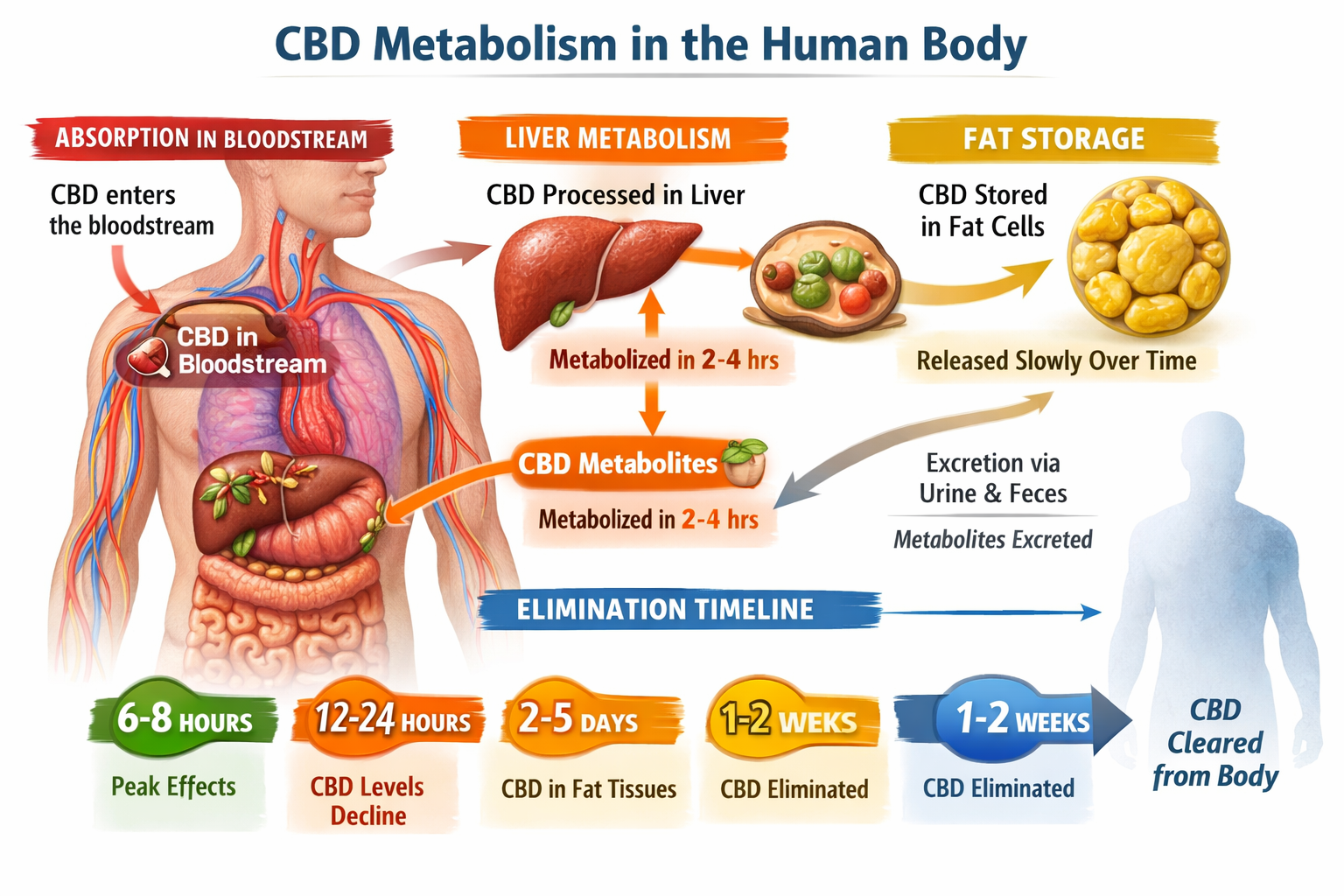
When you consume CBD oil, your body doesn’t simply absorb it and move on. CBD (cannabidiol) is a fat-soluble compound, which means it behaves differently from water-soluble substances. Instead of being rapidly flushed through the kidneys, CBD is absorbed into the bloodstream, distributed to tissues — including fat cells — and then gradually broken down by liver enzymes before being eliminated as waste.
Here’s a simplified breakdown of that process:
- Absorption — CBD enters the bloodstream through the gut (if ingested), lungs (if inhaled), or mucous membranes under the tongue (if taken sublingually). Bioavailability varies widely by method.
- Distribution — Once in the bloodstream, CBD binds to proteins and distributes into tissues. Because it’s lipophilic (fat-loving), it accumulates in fat cells.
- Metabolism — The liver’s cytochrome P450 enzyme system breaks CBD down into metabolites. This is the same system that processes many common medications.
- Elimination — CBD metabolites are excreted primarily through feces and, to a lesser extent, urine.
The key point: because CBD stores in fat tissue, it doesn’t leave your body on a simple linear schedule. People with higher body fat percentages will retain CBD — and its metabolites — for longer than leaner individuals, even if they took the same dose.
How Long Does CBD Oil Stay in Your System by Detection Method?
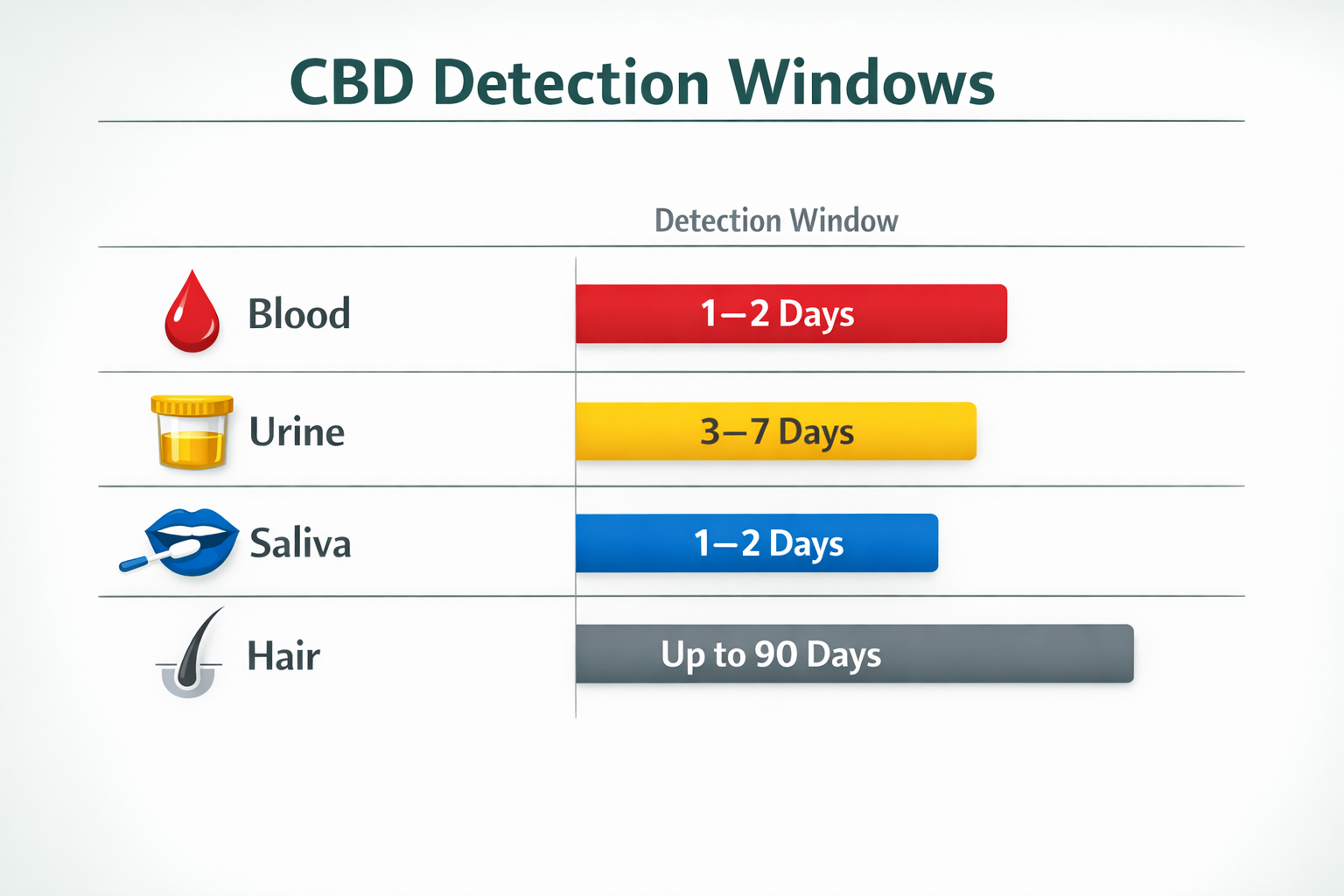
The answer to “how long does CBD oil stay in your system” depends heavily on what kind of test is being used. Different tests have different sensitivity thresholds and detection windows.
| Test Type | What It Detects | Typical Detection Window |
|---|---|---|
| Blood test | CBD and metabolites | Up to 5 days (occasional use); up to 7 days (heavy use) |
| Urine test | CBD metabolites | 24 hours to 30 days depending on frequency |
| Saliva test | CBD directly | Up to 72 hours |
| Hair follicle test | CBD metabolites | Theoretically up to 90 days (limited research) |
Important context: Most workplace and legal drug tests are not designed to detect CBD. They target THC-COOH, the primary metabolite of tetrahydrocannabinol. However, full-spectrum CBD products contain up to 0.3% THC by law in the United States. With daily use of high doses, that trace THC can accumulate in fat tissue and potentially trigger a positive result on a standard THC drug test.
If you use CBD isolate or broad-spectrum CBD (which contains no THC), the risk of failing a THC drug test is significantly lower — though not zero, since some products are mislabeled.
A note on urine testing: A 2016 study published in the Journal of Pain gave participants different CBD-rich cannabis products including oils, capsules, and flower. Two hours after administration, all 15 participants tested positive for CBD in urine. When one participant was followed after stopping use, CBD was undetectable in urine within 24 hours. This suggests that for single or infrequent use, clearance can be relatively fast — but chronic use changes the picture entirely.
How Long Do the Effects of CBD Oil Actually Last?
The effects of CBD and how long it stays detectable in your system are two different things. Understanding both matters, especially if you’re using CBD for a specific health purpose.
Effects typically last 2–8 hours, depending on the method of consumption and your individual response. Here’s how the most common methods compare:
Sublingual (under the tongue)
- Onset: 15–45 minutes
- Duration: 4–6 hours
- Bioavailability: Estimated 13–19% (higher than edibles)
Vaping or smoking
- Onset: Within minutes
- Duration: 2–3 hours
- Bioavailability: Estimated 31–56% — the highest of any method, because CBD bypasses first-pass liver metabolism
Edibles and capsules
- Onset: 30 minutes to 2 hours
- Duration: 6–8 hours
- Bioavailability: Roughly 6–19% — absorption is slow and inconsistent because CBD must survive digestion
Topicals (creams, balms)
- Onset: 15–45 minutes
- Duration: 2–4 hours (localized effect only)
- Bioavailability: Minimal systemic absorption; works primarily at the application site
Choose sublingual or vaping if you need faster relief. Choose edibles or capsules if you prefer longer-lasting effects and don’t mind the slower onset. Topicals are best for localized discomfort — they won’t contribute meaningfully to systemic CBD levels or show up on drug tests.
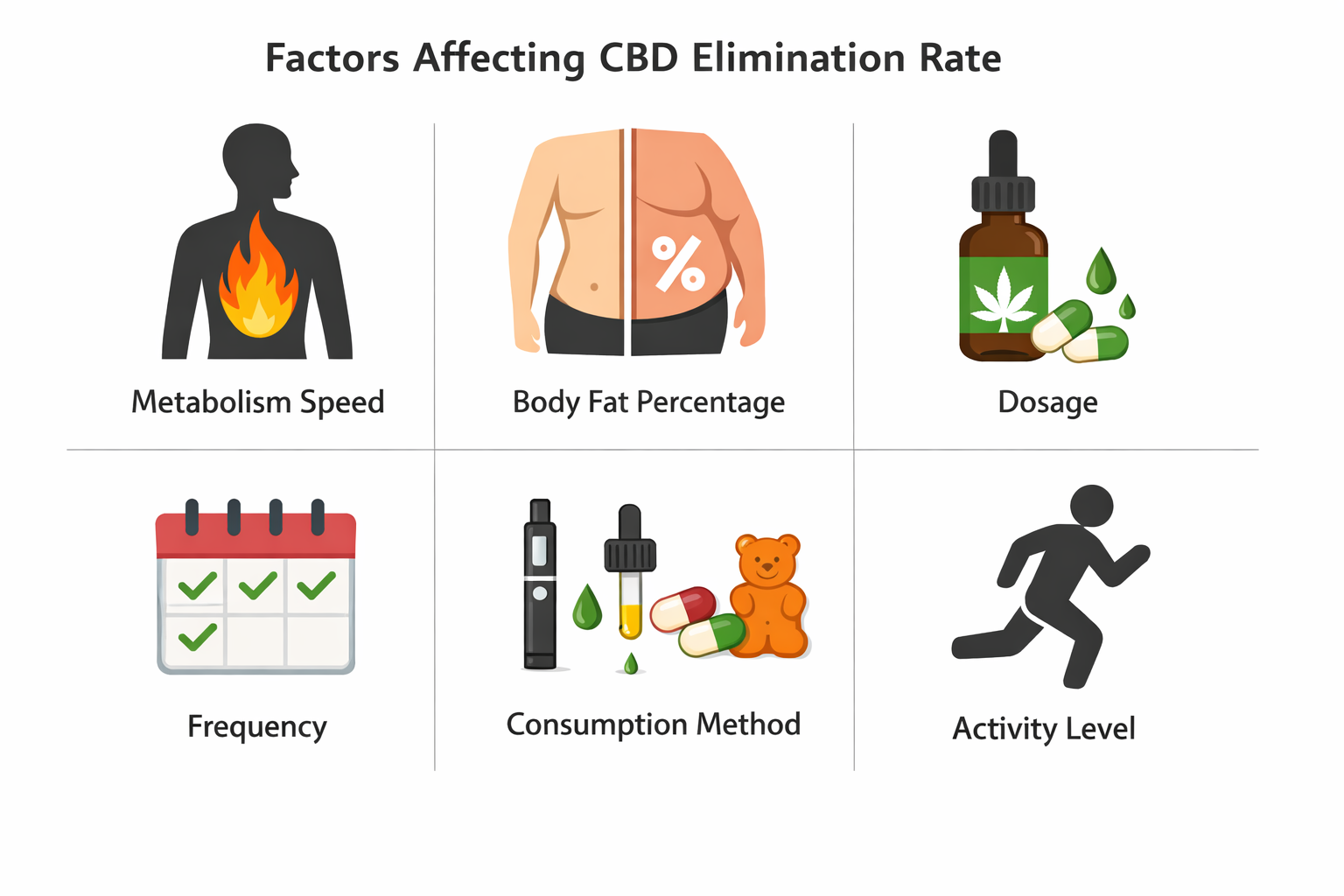
What Factors Determine How Long CBD Stays in Your System?
No two people process CBD at exactly the same rate. Several biological and behavioral factors influence how quickly CBD is metabolized and eliminated. Understanding these can help you make more informed decisions about timing, dosage, and product selection.
1. Metabolism Rate
Your basal metabolic rate — how efficiently your body converts substances into energy — directly affects CBD clearance. People with faster metabolisms process CBD more quickly, meaning it exits their system sooner. Metabolism is influenced by genetics, age, thyroid function, and overall health.
Taking CBD on an empty stomach speeds absorption but may also accelerate elimination. Taking it with a high-fat meal, on the other hand, can significantly increase bioavailability and slow clearance — because dietary fat helps CBD absorb more efficiently into the lymphatic system before reaching the bloodstream.
2. Body Composition
Because CBD is fat-soluble, it accumulates in adipose (fat) tissue. People with higher body fat percentages will store more CBD and release it more slowly back into the bloodstream over time. This means CBD can remain detectable for longer in someone with a higher BMI, even if they took the same dose as a leaner person.
This isn’t a reason to avoid CBD if you have higher body fat — it simply means you should factor in a longer clearance window when timing is important, such as before a drug test.
3. Dosage
Higher doses mean more CBD entering your system, which naturally takes longer to fully eliminate. This is straightforward pharmacokinetics: a 10mg dose will clear faster than a 100mg dose, assuming all other variables are equal.
If you’re new to CBD, starting with a low dose (10–20mg) and gradually increasing gives you better control over how your body responds — and makes it easier to predict clearance times.
4. Frequency of Use
This is one of the most significant factors. Occasional users who take CBD once or twice a week will typically clear it within 2–5 days. Daily users, especially those taking high doses, allow CBD to accumulate in fat tissue. That stored CBD is released gradually, extending the detection window to potentially 2–4 weeks.
Think of it like sunscreen applied daily versus once: daily application builds up in the skin layers in a way a single application doesn’t.
5. Method of Consumption
As outlined in the effects section above, the delivery method affects both how much CBD enters your bloodstream and how quickly it’s processed. Inhaled CBD reaches peak plasma concentration within minutes and is cleared faster. Edibles take hours to peak and may linger longer due to slower metabolic processing.
This is worth considering if you’re managing CBD use around a scheduled drug test. Switching from edibles to sublingual drops, for example, could shorten your clearance window.
6. Activity Level and Lifestyle
Regular physical activity boosts metabolism and can accelerate CBD clearance. There’s also a more direct mechanism: exercise mobilizes fat stores, which can temporarily release stored CBD (and THC) metabolites back into the bloodstream. This is why some people report feeling mild effects after intense exercise even days after their last CBD dose.
Poor sleep and a nutrient-poor diet can slow metabolic function, indirectly extending how long CBD stays in your system. Maintaining consistent healthy lifestyle habits supports faster, more predictable clearance.
How Does CBD Oil Show Up on Drug Tests?
This is the question most people actually need answered. The short answer: standard drug tests don’t screen for CBD, but they can still catch you if you’re using the wrong type of product.
Why full-spectrum CBD is a risk:
Full-spectrum CBD products contain all cannabinoids naturally found in hemp, including up to 0.3% THC. While that sounds negligible, daily use of a high-dose full-spectrum product can cause THC to accumulate in fat tissue to levels detectable by standard urine tests. The threshold for a positive THC result on most workplace drug tests is 50 nanograms per milliliter (ng/mL) — a level that chronic full-spectrum CBD users can potentially reach.
Why broad-spectrum and isolate products are safer:
- Broad-spectrum CBD contains all hemp compounds except THC, which is removed during processing.
- CBD isolate is pure cannabidiol — all other cannabinoids, terpenes, and plant compounds have been stripped away.
Neither should contain detectable THC, though mislabeling is a real issue in the CBD industry. A 2017 study published in JAMA found that nearly 70% of CBD products sold online were mislabeled — some contained more THC than advertised. Choosing products with third-party lab testing (Certificates of Analysis) is the most reliable way to verify what you’re actually consuming.
Common mistake: Assuming that because CBD is legal, it won’t cause a failed drug test. The test doesn’t care about legality — it measures metabolite levels. If you’re subject to workplace drug testing, choose a verified THC-free product and inform your employer or medical review officer that you use CBD.
What Does Research Say About CBD’s Half-Life?
The half-life of a substance is the time it takes for the concentration in your blood to drop by 50%. For CBD, research suggests a half-life ranging from 18 to 32 hours for moderate use, though this figure varies across studies and depends on the route of administration.
In a study following 14 patients who were each given approximately 700mg of CBD orally per day for six weeks — a very high clinical dose — average plasma levels dropped to just 1.5 ng/mL one week after the final dose and were undetectable shortly after. The researchers estimated the half-life at approximately 2–5 days for oral administration at that dosage level.
For context:
- After one half-life (roughly 1–2 days for a standard dose): 50% of CBD remains
- After two half-lives: 25% remains
- After five half-lives: less than 4% remains — generally considered clinically cleared
This means that for most people taking moderate doses occasionally, CBD is functionally out of the system within 5–10 days. The 30-day window applies primarily to heavy, chronic users with high body fat and slow metabolisms.
How Can You Speed Up CBD Clearance Before a Drug Test?
If you have an upcoming drug test and are concerned about CBD metabolites — particularly residual THC from full-spectrum products — there are practical steps you can take. None of these are guaranteed to produce a specific outcome, but they support your body’s natural elimination processes.
Steps to support faster clearance:
- Stop using CBD immediately — This is the most important step. Continued use keeps replenishing metabolite levels.
- Stay well-hydrated — Water supports kidney function and helps flush water-soluble metabolites through urine. It won’t eliminate fat-stored metabolites, but it helps overall.
- Exercise regularly — Cardiovascular exercise boosts metabolism and mobilizes fat stores. Be aware that this can temporarily increase blood levels of metabolites, so avoid intense exercise in the 24 hours immediately before a test.
- Eat a balanced, fiber-rich diet — CBD metabolites are excreted partly through feces. A diet high in fiber-rich foods supports healthy digestion and regular elimination.
- Get adequate sleep — Sleep is when the body performs much of its cellular repair and metabolic processing.
- Avoid high-fat meals immediately before a test — High-fat food can temporarily increase CBD bioavailability by releasing stored fat-soluble compounds.
What doesn’t work: Detox teas, activated charcoal supplements, and commercial “cleanse” products have no credible scientific evidence supporting their ability to accelerate CBD or THC clearance. Be skeptical of any product making those claims. If you’re curious about evidence-based approaches to supporting your body’s detox systems, natural digestive support strategies are a better starting point.
Is CBD Oil Safe, and Who Should Be Cautious?
CBD is generally well-tolerated by most adults. The World Health Organization concluded in its 2018 critical review that CBD has a good safety profile and is not associated with abuse potential. That said, it’s not without considerations.
Who should exercise caution:
- People on prescription medications — CBD inhibits cytochrome P450 liver enzymes, which can affect how other drugs are metabolized. This can cause medications to stay in your system longer or reach higher concentrations than intended. Consult your doctor before combining CBD with any prescription drug, particularly blood thinners, antiepileptics, or antidepressants.
- Pregnant or breastfeeding individuals — The FDA advises against CBD use during pregnancy or while nursing due to insufficient safety data.
- People subject to drug testing — As discussed, full-spectrum products carry real risk. Use verified THC-free products and disclose use to relevant parties.
- Those with liver conditions — High doses of CBD have been associated with elevated liver enzymes in some clinical studies. People with existing liver conditions should use CBD only under medical supervision.
CBD may also interact with inflammation pathways in the body, which is why many people use it alongside anti-inflammatory dietary approaches as part of a broader wellness strategy. However, CBD is not a substitute for medical treatment, and its therapeutic claims should be evaluated critically.
📂 Healthy Lifestyle & Longevity
This article is part of the APH cluster. Use the links below to move between the pillar and child articles.
- Read the pillar: Daily Habits of People Who Live Past 90: What the Research Shows
- → How to Maintain a Healthy Lifestyle While Living in a City (2026 Guide)
- YOU ARE HERE How Long Does CBD Oil Stay in Your System? A Complete Guide (2026)
- → Environmental factors that affect human health
- → How to Live a Healthy Lifestyle: A Practical, Evidence-Based Guide
Frequently Asked Questions
Q: Will CBD oil make me fail a drug test?
Pure CBD isolate or broad-spectrum CBD products containing no THC are very unlikely to cause a failed drug test. Full-spectrum CBD products, however, contain trace THC that can accumulate with daily use and potentially trigger a positive result on a standard THC urine test.
Q: How long does CBD oil stay in urine?
For occasional users, CBD metabolites may be undetectable in urine within 24–72 hours. For daily users taking moderate-to-high doses, detection is possible for up to 30 days. The exact window depends on dose, frequency, body composition, and metabolism.
Q: How long does CBD stay in blood?
CBD is detectable in blood for up to 5 days in occasional users and potentially up to 7 days in heavy users. Blood tests are less commonly used for CBD detection because the window is shorter than urine testing.
Q: Does CBD show up on a hair follicle test?
Hair follicle tests can theoretically detect CBD metabolites for up to 90 days, but this testing method is rarely used for CBD specifically. It’s more commonly used for THC and other controlled substances.
Q: Does the method of taking CBD affect how long it stays in my system?
Yes. Inhaled CBD (vaping, smoking) enters and exits the bloodstream faster than edibles or capsules, which are processed more slowly through the digestive system. Sublingual drops fall in between.
Q: Can drinking water flush CBD out of your system faster?
Water supports kidney function and helps eliminate water-soluble metabolites, but CBD is fat-soluble and stored in fat tissue. Hydration helps overall but won’t dramatically accelerate fat-stored CBD clearance.
Q: What’s the difference between full-spectrum, broad-spectrum, and CBD isolate?
Full-spectrum contains all hemp compounds including up to 0.3% THC. Broad-spectrum contains all compounds except THC. CBD isolate is pure CBD with everything else removed. For drug test safety, broad-spectrum or isolate is the better choice.
Q: How much CBD is too much to take in a day?
The FDA-approved CBD medication Epidiolex uses doses up to 20mg/kg/day in clinical settings. For general wellness use, most adults use 15–50mg per day. Very high doses (above 300mg/day) have been associated with side effects including fatigue and elevated liver enzymes in some studies. Always start low and increase gradually.
Q: Does exercise help clear CBD faster?
Regular exercise boosts metabolism and mobilizes fat stores, which can support faster clearance over time. However, intense exercise shortly before a drug test may temporarily increase metabolite levels in blood and urine as fat stores are released.
Q: Is CBD legal everywhere?
In the United States, hemp-derived CBD containing less than 0.3% THC is federally legal under the 2018 Farm Bill. However, individual state laws vary, and CBD remains a controlled substance in some jurisdictions internationally. Always check local regulations before purchasing or traveling with CBD products.
Related Reading
If you found this guide useful, these resources cover related topics in more depth:
- How to Live a Healthy Lifestyle — Building the daily habits that support overall wellness
- Anti-Inflammatory Foods: Ultimate Guide — Dietary strategies that complement natural pain management
- High-Fiber Foods: The Complete List — Supporting digestion and metabolic health
- 10 Ways to Soothe Your Stomach Naturally — Natural approaches to digestive comfort
- Exercise Guide for Better Health — How physical activity supports your body’s natural processes
Sources
- Ohlsson A, et al. “Single-dose kinetics of deuterium-labelled cannabidiol in man after smoking and intravenous administration.” Biomed Mass Spectrom. 1986. PubMed
- Millar SA, et al. “A Systematic Review on the Pharmacokinetics of Cannabidiol in Humans.” Frontiers in Pharmacology. 2018. PMC
- Vandrey R, et al. “Cannabinoid Dose and Label Accuracy in Edible Medical Cannabis Products.” JAMA. 2015.
- World Health Organization. “Cannabidiol (CBD) Critical Review Report.” Expert Committee on Drug Dependence, 2018.
- Huestis MA. “Human Cannabinoid Pharmacokinetics.” Chemistry & Biodiversity. 2007.
This article is for informational purposes only and does not constitute medical or legal advice. If you are subject to drug testing or taking prescription medications, consult a qualified healthcare provider before using any CBD product.
5 Herbs to Boost Metabolism and Lose Weight

Dave James has spent 30+ years reading health and longevity research, and has run All Perfect Health for the past five. His background is in Australian mining and industrial engineering — disciplines built on questioning claims, measuring outcomes, and respecting evidence. He writes about what the research actually says, including where the experts disagree.
More about Dave & this site →