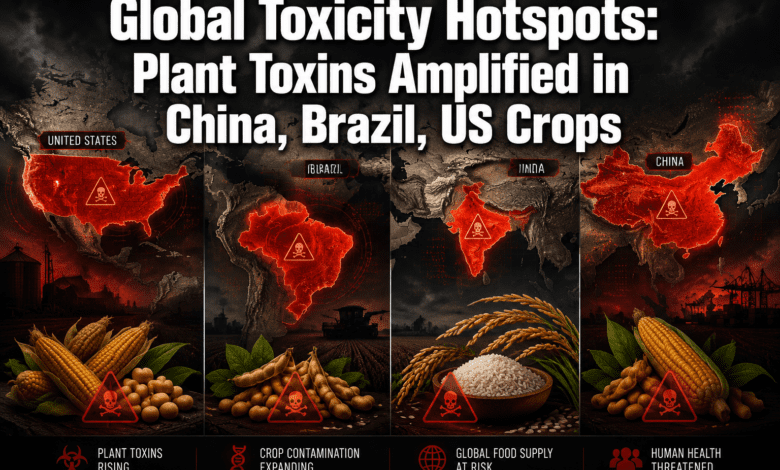
Global Toxicity Hotspots: Plant Toxins Amplified in China, Brazil, US Crops
Last updated: May 16, 2026
Quick Answer
A 2026 Science analysis estimated total applied pesticide toxicity (TAT) worldwide for 2013–2019. China, Brazil, the United States and India together accounted for 53–68% of global TAT, depending on the species group assessed; fruits, vegetables, maize, soybean, rice and other cereals together accounted for 76–83%. [1] TAT is an ecological metric, not a measurement of residues in a particular food, an imported shipment, dietary intake, or an individual health outcome. [1][5]
Key Takeaways
- 🌍 What the study measures: TAT combines pesticide application with estimated ecotoxicity across eight species groups; it covered 625 pesticides. [1]
- 📊 The central finding: TAT increased for most species groups from 2013–2019. China, Brazil, the United States and India together made up 53–68% of global TAT. [1]
- 🌾 The crop finding: Fruits, vegetables, maize, soybean, rice and other cereals contributed 76–83% of estimated global TAT. [1]
- 🧪 Important boundary: Ecological TAT is not a retail-food residue test, dietary-exposure estimate, or personal health-risk assessment. [1][5]
- 🎯 Policy context: Target 7 of the Kunming–Montreal framework calls for reducing overall pesticide and highly hazardous chemical risk by at least half by 2030. [2]
In this guide
- What Are Global Toxicity Hotspots and Why Do They Matter?
- Which Countries Are the Biggest Contributors to Global Pesticide Toxicity?
- How Do Plant Toxins in Soy, Corn, and Rice Add to the Burden?
- Why Is Toxicity Rising Even When Pesticide Use Appears Stable?
- What Does This Mean for Food Imported Into Your Kitchen?
- Are Organic and Certified Crops a Reliable Solution?
- What Can Individuals Do About Global Toxicity Hotspots in Their Food?
- FAQ: Global Toxicity Hotspots and Plant Toxins in Crops
- Conclusion: What Actually Matters Here
What Are Global Toxicity Hotspots and Why Do They Matter?
Total applied pesticide toxicity (TAT) is an ecological hazard-pressure metric. The 2026 analysis weighted applied mass of 625 pesticides by estimated ecotoxicity across eight species groups for 2013–2019. [1]
What TAT Measures—and What It Does Not
| Metric | Meaning |
|---|---|
| Applied mass | Quantity applied; it does not itself report ecotoxicity, food residues, or dietary exposure. |
| TAT | Applied mass weighted by estimated ecotoxicity for eight species groups. |
| Not measured by TAT | Residues in a food, a shipment, dietary intake, or an individual health outcome. |
Because TAT incorporates applied mass and ecotoxicity, it can show changes that kilograms applied alone may miss. It should not be converted into a direct measure of consumer exposure or disease risk. [1][5]
Which Countries Are the Biggest Contributors to Global Pesticide Toxicity?
For the study’s 2013–2019 estimates, China, Brazil, the United States and India together accounted for 53–68% of global TAT, depending on the species group. The primary study supports this collective finding; it does not by itself establish individual country ranks, per-hectare comparisons, crop-driver explanations, or consumer-food risk. [1]
Crop Contribution
Fruits, vegetables, maize, soybean, rice and other cereals contributed 76–83% of estimated global TAT. This is an aggregate ecological finding, not a ranking of which foods are safest or a reason to infer the residue level of a particular product. [1]
Policy Context
Target 7 of the Kunming–Montreal Global Biodiversity Framework calls for reducing the overall risk from pesticides and highly hazardous chemicals by at least half by 2030. The Science authors conclude that substantial action would be required to approach that target. [1][2]
How Do Plant Toxins in Soy, Corn, and Rice Add to the Burden?
Naturally occurring constituents in foods and pesticide residues are separate questions. The TAT analysis does not measure phytate, lectins, oxalates, food residues, or interactions among them; they should not be combined into a shared “toxicity burden.”
A Narrow Note on Phytate
Plant foods can contain phytate, whose effects on mineral bioavailability and processing are food-composition questions. Processing can change phytate content and bioavailability, but this does not establish a combined effect with pesticide residues or ecological TAT. [11]
A Separate Note on Mycotoxins
Mycotoxins are fungal—not plant—toxins. They are a separate food-safety concern; moulds can affect cereals including maize before or after harvest, and proper drying and storage help limit mould growth. A TAT hotspot does not identify mycotoxin contamination. [12]
Why Is Toxicity Rising Even When Pesticide Use Appears Stable?
The authors found increasing TAT for most species groups from 2013–2019. Because TAT incorporates both applied mass and ecotoxicity, it can reveal changes that simple mass totals miss. The study does not establish a universal “newer products are more potent” explanation for every country or crop. [1][3]
What Does This Mean for Food Imported Into Your Kitchen?
A country-level TAT estimate cannot determine whether a particular bag of rice, tofu, cornmeal, or produce contains a pesticide residue, exceeds a legal limit, or poses a health risk. Those questions require food-residue monitoring and exposure assessment. [1][5]
Food Residues and Personal Risk
In the United States, FDA monitors domestic foods and foods offered for import for compliance with EPA residue tolerances. Pesticides can be hazardous, but health risk depends on the substance, amount, route, and timing of exposure; this article does not assess an individual reader’s disease risk. [4][5][6]
Household Handling
Household processing can change pesticide-residue concentrations, but the result depends on the pesticide, food, and method. It should not be presented as a guarantee of removal. For routine hygiene, rinse produce under plain running water rather than using soap. [9][10][13]
Rice and Arsenic
FDA says rinsing rice before cooking has minimal effect on inorganic arsenic in cooked rice. Cooking rice in 6–10 parts water and draining it can reduce inorganic arsenic by 40–60%, depending on rice type, but can also reduce enrichment nutrients in white or parboiled rice. [8]
Are Organic and Certified Crops a Reliable Solution?
Organic certification is a production standard with restrictions on allowed and prohibited substances. It should not be treated as a test of a food’s residues, an automatic lower-TAT finding, or a guarantee of lower personal health risk. [7]
Food choices are better grounded in product-specific monitoring, handling, and dietary context than in a country-level ecological metric. [4][5][6]
What Can Individuals Do About Global Toxicity Hotspots in Their Food?
The practical response is to keep ecological pesticide metrics, food-residue monitoring, and naturally occurring food constituents separate rather than treating them as one personal “toxin score.”
- Use normal food-safety hygiene: rinse produce under plain running water. [13]
- Recognize that processing can change pesticide residues, but effects vary by pesticide, food, and method. [9][10]
- For rice, consider FDA’s guidance on the arsenic and nutrient trade-offs of excess-water cooking. [8]
- Do not use country-level TAT to infer the safety of a specific food or shipment. [1][4][5]
FAQ: Global Toxicity Hotspots and Plant Toxins in Crops
Q: What is total applied pesticide toxicity (TAT)?
TAT weights applied pesticide mass by estimated ecotoxicity for eight species groups. It is an ecological metric, not a residue or dietary-exposure test. [1]
Q: Does a country’s TAT predict residues in a food I buy?
No. A country-level estimate cannot determine residues in a particular product, shipment, or person’s diet. [1][4][5]
Q: How should produce be cleaned?
For normal hygiene, FDA advises rinsing under plain running water rather than using soap. Processing effects on pesticide residues vary with the food, pesticide, and method. [9][10][13]
Q: Does organic certification guarantee low residues or lower health risk?
No. Organic certification is a production standard with restrictions on permitted substances; it is not a residue test or a personal-risk assessment. [7]
Q: Are phytate and pesticide residues one combined burden?
No direct combined-risk conclusion follows from the TAT study. Phytate and processing are separate nutrition questions. [1][11]
Conclusion: What Actually Matters Here
The 2026 Science study provides a strong ecological finding: total applied pesticide toxicity increased for most species groups between 2013 and 2019, and a large share of estimated global TAT came from specified crop groups and four countries combined. [1]
What it does not provide is a test result for a particular food, a shipment, a personal diet, or a health outcome. Keeping those evidence categories separate makes the topic more useful and more honest. [1][4][5]
The practical takeaway: use ordinary food-safety hygiene, understand that processing effects vary, and rely on food-residue monitoring—not a country-level ecological metric—to answer questions about a product or personal exposure. [4][5][6][9][10][13]
References
These references distinguish ecological pesticide toxicity, food-residue monitoring, naturally occurring food constituents, and individual health risk. A country-level TAT estimate is not a food-residue test or a personal exposure estimate.
- Wolfram J, Bussen D, Bub S, Petschick LL, Herrmann LZ, Schulz R. Increasing applied pesticide toxicity trends counteract the global reduction target to safeguard biodiversity. Science. 2026;391(6785):616–621. https://doi.org/10.1126/science.aea8602
- Convention on Biological Diversity. Decision 15/4: Kunming–Montreal Global Biodiversity Framework. 2022, Target 7. https://www.cbd.int/doc/decisions/cop-15/cop-15-dec-04-en.pdf
- Food and Agriculture Organization of the United Nations. FAOSTAT: Pesticides Use. https://www.fao.org/faostat/en
- U.S. Food and Drug Administration. Pesticides. https://www.fda.gov/food/chemical-contaminants-pesticides/pesticides
- World Health Organization. Pesticide residues in food. 15 September 2022. https://www.who.int/news-room/fact-sheets/detail/pesticide-residues-in-food
- U.S. Department of Agriculture, Agricultural Marketing Service. Pesticide Data Program. https://www.ams.usda.gov/datasets/pdp
- U.S. Department of Agriculture, Agricultural Marketing Service. National List of Allowed and Prohibited Substances. https://www.ams.usda.gov/rules-regulations/organic/national-list
- U.S. Food and Drug Administration. What You Can Do to Limit Exposure to Arsenic. https://www.fda.gov/food/environmental-contaminants-food/what-you-can-do-limit-exposure-arsenic
- Naman M, Masoodi FA, Wani SM, Ahad T. Changes in concentration of pesticide residues in fruits and vegetables during household processing. Toxicology Reports. 2022;9:1419–1425. https://doi.org/10.1016/j.toxrep.2022.06.013
- Keikotlhaile BM, Spanoghe P, Steurbaut W. Effects of food processing on pesticide residues in fruits and vegetables: A meta-analysis approach. Food and Chemical Toxicology. 2010;48(1):1–6. https://doi.org/10.1016/j.fct.2009.10.031
- Schlemmer U, Frølich W, Prieto RM, Grases F. Phytate in foods and significance for humans: Food sources, intake, processing, bioavailability, protective role and analysis. Molecular Nutrition & Food Research. 2009;53(S2):S330–S375. https://doi.org/10.1002/mnfr.200900099
- World Health Organization. Mycotoxins. 2 October 2023. https://www.who.int/news-room/fact-sheets/detail/mycotoxins
- U.S. Food and Drug Administration. 7 Tips for Cleaning Fruits, Vegetables. 15 June 2021. https://www.fda.gov/consumers/consumer-updates/7-tips-cleaning-fruits-vegetables
Safety and nuance
TAT is an ecological pesticide-use metric, not a test of a particular food, shipment, or person’s health risk. It is not a reason to panic about every imported crop. People with existing liver, kidney, neurological, pregnancy or child-health concerns should use this article as a discussion starter with a qualified clinician, not as a diagnosis or treatment plan.
📂 Plant Toxins & Antinutrients
This article is part of the APH cluster. Use the links below to move between the pillar and child articles.
- Read the pillar: Plant Toxins, Antinutrients and Why Our Ancestors Cooked: The Complete Evidence-Based Guide
- → What Plant Toxins Actually Do to Your Body: Effects on Digestion, Absorption and Inflammation
- → Enzyme Inhibitors in Raw Plant Foods: Why Cooking Matters More Than Influencers Admit
- → How Traditional Food Preparation Reduces Antinutrients: Soaking, Sprouting, Fermenting and Cooking
- → Synergistic Plant Toxin Effects: How Oxalates Amplify Lectin Damage in the Gut
- → Histamine Intolerance and Plant Lectins: The Overlooked Gut-Brain Connection
- → Plant Toxins and Brain Fog: New 2026 Studies Linking Phytates to Cognitive Decline
- → Antinutrients and Skin Health: How Tannins and Phytoestrogens Trigger Eczema Flares
- → Kids and Plant Toxins: Antinutrient Impacts on Growth, ADHD, and Developing Brains
- → Pesticides vs Plant Toxins: Which Is the Bigger Threat to Your Health and the Environment?
- → Climate Change and Plant Toxins: Rising Levels of Alkaloids and Glycosides in Crops
- YOU ARE HERE Global Toxicity Hotspots: Plant Toxins Amplified in China, Brazil, US Crops