Enzyme Inhibitors in Raw Plant Foods: Why Cooking Matters More Than Influencers Admit
Last updated: October 29, 2026
Quick answer: Enzyme inhibitors are not one catch-all group. Protease inhibitors act on protein-digesting enzymes such as trypsin; alpha-amylase inhibitors act on starch digestion. They are different from phytate, oxalate and lectins. Preparation matters, but the right method depends on the food: a raw or undercooked kidney bean is a specific lectin food-safety problem, while phytate is mainly a nutrient-bioavailability question. Normal cooked plant foods do not need to be feared.
Key takeaways
- Keep the categories straight. Trypsin and chymotrypsin inhibitors are protease inhibitors; alpha-amylase inhibitors act on starch digestion. Phytate and oxalate are not enzyme inhibitors, and lectins are a separate protein family.
- Kidney beans are the urgent exception. Their risk comes from the lectin phytohaemagglutinin (PHA), not from a protease inhibitor. Do not treat soaking, sprouting or low-temperature cooking as substitutes for authoritative bean-safety guidance.
- Processing results are food-specific. Heating, germination and fermentation can reduce measured inhibitor activity or phytate in particular foods, but no one method removes every compound from every legume, grain or seed.
- Raw sprouts are a separate safety question. Their main concern is microbial contamination, not simply enzyme inhibitors.
- For most people, variety and ordinary preparation are the sensible middle ground. This is not a case for banning raw vegetables, avoiding all legumes or assuming a restrictive raw diet is automatically nutritionally complete.
What are enzyme inhibitors—and what are they not?
Plants contain many compounds that affect digestion, absorption or food safety. Calling all of them “enzyme inhibitors” makes the topic sound simpler than it is and leads to bad advice. The useful first step is to separate the mechanism from the food.
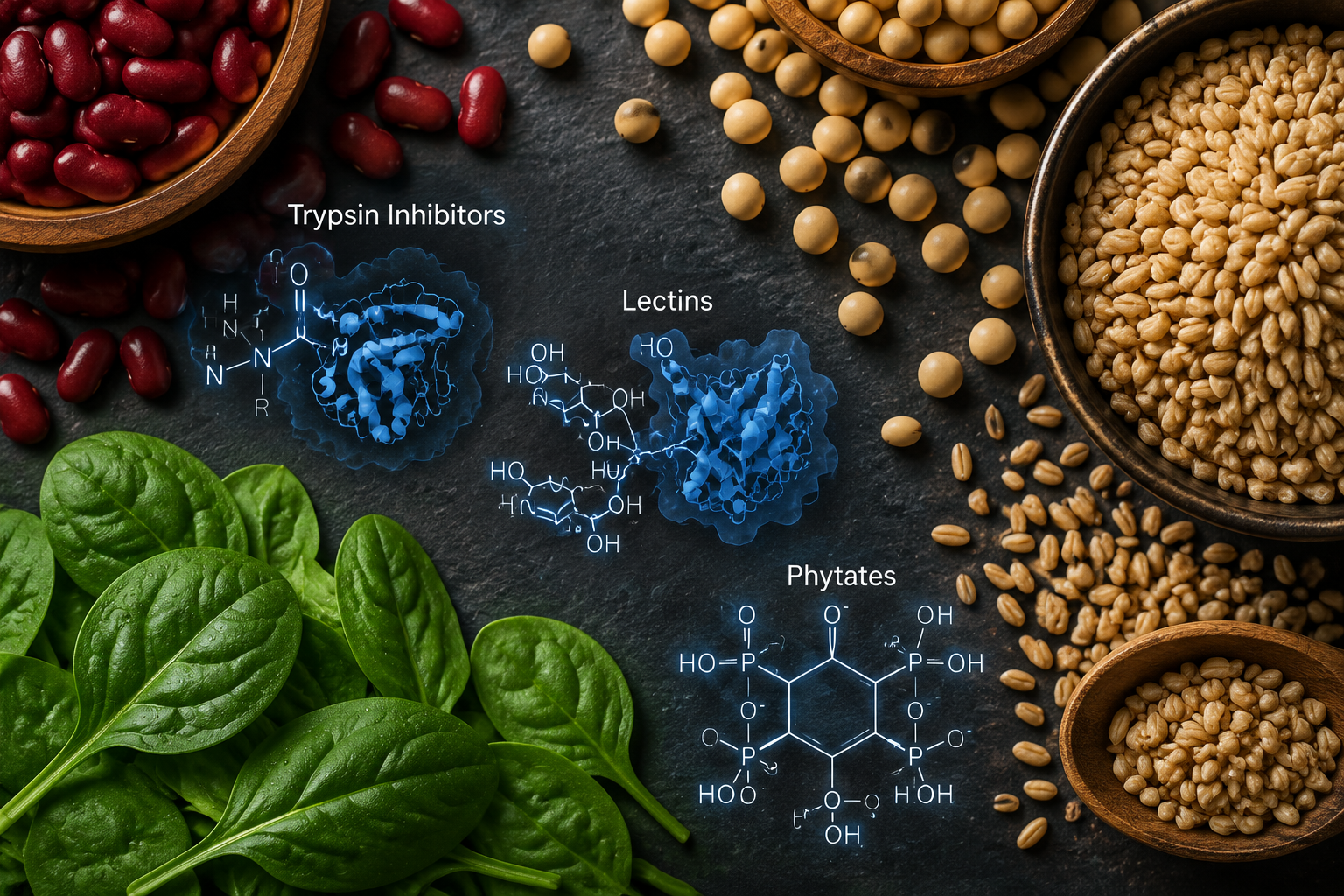
| Group | What it acts on | Examples | Key boundary |
|---|---|---|---|
| Protease inhibitors | Protein-digesting enzymes such as trypsin or chymotrypsin | Soy and other pulses | A measured reduction in activity is not the same as a medical outcome in people. |
| Alpha-amylase inhibitors | Alpha-amylase, which helps break down starch | Some beans and cereal proteins | They are not automatically protease inhibitors; some named cereal proteins are bifunctional. |
| Lectins | Carbohydrate-binding proteins | PHA in kidney beans | PHA is a specific food-safety issue; it is not a protease inhibitor. |
| Phytate and oxalate | Mineral availability in particular dietary contexts | Whole grains, legumes, seeds; spinach and some other plants | Neither is an enzyme inhibitor. Their practical relevance depends on the whole diet and individual context. |
This distinction is more than vocabulary. It stops us from treating a raw spinach salad, a fermented grain food and a raw kidney bean as versions of the same problem. For the broader chemistry and preparation context, see our Plant Toxins and Antinutrients guide.
Why the distinction matters more than a raw-versus-cooked debate
“Raw is always better” and “all antinutrients are harmful” are both shortcuts. Cooking can reduce some heat-sensitive vitamins, while also changing texture, cell walls, digestibility and the activity of particular proteins. The result depends on the food, the process and the rest of the diet.
The clearest safety boundary is not enzyme inhibition at all: raw or undercooked kidney beans can contain enough PHA to cause acute gastrointestinal illness. PHA is a lectin. The FDA treats it as a natural food toxin and distinguishes properly cooked beans from raw or undercooked beans. That is why it should not be folded into a vague claim that raw pulses are merely “harder to digest.”
At the other end of the spectrum, a raw fruit or ordinary salad vegetable is not comparable to a dried bean. The goal is not to make people anxious about plants. It is to use food-specific preparation rather than blanket rules.
Food-by-food priorities: safety first, then nutrition
1. Dried kidney beans: Treat this as a PHA/lectin food-safety issue. Use established food-safety instructions from an authoritative source; do not rely on raw, soaked, sprouted, dehydrated or low-temperature beans as a workaround.
2. Soy and other pulses: They can contain protease inhibitors, including trypsin inhibitors. Heat and other processing can reduce measured activity, but the remaining activity and nutritional effect vary by crop and process. Properly manufactured and normally prepared pulse foods are not evidence that every raw version is suitable to eat.
3. Raw sprouts: Sprouting may change some antinutritional factors, but it introduces a different consideration. The warm, moist conditions used for sprouting can allow pathogens to grow if seed is contaminated. FDA describes raw or undercooked sprouts as a recognized food-safety concern, especially for people more likely to become seriously ill from foodborne infection.
4. Grains, seeds and vegetables: Phytate, oxalate and glucosinolates deserve their own discussion rather than being presented as enzyme inhibitors. They can matter in defined dietary or health contexts, but they do not justify a universal “never eat raw” rule.
What cooking can—and cannot—do
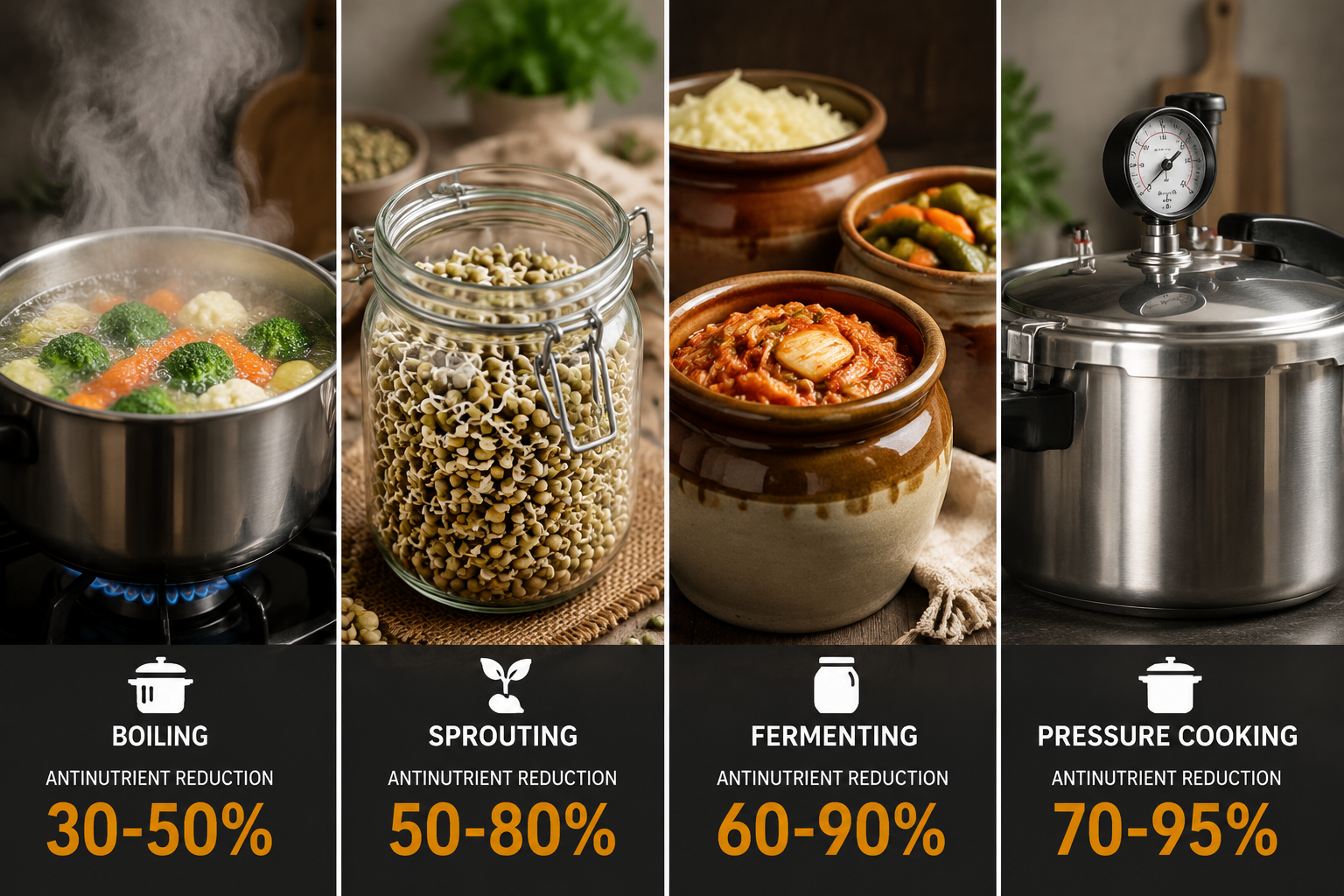
Many protease inhibitors are proteins, so heat can change their structure and reduce measured inhibitor activity. That is a useful mechanism, but it does not mean that every inhibitor behaves identically or that cooking erases every nutritional trade-off. Phytate, for example, is not a protein and should not be discussed as though heat affects it in the same way.
Food-processing studies support a narrower, more useful conclusion: methods such as heating, germination and fermentation can change antinutritional factors, but the direction and size of the change depend on the specific food and method. A cowpea experiment found different results across soaking, germination, cooking and fermentation; that does not prove the same result for soy, wheat or kidney beans.
For foods with a known safety hazard, safety guidance comes first. Preparation is not a contest between “natural” and “processed”; it is a way to match a method to the actual food.
Soaking, sprouting and fermentation: useful, not universal substitutes
These traditional methods can be valuable. Germination and fermentation can reduce some measured antinutritional factors in some legumes and grains, and fermentation can change food texture and flavour. But no honest summary should present them as automatic replacements for cooking.
- Soaking can change some compounds, but it is not a stand-alone safety guarantee for dried beans with a known lectin hazard.
- Sprouting can reduce some inhibitor activity or phytate in particular foods. It does not turn raw sprouts into a pathogen-free food and does not establish raw kidney beans as safe.
- Fermentation can reduce measured activity in specific foods, yet the outcome depends on the crop, culture, time and process. It should not be promoted as a universal “antinutrient remover.”
- Cooking remains important where authoritative food-safety guidance says it is required.
Traditional preparation is worth respecting as a practical food culture, not treating as proof that every tradition delivers the same biochemical result. Our guide to traditional food preparation goes deeper into the methods and their limits.
What this means for nutrient absorption in practice
Nutrient absorption is a whole-diet question. A food that contains phytate is not automatically “bad,” and a food that has been processed is not automatically superior. Food variety, total protein and mineral intake, preparation, and an individual’s medical or dietary context all matter.
The practical case for preparation is strongest when a dietary pattern relies heavily on a narrow set of raw pulses, unprocessed grains or seeds. It is much weaker as a reason to fear a mixed diet containing cooked legumes, whole grains, raw produce and fermented foods.
For people taking prescription medication or managing a diagnosed condition, general online guidance cannot replace individual advice. For example, the consumer drug label for levothyroxine notes that soybean flour can decrease absorption; a pharmacist or prescriber can advise on an individual medicine routine.
How to read food-preparation research without overclaiming
A laboratory or food-processing experiment can be genuinely useful without answering every nutrition question. It may show that a particular treatment lowers measured trypsin-inhibitor activity, phytate or another compound in a particular crop. That is different from proving that every version of the food has the same response, that all of the compound has disappeared, or that a specific disease outcome will follow in people.
Three checks keep the interpretation honest:
- Name the food and the compound. A result in cowpeas cannot automatically be transferred to kidney beans, soy, wheat or a home-made sprout.
- Name the process. Temperature, time, moisture, fermentation culture and starting material can all change the outcome. “Fermented” or “sprouted” is not a precise exposure.
- Keep safety separate from optimisation. A moderate change in mineral availability is a nutrition question. A known toxin or microbial hazard is a food-safety question and needs the stronger boundary.
This matters because food claims often leap from mechanism to certainty. A measured change in a digestive-enzyme inhibitor can help explain why a preparation method is studied; it does not by itself establish that every raw plant food is harmful, that everyone needs the same method, or that a processed food treats a health problem.
The raw-food argument: what it gets right and where it overreaches
Raw fruit and vegetables can be nutritious. Some cooking methods reduce certain heat-sensitive nutrients. Those facts do not show that raw food is always superior, that food enzymes replace human digestive enzymes, or that a restrictive raw diet is automatically adequate.
Evidence reviews of vegan dietary patterns identify nutrients that can be harder to obtain in adequate amounts; a more restrictive raw-vegan pattern should not be assumed adequate without looking at the full food pattern and individual circumstances. That is not an argument against plant foods. It is an argument against treating a dietary label as a nutritional guarantee.
The sensible middle ground is variety: raw foods where they suit the food, cooked foods where cooking improves palatability, digestibility or safety, and no ideology about a single “perfect” preparation method.
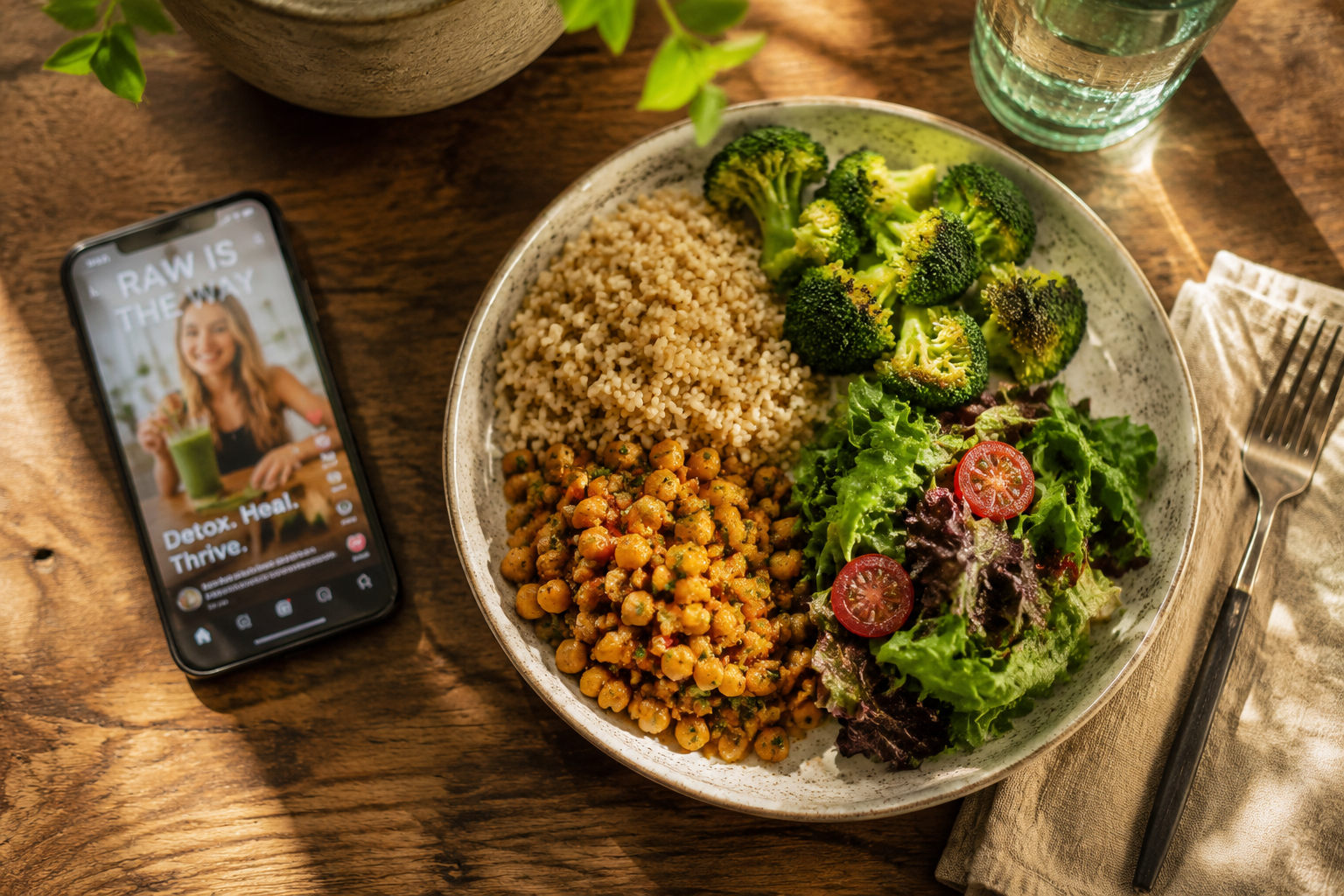
A practical decision guide
- Raw fruits and ordinary salad vegetables: usually a nutrition choice, not an enzyme-inhibitor emergency.
- Dried kidney beans: follow authoritative food-safety guidance; do not improvise with raw, low-temperature or alternative preparation claims.
- Other pulses and soy foods: choose normal, established preparation and remember that research findings are product-specific.
- Sprouts: treat them as a microbial-food-safety choice as well as a nutrition choice, especially if you are at higher risk from foodborne illness.
- Whole grains, seeds and vegetables: keep the conversation proportional. Phytate or oxalate content is not the same issue as a dangerous raw bean.
- Restrictive dietary changes: do not assume a raw or raw-vegan label guarantees nutritional adequacy. Seek qualified individual support when that is relevant to you.
FAQ: enzyme inhibitors in raw plant foods
Are enzyme inhibitors dangerous?
They are a broad class, so the answer depends on the specific compound and food. Protease inhibitors and alpha-amylase inhibitors should not be confused with phytate, oxalate or lectins. Raw or undercooked kidney beans are a separate PHA food-safety concern.
Are lectins enzyme inhibitors?
No. Lectins are carbohydrate-binding proteins. PHA in kidney beans is a lectin, which is why the kidney-bean warning needs its own category.
Can soaking, sprouting or fermentation replace cooking?
Not as a universal rule. They can change some factors in some foods, but they do not substitute for validated cooking when cooking is required for safety.
Are raw sprouts safe because they are sprouted?
No. Sprouting does not eliminate the microbial risk associated with contaminated seed. That risk is separate from the enzyme-inhibitor discussion.
Does roasting make mold-contaminated peanuts safe?
No. Research has found roasting can reduce measured aflatoxin in some circumstances, but reduction is incomplete and condition-dependent. Roasting is not a reliable home fix for contaminated food.
Is a raw-food diet nutritionally complete?
It should not be assumed to be. Nutritional adequacy depends on the complete pattern, and restrictive versions can make some nutrients harder to obtain in sufficient amounts.
Conclusion: match the method to the food
Enzyme inhibitors are real, but they are not a reason to turn ordinary plant foods into a fear list. The useful approach is precise: distinguish protease inhibitors from alpha-amylase inhibitors, keep lectins and mineral-binding compounds in their own lanes, and put known food-safety hazards first.
For most people, a varied diet that includes normally prepared legumes, grains, vegetables and fruit is a practical place to start. Where a food has a specific safety rule—especially dried kidney beans—follow the rule rather than a general raw-food claim. Preparation should be evidence-led, food-specific and proportionate.
This article is general education, not personal medical or nutrition treatment. If you have a diagnosed condition, history of food allergy, take prescription medicine, are pregnant, or are planning a major dietary change for a child, seek advice from an appropriately qualified clinician or dietitian. For dried kidney beans and other food-safety concerns, use current official food-safety guidance.
References
These sources support the category distinctions, food-processing limits and food-safety boundaries discussed above.
- U.S. Food and Drug Administration. Natural Toxins in Food.
- U.S. Food and Drug Administration. FDA Concludes Major Sampling Study of Sprouts.
- Alonso R, et al. Effect of soaking, germination, cooking and fermentation on antinutritional factors in cowpeas. Plant Foods Hum Nutr. 2000.
- Wieser H, et al. Wheat amylase/trypsin inhibitors: occurrence, function and health aspects. 2022.
- Simbar M, et al. Intake and adequacy of the vegan diet: A systematic review of the evidence. 2021.
- Pluyer HR, Ahmed EM, Wei CI. Destruction of Aflatoxins on Peanuts by Oven- and Microwave-Roasting. J Food Prot. 1987.
- Almanaa TN, et al. Aflatoxin reduction in nuts by roasting, irradiation and fumigation: a systematic review and meta-analysis. Crit Rev Food Sci Nutr. 2023.
- DailyMed. Levothyroxine Sodium tablet: consumer information.

Dave James has spent 30+ years reading health and longevity research, and has run All Perfect Health for the past five. His background is in Australian mining and industrial engineering — disciplines built on questioning claims, measuring outcomes, and respecting evidence. He writes about what the research actually says, including where the experts disagree.
More about Dave & this site →
📂 Plant Toxins & Antinutrients
This article is part of the APH cluster. Use the links below to move between the pillar and child articles.
- Read the pillar: Plant Toxins, Antinutrients and Why Our Ancestors Cooked: The Complete Evidence-Based Guide
- → What Plant Toxins Actually Do to Your Body: Effects on Digestion, Absorption and Inflammation
- YOU ARE HERE Enzyme Inhibitors in Raw Plant Foods: Why Cooking Matters More Than Influencers Admit
- → How Traditional Food Preparation Reduces Antinutrients: Soaking, Sprouting, Fermenting and Cooking
- → Synergistic Plant Toxin Effects: How Oxalates Amplify Lectin Damage in the Gut
- → Histamine Intolerance and Plant Lectins: The Overlooked Gut-Brain Connection
- → Plant Toxins and Brain Fog: New 2026 Studies Linking Phytates to Cognitive Decline
- → Antinutrients and Skin Health: How Tannins and Phytoestrogens Trigger Eczema Flares
- → Kids and Plant Toxins: Antinutrient Impacts on Growth, ADHD, and Developing Brains
- → Pesticides vs Plant Toxins: Which Is the Bigger Threat to Your Health and the Environment?
- → Climate Change and Plant Toxins: Rising Levels of Alkaloids and Glycosides in Crops
- → Global Toxicity Hotspots: Plant Toxins Amplified in China, Brazil, US Crops