
Sleep Calculator: Plan Your Bedtime, Wake Time and Wind-Down

Nearly a third of U.S. adults regularly get less sleep than recommended, according to the CDC’s sleep guidance. That gap explains why so many people search for a sleep calculator late at night, trying to figure out when to actually go to bed.
Let’s keep this practical: a sleep calculator is a scheduling tool, not a diagnostic device. Understanding that difference will save you from chasing numbers that were never meant to be exact.
I’ve used a sleep tracker for years. Later in this article, I’ll show you two of my own nights, one clean, one messy, because honest data is more useful than a tidy promise.
Practical planning tool
Sleep Schedule Planner
Plan a bedtime, wake time and wind-down around the routine you can actually keep. This calculator gives a sleep opportunity; it does not measure sleep stages, diagnose sleep problems or predict tonight’s result.
10:15 PMWake time
6:30 AMWind-down starts
9:15 PM
Planned sleep opportunity: 8h plus a 15-minute settling allowance. This is not a prediction of your actual sleep.
Optional 90-minute planning cards
Rough clock-time estimates only; they do not identify deep sleep, REM or a guaranteed wake-up point.
12:15 AM5 blocks
10:45 PM6 blocks
9:15 PM
Quick Answer
A sleep calculator helps you pick a bedtime or wake time by working backward or forward from a target sleep duration, usually seven to nine hours, plus a few minutes to fall asleep. It’s a planning aid, not a measurement of how well you actually slept.
Key Takeaways
- A sleep calculator estimates a workable bedtime or wake time. It cannot measure your actual sleep stages or tell you what you medically need.
- The “90-minute sleep cycle” is a familiar planning convention, not a precise biological fact. Real cycles vary, and actual cycle length can range roughly from 60 to 110 minutes and change from night to night.
- CDC guidance points to age-based sleep duration ranges, generally landing in the seven to nine hour range for most adults.
- Time in bed and tracker-estimated sleep are not the same thing, as my own two-night comparison shows.
- Persistent sleep trouble, loud snoring, or dangerous daytime sleepiness calls for professional evaluation, not a calculator.
Table of Contents
- How this sleep calculator works
- A planning estimate, not a prediction of your sleep stages
- Why time in bed and estimated sleep can differ
- A first-hand Fitbit Air comparison: two different nights
- Build a realistic wind-down around the schedule
- What to do when a routine still produces a poor night
- When persistent sleep problems need professional assessment
- Frequently asked questions
How this sleep calculator works
A sleep calculator does simple arithmetic. You give it a wake time or a planned lights-out time, choose a realistic sleep opportunity and allow a little time to settle. The result is a short list of possible clock times, not a single correct answer.

This math is a convenience, not a scientific measurement. A sleep calculator cannot see your brain waves. It works from population averages and rough conventions. A sensible approach is to treat the output as a short menu of reasonable bedtimes, then pick the one that fits your actual schedule, work start time, household routine, and how your body tends to feel on different amounts of sleep.
A practical planner is most useful when it helps you choose a repeatable wake time and a realistic opportunity for sleep, rather than promising precision that a clock cannot deliver.
A planning estimate, not a prediction of your sleep stages
We need to separate fact from hype. A sleep calculator cannot tell you when you’ll enter deep sleep, when REM will occur, or exactly how efficient your night will be. Those are physiological events that vary from night to night and person to person, shaped by age, stress, health conditions, and plain randomness, as outlined in the NIH’s overview of sleep stages.
The 90-minute cycle figure you see quoted everywhere is a familiar planning convention, not a fixed rule. Sleep cycles can run anywhere from roughly 60 to 110 minutes, and the length shifts across the night and from person to person. I’d be careful with any tool, article, or app that tells you an exact minute to wake up “at the top of a cycle.” That level of precision isn’t supported by the evidence.
In 2024, Australia’s Sleep Health Foundation published an article titled “The ‘Sleep Calculator’ is just unscientific hype,” stating plainly that the assumptions behind fixed-cycle sleep calculators, particularly the idea that timing bedtime around rigid cycles optimizes sleep, are not based on scientific evidence. That’s a strong, credible claim, and it lines up with what sleep science has generally said: cycle length varies, and no calculator can reverse-engineer your personal biology from a clock.
What matters most is this: treat the 90-minute cycle framing as one optional, familiar scheduling convention among several reasonable approaches, not as proof of anything about your individual sleep architecture. Even Healthline’s guidance on figuring out how much sleep you need frames cycle-based calculators as a starting point for experimentation, not a fixed prescription.
Why time in bed and estimated sleep can differ
Here’s something that surprises people: being in bed for nine and a half hours doesn’t guarantee anywhere near nine and a half hours of actual rest. Time in bed is just the window of opportunity. What happens inside that window, how long it takes to drift off, how often you wake, how long those wake-ups last, determines how much of that window counts as estimated sleep.

Consumer trackers estimate this using movement and heart-rate patterns. The American Academy of Sleep Medicine’s position on consumer sleep technology notes that these devices generally lack the validation or FDA clearance needed to diagnose or treat sleep disorders. A tracker can show you a rough pattern over time, but it cannot diagnose anything, and a single off night rarely means much on its own. Organizations like The Sleep Charity make a similar point: a calculator or tracker is a nudge toward better habits, not a verdict on your health.
The numbers matter, which is why a real example is more useful than another abstract explanation.
A first-hand Fitbit Air comparison: two different nights
Let’s call it what it is: two personal tracker readings, nothing more. These are not clinical sleep studies, and I won’t pretend they prove what caused either result.
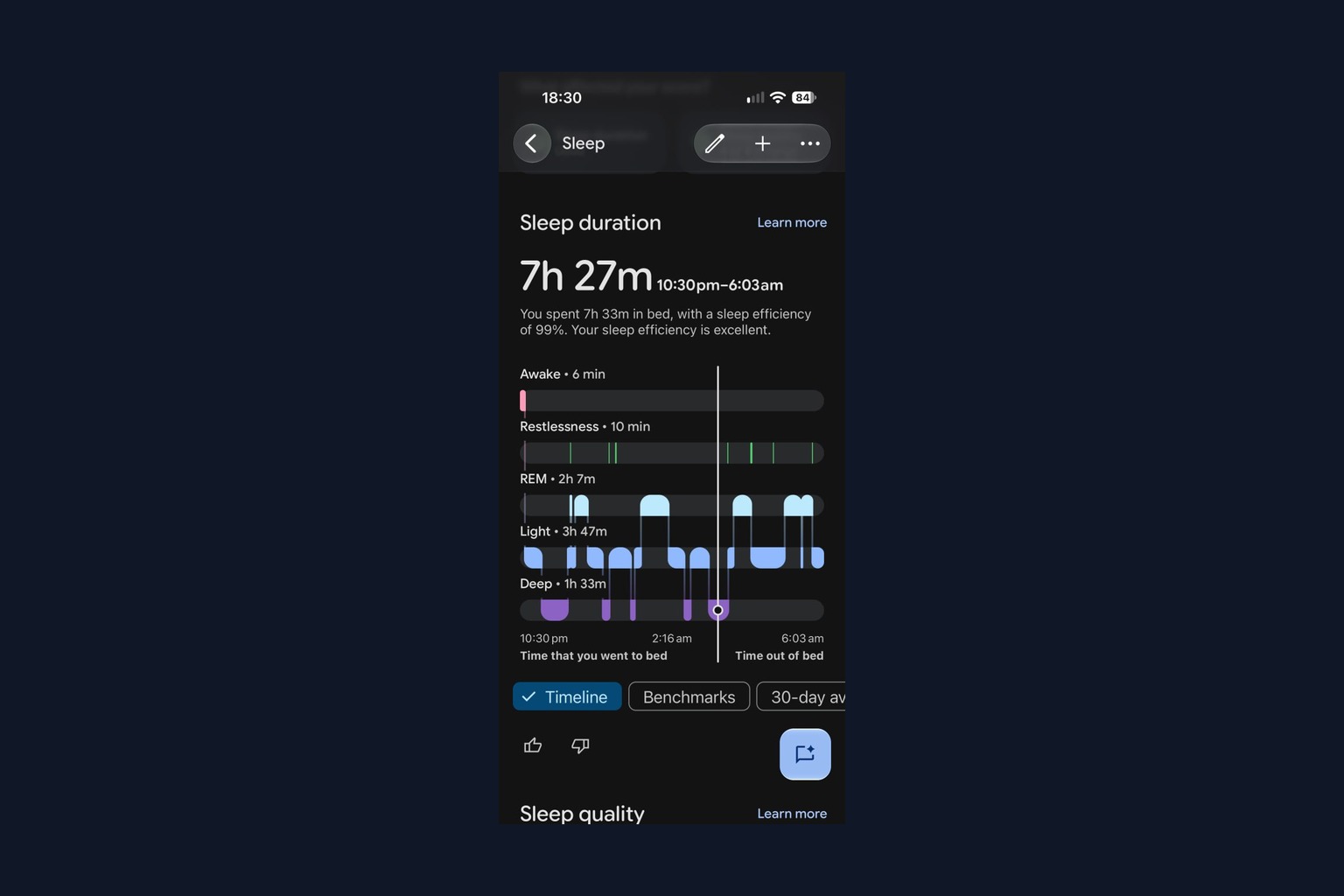
Night A: 7 hours 33 minutes in bed, 7 hours 27 minutes of estimated sleep, 99% estimated efficiency.
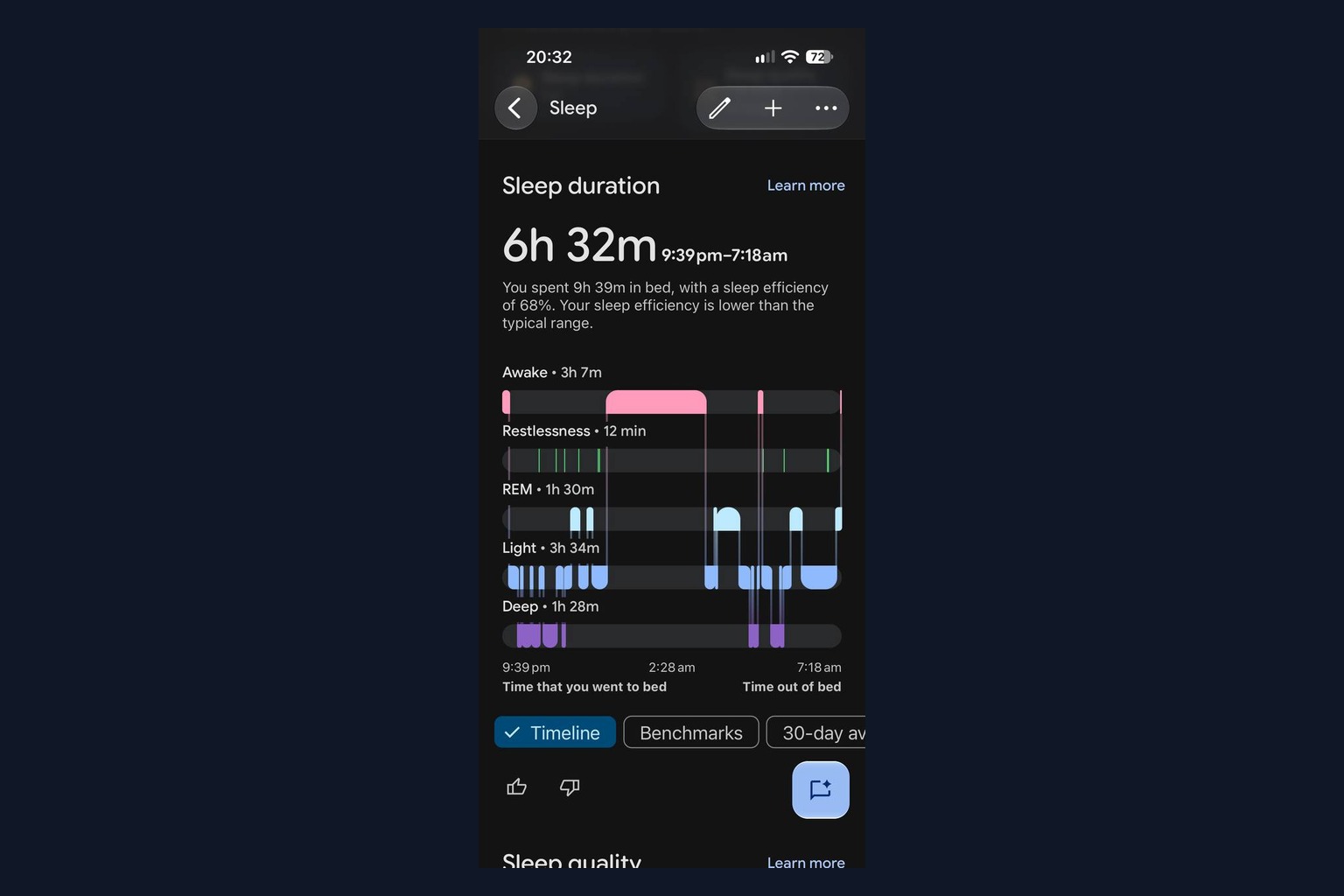
Night B: 9 hours 39 minutes in bed, 6 hours 32 minutes of tracker-estimated sleep, 68% estimated efficiency, with 3 hours 7 minutes marked awake by the device.
These two records show why I use the sleep calculator as a planning guide, not a scorecard. The Fitbit Air’s stage estimates are fairly close: Night A shows 2 hours 7 minutes of REM, 3 hours 47 minutes of light sleep, and 1 hour 33 minutes of deep sleep; Night B shows 1 hour 30 minutes of REM, 3 hours 34 minutes of light sleep, and 1 hour 28 minutes of deep sleep.
But the overall readings are quite different. Night A estimated 7 hours 27 minutes asleep and 99% efficiency from 7 hours 33 minutes in bed. Night B estimated 6 hours 32 minutes asleep and 68% efficiency despite 9 hours 39 minutes in bed. That contrast is a useful reminder: the calculator can help set a reasonable lights-out target, settling allowance, and wind-down routine, but it cannot tell you what will happen once you are in bed. A planned schedule may still lead to a restless, shorter, or otherwise non-ideal night.
Consumer-tracker figures are personal estimates and trend prompts rather than clinical measurements, consistent with the limitations outlined in the AASM consumer sleep technology statement.
Build a realistic wind-down around the schedule
A sleep calculator only sets the frame. What you do in the hour before that bedtime decides whether you actually use it well. Your body responds to light, routine, and timing cues far more than it responds to a clock number, as the National Institute of Neurological Disorders and Stroke explains in its overview of how sleep is regulated.

A few habits consistently show up in the sleep hygiene literature as worth prioritizing:
- Morning light exposure. Getting outside soon after waking helps anchor your circadian rhythm, which supports a more consistent evening wind-down. See our full piece on morning sunlight for sleep.
- Evening light hygiene. Dimmer, warmer light in the hours before bed reduces the kind of alerting signal that keeps your brain in daytime mode. Details are in our guide to evening light hygiene and LED bulbs.
- A repeatable sequence. The same few steps each night, lights down, devices away, same basic order of events, tend to matter more than any single trick.
On supplements: some readers ask about magnesium glycinate or L-theanine as part of a wind-down. These are separate topics with their own evidence base, not a stack to combine casually. For a deeper, evidence-aware look at one of them, our article on magnesium glycinate for sleep walks through what is and isn’t known. This article doesn’t recommend a dose or timing protocol, and I’d be cautious with anyone who does without qualified guidance.
For the full framework behind all of this, our complete guide to sleep hygiene covers the broader picture beyond scheduling alone.
What to do when a routine still produces a poor night
Keep it simple and consistent, and expect some nights to miss the mark anyway. One rough night, even after a careful wind-down, is not a failure of your sleep calculator or your routine. It’s a normal part of being human.
A sensible response is to avoid overcorrecting. Don’t chase a bad night with a drastically different bedtime, a long nap that disrupts the next night, or a new supplement tried for the first time out of frustration. Instead:
- Keep your wake time steady even after a poor night.
- Get morning light as usual.
- Let your next bedtime follow your normal schedule rather than an emergency adjustment.
If poor nights are occasional and your daytime functioning is fine, that’s ordinary variability. The main takeaway is to judge your sleep pattern over weeks, not single nights, and use a calculator to keep your average schedule steady rather than to chase a perfect night every time, in line with the CDC’s emphasis on consistent sleep and wake times.
When persistent sleep problems need professional assessment
No sleep calculator, tracker, or wind-down routine can diagnose a sleep disorder. That needs to be stated plainly, because getting this wrong has real consequences.
See a licensed medical professional if you notice any of the following on a regular basis:
- Trouble falling or staying asleep most nights, for weeks at a time.
- Loud snoring, gasping, or pauses in breathing noticed by a partner.
- Daytime sleepiness strong enough to be dangerous, for example while driving.
- Sleep problems that are clearly affecting your mood, memory, or work.
Consumer sleep technology, including wearables and apps, has acknowledged limits. The AASM’s position statement on consumer sleep technology is direct about this: most of these tools lack the validation or regulatory clearance needed to diagnose or treat sleep disorders. They can point you toward a conversation with a clinician, but they cannot replace one. Based on current guidance, the right use of any calculator or tracker is as an early signal, never a conclusion, and the CDC recommends talking to a healthcare provider if sleep problems persist.
Frequently asked questions
Is a sleep calculator accurate for my personal sleep cycles?
Not precisely. It relies on an average cycle length that can actually range from about 60 to 110 minutes and varies night to night and person to person. It’s useful for scheduling, not for predicting your exact sleep stages.
How many hours of sleep should I actually aim for?
The CDC’s sleep guidance outlines age-based ranges, generally falling between seven and nine hours for most adults. A sleep calculator should work from this range, not override it.
Can a sleep cycle calculator tell me the best time to wake up?
It can suggest a few reasonable options based on cycle-length estimates, but no option is scientifically “optimal.” Consistency and adequate duration matter more than hitting an exact cycle boundary.
Why did my tracker show less sleep than time in bed?
This is common and expected. Falling asleep takes time, and brief or longer wake-ups during the night reduce estimated sleep even when total time in bed is high, as shown in the Night B comparison above.
Should I combine magnesium glycinate and L-theanine for sleep?
I’d be careful with that. Each has its own separate body of evidence and should be considered individually with qualified guidance, not stacked together casually or used as a fix for poor sleep architecture.
When should I stop relying on a calculator and see a doctor?
If sleep trouble is persistent, if a partner notices loud snoring or breathing pauses, or if daytime sleepiness becomes dangerous, that’s the point to seek professional assessment rather than adjusting your schedule further.
References
- Centers for Disease Control and Prevention: About Sleep.
- American Academy of Sleep Medicine: Consumer Sleep Technology Position Statement.
- National Heart, Lung, and Blood Institute: How Sleep Works, Sleep Phases and Stages.
- National Institute of Neurological Disorders and Stroke: Brain Basics, Understanding Sleep.
- Sleep Health Foundation: The “Sleep Calculator” Is Just Unscientific Hype.
Medical Disclaimer
This article is for informational purposes only and is not medical advice. A schedule planner and a consumer sleep tracker cannot diagnose sleep disorders or determine treatment. Speak with a qualified healthcare professional about persistent sleep problems, breathing pauses during sleep, dangerous daytime sleepiness, or major daytime impairment.

About the author
Dave James has spent 30+ years reading health and longevity research and has run All Perfect Health for the past five. His background is in Australian mining and industrial engineering—disciplines built on questioning claims, measuring outcomes, and respecting evidence. He writes about what the research actually says, including where experts disagree. Dave is not a physician.
📂 Sleep Hygiene & Circadian Health
This article is part of the APH cluster. Use the links below to move between the pillar and related support articles.
- Read the pillar: Sleep Hygiene: The Complete Guide to Better Sleep for Health and Longevity
- YOU ARE HERE Sleep Calculator: Plan Your Bedtime, Wake Time and Wind-Down
- → Evening Light Hygiene: How Household LED Bulbs and Dimming Affect Melatonin and Sleep
- → Morning Sunlight for Sleep: How Light Timing Affects Your Body Clock
- → Magnesium Glycinate for Sleep: Benefits, Safety, and How to Choose a Supplement
- → Sleep Trackers Explained: What Wearables Can—and Cannot—Tell You About Your Sleep
- → Best Sleep Optimization Gear for Hot, Light and Noise-Sensitive Sleepers
- → Light Sensitivity and Migraine Photophobia: What It Is, Why It Happens, and What Actually Helps