
Yoga for Stress Management: A Practical Beginner’s Guide
Last updated: October 2026
When stress is running high, a short yoga practice can offer a practical pause: gentle movement, ordinary breathing and a few minutes of focused attention. It will not remove a difficult workload, relationship problem or health concern, but it may be a useful habit for feeling more settled and less physically braced.
This guide separates the useful, evidence-aware basics from claims that yoga is a cure, a perfect biomarker hack, or a replacement for appropriate care.
Quick Answer
Yoga may help some adults reduce perceived stress, particularly when it is a comfortable, repeatable practice. The evidence is encouraging but mixed in quality, so it is best treated as a useful health habit—not a cure or a replacement for mental-health or medical care. Start gently, keep breathing easy, and stop rather than force a position.
Key Takeaways
- Think useful, not miraculous. Recent meta-analyses report a moderate average improvement in perceived stress, with substantial variation between studies and people.[1][2]
- Beginner yoga need not be intense. A short, comfortable routine is a sensible place to start; pain, breath-holding and competition are signs to back off.
- Feeling calmer and changing a biomarker are different outcomes. The better-supported outcome is how people report feeling, not a guaranteed change in cortisol or other physiological markers.[3]
- Keep the bigger picture in view. Yoga can complement sleep, regular movement, social connection and appropriate professional care; it does not replace them.
What yoga can realistically contribute to stress management
In everyday Western practice, yoga usually combines movement, breathing and focused attention. That bundle matters: most research tests a program containing several of those elements, not one magic posture or breath pattern.
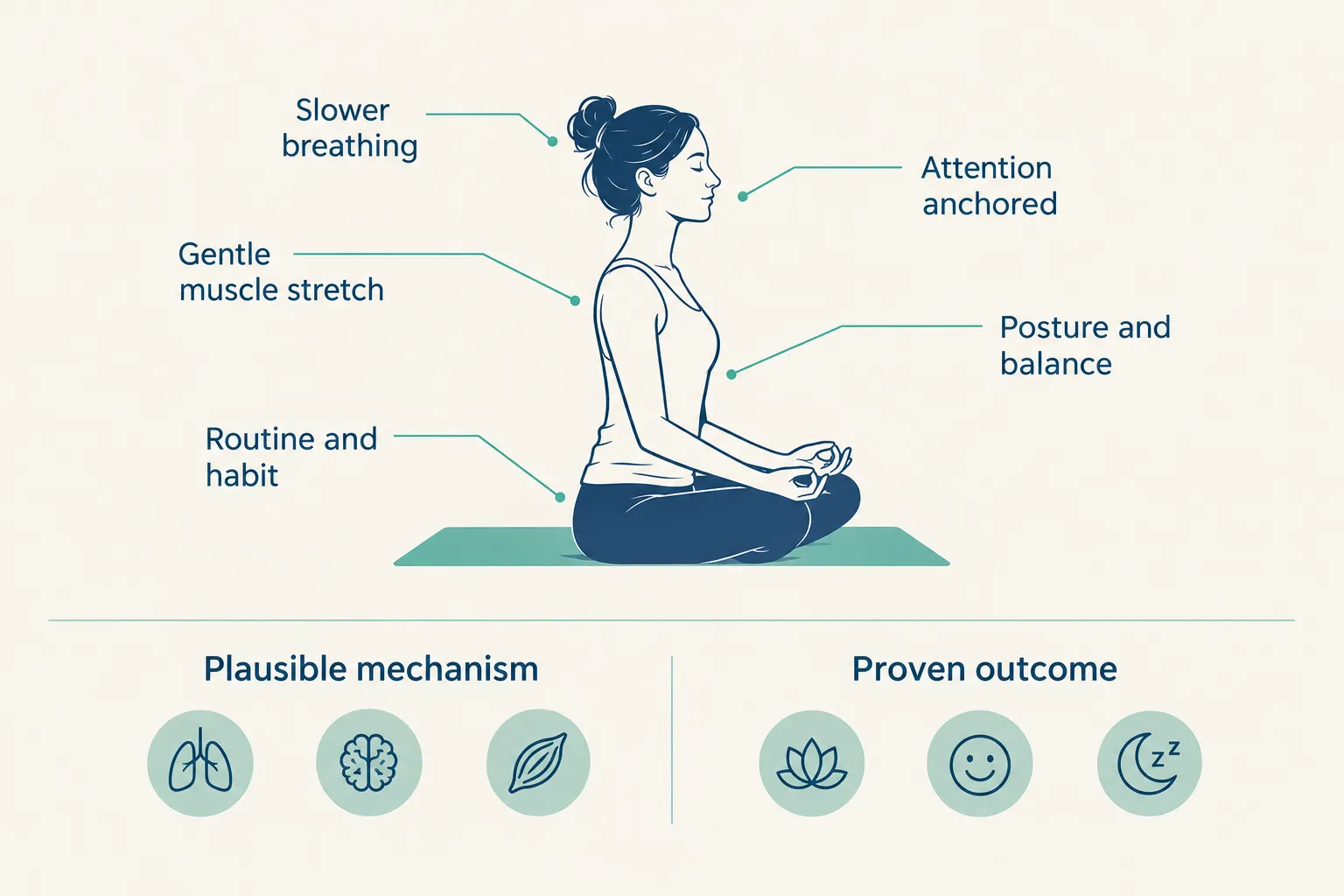
Yoga cannot solve the circumstances creating pressure—your workload, finances, caregiving or conflict. What it may offer is a reliable transition: a few minutes of less rushing, gentle movement after sitting, and an attention cue that can interrupt rumination. That is a worthwhile result without turning it into a medical claim.
What may be happening
Slower movement and comfortable breathing can make a practice feel settling, while a simple sequence gives attention somewhere concrete to go. These are plausible pathways, not proof that yoga corrects a particular nervous-system state or hormone level. Judge the practice by ordinary outcomes: whether it feels sustainable, leaves you feeling reasonably well, and fits alongside the habits that support your health.
What the evidence shows—and what it does not
A 2025 meta-analysis of 36 studies found a moderate average reduction in perceived stress among people assigned to yoga, but also substantial variation between studies.[1]
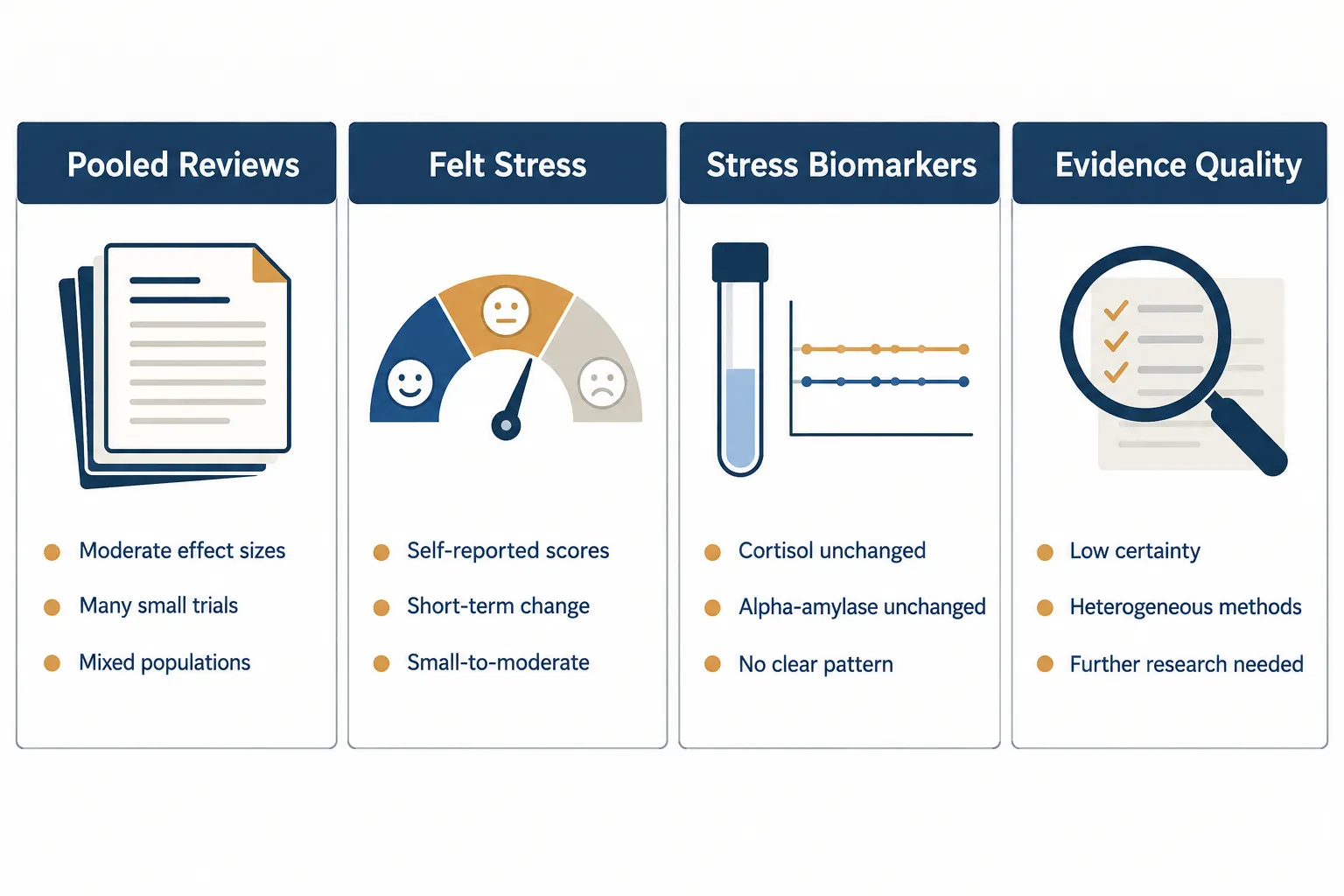
A separate systematic review in stressed adults judged evidence for short-term stress effects to be low quality and noted that longer-term conclusions were limited.[2]
That combination supports a practical conclusion: yoga is reasonable to try if you enjoy it and it suits your body, but the research does not justify promises that it will work the same way for everyone or treat a diagnosed condition.
| Question | A fair answer |
|---|---|
| Can yoga help people feel less stressed? | It may. Meta-analyses show an average benefit for perceived stress, with study-to-study variation.[1][2] |
| Does yoga reliably “lower cortisol”? | That is not established for every person or program. Subjective stress and biomarkers should not be treated as the same outcome.[3] |
| Can yoga replace treatment for anxiety, depression or trauma? | No. It may sit alongside appropriate care, but it is not a replacement for assessment or treatment. |
| Is more yoga always better? | No. A comfortable routine you can repeat is more useful than forcing intensity or difficult positions. |
Evidence is more useful when it prevents overstatement. A positive average result is a reason to make yoga available as an option; it is not a guarantee, a diagnosis, or a reason to ignore persistent symptoms.
A practical beginner-friendly yoga framework
The good news for anyone starting at 50 or 60 is that the dose requirements look modest. Research summarized by a Norwegian university group found that just a few hours of yoga produced meaningful reductions in perceived stress among both teenagers and working professionals . You do not need to train like a gymnast.
A sensible starting point is 10 to 15 minutes, two or three times a week, building to perhaps 20 to 30 minutes if you enjoy it. Start with what gives the biggest return: consistency beats intensity, every time.
Choosing comfortable movement and pace
The single most useful filter for a beginner is this: if a position hurts, it is the wrong position for you today. Not a challenge to overcome. Information.
Practical selection rules:
- Pick a gentle style. Look for classes labelled gentle, restorative, chair yoga, or beginner hatha. Avoid hot yoga, power yoga, and vinyasa flow until you know how your body responds.
- Use props without hesitation. A chair, two blocks, a folded blanket, and a strap are not training wheels. They let you get the shape of a posture without straining joints that have been doing their job for fifty-odd years.
- Breathe normally throughout. If you are holding your breath or clenching your jaw, you have gone too far. Back off until breathing is easy again.
- Work at roughly 60 to 70 percent of your available range. Stretching to the absolute end of your flexibility is where most beginner strains happen. There is no magic in it. More is not always better.
- Avoid loaded end-range neck and lower-back positions. Headstands, shoulderstands, and deep backbends have no place in a beginner stress-management practice.
I’d rather you do an easy version well for a year than an advanced version badly for three weeks.
A short, realistic practice structure
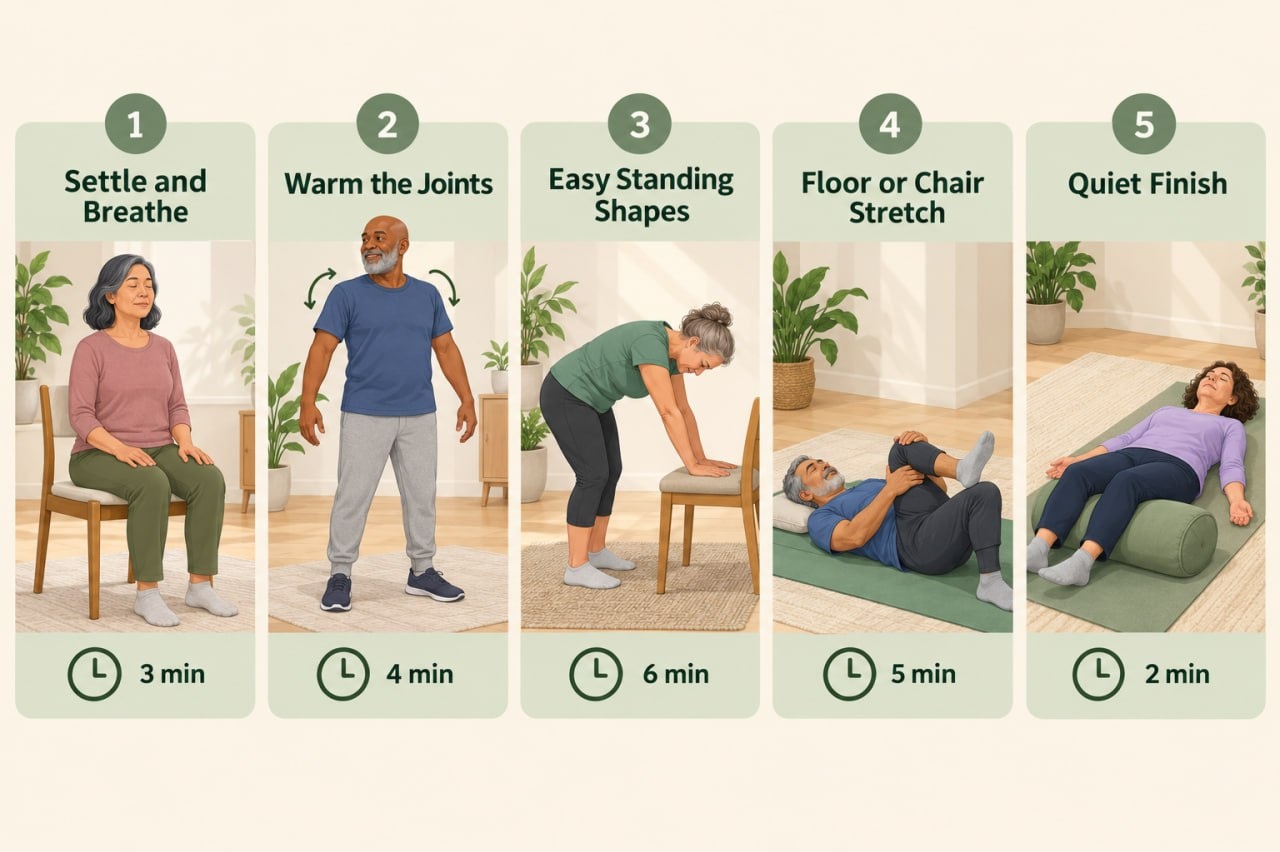
A 15-minute session that works, and can be done on a chair or a mat:
| Stage | Time | What to do |
|---|---|---|
| 1. Settle and breathe | 3 min | Sit upright, feet flat. Breathe in for a count of four, out for a count of six. Nothing else. |
| 2. Warm the joints | 3 min | Slow shoulder rolls, gentle neck turns side to side, ankle circles, slow seated spinal twists. |
| 3. Easy standing shapes | 4 min | Standing side bend, gentle forward fold with hands on a chair seat, a wide-stance leg stretch. Hold 20-30 seconds each. |
| 4. Floor or chair stretch | 3 min | Reclined knee hug, supported twist, or the seated chair equivalents. |
| 5. Quiet finish | 2 min | Lie or sit still. Let the breath settle on its own. Resist the urge to check your phone. |
Progression rule: add time before adding difficulty. Move from 15 minutes to 20, then 25, over several weeks. Only then consider a more demanding class.
Tracking rule: judge the practice on how you feel two hours later and how you sleep that night, not on how far you can reach. If you want a simple measure, rate your stress from 0 to 10 before and after each session and look at the pattern over a month.
If group settings suit you better than solo practice, a studio class with an instructor who modifies for older beginners is worth the money. Tell them your limits before the class starts, not during.
How yoga fits with sleep, walking, breathing and social support
From a practical point of view, yoga is one input among several. The basics still do the heavy lifting, and yoga works best stacked on top of them rather than substituted for them. For the wider picture, our guide on how to manage stress for better long-term health sets out the full framework.
Sleep. The 12-week yoga plus mindfulness program mentioned earlier reported a 36.9% improvement in sleep disturbance scores alongside its stress findings [3]. That is one of the more interesting signals in this literature, because poor sleep and high stress reinforce each other. A short evening practice may help you wind down, but it will not outperform the fundamentals covered in our complete guide to sleep hygiene, consistent timing, a dark cool room, and limiting late caffeine.
General movement. Yoga is mobility, balance, and modest strength work. It is not cardiovascular training and only lightly loads muscle for strength purposes. Most adults over 45 still need brisk walking, some resistance training, and general activity. Our exercise guide for better health covers how to build that base. Treat yoga as a complement, not a replacement.
Related mind-body options. If floor work is awkward or balance is a concern, slow standing practices may suit you better. Tai chi for beginners offers a similar combination of controlled movement, breathing, and attention, entirely upright.
Breathing on its own. A short breathing pause can be useful when a full practice is not possible. Our deep breathing for stress guide explains how to keep that practice comfortable and avoid turning it into a forced exercise.
Social contact. Class attendance adds a quietly powerful ingredient that solo video sessions do not: regular contact with other people. For adults in midlife, that may be a real part of why group programs perform well.
| Input | What it mainly does | Effort to start |
|---|---|---|
| Yoga (gentle) | Mobility, attention, perceived stress | Low |
| Brisk walking | Cardiovascular base, mood | Very low |
| Resistance training | Strength, bone, metabolic health | Moderate |
| Sleep routine | Recovery, stress tolerance | Low but needs discipline |
| Breathing drills | Immediate state change | Minimal |
The simplest way to look at it is this: yoga is a good third or fourth item on the list. It is rarely the first.
Safety, modifications and when to seek individual advice
Yoga is often gentle, but it is still physical activity. A systematic review of randomized trials found yoga broadly comparable with usual care and exercise for reported adverse events, while also noting the need for better safety reporting.[4] Survey data suggest that difficult inversions and unsupervised self-practice can be associated with problems, especially for people managing chronic illness.[5]
Useful beginner rules
- Choose a gentle, beginner or chair-based class if you are new to yoga or returning after a long break.
- Use a chair, wall, blocks or folded blanket whenever they make a movement more comfortable.
- Keep breathing normally. Sharp pain, dizziness, tingling, breath-holding or a sense of panic are cues to stop and return to an easy position.
- Leave headstands, shoulderstands, forceful twists and deep backbends for later—or skip them altogether. They are not required for a useful stress-management practice.
Individual advice is sensible if you have a recent injury or surgery, recurrent falls or dizziness, are pregnant, or live with a condition that affects balance, joints, blood pressure, eyes or heart. If anxiety, low mood, panic or sleep difficulty is interfering with daily life, yoga may be supportive, but a clinician or qualified mental-health professional can help you assess the bigger picture.
Frequently Asked Questions
How long before yoga might help with stress?
Some people feel more settled after one gentle session. Research programs commonly run for several weeks, and there is no reliable timetable for an individual. The useful test is whether a modest routine feels helpful and sustainable—not whether you can reproduce a headline result.
Do I need to be flexible to start?
No. Flexibility is not an entry requirement. Chair-based and prop-supported options can let you practise comfortably while you learn what your body tolerates.
Does yoga actually lower cortisol?
Not reliably enough to promise it. Stress hormones and other biomarkers are complicated, and an improvement in how someone feels is not the same as a guaranteed biological change. The more defensible claim is that yoga may help some people with perceived stress.[1][2][3]
Is online or in-person better for a beginner?
Either can work. An in-person beginner class may make it easier to ask for simple modifications; a calm, well-taught online class can be easier to repeat at home. Avoid treating either format as a reason to push through pain or dizziness.
How does yoga compare with walking for stress?
They can complement each other. Walking is an accessible way to build general activity; yoga adds a focused movement-and-breathing practice. You do not need to choose only one.
Can yoga replace therapy or medication?
No. Yoga can be one supportive habit, but it is not a substitute for care recommended for a diagnosed mental-health or medical condition.
Conclusion
Yoga for stress management is worth considering as a low-cost, adaptable habit—not because it is magic, but because it gives you a repeatable way to move, breathe and pause. The evidence supports modest expectations: it may help perceived stress for some people, while the details of dose, style and long-term effects remain uncertain.[1][2]
Start easy: ten comfortable minutes, two or three times a week, with no need to master a pose. Keep walking, protect sleep, and use professional support when stress or symptoms are taking over daily life.
References
- Yoga as an intervention for stress: a meta-analysis. Health Psychology Review. 2025.
- Effects of yoga on stress in stressed adults: a systematic review and meta-analysis. 2024.
- Hatha yoga reduces momentary stress but does not impact diurnal physiological stress markers.
- The safety of yoga: a systematic review and meta-analysis of randomized controlled trials. 2015.
- Adverse effects of yoga: a national cross-sectional survey. 2019.
- National Center for Complementary and Integrative Health: Yoga—Effectiveness and Safety.
Medical Disclaimer
This article is for general information and education only. It is not medical advice, and it is not a diagnosis, treatment plan, or recommendation for any individual. Yoga is not presented here as a treatment for anxiety, depression, trauma, insomnia, chronic pain, or any other medical or mental health condition. Always consult a qualified healthcare professional before beginning a new exercise or movement practice, particularly if you have an injury, balance concerns, are pregnant, have had recent surgery, or manage a significant health condition. If you are experiencing symptoms that affect your daily functioning, contact a licensed clinician. In an emergency, call 911 or your local emergency number.

About the author
Dave James is the founder of All Perfect Health. He writes practical, evidence-aware health guides that separate useful habits from exaggerated claims.