
Deep Breathing for Stress: Simple Techniques to Help You Reset
Last updated: October 2026
Stress advice often arrives after your body is already running too fast. Deep breathing for stress will not fix a difficult life, but a few unforced minutes can create useful space before you react. This guide separates what the evidence supports from what the internet tends to exaggerate.
Quick Answer
Slow, comfortable breathing may help some people feel more settled in the moment. Keep the breath easy rather than deep or forced, and treat it as one small tool alongside sleep, movement, relationships and professional support when needed. It is not a treatment for an underlying condition.
Key Takeaways
- Think modest, not miraculous. Reviews suggest that paced breathing can support short-term settling for some people, but study methods and results vary.
- Comfort matters more than precision. A gentle pace and an unforced exhale are more useful than chasing a perfect count or a dramatic breath.
- Stop if it feels wrong. Light-headedness, tingling, air hunger or distress are reasons to return to normal breathing rather than push through.
- Use it as part of the bigger picture. Breathing practice does not replace assessment or treatment for persistent anxiety, panic, insomnia, trauma, heart disease or lung disease.
Why stress can change the way you breathe
Breathing is unusual among body systems. The heart beats without permission. Digestion happens whether it is invited or not. Breathing runs automatically too, but it can also be taken over deliberately at any moment. That dual control is the whole reason it is useful here.
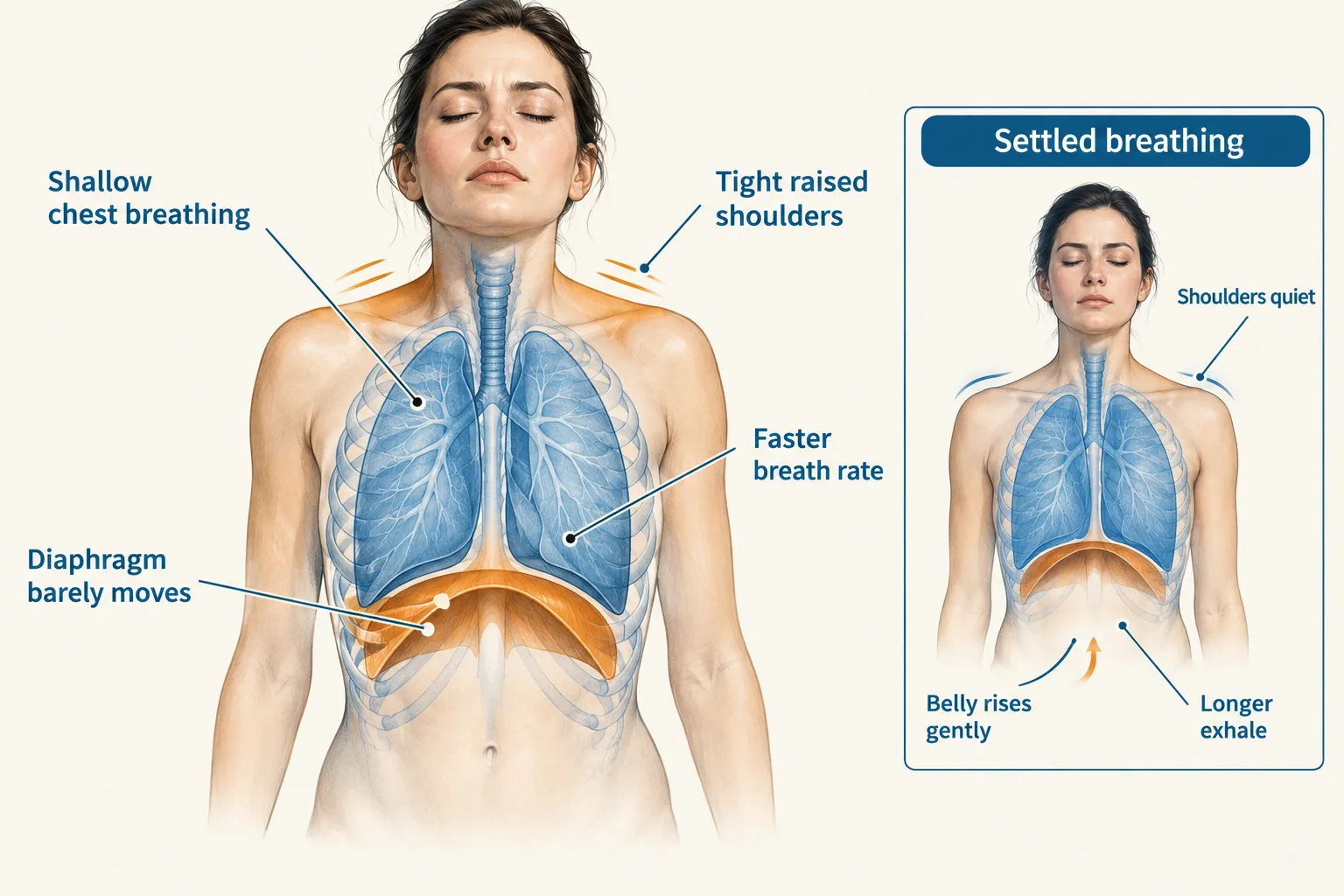
Under pressure, many people notice a faster or more effortful rhythm, a tight jaw or shoulders, and more sighing. Those patterns vary, and no single visible feature can diagnose a breathing problem. For an everyday stressor, however, a deliberate pause can be a practical way to interrupt the sense of rushing.
Here’s the real issue for people in midlife. Everyday stress is rarely one big event. It is a steady accumulation of small ones, and the breathing pattern that goes with it becomes a background habit. Tight shoulders. A jaw that aches by evening. Sighing without noticing. None of that is dangerous on its own, but it keeps the nervous system a little closer to “on” than it needs to be.
Breathing is the one part of the stress response you can take the controls of directly. That is its advantage, and the limit of what it can do.
Slow, deliberate breathing can shift pace and attention, and studies often measure accompanying changes in heart-rate variability. Those findings are interesting, but they are intermediate markers rather than a personal scorecard. The practical question is simpler: does a gentle pause help you feel more settled without discomfort?[2][4]
Context matters. Markers like heart-rate variability tell us something real is happening physiologically. They do not tell us how much a person’s week will actually improve. Keep both facts in view.
What slow, comfortable breathing may help with, and what it cannot do
We need to separate fact from hype here, because breathwork has attracted a lot of ambitious marketing. The honest version is more useful than the exciting one.
What the evidence can and cannot say
Short-term settling is plausible and supported by limited human evidence. Systematic reviews of breathing-exercise interventions report potential benefits for stress and anxiety symptoms, but the practices, populations and comparison groups vary widely.[1][2]
The mechanism is not a diagnosis. Slow, comfortable breathing can change attention, pace and autonomic measurements such as heart-rate variability. Those measurements may be useful research markers, but they do not tell us whether a person has a “good” or “bad” breathing pattern.[2][4]
More specific claims deserve more caution. A 2025 review of pranayama found short-term effects in clinical populations, while also reporting a small evidence base and frequent risk-of-bias concerns. That supports measured language, not promises of a cure or a replacement for established care.[3]
| Claim about deep breathing for stress | What is fair to say |
|---|---|
| May help a person feel calmer in the moment | Reasonable for some people; effects vary.[1][2] |
| Changes heart-rate variability or breathing pace | Observed in research; not a diagnostic score.[2][4] |
| Improves sleep or treats anxiety | Not established as a stand-alone treatment. |
| Replaces therapy or prescribed treatment | Not supported. |
Where the uncertainty sits
Three honest caveats. First, most stress outcomes are self-reported, and people know they are breathing on purpose, blinding is nearly impossible. Second, effect sizes vary widely between studies, which usually signals differences in protocol, population, and control group rather than one true number. Third, the research base is heavily weighted toward short-term outcomes. We know far less about what six or twelve months of regular practice does.
The stronger evidence points to this: breathing is a dependable short-term regulator and a reasonable daily habit. It is not a treatment. The basics still do the heavy lifting, sleep, movement, food, connection, and dealing with the actual source of the pressure where that is possible. If you want the wider framework, APH’s guide on how to manage stress for better long-term health puts breathing in its proper place among those pillars.
Three simple deep-breathing techniques for stress
Three patterns cover almost everything most people need. All share the same foundation: nasal inhale where comfortable, relaxed exhale, no straining, no forcing.
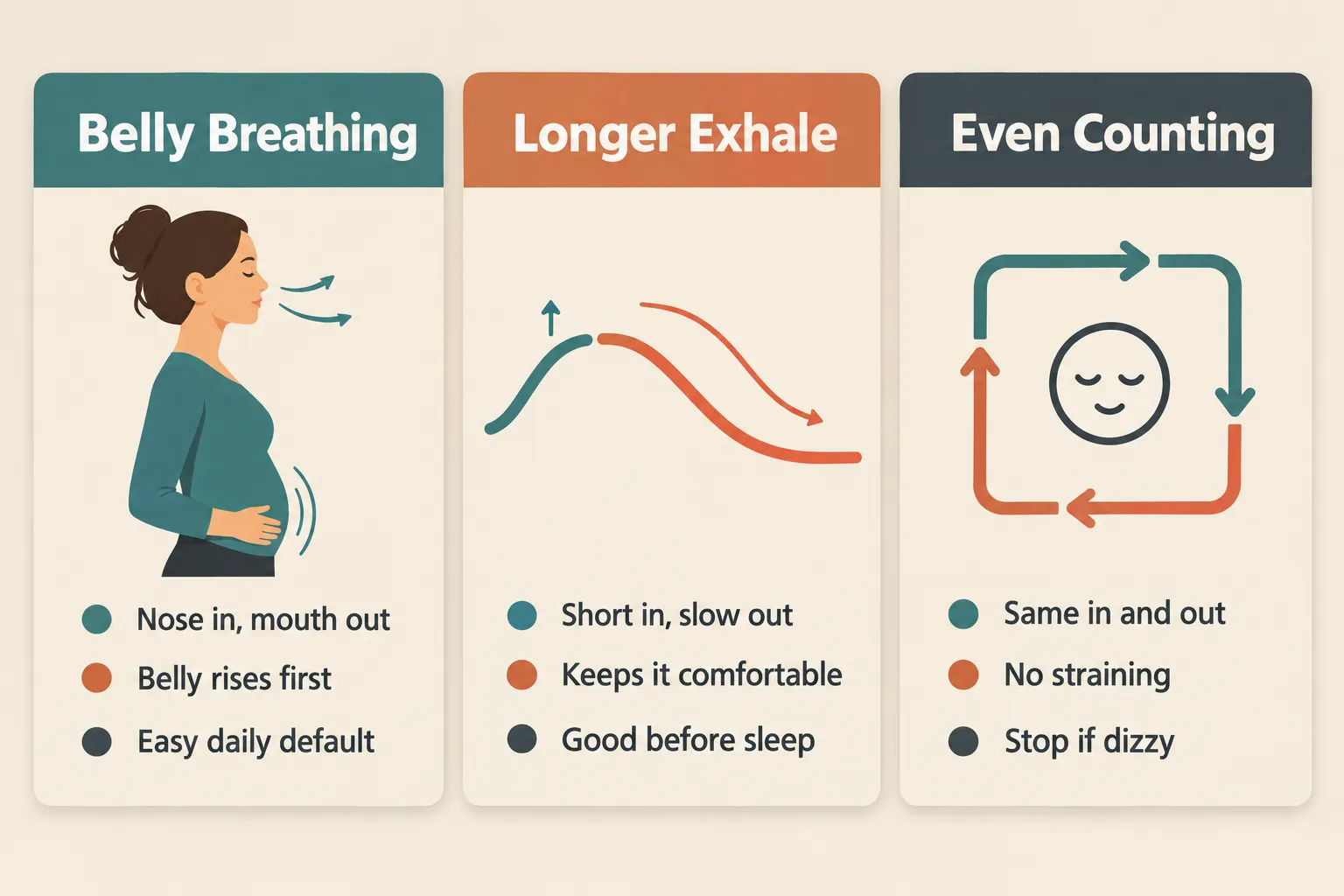
1. Belly breathing (diaphragmatic breathing). The default. Sit or lie comfortably. Place one hand on the chest and one on the abdomen. Breathe in gently through the nose so the lower hand rises more than the upper one, then let the air out slowly. The UK’s National Health Service suggests breathing gently down into the belly, counting from 1 to 5 on the way in and on the way out, for at least five minutes. Consumer clinical guides teach essentially the same method, often paired with a calming phrase or image.
2. Extended-exhale breathing. Same posture, but the exhale is deliberately a little longer than the inhale, for example, in for a count of four, out for a count of six. Reviews of breathing practices single out extended exhalation and slow diaphragmatic breathing as particularly useful for lowering physiological arousal and perceived stress.[2] This is the one most people find settling in the evening.
3. Even-count breathing. Equal inhale and exhale, often around a count of four each, producing roughly six breaths per minute. The American Heart Association includes structured patterns of this kind, including box breathing and pursed-lip slow exhalation, in its stress-management guidance, noting that slow, deep breaths can help stabilize or lower blood pressure. If a pattern includes breath holds and they feel at all uncomfortable, leave them out. There is no requirement to hold your breath to get the benefit.
A gentle 5-minute reset
Nothing rigid here. Think of it as a template to adjust.
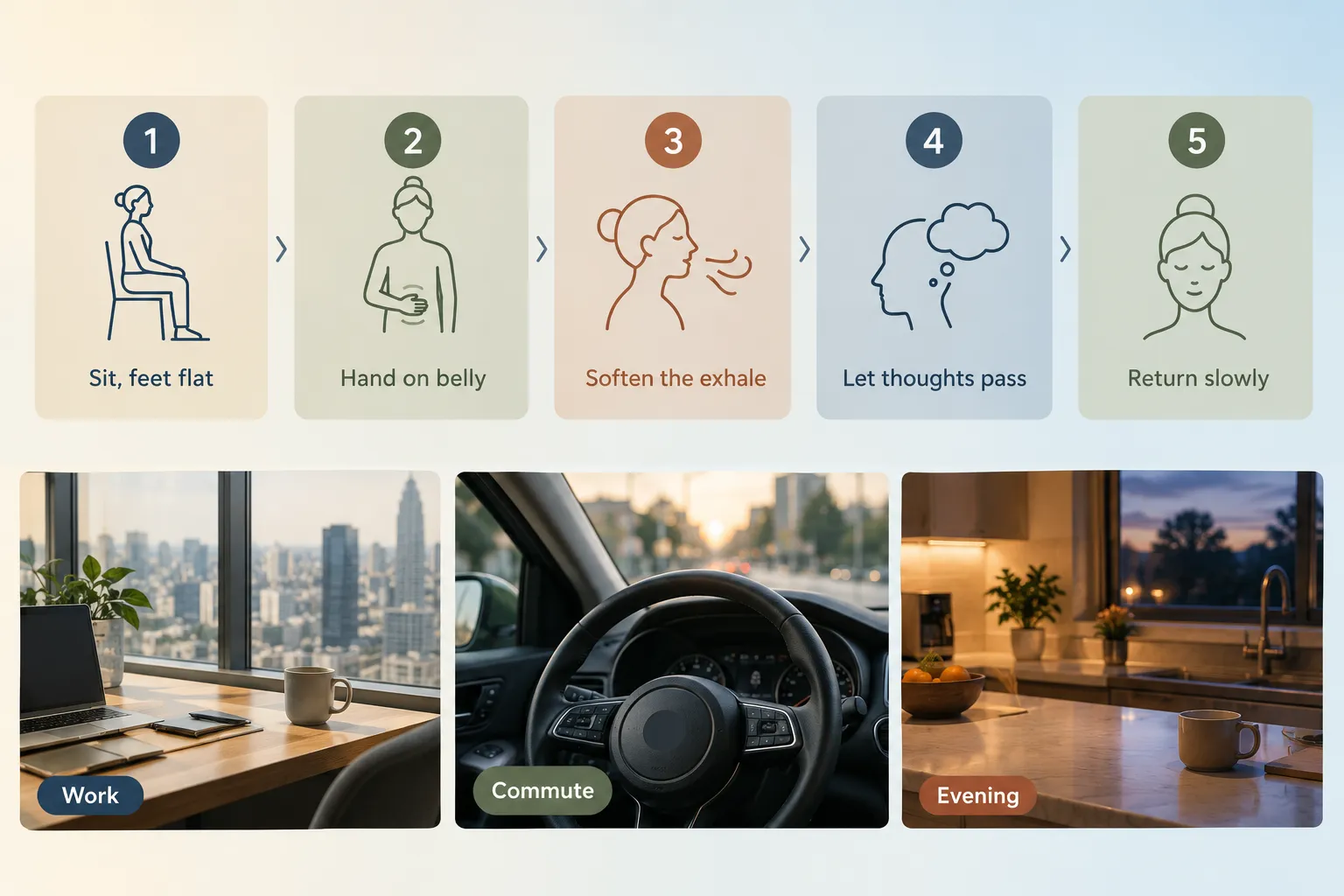
- Settle (about 30 seconds). Sit with both feet flat on the floor, hip-width apart, spine tall but not stiff. Let the shoulders drop. Rest one hand on the abdomen if that helps you notice the movement.
- Observe without changing (about 30 seconds). Simply notice the breath as it is. Fast, shallow, uneven, all fine. No correcting yet.
- Lengthen gently (about 2 minutes). Breathe in through the nose for a slow count of four, letting the belly rise. Breathe out for a count of five or six, through the nose or softly through the mouth. Keep it easy. If counting feels fussy, just make the exhale a little longer than the inhale.
- Let it even out (about 1.5 minutes). Stop counting. Keep the slow rhythm. When attention wanders, it will, bring it back to the sensation of air moving. Wandering is not failure; returning is the practice.
- Return (about 30 seconds). Let the breath go back to normal. Notice how the body feels before standing up.
Stop immediately if you feel dizzy, lightheaded, tingly, short of breath, or uneasy. Return to ordinary breathing and rest. That reaction usually means the breathing has become too deep or too fast, and the fix is to do less, not more. More is not always better.
Choosing a pattern that feels comfortable
A sensible starting point is the one you will actually repeat. Comfort is the deciding factor, not sophistication.
| Situation | Pattern worth trying | Why |
|---|---|---|
| Desk tension mid-afternoon | Belly breathing, 5 minutes | Discreet, no counting needed |
| Wound up before a difficult call | Even-count, 1-2 minutes | Structure gives the mind a job |
| Winding down in the evening | Extended exhale | Longer out-breath suits settling |
| Lying awake, mind racing | Extended exhale, no counting | Counting can become another task |
| New to this entirely | Belly breathing | Simplest, most forgiving |
Keep it simple and consistent. Two or three minutes most days will do more than a 30-minute session you dread and abandon by Thursday.
Building a breathing pause into a busy day
The hardest part of deep breathing for stress is never the technique. It is remembering at the moment it would help.
The most reliable approach is to attach the practice to something that already happens. Not a reminder app, an existing anchor.
- Before the car starts. Sixty seconds in the driver’s seat before turning the key, or after pulling into the driveway before going inside.
- The kettle or coffee machine. Two minutes of slow breathing while it runs. The timing takes care of itself.
- Between meetings or tasks. A deliberate pause before opening the next thing.
- Before the first bite of a meal. Three slow breaths. This one has a second benefit, since slowing down before eating also interrupts the automatic reach for food under pressure, covered in APH’s guide to mindful eating and breaking a stress eating cycle.
- Lights out. A few minutes of extended-exhale breathing once you are in bed, as part of a broader routine. Breathing is one input among several; the fundamentals are set out in APH’s guide to sleep hygiene for better sleep, health and longevity.
The clinical trial in cardiac surgery patients is instructive on scheduling. The benefit there came from short, repeated sessions, ten breaths every three hours over several days, rather than one long effort. That is a scheduling lesson, not a protocol to copy at home, but the principle travels well: frequency beats duration.
Start with what gives the biggest return. For most people that is one anchored minute a day that actually happens, not a perfect ten-minute session that does not.
Two practical notes. If slow breathing makes you feel more aware of your body in an unwelcome way, some people find close attention to breathing uncomfortable rather than calming, it is reasonable to stop and use a different approach. Walking, stretching, or simply stepping outside are legitimate alternatives. And if neck and shoulder tension is a regular part of your stress pattern, breathing may help a little but is unlikely to be the whole answer; APH’s piece on relief for tension and stress headaches covers the other contributing factors.
Low cost, low risk, easy to use anywhere, that combination is why the World Health Organization’s Eastern Mediterranean mental health platform includes slow, deep breathing among its core practical coping steps, including for people in high-stress and humanitarian settings.[5]
When breathing is not enough and when to seek help
I’d rather be accurate than impressive, so let’s call it what it is: a breathing exercise is a short-term regulator. It is not an answer to a chronic problem, and treating it as one can delay getting proper help.
Seek urgent medical attention for chest pain or pressure, severe or sudden shortness of breath, fainting, a severe sudden headache, weakness or numbness on one side, confusion, or any symptom that is severe, new, and unexplained. Do not sit and breathe through symptoms like these. In the United States, call 911. Breathing difficulty in particular deserves assessment, it can have causes that have nothing to do with stress.
Arrange a professional appointment if any of the following describe your situation:
- Stress, worry, or low mood persists most days for several weeks
- Sleep is disrupted most nights, or you wake unrefreshed over a sustained period
- Panic-like episodes occur, or you begin avoiding places and activities
- Everyday functioning at work, at home, or in relationships is slipping
- You are using alcohol or other substances more often to cope
- You have thoughts of harming yourself, in the US, call or text 988 for the Suicide and Crisis Lifeline
Check with your clinician first if you have a respiratory condition such as COPD or poorly controlled asthma, significant cardiovascular disease, a history of fainting with breathing exercises, uncontrolled high blood pressure, or if you are pregnant. In most cases gentle slow breathing is fine, but the sensible move is to ask rather than assume. The same applies if breathing practice triggers distressing memories or a trauma response, that calls for support from a qualified professional, not more practice.
The main takeaway is this: use slow breathing as a steadying tool, keep expectations proportionate, and let it sit alongside sleep, movement, sensible eating, and real human support. There is no magic in it. There is something genuinely useful in it, which is a better thing to have.
Frequently Asked Questions
How long before deep breathing for stress makes a difference? Some people feel more settled during a short practice; others notice little change. If it helps, the effect is usually immediate and temporary rather than a permanent shift.
Is a specific breathing pattern best?
No single pattern has clearly beaten the others in head-to-head research. Slow diaphragmatic breathing and extended exhalation are the two most consistently highlighted for reducing physiological arousal.[2] Comfort and consistency matter more than precision.
Should I breathe through the nose or the mouth?
Nasal breathing is the usual recommendation for the inhale, and is what most reviews describe.[4] Exhaling through the nose or gently through pursed lips are both fine; the American Heart Association includes pursed-lip slow exhalation among its suggested patterns. Use whichever stays comfortable.
Can deep breathing replace medication or therapy?
No. Nothing in the current evidence supports that, and no responsible source makes that claim. Breathing exercises are described as a low-risk complementary practice to be used alongside other approaches. Never change prescribed treatment without speaking to the prescribing clinician.
Why do I feel lightheaded when I try it?
Usually because the breathing has become deeper or faster than intended, which alters carbon dioxide levels. Stop, let your breathing return to normal, rest, and try again later with smaller, gentler breaths. If it keeps happening, speak to a healthcare professional.
Does it help with sleep? A gentle breathing pause may be a useful wind-down habit for some people, but it is not a proven stand-alone treatment for insomnia. Pair it with a broader sleep routine and seek help if sleep problems persist.
Conclusion
Deep breathing for stress is a modest, well-tolerated, genuinely useful tool, and the honesty about its limits is what makes it worth trusting. The randomized evidence points to small-to-medium reductions in self-reported stress,[1][3] with physiological changes that line up with what people report feeling.[4] That is a real finding. It is not a transformation, and it was never going to be.
Three next steps, in order of return:
- Pick one anchor this week. The kettle, the car, the moment before bed. One place where five minutes of slow belly breathing will reliably fit.
- Run the gentle 5-minute reset once a day for two weeks. Keep the exhale a little longer than the inhale. Stop if anything feels uncomfortable.
- Look at the bigger picture. If stress is persistent rather than occasional, breathing alone is the wrong lever. Sleep, movement, workload, and professional support do the heavier work.
Clear beats clever. Start small, stay consistent, and keep the expectations honest.
References
- A systematic review of breathing-exercise interventions for anxiety and stress in adults.
- Breathing practices for stress and anxiety reduction: systematic-review-informed implementation guidance.
- Prāṇāyāma for mental disorders: systematic review and meta-analysis of randomized trials.
- A narrative review of breathwork for mental health and stress resilience.
- World Health Organization: dealing with stress.
Medical Disclaimer
This article is for general information and education only. It is not medical advice, and it is not a diagnosis or treatment plan for anxiety, panic, insomnia, trauma, depression, or any other condition. Individual circumstances vary. Always consult a qualified healthcare professional before starting a new practice, particularly if you have a heart or lung condition, are pregnant, or are currently receiving treatment. Never delay seeking urgent care, and never change prescribed treatment, on the basis of information read online.

About the author
Dave James is the founder of All Perfect Health. He writes practical, evidence-aware health guides that separate useful habits from exaggerated claims.