
Mindful Eating: Breaking the Stress-Eating Cycle for Good

- What Is Mindful Eating, and How Does It Actually Work?
- Why Does Stress Make You Reach for Junk Food?
- How Do You Know If You’re Stress Eating (vs. Genuinely Hungry)?
- What Are the Proven Benefits of Mindful Eating?
- How Do You Actually Practice Mindful Eating? (Step-by-Step)
- What Foods Support Mindful Eating and Stress Reduction?
- How Does Stress Management Complement Mindful Eating?
- What Are the Most Common Mistakes People Make When Trying Mindful Eating?
- When Should You Seek Professional Help for Stress Eating?
Last updated: April 9, 2026
Quick Answer: Mindful eating breaks the stress-eating cycle by training you to pause before eating, identify whether hunger is physical or emotional, and respond to your body’s actual needs rather than reacting to stress hormones. It works best when combined with practical stress management techniques. Most people begin noticing changes in their eating patterns within two to four weeks of consistent practice.
Key Takeaways
- Stress triggers cortisol release, which amplifies cravings for high-fat, high-sugar foods — this is a biological response, not a willpower failure
- Mindful eating means paying deliberate attention to what, when, why, and how much you eat — not following a restrictive diet
- Research published in journals including Appetite and Obesity Reviews links mindful eating interventions to meaningful reductions in binge eating and emotional eating episodes
- The hunger scale (rating hunger from 1–10 before and during meals) is one of the most practical tools for interrupting automatic stress eating
- Eating slowly — aiming for 20 minutes per meal — gives your brain time to register fullness signals from the gut
- Stress management and mindful eating work together; addressing only one side of the equation produces weaker results
- Common mistakes include skipping meals (which worsens cravings under stress) and labeling foods as “good” or “bad” (which increases guilt-driven eating)
- Small, consistent habit changes outperform dramatic overhauls — starting with one mindful meal per day is enough to build momentum
- Emotional resilience skills — including journaling, breathwork, and social support — reduce the frequency of stress-eating triggers over time
- If stress eating is severe or tied to trauma, working with a therapist or registered dietitian who specializes in eating behaviors is the most effective path
What Is Mindful Eating, and How Does It Actually Work?
Mindful eating is the practice of bringing full, non-judgmental attention to the experience of eating — including the sensations, emotions, and thoughts that arise before, during, and after a meal. It is not a diet. It has no forbidden foods and no calorie targets.
The core mechanism is awareness. When you slow down and pay attention, you create a gap between a craving and the automatic act of eating. That gap is where choice lives. Over time, that gap gets wider and easier to use.
Mindful eating draws from mindfulness-based cognitive therapy (MBCT) and the work of researchers like Dr. Jan Chozen Bays, whose clinical work at Oregon Health & Science University helped define the practice for modern healthcare settings. The approach asks you to engage multiple dimensions of eating:
- Physical hunger: Is your stomach empty? When did you last eat?
- Sensory experience: What does the food smell, look, and taste like?
- Emotional state: Are you eating because you’re bored, anxious, lonely, or genuinely hungry?
- Satiety signals: Are you still enjoying the food, or are you eating out of habit?
- Food origin: Where did this food come from, and how does it nourish your body?
Mindful eating is appropriate for most adults who struggle with emotional eating, overeating, or a chaotic relationship with food. It is not a substitute for medical treatment of clinical eating disorders like anorexia or bulimia — those require specialized clinical care.
Why Does Stress Make You Reach for Junk Food?
Stress eating is not a character flaw. It is a predictable physiological response rooted in how the human stress system evolved.
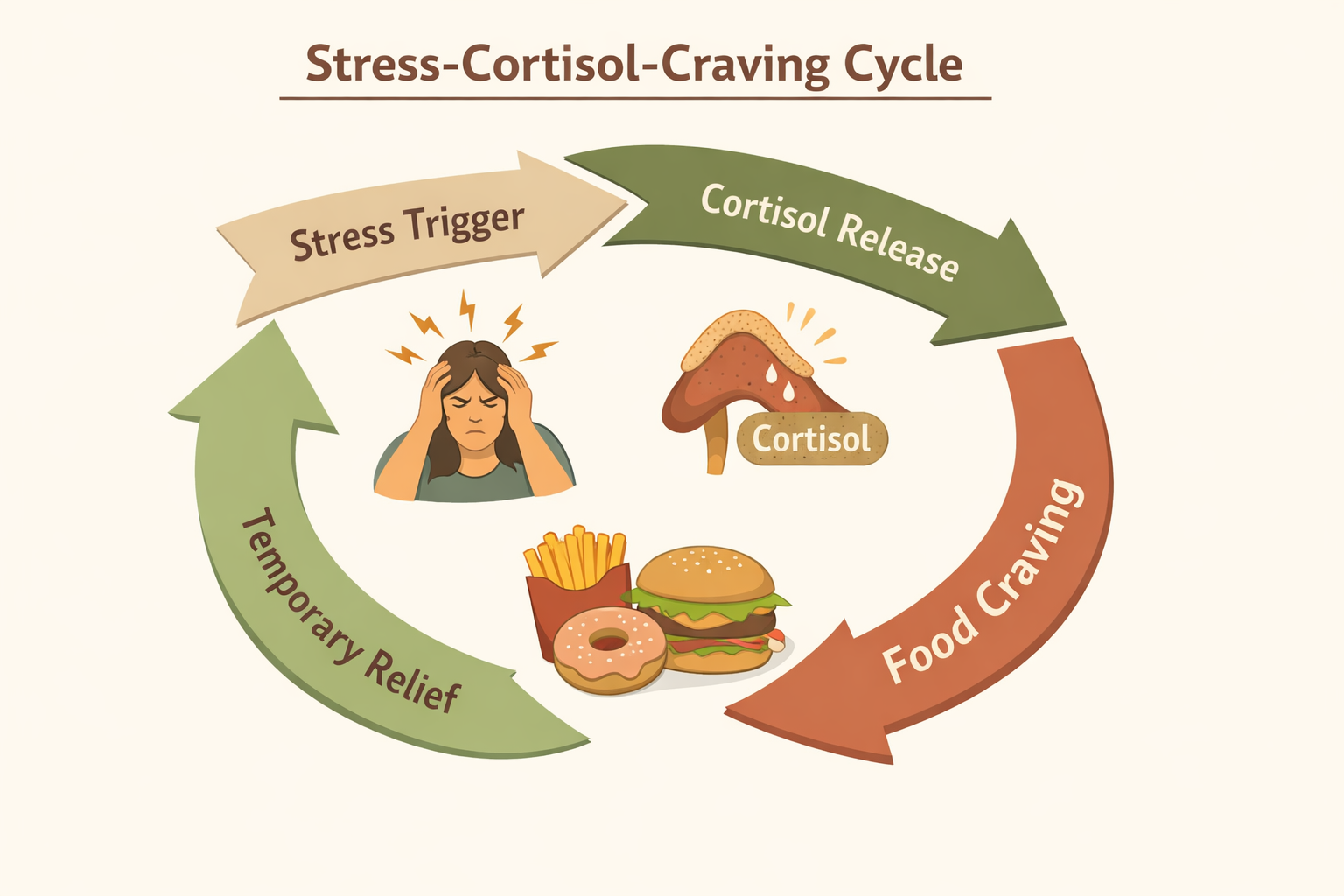
When your brain perceives a threat — whether that’s a work deadline, a difficult conversation, or financial pressure — it activates the hypothalamic-pituitary-adrenal (HPA) axis. This triggers the release of cortisol, your primary stress hormone. Cortisol does several things that directly affect eating behavior:
- It increases appetite, particularly for calorie-dense foods
- It raises blood sugar temporarily, then causes a drop that intensifies cravings
- It suppresses the prefrontal cortex (the brain region responsible for rational decision-making), making impulsive food choices more likely
- It activates the brain’s reward system, making the dopamine hit from sugar or fat feel more compelling than usual
This made evolutionary sense when stress meant physical danger requiring immediate energy. Today, most stress is psychological — and the cortisol response still fires the same way, pushing you toward the nearest bag of chips.
Chronic stress compounds this further. Persistently elevated cortisol disrupts leptin and ghrelin, the hormones that regulate hunger and fullness. Over time, you may feel hungry even when you’ve eaten enough, or feel full but still want to keep eating.
Research estimates that roughly 40% of people increase their food intake under stress, while around 40% eat less and 20% show little change — with women and individuals with higher baseline anxiety more likely to fall into the stress-eating group. These figures come from multiple survey-based studies reviewed in Physiology & Behavior (Greeno & Wing, 1994, and subsequent replications).
The key insight: stress eating is a learned coping mechanism layered on top of a biological drive. You can interrupt the learned behavior without fighting the biology.
How Do You Know If You’re Stress Eating (vs. Genuinely Hungry)?
The clearest way to distinguish stress hunger from physical hunger is to check four signals before you eat.
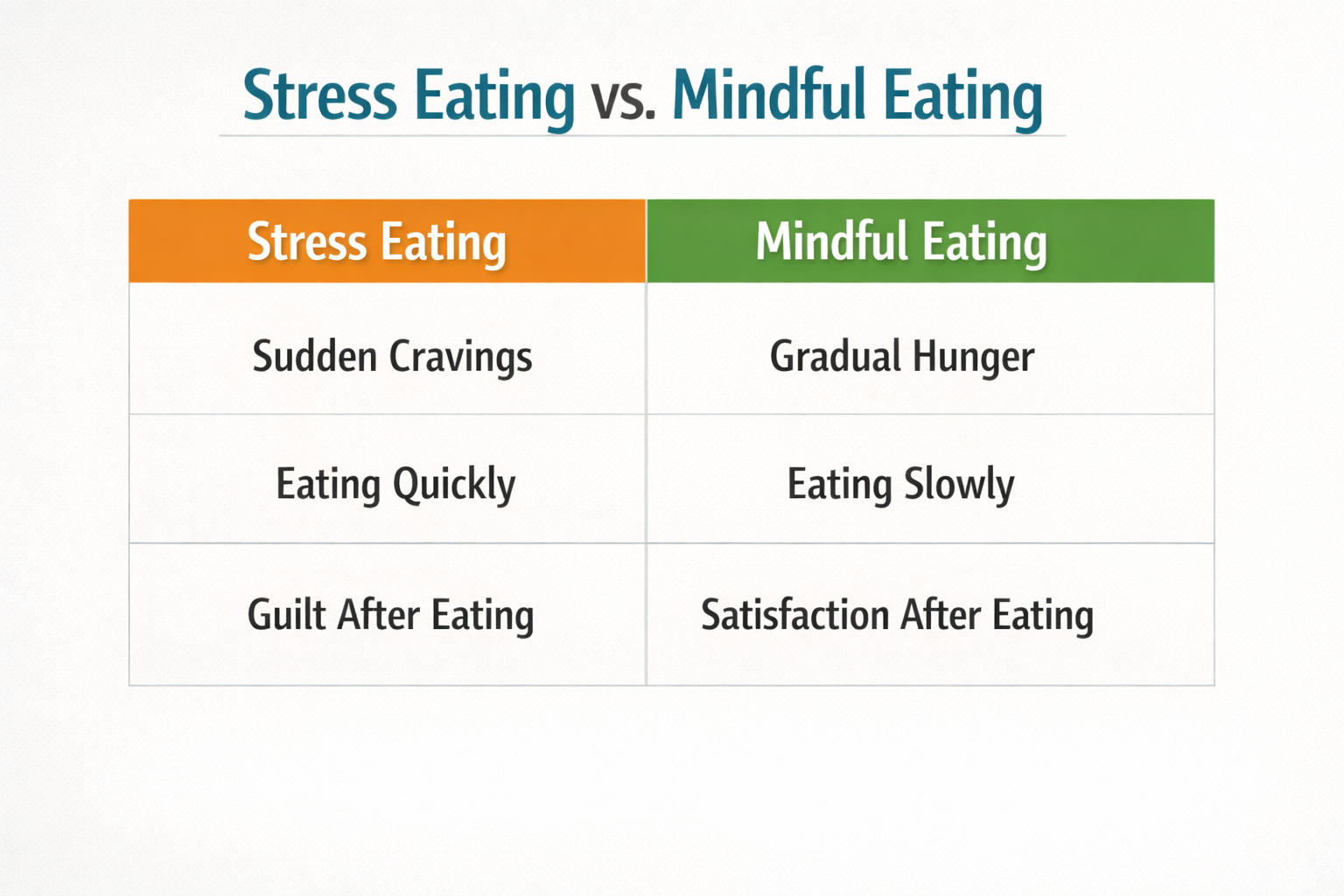
Physical hunger:
- Builds gradually over one to four hours after your last meal
- Can be satisfied by a range of foods, not just specific cravings
- Comes with physical sensations: stomach growling, slight lightheadedness, low energy
- Goes away once you’ve eaten a reasonable amount
- Does not typically come with guilt after eating
Stress or emotional hunger:
- Arrives suddenly, often triggered by a specific event, feeling, or environment
- Fixates on a specific food (usually high in sugar, fat, or salt)
- Persists even after eating — you may feel full but still want more
- Is often accompanied by guilt, shame, or numbness during or after eating
- Frequently occurs in the absence of physical hunger signals
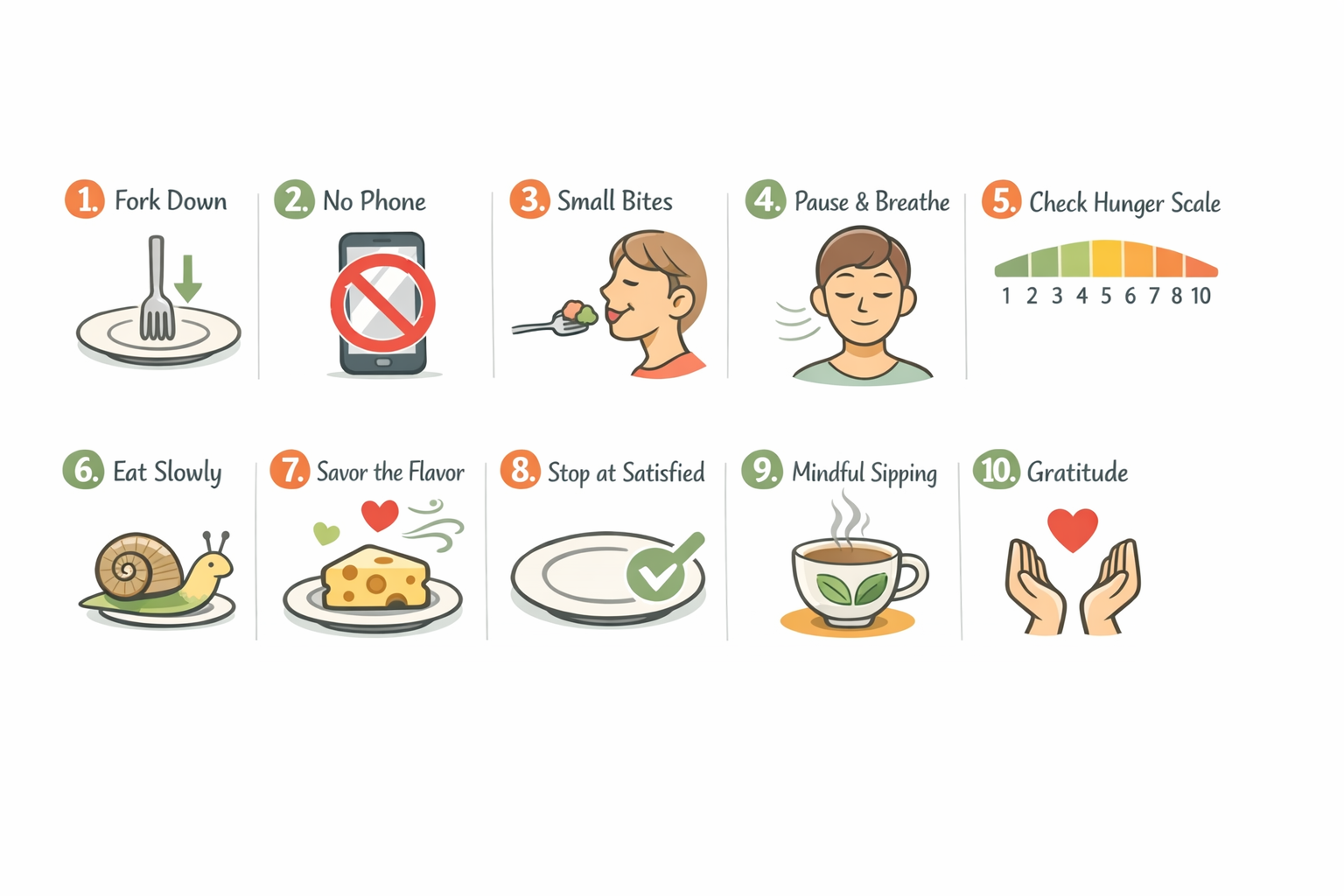
A practical tool is the hunger scale: before eating, rate your hunger from 1 (ravenous, lightheaded) to 10 (uncomfortably stuffed), with 5 being neutral. Ideally, you eat when you’re around a 3–4 and stop around 6–7. If you’re at a 6 or above and still want to eat, that’s a signal worth pausing on.
Common mistake: Many people skip meals when stressed, which pushes their hunger score to a 1 or 2 by the time they do eat — making mindful eating nearly impossible because the body is in emergency mode. Eating regular meals is a prerequisite for mindful eating to work.
What Are the Proven Benefits of Mindful Eating?
Mindful eating has a growing evidence base, particularly for emotional and binge eating. Here’s what the research actually supports:
Reduced binge eating and emotional eating. A 2014 meta-analysis published in Clinical Psychology Review (Katterman et al.) reviewed 14 studies and found that mindfulness-based interventions significantly reduced binge eating and emotional eating compared to control conditions.
Improved weight management over time. A review in Obesity Reviews (Olson & Emery, 2015) found that mindful eating, when combined with nutrition education, produced modest but meaningful weight loss that was more sustainable than restriction-based approaches alone. Mindful eating is not a rapid weight loss strategy — it’s a long-term behavioral shift.
Better blood sugar regulation. A study at UC San Francisco (Daubenmier et al., 2011) found that mindful eating practices reduced cortisol levels and improved insulin resistance in overweight adults, independent of significant weight change.
Reduced anxiety around food. Mindful eating consistently improves what researchers call “food-related anxiety” — the guilt, shame, and preoccupation with eating that many chronic stress eaters experience.
Improved digestion. Eating slowly and chewing thoroughly reduces the digestive load on the stomach. This is particularly relevant for people who experience bloating, acid reflux, or discomfort after meals — issues often worsened by eating quickly under stress. For more on digestive support, see our guide to natural ways to soothe your stomach.
What mindful eating does not do: It is not a cure for clinical eating disorders, and it does not replace medical nutrition therapy for conditions like diabetes or inflammatory bowel disease.
How Do You Actually Practice Mindful Eating? (Step-by-Step)
Mindful eating is a skill, not a mindset you either have or don’t. It develops through repetition. Start with one meal per day — breakfast tends to be the easiest because it’s less social and more routine.
Before You Eat
- Pause for 60 seconds. Before opening the fridge or unwrapping anything, stop. Ask: “Am I physically hungry right now? What am I feeling?”
- Rate your hunger. Use the 1–10 scale. If you’re above a 5, identify what emotion or situation is driving the urge to eat.
- Choose your environment. Sit down. Remove screens if possible. Eating at a desk while reading emails is one of the most reliable ways to overeat without noticing.
During the Meal
- Take smaller bites and put your utensil down between them. This single habit alone slows eating pace significantly.
- Chew each bite 15–20 times. This sounds excessive until you try it and realize how little most people chew.
- Notice the food actively. What does it smell like? How does the texture change as you chew? What flavors emerge? This isn’t precious — it’s functional. Sensory engagement slows eating and increases satisfaction.
- Check in halfway through. Rate your hunger/fullness again. Are you eating because the food is still enjoyable, or because it’s there?
- Eat without multitasking. If you must eat at your desk, at minimum close email and put your phone face-down.
After You Eat
- Wait 10 minutes before going back for more. Satiety signals from the gut take roughly 15–20 minutes to reach the brain. What feels like “not enough” at the end of a meal often resolves on its own.
- Notice how you feel — without judgment. Did you feel satisfied? Overly full? Still emotionally unsettled? This information helps you recognize patterns over time.
Edge case: Mindful eating is harder in social settings where eating pace is set by others, food is abundant, and emotional dynamics are present (family dinners, work events). In these situations, focus on just one practice — such as putting your fork down between bites — rather than trying to apply the full approach.
What Foods Support Mindful Eating and Stress Reduction?
Mindful eating works with any food, but certain nutritional patterns make the stress-eating cycle easier to interrupt by stabilizing blood sugar and supporting stress hormone regulation.
Prioritize these:
- High-fiber foods — oats, legumes, vegetables, and whole grains slow glucose absorption, preventing the blood sugar spikes and crashes that intensify cravings. See our complete guide to high-fiber foods for practical options.
- Lean protein at each meal — protein increases satiety hormones (GLP-1, peptide YY) and reduces ghrelin, the hunger hormone. Eggs, legumes, Greek yogurt, fish, and chicken are practical choices. Our high-protein diet guide covers this in depth.
- Anti-inflammatory foods — chronic stress promotes systemic inflammation, and dietary choices can either worsen or buffer this. Fatty fish, berries, leafy greens, and olive oil are among the most well-studied options. For a full breakdown, see our anti-inflammatory foods guide.
- Healthy fats — avocados, nuts, seeds, and olive oil support satiety and brain function. The health benefits of olive oil include anti-inflammatory effects relevant to stress-related eating patterns.
- Magnesium-rich foods — dark leafy greens, pumpkin seeds, and dark chocolate contain magnesium, which plays a role in cortisol regulation and sleep quality.
Limit these (especially under stress):
- Ultra-processed foods high in refined sugar and industrial seed oils — these worsen blood sugar instability and can amplify the cortisol-craving loop
- Alcohol — commonly used as a stress reliever, but it disrupts sleep, raises cortisol the following day, and reduces the prefrontal control needed for mindful eating
- Caffeine in excess — particularly on an empty stomach, caffeine elevates cortisol and can trigger anxiety-driven eating
The practical rule: You don’t need a perfect diet to practice mindful eating. But eating regular, balanced meals makes mindful eating dramatically easier because you’re not fighting extreme hunger or blood sugar crashes on top of stress.
How Does Stress Management Complement Mindful Eating?
Mindful eating addresses how you respond to stress at the table. Stress management reduces how much stress reaches the table in the first place. Both are necessary.
If you only practice mindful eating without addressing chronic stress, you’re constantly working against a biological tide. Cortisol will keep firing, cravings will keep intensifying, and the effort required to pause and make conscious choices will remain high.
Effective stress management strategies with strong evidence behind them include:
Breathwork and meditation. Slow diaphragmatic breathing (inhale for 4 counts, hold for 4, exhale for 6–8) activates the parasympathetic nervous system within minutes, reducing cortisol acutely. Regular meditation practice — even 10 minutes daily — has been shown to lower baseline cortisol over time. Our exercise guide for better health includes breathing techniques alongside movement recommendations.
Regular physical activity. Exercise is one of the most reliable cortisol regulators available. It also improves insulin sensitivity, supports sleep, and releases endorphins that reduce emotional eating urges. Even a 20-minute walk has measurable effects on mood and stress hormone levels.
Sleep (7–9 hours for most adults). Sleep deprivation raises cortisol, increases ghrelin (hunger hormone), and reduces leptin (fullness hormone) — a perfect storm for stress eating. Prioritizing sleep is not optional if you’re serious about breaking the cycle.
Social connection. Talking through stress with a trusted person activates oxytocin, which directly counteracts cortisol. Isolation, conversely, amplifies stress eating.
Journaling. Writing about stressful events — specifically processing the emotions rather than just describing events — has been shown in multiple studies to reduce emotional eating frequency. Even five minutes of expressive writing after a stressful day can interrupt the urge to eat in response to emotions.
Choose X if: You’re primarily stress eating in the evenings after work — focus first on a structured wind-down routine (walk, breathwork, brief journaling) before entering the kitchen. This addresses the trigger before it reaches the food environment.
What Are the Most Common Mistakes People Make When Trying Mindful Eating?
Treating it as another diet rule. Mindful eating has no rules about what to eat. If you approach it with a “pass/fail” mindset, you’ll create the same guilt cycle you’re trying to escape. It’s an observational practice, not a compliance exercise.
Trying to be mindful at every meal immediately. This is unsustainable and sets you up for discouragement. Start with one meal or one snack per day. Build from there.
Ignoring the stress side of the equation. Mindful eating alone is harder to sustain if you’re under extreme, unmanaged stress. The two practices need to work together.
Eating while standing, in the car, or over the sink. Environment matters more than most people expect. Eating in non-eating spaces trains your brain to eat mindlessly in those spaces. Create a consistent eating environment — even a simple, clear spot at a table.
Skipping meals to “compensate” after stress eating. Restriction after overeating increases the likelihood of the next stress-eating episode. Eat your next regular meal as planned.
Expecting linear progress. Stress eating patterns built over years don’t dissolve in a week. Setbacks are part of the process. The goal is a gradually improving average, not perfection.
When Should You Seek Professional Help for Stress Eating?
Mindful eating and self-directed stress management are effective for most people with moderate stress eating. But there are situations where professional support is the right first step.
Consider working with a registered dietitian (RD) or therapist if:
- Stress eating is happening daily and feels completely out of your control
- You regularly eat until you’re physically uncomfortable or in pain
- You experience significant guilt, shame, or self-loathing after eating episodes
- Eating is connected to a history of trauma, disordered eating, or body image distress
- You’ve tried multiple self-directed approaches without meaningful change over several months
- Stress eating is affecting your physical health (blood sugar, weight, digestive issues)
A therapist trained in Cognitive Behavioral Therapy (CBT) or Dialectical Behavior Therapy (DBT) can address the emotional regulation skills underlying stress eating. A registered dietitian can provide personalized nutrition guidance alongside behavioral strategies. These two professionals working together produce the strongest outcomes for complex cases.
Frequently Asked Questions
What is the difference between mindful eating and intuitive eating?
Mindful eating focuses specifically on the act of eating — paying attention to sensory experience, hunger cues, and emotional triggers during meals. Intuitive eating is a broader framework developed by dietitians Evelyn Tribole and Elyse Resch that includes 10 principles covering body respect, movement, and rejecting diet culture. Mindful eating is often considered a component of intuitive eating.
How long does it take to break the stress-eating cycle?
Most people notice meaningful changes in their awareness and eating patterns within two to four weeks of consistent mindful eating practice. Breaking deeply ingrained stress-eating habits typically takes three to six months of combined mindful eating and stress management work. Progress is rarely linear.
Can mindful eating help with weight loss?
It can, but it’s not a direct weight loss tool. By reducing overeating, binge eating, and emotional eating, mindful eating often leads to gradual, sustainable weight changes over time. It works best alongside a balanced diet rather than as a standalone approach. See our healthy meals for weight loss guide for practical meal ideas.
Is mindful eating suitable for people with diabetes?
Yes, and it may be particularly useful because it supports better blood sugar regulation through slower eating, reduced overeating, and more consistent meal timing. However, people with diabetes should work with their healthcare provider or a registered dietitian to integrate mindful eating with their specific medical nutrition plan.
What if I don’t have time to eat slowly at every meal?
You don’t need every meal to be a 20-minute mindful experience. Even applying one or two practices — rating your hunger before eating, or putting your fork down between bites — during a quick lunch provides benefit. Consistency across imperfect conditions beats occasional perfection.
Does mindful eating work for children?
Yes. Teaching children to recognize hunger and fullness signals, eat without screens, and describe what their food tastes like are age-appropriate mindful eating practices. Research suggests these habits, established early, reduce the likelihood of emotional eating in adolescence and adulthood.
What should I do immediately after a stress-eating episode?
Don’t restrict your next meal. Drink water, take a short walk if possible, and spend five minutes writing about what triggered the episode — not to judge yourself, but to identify the pattern. Self-compassion after setbacks is associated with better long-term outcomes than self-criticism.
Can mindful eating help with gut health?
Eating slowly and chewing thoroughly directly improves digestion by reducing the burden on the stomach and supporting enzyme activity. Stress also disrupts the gut microbiome through the gut-brain axis, so reducing stress eating can have downstream benefits for gut health. For more on this connection, see our gut health and digestive wellness guide.
What’s the single most effective mindful eating habit to start with?
Pause for 60 seconds before eating and rate your hunger on a scale of 1–10. This one habit interrupts the automatic eating response and builds the foundational awareness that all other mindful eating practices depend on.
Is mindful eating the same as eating healthy?
No. Mindful eating is about how you eat, not what you eat. You can eat a donut mindfully or eat a salad mindlessly. The goal is awareness and intentionality, which over time tends to naturally shift food choices — but it doesn’t require eating “perfectly” to work.
Sources
The Ultimate Seasonal Eating Guide: Nourish Your Body Naturally Year-Round
- Katterman, S. N., Kleinman, B. M., Hood, M. M., Nackers, L. M., & Corsica, J. A. (2014). Mindfulness meditation as an intervention for binge eating, emotional eating, and weight loss: A systematic review. Eating Behaviors, 15(2), 197–204. https://pubmed.ncbi.nlm.nih.gov/24854804/
- Olson, K. L., & Emery, C. F. (2015). Mindfulness and weight loss: A systematic review. Psychosomatic Medicine, 77(1), 59–67. https://pubmed.ncbi.nlm.nih.gov/25490697/
- Daubenmier, J., Kristeller, J., Hecht, F. M., Maninger, N., Kuwata, M., Jhaveri, K., Lustig, R. H., Kemeny, M., Karan, L., & Epel, E. (2011). Mindfulness intervention for stress eating to reduce cortisol and abdominal fat among overweight and obese women: An exploratory randomized controlled study. Journal of Obesity, 2011, Article 651936. https://pubmed.ncbi.nlm.nih.gov/21977314/
- Greeno, C. G., & Wing, R. R. (1994). Stress-induced eating. Psychological Bulletin, 115(3), 444–464. https://pubmed.ncbi.nlm.nih.gov/8016287/
- Tribole, E., & Resch, E. (2020). Intuitive Eating: A Revolutionary Anti-Diet Approach (4th ed.). St. Martin’s Essentials. https://us.macmillan.com/books/9781250255198/intuitiveeating4thedition/