
The Complete Home Sauna Guide: Types, Costs, Safety and How to Choose

Last updated: September 27, 2026
Most home sauna mistakes happen before the first session. People compare heat claims and glossy timber photos, then miss the boring details that decide whether the sauna gets used: space, electrical load, ventilation, running cost and safety.
This guide keeps the decision practical. You’ll see which sauna type fits your home, what the real costs look like, where the health evidence is strongest, and when heat therapy deserves caution rather than hype.
Quick Answer: Is a Home Sauna Worth It?
A home sauna is worth the investment for people who will use it consistently, have adequate space, and can absorb the upfront cost. The evidence suggests regular sauna use is associated with meaningful cardiovascular and stress-related benefits, but the financial case depends entirely on your usage habits, installation conditions, and how much you value private, on-demand access to heat therapy. For most buyers, the honest answer is: it depends on the conditions.
Key Takeaways
- Home-sauna purchase and installation costs vary substantially by model, location, electrical work and local requirements. Verify current figures against the exact model and a qualified-installation quote rather than relying on a generic range.
- Infrared and traditional cabins have different heating methods and installation requirements. Popularity claims and product-market statistics do not establish a health advantage.
- The strongest health evidence comes from long-term observational studies linking frequent sauna use (4-7 times per week) to reduced cardiovascular risk, not from short-term trials [6][9]
- Sauna use does not “detox” the body or guarantee fat loss; these are marketing claims, not established science
- Electrical requirements depend on the exact model, market and installation. Check the current manufacturer manual and use a qualified installer where required; do not assume a standard outlet or circuit is suitable.
- Key safety considerations include dehydration, overheating, alcohol use, pregnancy, and specific cardiovascular conditions
- Outdoor barrel saunas and indoor pre-built cabins are both viable options; the right choice depends on space, budget, and climate
- A poorly planned installation can be a liability rather than an asset; professional electrical work and proper ventilation are non-negotiable
Table of Contents
- What Is a Home Sauna?
- Home Sauna Types Compared
- How Much Does a Home Sauna Cost?
- Home Sauna Size, Capacity and Materials
- Home Sauna Benefits: What the Evidence Actually Shows
- Infrared vs Traditional Sauna: Which Is Better?
- Home Sauna Safety and Who Should Be Cautious
- How to Choose the Right Home Sauna
- FAQ: Home Sauna Questions Answered
- References
What Is a Home Sauna?
A home sauna is a private, enclosed heat therapy space installed in or around a residence, designed to raise the body’s core temperature through dry heat, infrared radiation, or steam. Unlike commercial or public saunas, a home sauna gives you on-demand access without shared facilities, membership fees, or travel time.
The basic principle is straightforward: you sit in a heated enclosure, your body temperature rises, you sweat, your heart rate increases, and your body works to regulate its temperature. What varies considerably is how that heat is generated, at what temperature, and with what humidity level, and those differences matter both for the experience and for the evidence behind the claimed benefits.
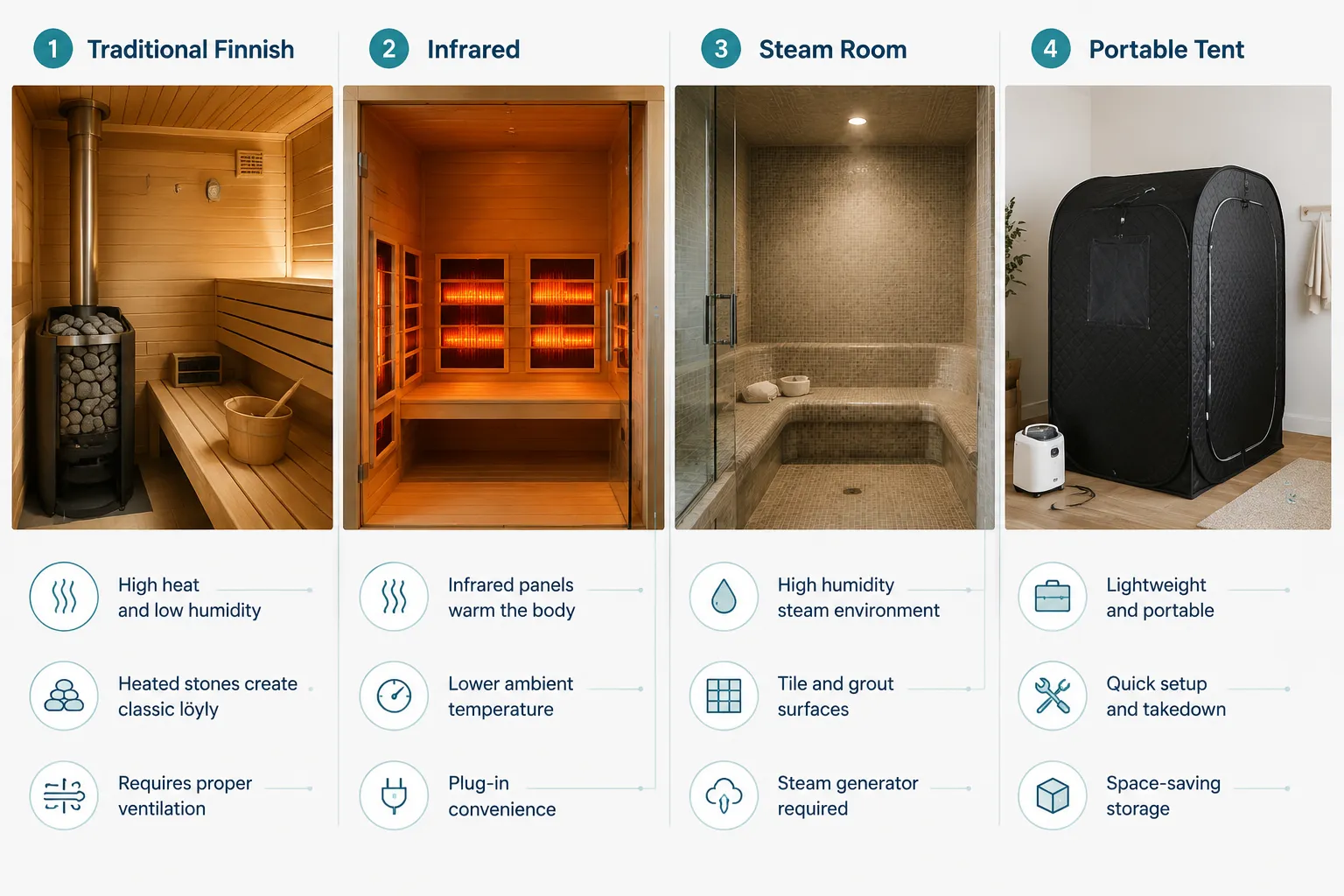
Product note: this pillar is not a ranked product roundup. Use it to choose the right category of home sauna first: indoor sauna, outdoor sauna, infrared sauna, traditional dry sauna, steam sauna, or portable sauna tent. Individual product reviews can sit underneath this page as child articles once the cluster is built.
Home Sauna Types Compared: Traditional, Infrared, Steam and Portable
Choosing the right type is the single most important decision you will make. Each type has a different heat source, temperature range, installation requirement, and user experience. Let’s keep this practical.
Traditional Finnish and Dry Saunas
Traditional Finnish saunas use an electric or wood-burning heater to warm a pile of sauna stones, which then radiate heat into the room. Air temperatures typically range from 70°C to 100°C (160°F to 212°F), with low humidity unless you pour water over the stones (a practice called “löyly”), which creates a brief burst of steam.
This is the oldest and most studied sauna type. The long-term Finnish cohort studies that form the backbone of sauna health research were conducted using traditional Finnish saunas [6][9]. If you want the closest match to the research evidence, this is it.
Key considerations:
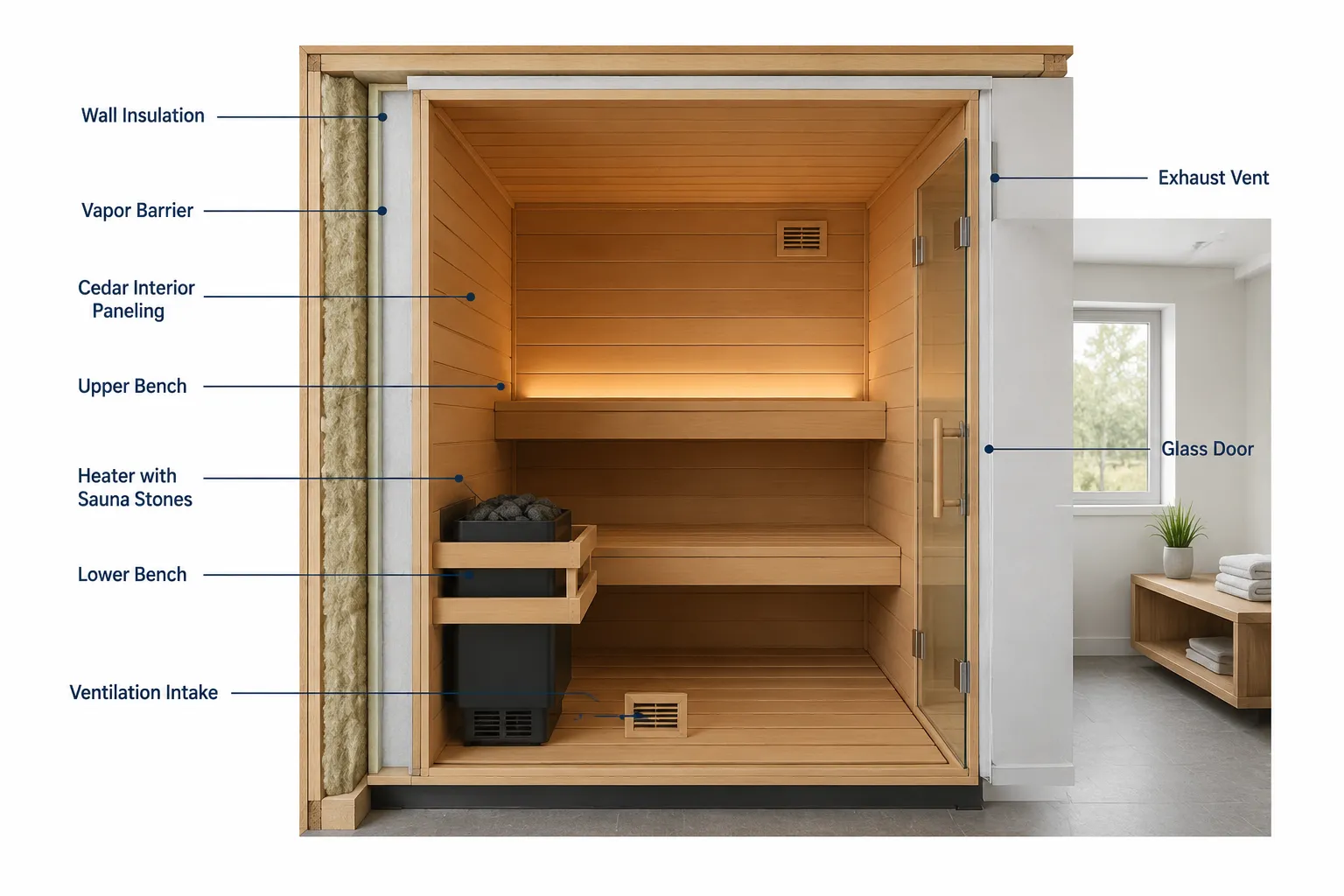
- Requires proper room construction with insulation, vapor barrier, and ventilation
- Electric requirements vary by exact heater, market and installation. Use the current manufacturer manual and a qualified electrician where required.
- Wood-burning options are possible outdoors but require local fire and building code clearance
- Preheat time varies by room size, heater, insulation and the exact equipment
Infrared Saunas
Infrared saunas use infrared heating panels (near, mid, or far infrared) to warm the body directly rather than heating the surrounding air. Operating temperatures are lower, typically 45°C to 65°C (113°F to 149°F), which many users find more comfortable for longer sessions.
On EMF claims: Some infrared sauna manufacturers market “low EMF” or “ultra-low EMF” as a premium feature. The real issue here is that the evidence for harm from the low-level EMF produced by infrared panels at normal use distances is not established. It is a marketing differentiator more than a proven safety concern, but if it matters to you, look for third-party tested units with published EMF readings.
Key considerations:
- Some models may be designed for a standard outlet while others require different supply arrangements; verify the exact model manual before purchase or installation
- Preheat time varies by model and room conditions
- Lower temperatures may suit people who find traditional saunas too intense
- Full-spectrum infrared units (near, mid, and far) are premium options with higher price points [10]
Steam Rooms and Steam Showers
Steam rooms use a steam generator to fill an enclosed, tiled space with moist heat, typically at 40°C to 50°C (104°F to 122°F) but with near 100% humidity. The experience is quite different from a dry sauna: the air feels heavier, breathing is more labored, and the perceived heat is intense despite lower air temperatures.
Steam rooms suit people who specifically prefer humid heat, but they need proper waterproofing, drainage and a steam generator. They are not a like-for-like substitute for a dry sauna.
Portable Sauna Tents
Portable sauna tents are collapsible fabric enclosures that use a small steam generator or infrared panels to create heat. They fold away for storage and typically cost US$200-US$600.
Treat portable tents as a low-commitment trial, not a permanent substitute for a proper home sauna.
Indoor vs Outdoor Home Saunas
Indoor saunas (pre-built cabin kits or custom-built rooms) offer year-round convenience and no weather exposure. Their space, ventilation and electrical requirements depend on the exact system, room and applicable local requirements.
Home Sauna Price, Installation and Running Costs
The total cost of a home sauna has three components: purchase price, installation, and ongoing running costs. Getting all three right before you buy prevents the most common financial surprises.
Purchase Price and Installation
Basic indoor infrared cabin kits start around US$1,800. Premium full-spectrum infrared units or larger outdoor barrel saunas can exceed US$11,000 before any installation work [10]. Custom-built traditional saunas with professional construction can run significantly higher, depending on materials and room size.
Installation costs vary widely:
- A plug-in infrared cabin may need only a standard outlet and basic assembly: minimal additional cost
- A 240V traditional sauna heater typically requires a licensed electrician to run a dedicated circuit: US$300-US$1,000 or more depending on panel distance and local rates
- Custom-built saunas with framing, insulation, vapor barrier, benches, and tiling can add US$3,000-US$10,000+ in labor and materials
- Outdoor installations may require a concrete pad, weatherproof electrical conduit, and local permit fees
The numbers matter: budget for the full installed cost, not just the unit price. A US$3,000 sauna with US$2,500 in electrical and carpentry work is a US$5,500 project.
Running Costs and Electricity
A traditional electric sauna heater rated at 6kW running for one hour costs roughly US$0.72-US$1.20 per session at average US residential electricity rates of US$0.12-US$0.20 per kWh (rates vary by state and provider). A 2kW infrared unit running for 45 minutes costs considerably less, around US$0.18-US$0.30 per session.
At four sessions per week, annual electricity costs range from roughly US$37 (low-use infrared) to US$250 (frequent traditional sauna use). These are estimates based on typical heater ratings and average US electricity rates; your actual cost depends on your local tariff and usage pattern.
Maintenance, Repairs and Warranty
Maintenance is simple but real: clean the cabin, inspect sauna stones, use sauna-safe wood treatment only, and confirm replacement heaters or infrared panels are available before you buy.
Look for at least 2-3 years on the heater and clear coverage on the cabinet. A vague warranty is a warning sign.
Home Sauna Size, Capacity and Materials
One-, Two- and Four-Person Saunas
One-person saunas suit tight spaces. Two-person units are the practical default for most homes. Four-person models need more floor space, more heat output and a stronger installation plan.
A practical rule: measure your available space first, then find a sauna that fits with at least 30cm clearance on all sides for ventilation and access. Do not buy a sauna and then try to make the space work around it.
Wood, Glass and Construction Quality
Cedar is the most common wood for home saunas because it is naturally resistant to moisture, resists warping, and has a pleasant aroma. Hemlock is a less expensive alternative with similar properties. Avoid saunas built from pine or composite materials that are not rated for high-heat environments.
Glass panels and doors add a modern aesthetic and make small spaces feel less enclosed. Tempered safety glass is standard in quality units; check that it is specified, not assumed.
Look for tongue-and-groove paneling, insulated construction, tempered glass, smooth benches and low-resin wood. Cheap construction shows up quickly once heat and humidity are involved.
Heaters, Controls and Ventilation
The heater is the heart of a traditional sauna. Match the kilowatt rating to room volume and follow the manufacturer’s sizing chart rather than guessing.
Ventilation is non-negotiable. A sauna without adequate air exchange becomes stale, uncomfortable, and potentially unsafe. The standard approach is a low intake vent (near the heater) and a high exhaust vent on the opposite wall. In indoor installations, the exhaust must vent to the outside, not into the ceiling cavity.
Electrical Requirements, Flooring and Clearances
Most traditional sauna heaters above 3kW require a dedicated 240V, 30-50 amp circuit. This is not a DIY job in most jurisdictions; it requires a licensed electrician and may require an electrical permit. Infrared units under 1.5kW often plug into a standard 120V, 15-amp outlet, which is one reason they are easier to install.
Flooring should be non-slip and heat-tolerant inside and outside the door.
Minimum clearances from the heater to combustible materials (benches, walls) are specified by the heater manufacturer and must be followed. These are safety requirements, not suggestions.
Home Sauna Benefits: Evidence, Limits and Practical Expectations
The evidence base for sauna use is real but requires careful reading. There is a difference between an acute physiological response (what happens during a session), an observational association (what populations of regular sauna users tend to experience over time), and a proven causal effect (what a controlled trial shows sauna use directly causes). Most of the headline claims sit in the first two categories.
Relaxation and Stress
If stress is the main reason you want a sauna, treat heat as one tool, not the whole plan. For the broader foundation, see our guide to managing stress for better long-term health.
Many people report relaxation after heat exposure. That subjective experience is a reasonable reason to enjoy a sauna, but it should not be presented as proof of a durable hormone change or a treatment for stress-related conditions.
Cardiovascular Responses
This is where the stronger evidence points. A long-term Finnish cohort study included 2,315 men aged 42–60 and followed them for a median of 20.7 years. More frequent reported traditional-sauna use was associated with lower fatal cardiovascular and all-cause mortality outcomes in that population. This was an observational study, so it cannot show that sauna bathing caused the difference or establish a personal prescription; it also does not establish the same outcomes for infrared products.
Exercise Recovery, Pain and Sleep
Regular sauna use is associated with reduced muscle soreness and improved perceived recovery in athletes, though the evidence here is less robust than the cardiovascular data. Some users report improved sleep quality, which is plausible given the relaxation response and the body temperature drop that follows a sauna session. If you are building a broader home fitness routine, pair sauna use with the basics in our exercise guide for better health.
What Sauna Use Does Not Do: Detox and Weight-Loss Myths
Let’s call it what it is: the “detox” claim is not supported by evidence. The liver and kidneys handle the body’s detoxification processes. Sweat is primarily water, sodium, and trace minerals, not a meaningful route for eliminating toxins. Any weight lost during a sauna session is water weight, restored as soon as you rehydrate.
This is where hype gets in the way. Some infrared sauna marketing leans heavily on detoxification and fat-burning language. That is a strong claim and needs strong proof, and the proof is not there. The genuine benefits are worth talking about; the invented ones are not.

Infrared vs Traditional Sauna: Which Is Better?
Neither is universally better. The right choice depends on your priorities, space, and budget.
| Factor | Traditional Finnish | Infrared |
|---|---|---|
| Air temperature | 70-100°C | 45-65°C |
| Humidity | Low (adjustable with water) | Very low |
| Preheat time | 30-60 minutes | 10-15 minutes |
| Electrical requirement | Usually 240V dedicated circuit | Often 120V standard outlet |
| Evidence base | Extensive (Finnish cohort studies) | Growing, but more limited |
| Installation complexity | Higher | Lower |
| Running cost per session | Higher | Lower |
| Typical price range | US$3,000-US$15,000+ installed | US$1,800-US$11,000+ [10] |
Choose a traditional sauna if you want the closest match to the research evidence, prefer high-heat sessions with steam, and have the space and budget for proper installation.
Choose an infrared sauna if you prefer lower temperatures, want simpler installation, have budget constraints, or are new to sauna use and want a more accessible entry point.
The sauna vs steam room question is separate: steam rooms use moist heat at lower temperatures and are a genuinely different experience. They are not a substitute for either sauna type if cardiovascular or recovery benefits are your primary goal, as the research evidence base is specific to dry sauna use.
Home Sauna Safety and Who Should Be Cautious
If you have health conditions, take regular medicines, are pregnant, or have questions about your personal risk, read our clinician-discussion guide before making sauna use a routine.
Safety is not a footnote. It belongs at the centre of any honest guide to home sauna use.
Dehydration and Overheating
A typical sauna session produces significant sweat loss. Drink water before and after each session. Avoid entering a sauna already dehydrated. There is no one safe session length that applies to every sauna or person. Follow the exact manufacturer guidance, begin conservatively, and leave immediately if you feel unwell; health conditions, medicines, recent illness and heat tolerance can change the risk.
Research indicates that for otherwise healthy women who are not regular sauna users, exposure to around 80°C can be safe and beneficial, while temperatures approaching 120°C may pose significant health risks [3]. Start at lower temperatures and shorter durations, then adjust based on how you feel.
Alcohol, Pregnancy and Medical Conditions
Do not use a sauna after consuming alcohol. Alcohol impairs thermoregulation and significantly increases the risk of overheating, dangerous drops in blood pressure, and cardiac events.
Pregnant individuals should consult a clinician before using any sauna. High heat exposure, particularly in the first trimester, may pose risks to fetal development [6][9]. This is not a blanket prohibition, but it is a conversation to have with your healthcare provider, not a decision to make based on a buying guide.
Blood Pressure, Cardiovascular Conditions and Medications
People with unstable angina, a recent myocardial infarction, or severe aortic stenosis should avoid sauna use without explicit medical clearance [6][9]. The cardiovascular demands of sauna use are real: heart rate increases substantially, and blood pressure fluctuates during and after a session.
Certain medications affect how the body handles heat: diuretics, beta-blockers, antihypertensives, and some psychiatric medications can all alter thermoregulation or blood pressure responses. If you take any regular medication, speak to your prescribing clinician before starting a sauna routine. This article cannot and does not advise on individual medication decisions.
Children, Older Adults and Supervision
Children should not use saunas unsupervised. Older adults, especially anyone with cardiovascular history, should start with lower temperatures, shorter sessions and medical guidance where appropriate.
When to Stop Using a Sauna and Seek Medical Care
Exit the sauna immediately if you experience any of the following:
- Dizziness or lightheadedness
- Chest pain or tightness
- Shortness of breath
- Nausea
- Heart palpitations
- Feeling faint
These are not symptoms to push through. Sit or lie down in a cool area, hydrate, and seek medical attention if symptoms do not resolve quickly. For broader guidance on recognising health symptoms that warrant attention, see our common health symptoms guide.
How to Choose the Right Home Sauna: A Buying Checklist
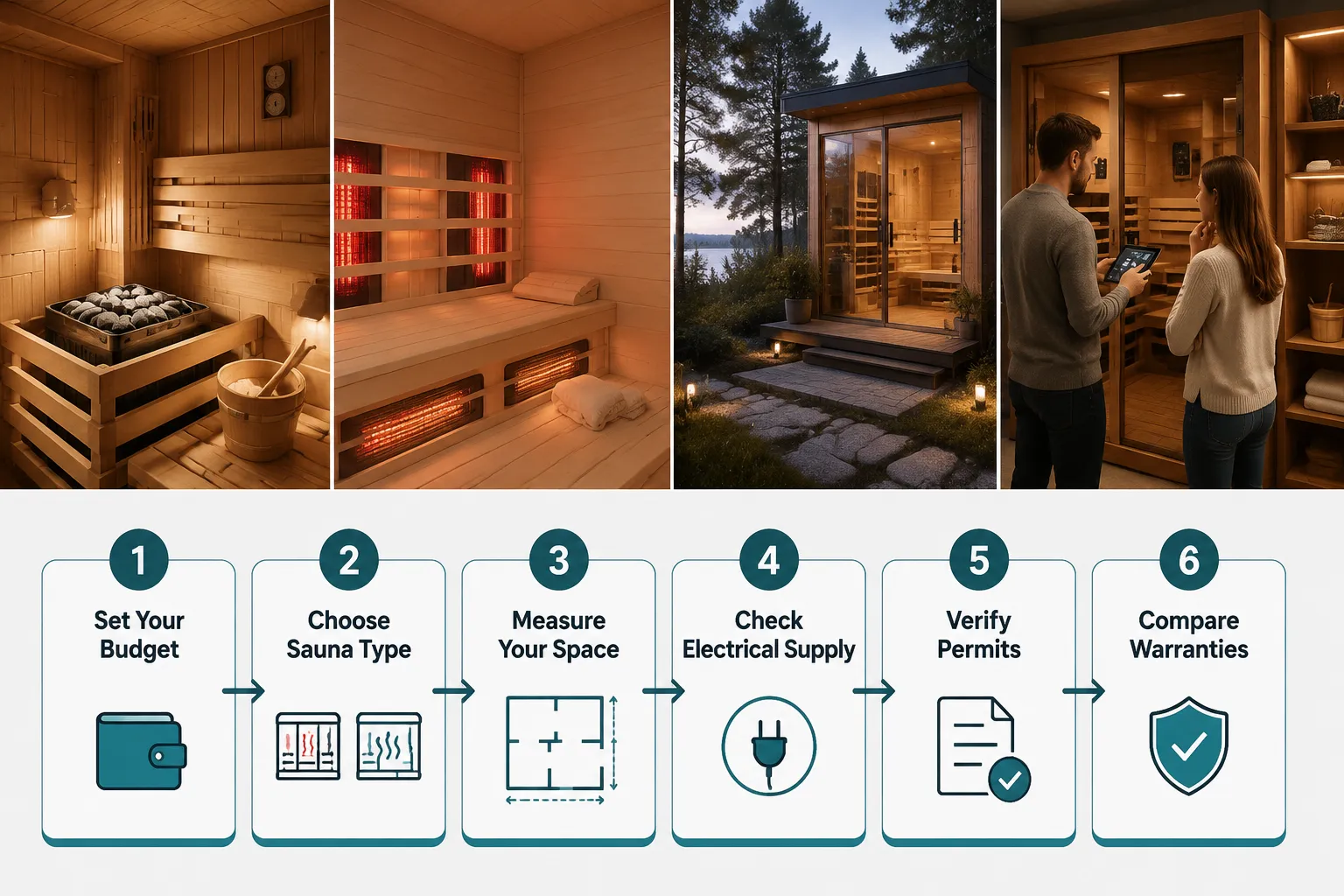
The decision comes down to six practical factors: type, space, budget, electrical supply, usage frequency, and health context.
A Practical Buying Checklist
Before you commit to a purchase, work through this checklist:
Space and installation:
- Measure the available space, including ceiling height (minimum 190cm, ideally 210cm)
- Confirm ventilation route to the outside for indoor installations
- Check whether your electrical panel has capacity for a new circuit
- Determine whether a building permit is required in your local jurisdiction (requirements vary by municipality; check with your local building authority before starting any work)
Choosing the unit:
- Decide between infrared and traditional based on your temperature preference and installation constraints
- Choose capacity (one, two, or four person) based on actual likely users, not aspirational use
- Verify wood type (cedar or hemlock preferred), construction quality, and warranty terms
- Confirm that replacement parts and heater elements are available from the manufacturer
Budget:
- Calculate the full installed cost, including electrical work, any carpentry, and permit fees
- Factor in annual maintenance costs (wood treatment, stone replacement, cleaning)
- Set a realistic usage frequency target; a sauna used once a month is an expensive luxury, not a health investment
Can you put a sauna in a small bathroom? A pre-built infrared cabin can technically fit in a larger bathroom if there is adequate floor space (typically a minimum of about 90cm x 90cm for a one-person unit), a standard outlet nearby, and sufficient ventilation. However, bathroom humidity can affect the cabinet exterior over time, and you need to ensure the floor can handle the weight. A dedicated corner of a basement, spare room, or garage is generally a better location than a bathroom.
Common Home Sauna Buying Mistakes
Buying on price alone. The cheapest units often use low-grade wood, under-powered heaters, and thin insulation. They also tend to have poor warranty support. The basics still do the heavy lifting: wood quality, heater quality, and ventilation.
Ignoring electrical requirements. Discovering that your panel needs an upgrade after the sauna arrives is an expensive surprise. Confirm electrical capacity before purchasing.
Overestimating usage. Be honest about how often you will actually use it. A two-person sauna used four times a week justifies the cost; the same sauna used once a month does not.
Skipping the permit check. Some jurisdictions require permits for permanent sauna installations, particularly for electrical work and outdoor structures. A sauna installed without required permits can complicate home sales and insurance claims [4].
Choosing size over fit. A four-person sauna in a space that only comfortably fits a two-person unit is worse than a well-fitted smaller unit. Clearances matter for safety and for the experience.
FAQ: Home Sauna Questions Answered
Is a home sauna worth it?
For regular users who will use it at least 3-4 times per week, a home sauna can be a worthwhile long-term investment in both wellness and property value. For occasional users, the upfront and installation costs are difficult to justify. Honest self-assessment of likely usage frequency is the most important factor in the decision [4].
What is the best personal sauna for home use?
There is no single best option. For traditional heat and the strongest evidence base, a well-built Finnish-style electric sauna is the benchmark. For easier installation and lower operating temperatures, a quality full-spectrum infrared cabin is the most popular residential choice in 2026 [1][7][10]. The best unit is the one that fits your space, budget, and usage habits, not the most expensive or most marketed.
How much does a home sauna cost to run?
Running costs are modest. A 2kW infrared sauna used for 45 minutes, three times per week, costs roughly US$30-US$60 per year in electricity at average US rates. A 6kW traditional sauna used at the same frequency costs approximately US$100-US$200 per year. The bigger ongoing costs are maintenance and, if applicable, water treatment for steam units.
What is the difference between an infrared and a traditional sauna?
A traditional sauna heats the air to 70-100°C; an infrared sauna uses radiant panels to heat the body directly at 45-65°C. Traditional saunas have a longer evidence base from Finnish cohort research. Infrared units are easier to install, have lower running costs, and are more accessible for people who find high temperatures uncomfortable. Neither is categorically superior; the right choice depends on your priorities [6][9].
Can a sauna be installed outdoors?
Yes. Outdoor barrel saunas and custom outdoor sauna buildings are practical and increasingly popular. They require weatherproof electrical installation (conduit and outdoor-rated wiring), a stable, level base (concrete pad or compacted gravel), and materials suited to outdoor exposure. Check local building codes and HOA rules before installation, as outdoor structures may require permits [4].
Can you use a home sauna every day safely?
For healthy adults without contraindicated conditions, daily sauna use appears to be safe and is associated with the greatest observed health benefits in the Finnish cohort data [6][9]. Start with shorter sessions (10-15 minutes) at moderate temperatures and increase gradually. Stay hydrated, avoid alcohol, and listen to your body. People with cardiovascular conditions, those on relevant medications, or those who are pregnant should consult a healthcare provider before establishing a daily routine.
Final Decision: Who Should Buy a Home Sauna?
Buy a home sauna if you will use it consistently, can install it safely, and understand that the real value is convenience plus repeat use. Don’t buy one because an advert promised detox, effortless weight loss, or miracle recovery.
The best sauna is the one that fits your home without electrical shortcuts, gives you the heat style you’ll actually tolerate, and makes regular use easy. Get that right and the purchase can make sense. Get it wrong and it becomes expensive timber storage.

Dave James has spent 30+ years reading health and longevity research, and has run All Perfect Health for the past five. His background is in Australian mining and industrial engineering — disciplines built on questioning claims, measuring outcomes, and respecting evidence. He writes about what the research actually says, including where the experts disagree.
📂 Home Saunas & Heat Therapy
This article is part of the APH Home Saunas & Heat Therapy cluster. Use the links below to move between the main guide and supporting child articles.
- YOU ARE HERE
The Complete Home Sauna Guide: Types, Costs, Safety and How to Choose - → Sauna, Medicines and Health Conditions: Questions to Take to a Clinician
- → Home Sauna Safety: Risks, Precautions and Who Should Be Careful
- → Sauna Health Benefits: What the Evidence Shows About Heat Therapy
Medical Disclaimer
This article is for informational purposes only and is not medical advice. Always consult a qualified healthcare provider before making changes to your diet, exercise, supplements, or medications. The information in this article does not constitute a diagnosis, treatment recommendation, or substitute for professional medical guidance. Individual health circumstances vary; what is appropriate for one person may not be appropriate for another.
References
[1] Best Home Sauna – https://www.forbes.com/sites/forbes-personal-shopper/article/best-home-sauna/
[2] Sauna Market Report – https://www.snsinsider.com/reports/sauna-market-9094
[3] PMC12679837 – https://pmc.ncbi.nlm.nih.gov/articles/PMC12679837/
[4] Home Sauna Worth It 2026 – https://www.realtor.com/living/personal-finance/home-sauna-worth-it-2026/
[5] Infrared Saunas Market Report – https://www.cognitivemarketresearch.com/infrared-saunas-market-report
[6] Sauna Health Benefits Research Backed – https://coldture.com/en-us/blogs/news/sauna-health-benefits-research-backed
[7] Best Home Sauna (Garage Gym Reviews) – https://www.garagegymreviews.com/best-home-sauna
[8] Infrared Saunas Market (Coherent Market Insights) – https://www.coherentmarketinsights.com/industry-reports/infrared-saunas-market
[9] Sauna Benefits (Forbes Health) – https://www.forbes.com/health/wellness/sauna-benefits/
[10] Best Home Sauna 2026 (Sun Home Saunas) – https://sunhomesaunas.com/blogs/saunas/best-home-sauna-2026