
Home Sauna Safety: Risks, Precautions and Who Should Be Careful
Last updated: September 27, 2026
Quick Answer: Is Home Sauna Use Safe?
Home-sauna risk depends on the heat source, exact equipment, health history, medicines, hydration and conditions on the day. Do not treat a generic temperature or timer as a personal safety clearance. Alcohol, illness, dehydration, pregnancy, a history of fainting, cardiovascular concerns and medicines that affect heat tolerance all warrant extra caution and, where relevant, individual clinical advice.
For the wider buying, installation and equipment context, see our complete home sauna guide.
Key Takeaways
- Traditional and steam saunas can vary considerably. Follow the manufacturer’s temperature guidance, begin conservatively, and leave if you feel unwell rather than treating a temperature number as a guarantee of safety.
- Use the exact manufacturer guidance for your equipment and leave as soon as you feel unwell. A timer is not a safety guarantee, and a generic schedule cannot account for heat, humidity, illness, medicines or personal tolerance.
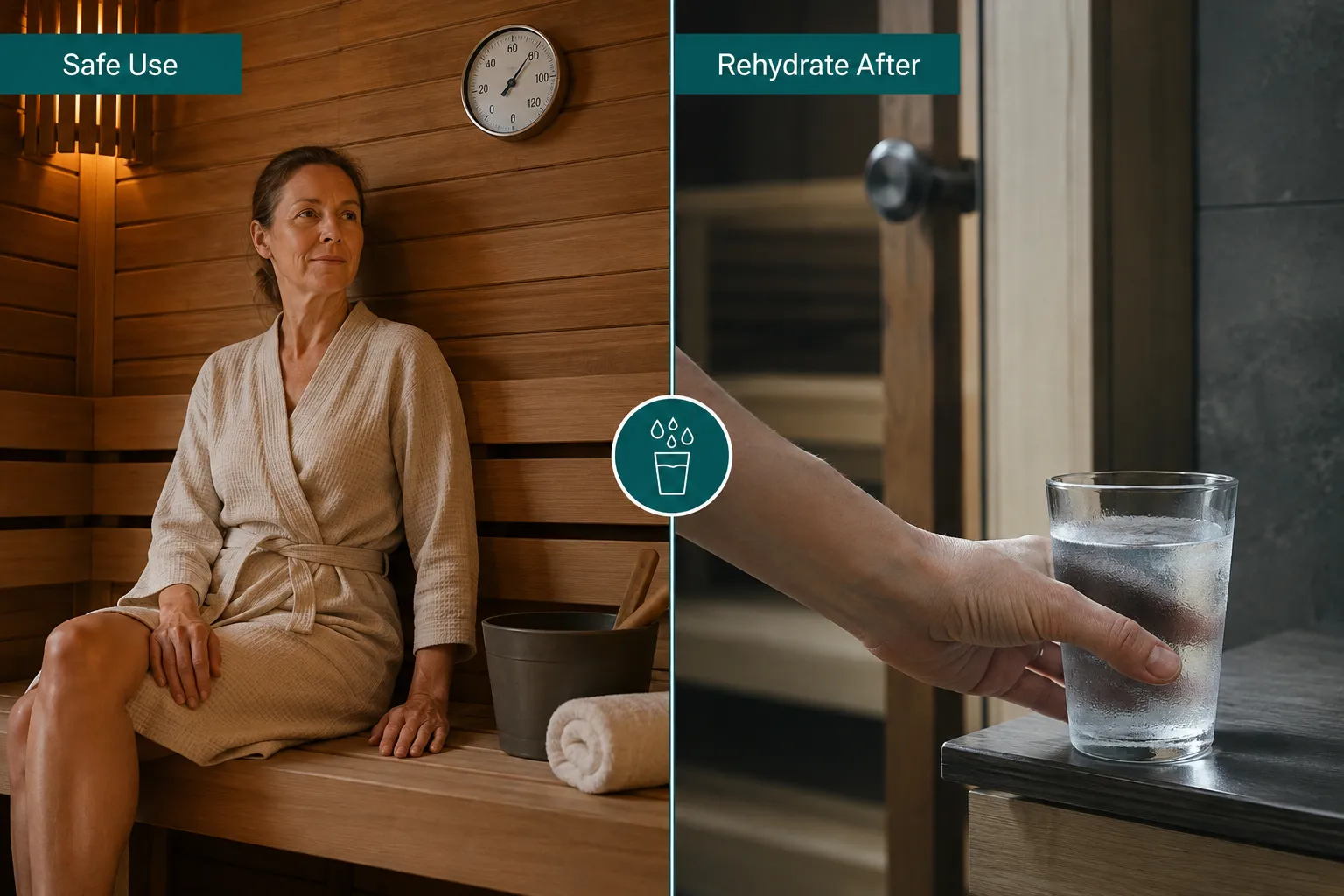
- Drink water before and after a session, and keep fluids available if you are sweating heavily. The amount needed varies with the person, the heat, and the length of the session.
- Never use a sauna after drinking alcohol. The combination raises the risk of dehydration, low blood pressure, arrhythmias, and sudden death.
- People with heart disease, uncontrolled high blood pressure, or a history of fainting should get medical clearance before using a sauna.
- People who are pregnant should discuss sauna and heat exposure with their obstetric clinician; many medical sources advise avoiding saunas, particularly early in pregnancy.
- Children need a child-health professional’s advice and close adult supervision; this general guide does not provide an age or time rule for a child.
- Infrared cabins often operate at lower air temperatures than traditional saunas, but lower air temperature does not establish lower personal risk or remove the need for the same core precautions.
- Stop any session immediately if you feel dizzy, nauseous, confused, or unusually weak, and cool down gradually.
- Electrical installation, ventilation, and fire safety are non-negotiable home sauna safety requirements, follow manufacturer specifications and local codes.
Table of Contents
- Dehydration and Overheating
- How Long Should You Stay in a Sauna?
- Alcohol and Sauna Use
- Blood Pressure and Cardiovascular Conditions
- Medication Considerations
- Pregnancy and Sauna Use
- Children and Older Adults
- Infrared Sauna Safety
- Electrical, Ventilation and Installation Risks
- Warning Symptoms: When to Stop Using a Sauna
- Questions to Discuss With a Healthcare Professional
- FAQ: Home Sauna Safety
- Related Home Sauna Guidance
- Medical Disclaimer
- References
Dehydration and Overheating
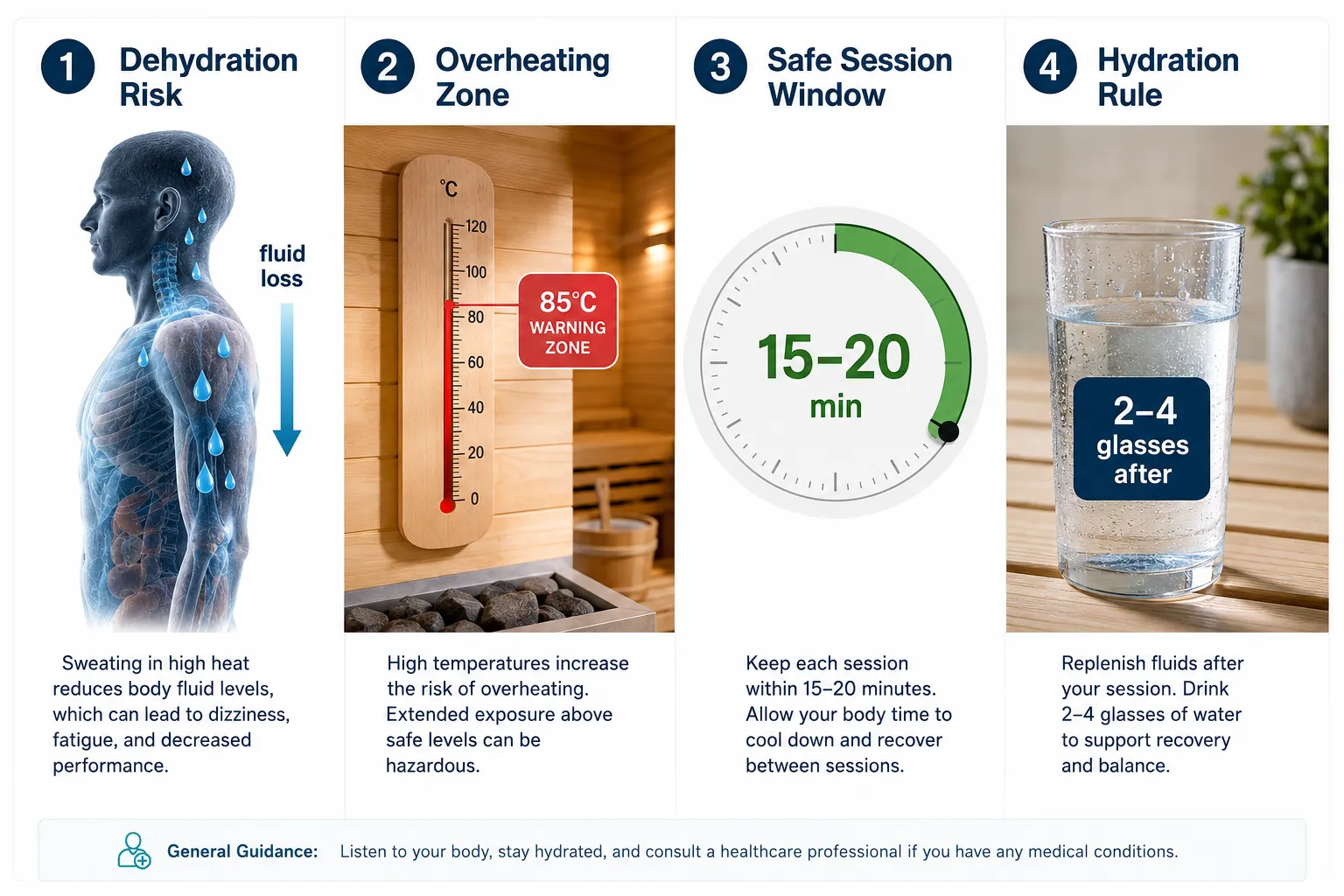
Dehydration is the most common risk associated with home sauna use, and it is also the most preventable. A standard sauna session causes significant fluid loss through sweating, and if that fluid is not replaced, the consequences range from mild headache and fatigue to heat exhaustion and, in serious cases, heat stroke.
Here is what the evidence supports in plain English:
- Before your session: Do not start a sauna session when you are already dehydrated, ill, or recovering from alcohol or strenuous heat exposure.
- During your session: Fluid needs vary. Follow any prescribed fluid restriction and seek individual advice rather than applying a generic drinking rule.
- After your session: Afterward, rehydrate according to thirst and your individual needs. Do not override prescribed fluid or salt restrictions.
- Temperature limits matter: Use the manufacturer’s temperature, ventilation and operation guidance for the exact equipment. It is not appropriate to turn a general review or another sauna’s settings into a universal home-safety limit.
The simplest way to look at it is this: your body can handle controlled heat stress reasonably well when it has enough fluid to work with. Remove that fluid, push the temperature higher, or stay in longer than recommended, and the margin for error shrinks fast.
Common mistake: Assuming that because you feel fine at 10 minutes, staying for 30 minutes is equally safe. Heat stress is cumulative within a session, not linear. The last 10 minutes carry more risk than the first 10.
How Long Should You Stay in a Sauna?
There is no single session length that is safe for every type of sauna or every person. Heat, humidity, equipment, illness, medicines, recent exercise and individual tolerance all change risk. Use the current manufacturer guidance for the exact equipment, begin conservatively and leave as soon as you feel unwell.
- Do not treat a time limit from another sauna, a consumer article or a research protocol as a personal clearance.
- Do not continue because a timer has not finished; discomfort, dizziness, nausea, unusual weakness, chest discomfort or confusion are reasons to leave the heat.
- If you have health conditions, take medicines that may affect heat tolerance, have fluid restrictions, are pregnant or have a history of fainting with heat, get individual advice rather than following a generic schedule.
Alcohol and Sauna Use
This one is straightforward, and the evidence is not ambiguous. Do not use a sauna if you have been drinking alcohol, and do not drink alcohol immediately after a session.
Alcohol and heat stress interact in ways that raise the risk of serious harm. Alcohol is a diuretic, which means it accelerates fluid loss at exactly the point when your body is already losing fluid through sweat. Beyond dehydration, alcohol causes blood vessels to dilate, which can cause a sudden drop in blood pressure when combined with the vasodilation already triggered by heat. The result can be dizziness, fainting, or in the worst cases, cardiac arrhythmias and sudden death [2][5][7].
In real-world terms, this is not a theoretical risk. It is one of the most consistently cited factors in sauna-related fatalities across medical and safety literature.
The rule is simple: Water before and after. Alcohol has no place in a sauna session, before or after.
Blood Pressure and Cardiovascular Conditions
People with high blood pressure or heart disease are not automatically excluded from sauna use, but they need individual medical clearance before starting.
The reason this matters is that sauna heat causes blood vessels to dilate, which temporarily lowers blood pressure and increases heart rate. For most healthy adults, this is a manageable, even beneficial, cardiovascular response. For someone with uncontrolled hypertension, heart failure, a recent cardiac event, or a history of arrhythmia, the same response can be unpredictable and potentially dangerous [5][9].
What the evidence suggests:
- Controlled, stable hypertension does not automatically rule out sauna use, but the decision belongs with a physician who knows the individual’s full medical picture [5].
- Recent cardiac events (heart attack, cardiac surgery, unstable angina) are a clear reason to avoid saunas until a cardiologist says otherwise.
- Infrared saunas: lower air temperature does not establish lower personal cardiovascular risk. Do not use that distinction as a reason to start heat exposure without individual advice when cardiovascular risk is relevant.
- Low blood pressure (hypotension) is also a concern. The vasodilatory effect of heat can cause a significant blood pressure drop on standing, increasing the risk of fainting [5].
Context matters here. Someone who is 55, exercises regularly, has well-managed blood pressure, and no cardiac history is in a very different position from someone who had a stent placed three months ago. The guidance is not the same for both people.
Medication Considerations
Certain medications change how the body responds to heat, and that is worth understanding before using a home sauna.
This article cannot and does not advise on specific medications or individual drug interactions. That conversation belongs with a pharmacist or prescribing physician. However, the general categories worth discussing with a healthcare provider include:
- Diuretics: Already reduce fluid volume; sauna-induced sweating adds to that effect.
- Beta-blockers and antihypertensives: Can blunt the heart rate and blood pressure response to heat, making it harder to gauge how the body is actually coping.
- Anticoagulants: Heat-related vasodilation and dehydration can affect how these medications work.
- Sedatives, sleep aids, and certain antihistamines: Can impair the body’s ability to regulate temperature and reduce the awareness of warning symptoms.
- Stimulants and some cardiac medications: May interact with heat-induced cardiovascular changes in ways that vary by individual [5][7].
The main takeaway is this: if you take any regular prescription medication, particularly for blood pressure, heart rhythm, blood thinning, or mood, check with your doctor or pharmacist before using a sauna. This is not excessive caution, it is basic due diligence.
Pregnancy and Sauna Use
Pregnant women should avoid saunas, particularly during the first trimester. This is one of the clearer positions in sauna safety guidance, and it is based on real physiological concern.
Elevated core body temperature during early pregnancy has been associated with neural tube defects and other developmental risks [5]. The sauna environment, high heat, enclosed space, limited ability to cool down quickly, creates conditions that can raise core temperature faster than most other activities.
Medical and safety sources are consistent on this point: if you are pregnant, avoid sauna use until after delivery and until your healthcare provider confirms it is appropriate to resume [1][5]. This applies to traditional saunas and infrared saunas alike.
Children and Older Adults
For condition- and medication-specific context, see our clinician-discussion guide.
Children
Young children can overheat quickly and should not use a sauna unless a child’s healthcare professional and local safety guidance specifically support it. Their thermoregulatory systems are less developed than adults, meaning they overheat faster and have less capacity to signal distress before it becomes a problem [1][5].
For older children, if a parent or guardian decides to allow supervised sauna use:
- Keep sessions to around 15 minutes maximum.
- Use lower temperatures than adult sessions.
- Supervise actively throughout, do not leave children unattended.
- Ensure they drink water before and after.
- Exit immediately at any sign of discomfort, flushing, or distress.
Older Adults
For adults over 65, the core guidance is the same as for anyone else, but with a few additional considerations:
- Heat tolerance decreases with age. Older adults may not feel the heat as intensely as they actually experience it, which can delay the recognition of warning symptoms.
- Medication interactions are more common in this age group (see the medication section above).
- Cardiovascular conditions are more prevalent. Medical clearance is especially important.
- Shorter sessions and lower temperatures are a sensible starting point for older adults new to sauna use [5][8].
If you are supporting a parent or older family member who wants to use a home sauna, a conversation with their doctor before the first session is time well spent. For those interested in broader healthy ageing strategies, the healthy lifestyle and longevity section at All Perfect Health covers complementary approaches worth reading alongside this guidance.
Infrared Sauna Safety
Infrared saunas are not the same as traditional saunas, and the difference matters for safety. They operate at lower ambient temperatures, typically 45-60°C, and heat the body through radiant energy rather than hot air. A 2025 synthesis of sauna research found that traditional hot-air saunas produce greater acute core-temperature elevation and cardiovascular strain than far-infrared saunas .
That said, infrared saunas are not without risk, and the lower temperature does not mean the session can be treated casually.
Key points for infrared sauna safety:
- Session limits still apply. Up to 30 minutes is the commonly cited guideline for healthy adults, with beginners starting at 10-15 minutes [1][5][8].
- Hydration rules are identical. You still sweat, and you still need to replace that fluid [2][7].
- Skin exposure. A 2023 dermatology review noted that potential skin risks from infrared exposure remain poorly characterised, and that claimed skin benefits have not been well validated [3]. Monitor any skin irritation or unusual redness and stop use if it develops.
- EMF considerations. When choosing a home infrared sauna, check the manufacturer’s specifications for low ELF-EMF ratings. This is an area where more research is expected in coming years [1][4][10].
- Mayo Clinic guidance notes that no adverse effects were reported in clinical studies of infrared saunas reviewed, suggesting they are safe for most people when used appropriately [9].
We need to separate fact from hype here: infrared saunas are a legitimate option and may be a gentler starting point for some users, but they are not a risk-free upgrade. The same discipline around time, temperature, hydration, and medical clearance applies.
Electrical, Ventilation and Installation Risks
Home sauna safety does not begin when you step inside, it begins at installation. Electrical and structural risks are among the most serious and most underappreciated hazards associated with home saunas.
Electrical safety:
- Home saunas, particularly traditional electric heaters, require dedicated electrical circuits. Overloading a standard circuit is a fire risk.
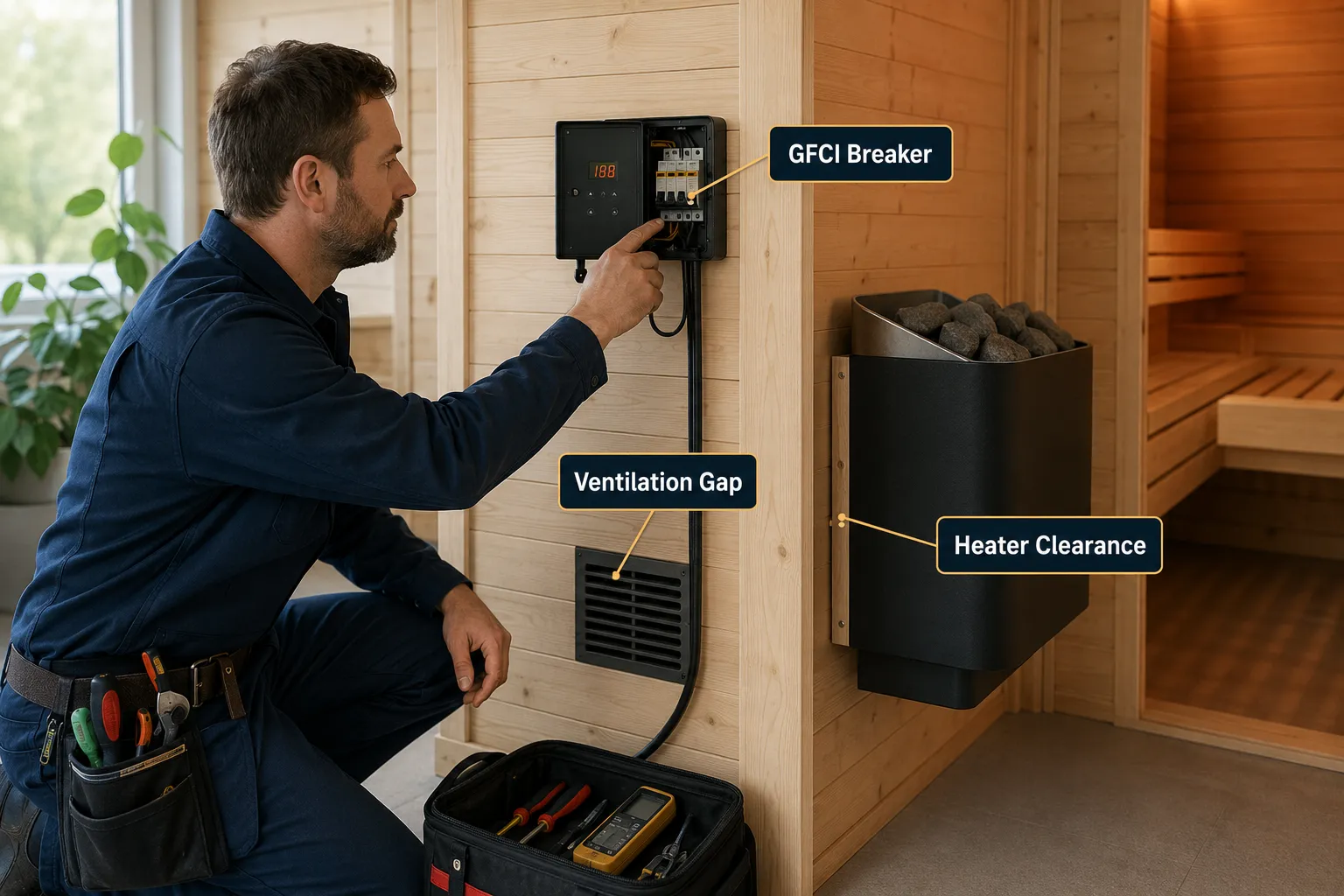
- A Electrical protection, circuit capacity and installation requirements depend on the exact model, the applicable local rules and the installation setting. Use the current manufacturer documentation and a qualified electrician where required; this article does not prescribe a universal GFCI or circuit rule.
- Follow the manufacturer’s specifications for heater clearance from walls, ceiling, and benches. These distances exist for fire prevention, not aesthetics [1][10].
Ventilation:
- Adequate ventilation prevents carbon monoxide build-up (relevant for wood-burning saunas), controls humidity, and allows fresh air exchange.
- A low vent near the heater and a high vent on the opposite wall is a standard configuration for traditional saunas.
- Sealed, unventilated spaces can cause oxygen depletion during extended sessions. This is not a theoretical risk [7].
Permits and installation codes:
- Many local authorities require a building permit for a home sauna installation, particularly for permanent structures or those requiring electrical work.
- Check with your local council or building authority before installation. Requirements vary by location, property type, and sauna type [4][7][10].
- Skipping permits is not just a legal issue, it can affect home insurance and create liability problems if something goes wrong.
Fire prevention:
- Keep flammable materials away from the heater.
- Never leave a sauna heater running unattended for extended periods.
- Install a smoke detector near (but not inside) the sauna.
- Sit on a towel to avoid direct contact burns from hot wooden benches, and remove metal jewellery before entering [1][7].
Warning Symptoms: When to Stop Using a Sauna
Exit the sauna immediately if you experience any of the following:
- Dizziness or lightheadedness
- Nausea or vomiting
- Confusion or difficulty thinking clearly
- Unusual weakness or muscle cramps
- Chest pain, tightness, or palpitations
- Fainting or near-fainting
- Skin that stops sweating despite the heat (a sign of heat stroke)
- Any feeling that something is wrong [1][5][7]
After exiting, cool down gradually. Sit or lie down in a cool area. Drink water. Do not jump into a cold shower immediately if you feel faint, the sudden temperature change can cause a further blood pressure drop.
When to call emergency services: Chest pain, loss of consciousness, confusion that does not resolve quickly, or any suspected heatstroke, especially altered mental status, collapse or confusion, requires emergency medical attention. Sweating does not rule out heatstroke. Do not wait to see if it passes.
Questions to Discuss With a Healthcare Professional
Before using a home sauna for the first time, particularly if you are over 45 or have any existing health conditions, these are worth raising with your doctor or healthcare provider:
- Is sauna use appropriate given my current cardiovascular health?
- Do any of my medications affect heat tolerance or blood pressure response?
- Are there any conditions I have that make sauna use higher risk?
- What session duration and temperature range would be appropriate for me specifically?
- Are there any warning signs I should be particularly alert to given my health history?
This article provides general education. It does not replace individual medical assessment. The distinction matters, and a good clinician will be able to give you guidance that is specific to your situation in a way that no article can.
For those managing joint health or recovering from injury alongside their sauna use, the exercise guide for better health and returning to exercise after joint surgery resources at All Perfect Health may also be useful reading.
FAQ: Home Sauna Safety
What temperature is safe for a home sauna?
There is no single temperature that is safe for every person or sauna. Follow the manufacturer’s limits, start at a lower setting, keep sessions short, and leave immediately if symptoms develop.
How long can you stay in a sauna safely?
Healthy adults are generally advised to keep traditional sauna sessions to 15-20 minutes, steam sessions to around 15 minutes, and infrared sessions to up to 30 minutes. Beginners should start at 5-10 minutes and build up gradually over multiple visits [1][2][5][8].
Is it safe to use a sauna if you have high blood pressure?
It depends on the individual. Controlled, stable hypertension does not automatically rule out sauna use, but uncontrolled hypertension or a recent cardiac event does. Anyone with a cardiovascular condition should get explicit medical clearance before using a sauna [5][9].
Can you use a sauna every day without health problems?
Daily use is not inherently harmful for healthy adults who follow recommended time and temperature limits and maintain good hydration. However, the evidence base for optimal frequency is still developing. Most guidance suggests starting with two to three sessions per week and assessing how your body responds before increasing frequency [5][8].
Is it safe to use a sauna when pregnant?
No. Pregnant women, especially in the first trimester, should avoid saunas. Elevated core body temperature during early pregnancy carries developmental risks. Ask your healthcare provider when resuming sauna use after delivery [5].
Are infrared saunas safer than traditional saunas?
Infrared cabins often operate at lower air temperatures than traditional saunas, but lower air temperature does not establish lower personal cardiovascular risk. The same core precautions apply, and individual clinical advice matters when health conditions or medicines may affect heat tolerance.
Can kids use a home sauna safely?
Young children should generally not use a sauna. For older children, follow local guidance and obtain professional advice; never leave a child unsupervised, and use substantially less heat and time than for adults.
What should you do if you feel dizzy or faint in a sauna?
Exit immediately. Sit or lie down in a cool area, drink water, and cool down gradually. If symptoms do not resolve quickly, or if chest pain, confusion, or loss of consciousness occurs, call emergency services.
What ventilation do you need for a home sauna?
Traditional saunas need adequate ventilation designed for the specific heater and room. Follow the manufacturer’s instructions and applicable building and electrical codes rather than relying on a generic vent layout. Wood-burning saunas also require ventilation to prevent carbon monoxide build-up. Always follow manufacturer and local building code requirements [7][10].
Do you need a permit to install a sauna in your home?
In many jurisdictions, yes, particularly for permanent installations or those requiring dedicated electrical work. Requirements vary by location. Check with your local council or building authority before installation [4][7][10].
Related Home Sauna Guidance
For broader context on home wellness practices and supporting your health alongside sauna use, these resources from All Perfect Health may be useful:
- Healthy lifestyle and longevity, a practical overview of evidence-based habits that support long-term health.
- Exercise guide for better health, how to build a sustainable movement practice that complements recovery tools like saunas.
- The Complete Home Sauna Guide, for a broader look at types, setup, costs and practical home-sauna decisions.
Conclusion
Home sauna safety comes down to a small number of well-established principles applied consistently. Keep temperatures within recommended ranges. Keep sessions short, especially at the start. Drink water before and after every session. Never use a sauna after drinking alcohol. Know which health conditions and medications require a conversation with a doctor before you begin. Recognise the warning symptoms that mean it is time to exit immediately.
None of this is complicated, but it does require attention. The people most likely to run into trouble are those who treat a sauna as a passive activity, something that just happens to them, rather than a deliberate heat exposure that the body has to manage. Approached with that awareness, a home sauna can be a genuinely useful part of a health routine for most adults.
If you are in the 45-65 age group, have any cardiovascular history, take regular medications, or are new to sauna use, the practical next step is simple: discuss sauna use with your doctor before your first session to remove a significant amount of uncertainty. That is a good return on a small investment of time.

Dave James has spent 30+ years reading health and longevity research, and has run All Perfect Health for the past five. His background is in Australian mining and industrial engineering — disciplines built on questioning claims, measuring outcomes, and respecting evidence. He writes about what the research actually says, including where the experts disagree.
📂 Home Saunas & Heat Therapy
This article is part of the APH Home Saunas & Heat Therapy cluster. Use the links below to move between the main guide and supporting child articles.
- Read the pillar: The Complete Home Sauna Guide: Types, Costs, Safety and How to Choose
- YOU ARE HERE Home Sauna Safety: Risks, Precautions and Who Should Be Careful
- → Sauna Health Benefits: What the Evidence Shows About Heat Therapy
Medical Disclaimer
This article is for informational purposes only and is not medical advice. Always consult a qualified healthcare provider before making changes to your diet, exercise, supplements, or medications. The information presented here is general in nature and does not account for individual health circumstances, medical history, or specific conditions. Do not use this article as a substitute for professional medical assessment.