
Magnesium for Headaches and Migraine: Forms, Food Sources, Safety and Evidence

Last updated: September 2026
Magnesium for headaches is one of the better-studied supplements for migraine prevention, but it is not a guaranteed treatment and it is not a substitute for medical care. Research suggests that some people with migraine may have lower magnesium status and may experience fewer or less severe attacks when adequate magnesium intake is maintained over time. The evidence is more supportive for prevention than for stopping an attack that has already begun.
This guide explains what magnesium does, which forms are commonly used, what food can contribute, how study doses should be interpreted, and when supplementation needs professional guidance.
Key takeaways
- Magnesium may help reduce migraine frequency or severity for some people, but results vary and the evidence is not a promise of benefit.
- Most of the research concerns migraine prevention, not rapid relief during an active headache.
- Magnesium oxide, citrate and glycinate are commonly discussed, but no form is proven to be best for everyone.
- Study doses are not personal prescriptions. Kidney disease, pregnancy, medicines and digestive tolerance all matter.
- Food sources such as seeds, legumes, leafy greens and whole grains are a sensible foundation.
- Give a prevention strategy enough time to assess—often several weeks—and keep a headache diary rather than relying on memory.
- A sudden, severe or changing headache needs medical assessment regardless of supplement use.
Medical disclaimer: This article is general health information, not a diagnosis or individual treatment plan. Speak with a qualified healthcare professional before starting a magnesium supplement, particularly if you have kidney disease, are pregnant or breastfeeding, take regular medicines, or are considering supplementation for a child.
Table of contents
- What is magnesium?
- Does magnesium help headaches or migraine?
- Can magnesium prevent migraine or treat an active attack?
- Which form of magnesium is best?
- Which foods contain magnesium?
- What do magnesium study doses mean?
- How long might magnesium take to work?
- What are the side effects and safety issues?
- Can magnesium interact with medicines?
- When should you seek medical care?
- Frequently asked questions
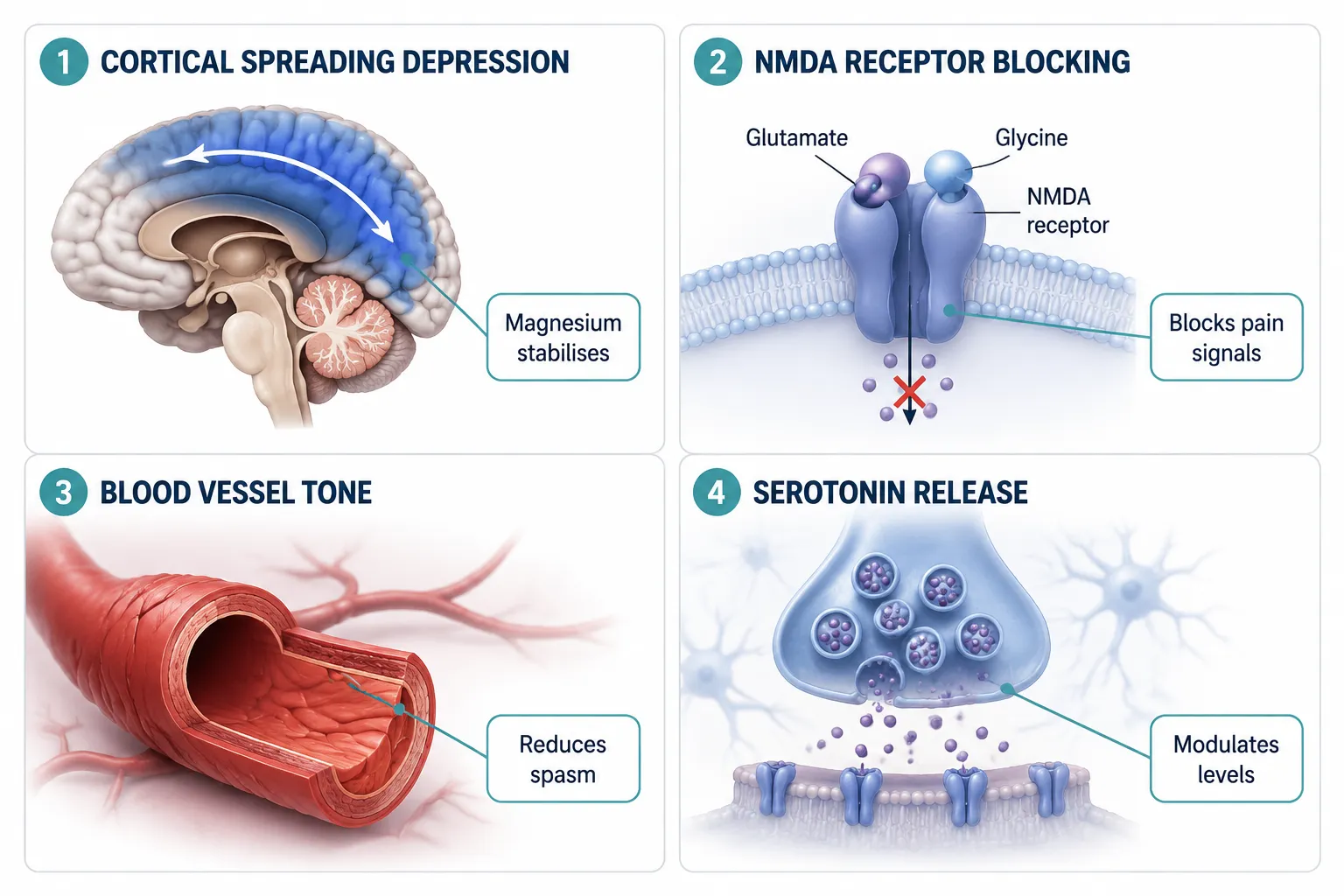
What is magnesium?
Magnesium is an essential mineral involved in nerve signalling, muscle function, energy production and normal bone health. It also participates in processes that regulate calcium movement and excitatory signalling in the nervous system.
These roles help explain why researchers have studied magnesium in migraine. Migraine is a neurological condition involving multiple pathways, and magnesium may influence some of them. That biological plausibility is useful, but it does not by itself prove that a supplement will prevent migraine for a particular person.
Magnesium status is not always easy to assess. Most magnesium is stored in bone and tissue, while only a small proportion circulates in blood. A serum test can be clinically useful in the right context, but it does not provide a complete picture of total body stores. Testing and interpretation should be handled by a clinician rather than guessed from symptoms alone.
Does magnesium help headaches or migraine?
The most accurate answer is: magnesium may help some people with migraine, while evidence for other headache types is less developed. Reviews of clinical trials have reported reductions in attack frequency, pain intensity or medication use in some participants. However, studies differ in the form of magnesium, dose, duration and people included, so the size of any benefit is difficult to predict.
Professional headache resources commonly describe magnesium as a reasonable non-prescription option to discuss for migraine prevention. “Reasonable” does not mean universally effective, risk-free or equivalent to a prescribed preventive medicine. It means the potential benefit and generally manageable risks may justify a properly monitored trial for some adults.
Evidence for tension-type headache is much thinner. Magnesium may be relevant when a person has inadequate intake or overlapping migraine, but it should not be presented as an established treatment for every tension headache.
If you are looking at a wider range of non-drug options, our guide to herbs for headaches covers a different group of approaches. It should be read as complementary information, not as a reason to combine several supplements without checking for interactions.
Can magnesium prevent migraine or treat an active attack?
Most oral magnesium research is about prevention: taking an appropriate amount consistently over time in the hope of reducing how often attacks occur or how severe they become. It is not the same as taking a capsule when an attack starts and expecting rapid relief.
Intravenous magnesium has been studied in clinical settings for selected acute migraine presentations, particularly where aura or low magnesium status may be relevant. Intravenous treatment is administered by healthcare professionals and should not be confused with self-treating an active headache with oral supplements.
For recurring migraine, keep a record of headache days, severity, duration, associated symptoms and acute medicines used. That makes it easier to judge whether a prevention strategy is helping and gives your clinician better information.

Which form of magnesium is best for migraine?
There is no single form that is best for every person. Magnesium compounds differ in elemental magnesium content, absorption, cost and gastrointestinal tolerance. Product marketing often makes the differences sound more certain than the clinical evidence allows.
| Form | Practical considerations |
|---|---|
| Magnesium oxide | Used in some migraine research and usually inexpensive, but more likely to cause loose stools at higher amounts. |
| Magnesium citrate | Often absorbed better than oxide and may loosen stools, which can be a disadvantage for people with diarrhoea or sensitive digestion. |
| Magnesium glycinate | Often chosen for tolerability, although migraine-specific evidence is not enough to call it universally superior. |
| Magnesium malate | Available in supplements but less specifically studied for migraine prevention. |
| Magnesium L-threonate and other newer forms | Often marketed for brain or cognitive effects; migraine-specific evidence remains limited. |
When comparing labels, check whether the stated amount refers to elemental magnesium or the total weight of the compound. Those are not the same thing. A pharmacist can help interpret a product label and check whether its form is suitable for you.
In practical terms, tolerability and safety are more important than chasing a “premium” form. Do not switch forms or increase the amount simply because a marketing page promises better results.
Which foods contain magnesium?
Food is a useful starting point because it provides magnesium alongside protein, fibre and other nutrients. Good sources include:
- pumpkin seeds, chia seeds and other seeds;
- almonds, cashews and peanuts;
- black beans, lentils and other legumes;
- spinach and other dark leafy greens;
- oats, brown rice and other whole grains;
- avocado;
- some fish and seafood; and
- dark chocolate, where the portion and added sugar fit your overall diet.
Recommended dietary allowances vary by age and sex. For adults, the US National Institutes of Health lists 310–320 mg per day for most women and 400–420 mg per day for most men, with individual needs affected by life stage. These are dietary reference values, not migraine prescriptions.
Our companion guide to magnesium-rich foods provides more food examples. If headaches seem linked to reduced eating, vomiting, diarrhoea or dehydration, address the underlying problem and seek medical advice when symptoms are significant. Our article on dehydration and electrolytes for headaches covers that issue separately.
What do magnesium study doses mean?
Clinical resources often discuss approximately 400–600 mg of elemental magnesium per day in the context of migraine prevention studies. That figure is a description of research and clinical practice—not an instruction for every reader.
The NIH lists an adult upper limit of 350 mg per day for magnesium from supplements and medicines alone, excluding magnesium naturally present in food. This limit is based largely on diarrhoea and gastrointestinal effects and is not identical to a total daily requirement. Some migraine protocols use higher amounts under professional supervision, which is precisely why a study dose should not be copied without considering personal risk.
Before supplementing, a clinician may need to consider kidney function, age, pregnancy or breastfeeding, dietary intake, bowel symptoms, blood pressure and other medicines. The label should be read carefully so the amount of elemental magnesium is understood.
How long might magnesium take to work?
Prevention trials commonly run for several weeks, with many assessing outcomes after roughly 8–12 weeks. That does not mean everyone will respond, or that a person should continue a poorly tolerated supplement without review. It means that judging a preventive effect after one or two days is unlikely to be meaningful.
A headache diary is more reliable than memory. Record the number of headache or migraine days, severity, duration, triggers, sleep, menstrual factors where relevant, and any unwanted effects. Review the pattern with a healthcare professional if there is no improvement or if symptoms change.
What are the side effects and safety issues?
The most common problem with supplemental magnesium is gastrointestinal upset, especially loose stools or diarrhoea. Nausea and abdominal cramping can also occur. These effects may be related to the form and amount, but do not simply push through significant symptoms or keep increasing the dose.
Kidney disease is an important safety boundary. The kidneys help remove magnesium. Reduced kidney function can allow magnesium to accumulate, potentially causing weakness, low blood pressure, confusion, breathing problems or heart-rhythm disturbances. Anyone with known kidney disease or uncertain kidney function should obtain medical guidance before using a supplement.
Extra caution is also appropriate during pregnancy and breastfeeding, in older adults taking several medicines, and in people with low blood pressure or conditions affecting mineral balance. Children should not be given adult migraine supplement amounts without advice from a paediatric clinician.
Can magnesium interact with medicines?
Magnesium can reduce the absorption of some medicines when taken at the same time. Important examples include tetracycline or quinolone antibiotics and bisphosphonates used for bone health. The correct separation interval depends on the medicine, so follow the pharmacist’s or prescriber’s instructions rather than using a generic rule.
Diuretics and long-term proton-pump inhibitor use can affect magnesium balance, while kidney problems can change how the body handles supplementation. Magnesium may not have a direct interaction with every migraine medicine, but people taking beta-blockers, calcium-channel blockers, anti-seizure medicines, blood-pressure medicines or several medicines together should still ask a pharmacist or doctor to review the full list.
Do not stop, replace or alter a prescribed medicine because a supplement is described as “natural.”
When should you seek medical care?
Magnesium is not a reason to delay assessment of a concerning headache. Seek urgent medical help for a sudden thunderclap headache, a new severe headache with weakness or confusion, fainting, seizure, fever and stiff neck, serious visual or speech changes, a headache after head injury, or rapidly worsening symptoms.
A new headache pattern after age 50, a progressive change in established headaches, or headaches becoming increasingly frequent also deserves medical review. The herbs for headaches guide includes related safety reminders, but no supplement should be used in place of an assessment when red flags are present.
Frequently asked questions
How much magnesium should I take for migraine?
Studies and clinical resources often discuss 400–600 mg of elemental magnesium per day for prevention, but this is not a personal prescription. Ask a healthcare professional to consider kidney function, medicines, pregnancy, age, diet and digestive tolerance first.
Which magnesium form is best for headaches?
No form is proven best for everyone. Oxide has migraine study data but may cause more loose stools; citrate and glycinate are often selected for practical tolerability. Read the elemental magnesium amount and ask a pharmacist if unsure.
Can magnesium stop a migraine that has already started?
Oral magnesium is mainly studied for prevention and is not a reliable rapid rescue treatment. Severe, unusual or persistent headaches need appropriate medical assessment and an evidence-based acute treatment plan.
How quickly does magnesium work for migraine prevention?
Prevention studies often assess results over 8–12 weeks. A diary can show whether headache frequency, severity or duration is changing, but stop and seek advice if the supplement causes significant side effects.
Can magnesium cause headaches?
Very high or poorly tolerated supplemental amounts can cause nausea, diarrhoea, weakness and other symptoms; magnesium accumulation is a particular concern with impaired kidney function. Do not treat new symptoms by increasing the dose.
Can I take magnesium during pregnancy?
Do not copy migraine study amounts during pregnancy. Discuss the product, amount and reason for use with an obstetric clinician or midwife, especially if other medicines or supplements are involved.
The bottom line
Magnesium is a plausible and reasonably supported option to discuss for migraine prevention, particularly when dietary intake is inadequate or a clinician identifies a relevant risk. The evidence is not a guarantee, and it is less clear for tension-type or other headaches. Food sources, a headache diary, careful product-label reading and a safety review are more useful than chasing a high dose or a heavily marketed form.
Use magnesium as one possible part of a broader plan that may also include regular sleep, adequate food and fluids, trigger management and appropriate medical care. Keep the protected Herbs for Headaches pillar as a companion resource, not a substitute for diagnosis or prescribed treatment.
About the author: Dave James publishes practical, evidence-aware health information for All Perfect Health. Content is reviewed for clarity, source quality and appropriate safety boundaries; it is not individual medical advice.
This article is part of the APH headaches and natural support cluster. Use these guides to explore related questions without treating one symptom pattern as a diagnosis.
References
- Magnesium and Migraine. Review of magnesium and migraine evidence. National Library of Medicine.
- Supplements for migraine. The Migraine Trust.
- Magnesium supplementation for migraine prophylaxis. National Library of Medicine.
- Magnesium. StatPearls/NCBI Bookshelf, including clinical safety considerations.
- Magnesium: Fact Sheet for Health Professionals. US National Institutes of Health Office of Dietary Supplements.
- Magnesium in migraine pathophysiology and treatment. National Library of Medicine.