
How to Exercise When You’re Over 50
Last updated: April 8, 2026
Quick Answer: Adults over 50 should aim for at least 150 minutes of moderate-intensity aerobic activity per week, plus muscle-strengthening work on at least two days. The most important thing is not finding the perfect program — it is starting, staying consistent, and choosing activities you can actually stick with. Low-impact options like walking, swimming, cycling, and resistance training are safe, effective, and well-supported by current evidence. This is especially crucial when considering how to exercise when you’re over 50.
Key Takeaways
- 150 minutes per week of moderate aerobic activity is the standard recommendation for adults 65 and older, or 75 minutes of vigorous activity [2]
- Strength training at least twice a week targeting all major muscle groups is essential for preventing age-related muscle loss [6]
- Balance and flexibility work should be included regularly, especially to reduce fall risk
- You do not need long sessions — short bursts of activity throughout the day count toward your weekly total [5]
- Low-impact activities like walking, swimming, and cycling protect aging joints while delivering real cardiovascular benefit [1]
- Warm up properly — Harvard Medical School recommends at least five minutes before exercise to prepare muscles and reduce injury risk [1]
- Adherence beats perfection — the ACSM’s 2026 Position Stand confirms that enjoyment and consistency matter more than following a rigid ideal program [6]
- Functional movements — squats, carries, and grip work — help preserve independence and daily physical capacity [4]
- Mental health benefits are real — regular exercise reduces anxiety, improves mood, and supports cognitive function in older adults
- Always consult your GP or healthcare provider before starting a new exercise program, particularly if you have existing health conditions
Why Exercise Changes After 50
The basics of exercise do not change after 50. The body still responds to movement, still builds muscle when challenged, and still benefits from cardiovascular work. What changes is the context.
From around the age of 30, adults lose roughly 3–8% of muscle mass per decade, a process called sarcopenia. After 50, that rate can accelerate if you are sedentary. Bone density also declines, joint cartilage becomes less resilient, and recovery takes longer than it did at 30. These are biological facts, not reasons to stop exercising. They are reasons to exercise more thoughtfully.
Here is the real issue: most fitness content is written for younger adults and then loosely adapted for older ones. The result is advice that either undersells what people over 50 can actually do, or ignores the genuine physiological differences that make smart programming important.
Let’s keep this practical. The goal of exercise after 50 is not just fitness for its own sake. It is maintaining the physical capacity to live well — to carry groceries, climb stairs, play with grandchildren, and stay independent for as long as possible. That reframe matters, because it shifts the focus from aesthetics to function.
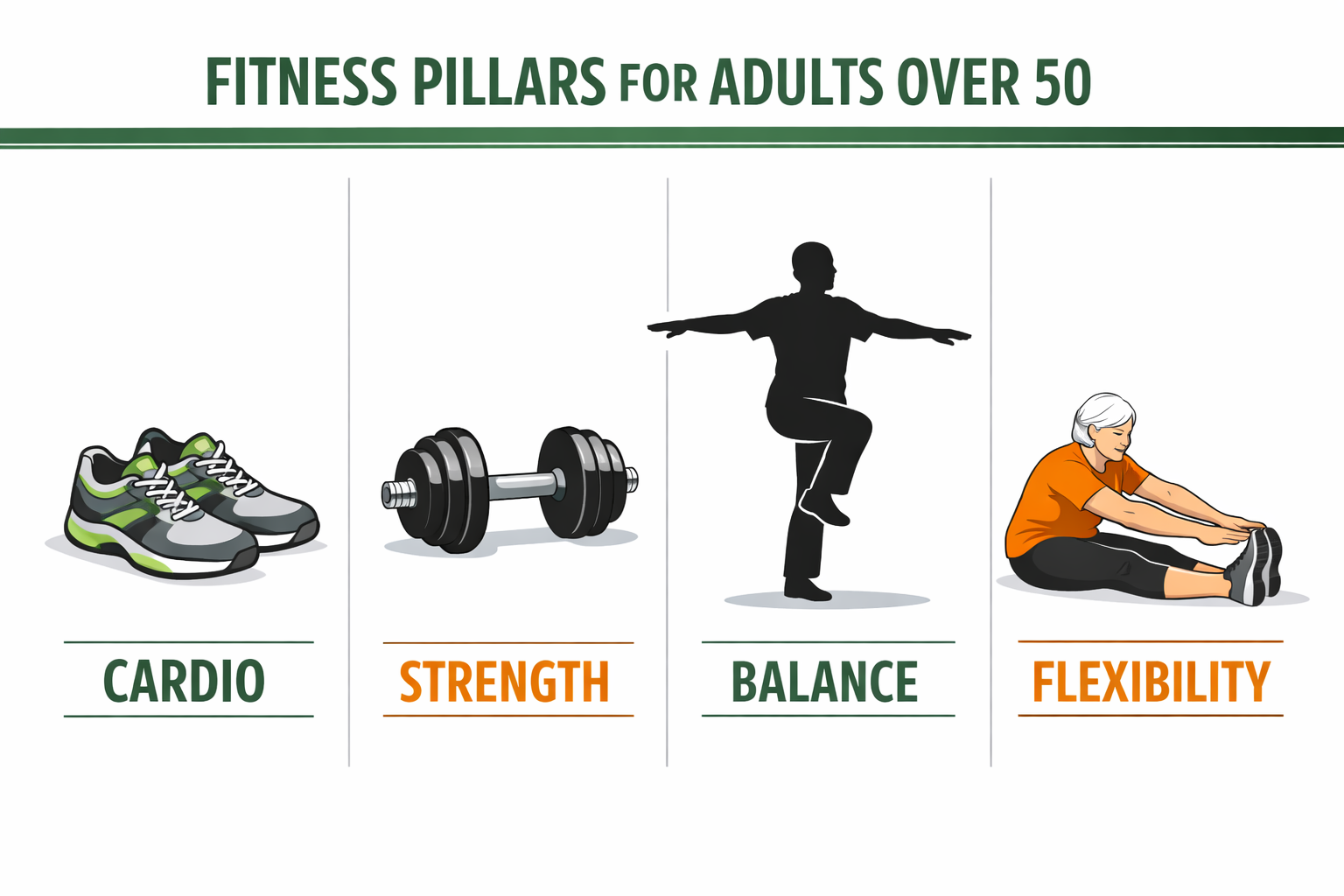
The Four Pillars of Fitness After 50
Knowing how to exercise when you’re over 50 starts with understanding what the body actually needs. There are four categories of physical activity that matter, and each serves a distinct purpose.
1. Cardiovascular (Aerobic) Activity
This is movement that raises your heart rate and keeps it elevated — walking, swimming, cycling, dancing. It supports heart health, lung function, blood sugar regulation, and mood. For older adults, the emphasis should be on moderate intensity: you can hold a conversation but would find it hard to sing.
2. Muscle-Strengthening (Resistance) Training
Resistance training is arguably the most important category for adults over 50. It counteracts sarcopenia, supports bone density, improves metabolic function, and directly preserves the strength needed for daily tasks. This includes bodyweight exercises, free weights, resistance bands, and machine-based training.
Recent ACSM research analysing over 30,000 participants across 137 systematic reviews confirmed that even small amounts of resistance training improve strength, muscle size, power, and physical function [6]. The takeaway: you do not need to do a lot to get meaningful results.
3. Balance Training
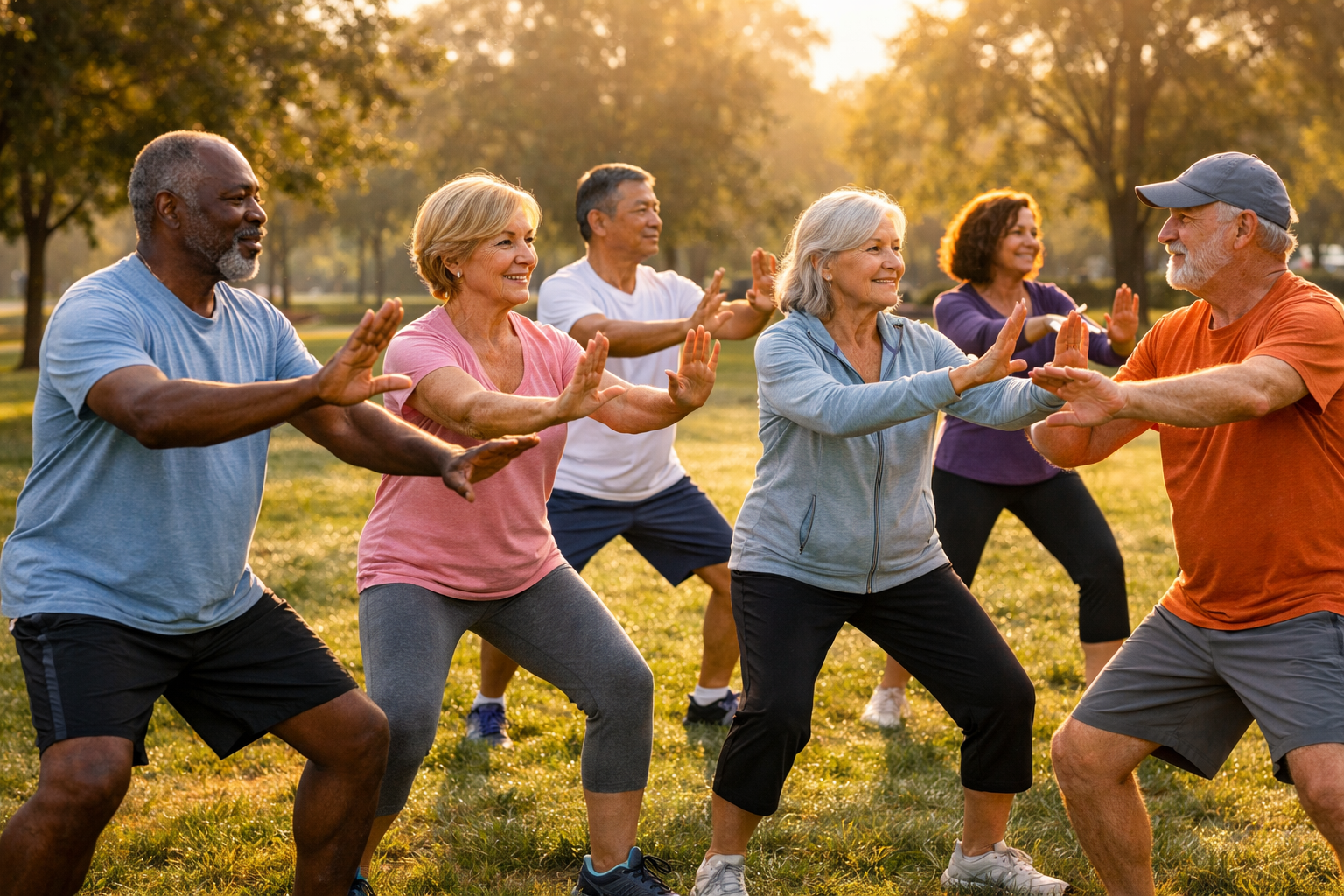
Falls are one of the leading causes of injury and loss of independence in adults over 65. Balance training — including tai chi, single-leg standing, and heel-to-toe walking — directly addresses this risk. It is often overlooked but should be a regular part of any fitness routine for older adults.
4. Flexibility and Mobility Work
Flexibility training improves range of motion and supports functional movement. Research published in a peer-reviewed NIH analysis recommends stretches targeting major muscle-tendon units, held to mild discomfort for 30–60 seconds each, performed 2–7 times per week for best results [3]. Yoga and gentle stretching routines fit well here.
How Much Exercise Do You Actually Need Each Week?
The standard recommendation for adults 65 and older is at least 150 minutes of moderate-intensity aerobic activity per week, or 75 minutes of vigorous-intensity activity, plus muscle-strengthening activities on at least two days per week [2].
That breaks down to roughly 30 minutes of moderate activity on five days, which is a manageable target for most people. Balance exercises are also recommended, particularly for those at risk of falls.
Here is what “moderate intensity” means in practice:
| Activity | Intensity Level | Counts Toward Weekly Goal? |
|---|---|---|
| Brisk walking (3–4 mph) | Moderate | Yes |
| Swimming laps | Moderate–Vigorous | Yes |
| Cycling on flat ground | Moderate | Yes |
| Jogging or running | Vigorous | Yes (counts double) |
| Yoga or tai chi | Light–Moderate | Yes (flexibility + balance) |
| Resistance training | Strengthening | Yes (separate category) |
| Casual strolling | Light | Partially |
One thing worth knowing: you do not need to do it all in one block. Updated evidence confirms that exercise does not need to meet a 10-minute minimum threshold. Any total volume of activity counts toward your weekly goals, even if accumulated in short bursts throughout the day [5]. Ten minutes in the morning, ten at lunch, ten in the evening — it all adds up.
Beginner-Friendly Exercises: Where to Start
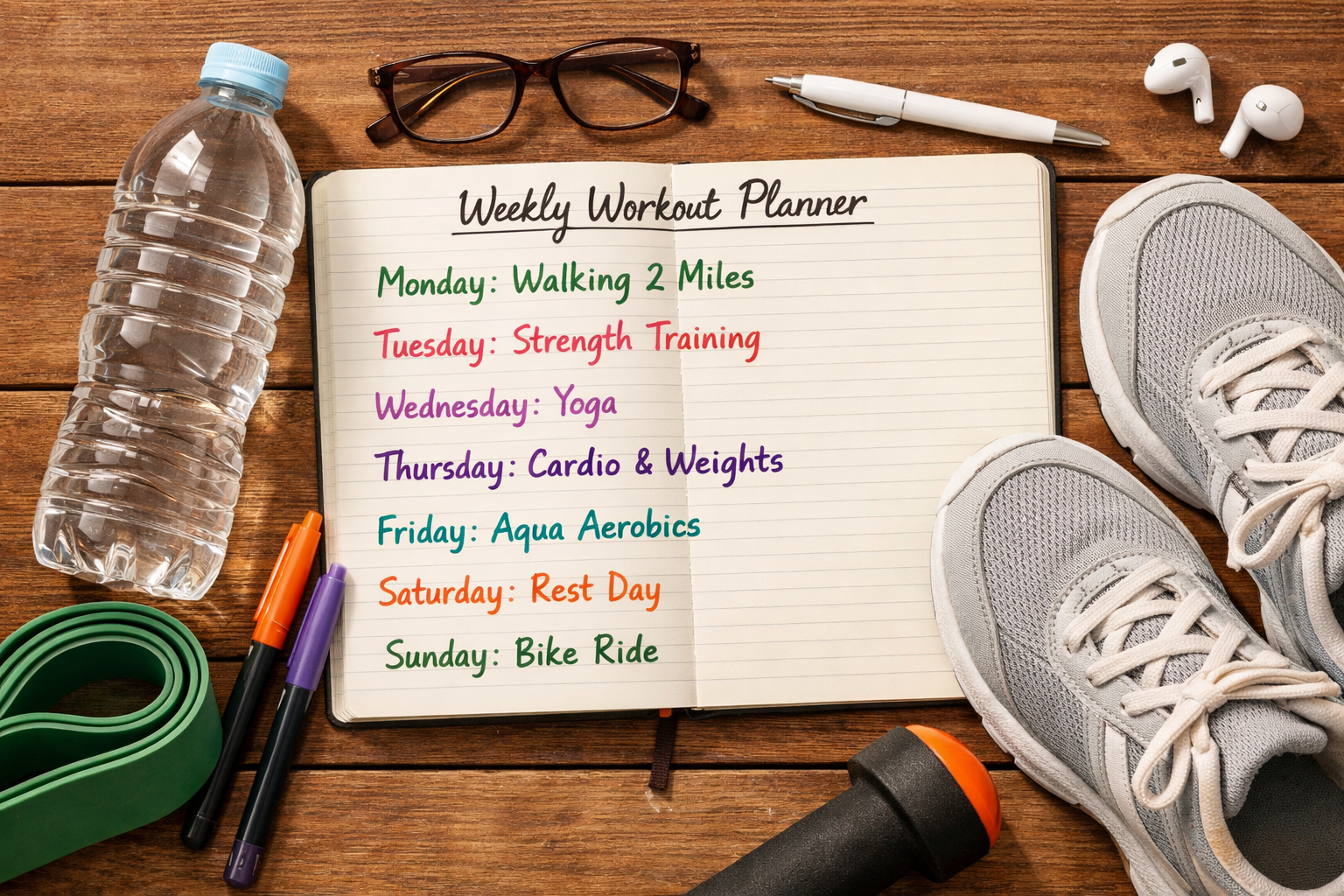
If you are new to exercise or returning after a long break, the question of how to exercise when you’re over 50 comes down to choosing activities that are accessible, joint-friendly, and genuinely sustainable. Here are the best options, with practical notes on each.
Brisk Walking
Walking is the most underrated form of exercise available. It is free, low-impact, requires no equipment, and is supported by strong evidence for cardiovascular and mental health benefits. A good starting point is 20–30 minutes at a pace that raises your breathing slightly. Our beginner’s guide to walking for exercise covers how to build up gradually without overdoing it.
Swimming
Swimming is one of the best options for anyone with joint pain, arthritis, or mobility limitations. The water supports body weight, reducing stress on hips, knees, and the lower back while still providing a solid cardiovascular and muscular workout. The health benefits of swimming are well-documented and particularly relevant for older adults.
Cycling
Cycling — whether outdoors or on a stationary bike — offers a low-impact cardiovascular workout with minimal joint loading. For those with knee issues specifically, a well-fitted exercise bike can be a better option than walking or jogging. Our guide to the best exercise bike for knee issues can help you choose the right setup.
Yoga and Tai Chi
Both yoga and tai chi combine flexibility, balance, and gentle strength work in a single session. Tai chi in particular has strong evidence for fall prevention in older adults. These are also excellent for managing stress and improving sleep quality — two factors that directly affect physical recovery and overall health.
Resistance Training
Resistance training does not require a gym. Bodyweight exercises — squats, wall push-ups, step-ups, and seated leg raises — are a practical starting point. As you build confidence and strength, resistance bands and light dumbbells add useful progression. The focus should be on functional movements: the kind that mirror what you do in daily life.
A 2026 FitBodySync analysis highlights grip strength work and eccentric loading (the lowering phase of a movement) as particularly valuable for preserving skeletal muscle density and independence in adults over 50 [4]. In plain English: slow, controlled movements are more effective than fast, sloppy ones.
How to Start Safely: The Practical Checklist
Starting exercise safely is not complicated, but there are a few things worth getting right from the beginning.
Before you start:
- Speak to your GP or healthcare provider, especially if you have heart disease, diabetes, osteoporosis, or joint problems
- Get a basic fitness assessment if you have been sedentary for more than a year
- Choose activities that suit your current physical condition, not your aspirations
When you exercise:
- Always warm up — at least five minutes of light movement (brisk walking, gentle cycling) before any session [1]
- Cool down and stretch after each session to support recovery and flexibility [1]
- Monitor how you feel — dizziness, chest pain, shortness of breath beyond normal exertion, or sharp joint pain are signals to stop and seek advice [1]
- Start at a lower intensity than you think you need and build gradually
- Allow adequate recovery — tissue repair takes longer after 50, so rest days are not optional [1]
What to watch for:
- Normal: mild muscle soreness 24–48 hours after a new activity
- Not normal: chest tightness, severe breathlessness, joint swelling, persistent pain
“Individuals over 50 should monitor for signs of overexertion including dizziness, excessive fatigue, chest pain, or joint discomfort, and adjust intensity or exercise selection accordingly.” [1]
Common Mistakes to Avoid
Even well-intentioned exercise routines go wrong in predictable ways. Here are the ones I see most often.
Doing too much too soon. The most common mistake. Starting with five sessions a week when you have been sedentary for years is a reliable path to injury and burnout. A sensible starting point is two or three sessions per week, built up gradually over months.
Skipping strength training in favour of cardio only. Long cardio sessions feel productive, but they do not adequately address sarcopenia. Recent guidance is clear: resistance training is more critical than extended cardiovascular work for preventing muscle loss and maintaining metabolic function in the 50+ demographic [4]. Both matter, but do not neglect the weights.
Ignoring balance and flexibility. These are not optional extras. They are the categories most directly linked to fall prevention and functional independence — the things that determine whether you can live well in your 70s and 80s.
Exercising through pain. Discomfort from effort is normal. Pain from a joint or sharp localised pain is not. The distinction matters. I would be careful with any advice that says “push through it” without qualification.
Treating every session the same. Interval training — alternating between higher-effort periods and recovery — provides greater benefits than constant-pace exercise and can allow for shorter overall workout times [1]. It is worth including once or twice a week once you have a base level of fitness.
Neglecting nutrition. Exercise and nutrition work together. Protein intake is particularly important for muscle preservation after 50. If you are strength training, aim for adequate protein at each meal. Our guide to healthy meals for weight loss covers practical approaches to eating well alongside an active routine.
A Simple Weekly Workout Plan for Over 50s
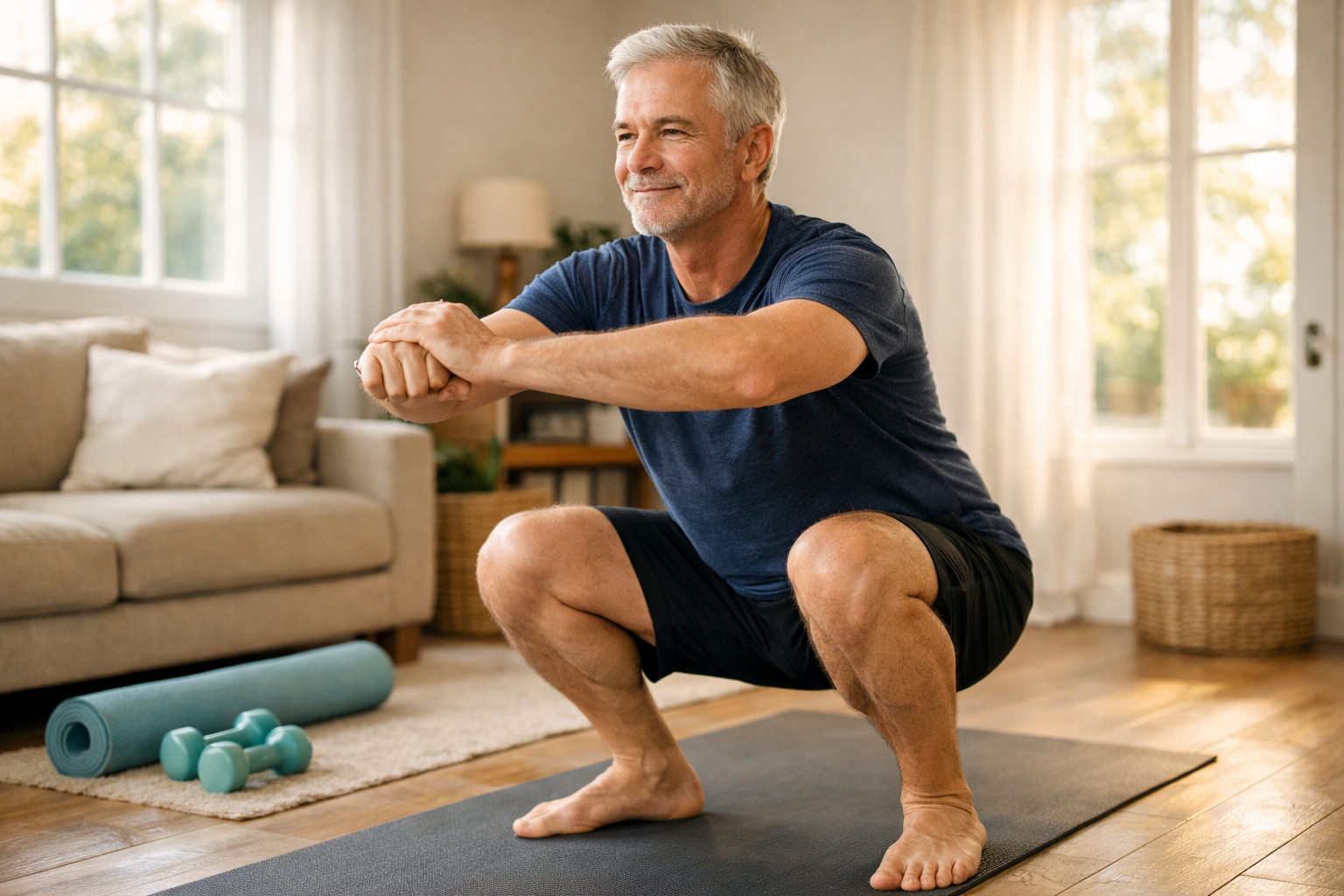
This is a starting framework, not a rigid prescription. Adjust based on your current fitness level and any health conditions.
Week 1–4 (Building the habit):
| Day | Activity | Duration |
|---|---|---|
| Monday | Brisk walk | 20–30 min |
| Tuesday | Rest or gentle stretching | 10–15 min |
| Wednesday | Bodyweight strength (squats, wall push-ups, step-ups) | 20–25 min |
| Thursday | Rest or light walk | 20 min |
| Friday | Swimming or cycling | 20–30 min |
| Saturday | Yoga or tai chi | 30 min |
| Sunday | Rest | — |
Week 5–8 (Building volume):
- Increase walking sessions to 30–40 minutes
- Add a second strength session (Friday or Saturday)
- Include one interval session: alternate 2 minutes brisk walking with 1 minute slower pace, repeated 6–8 times
Progression principle: Add no more than 10% to your total weekly activity volume each week. More is not always better, and recovery is where adaptation actually happens.
For a more detailed structure, our exercise guide for better health covers how to build a sustainable long-term routine.
Mental Health, Technology, and Staying Consistent
The physical benefits of exercise after 50 are well-established. The mental health benefits are equally real and often underappreciated.
Regular physical activity is associated with reduced symptoms of anxiety and depression, better sleep, improved cognitive function, and a stronger sense of self-efficacy. For older adults, this matters enormously — particularly those navigating retirement transitions, social changes, or chronic health management.
On technology: Fitness trackers and smartwatches can be genuinely useful tools for older adults. Step counts, heart rate monitoring, and sleep tracking provide feedback that helps calibrate effort and recovery. They are not essential, but for people who respond well to data, they can support consistency.
On community: Group exercise classes — whether in-person or online — add a social dimension that improves adherence. Tai chi groups, walking clubs, and community fitness programmes provide accountability and connection alongside the physical benefits. The evidence suggests that people who exercise with others are more likely to stick with it long-term.
The main takeaway on consistency: The ACSM’s 2026 Position Stand is direct on this point — personal goals, enjoyment, and long-term adherence matter more than following any specific ideal program [6]. Find something you will actually do. That is the most important variable.
Modifications for Specific Health Conditions
How to exercise when you’re over 50 looks different depending on your health history. Here are practical adjustments for common conditions.
Arthritis or joint pain:
- Prioritise swimming, cycling, and water aerobics
- Avoid high-impact activities (running on hard surfaces, jumping)
- Warm up longer — 8–10 minutes rather than five
- Focus on range of motion work and light resistance
Osteoporosis:
- Weight-bearing exercise (walking, resistance training) is beneficial and recommended
- Avoid high-impact activities and exercises that involve forward spinal flexion (like sit-ups)
- Balance training is particularly important to reduce fall risk
Type 2 diabetes:
- Both aerobic and resistance training improve insulin sensitivity
- Monitor blood glucose before and after exercise, especially when starting
- Consistency matters more than intensity — regular moderate activity is more useful than occasional intense sessions
Cardiovascular disease:
- Cardiac rehabilitation programmes provide supervised, structured exercise for those with heart conditions
- Start at light intensity and progress slowly
- Avoid isometric exercises (sustained muscle contractions like planks held for long periods) without medical clearance
Chronic back pain:
- Focus on core stability, gentle movement, and swimming
- Avoid heavy loaded spinal flexion
- Yoga and tai chi can be particularly helpful
Context matters. These are general guidelines, not medical advice. Always work with your healthcare provider to tailor exercise to your specific situation.
Conclusion: Start Where You Are, Build From There
The evidence on how to exercise when you’re over 50 is clearer than ever in 2026. You do not need a perfect programme. You do not need a gym membership or expensive equipment. You do not need to exercise for hours each week to get meaningful results.
What you need is a consistent habit built around activities you can sustain — walking, swimming, resistance training, yoga, or whatever combination works for your life. The basics still do the heavy lifting here: move regularly, build strength, work on balance, stay flexible, and recover properly.
Actionable next steps:
- Speak to your GP before starting if you have any existing health conditions
- Choose one or two activities from this guide that genuinely appeal to you
- Start with two or three sessions per week and build gradually
- Add strength training as soon as you feel ready — even bodyweight work counts
- Track your progress simply — a notebook or basic fitness app is enough
- Find a walking partner or local class to support consistency
There is no magic in it. The people who benefit most from exercise after 50 are not the ones who find the optimal programme. They are the ones who show up consistently, adjust when needed, and treat physical activity as a non-negotiable part of their week.
Start with what gives the biggest return. For most people over 50, that is a daily walk and two strength sessions per week. Everything else builds from there.
Frequently Asked Questions
What counts as moderate-intensity exercise for adults over 50?
Moderate-intensity exercise raises your heart rate and breathing noticeably, but you can still hold a conversation. Examples include brisk walking at 3–4 mph, cycling on flat ground, swimming at a comfortable pace, and dancing. You should feel warmer and be breathing harder than at rest, but not gasping.
How many minutes of exercise do seniors need each week?
Current guidelines recommend at least 150 minutes of moderate-intensity aerobic activity per week, or 75 minutes of vigorous activity, plus muscle-strengthening activities on at least two days [2]. This can be broken into shorter sessions throughout the day — there is no minimum session length required [5].
Is it safe to start exercising at 60 or 65 with no prior fitness history?
Yes. Starting exercise at any age produces measurable health benefits. The key is beginning at a low intensity, building gradually, and consulting a healthcare provider beforehand — particularly if you have cardiovascular disease, diabetes, or musculoskeletal conditions. The body responds to training stimulus at any age.
What is the best low-impact exercise for older adults?
Swimming, cycling, walking, yoga, and tai chi are all excellent low-impact options. Swimming is particularly useful for those with joint pain or arthritis, as water supports body weight and reduces joint stress while still providing cardiovascular and muscular challenge.
How often should adults over 50 do strength training?
At least twice per week, targeting all major muscle groups. More frequent sessions are fine once you have built a base, but two sessions per week is the evidence-supported minimum for meaningful muscle preservation and strength gains [2][6].
Do I need to join a gym to exercise effectively after 50?
No. Bodyweight exercises, resistance bands, and walking require no gym membership. A pair of light dumbbells and a mat cover most of what you need for home-based strength and flexibility work. The gym offers variety and equipment, but it is not a requirement for an effective routine.
What should I do if exercise causes joint pain?
Stop the activity causing pain and assess whether it is normal muscle soreness (which typically appears 24–48 hours later and fades) or joint pain (which is sharp, immediate, or persistent). Joint pain warrants a conversation with your GP or a physiotherapist before continuing. Switching to lower-impact alternatives is often the right short-term adjustment.
How long does it take to see results from exercise after 50?
Most people notice improvements in energy, sleep, and mood within two to four weeks of consistent exercise. Measurable strength gains typically appear within six to eight weeks. Cardiovascular improvements take a similar timeframe. Consistency over months produces the most significant and lasting changes.
Can exercise help with weight management after 50?
Yes, though exercise alone is rarely sufficient for significant weight loss. Combined with a sensible eating approach, regular physical activity supports a healthy body composition. Resistance training is particularly valuable here because it preserves muscle mass, which supports metabolic rate. Our guide to healthy meals for weight loss covers the nutrition side of this.
What role does nutrition play in exercise after 50?
Nutrition and exercise are closely linked. Adequate protein intake supports muscle repair and preservation — particularly important after strength training. Hydration, calcium, and vitamin D also matter more after 50. Eating well does not need to be complicated. For a practical starting point, see our exercise guide for better health.
Interactive Tool: Weekly Exercise Planner for Over 50s
Weekly Exercise Planner — Over 50s
Select your fitness level and goals to generate a personalised weekly exercise plan.
This plan is for general guidance only. Consult your GP or healthcare provider before starting a new exercise programme, especially if you have existing health conditions.