Can a Bland Diet Cause Constipation? What to Know and When to Change Course

Last updated: October 4, 2026
A banana, a slice of dry toast, a bowl of plain white rice. Nothing about that plate looks dangerous. Yet a surprising number of people who eat this way for more than a few days report the same complaint: they feel backed up. So the question deserves a straight answer, not a hedge. Can a bland diet cause constipation? For some people, yes, and the mechanism is not mysterious. For others, the same menu causes no trouble at all. Let’s keep this practical and look at what the evidence actually shows, what still carries uncertainty, and when it is time to change course.
This article is not a treatment guide. It will not tell you how to cure constipation, treat irritable bowel syndrome, or manage any diagnosed digestive disease. Its job is narrower and, frankly, more useful: to explain, in plain English, whether a short-term bland or low-fiber eating pattern can contribute to constipation, who is more likely to notice it, and when generic food advice should give way to a conversation with a clinician.
Quick Answer
A bland diet does not cause constipation in everyone, and it does not cure constipation in anyone. What the evidence suggests is narrower and more conditional: because bland and low-fiber foods leave less undigested material behind, stool can become smaller, firmer, and slower to pass for some people, especially if fluid intake drops at the same time [1][2][8]. This is a known, commonly cited side effect of low-fiber eating patterns, not a universal rule. Tolerance varies by person, by underlying health status, and by how long the restrictive pattern continues. If a bland diet is part of a clinician-directed recovery plan, after surgery, during a flare, or for a specific condition, that guidance should take priority over general nutrition advice like this.
Key Takeaways
- Can a bland diet cause constipation? For some people, yes, mainly because low-fiber, low-residue foods reduce stool bulk and can slow transit time [1][8][11].
- A bland diet does not cause constipation in everyone, does not cure constipation, and is not a treatment for IBS or any digestive disease.
- Fluid intake, physical activity, medications, and individual health conditions often matter as much as the food choices themselves [2][3][4].
- Short-term comfort eating after an upset stomach is different from a clinician-directed low-fiber diet used after surgery or for a specific medical condition [8][15].
- Severe pain, vomiting, dehydration, fever, black or bloody stools, unexplained weight loss, or symptoms that persist or worsen are reasons to seek care promptly, not reasons to keep adjusting food on your own.
Table of Contents
- What Constipation Means in Practical Terms
- Can a Lower-Fiber or Restrictive Bland-Food Menu Contribute to Constipation for Some People?
- Other Factors That May Matter Besides Food
- How to Broaden a Temporary Menu Based on Individual Tolerance and Clinician Guidance
- Food and Meal Adjustments to Consider Without Universal Prescriptions
- When a Bland Menu May Be Medically Directed
- Red Flags and When to Seek Professional Care
- FAQ
What Constipation Means in Practical Terms
Before going further, it helps to define terms. This section is educational only, it is not a diagnostic tool, and it will not tell you whether what you are experiencing qualifies as a medical problem.
In plain English, constipation generally means fewer bowel movements than usual, stool that is hard or difficult to pass, a sense of incomplete emptying, or straining that feels excessive for you. Normal bowel habits vary widely between individuals, some people go three times a day, others every other day, and both can be entirely normal for that person. What matters most is this: a change from your own baseline pattern, especially one that is uncomfortable or persistent, is the signal worth paying attention to, not a fixed number of days.
The U.S. National Institute of Diabetes and Digestive and Kidney Diseases describes constipation as a common digestive complaint tied closely to diet, fluid intake, and activity level, and notes that low-fiber eating patterns are one of several contributing factors clinicians commonly ask about [3]. That is useful context, but it is not a diagnosis, and it does not replace a clinical evaluation if symptoms are new, severe, or unusual for you.
Can a Lower-Fiber or Restrictive Bland-Food Menu Contribute to Constipation for Some People?
Here’s the real issue: bland diets and low-fiber diets overlap heavily. Classic bland-diet staples, white rice, bananas, applesauce, dry toast, plain crackers, boiled chicken, are, by design, low in fiber and low in residue. That overlap is exactly why this question keeps coming up.
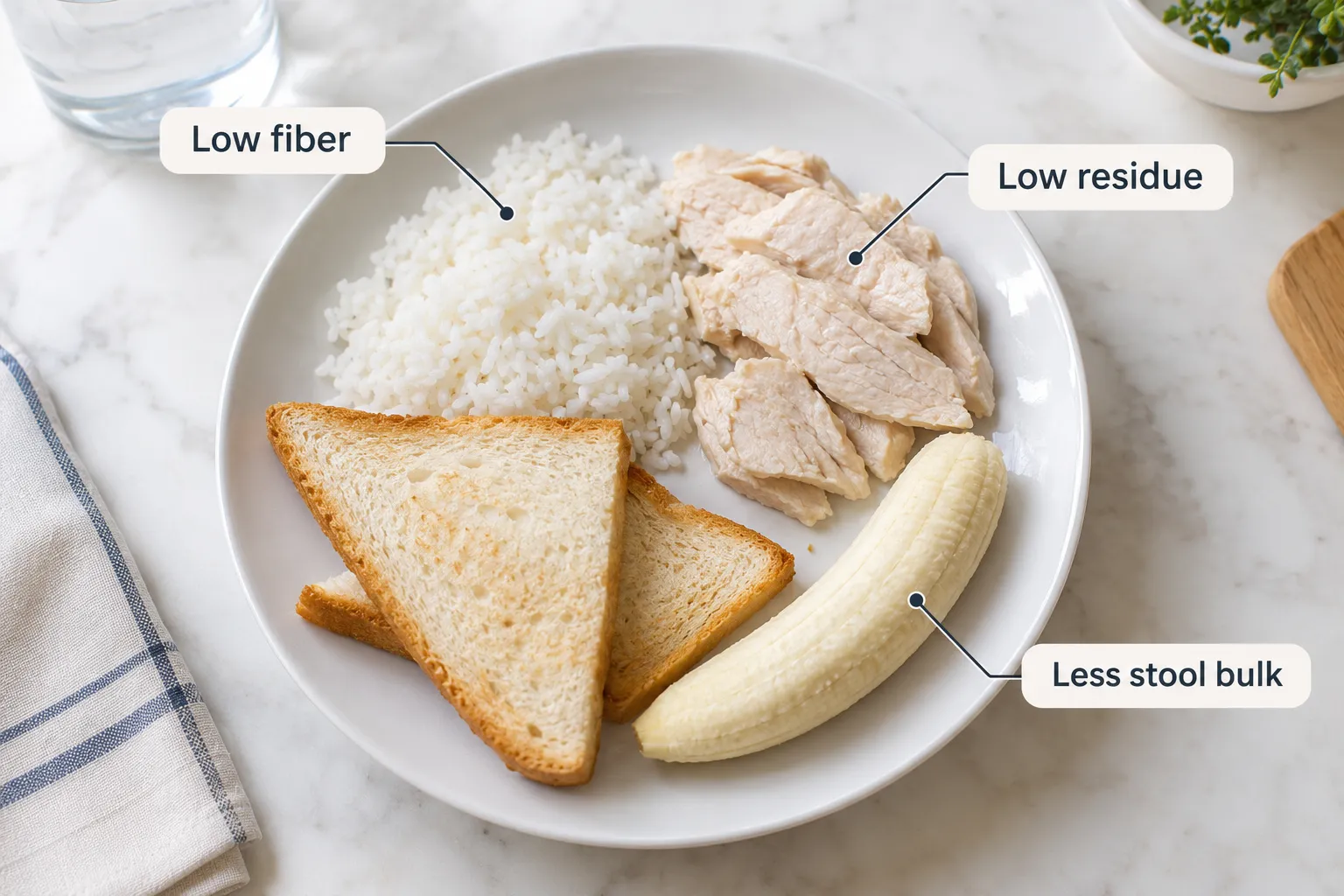
Mayo Clinic’s low-fiber diet guidance explains the mechanism clearly: with less undigested fiber moving through the digestive tract, stool becomes less bulky, bowel movements can become less frequent, and stools may be smaller, and it states plainly that constipation can occur on a low-fiber diet unless a person compensates with extra fluids [1]. Memorial Sloan Kettering Cancer Center’s patient education on low-fiber eating makes the same point: limiting fiber reduces the amount of undigested material moving through the gut, so the body produces less stool and that stool tends to move more slowly, which is why adequate fluid intake, generally framed as eight to ten eight-ounce glasses of non-caffeinated liquid per day, is recommended as a protective step [8]. Cleveland Clinic’s clinical overview goes further and calls constipation a common experience during a low-fiber diet, again pointing to hydration as a central countermeasure, along with smaller, more frequent portions if bloating develops [2].
Healthline’s medically reviewed overview of the bland diet specifically notes that because the diet is low in fiber, it can lead to constipation, and recommends drinking plenty of water throughout the day as a preventive measure [9]. Memorial Sloan Kettering’s bland diet patient sheet is even more direct, describing bland “binding” foods, the banana, rice, applesauce, toast pattern many people know informally as BRAT, as foods that can cause constipation, with fluid intake again named as the practical countermeasure [6]. It is worth being precise here: this pattern is referenced as an example of binding, low-residue foods, not as a structured medical protocol to follow on your own.
So the evidence suggests a real, mechanistically sensible connection: less fiber and less residue generally means less stool bulk and, for some people, slower transit. The stronger evidence points toward this being common enough that major clinical and cancer-care institutions routinely warn about it and build hydration guidance around it [1][2][6][8][9]. That is a meaningfully different claim from saying a bland diet causes constipation in everyone, and it is important to separate the two.
It Is Not That Simple, Individual Tolerance Varies
This is where hype gets in the way of accuracy. Fiber and residue tolerance is not uniform. A population-based study of adults found significantly higher constipation rates among those in the lowest quartile of both fiber intake and fluid intake, supporting the general idea that low fiber plus low fluids raises risk for many people [4]. But a separate clinical study of people with idiopathic constipation found the opposite pattern in a subset of patients: those who reduced dietary fiber actually experienced meaningful improvement in their symptoms, while those who continued a high-fiber diet saw no change [5][12]. A broader 2015 review of low-residue and low-fiber diets in gastrointestinal disease concluded there is not enough evidence to justify routine use of low-residue diets across the board, while also acknowledging that reducing fiber helps some individuals even though high-fiber diets are the more commonly recommended approach for constipation generally [7].
Put plainly: more fiber is not automatically better for every digestive system, and less fiber is not automatically worse. Context matters, the conditions matter, and this is exactly why a bland or low-fiber pattern can be constipating for one person and genuinely soothing for another.
Other Factors That May Matter Besides Food
A sensible starting point is recognizing that food is rarely acting alone. Several other factors commonly interact with a low-fiber, low-residue eating pattern to influence bowel habits. This is general education, not an individualized assessment.
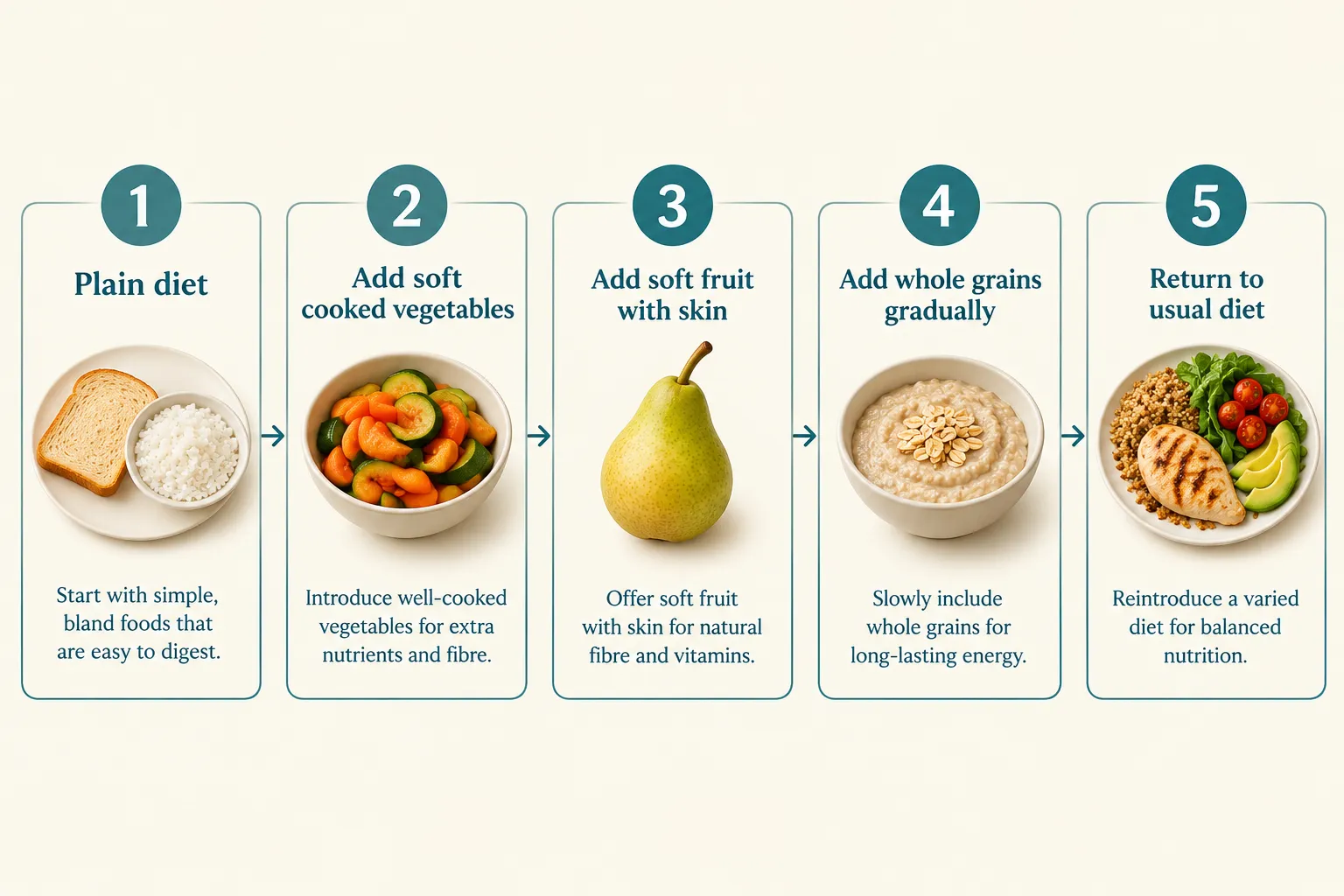
- Fluid intake. Multiple clinical sources tie fluid intake directly to constipation risk alongside fiber, with specific hydration ranges, roughly 8 to 10 eight-ounce glasses of non-caffeinated liquid daily, mentioned as a standard protective measure during low-fiber or bland eating [1][2][8][11].
- Baseline diet before the bland period began. Someone who normally eats a high-fiber diet and temporarily drops to bland foods may notice a bigger shift than someone whose usual diet was already fiber-light.
- Physical activity. University of Michigan Health’s constipation overview notes that low-fiber, high-fat eating patterns are commonly associated with constipation, and that this is particularly notable in older adults who often rely on quick, prepared foods that tend to be both low in fiber and high in fat, a pattern that can combine with reduced activity levels [14].
- Medications. Certain medications, including some pain relievers, iron supplements, and other common prescriptions, are well known to slow bowel transit. This article will not recommend adjusting any medication; that decision belongs with the prescribing clinician.
- Underlying health conditions. Conditions affecting the thyroid, the nervous system, or the structure of the digestive tract can influence bowel habits independently of diet.
The numbers matter here, too: UCLH’s low-fiber diet guidance defines a genuinely low-fiber intake as roughly 10 grams per day or less, which is well below general population fiber recommendations, and it notes that fiber can actually help with both diarrhea and constipation depending on the situation, underscoring, again, how conditional this topic is [11]. The main takeaway is that food is one variable among several, and isolating it without considering fluids, activity, medications, and health history will usually give an incomplete picture.
How to Broaden a Temporary Menu Based on Individual Tolerance and Clinician Guidance
From a practical point of view, most people who adopt a bland diet do so for a short, specific reason, recovering from a stomach bug, easing nausea, or getting through a rough few days. A sensible approach for broadening the menu back out is gradual and based on personal tolerance, not a fixed calendar.
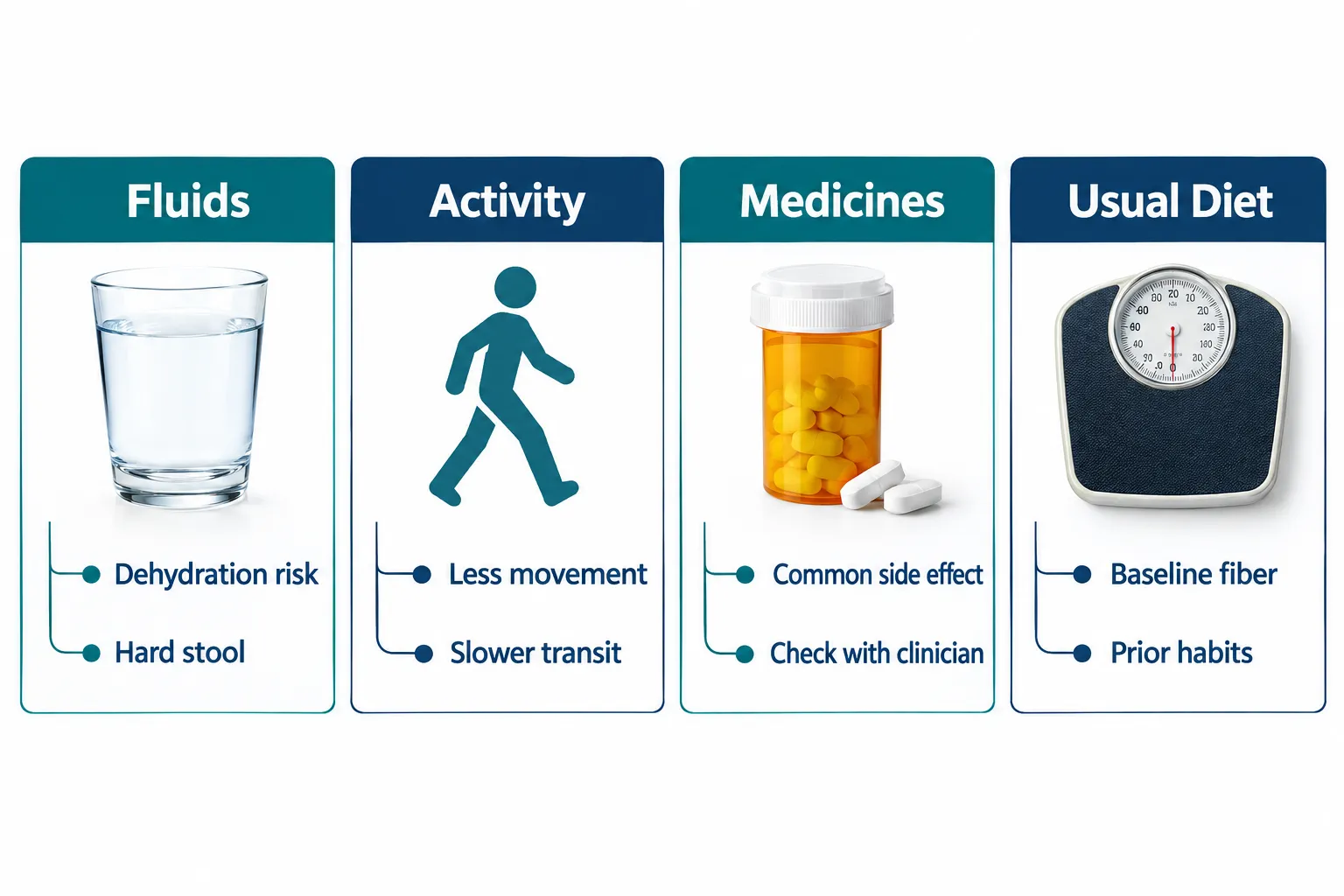
There is no universal timetable here, and this article will not provide one, because recovery speed depends on the original reason for the bland diet, overall health, age, and how the digestive system responds as foods are reintroduced. What tends to make sense, in general terms, is:
- Reintroducing foods one or two at a time rather than returning to a full, varied diet all at once, so that any food that does not sit well is easier to identify.
- Paying attention to how fiber-containing foods, cooked vegetables, fruit with skin, whole grains, feel as they are added back, since tolerance differs from person to person.
- Keeping fluid intake steady or increased as fiber is reintroduced, since fiber and fluid tend to work together rather than independently [1][8].
- Stopping and reassessing, rather than pushing through, if reintroducing fiber brings on new discomfort, bloating, or a return of the original symptoms.
Keep it simple and consistent: small, steady changes are easier to evaluate than large ones, and they make it easier to notice what is actually helping versus what is simply coinciding with other changes in the week.
Food and Meal Adjustments to Consider Without Universal Prescriptions
There is no single fiber number, food list, or meal pattern that works identically for everyone recovering from a short bland-diet period. That said, some general, non-prescriptive adjustments are commonly discussed in clinical nutrition education:
| Consideration | What the evidence generally supports | What it does not mean |
|---|---|---|
| Fluids | Adequate non-caffeinated fluid intake is consistently named alongside fiber as protective against constipation on low-fiber diets [1][2][8][11] | It does not mean more fluid alone will resolve all constipation |
| Gradual fiber reintroduction | Slowly adding cooked vegetables, soft fruit, and whole grains is a commonly used approach once tolerance allows | It is not a fixed schedule that applies to every person or condition |
| Portion size | Cleveland Clinic notes smaller, more frequent portions may help if bloating occurs on a low-fiber diet [2] | It is not a weight-management strategy |
| Activity level | Movement is commonly associated with more regular bowel habits in general health guidance | It is not a substitute for addressing an underlying medical cause |
A sensible starting point, once any acute stomach upset has settled, is simply noticing whether your usual, varied diet, the one you ate before the bland period, tends to keep things moving comfortably. If it does, there is often little reason to stay on a restrictive bland pattern longer than needed. If it does not, that is useful information to bring to a clinician rather than something to solve through trial and error with more and more dietary restriction.
For readers who want a deeper look at fiber specifically, how much is generally recommended, and the difference between soluble and insoluble types, that is a more detailed topic in its own right and sits outside the scope of this article.
When a Bland Menu May Be Medically Directed and Generic Advice Should Not Override It
This distinction deserves its own section because it is where confusion often causes harm. A short-term, self-selected bland diet used for a few days of stomach upset is a completely different situation from a bland or low-fiber diet prescribed by a clinician as part of a defined medical plan.
Michigan Medicine’s guidance on low-fiber and low-residue diets is explicit that these diets are sometimes used deliberately for conditions such as slow-transit constipation, inflammatory bowel disease flares, diverticulitis recovery, or after certain bowel surgeries, but it also stresses that fiber tolerance is highly individual, that many patients do not need to stay on a low-fiber diet long term, and that fiber should be reintroduced under clinician guidance rather than by generic rule of thumb [15]. That is an important nuance: the same dietary pattern that can contribute to constipation in one context is deliberately used, under supervision, to calm the digestive tract in another.
If a bland or low-fiber diet is part of a post-surgical recovery plan, a gastroenterology-directed protocol, or management for a diagnosed condition, that individualized guidance should take priority over any general food advice, including the general observations in this article. I would be careful with that distinction, because following generic nutrition content instead of a clinician’s specific plan is one of the more common ways people inadvertently slow their own recovery or worsen a managed condition.
Children, older adults, pregnant people, and people with chronic health conditions fall into this same category of needing earlier, more individualized guidance. Bowel patterns, fluid needs, medication interactions, and risk tolerance all differ meaningfully across these groups, and general adult nutrition advice is less reliably applicable to them.
Red Flags and When to Seek Professional Care
The main takeaway from everything above is this: a bland diet’s connection to constipation is plausible, evidence-aware, and conditional, but it is never something to self-diagnose around if symptoms are serious. This section is not meant to alarm; it is meant to give a clear, conservative line for when food adjustments are no longer the right tool.
Seek prompt medical care, rather than continuing to adjust diet at home, if you or someone you are caring for experiences any of the following:
- Severe or worsening abdominal pain
- Persistent vomiting
- Signs of significant dehydration, such as dizziness, very dark urine, or confusion
- Fever alongside digestive symptoms
- Black, tarry, or visibly bloody stools
- Unexplained weight loss
- Constipation or other digestive symptoms that persist for more than a few days or continue to worsen despite reasonable fluid and activity adjustments
Children, older adults, pregnant people, and people managing chronic conditions such as diabetes, inflammatory bowel disease, kidney disease, or cardiovascular disease should generally seek clinical guidance earlier and with a lower threshold than a healthy adult might, since digestive symptoms can signal different underlying issues, and fluid or dietary changes that are safe for one group may not be appropriate for another.
The simplest way to look at it is this: dietary tweaks are a reasonable first step for mild, short-term, non-alarming symptoms. Anything on the list above moves the situation out of the realm of food adjustment and into the realm of a clinical evaluation.
FAQ
Can a bland diet cause constipation in everyone who tries it?
No. The evidence suggests it can contribute to constipation for some people, largely because bland foods tend to be low in fiber and residue, but tolerance varies widely, and many people experience no change at all [1][8].
Does drinking more water fix constipation caused by a bland diet?
Clinical sources consistently name adequate fluid intake as a key protective factor alongside fiber when following a low-fiber or bland eating pattern [1][2][8][11]. That said, this article does not provide fluid-intake prescriptions for individual medical situations, and fluid alone will not resolve constipation that has another underlying cause.
Is the BRAT diet something I should follow to prevent constipation?
BRAT foods (bananas, rice, applesauce, toast) are commonly referenced as an example of binding, low-residue foods, and at least one major cancer center specifically notes they can contribute to constipation [6]. This article does not present BRAT as a structured protocol, and it is generally intended as a short-term comfort pattern rather than an ongoing eating plan.
How long is it normal to eat a bland diet before symptoms should improve?
There is no fixed, universal timetable, because recovery depends on the original reason for the bland diet, individual health status, and how foods are reintroduced. If symptoms persist or worsen, that is a signal to seek clinical input rather than to keep waiting.
Does a low-fiber diet treat irritable bowel syndrome or other digestive diseases?
No. A bland or low-fiber eating pattern is not a treatment for IBS or any other digestive disease. In certain medically supervised contexts, clinicians do use structured low-residue diets for specific conditions, but that is a clinician-directed plan, not a general self-care strategy [15].
Should older adults or people with chronic conditions follow the same general guidance as healthy adults?
No. Children, older adults, pregnant people, and people with chronic health conditions typically need earlier, individualized clinical guidance rather than general dietary adjustment, since their risk factors and appropriate responses can differ substantially.
Conclusion
Let’s call it what it is: a bland diet can contribute to constipation for some people, mainly because it tends to be low in fiber and residue, which reduces stool bulk and can slow transit, and this effect is well enough recognized that major clinical institutions build hydration advice directly around it [1][2][8]. But it is not that simple, and it is not universal. Fiber tolerance varies, fluid intake and activity matter, certain medications and health conditions play a role, and in some documented cases, reducing fiber actually improves symptoms rather than worsening them [5][7][12]. The basics still do the heavy lifting: steady fluids, gradual food reintroduction based on how your own body responds, and a willingness to bring in a clinician when symptoms are new, persistent, or severe.
A short-term bland diet used for a few uncomfortable days is a different situation from a clinician-directed low-fiber diet used after surgery or for a diagnosed condition, and the second should always take priority over general nutrition content, including this article. If you notice red flag symptoms such as severe pain, vomiting, signs of dehydration, fever, black or bloody stools, unexplained weight loss, or symptoms that are not improving, the right next step is professional evaluation, not further dietary experimentation.
References
[1] Art 20048511 – https://www.mayoclinic.org/healthy-lifestyle/nutrition-and-healthy-eating/in-depth/low-fiber-diet/art-20048511[2] Low Fiber Diet – https://health.clevelandclinic.org/low-fiber-diet
[3] Eating Diet Nutrition – https://www.niddk.nih.gov/health-information/digestive-diseases/constipation/eating-diet-nutrition
[4] Pmc3786707 – https://pmc.ncbi.nlm.nih.gov/articles/PMC3786707/
[5] Pmc3435786 – https://pmc.ncbi.nlm.nih.gov/articles/PMC3435786/
[6] Bland Diet – https://www.mskcc.org/experience/patient-support/nutrition-cancer/diet-plans-cancer/bland-diet
[7] Pmc4642427 – https://pmc.ncbi.nlm.nih.gov/articles/PMC4642427/
[8] Low Fiber Diet – https://www.mskcc.org/cancer-care/patient-education/low-fiber-diet
[9] Bland Diet – https://www.healthline.com/health/food-nutrition/bland-diet
[11] UCLH Low-Fibre Diet Sheet – https://www.uclh.nhs.uk/patients-and-visitors/patient-information-pages
[12] Pmc3435786 – https://pmc.ncbi.nlm.nih.gov/articles/PMC3435786/
[14] University of Michigan Health Constipation Overview – https://www.uofmhealth.org/
[15] Michigan Medicine Low-Fiber/Low-Residue Diet Guide – https://www.uofmhealth.org/
Medical Disclaimer
This article is for general educational purposes only and does not constitute medical advice. It does not diagnose any condition, recommend treatment, prescribe medications or supplements, or suggest changes to any existing medication or treatment plan. Bland and low-fiber diets are discussed here only in general, non-individualized terms, and tolerance, needs, and appropriate care vary from person to person. Always consult a qualified healthcare professional before making changes to your diet, especially if you are pregnant, caring for a child, managing a chronic condition, recovering from surgery, or experiencing new, severe, or persistent digestive symptoms. If you are experiencing a medical emergency, contact emergency services immediately.

Dave James is a health researcher and writer specialising in evidence-aware nutrition, digestive health, exercise and longevity. He founded All Perfect Health to provide clear, practical health guidance rooted in current research and real-world experience. He writes about what the evidence does — and does not — show.
📂 Bland Diet & Digestive Recovery
This article is part of the All Perfect Health Bland Diet cluster. Use the links below to move between the pillar and supporting guides.
→ Bland Diet for Diarrhea: What to Eat, What to Avoid, and When to Get Help
→ Stomach Flu (Gastroenteritis): Symptoms, Causes, Treatment, and When to Get Help
→ BRAT Diet for Nausea: What to Eat, What to Avoid, and What Works Better
→ Bland Diet Food List: Gentle Foods to Eat, Foods to Avoid and a Simple Grocery List
→ Bland Diet Meal Plan: A Gentle 1-Day Plan for Breakfast, Lunch, Dinner and Snacks
→ 6 Best Bland Diet Recipes for Digestive Recovery (2026)
→ Bland Diet Breakfast: 15 Satisfying Recipes That Won’t Upset Your Stomach
→ Bland Food Diet Guide: Gentle Foods, Meal Ideas and What to Avoid
YOU ARE HERECan a Bland Diet Cause Constipation? What to Know and When to Change Course