
Best Home Workouts Without Equipment
Last updated: April 8, 2026
Quick Answer: The best home workouts without equipment use bodyweight movements — push-ups, squats, lunges, planks, and mountain climbers — arranged into short circuits of 10 to 20 minutes. Beginners can start with three sessions per week and see measurable improvements in strength and endurance within three to four weeks. No gym, no gear, no excuses needed.
Key Takeaways
- Bodyweight training builds real strength and cardiovascular fitness without any equipment
- Six foundational movements — push-ups, squats, lunges, planks, glute bridges, and mountain climbers — cover most of what your body needs
- A 10-minute beginner circuit is enough to start; 20 minutes is the standard for a full-body session
- Three sessions per week is the evidence-supported minimum for noticeable progress
- Proper form matters more than volume, especially in the first four weeks
- Low-impact versions of every exercise exist for people with joint sensitivity or mobility limitations
- Progress is built through small, consistent increases — not by doing more in one session
- The only equipment you genuinely need is a flat floor, comfortable clothing, and a timer
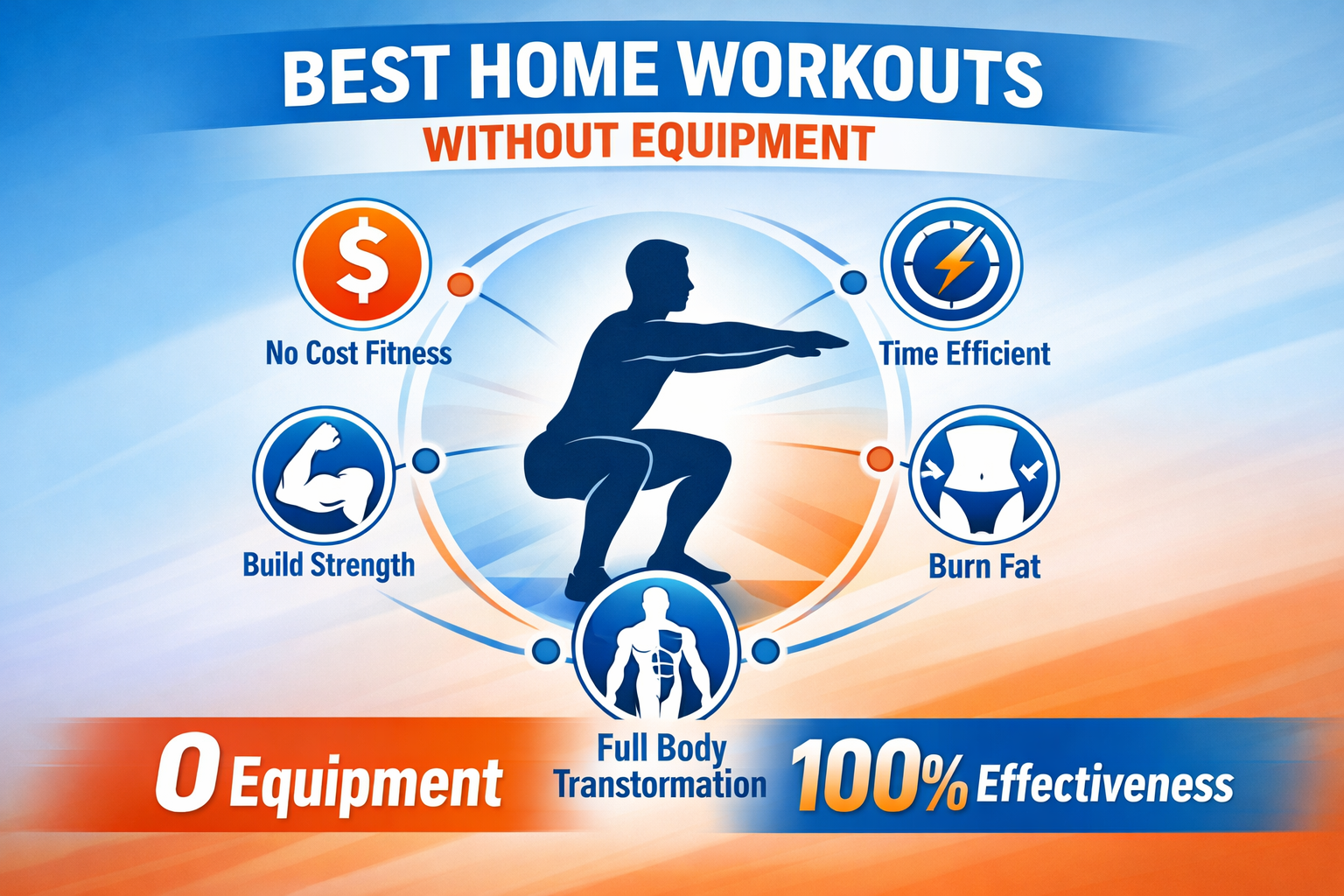
Why No-Equipment Home Workouts Work
Bodyweight training works because your body does not know the difference between a barbell and gravity — it only knows resistance. When you perform a squat, a push-up, or a plank, your muscles are contracting against load. The source of that load is irrelevant to the adaptation process.
The evidence for this is consistent. A review published in the Journal of Human Kinetics found that bodyweight resistance training produces significant improvements in muscular strength, endurance, and body composition when performed with adequate intensity and progressive overload. The mechanism is the same as gym-based training: you stress the muscle, it recovers, it adapts.
From a practical point of view, home workouts without equipment remove the two most common barriers to exercise: cost and convenience. There is no commute, no membership fee, no waiting for machines, and no scheduling around gym hours. You can train at 6 am in your living room or at 10 pm in a hotel room. That flexibility is not a minor benefit — for busy adults, it is often the difference between training consistently and not training at all.
Here’s the real issue with most people’s approach: they assume that without equipment, the workout cannot be serious. That is simply not accurate. The best home workouts without equipment, when structured correctly, challenge every major muscle group, elevate heart rate, and drive the same physiological adaptations as gym-based training. The structure is what matters, not the setting.
“Consistency in a simple routine beats occasional heroics in a complicated one. The basics still do the heavy lifting.”
For anyone looking to understand how exercise fits into a broader health strategy, our Exercise Guide for Better Health covers the wider picture clearly.
Best Bodyweight Exercises to Do at Home
The strongest no-equipment routines are built from a short list of movements that cover pushing, pulling, hinging, squatting, and core stability. You do not need twenty exercises. You need the right ten, performed well.
Here are the ten foundational movements that leading fitness sources consistently recommend for home workouts without equipment [3]:
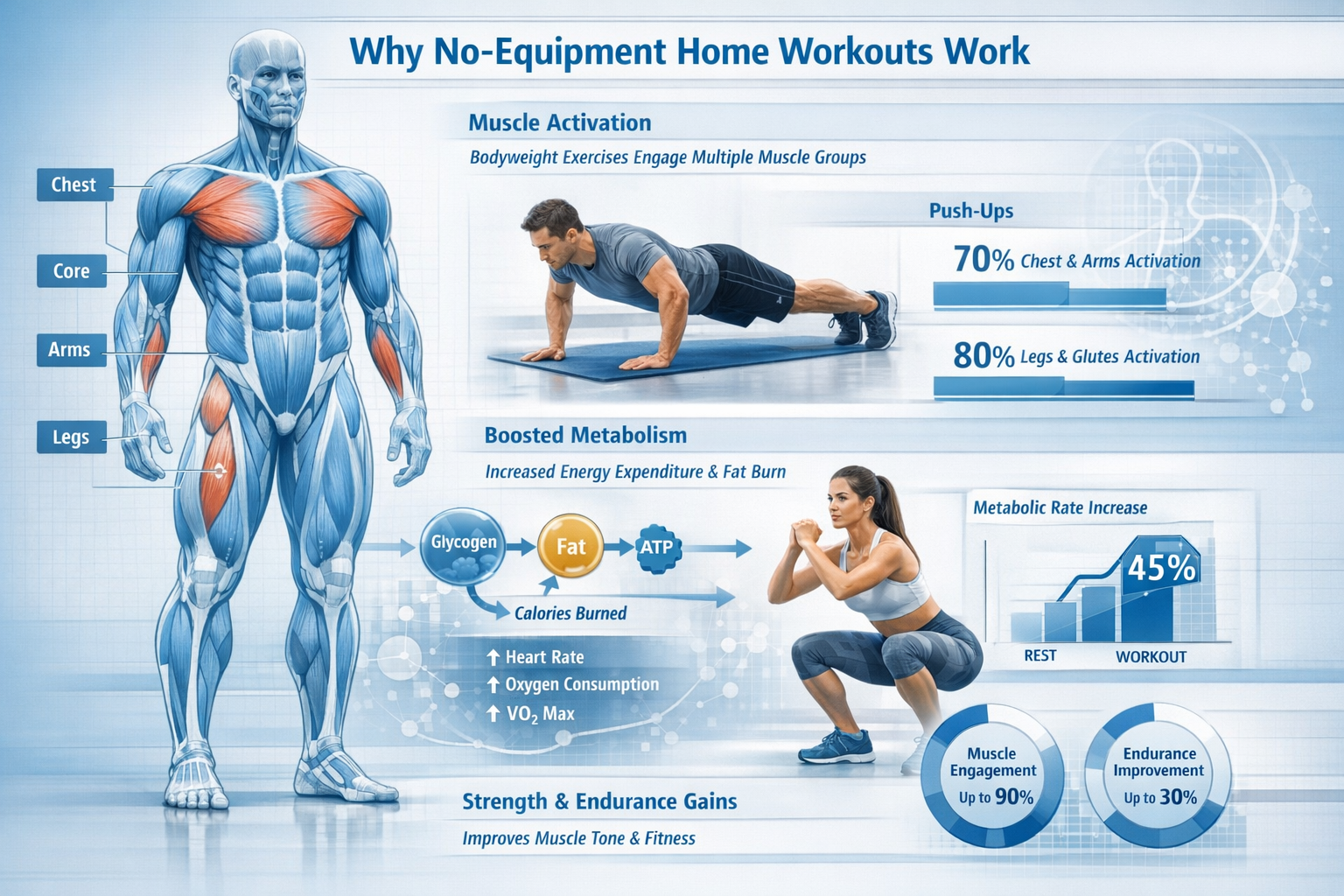
The Core Ten
| Exercise | Primary Muscles | Beginner Modification |
|---|---|---|
| Push-up | Chest, shoulders, triceps | Knee push-up |
| Bodyweight squat | Quads, glutes, hamstrings | Shallow squat to chair |
| Reverse lunge | Glutes, quads, balance | Supported lunge (hold wall) |
| Plank | Core, shoulders, glutes | Knee plank |
| Glute bridge | Glutes, hamstrings, lower back | Standard version suits most |
| Mountain climber | Core, hip flexors, cardio | Slow-tempo mountain climber |
| Burpee | Full body, cardio | Step-back burpee (no jump) |
| Wall sit | Quads, glutes, endurance | Shorter hold duration |
| Tricep dip | Triceps, shoulders | Use a sturdy chair |
| Jumping jack | Cardio, coordination | Step jack (no jump) |
A note on form: every exercise on this list has a modification. If you cannot perform the standard version with control, use the modification. There is no benefit in doing a sloppy full push-up when a controlled knee push-up delivers better stimulus and lower injury risk.
Exercise Technique Notes Worth Knowing
Push-ups: Keep your body in a straight line from head to heels. Elbows should track at roughly 45 degrees from your torso, not flared out wide. Lower your chest to within an inch of the floor.
Squats: Feet shoulder-width apart, toes slightly out. Push your knees out in line with your toes as you descend. Aim to get your thighs parallel to the floor. Keep your chest up.
Planks: Hips level — not sagging, not raised. Squeeze your glutes and brace your core as if bracing for a punch. Breathe steadily. Start with 20-30 second holds and work toward 60 seconds before advancing to variations [3].
Glute bridges: Lie on your back, feet flat on the floor, knees bent. Drive your hips up until your body forms a straight line from knees to shoulders. Squeeze at the top. This is one of the most underrated exercises in any bodyweight routine.
10-Minute Beginner Home Workout Without Equipment
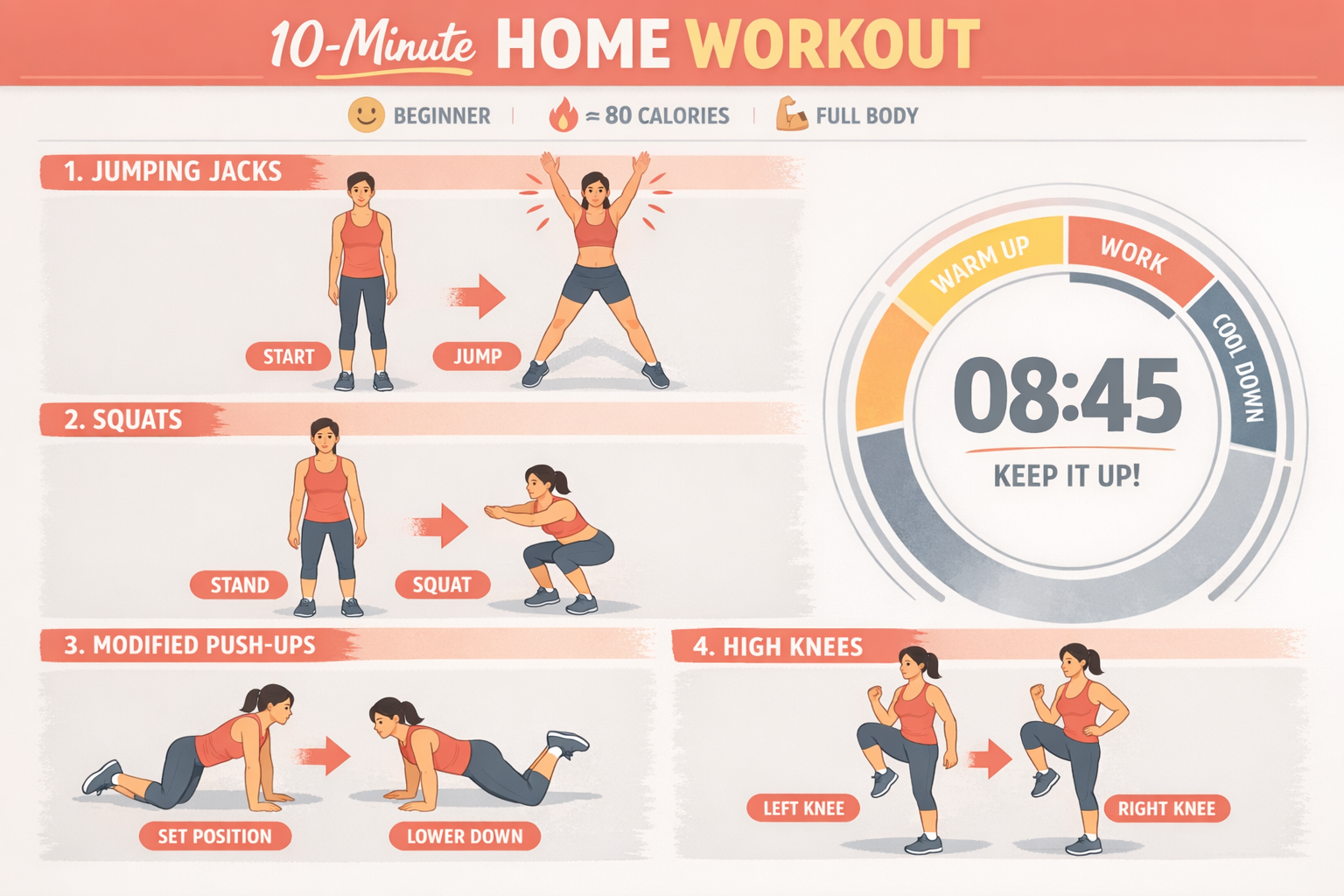
This is where most people should start. A 10-minute beginner home workout no equipment routine removes the intimidation factor and builds the habit before building the volume.
The structure is simple: three rounds of four exercises, with one-minute rest between rounds [1].
Beginner Circuit (10 Minutes)
Round structure: Complete all four exercises back to back, then rest 60 seconds. Repeat for 3 rounds.
- Bodyweight squats — 10 reps
- Knee push-ups — 5 reps
- Jumping jacks — 15 reps
- Plank hold — 20 seconds
Frequency: 3 times per week, with at least one rest day between sessions.
What to expect: Most beginners notice improved endurance and reduced muscle soreness within two to three weeks. Visible strength changes typically appear at the three to four week mark [1].
A sensible starting point is to treat the first two weeks as a learning phase. Focus on form, not speed. Count reps slowly. Pause between exercises if you need to. The goal in week one is not to finish exhausted — it is to finish with good technique and come back two days later.
Common beginner mistake: Skipping the warm-up. Even for a 10-minute session, two minutes of dynamic movement — arm circles, leg swings, hip rotations — reduces injury risk and improves performance. It is not optional.
20-Minute Full-Body No-Equipment Workout
Once the beginner circuit feels manageable — usually after two to four weeks — the 20-minute full-body format is the standard step up. This is the format that most structured home workout programs use as their baseline [3].
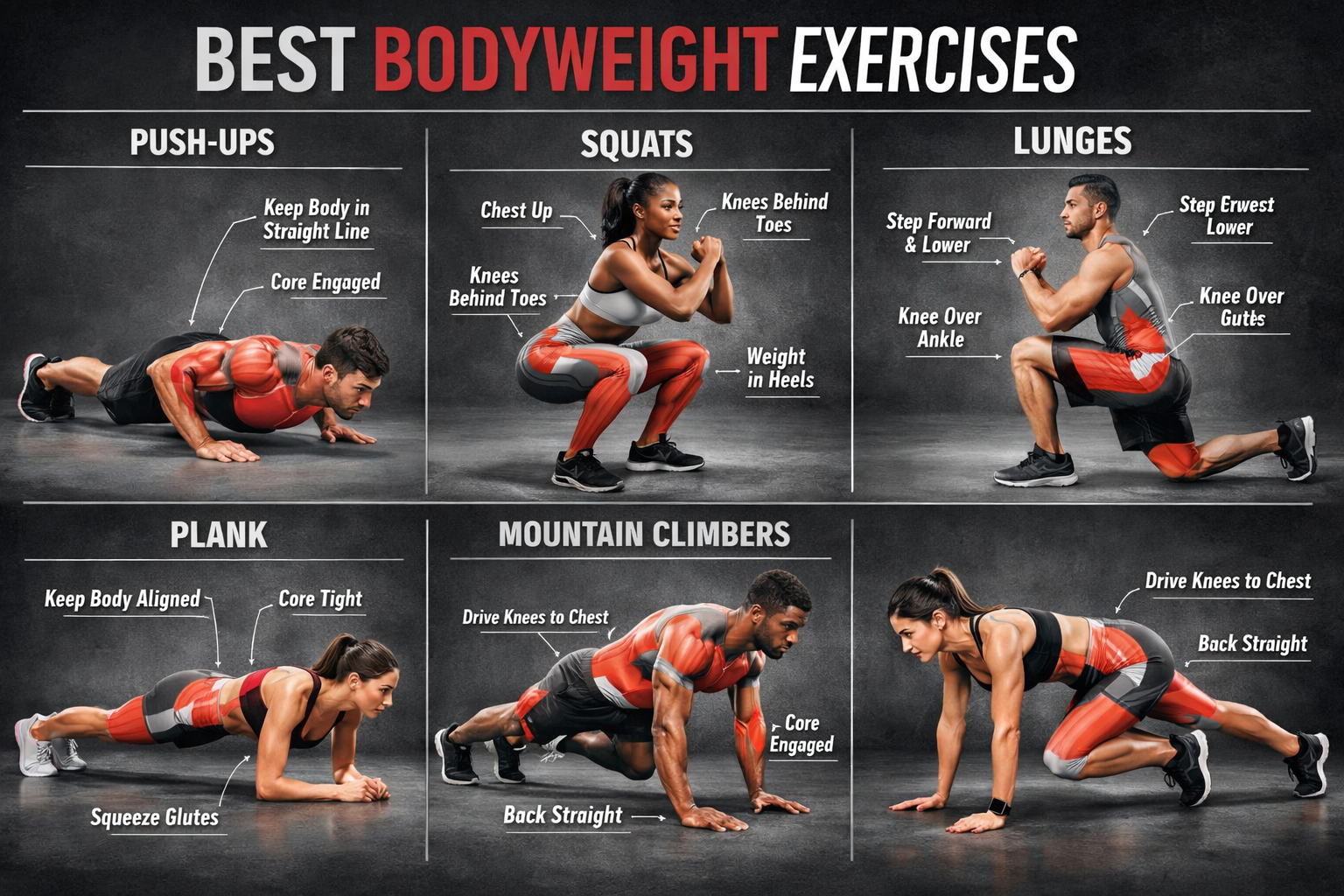
20-Minute Full-Body Circuit
Warm-up (3 minutes):
- 25 jumping jacks
- 20 bodyweight squats
- 5 lunges per leg
- 10 hip circles per side
- 10 forward leg swings per leg [2]
Main Circuit — 3 Rounds:
Perform each exercise for 45 seconds, then move immediately to the next. Rest 60 seconds between rounds.
| Exercise | Duration | Notes |
|---|---|---|
| Push-ups | 45 seconds | Modify to knee push-ups if needed |
| Bodyweight squats | 45 seconds | Controlled descent |
| Reverse lunges | 45 seconds | Alternate legs |
| Mountain climbers | 45 seconds | Drive knees toward chest |
| Glute bridges | 45 seconds | Squeeze at top of each rep |
| Plank hold | 30 seconds | Maintain neutral spine |
Rest: 60 seconds between rounds
Cool-down (2 minutes): Static stretches — hip flexor stretch, hamstring stretch, chest opener, child’s pose.
Total time: approximately 20 minutes.
This format keeps your heart rate elevated while building strength simultaneously — which is the core advantage of circuit training for people with limited time [1]. You are getting cardiovascular and muscular stimulus in one session.
HIIT Variation for Fat Loss
If fat loss is the primary goal, a HIIT format is worth considering. The evidence suggests that high-intensity interval training produces greater calorie burn per minute than steady-state cardio, and it continues to elevate metabolism for a period after the session ends.
Simple HIIT structure:
- 30 seconds of burpees (or mountain climbers) at maximum effort
- 30 seconds complete rest
- Repeat 8 times [1]
That is eight minutes of actual work. It is not comfortable, but it is effective. Start with four rounds if eight feels unmanageable, and build up over two weeks.
For those interested in how nutrition supports fat loss alongside exercise, our guide on high-protein diet for weight loss covers the dietary side in practical detail.
Low-Impact Home Workouts Without Equipment
Low-impact does not mean low-effort. For people managing joint sensitivity, recovering from injury, or simply preferring gentler movement, low-impact bodyweight training is a legitimate and effective option.
The key distinction: low-impact means one foot stays in contact with the floor at all times. There is no jumping, no sudden impact loading. This reduces stress on knees, hips, and ankles without eliminating the cardiovascular or strength benefit.
Low-Impact Routine (15 Minutes)
Perform each exercise for 40 seconds, rest 20 seconds, then move to the next. Complete 2-3 rounds.
- Step jacks (instead of jumping jacks) — step one foot out at a time
- Slow bodyweight squats — 4-second descent, pause at bottom
- Standing hip abduction — lift one leg out to the side, controlled
- Glute bridges — standard or single-leg
- Wall sit — hold for 30-40 seconds
- Bird-dog — from hands and knees, extend opposite arm and leg
- Standing march — high knees, slow and controlled
This type of routine is particularly well-suited to adults over 50, those returning to exercise after a break, or anyone with knee or hip concerns. If you are managing a specific knee issue, our article on the best exercise bike for knee issues offers additional low-impact options worth considering.
Pilates and yoga-fusion approaches are also growing in 2026 as structured low-impact alternatives. Programs combining Pilates core work with yoga mobility — sometimes called PiYo-style training — run 25 to 45 minutes and build flexibility alongside lean muscle without joint strain [5]. These are not beginner-only options. They challenge coordination, balance, and muscular endurance in ways that pure strength circuits do not.
How Often Should You Do Bodyweight Workouts at Home?
Three sessions per week is the evidence-supported starting point for most adults. The American College of Sports Medicine recommends at least 150 minutes of moderate-intensity activity per week, which three 20-minute circuit sessions satisfy at the lower end.
Let’s keep this practical:
- Beginners (weeks 1-4): 3 sessions per week, with rest days between each session
- Intermediate (months 2-3): 4 sessions per week, alternating upper-body focus and lower-body focus
- Advanced: 5-6 sessions per week, with deliberate variation in intensity and movement patterns
The most common mistake is training too frequently too soon. Muscles adapt during rest, not during the workout. If you train every day in week one, you will not recover properly, your performance will decline, and the risk of overuse injury increases. More is not always better — this is one area where the evidence is clear.
Rest days are not wasted days. Light walking, stretching, or yoga on rest days supports recovery without adding training stress. Our guide on good morning exercises has some useful movement ideas for active recovery days.
Progression Framework (4 Weeks)
| Week | Sessions/Week | Focus | Volume |
|---|---|---|---|
| Week 1 | 3 | Form and technique | 2 rounds per session |
| Week 2 | 3 | Building endurance | 3 rounds per session |
| Week 3 | 3-4 | Adding intensity | 3 rounds + HIIT option |
| Week 4 | 4 | Full routine + progression | 3-4 rounds, harder variations |
After four weeks, reassess. If the current routine feels manageable, introduce harder exercise variations: standard push-ups instead of knee push-ups, walking lunges instead of reverse lunges, single-leg glute bridges instead of double-leg. Advanced progressions include Bulgarian split squats, jump squats, and eventually single-leg squat variations [2].
Common Mistakes to Avoid in Home Workouts Without Equipment
These are the patterns I see most often, and they are worth addressing directly because they slow progress and increase injury risk.
1. Skipping the warm-up
Even five minutes of dynamic movement matters. Cold muscles are less pliable and more prone to strain. A proper warm-up also improves performance — you will do more reps with better form.
2. Prioritising speed over control
A slow, controlled squat is more effective than a fast, sloppy one. The muscle needs time under tension to adapt. Rushing through reps to finish faster is counterproductive.
3. Neglecting the posterior chain
Most beginners focus on push-ups and squats and ignore glute bridges, bird-dogs, and hip extensions. The muscles on the back of your body — glutes, hamstrings, lower back — are critical for posture, injury prevention, and functional strength. Include them every session.
4. Not progressing over time
Doing the same workout with the same reps and the same intensity for months produces diminishing returns. Your body adapts. You need to give it new challenges — more reps, harder variations, shorter rest periods, or slower tempo.
5. Ignoring recovery and nutrition
Exercise is the stimulus. Recovery is where adaptation happens. Poor sleep and inadequate protein intake will blunt your results regardless of how well you train. A sensible approach to nutrition — particularly adequate protein — supports muscle repair and growth. Our high-fiber foods guide is a useful companion resource for building a diet that supports an active lifestyle.
6. Expecting results in one week
The evidence suggests three to four weeks for noticeable endurance improvements, six to eight weeks for visible strength changes. Patience is not optional — it is part of the process.
Interactive Workout Planner
Use the tool below to build a simple weekly bodyweight workout plan based on your current fitness level and available time.
🏠 Home Workout Planner
Build your no-equipment weekly routine in 30 seconds
Your Weekly Plan
Related Reading
If you want to go deeper on how exercise fits into a broader health and wellness strategy, our comprehensive Exercise Guide for Better Health covers the full picture — from cardiovascular training principles to strength programming and recovery. It is a practical companion to everything covered in this article.
For those combining home training with dietary changes, the guides on healthy meals for weight loss and intermittent fasting for weight loss are worth reading alongside your new workout routine.
Frequently Asked Questions
Can you actually build strength with no-equipment home workouts?
Yes. Bodyweight training builds genuine muscular strength through the same mechanism as gym training — progressive overload and resistance. The key is increasing difficulty over time through harder exercise variations, slower tempo, or reduced rest periods, rather than simply adding more reps of the same movement.
How long before I see results from home workouts without equipment?
Most beginners notice improved endurance and reduced breathlessness within two to three weeks. Visible strength and muscle tone changes typically appear at the six to eight week mark with consistent training three times per week [1].
What is the minimum space needed for a home workout?
A yoga mat-sized floor space — roughly 2 metres by 0.6 metres — is sufficient for the vast majority of bodyweight exercises. You need enough room to lie flat and extend your arms overhead [1].
Are home workouts without equipment good for weight loss?
Yes, particularly when combined with a calorie-appropriate diet. HIIT-format home workouts produce significant calorie burn during and after the session. Strength-based circuits preserve muscle mass during fat loss, which supports a healthier metabolic rate over time [1].
What is the best beginner home workout without equipment?
A simple circuit of 10 bodyweight squats, 5 knee push-ups, 15 jumping jacks, and a 20-second plank, repeated three times with 60-second rests, performed three times per week, is a well-structured and evidence-informed starting point for most beginners [1].
Do I need a warm-up for short home workouts?
Yes, even for 10-minute sessions. Two to three minutes of dynamic movement — leg swings, arm circles, hip rotations, and light squats — prepares the joints and muscles for load and reduces injury risk. It also improves performance during the session.
How do I progress when bodyweight exercises get too easy?
Move to harder variations before adding more reps. Replace knee push-ups with full push-ups, then progress to archer push-ups or decline push-ups. Replace double-leg glute bridges with single-leg versions. Replace squats with Bulgarian split squats. Progression through movement complexity is more effective than simply doing more of the same exercise [2].
Is a 10-minute home workout enough?
For a complete beginner, yes — a structured 10-minute circuit three times per week is enough to produce measurable improvements in the first four to six weeks. As fitness improves, 20 minutes becomes the more appropriate standard for continued progress [1] [3].
What should I eat to support home workouts?
Adequate protein is the most important dietary factor for muscle repair and adaptation. A general guideline is 1.6 to 2.2 grams of protein per kilogram of bodyweight per day for active adults. Our high-protein diet for weight loss guide covers practical food choices in detail.
Can older adults do home workouts without equipment?
Absolutely. Low-impact versions of all foundational exercises are suitable for most older adults. Glute bridges, wall sits, bird-dogs, and slow bodyweight squats build meaningful strength without joint stress. Anyone with specific health conditions should check with their doctor before starting a new exercise programme.
What is the difference between circuit training and HIIT for home workouts?
Circuit training moves through a sequence of exercises with short rests, keeping heart rate moderately elevated while building strength. HIIT alternates short bursts of maximum effort with full rest periods, producing a higher peak calorie burn. Both are effective; the choice depends on your goal and current fitness level [1].
Do I need a yoga mat for home workouts?
A yoga mat is useful for floor-based exercises like planks, glute bridges, and push-ups — it provides grip and cushioning. It is not strictly necessary, but it makes training more comfortable and reduces the risk of slipping on hard floors.
Conclusion
The main takeaway is this: the best home workouts without equipment are the ones you will actually do consistently. A simple three-day-per-week bodyweight circuit — built around push-ups, squats, lunges, planks, and glute bridges — delivers real, measurable results without a gym, without gear, and without a complicated programme.
Start with the 10-minute beginner circuit if you are new to exercise. Move to the 20-minute full-body format after two to four weeks. Progress through harder exercise variations as the current routine becomes manageable. Rest properly between sessions. Keep the nutrition side of things sensible.
There is no magic in it. The evidence is consistent, the movements are simple, and the barrier to entry is as low as it gets. The only thing standing between you and a functional, effective home workout routine is starting.
Your next step: Choose your fitness level and goal in the workout planner above, build your weekly plan, and complete your first session today. Three rounds of four exercises. Ten minutes. That is enough to begin.