
Resistance Band Workouts for Building Real Strength at Home
Last updated: July 2026
Strength training equipment doesn’t need to cost thousands of dollars or take up half your living room. Research published in the Journal of Sports Medicine and Physical Fitness shows that resistance band training can produce strength gains comparable to traditional weight training—often with better results for functional movement patterns that matter in daily life.
The evidence is clear: resistance band workouts for strength aren’t just a substitute for “real” training. They’re a legitimate tool that offers unique advantages, particularly for adults who want to build and maintain strength without the joint stress that comes with heavy weights. Let’s keep this practical and look at what actually works. This article is part of our Home Workouts & Strength cluster, where we explore resistance band training alongside bodyweight exercises and home gym setups.
In this article
Key Takeaways
- Resistance bands provide variable resistance that matches your strength curve better than fixed weights
- Loop bands, tube bands, and mini bands each serve specific training purposes for comprehensive strength development
- Progressive overload with bands comes from band thickness, exercise tempo, and range of motion—not just adding weight plates
- A complete resistance band routine can target all major muscle groups effectively in 30-45 minutes
- Bands are particularly joint-friendly, making them ideal for adults 45+ who want to build strength safely
In this guide
Expert insight: This video demonstrates proper form for exercises covered in this article, helping you get the most from every rep while avoiding common mistakes.
Why Resistance Bands Deserve a Place in Your Home Gym
Here’s the real issue with how most people think about resistance bands: they see them as physical therapy tools or light exercise accessories. The evidence suggests otherwise. A 2019 systematic review found that elastic resistance training produced similar strength gains to conventional weight training across multiple studies.
What makes bands different—and in some ways better—is variable resistance. As you stretch a band, the resistance increases. This matches how your muscles actually work. Take a bicep curl: you’re strongest in the middle of the movement, weaker at the bottom and top. Fixed weights provide the same resistance throughout, limiting you to what you can handle at your weakest point. Bands provide more resistance where you’re stronger.
From a practical point of view, this means better muscle activation and less joint stress. The stronger evidence points to bands being particularly effective for:
- Functional movement patterns that translate to real-world activities
- Joint-friendly resistance that reduces injury risk
- Accommodating resistance that challenges muscles optimally throughout the range of motion
- Stabilizer muscle activation because bands require more balance and control
For adults dealing with joint concerns—which includes most of us over 45—this matters. You can build real strength without the compressive forces that make traditional weight training problematic for some people.
The main takeaway is this: resistance bands aren’t a compromise. They’re a different tool with specific advantages. Home workouts without equipment have their place, but adding bands gives you the resistance needed for serious strength development.
Types of Bands and What Each Is Best For
Not all resistance bands are created equal. Understanding the differences helps you choose the right tool for specific exercises and training goals.
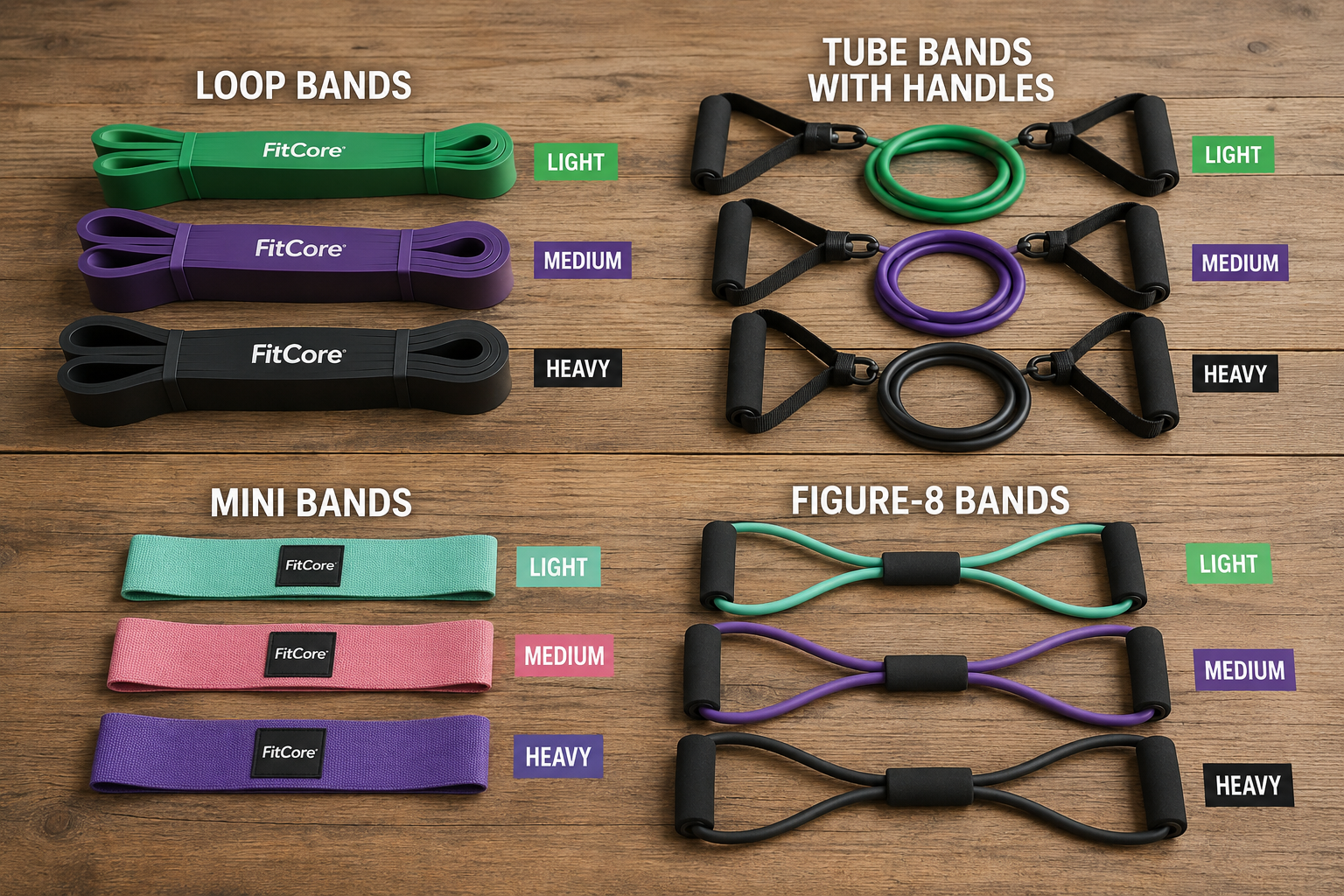
Loop Bands (Closed Loop)
These are continuous loops of elastic material, typically 12-15 inches in circumference. They’re excellent for:
- Lower body exercises like squats, lunges, and lateral walks
- Glute activation and hip strengthening
- Upper body exercises when anchored properly
Loop bands usually come in light, medium, and heavy resistance levels. A sensible starting point is to get all three—you’ll use different resistances for different muscle groups and exercises.
Tube Bands with Handles
These feature comfortable handles connected by elastic tubing, often with interchangeable resistance levels. They excel at:
- Upper body pulling and pushing movements
- Exercises that require a comfortable grip
- Movements that benefit from longer range of motion
Many tube band sets include door anchors, ankle straps, and multiple resistance tubes. This versatility makes them ideal for full-body training.
Mini Bands (Short Loop Bands)
These are smaller loop bands, typically 9-12 inches, designed for:
- Glute activation and hip stability work
- Physical therapy and rehabilitation exercises
- Adding resistance to bodyweight movements
Figure-8 Bands
Shaped like the number 8 with handles at each loop, these work well for:
- Upper body exercises with a secure grip
- Exercises requiring two anchor points
- Rehabilitation and lighter resistance work
The numbers matter here. Most quality bands are rated by resistance level—light (10-35 lbs), medium (40-60 lbs), heavy (65+ lbs). These numbers represent the resistance at full stretch, not the starting resistance.
For building real strength, you’ll need medium to heavy resistance bands. Light bands have their place for warm-ups and certain exercises, but they won’t provide enough challenge for major muscle groups in most adults.
How Progressive Tension Works With Bands
Progressive overload—gradually increasing training demands—is the foundation of strength building. With weights, you add plates. With bands, it’s more nuanced but equally effective.
Band Thickness and Resistance
The simplest way to progress is using thicker, higher-resistance bands. Start with a resistance that allows 12-15 quality repetitions. When you can complete 20 reps easily, move to a heavier band.
Pre-Stretching the Band
This is where bands get interesting. By starting an exercise with the band already stretched, you increase the resistance throughout the entire range of motion. For example, in a chest press, step further from your anchor point to pre-stretch the band before starting the movement.
Tempo Manipulation
Slowing down the eccentric (lengthening) portion of each rep increases difficulty significantly. A 3-second lowering phase can make a moderate resistance band feel much heavier.
Range of Motion Progression
Start with partial range of motion and progress to full range as strength improves. This is particularly useful for exercises like overhead presses where shoulder mobility might be limiting.
Combining Bands
Using two bands simultaneously doubles the resistance. This works well for lower body exercises where you might outgrow single-band resistance quickly.
The evidence suggests that these progression methods are as effective as adding weight plates for strength development. A 2018 study in the European Journal of Sport Science found that elastic resistance training produced similar strength gains to traditional weight training when progression was properly managed.
What matters most is consistency and gradual progression. More is not always better—focus on quality movement patterns and systematic increases in resistance or difficulty.
A Full-Body Resistance Band Routine
This routine targets all major muscle groups using resistance band workouts for strength development. Perform 2-3 times per week with at least one day of rest between sessions.
Upper Body Push: Band Chest Press
- Anchor band at chest height (door anchor or sturdy fixture)
- Face away from anchor, handles in each hand
- Press forward and slightly together, squeezing chest muscles
- 3 sets of 10-15 reps
Upper Body Pull: Band Rows
- Anchor band at chest height, face the anchor
- Pull handles to your ribs, squeezing shoulder blades together
- Focus on controlled movement, pause at the back
- 3 sets of 12-15 reps
Vertical Pull: Band Lat Pulldowns
- Anchor band overhead, kneel or sit below anchor point
- Pull handles down and back, engaging lats and mid-traps
- Keep chest up, shoulders down and back
- 3 sets of 10-12 reps
Lower Body: Band Squats
- Stand on band with feet shoulder-width apart
- Hold handles at shoulder height
- Squat down keeping knees aligned over toes
- Drive through heels to return to standing
- 3 sets of 15-20 reps
Single Leg: Band Lunges
- Step one foot forward onto band, hold handles at shoulders
- Lunge down keeping front knee over ankle
- Push through front heel to return to start
- 3 sets of 10-12 per leg
Core: Band Rotations
- Anchor band at chest height, stand perpendicular to anchor
- Hold handle with both hands, rotate away from anchor
- Keep core engaged, move from your torso not arms
- 3 sets of 12-15 per side
Posterior Chain: Band Romanian Deadlifts
- Stand on band with feet hip-width apart
- Hold handles, hinge at hips keeping back straight
- Feel stretch in hamstrings, return to standing
- 3 sets of 12-15 reps
Shoulders: Band Overhead Press
- Stand on band, hold handles at shoulder height
- Press handles overhead, keeping core engaged
- Lower with control, maintain neutral spine
- 3 sets of 10-12 reps
Start with moderate resistance that allows you to complete all reps with good form. Rest 30-60 seconds between sets, 60-90 seconds between exercises.
This routine provides the foundation for serious strength development. As you progress, increase resistance, add pre-stretch, or slow down the tempo. The key is consistent progression over time.
Combining Bands With Bodyweight Exercises
The real power of resistance band workouts for strength comes from combining bands with bodyweight movements. This creates unique training stimulus that’s difficult to replicate with weights alone.
Band-Assisted Bodyweight Movements
For exercises where bodyweight might be too challenging, bands provide assistance:
- Assisted Pull-ups: Loop a band over the pull-up bar, place knees or feet in the loop for assistance
- Assisted Pistol Squats: Hold band handles anchored overhead for balance and slight assistance
- Assisted Dips: Similar setup to pull-ups, band reduces bodyweight load
Band-Resisted Bodyweight Movements
Adding bands to standard bodyweight exercises increases difficulty:
- Banded Push-ups: Place band across your back, hold ends under your hands
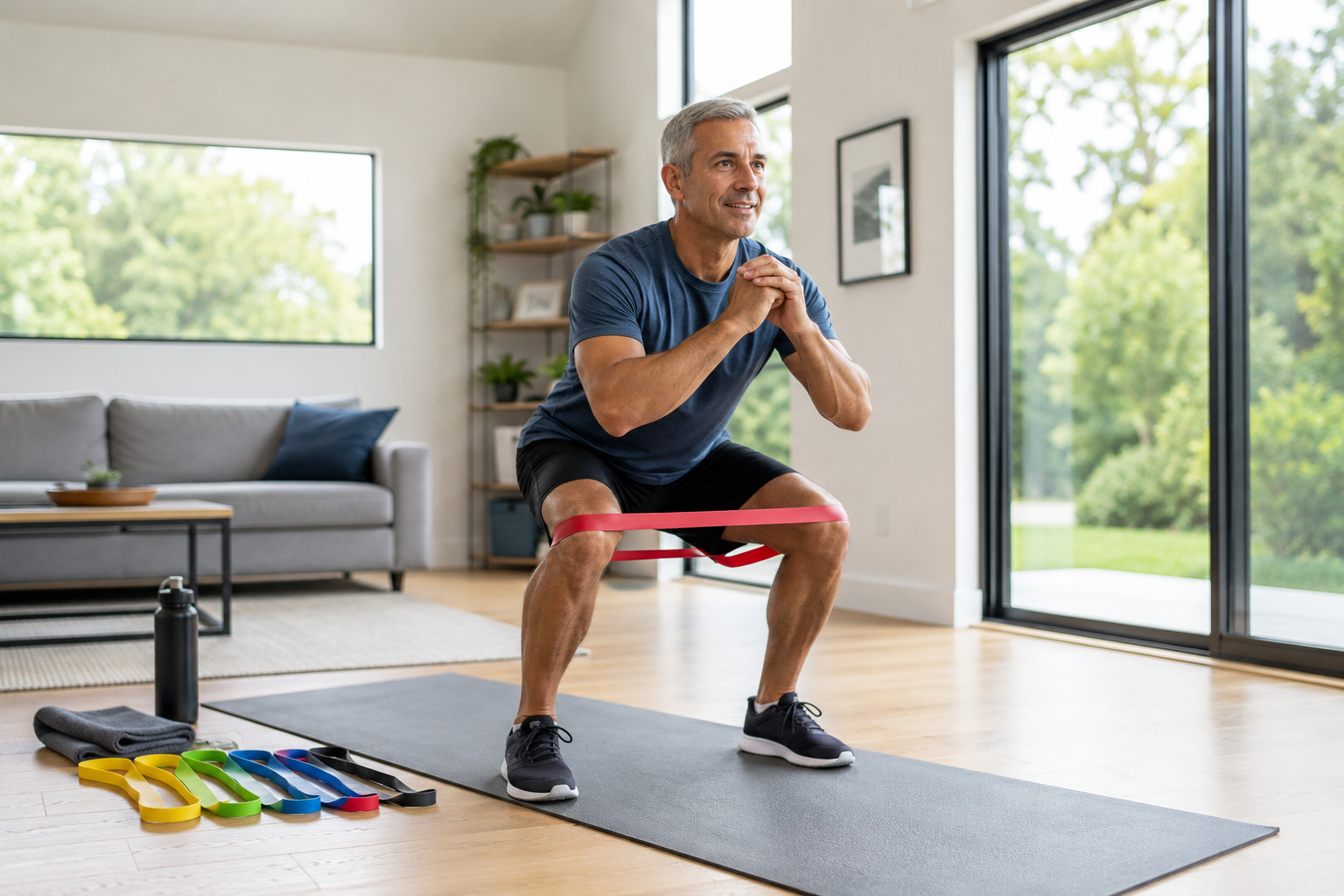
- Banded Squats: Stand on band or loop around thighs for additional resistance
- Banded Planks: Loop band around feet, hold handles to add anti-extension challenge
Dynamic Movement Patterns
Bands excel at resisting movement in multiple planes:
- Lateral Band Walks: Mini band around ankles or thighs, step sideways maintaining tension
- Band Monster Walks: Forward/backward walks with band resistance
- Banded Bear Crawls: Band around feet adds instability and resistance
These combinations work particularly well because they challenge stability and coordination while building strength. Resistance band training for joint health becomes even more effective when movement quality is emphasized alongside strength development.
Programming Considerations
When combining bands with bodyweight exercises:
- Start simple: Master the bodyweight movement before adding band resistance
- Focus on control: Bands will challenge your stability—maintain good form
- Progress gradually: Small increases in band tension create significant difficulty increases
- Listen to your body: The variable resistance can be more fatiguing than expected
This approach bridges the gap between basic bodyweight training and more advanced strength training methods. You get the benefits of resistance training without needing a full gym setup.
The evidence supports this combined approach. Research shows that elastic resistance training improves functional movement patterns better than traditional weights alone, particularly for older adults who need to maintain independence in daily activities.
Resistance Band Strength Finder
Select the muscle group to target:
FAQ
Can resistance bands really build as much strength as weights?
Based on current evidence, yes—when programmed correctly. Multiple studies show similar strength gains between elastic resistance and traditional weight training. The key is using appropriate resistance levels and progressive overload. Bands won’t make you a powerlifter, but they’ll build functional strength effectively for most people’s needs.
What resistance level should I start with?
A sensible starting point is medium resistance for most exercises. You should be able to complete 12-15 reps with good form, feeling challenged on the last 2-3 reps. If you can easily do 20+ reps, increase resistance. If you can’t maintain good form for 10 reps, decrease resistance.
How often should I do resistance band workouts for strength?
2-3 times per week works well for most people, with at least one day of rest between sessions. This allows for recovery while maintaining consistent stimulus for strength development. You can do light mobility work with bands on off days if desired.
Do I need different types of bands or will one set work?
For comprehensive strength training, you’ll want both loop bands and tube bands with handles. Loop bands excel for lower body exercises, while tube bands with door anchors give you more upper body options. A complete set covering light, medium, and heavy resistance levels provides the most versatility.
Are resistance bands safe for people with joint problems?
Generally yes, which is why they’re often recommended for joint health. The variable resistance reduces stress at the weakest points in your range of motion, and there’s no risk of dropping weights. However, if you have specific joint issues, consult with a healthcare provider before starting any new exercise program.
How do I know when to progress to harder exercises?
When you can complete all prescribed reps with perfect form and feel like you could do 5+ more reps, it’s time to progress. This might mean thicker bands, more pre-stretch, slower tempo, or more challenging exercise variations. The progression should feel challenging but manageable.
Conclusion
Resistance band workouts for strength aren’t a compromise—they’re a legitimate training method with unique advantages. The variable resistance matches your natural strength curves better than fixed weights, while being gentler on joints and more convenient for home use.
The evidence is clear: when programmed with appropriate resistance and progressive overload, bands can build real strength. For adults 45-65 who want to maintain and build strength at home, they offer an ideal combination of effectiveness, safety, and convenience.
Start with a basic set including loop bands and tube bands with handles in multiple resistance levels. Focus on the fundamental movement patterns covered in the routine above, and progress systematically by increasing resistance, tempo, or exercise complexity.
Keep it simple and consistent. The basics still do the heavy lifting when it comes to strength development—resistance bands just make those basics more accessible and joint-friendly. Whether you’re supplementing gym training or building a complete home routine, bands deserve a place in your strength-building toolkit.
📂 Best Home Workouts Without Equipment
This article is part of the APH cluster. Use the links below to move between the pillar and child articles.
- Read the pillar: Best Home Workouts Without Equipment
- → 7 Best Body Composition Exercises (With Examples) to Build Muscle and Burn Fat
- → Performing Leg Lifts Exercise: Complete Guide to Form, Benefits, and Variations
- → 10 Best Good Morning Exercises to Start Your Day Strong
- → Bodyweight Strength Training: How to Build Muscle Without Weights
- YOU ARE HERE Resistance Band Workouts for Building Real Strength at Home
- → The Best Home Gym Equipment for Strength Training on Any Budget
- → Quick Home Workouts: 15-Minute Routines for Busy Adults Over 40