
Zone 2 Cardio: A Practical Beginner’s Guide to Steady Aerobic Training

Last updated: September 30, 2026
Quick Answer
Zone 2 cardio is steady, comfortable aerobic exercise done at an effort you can sustain while still holding a short conversation. It is not a precise, universal heart-rate number, and recent research pushes back on the idea that it is a uniquely superior “fat-burning” or fitness zone [4]. For most adults 45 to 65, the practical version of zone 2 training is simple: pick a pace where breathing is elevated but controlled, do it several times a week, and build the habit before worrying about exact numbers.
Key Takeaways
- Zone 2 cardio means steady, low-to-moderate aerobic effort, not a fixed heart-rate number that applies to everyone the same way.
- The talk test—being able to speak comfortably in sentences rather than only a few words—is usually more useful day to day than a generic formula.
- Heart-rate estimates and wearable zone calculations vary with age, medications, fitness level, heat, hydration, and device accuracy [3].
- A 2025 review found no strong evidence that zone 2 is uniquely better than other intensities for mitochondrial or metabolic adaptation [4].
- Walking, cycling, and swimming at a steady, sustainable pace are all valid zone 2 exercise options.
- A sensible beginner pattern is to start with a duration and frequency you can recover from, then build gradually toward the broader public-health activity guidelines over time [5].
- Zone 2 training and harder efforts like HIIT are not rivals; they serve different purposes in a well-rounded routine.
- People with diagnosed heart disease, chest symptoms, or heart-rate-altering medications should get individualized guidance before starting a new cardio routine.
Table of Contents
- What Zone 2 Cardio Means in Plain English
- Why the Talk Test and Perceived Effort Come First
- Zone 2 Heart Rate: Useful Estimate, Not a Universal Prescription
- Beginner-Friendly Zone 2 Options: Walking, Cycling, and Swimming
- A Practical Weekly Progression for Adults Starting Out
- Zone 2 vs HIIT and Other Harder Cardio
- Common Mistakes That Make Easy Cardio Harder Than It Needs to Be
- When Individual Advice Makes Sense
- FAQ
- References
- Medical Disclaimer
What Zone 2 Cardio Means in Plain English
Zone 2 cardio is exercise performed at a steady, comfortable aerobic effort, roughly the pace you could hold for 30 to 60 minutes without needing to stop and gasp. In plain English, it sits between “barely trying” and “working hard,” and it is usually described by exercise physiologists as the intensity just below the point where breathing shifts from easy to labored [1].
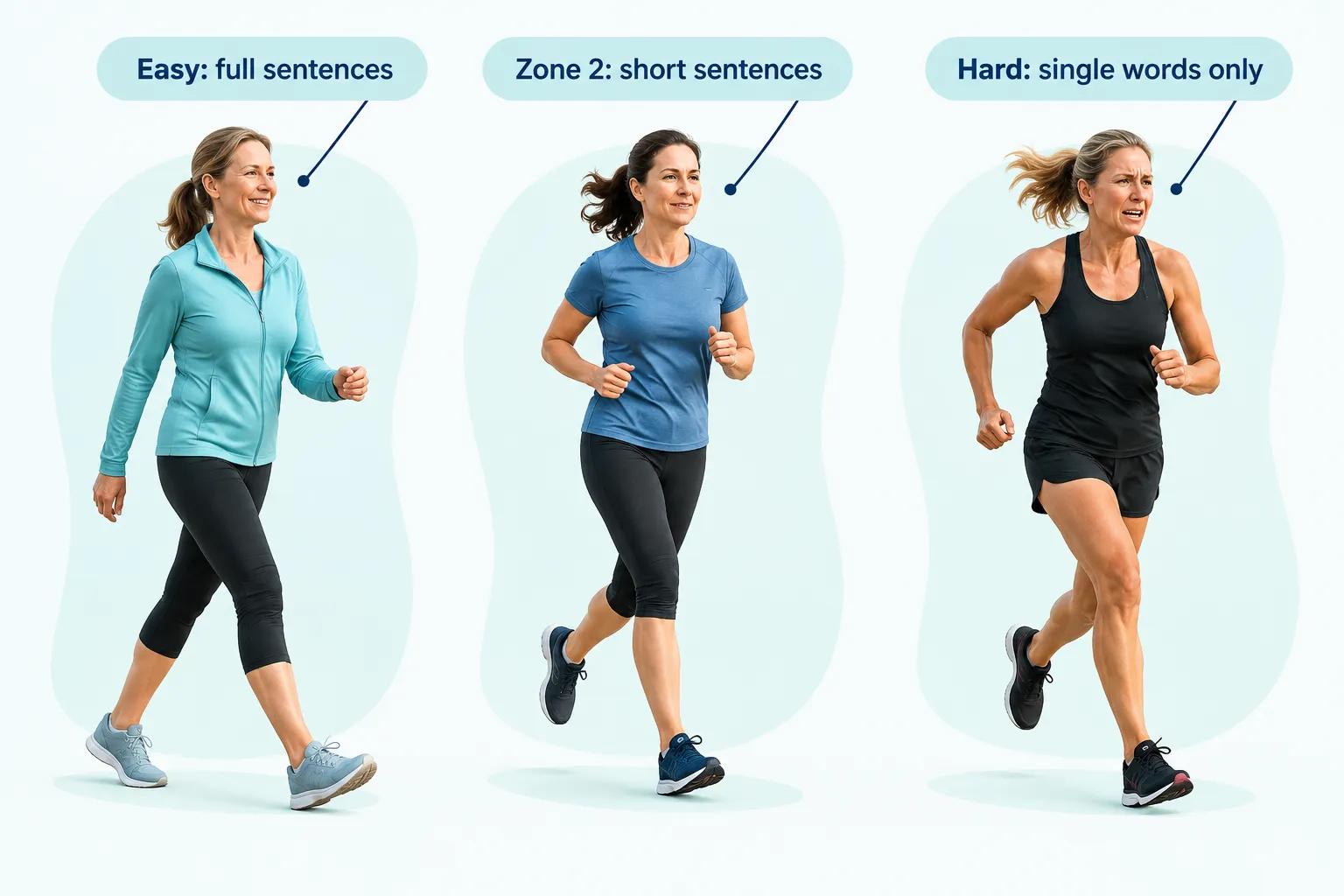
Practical note: the talk test is only a rough guide. A comfortable full-sentence conversation can still fit an individual steady, moderate effort.
In sports science, this zone is often tied to a specific physiological marker called the first lactate or ventilatory threshold, the point where the body starts relying more heavily on carbohydrate and produces more lactate than it can quietly clear. In consumer fitness culture, though, zone 2 usually gets simplified into a flat heart-rate band, often something like 60 to 70 percent of an estimated maximum heart rate. Those two definitions are related but not identical, and the gap between them explains a lot of the confusion around this topic [2] [2].
Here’s the real issue: the clinical version of zone 2 is measured in a lab with blood lactate testing or gas analysis. The everyday version most people use is a rough estimate from an age-based formula or a wearable device. Both can be useful, but they are not interchangeable, and treating a generic number as a precise medical measurement is where a lot of the hype gets in the way [2].
From a practical point of view, zone 2 exercise matters because it builds a base of aerobic capacity without piling up excessive fatigue. It is the kind of effort you can repeat day after day, which is exactly what makes it useful for building a habit. This article is about that practical, repeatable version. It is not a promise of a special fat-burning switch, and it does not replace the separate discussion of why a generic “fat-burning heart-rate zone” is not magic on its own.
The simplest way to look at it is this: zone 2 cardio is steady effort you can sustain, done often enough to matter. For a broader look at how different types of movement fit into an overall routine, the Exercise Guide for Better Health is a useful starting reference.
Why the Talk Test and Perceived Effort Come First
The talk test works better than a heart-rate number for most beginners because it adjusts automatically for heat, fatigue, medication, sleep, and daily variation, none of which a fixed number accounts for. A sensible starting point is this: if you can speak in short sentences, but not sing or chat easily in long paragraphs, you are almost certainly in a reasonable zone 2 range.
How Do I Know if I’m in Zone 2?
The clearest sign of zone 2 effort is breathing that is noticeably up from resting, but still controlled enough to speak in short phrases. Three simple checkpoints:
- Full sentences with no effort at all usually means the pace is too easy to count as meaningful aerobic work.
- Short, broken sentences, needing a breath every few words is the sweet spot most coaches associate with zone 2 exercise.
- Single words or gasping means the effort has moved past zone 2 into a harder, less sustainable intensity.
A useful secondary check is recovery. After a zone 2 session, breathing and heart rate should settle back toward normal within several minutes of stopping, and there should be no lingering breathlessness sitting down afterward. If recovery takes a long time or leaves you wiped out for hours, the effort was likely harder than intended.
Zone 2 Cardio Without a Heart Rate Monitor
Zone 2 cardio without a heart rate monitor is entirely realistic. The talk test, a perceived-effort scale, and simple pacing landmarks (a walking route, a familiar loop, a known swim distance) all work without any device.
A basic 1-to-10 perceived effort scale is a good backup: zone 2 usually feels like a 3 to 5 out of 10, noticeably more than a stroll but well short of a hard push. Keep it simple and consistent: pick one method, whether that’s the talk test or a perceived effort number, and use it the same way every session so your sense of “steady effort” gets more accurate over time.
Zone 2 Heart Rate: Useful Estimate, Not a Universal Prescription
Zone 2 heart rate estimates can offer a helpful ballpark for beginners, but they are not a precise medical prescription, and they should never override how the body actually feels during exercise. A 2026 analysis found that commonly used zone 2 markers vary substantially between people, with reported coefficients of variation around 6 to 29 percent, and that fixed heart-rate and power markers can differ substantially between people [3].
Zone 2 Cardio Heart Rate by Age
The most common shortcut is the 220-minus-age formula for estimated maximum heart rate, with zone 2 set at roughly 60 to 70 percent of that number. Treat the table below as a rough starting estimate, not a fixed target.
| Age | Estimated max HR (220 minus age) | Rough zone 2 range (60 to 70 percent) |
|---|---|---|
| 45 | 175 | 105 to 123 |
| 50 | 170 | 102 to 119 |
| 55 | 165 | 99 to 116 |
| 60 | 160 | 96 to 112 |
| 65 | 155 | 93 to 109 |
The numbers matter, but only as a rough guide. Context matters more: age, fitness level, medications, heat, hydration, and stress all shift where a real training zone sits on any given day.
Several factors routinely push actual heart rate away from the formula estimate:
- Medications that slow or raise heart rate, including some blood pressure and heart rhythm drugs, can shift the usable range noticeably.
- Fitness level changes resting and working heart rate over months, so a number that fit six months ago may not fit now.
- Heat and humidity raise heart rate at the same walking or cycling pace compared with cooler conditions.
- Hydration status affects blood volume and, in turn, how hard the heart works at a given effort.
- Device and formula error is real: chest straps tend to be more accurate than wrist-based optical sensors, and age-based formulas were built from population averages, not from any one individual [1] [3].
A 2025 expert viewpoint placed Zone 2 just below the first lactate or ventilatory threshold, while also emphasizing that fixed percentages and consumer zone labels are only estimates outside laboratory testing [2]. That level of individualized testing is not something most people need to start training. It is a reason to hold the age-based numbers loosely rather than treat them as a rule.
I would be careful with that 220-minus-age formula in particular. It was never meant to be a precise personal ceiling, and using it that way is a common source of frustration when a wearable device disagrees with how a workout actually feels.
Beginner-Friendly Zone 2 Options: Walking, Cycling, and Swimming
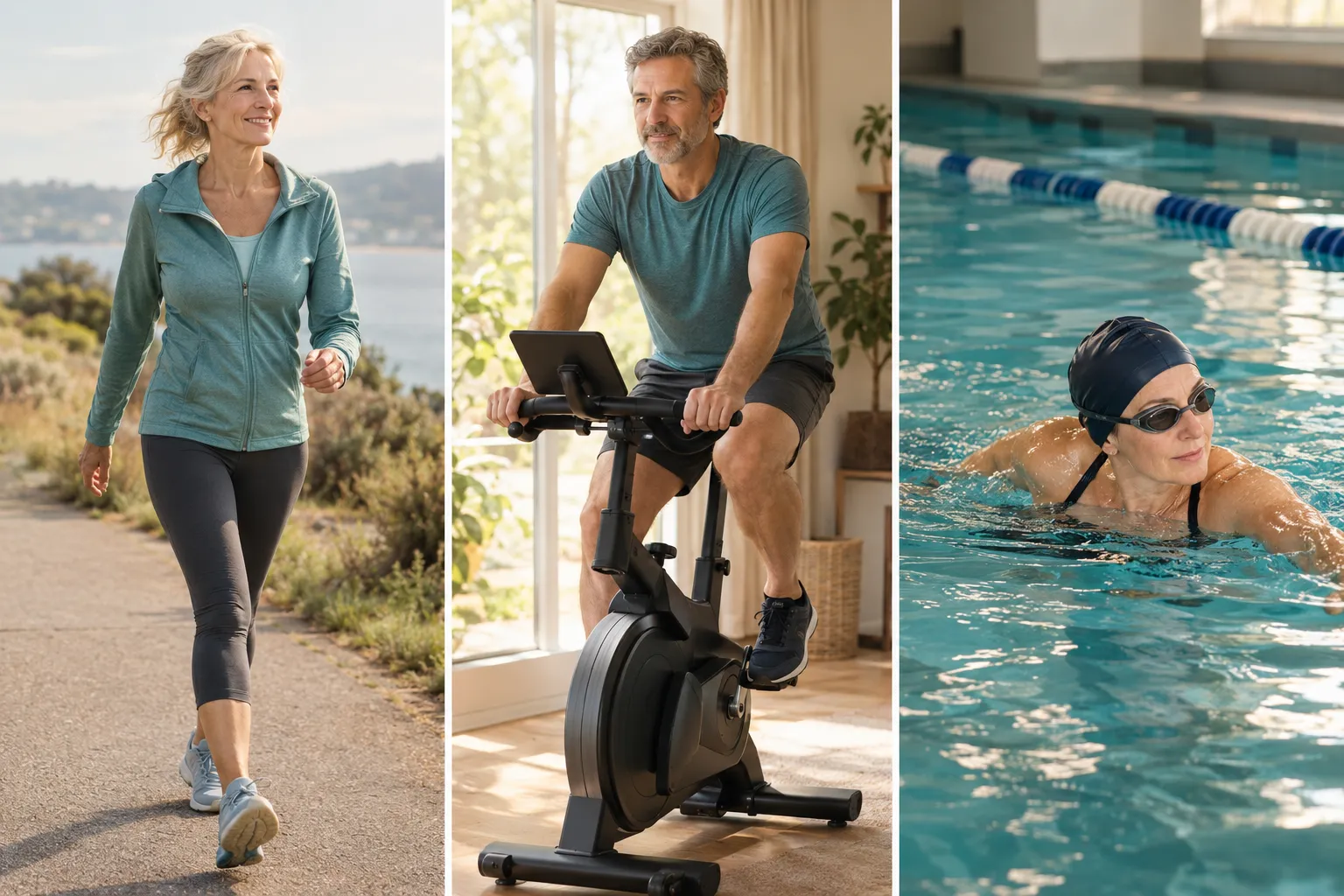
Walking, cycling, and swimming are the three most practical zone 2 exercise options for beginners because all three let you control pace precisely and stop or slow down instantly if needed. None require special skill, and all three can be adjusted in tiny increments, which matters more than people expect when the goal is a steady, sustainable effort.
Walking is the easiest entry point for most adults starting a zone 2 routine. A brisk, purposeful walking pace, faster than a stroll but not a race, puts most healthy adults comfortably into a zone 2 style effort. If joint discomfort is a factor, our guide to low impact cardio for bad knees and hips covers ways to keep walking and similar movement comfortable.
Cycling, whether outdoors or on a stationary bike, offers excellent control over effort because gear and resistance can be adjusted second by second. It is also easier on joints than walking or running for people managing knee or hip sensitivity.
Swimming provides a full-body, joint-friendly steady effort, and pace is naturally limited by breathing rhythm, which makes it hard to accidentally overdo the intensity. It also removes heat as a major variable when done in a climate-controlled pool.
Best Zone 2 Cardio Exercises for Beginners
Choose the activity that fits your joints, schedule, and access to equipment, not the one that sounds most impressive. A decision rule that works well in practice:
- Choose walking if you want the simplest option with no equipment and are comfortable outdoors or on a treadmill.
- Choose cycling if joint comfort is a priority or you want precise control over resistance.
- Choose swimming if you have pool access and want a joint-friendly, full-body steady effort.
- Choose a mix if boredom or weather is a concern, since rotating activities keeps the routine sustainable long term.
For readers curious about low-equipment options that complement steady cardio, best home workouts without equipment is a useful companion resource, and pickleball conditioning for seniors shows how steady aerobic fitness supports other activities too.
Zone 2 Cardio on Treadmill vs Running Outside
A treadmill offers more control over pace and eliminates weather and terrain as variables, which makes it easier to hold a truly steady zone 2 effort, especially for beginners still learning what steady feels like. Running outside adds variables like wind, hills, and uneven ground that can push effort higher without a person noticing, since the body compensates automatically for terrain changes.
In real-world terms, neither is “better” for zone 2 purposes. A treadmill is more predictable and a good teaching tool early on. Outdoor movement adds variety, fresh air, and often better long-term adherence once someone understands what a sustainable pace feels like. Context matters: choose whichever option you will actually repeat three or more times a week.
A Practical Weekly Progression for Adults Starting Out
A sensible starting point for zone 2 cardio is three sessions a week of 20 to 30 minutes, building gradually toward four or five sessions of 30 to 45 minutes over several weeks. Start with what gives the biggest return: consistency matters more in the first month than duration or exact intensity.

How Long Should Zone 2 Cardio Workouts Be
Twenty to forty-five minutes per session is a workable range for most beginners, with shorter sessions on busier days and longer ones when time allows. There is no fixed minimum that unlocks a special benefit, and there is no strong evidence that a session must hit an exact duration to count. More is not always better here; a shorter session done consistently beats an occasional long one done rarely.
Zone 2 Cardio: How Many Days per Week
Three to five days a week is a reasonable target for most adults, spaced to allow easy recovery between sessions since the effort is low enough that back-to-back days are generally fine for healthy beginners. A simple four-week progression:
| Week | Sessions per week | Session length | Notes |
|---|---|---|---|
| 1 | 3 | 20 minutes | Focus on the talk test, not the pace |
| 2 | 3 to 4 | 25 minutes | Add one session if energy allows |
| 3 | 4 | 30 minutes | Keep effort steady, not harder |
| 4 | 4 to 5 | 30 to 40 minutes | Settle into a repeatable routine |
Can You Build Fitness with Only Zone 2 Cardio
Yes, steady aerobic exercise alone can meaningfully improve cardiovascular fitness, especially for beginners and people returning to exercise after time off. The stronger evidence points to zone 2-style training as a solid foundation, though a 2025 review found no proof it is uniquely superior to other intensities for building mitochondrial capacity, and suggested that some higher-intensity work may matter more when total training time is limited [4].
The main takeaway is this: zone 2 alone is a legitimate way to build a base level of fitness, particularly if consistency is the priority. It is simply not the only path, and pairing it with occasional harder efforts, once a base is established, tends to add more than zone 2 alone once fitness plateaus.
Zone 2 vs HIIT and Other Harder Cardio
Zone 2 training and HIIT are not competing for the same job. Zone 2 builds a repeatable aerobic base with low fatigue cost, while HIIT trades a smaller time investment for a higher physical and recovery cost. We need to separate fact from hype here rather than pick a winner.
The table below is a simple, honest comparison.
| Factor | Zone 2 cardio | HIIT |
|---|---|---|
| Typical session length | 20 to 45 minutes | 10 to 25 minutes including rest intervals |
| Perceived effort | Moderate, sustainable, conversational | High, breathless, not conversational |
| Recovery needed | Minimal, can repeat daily | More, typically 24 to 48 hours between sessions |
| Injury and overtraining risk | Lower for most beginners | Higher if progressed too quickly |
| Best fit | Building a habit, older beginners, daily movement | Time-limited training, adding variety once a base exists |
Zone 2 Cardio vs HIIT: Which Is Better
Neither is universally better; the right choice depends on time available, joint health, and current fitness level. That is a strong claim to make about either one, and it needs strong proof, which is exactly why current research treats this as a “both matter” question rather than a contest. HIIT can produce meaningful fitness gains in less total time, but it comes with a higher demand on recovery and a steeper learning curve for pacing effort safely [4].
Zone 2 Cardio for Weight Loss: Does It Work
Zone 2 cardio can support weight management as part of an overall calorie and activity picture, but it does not have a special fat-loss advantage over other intensities. A lower-intensity session may use a greater proportion of fat as fuel at that moment, but that does not make Zone 2 a special fat-loss setting. The repeatable activity pattern and overall habits matter more than chasing a particular fuel mix [4].
That is where hype gets in the way. The idea of a special “fat-burning zone” sounds precise and appealing, but it is not that simple. For readers focused specifically on weight management, a brief guide into weight loss covers the bigger picture beyond any single type of cardio.
Zone 2 Cardio for Runners: Where It Fits in a Training Plan
For runners, zone 2 style easy running typically forms the bulk of weekly mileage, with a smaller portion reserved for harder efforts like tempo runs or intervals. This pattern, often called polarized training, keeps most running easy enough to recover from quickly while a smaller share of harder sessions drives most of the fitness gain [2].
A sensible starting point for a recreational runner is to keep most easy runs at a pace where conversation is possible in short sentences, saving harder breathing for one or two sessions a week once a comfortable base is established.
Common Mistakes That Make Easy Cardio Harder Than It Needs to Be
The most common mistake beginners make is running or cycling too hard on “easy” days, which quietly turns a zone 2 session into a moderate-hard effort that leaves less room for recovery. This single habit undoes most of the point of a steady, repeatable aerobic base.
Zone 2 Cardio Mistakes Beginners Make
- Chasing a heart-rate number instead of how the body feels, which leads to pushing through discomfort just to match a screen.
- Ignoring heat, poor sleep, or stress, all of which raise heart rate at the same physical pace and make a fixed number misleading on a bad day.
- Ramping up duration or frequency too quickly, which raises injury risk without adding proportional fitness benefit.
- Skipping the talk test entirely and relying only on a device, especially wrist-based sensors that can misread heart rate during arm movement.
- Treating one bad reading as a crisis rather than recognizing normal day-to-day variation in heart rate and effort.
The basics still do the heavy lifting: a comfortable pace, done often, beats a perfectly calculated number chased inconsistently.
Is Zone 2 Cardio Boring
Zone 2 cardio can feel repetitive at first, but boredom usually comes from doing the same activity in the same setting every time, not from the intensity itself. Rotating between walking, cycling, and swimming, changing routes, adding a podcast or audiobook, or training with a friend all address the boredom problem directly without changing the underlying effort level.
Let’s call it what it is: steady cardio is not designed to feel exciting in the moment. Its value comes from repeatability over months, not from intensity or novelty in any single session.
When Individual Advice Makes Sense
Individual, personalized guidance makes sense before starting any new cardio routine if there are symptoms, a diagnosed heart condition, or medications that affect heart rate. This is not cotton-wool caution; it is a specific, proportionate list.
Seek personalized advice before starting or significantly increasing zone 2 exercise if any of the following apply:
- Chest pain, unusual shortness of breath, dizziness, or fainting during exertion
- A diagnosed cardiovascular condition, including arrhythmia, heart failure, or prior heart attack
- Medications known to change heart rate, such as beta blockers or certain blood pressure drugs
- Uncontrolled high blood pressure or diabetes
- Long-term inactivity combined with other health conditions, where a gradual, supervised start is safer
For everyone else without these flags, the evidence suggests a gradual, self-paced start using the talk test is a reasonable and low-risk way to begin. Evidence first, common sense backed by evidence second: most healthy adults do not need clearance to start a walking program, but a conversation with a clinician is worthwhile when any of the items above apply, or when there is genuine uncertainty about current health status.
FAQ
Is zone 2 cardio the same as the fat-burning zone?
No. They overlap in intensity but are not the same claim. Zone 2 refers to a steady aerobic effort level; the fat-burning zone idea specifically claims a special advantage for fat loss, which current evidence does not clearly support over other intensities [4].
What heart rate is zone 2 for a 55-year-old?
Using the common estimate of 220 minus age, a 55-year-old has an estimated maximum heart rate around 165, putting a rough zone 2 range near 99 to 116 beats per minute. Treat this as a starting estimate, not a fixed personal target, since individual variation is significant [3].
Can I do zone 2 cardio every day?
For most healthy adults, yes, since the effort is low enough to allow same-day or next-day recovery. It is still sensible to include at least one lighter or rest day per week, especially when starting out.
Do I need a heart rate monitor for zone 2 training?
No. The talk test and a perceived effort scale work well without any device, and many beginners find them more reliable day to day than a wearable estimate.
Is walking enough for zone 2 cardio, or do I need to run?
Brisk walking is a completely valid zone 2 exercise for most beginners and many experienced exercisers. Running is not required; pace matters far more than the specific activity.
How is zone 2 cardio different from HIIT?
Zone 2 is a steady, sustainable effort done for longer periods with minimal recovery needed between sessions. HIIT alternates short bursts of hard effort with recovery periods and demands more rest between sessions. Both can have a place in a well-rounded routine.
Conclusion
The practical point is simple: Zone 2 cardio is steady, comfortable aerobic work that you can repeat, not a precise number or a secret fat-burning switch. Start with the activity that fits your joints, confidence, and schedule—often walking, cycling, or swimming—and let the talk test keep the effort honest.
For the wider picture, use the Exercise Guide for Better Health as your foundation. Fat Burn Heart Rate explains why a zone is not a weight-loss shortcut, while HIIT Workouts covers the separate role of harder intervals. Consistency beats chasing perfect numbers.
References
[1] American College of Sports Medicine. Monitoring Aerobic Exercise Intensity. [2] Iannetta D, et al. What Is “Zone 2 Training”? Experts’ Viewpoint on Definition, Intensity, and Research Gaps. International Journal of Sports Physiology and Performance. 2025. [3] Zone 2 Intensity: A Critical Comparison of Individual Variability in Different Submaximal Exercise Intensity Boundaries. 2025. [4] Storoschuk A, et al. Much Ado About Zone 2: A Narrative Review Assessing the Efficacy of Zone 2 Training for Improving Mitochondrial Capacity and Cardiorespiratory Fitness in the General Population. Sports Medicine. 2025. [5] World Health Organization. Physical Activity.Medical Disclaimer

Dave writes practical, evidence-aware health guidance that helps readers make steadier decisions without chasing extremes.
📂 Exercise Guide for Better Health
This article is part of the APH cluster. Use the links below to move between the pillar and child articles.
- Read the pillar: Exercise Guide for Better Health
- → Body Mass Index (BMI) Chart
- → How to Start Walking for Exercise
- → HIIT Workouts
- → Walking vs. Running for Weight Loss
- → Fat Burn Heart Rate
- YOU ARE HEREZone 2 Cardio: A Practical Beginner’s Guide to Steady Aerobic Training
- → Health Benefits of Swimming
- → Explore all Exercise guides