
Intermittent Fasting for Beginners: A Practical Evidence-Based Guide
More than 10% of American adults now report using some form of intermittent fasting, making it one of the most widely adopted dietary strategies of the past decade [6]. Yet for every person who swears by it, there is another who tried it for two weeks, felt terrible, and gave up. The difference is almost always the same thing: they started without understanding what intermittent fasting actually is, what it can and cannot do, and whether it was the right fit for them in the first place.
Table of Contents
- What Intermittent Fasting Actually Is (And Isn’t)
- The Science Behind Fasting — Autophagy, Mitophagy, and Circadian Biology
- Featured Video: How Intermittent Fasting Triggers Cellular Repair
- The Main Fasting Protocols: 16:8, 18:6, OMAD, and 5:2
- Who Benefits Most From Intermittent Fasting
- Who Should Be Cautious With Fasting
- Practical Guide to Starting Your First Fast
- Common Fasting Mistakes and How to Avoid Them
- Frequently Asked Questions
Key Takeaways
- Intermittent fasting is a structured eating pattern, not a specific diet — the food choices still matter
- The primary driver of weight loss from fasting is a calorie deficit, not the fasting window itself
- Popular protocols include 16:8, 18:6, OMAD, and 5:2 — each with different trade-offs for adherence and lifestyle fit
- Fasting triggers meaningful cellular repair processes including autophagy and mitophagy, though the clinical significance in humans is still being studied
- Certain groups — including older adults concerned about muscle mass, women with hormonal considerations, and people with specific medical conditions — should approach fasting with more care
What Intermittent Fasting Actually Is (And Isn’t)
Intermittent fasting is not a diet in the traditional sense. It does not tell you what to eat. It tells you when to eat. The core principle is simple: you cycle between defined periods of eating and defined periods of not eating.
What it is not is a metabolic miracle. Here is the real issue with how fasting gets discussed online — it gets wrapped in so much hype that the actual mechanism gets buried. In plain English, the main reason intermittent fasting helps people lose weight is that it reduces the window in which they eat, which tends to reduce total calorie intake. That is the engine. Everything else — the hormonal shifts, the cellular repair processes, the metabolic improvements — sits on top of that foundation [5].
A 2026 Cochrane review found no significant superiority of intermittent fasting over standard calorie restriction for weight loss when total energy intake was matched. The energy deficit, not the fasting window, is the primary driver of benefit. That is a strong finding and it matters for setting realistic expectations.
That said, the fasting window is not irrelevant. There are real biological processes triggered by fasting that go beyond simple calorie reduction — and those are worth understanding properly.
The Science Behind Fasting — Autophagy, Mitophagy, and Circadian Biology
When the body goes without food for an extended period, it does not simply idle. It shifts into a different metabolic mode. Several key processes become active that do not operate at the same level during a fed state.
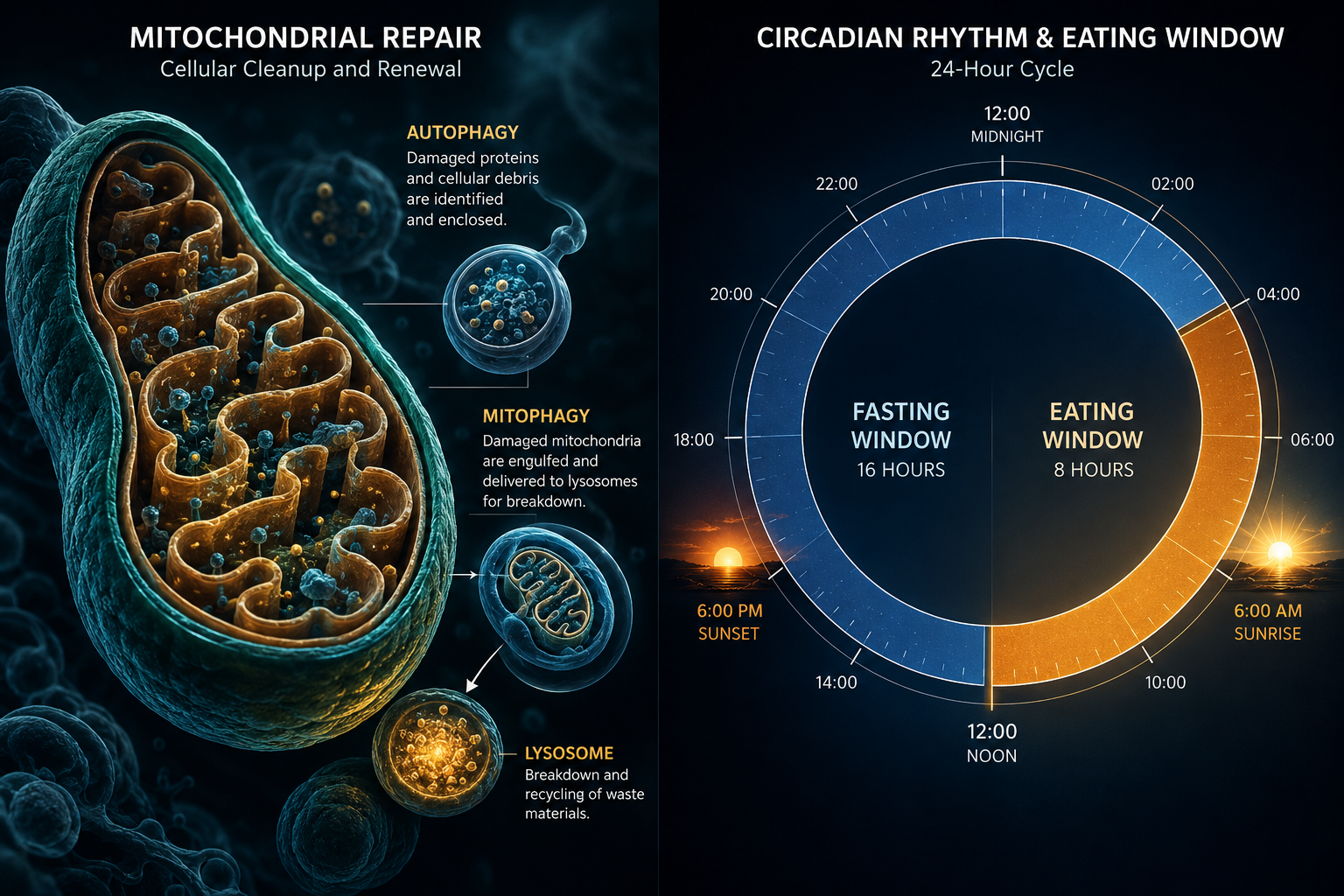
Autophagy is the body’s internal recycling system. The word comes from the Greek for “self-eating.” During fasting, cells begin breaking down and clearing out damaged proteins, dysfunctional organelles, and cellular debris. This is a normal maintenance process, but it accelerates during periods of nutrient scarcity [3].
Mitophagy is a specific form of autophagy focused on mitochondria — the energy-producing structures inside cells. When mitochondria become damaged or inefficient, mitophagy clears them out so they can be replaced with healthier ones. This process is directly relevant to metabolic health, energy production, and the aging process [4].
Circadian biology adds another layer. The body’s internal clock governs when metabolic processes are most efficient. Research suggests that eating earlier in the day — aligning food intake with daylight hours — produces better outcomes for blood sugar regulation, insulin sensitivity, and lipid profiles than eating the same calories later in the day [5]. This is why an early eating window (for example, 8am to 4pm) may offer metabolic advantages over a late eating window (12pm to 8pm), even when calories are identical.
The evidence suggests these are real mechanisms with genuine relevance to long-term health. The honest caveat is that most of the human research on autophagy and mitophagy is still early-stage. We know these processes occur. We are less certain about the precise fasting duration required to trigger meaningful clinical benefit in humans, or how much that benefit translates to measurable health outcomes over time [6].
How Intermittent Fasting Triggers Cellular Repair
We Finally Know How To Regrow Mitochondria & Reverse Aging
Speaker: Dr. William Li
Dr. William Li is a physician, scientist, author of Eat to Beat Disease, and president of the Angiogenesis Foundation. His work focuses on how food influences angiogenesis, metabolism, immunity, regeneration, and cellular health.
This section pairs with a video explanation of the cellular mechanisms involved in fasting-induced repair. The visual context helps make these processes easier to follow.
When you eat, insulin rises, cells take in glucose, and the body operates in a growth and storage mode. When you fast, insulin falls, glucose stores deplete, and the body begins shifting fuel sources. After roughly 12 to 16 hours of fasting, several repair-oriented processes become more active [1].
Here is what happens in sequence:
- Glycogen depletion: Liver glycogen stores are used up, typically within 12 to 24 hours depending on activity level
- Ketone production begins: The liver starts converting fatty acids into ketone bodies, which serve as an alternative fuel source for the brain and other tissues
- mTOR suppression: The mTOR signalling pathway — which promotes cell growth — is downregulated, allowing autophagy to increase
- Autophagy activation: Cellular cleanup accelerates, clearing damaged proteins and organelles
- Mitophagy follows: Damaged mitochondria are selectively removed, supporting mitochondrial quality control [4]
The connection between mitochondrial health and fasting results is worth noting. People with healthier mitochondria tend to respond better to fasting protocols because their cells are more efficient at switching between fuel sources. Conversely, improving mitochondrial quality through fasting may itself improve metabolic flexibility over time.
What matters most is this: these processes are real, they are biologically meaningful, and they represent a genuine reason to consider fasting beyond simple calorie reduction. But they are not magic. They are part of normal cellular maintenance, and fasting is one way to support them — not the only way [3].
The Main Fasting Protocols: 16:8, 18:6, OMAD, and 5:2
Intermittent fasting for beginners typically involves choosing one of four main protocols. Each has a different structure, level of restriction, and practical fit depending on lifestyle.
| Protocol | Eating Window | Fasting Window | Best For |
|---|---|---|---|
| 16:8 | 8 hours | 16 hours | Most beginners, sustainable daily use |
| 18:6 | 6 hours | 18 hours | Those comfortable with 16:8 wanting more |
| OMAD | 1 meal | ~23 hours | Experienced fasters, not recommended for beginners |
| 5:2 | Normal 5 days | 500-600 kcal on 2 days | Those who prefer weekly flexibility |
16:8 is the most studied and most commonly used protocol. A typical approach is skipping breakfast and eating between 12pm and 8pm, or eating between 8am and 4pm for better circadian alignment. CALERIE-2 trial data and more recent 2025-2026 trials show that 16:8 produces similar weight loss outcomes to continuous calorie restriction when adherence is matched [2].
18:6 extends the fasting window by two hours. It is a reasonable progression once 16:8 feels comfortable, but it does not appear to offer dramatically superior outcomes for most people.
OMAD (One Meal A Day) compresses all eating into a single meal. This is not a sensible starting point for most people. Protein distribution across a single meal is a significant concern for muscle protein synthesis, particularly in adults over 50. More is not always better.
5:2 involves eating normally for five days and restricting calories to around 500-600 on two non-consecutive days. Adherence data from recent trials actually favours 5:2 for some people because the restriction is time-limited — it is easier to tolerate two difficult days knowing the others are unrestricted [7].
For a deeper look at how fasting integrates with weight loss strategy, the complete intermittent fasting for weight loss guide covers the evidence in more detail.
Who Benefits Most From Intermittent Fasting
The evidence suggests certain groups are particularly well-suited to intermittent fasting:
- Adults with insulin resistance or pre-diabetes: Fasting improves insulin sensitivity and fasting glucose in multiple trials, with effects that go beyond what calorie restriction alone explains in some studies [5]
- People who find calorie counting unsustainable: Removing an entire meal simplifies eating decisions without requiring precise tracking
- Those with metabolic syndrome markers: Improvements in blood pressure, triglycerides, and HDL cholesterol have been observed in several trials [6]
- Adults who eat late at night habitually: Imposing a structured eating window naturally eliminates late-night eating, which is a meaningful behavioural change for many people
From a practical point of view, fasting works best when it fits naturally into an existing schedule. Someone who is never hungry in the morning is a good candidate for 16:8. Someone who prefers flexibility across the week may do better with 5:2.
Pairing fasting with nutrient-dense food choices amplifies the results. Reviewing the most nutrient-dense foods is a useful complement to any fasting protocol.
Who Should Be Cautious With Fasting
This is where hype gets in the way of sensible guidance. Intermittent fasting is not appropriate for everyone, and some groups need to be particularly careful.
Older adults and muscle preservation: This is a real concern. Muscle protein synthesis requires adequate protein distributed across meals. Compressing eating into a very narrow window — particularly with OMAD — makes it harder to meet protein targets and may accelerate age-related muscle loss (sarcopenia). A sensible starting point is 16:8 with deliberate attention to protein intake at each meal [8]. For those over 50, the exercise guide for adults over 50 provides useful context on preserving lean mass alongside dietary changes.
Women with hormonal considerations: The evidence here is less clear-cut, but it is not that simple. Some women report disruptions to menstrual cycles, thyroid function, and cortisol patterns with extended fasting protocols. The research is limited and mixed, but the signals are sufficient to recommend a more cautious approach — shorter fasting windows (12-14 hours rather than 16+), and close attention to how the body responds over the first few weeks [9].
People with a history of disordered eating: Structured restriction can be a trigger. I would be careful with that.
Those on medications that require food: Certain medications — including metformin, some blood pressure drugs, and insulin — require food for safe administration. Medical supervision is essential before starting any fasting protocol.
Pregnant or breastfeeding women: Not appropriate without medical guidance.
People who are already underweight: Fasting is not the right tool here.
Practical Guide to Starting Your First Fast
The simplest way to look at it is this: start with the smallest effective change, not the most dramatic one.
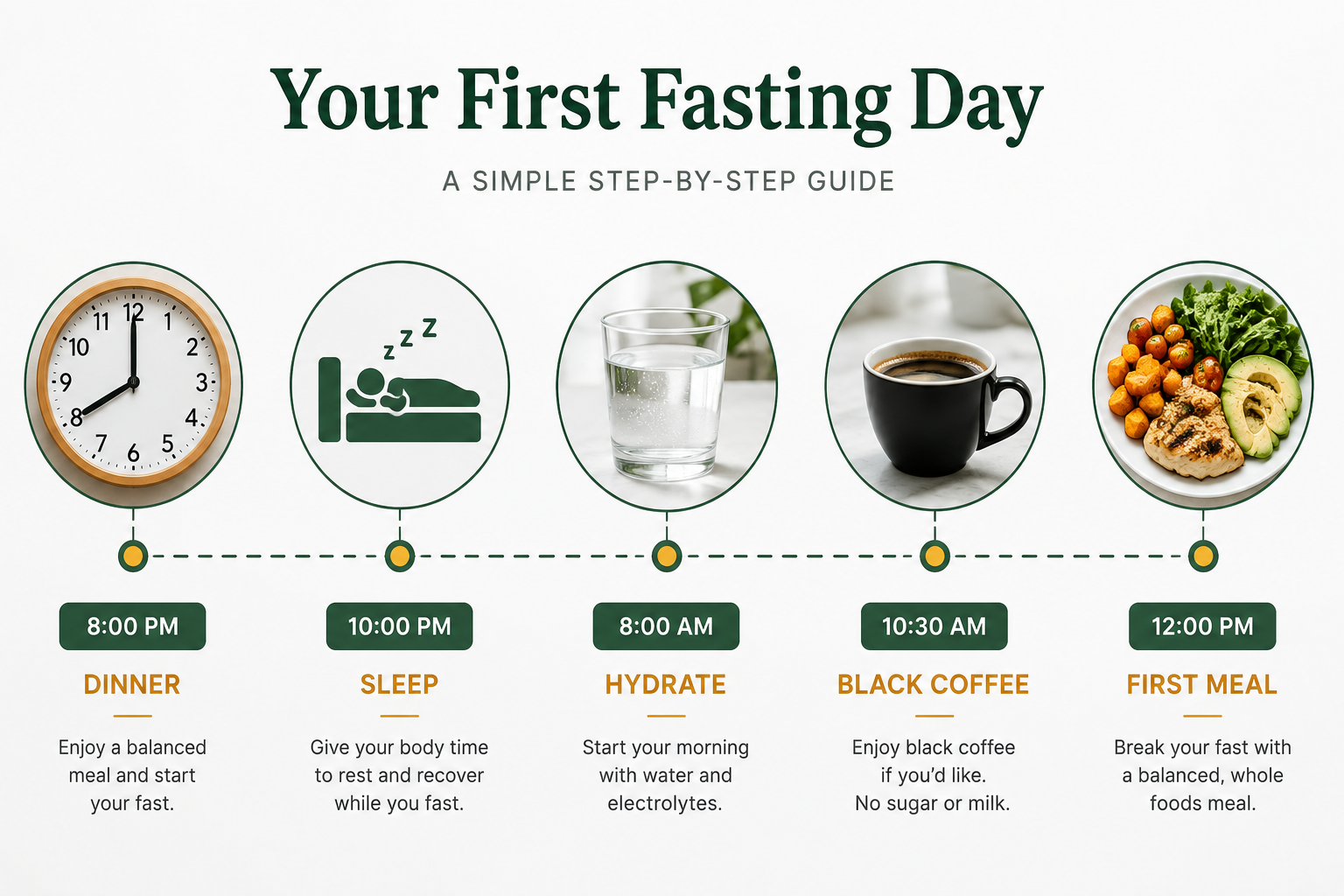
Week 1-2: Start with a 12-hour fast
Most people already fast for 10-11 hours overnight. Extending that to 12 hours is a low-friction starting point. Eat your last meal at 8pm and have breakfast at 8am.
Week 3-4: Move to 14 hours
Push the eating window slightly. Last meal at 7pm, first meal at 9am. This is where most people begin to notice changes in hunger patterns.
Week 5 onwards: Try 16:8 if it feels right
Do not force the progression. If 14 hours feels comfortable and sustainable, that is a legitimate long-term approach.
Practical tips that actually matter:
- Hydration: Drink water consistently throughout the fasting window. Dehydration is frequently mistaken for hunger
- Electrolytes: If fasting beyond 16 hours, sodium, potassium, and magnesium matter. Black coffee and plain tea are generally considered non-breaking for most protocols [1]. See also: magnesium-rich foods for sleep and recovery
- What breaks a fast: Calories break a fast. Black coffee, plain tea, and water do not. Milk, sweeteners with calories, and food of any kind do
- Managing hunger: Hunger during fasting is largely hormonal and follows a wave pattern — it peaks and then subsides. Knowing this makes it easier to wait it out
- Protein at breaking the fast: Start the eating window with a protein-rich meal to support muscle protein synthesis and reduce the risk of overeating later
For meal ideas that work well within a fasting structure, the healthy meals for weight loss guide offers practical options.
Common Fasting Mistakes and How to Avoid Them
Mistake 1: Eating more during the eating window to compensate
This is the most common reason fasting does not produce results. The calorie deficit still has to exist. Keep it simple and consistent.
Mistake 2: Starting with too aggressive a protocol
OMAD or 18:6 on day one is not a sensible starting point. The body adapts gradually. Starting too hard leads to misery and abandonment.
Mistake 3: Ignoring protein intake
Fasting without adequate protein leads to muscle loss alongside fat loss. Aim for at least 1.6g of protein per kilogram of body weight distributed across the eating window.
Mistake 4: Treating fasting as a licence to eat poorly
The basics still do the heavy lifting. Fasting does not neutralise the effects of a poor quality diet. What you eat during the eating window still determines nutritional outcomes. The health benefits of natural foods and herbs is worth reading alongside any fasting approach.
Mistake 5: Not accounting for sleep quality and stress
Fasting increases cortisol slightly, particularly in the morning. If sleep is poor or stress is high, adding fasting stress on top can backfire. Context matters. Address sleep and stress management as part of the overall picture.
Mistake 6: Expecting rapid results
Based on current evidence, intermittent fasting produces modest, gradual weight loss comparable to other calorie-restriction methods. It is not a fast track. The advantage is sustainability for those who find it easier to maintain than daily calorie counting [10].
If weight loss has stalled, the evidence-based strategies for breaking a weight loss plateau covers what actually works.
Frequently Asked Questions
Does intermittent fasting slow your metabolism?
Short-term fasting does not meaningfully slow metabolism. In fact, fasting for up to 72 hours has been shown to slightly increase metabolic rate due to norepinephrine release. Prolonged calorie restriction over months can reduce metabolic rate, but this is related to calorie deficit and weight loss — not fasting per se [6].
Can you exercise while fasting?
Yes, for most people. Light to moderate exercise in a fasted state is well-tolerated and may enhance fat oxidation. High-intensity training in a fasted state is more individual — some people perform well, others do not. Pay attention to how the body responds and adjust accordingly.
Is intermittent fasting safe for people with type 2 diabetes?
It can be, but it requires medical supervision. Fasting significantly affects blood glucose and insulin levels, which can interact with diabetes medications. Do not attempt fasting with type 2 diabetes without discussing it with a doctor first.
How long before intermittent fasting produces noticeable results?
Most people notice changes in hunger patterns and energy within the first two weeks. Measurable changes in body weight typically appear within four to six weeks when a consistent calorie deficit is maintained [8].
Does intermittent fasting affect women differently than men?
The evidence suggests women may be more sensitive to the hormonal effects of extended fasting. Some women experience disruptions to menstrual regularity with aggressive protocols. Starting with shorter fasting windows and monitoring closely is the recommended approach [9].
What is the best protocol for intermittent fasting for beginners?
16:8 is the most practical and best-studied starting point for most adults. It is sustainable, fits most schedules, and produces results comparable to more restrictive protocols with fewer side effects [2].
The Bottom Line
Intermittent fasting is a legitimate, evidence-supported dietary strategy. It is not magic, and it is not the right fit for everyone. The main takeaway is this: it works primarily by creating a calorie deficit in a structured, sustainable way — and for many people, that structure is easier to maintain than daily calorie counting.
The cellular repair processes it triggers — autophagy, mitophagy, improved mitochondrial quality — are real and meaningful, particularly from a long-term health perspective. The circadian timing of the eating window adds another layer of benefit that goes beyond calories alone.
Start with what gives the biggest return: a modest 12 to 14-hour fast, consistent hydration, adequate protein, and food quality that supports the effort. Build from there based on how the body responds.
Truth over hype. Evidence first. That is the only sensible way to approach this.
References
- [Video] Speaker. YouTube. https://www.youtube.com/watch?v=71VCkTZYRrQ
- Liu D, et al. Intermittent fasting in cardiovascular disorders: current evidence and unresolved questions. Journal of the American Heart Association, 2018.
- de Cabo R, Mattson MP. Effects of intermittent fasting on health, aging, and disease. New England Journal of Medicine, 2019.
- Liu D, et al. Calorie restriction with or without time-restricted eating in weight loss. New England Journal of Medicine, 2022.
📂 Diet Frameworks
This article is part of the APH cluster. Use the links below to move between the pillar and child articles.
- Read the pillar: The Comprehensive Guide to Modern Diets: What Actually Works in 2026
- → The Carnivore Diet: A Complete Evidence-Based Guide
- → Elimination Diet: A Step-by-Step Guide to Identifying Food Sensitivities
- YOU ARE HERE Intermittent Fasting for Beginners: A Practical Evidence-Based Guide
- → Metabolic Flexibility: Train Your Body to Burn Fat for Fuel — A Practical Guide to the Metabolic Flexibility Diet
- → Vegan Diet Weight Loss: What the Evidence Actually Shows
- → The Complete Guide to Mediterranean Food: Dishes, Health Benefits, and What to Eat
- → Low Carb Diet for Weight Loss
- → The Ultimate Seasonal Eating Guide: Nourish Your Body Naturally Year-Round
- → The Ultimate Guide to the Liver Shrinking Diet (2026)