
How to Break a Weight Loss Plateau: What the Evidence Actually Says

Most people who have been dieting for more than a few months will hit a point where the scale simply stops moving. Not because they have failed, and not because the approach was wrong from the start. The body adapts. That is what it is designed to do. Understanding how to break a weight loss plateau means understanding why the body fights back — and what you can actually do about it that is grounded in evidence rather than marketing.
This article replaces an earlier piece on this site that promoted rapid weight loss techniques. Let’s call that what it was: hype dressed up as strategy. The stronger evidence points to something less exciting but far more useful — a methodical, sustainable approach that works with your biology rather than against it.
Medical disclaimer: This article is for general informational purposes only. It does not constitute medical advice. If you have an underlying health condition, are taking medication, or have concerns about your weight or metabolism, consult your clinician before making changes to your diet or exercise programme.
Key Takeaways
- A weight loss plateau is a normal physiological response, not a personal failure
- Metabolic adaptation reduces your calorie needs as you lose weight, which is the core mechanism behind most plateaus
- Recalculating calorie targets, adjusting protein intake, and varying exercise stimulus are the most evidence-supported first steps
- Sleep quality and stress management have a measurable impact on fat loss and are frequently overlooked
- There is no single fix — the right approach depends on where you are, how long you have been dieting, and your individual context
Table of Contents
- Why Weight Loss Plateaus Happen
- How to Break a Weight Loss Plateau: The Core Strategies
- Exercise, Recovery, and the Plateau Problem
- Frequently Asked Questions
- Conclusion
Why Weight Loss Plateaus Happen
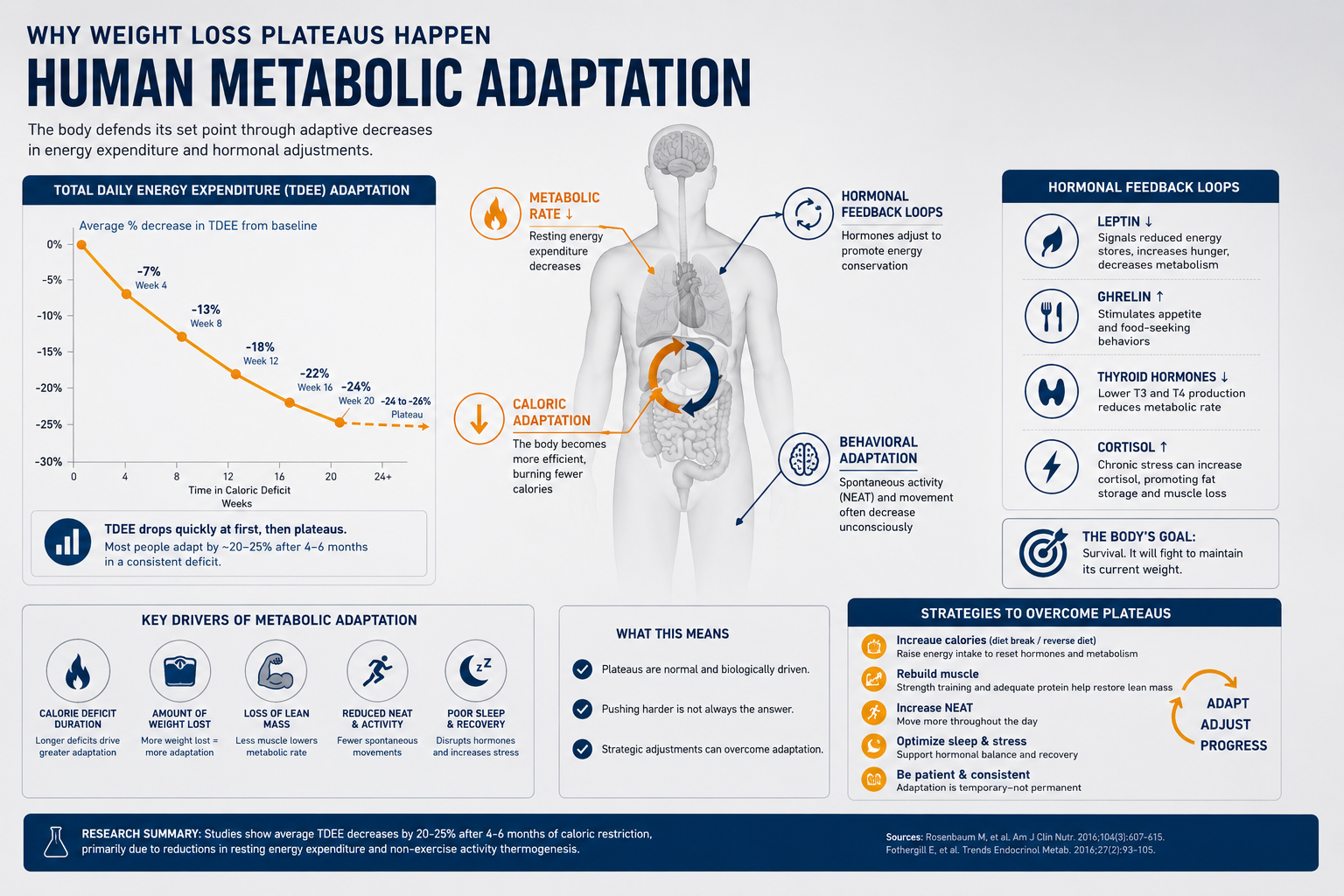
Here is the real issue: your body is not broken. It is doing exactly what evolution designed it to do — defend against what it interprets as a threat to survival.
When you reduce calories and lose weight, several things happen simultaneously. Your resting metabolic rate drops because a smaller body requires less energy to run. The thermic effect of food decreases because you are eating less. Non-exercise activity thermogenesis — the energy you burn through fidgeting, walking around, general movement — also tends to fall, often without you noticing. Collectively, researchers refer to this as metabolic adaptation or adaptive thermogenesis.
In plain English: the gap between calories in and calories out narrows as you lose weight, even if you keep eating the same amount. What was once a meaningful calorie deficit becomes maintenance.
The numbers matter here. A person who starts at 220 pounds and loses 20 pounds may find their total daily energy expenditure has dropped by 200 to 400 calories compared to what a simple calculation would predict. That is not a small margin. It is enough to erase a deficit entirely.
Hormonal Factors That Reinforce the Plateau
Beyond raw calorie arithmetic, hormones play a significant role. Leptin — a hormone produced by fat cells that signals satiety and supports metabolic rate — falls as body fat decreases. Ghrelin, which drives hunger, tends to rise. This combination makes you simultaneously hungrier and less metabolically active. It is not that simple to override with willpower alone, which is why sustainable strategies matter more than short-term intensity.
Cortisol, the primary stress hormone, also deserves attention. Prolonged calorie restriction is itself a physiological stressor. Elevated cortisol can promote fat retention, particularly around the abdomen, and can interfere with the hormonal signals that support fat loss. Context matters here — chronic dieting without adequate recovery can make the plateau worse, not better.
How to Break a Weight Loss Plateau: The Core Strategies
A sensible starting point is to audit what is actually happening before changing anything. Many plateaus are not true metabolic adaptations — they are measurement drift. Portion sizes creep up. Cooking oils get estimated rather than weighed. Weekend eating patterns diverge from weekday ones. Before concluding that your metabolism has adapted, it is worth tightening the accuracy of your tracking for one to two weeks.
If the numbers are accurate and the plateau persists, the following strategies have the strongest evidence base.
Recalculate Your Calorie Target
This is the most straightforward intervention and the one most people skip. If you set your calorie target based on your starting weight and have since lost 15 or 20 pounds, that target is now too high. Your body’s energy requirements have changed.
Use a validated equation — the Mifflin-St Jeor formula is currently the most widely recommended for estimating resting metabolic rate — and recalculate based on your current weight. Apply an appropriate activity multiplier. Then set a modest deficit of 300 to 500 calories below that new maintenance figure.
More is not always better here. Aggressive deficits accelerate metabolic adaptation, increase muscle loss, and are harder to sustain. The evidence suggests a moderate deficit maintained consistently outperforms a severe deficit applied intermittently.
Prioritise Protein Intake
The role of dietary protein in weight management is one of the more robust findings in nutrition research. Protein has a higher thermic effect than carbohydrate or fat, meaning your body burns more calories simply digesting it. It also supports muscle retention during a calorie deficit, which matters because muscle tissue is metabolically active — losing it reduces your resting metabolic rate further.
A practical target for most adults in a calorie deficit is 1.6 to 2.2 grams of protein per kilogram of body weight per day. For someone weighing 80 kilograms, that is roughly 130 to 175 grams per day. This is higher than most people currently eat, and increasing it often requires deliberate planning.
Good sources include lean meat, fish, eggs, dairy, legumes, and protein-rich plant foods. The basics still do the heavy lifting here — there is no need for exotic supplements when whole food sources are adequate.
Consider a Structured Diet Break
The concept of a diet break — a planned period of eating at maintenance calories for one to two weeks — has gained research support as a tool for managing metabolic adaptation. The evidence suggests that periodic maintenance phases can partially restore leptin levels and reduce the degree of adaptive thermogenesis, making the subsequent deficit phase more effective.
This is not the same as giving up or going off-plan. It is a deliberate, structured pause. Calories go up to maintenance, protein stays high, and the goal is physiological recovery rather than additional loss. Some people find this psychologically useful as well — a break from restriction that is built into the plan rather than a deviation from it.
I would be careful with the claim that diet breaks produce dramatically faster fat loss overall. The research is promising but not conclusive. What they do appear to do is make long-term adherence more manageable, which is itself a meaningful outcome.
Exercise, Recovery, and the Plateau Problem
From a practical point of view, exercise is often the first lever people reach for when weight loss stalls. They add more cardio, train harder, move more. Sometimes this works. Often, it does not — and understanding why is useful.
How to Break a Weight Loss Plateau With Exercise Adjustments
The body adapts to exercise just as it adapts to diet. A cardio routine that was challenging three months ago has likely become efficient — your body performs it with less effort and burns fewer calories per session. This is not failure. It is adaptation, and it requires a response.
Resistance training deserves particular emphasis here. Strength work preserves and builds muscle mass, which supports resting metabolic rate. The evidence for resistance training as a tool for long-term weight management is considerably stronger than for steady-state cardio alone. If your current programme is predominantly aerobic, adding two to three resistance sessions per week is a well-supported adjustment.
For cardio, varying the intensity is more effective than simply adding volume. High-intensity interval training (HIIT) has shown benefits for metabolic rate and fat oxidation in research settings, though it is more demanding on recovery. A balanced approach — some steady-state work, some interval work, adequate rest days — tends to be more sustainable than maximum effort every session.
The main takeaway is this: more exercise is not always the answer. If you are already training five or six days per week and sleeping poorly, adding a seventh session is unlikely to break your plateau and may make things worse through accumulated fatigue and elevated cortisol.
Sleep and Stress: The Overlooked Variables
This is where hype gets in the way of practical advice. Most weight loss content focuses on diet and exercise and says almost nothing about sleep or stress — yet the evidence connecting both to fat loss is substantial.
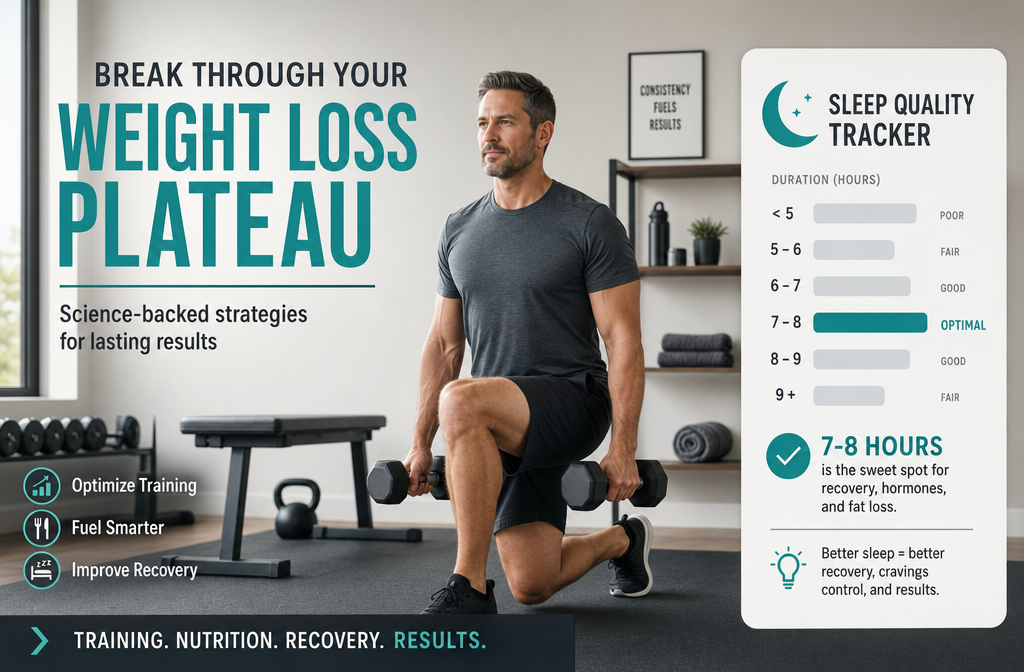
Sleep deprivation, even moderate (six hours versus eight hours per night), measurably increases ghrelin, decreases leptin, and impairs insulin sensitivity. Studies show that people in a calorie deficit who sleep fewer hours lose a higher proportion of muscle mass rather than fat. In real-world terms: poor sleep makes your deficit less effective and your hunger harder to manage.
Chronic psychological stress follows a similar pattern. Elevated cortisol promotes fat storage, increases cravings for energy-dense foods, and disrupts the hormonal environment that supports fat loss. Managing stress is not a soft, optional add-on to a weight loss plan. It is a physiological requirement.
Practical steps here are straightforward: aim for seven to nine hours of sleep per night, establish a consistent sleep schedule, and identify the primary sources of stress in your life. These are not glamorous interventions, but the evidence for their impact is real.
Frequently Asked Questions
How long does a weight loss plateau typically last?
It varies considerably. A true plateau — where weight has not moved for three to four weeks despite accurate tracking — is worth addressing. Shorter stalls of one to two weeks may reflect water retention, hormonal fluctuations, or measurement variability rather than a genuine metabolic plateau.
Is it possible that my metabolism is permanently damaged from dieting?
The term “metabolic damage” is used loosely and often inaccurately. Metabolic adaptation is real, but it is not permanent. Research shows that resting metabolic rate can recover with adequate calorie intake, sufficient protein, resistance training, and time. A period of eating at maintenance after a long deficit is often beneficial.
Should I try intermittent fasting to break a plateau?
Intermittent fasting can be a useful tool for some people, primarily because it helps reduce total calorie intake by narrowing the eating window. The evidence does not suggest it has unique metabolic benefits beyond calorie restriction itself. If it suits your lifestyle and helps you maintain a deficit, it is a reasonable option. If it increases stress or disrupts sleep, it is probably not the right tool for you.
How much protein do I actually need during a deficit?
The evidence supports a range of 1.6 to 2.2 grams per kilogram of body weight per day for adults in a calorie deficit who are also resistance training. If you are not training with weights, the lower end of that range is likely sufficient. Spreading protein intake across three to four meals appears to support muscle protein synthesis better than concentrating it in one or two large meals.
Can stress really stop weight loss?
Yes, in meaningful ways. Elevated cortisol from chronic stress promotes fat retention, disrupts sleep, increases appetite, and drives cravings for high-calorie foods. Addressing stress is not optional if you want consistent fat loss results. This does not mean eliminating all stress — that is not realistic — but identifying and managing the primary sources is a legitimate part of the strategy.
When should I see a doctor about a weight loss plateau?
If you have been in a consistent, well-tracked calorie deficit for more than two to three months with no measurable progress, it is worth consulting your clinician. Thyroid dysfunction, insulin resistance, polycystic ovary syndrome, and certain medications can all impair fat loss. These are medical conditions, not lifestyle problems, and they require proper diagnosis and management.
Conclusion
Breaking a weight loss plateau is not about finding a shortcut or a technique that bypasses biology. It is about understanding what has changed — your body’s energy needs, your hormonal environment, your training stimulus — and making measured adjustments based on that understanding.
Let’s keep this practical. The most evidence-supported steps are:
- Recalculate your calorie target based on your current weight
- Increase or protect your protein intake
- Add or prioritise resistance training
- Consider a structured two-week diet break at maintenance calories
- Audit your sleep quality and stress levels honestly
Start with what gives the biggest return. For most people, that is recalculating calories and increasing protein. Everything else builds on that foundation.
The basics still do the heavy lifting. There is no magic in it — just a clearer understanding of what the body is doing and a willingness to adjust accordingly. If you are uncertain about any of these steps in the context of your own health history, the right first call is to your clinician, not a supplement website.
References
- Strohacker K, Galarraga A, Williams DM, et al. Do changes in metabolic rate explain the weight loss plateau? Medicine & Science in Sports & Exercise, 2013. https://doi.org/10.1249/MSS.0b013e31828c7f09
- Byrne NM, et al. Intermittent energy restriction improves weight loss efficiency in obese men: the MATADOR study. International Journal of Obesity, 2018. https://doi.org/10.1038/ijo.2017.206
- Hall KD, et al. Energy expenditure and body composition changes after weight loss: a systematic review and meta-analysis. Obesity Reviews, 2018. https://doi.org/10.1111/obr.12622
- Fothergill E, et al. Persistent metabolic adaptation 6 years after The Biggest Loser competition. Obesity, 2016. https://doi.org/10.1002/oby.21538
📂 Weight Loss & Metabolic Health
This article is part of the APH cluster. Use the links below to move between the pillar and child articles.
- Read the pillar: The Best Weight Loss Diet in 2026: A Science-Backed Guide to Every Major Approach
- → Intermittent Fasting for Weight Loss: Complete 2026 Guide
- → High Protein Diet for Weight Loss
- → The Protein Leverage Hypothesis: Why Protein Controls Your Weight
- YOU ARE HERE How to Break a Weight Loss Plateau: What the Evidence Actually Says
- → Breaking the Weight Loss Plateau: Metabolic Adaptation and How to Overcome It
- → Herbs for Weight Loss: 10 Evidence-Based Herbs That Boost Metabolism
- → 9 Healthy Meals for Weight Loss: A Practical Guide to Eating Well in 2026
- → The Best Weight Loss Diet in 2026: A Science-Backed Guide to Every Major Approach