Best Sleep Optimization Gear for Hot, Light and Noise-Sensitive Sleepers
Last updated: September 4, 2026
Quick Answer
If heat, light, or noise is disrupting your sleep, the most effective first step is to identify which one is the primary problem, then address that single issue before spending money on anything else. The best sleep optimization gear for most adults is not the most expensive option, it is the right tool matched to the right problem. Start with passive, low-cost changes in your bedroom environment before moving to active or powered systems.
Key Takeaways
- Heat, light, and noise are the three most common environmental sleep disruptors for adults aged 45 to 65, and each requires a different category of gear.
- Identify your main disruptor first. Buying cooling gear when noise is the real problem wastes money and delivers no benefit.
- Passive solutions, breathable bedding, blackout curtains, earplugs, are the logical starting point before active or powered systems.
- Consumer sleep trackers and wearables can help you monitor trends, but they do not replace clinical assessment and their accuracy varies by device and metric [2][4].
- No gear fixes insomnia, sleep apnea, menopause-related night sweats, anxiety, or any other medical condition. Environmental tools support sleep; they do not treat it.
- Marketing claims in this category are often well ahead of the evidence. Separate what is mechanistically plausible from what has been tested in humans.
- Start with one change, test it consistently for two to three weeks, then layer additional tools only if needed.
- Several red flags, loud snoring with witnessed breathing pauses, severe daytime sleepiness, new severe night sweats, chest symptoms, require clinical assessment, not a gear upgrade.
Table of Contents
- What Is Sleep Optimization and Why Does It Matter?
- How to Know If You Need Sleep Optimization Gear
- Find Your Main Sleep Disruptor
- The Lifestyle Basics to Fix Before Buying More Gear
- Match the Problem to the Right Gear Category
- Where Sleep Tracking Fits
- What Should a Sensible Sleep Setup Cost?
- Common Mistakes With Sleep Gear
- Safety: When Gear Is Not the Answer
- Frequently Asked Questions
What Is Sleep Optimization and Why Does It Matter?
Sleep optimization, in plain English, means adjusting the conditions around your sleep, your environment, habits, and timing, to give your body the best realistic chance of getting restorative rest. It is not about chasing a perfect sleep score. It is about removing the obstacles that are actually in the way.
For adults between 45 and 65, this matters more than it did at 30. Sleep architecture changes with age: deep slow-wave sleep tends to decrease, sleep becomes lighter and more fragmented, and sensitivity to environmental disruption, heat, light, noise, often increases. Hormonal shifts, particularly around perimenopause and menopause, can amplify night sweats and temperature dysregulation. Stress and life demands do not shrink either.
The evidence connecting poor sleep to cardiovascular risk, metabolic function, cognitive performance, and mood is substantial and consistent [2]. That does not mean a cooling pad will add years to your life. It means that if a fixable environmental problem is cutting your sleep short night after night, addressing it is worth the effort. The basics still do the heavy lifting here, and our complete guide to sleep hygiene covers the behavioral foundation that gear should sit on top of, not replace.
How to Know If You Need Sleep Optimization Gear
Most adults do not need specialized gear. They need consistent sleep and wake times, a reasonably dark and quiet room, and a bedroom that is not too warm. If those basics are already in place and sleep is still poor, gear may help, but only if the problem is environmental.
Signs that an environmental fix is worth trying:
- You fall asleep reasonably well but wake during the night feeling hot or sweaty.
- You wake early because of light entering the room, particularly in summer.
- You live on a noisy street, near a snoring partner, or in a home with unpredictable nighttime sounds.
- Your sleep quality noticeably improves when you sleep somewhere with different conditions, a hotel, a quieter room, or a cooler night.
Signs that gear is probably not the main answer:
- You cannot fall asleep regardless of conditions, and your mind is active and anxious at bedtime.
- You feel unrefreshed even after what appears to be a full night of sleep.
- You snore loudly, or a partner has witnessed you stop breathing during sleep.
- You have persistent insomnia that has lasted more than three months.
In those cases, the right starting point is a conversation with a physician or sleep specialist, not a product purchase. The Sleep Hygiene guide covers practical behavioural and environmental foundations in more depth.
Find Your Main Sleep Disruptor
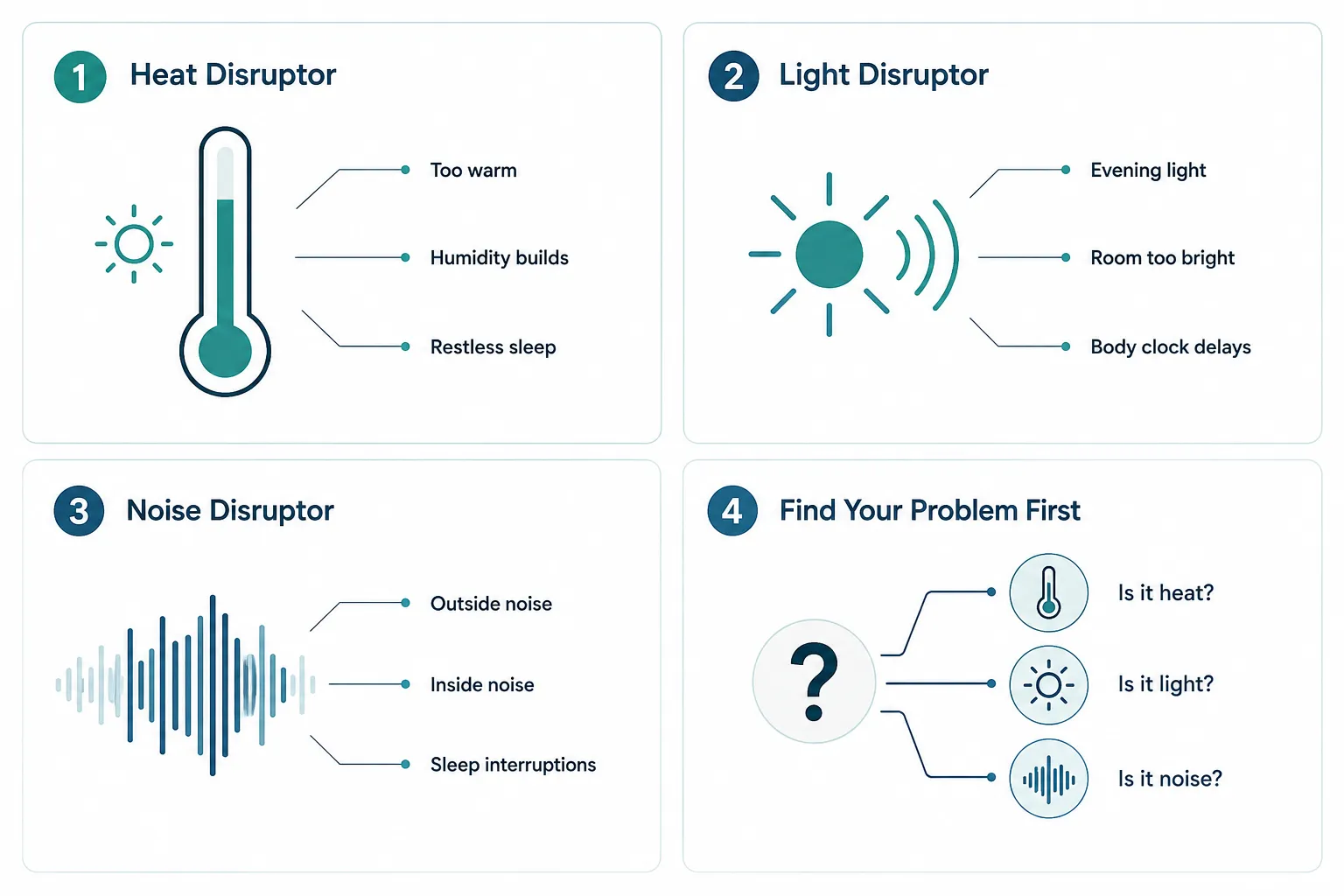
Before spending anything, answer these three questions honestly.
1. Are you waking up hot or sweating during the night?
If yes, and this happens more than two or three nights per week, heat is likely a primary disruptor. Note whether this is worse in summer, after alcohol, or during hormonal fluctuations, context matters.
2. Is light waking you earlier than you want, or is light exposure at night delaying your sleep?
If you wake at 5 a.m. because of dawn light, or you find it hard to wind down because screens and room lighting stay bright until bedtime, light management is the priority.
3. Are sounds waking you, or preventing you from falling asleep?
Traffic, a snoring partner, neighbors, or early-morning sounds are fixable with the right noise management approach.
The practical rule: Pick the one disruptor that accounts for most of your lost sleep and address that first. If two problems are roughly equal, start with the one that is cheaper and simpler to fix. Do not buy three categories of gear simultaneously, you will not know what helped.
The Lifestyle Basics to Fix Before Buying More Gear
Sleep optimization is not a contest to collect more devices. If the basics are working against you, an expensive product may simply give you a more detailed record of the same problem. Before spending money, test the changes that cost little or nothing.
- Protect enough time for sleep. A tracker cannot compensate for regularly allowing too little time in bed. Keep a reasonably consistent sleep and wake schedule when work and family life allow.
- Review evening food and alcohol. A large meal close to bedtime can worsen discomfort or reflux for some people. Alcohol may make you feel sleepy initially but can disturb sleep later in the night. These are useful personal experiments, not rigid rules that apply identically to everyone.
- Reduce bright evening light. Dim the room and reduce bright, blue-enriched screens when they delay your normal bedtime. The goal is sensible light timing and less stimulation, not fear of every screen.
- Check caffeine timing. If late-day caffeine leaves you alert at bedtime or causes lighter sleep, move it earlier and observe the result.
- Move regularly and build a wind-down. Regular activity supports overall health and sleep, while a short predictable wind-down can help signal that the day is ending. Late intense exercise affects people differently, so use your own response rather than a universal cutoff.
- Make the bedroom comfortable. Heat, light and noise are genuine environmental problems. Start with the simplest change that addresses the main disruptor, then use the specialist guides in this cluster for detailed product decisions.
The useful question is not whether one habit is “perfect.” It is whether a specific change consistently improves your own sleep without creating a new source of stress.
Match the Problem to the Right Gear Category
Each disruptor maps to a distinct set of tools. Here is a high-level orientation.
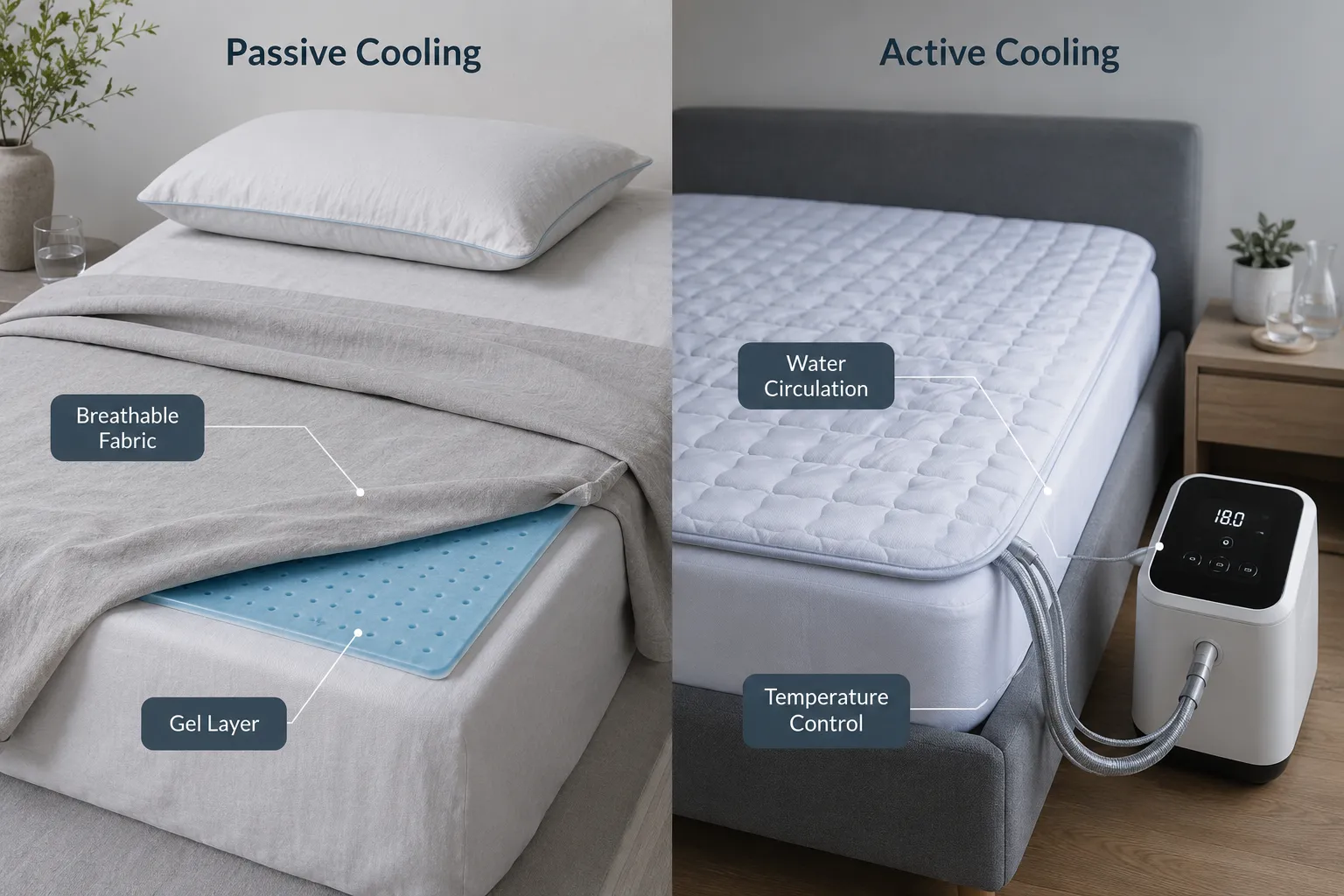
Heat is addressed through two broad approaches: passive cooling (breathable bedding, gel pads, airflow) and active cooling (water-circulated or thermoelectric systems that actively lower surface temperature). Passive options are lower cost and lower complexity. Active systems offer more precise temperature control but come with higher cost, maintenance considerations, and in the case of water-based systems, relevant electrical and water safety factors.
Light is addressed through two approaches: blocking external light before it reaches your eyes (blackout curtains, room-darkening shades) or blocking light at the eye level (sleep masks). On the other side, circadian light management, using timed light exposure to support your body clock, involves sunrise alarm clocks and light therapy devices. These are distinct problems requiring distinct tools. A sunrise clock helps with morning wake timing; it does not substitute for blocking light that is disrupting your sleep.
Noise is addressed through masking (white noise machines, fans, apps) or blocking (earplugs, noise-attenuating headphones). Masking works by raising the ambient sound floor so that sudden spikes, a car, a door, are less jarring. Blocking physically reduces sound reaching the ear. Both have trade-offs: masking adds sound to the environment, and earplugs carry ear irritation risks with long-term use.
Comparison: The Five Sleep Environment Categories at a Glance
| Category | Problem Addressed | First Option to Investigate | Main Trade-off | Evidence Level |
|---|---|---|---|---|
| Active Bed Cooling | Persistent night heat; hot sleepers who have tried passive options | Water-circulated mattress pad with temperature control | Higher cost; water/electrical safety considerations; maintenance | Mechanistic rationale is sound; direct RCT evidence in general populations is limited |
| Cooling Pads and Bedding | Mild to moderate night heat; first-line for most hot sleepers | Breathable linen or Tencel sheets plus a gel or phase-change pad | Passive options depend on ambient room temperature; cooling effect varies | Reasonable observational and mechanistic support; manufacturer claims often exceed evidence |
| Sunrise Clocks and Circadian Lights | Early-morning wake difficulty; circadian rhythm support; winter low mood | Gradual-dawn alarm clock | Consumer devices are not equivalent to clinical light therapy; timing matters | Light’s role in circadian biology is well established; consumer device efficacy data is thinner |
| White Noise, Fans and Earplugs | Noise-related wake-ups; partner snoring; traffic | White noise machine or a simple fan | Prolonged loud white noise has its own hearing exposure considerations; earplugs can cause ear irritation | Moderate evidence for masking sudden noise; earplug NRR ratings are standardized but real-world results vary |
| Blackout Curtains and Sleep Masks | Early light wake-ups; light pollution; shift workers | Blackout curtains for whole-room solution; sleep mask for travel or shared spaces | Curtains require installation; masks vary in comfort and fit | Light suppression of melatonin is well established; product-level evidence is largely observational |
Where Sleep Tracking and Wearables Fit
Sleep tracking belongs alongside sleep-environment decisions, not above them. If you cannot measure a problem, it is harder to know whether a change helped—but consumer trackers only provide estimates. Wearables commonly use movement, heart-rate patterns and other signals to estimate sleep timing, duration, awakenings and sleep stages. They do not directly measure every stage of sleep, and their scores are not diagnoses.
Validation studies can compare a device with laboratory methods, but a favorable validation result does not make a consumer wearable a medical diagnostic tool. Accuracy varies by device, software, sleep stage and person. Treat the data as a useful clue rather than a verdict, especially when deciding whether a tracker is worth the money.
Use a wearable to answer one practical question: “Did this change improve the pattern?” Record context such as alcohol, late meals, caffeine, illness, travel and stress. Look at trends rather than treating a single night as a verdict. If tracking makes you anxious or causes compulsive checking, it may be doing more harm than good. A wearable should support a sensible experiment—not replace sleep habits, environmental changes or professional assessment.
For a deeper guide to sleep tracking devices, wearables, measurement limits and value, see the planned sleep tracking devices child article when it is published.
What Should a Sensible Sleep Setup Cost?
The cost range in this category is genuinely wide. A sleep mask or a pair of earplugs costs a few dollars. Blackout curtains for a standard window can be purchased for under fifty dollars. A quality white noise machine sits in the moderate range. A gel cooling pad is a mid-range purchase. An active water-circulated cooling system is a significant investment, and a fully integrated smart mattress system is at the high end of the consumer sleep tech market.
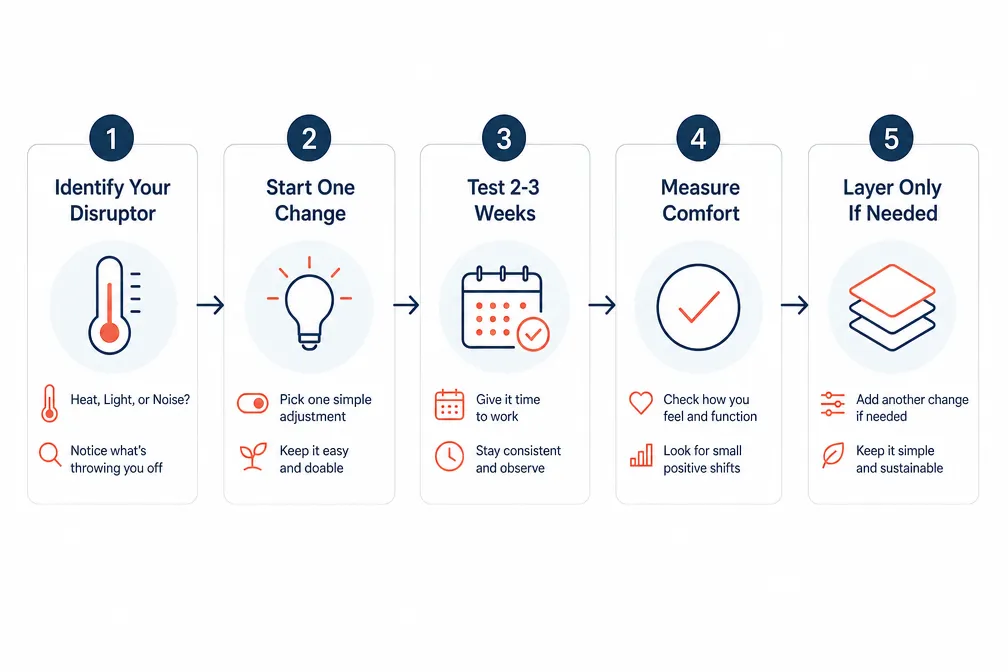
I prefer not to quote specific prices here because they change, vary by retailer, and can be misleading without context. What I will say is this: the cost-to-benefit relationship does not scale linearly. The biggest improvements for most people come from the lower-cost interventions, better bedding, a blackout solution, a noise masking option, not from the most expensive systems.
A sensible approach: set a budget for a single intervention, try it for three weeks, and evaluate honestly before spending more. The most common mistake in this category is buying multiple products simultaneously and then having no idea which one, if any, made a difference.
Common Mistakes With Sleep Gear
Based on the evidence and practical reasoning, these are the patterns worth avoiding.
Buying multiple products at once. You cannot isolate what helped. Start with one change.
Not testing long enough. Two to three weeks of consistent use is the minimum to assess whether an environmental change is making a difference. One or two nights tells you very little.
Addressing the wrong problem. Buying cooling gear when noise is the disruptor, or blackout curtains when the real issue is anxiety and racing thoughts at bedtime, delivers no benefit.
Expecting gear to fix a medical issue. Night sweats caused by a thyroid condition, sleep fragmentation caused by sleep apnea, or insomnia driven by anxiety are not solved by environmental tools.
Setting white noise too loud. Louder is not more effective and adds its own risk.
Ignoring the behavioral foundation. Gear sits on top of sleep hygiene, not instead of it. Irregular sleep timing, late caffeine, and screen use before bed undermine any environmental improvement you make. The sleep hygiene complete guide is the right place to start if that foundation is not yet solid.
Safety: When Gear Is Not the Answer
Environmental sleep gear is appropriate for healthy adults dealing with identifiable environmental disruptions. It is not appropriate as a substitute for medical assessment in the following situations.
Seek clinical assessment if you experience:
- Loud snoring with witnessed pauses in breathing during sleep, this is a red flag for obstructive sleep apnea, which requires diagnosis and treatment.
- Severe daytime sleepiness that affects your ability to function, drive, or work safely.
- Persistent insomnia lasting more than three months, particularly if it is causing significant distress or functional impairment.
- New or severe night sweats, especially if accompanied by other symptoms, this warrants medical evaluation to rule out underlying causes.
- Chest symptoms, palpitations, or other cardiovascular concerns that occur at night.
- Significant mood changes, depression, or anxiety that are affecting sleep, these require appropriate clinical care, not a light clock.
Product-specific safety notes:
- Active water-circulated cooling systems involve water near electrical components. Follow manufacturer guidance precisely. Do not use with young children in the bed without specific manufacturer clearance.
- Do not set cooling systems to temperatures that are excessively cold, hypothermia risk is unlikely in normal use but excessive cooling is not beneficial and may be uncomfortable or harmful.
- White noise at high volume over extended periods carries hearing exposure considerations. Keep volume moderate.
- Earplugs used nightly long-term can cause ear canal irritation or wax impaction in some individuals. Periodic breaks and attention to ear hygiene are sensible.
- Sunrise clocks are not equivalent to clinical light therapy devices and should not be used as a substitute for treatment of diagnosed conditions.
- Older adults, pregnant women, and people with certain medical conditions should discuss any new sleep intervention with their physician, particularly active cooling systems and light therapy devices.
Frequently Asked Questions
Q: Should I fix my sleep environment before trying a sleep tracker?
A: Yes. A tracker tells you what is happening; it does not fix the environment. Identify and address your main disruptor first, then use tracking to monitor whether the change made a difference. Tracking a poor sleep environment just gives you detailed data on a problem you have not yet solved.
Q: Can the best sleep optimization gear replace good sleep habits?
A: No. Environmental tools support sleep; they do not substitute for consistent sleep timing, appropriate light management in the evening, limited caffeine, and the other behavioral foundations of good sleep. Gear layered on top of poor habits delivers limited benefit.
Q: Is it safe to use a cooling system and a white noise machine at the same time?
A: Generally yes, if each is used correctly and within manufacturer guidelines. The risk is not in combining them, it is in using either incorrectly. Set white noise at a moderate volume. Follow all safety guidance for active cooling systems.
Q: How long should I test a new piece of sleep gear before deciding if it works?
A: Two to three weeks of consistent use is a reasonable minimum. Sleep varies night to night for many reasons, and a few nights is not enough to draw a conclusion. Keep other variables as consistent as possible during the test period.
Q: Do I need to spend a lot of money to improve my sleep environment?
A: Not as a starting point. The most cost-effective interventions, blackout curtains, earplugs, breathable bedding, a simple white noise machine, are among the lower-cost options in this category. Expensive active systems are for people who have tried simpler approaches and still have a persistent problem.
Q: When should I see a doctor instead of buying sleep gear?
A: If you snore loudly with witnessed breathing pauses, feel severely sleepy during the day, have had persistent insomnia for more than three months, experience new severe night sweats, or have any concerning symptoms at night, see a physician before purchasing any sleep product. Environmental gear is not a treatment for medical conditions.
Conclusion
The best sleep optimization gear is not the most expensive or technically sophisticated product. It is the tool that matches the problem you can identify, used consistently enough to judge whether it helps. Start with sleep opportunity, schedule, evening habits and the bedroom environment. Then use tracking or specialist gear to test one change at a time—not to chase a perfect score.
📂 Sleep Optimization
This article is part of the APH sleep optimization cluster. Use the links below to move between the pillar and supporting guides.
- Pillar: Sleep Hygiene: The Complete Guide to Better Sleep for Health and Longevity
- YOU ARE HERE Best Sleep Optimization Gear for Hot, Light and Noise-Sensitive Sleepers
- → Sleep Trackers Explained: What Wearables Can—and Cannot—Tell You About Your Sleep
- → Magnesium Glycinate for Sleep: Benefits, Safety, and How to Choose a Supplement
References
- American Academy of Sleep Medicine. Clinical practice guideline for diagnostic testing for adult obstructive sleep apnea. Explains why clinical assessment and validated testing are required rather than consumer-device scores alone.
- de Zambotti M, et al. “Wearable Sleep Technology in Clinical and Research Settings.” Medicine & Science in Sports & Exercise. Reviews how wearable sleep technology works and its limitations.
- Khosla S, et al. “Consumer Sleep Technology: An American Academy of Sleep Medicine Position Statement.” Journal of Clinical Sleep Medicine. Discusses consumer sleep technology, clinical limitations and responsible use.
- Chinoy ED, et al. “Performance of seven consumer sleep-tracking devices compared with polysomnography.” Sleep. Illustrates why accuracy differs between devices and measurements.
- National Heart, Lung, and Blood Institute. Sleep deprivation and deficiency. Background on the importance of adequate sleep and the limits of treating a sleep problem as a gadget problem.

About the author
Dave James is a health researcher and writer specializing in evidence-based nutrition, exercise, sleep and longevity. He founded All Perfect Health to provide clear, practical health guidance rooted in current research and real-world experience.