
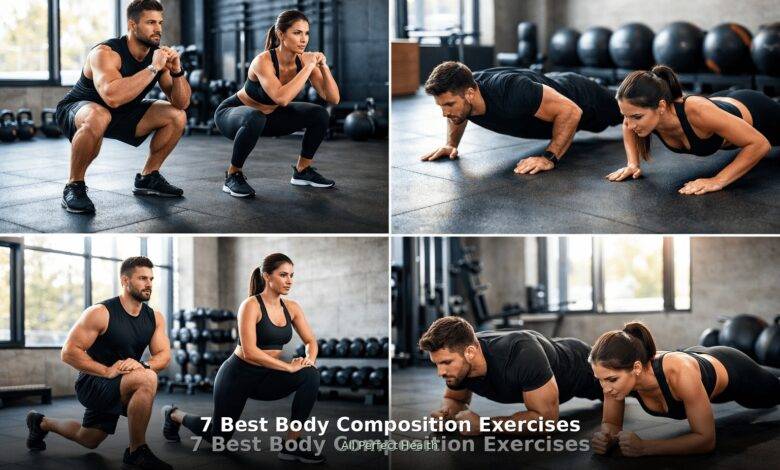
7 Best Body Composition Exercises (With Examples) to Build Muscle and Burn Fat
Last updated: July 2026
In this guide
- Featured Video: How to Lose Fat AND Gain Muscle at the Same Time
- What Are Body Composition Exercises?
- What Actually Impacts Body Composition?
- How Do You Measure Your Body Composition?
- The 7 Best Body Composition Exercises (With Proper Form)
- How Should You Structure These Exercises Into a Routine?
- Does Diet Matter as Much as Exercise for Body Composition?
- What Are the Most Common Mistakes People Make With Body Composition Training?
- Body Composition Exercises Examples (Sample Plans)
- FAQ: Body Composition Exercises
Last updated: March 28, 2026
Quick Answer
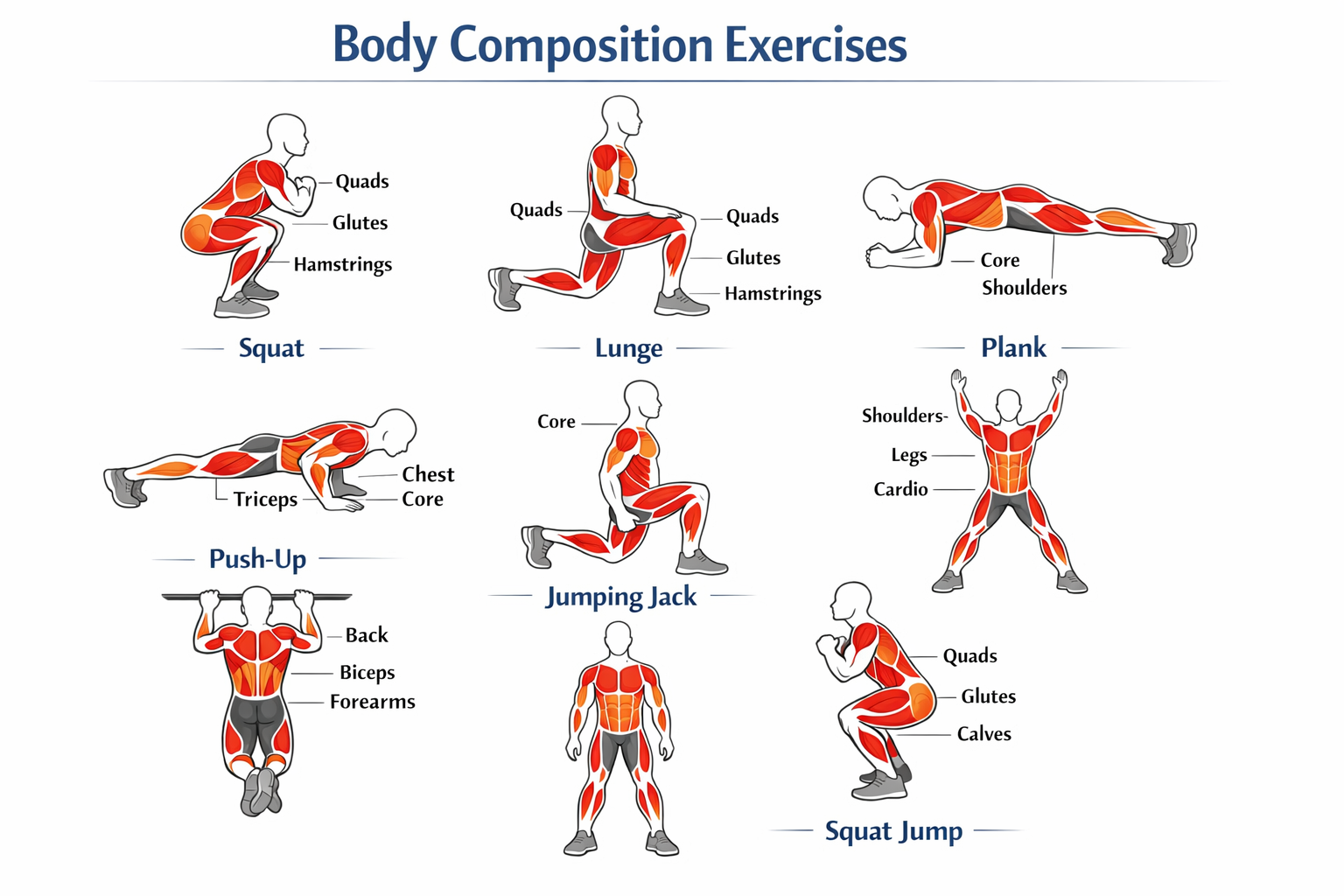
The 7 best body composition exercises are squats, lunges, push-ups, planks, pull-ups, jumping jacks, and squat jumps. These movements build muscle mass, reduce body fat, and improve metabolic function — all without requiring a gym membership or expensive equipment. For best results, combine these exercises with a balanced diet and perform them at least three times per week. Below you will find body composition exercises examples for beginners, intermediate trainees, and advanced lifters, along with sample weekly schedules you can copy directly.
Key Takeaways
- Body composition — the ratio of fat mass to lean muscle mass — is a more meaningful health marker than body weight alone
- Resistance-based exercises like squats, lunges, and push-ups build muscle, which raises your resting metabolic rate
- Compound movements (exercises that work multiple muscle groups simultaneously) deliver the most efficient body composition changes per workout
- Cardio and strength training work best together; neither alone produces optimal results
- You don’t need gym equipment to get started — all 7 exercises in this guide can be performed at home
- Tracking body fat percentage, not just scale weight, gives you a more accurate picture of progress
- Consistency over three to four weeks is when most beginners notice measurable changes in muscle tone and endurance
- Nutrition directly supports exercise outcomes — what you eat before and after training affects muscle recovery and fat loss
- Training to muscular fatigue (not just going through the motions) is what drives real body composition change
- Motivation and a clear goal — whether fat loss, muscle gain, or both — determine long-term adherence
Expert insight: Jeremy Ethier is a certified fitness trainer and researcher who breaks down the science of body recomposition — how to build muscle and lose fat simultaneously through the right exercise and nutrition strategies.
What Are Body Composition Exercises?
Body composition exercises are physical movements specifically selected to shift the ratio of fat to lean muscle in your body. Rather than simply burning calories in the moment, these exercises stimulate muscle growth, elevate your resting metabolism, and improve how your body processes energy over time.
The term covers a broad range of movement types:
- Compound strength movements — squats, lunges, push-ups, pull-ups
- Core stabilization exercises — planks, hollow holds, dead bugs
- Plyometric and cardio-hybrid movements — squat jumps, jumping jacks, burpees
What makes an exercise “body composition-focused” isn’t just the movement itself — it’s the intent behind it. Performing a squat slowly with full range of motion to build quad and glute strength has a different effect than rushing through it. The goal is always to challenge your muscles enough to stimulate adaptation.
These exercises are suitable for most adults, from beginners to experienced athletes. They’re particularly useful for people who want to lose fat without losing muscle, improve athletic performance, or build functional strength for everyday life.
What Actually Impacts Body Composition?
Body composition is shaped by two primary factors: how you train and how you eat. Exercise determines how your body uses and stores energy; nutrition determines whether it has the right materials to build or repair muscle tissue.
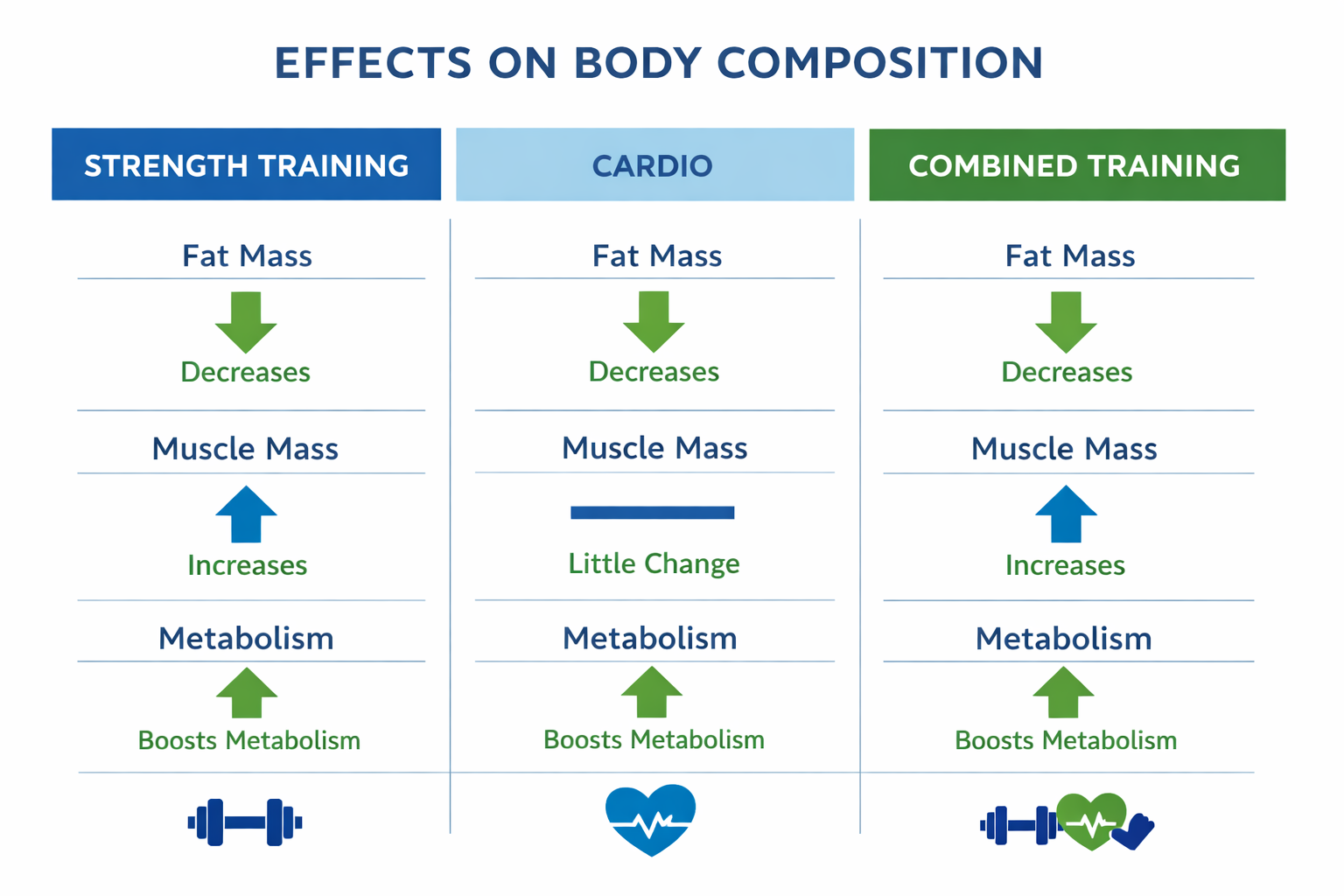
According to research published in the Journal of Applied Physiology, men who performed resistance training showed significantly lower fat mass compared to those who performed aerobic exercise alone. A separate body of research consistently shows that women who include strength training in their routines lose more body fat while preserving lean muscle mass than those who rely on cardio exclusively.
Key factors that influence body composition:
- Resistance training volume and intensity — more muscle recruited means more adaptation
- Protein intake — adequate protein (generally estimated at 1.6–2.2g per kg of bodyweight for active adults, per current sports nutrition guidelines) supports muscle repair and growth
- Sleep quality — poor sleep elevates cortisol, which promotes fat storage and muscle breakdown
- Hormonal health — testosterone, estrogen, insulin, and cortisol all affect how your body stores fat and builds muscle
- Training consistency — irregular workouts produce inconsistent results; three to four sessions per week is a widely recommended minimum
- Caloric balance — you can build muscle in a slight caloric surplus or lose fat in a deficit, but trying to do both simultaneously (body recomposition) requires precise nutrition management
The takeaway: cardio alone won’t transform your body composition. Strength training is non-negotiable if muscle retention or growth is part of your goal. Pair both training styles with healthy meals for weight loss and you create the conditions your body needs to change.
How Do You Measure Your Body Composition?
Knowing your current body composition helps you set realistic goals and track actual progress — not just fluctuations on a scale. There are several measurement methods, each with different accuracy levels and accessibility.
Bioelectrical Impedance Analysis (BIA)
BIA devices send a small electrical current through the body and estimate fat mass versus lean mass based on resistance. Consumer-grade BIA scales are widely available and affordable, though their accuracy can vary based on hydration levels. Clinical-grade BIA devices used by healthcare providers are considerably more accurate.
Dual-Energy X-Ray Absorptiometry (DXA)
DXA scans are considered one of the most accurate methods for measuring body fat percentage, bone density, and lean mass distribution. They’re available at many sports medicine clinics and some gyms. A single scan typically costs between $50–$150 USD, depending on location.
Skinfold Calipers
A trained professional uses calipers to measure skin fold thickness at four to seven body sites, then calculates an estimated body fat percentage. Less precise than DXA, but inexpensive and repeatable for tracking trends over time.
Body Mass Index (BMI)
BMI divides your weight in kilograms by the square of your height in meters. A healthy range is generally 18.5–24.9. BMI is a rough population-level screening tool — it doesn’t distinguish between fat mass and muscle mass, so a muscular athlete may show a “high” BMI without excess body fat.
Choose your measurement method based on your goal:
- For general progress tracking at home: BIA scale or calipers
- For a detailed baseline before a structured program: DXA scan
- For a quick health screening: BMI, with the understanding of its limitations
The 7 Best Body Composition Exercises (With Proper Form)
These seven exercises were selected because they work multiple muscle groups, require no equipment, and are scalable for all fitness levels. Perform them as a circuit, in supersets, or as standalone movements within a broader program.
1. Squats
Squats are the single most effective lower-body exercise for building muscle mass and improving functional strength. They target the quadriceps, hamstrings, glutes, calves, and lower back — essentially the entire posterior chain plus the front of your legs.
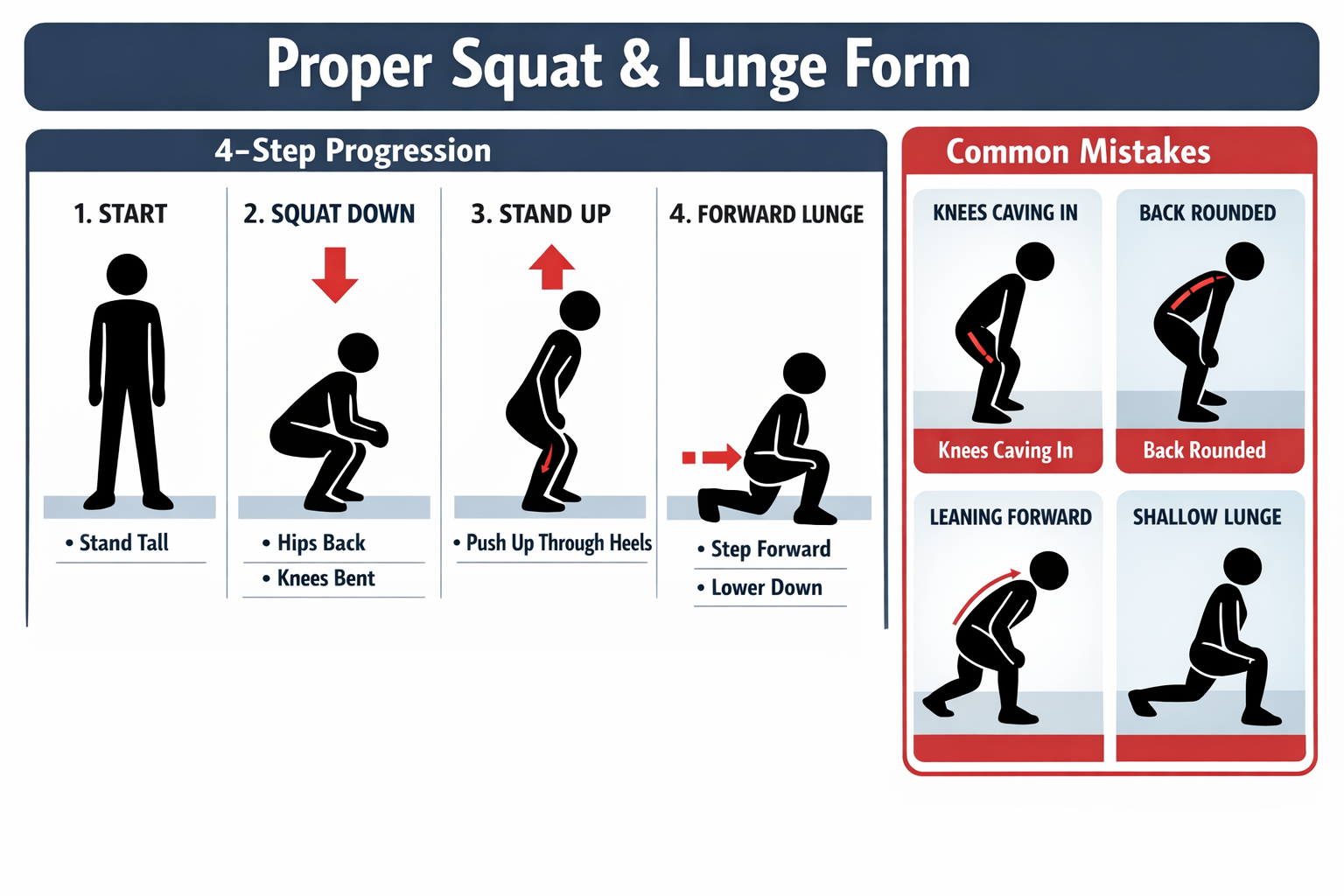
How to perform a bodyweight squat:
- Stand with feet shoulder-width apart, toes pointed slightly outward
- Engage your core and keep your chest upright
- Push your hips back and bend your knees simultaneously
- Lower until your thighs are parallel to the floor (or as low as mobility allows)
- Drive through your heels to return to standing
- Aim for 3 sets of 12–15 repetitions
Common mistake: Letting the knees cave inward as you lower. Focus on pushing your knees out in line with your toes throughout the movement.
Progression: Once bodyweight squats feel easy, add a pause at the bottom for two seconds, or progress to goblet squats holding a dumbbell or kettlebell at chest height.
2. Lunges
Lunges build unilateral (single-leg) strength, which corrects muscle imbalances and improves balance and coordination. They target the quads, glutes, hamstrings, hip flexors, and adductors.
How to perform a forward lunge:
- Stand tall with feet together
- Step forward with your left foot, landing heel-first
- Lower your back knee toward the floor until both knees form roughly 90-degree angles
- Keep your front knee directly above your ankle — not pushing past your toes
- Push off your front foot to return to standing
- Alternate legs for 3 sets of 10 repetitions per side
Variation: Reverse lunges (stepping backward instead of forward) place less stress on the knee joint and are a better starting point for beginners or anyone with knee sensitivity. For a related low-impact option, see our guide on the best exercise bike for knee issues.
3. Push-Ups
Push-ups are a compound upper-body exercise that builds strength in the chest, shoulders, triceps, and core simultaneously. They’re one of the most well-researched bodyweight movements for upper-body muscle development.
How to perform a standard push-up:
- Start in a high plank position, hands slightly wider than shoulder-width
- Keep your body in a straight line from head to heels — no sagging hips or raised backside
- Lower your chest toward the floor by bending your elbows at roughly a 45-degree angle from your torso
- Stop just before your chest touches the ground
- Press back up to the starting position
- Aim for 3 sets of 8–15 repetitions
Beginner modification: Perform push-ups with your knees on the floor until you build enough strength for full reps. This is not a lesser version — it’s a legitimate progression step.
Advanced variation: Decline push-ups (feet elevated on a chair or bench) shift more load onto the upper chest and shoulders.
4. Plank
The plank is the foundational core stability exercise. Unlike crunches, which work the rectus abdominis through movement, the plank trains your entire core — including the transverse abdominis, obliques, and lower back — to resist movement. This is exactly how your core functions in real life.
How to perform a forearm plank:
- Place your forearms on the floor, elbows directly beneath your shoulders
- Extend your legs behind you, resting on your toes
- Keep your body in a straight line — hips level, not raised or sagging
- Engage your glutes and brace your core as if bracing for a punch
- Hold for 20–60 seconds, rest for 30 seconds, repeat 3 times
Common mistake: Holding your breath. Breathe steadily throughout the hold — this also helps you maintain tension without fatiguing as quickly.
Progression: Once you can hold a plank for 60 seconds with good form, progress to side planks, plank shoulder taps, or RKC planks (a more intense variation using maximum full-body tension).
5. Pull-Ups
Pull-ups are the most effective bodyweight exercise for building back width and bicep strength. They target the latissimus dorsi, rhomboids, rear deltoids, and biceps — muscle groups that are often underdeveloped in people who focus primarily on pushing movements.
How to perform a pull-up:
- Hang from a bar with an overhand grip, hands slightly wider than shoulder-width
- Engage your shoulder blades by pulling them down and back before you begin the pull
- Drive your elbows toward your hips as you pull your chin above the bar
- Lower yourself slowly and with control — the descent is as important as the ascent
- Aim for 3 sets of as many controlled reps as possible
Beginner modification: Use a resistance band looped over the bar for assistance, or perform negative pull-ups (jump to the top position and lower yourself as slowly as possible — aim for 5 seconds on the way down).
Why pull-ups matter for body composition: Back muscles are among the largest in the upper body. Building them increases your overall lean mass, which raises your basal metabolic rate.
6. Squat Jumps
Squat jumps add a plyometric element to the standard squat, turning it into a cardio-strength hybrid movement. They elevate heart rate rapidly, burn more calories per minute than standard squats, and develop explosive power in the legs and glutes.
How to perform a squat jump:
- Start in a squat position, feet shoulder-width apart
- Lower into a full squat, then explode upward as forcefully as possible
- Leave the ground completely, extending your body fully at the top
- Land softly with bent knees, absorbing the impact through your hips and legs — not your knees
- Go directly into the next squat without pausing
- Perform 3 sets of 10–12 repetitions
Who should avoid this: People with knee pain, joint issues, or those who are very new to exercise should master standard squats first. Landing mechanics matter — poor landing form increases injury risk.
7. Jumping Jacks
Jumping jacks are a full-body cardiovascular exercise that elevates heart rate, improves coordination, and burns calories efficiently. While they don’t build significant muscle mass on their own, they serve as an excellent warm-up, active recovery movement, or cardio interval between strength sets.
How to perform jumping jacks:
- Stand with feet together and arms at your sides
- Jump your feet out to shoulder-width while simultaneously raising your arms overhead
- Jump your feet back together while lowering your arms
- Maintain a light, rhythmic pace — land softly on the balls of your feet
- Perform 3 sets of 30–60 seconds
For body composition purposes: Use jumping jacks as a 30-second active recovery between strength exercises rather than as a standalone workout. This keeps your heart rate elevated throughout the session, increasing total caloric expenditure without adding significant fatigue to your muscles.
How Should You Structure These Exercises Into a Routine?
A well-structured routine using these 7 exercises can be completed in 30–45 minutes, three to four times per week. Here’s a practical starting framework:
Beginner Full-Body Circuit (3x per week)
| Exercise | Sets | Reps / Duration | Rest |
|---|---|---|---|
| Squat | 3 | 12 reps | 45 sec |
| Lunge (each leg) | 3 | 10 reps | 45 sec |
| Push-Up | 3 | 8–12 reps | 45 sec |
| Plank | 3 | 30 sec hold | 30 sec |
| Jumping Jacks | 3 | 45 sec | 30 sec |
| Squat Jump | 2 | 10 reps | 60 sec |
| Pull-Up (or negative) | 2 | Max reps | 60 sec |
Progressive overload principle: Each week, aim to add one to two reps per set, increase hold time on the plank by five seconds, or reduce rest periods by five to ten seconds. This gradual increase in demand is what drives continued body composition change.
For those looking to accelerate fat loss alongside this routine, reviewing proven techniques for rapid weight loss can help you align your nutrition strategy with your training.
Does Diet Matter as Much as Exercise for Body Composition?
Yes — and for many people, nutrition has a greater impact on body composition than exercise alone. You can train consistently and still see minimal change if your diet doesn’t support your goals.
The core nutritional principles that support body composition change:
- Adequate protein: Supports muscle repair and growth after resistance training. Lean sources include eggs, chicken, fish, legumes, and Greek yogurt.
- Caloric awareness: You don’t need to obsessively count calories, but understanding whether you’re in a rough surplus or deficit helps you move in the right direction.
- Anti-inflammatory foods: Chronic inflammation impairs recovery. Incorporating anti-inflammatory foods like leafy greens, berries, and fatty fish supports faster muscle repair.
- Meal timing: Eating protein within two hours of a workout supports muscle protein synthesis, though total daily protein intake matters more than precise timing.
- Hydration: Dehydration reduces exercise performance and slows recovery. Aim for consistent fluid intake throughout the day.
Eating healthy doesn’t require complicated meal plans. Simple, whole-food meals built around protein, vegetables, and complex carbohydrates cover most of your nutritional needs. For practical ideas, explore healthy choice meals that align with an active lifestyle.
What Are the Most Common Mistakes People Make With Body Composition Training?
1. Measuring success only by scale weight
Scale weight fluctuates daily based on water retention, food volume, and hormonal changes. A person can lose fat and gain muscle simultaneously while the scale barely moves. Track body fat percentage, progress photos, and strength improvements alongside weight.
2. Skipping the eccentric (lowering) phase
Most people rush through the lowering portion of squats, push-ups, and lunges. The eccentric phase — when the muscle lengthens under load — is where much of the muscle-building stimulus occurs. Slow it down.
3. Not eating enough protein
Under-eating protein is the most common nutritional mistake in body composition training. Without sufficient protein, your body struggles to repair and build muscle tissue after workouts.
4. Doing only cardio
Cardio burns calories but does not build significant muscle mass. Without resistance training, fat loss often comes with muscle loss — which lowers your metabolism and makes long-term maintenance harder.
5. Inconsistent training
Two weeks on, two weeks off produces negligible results. Consistent effort over 8–12 weeks is the minimum timeframe for visible body composition changes in most adults.
6. Neglecting sleep and recovery
Muscle is built during rest, not during the workout itself. Consistently sleeping fewer than seven hours per night impairs muscle protein synthesis and elevates cortisol, which promotes fat storage.
Body Composition Exercises Examples (Sample Plans)
Here are practical body composition exercises examples organized by experience level. Each example uses only the seven exercises covered above, so you can copy any plan directly without buying equipment or joining a gym. Pick the level that matches where you are right now, run it for four to six weeks, then progress to the next stage.
Beginner Example: Three Sessions Per Week (Weeks 1–4)
This plan is built for someone who has not exercised consistently in the past year. Each session takes 25 to 30 minutes and uses only bodyweight movements. Rest at least one full day between sessions.
- Monday — Full Body Foundation: Squats 3 sets of 10, Push-ups (knee version if needed) 3 sets of 8, Plank 3 holds of 20 seconds, Jumping Jacks 2 sets of 30 seconds
- Wednesday — Lower Body Focus: Squats 3 sets of 12, Lunges 3 sets of 8 per leg, Plank 3 holds of 25 seconds, Jumping Jacks 3 sets of 30 seconds
- Friday — Upper Body and Core: Push-ups 3 sets of 8, Plank 3 holds of 30 seconds, Squats 2 sets of 10, Jumping Jacks 2 sets of 45 seconds
Most beginners notice better posture and improved endurance by the end of week three. Visible muscle tone usually starts to appear around weeks six to eight when paired with adequate protein intake.
Intermediate Example: Four Sessions Per Week (Weeks 5–12)
This example assumes you can complete 15 unbroken push-ups, hold a plank for 45 seconds, and perform deep bodyweight squats with full control. Sessions run 35 to 45 minutes.
- Monday — Lower Body Strength: Squats 4 sets of 15, Lunges 4 sets of 10 per leg, Squat Jumps 3 sets of 8, Plank 3 holds of 45 seconds
- Tuesday — Upper Body and Core: Push-ups 4 sets of 12, Pull-ups (assisted with a band if needed) 4 sets of 5, Plank 4 holds of 45 seconds, Jumping Jacks 3 sets of 60 seconds
- Thursday — Power Circuit: Squat Jumps 4 sets of 10, Push-ups 4 sets of 12, Lunges 3 sets of 12 per leg, Jumping Jacks 4 sets of 45 seconds
- Saturday — Full Body Conditioning: Squats 3 sets of 20, Pull-ups 3 sets of 6, Push-ups 3 sets of 15, Plank 3 holds of 60 seconds, Jumping Jacks 3 sets of 60 seconds
At this stage, the eccentric phase becomes the priority. Lower into every squat, push-up, and lunge over a count of three seconds. The slow lowering phase is where most muscle growth happens, so do not rush it.
Advanced Example: Five Sessions Per Week (Weeks 13+)
Use this plan once you can perform five strict pull-ups, 25 push-ups, and a 90-second plank. Sessions are split into upper and lower body days, with one full body conditioning session at the end of the week. Each workout takes 45 to 60 minutes.
- Monday — Lower Body Power: Squat Jumps 5 sets of 10, Squats 5 sets of 20 (slow tempo), Lunges 4 sets of 15 per leg, Plank 4 holds of 60 seconds
- Tuesday — Upper Body Pull: Pull-ups 5 sets of 8, Push-ups (close grip) 4 sets of 15, Plank 4 holds of 75 seconds
- Wednesday — Active Recovery: Plank 3 holds of 90 seconds, Jumping Jacks 5 sets of 60 seconds, walking 30 minutes
- Friday — Upper Body Push: Push-ups 5 sets of 20, Pull-ups 4 sets of 6, Plank 4 holds of 75 seconds, Squat Jumps 3 sets of 12
- Saturday — Full Body Circuit: Run all seven exercises as a continuous circuit. 20 squats, 15 push-ups, 10 lunges per leg, 60-second plank, 6 pull-ups, 12 squat jumps, 45 seconds of jumping jacks. Rest 90 seconds, repeat four to five rounds.
Example for Older Adults (50+)
This example uses the same seven exercises but with lower-impact modifications. Squat jumps and jumping jacks are replaced with controlled marching in place, which delivers similar cardiovascular benefit without joint stress.
- Day 1: Chair-assisted squats 3 sets of 10, Wall push-ups 3 sets of 10, Plank on knees 3 holds of 20 seconds, Marching in place 3 sets of 60 seconds
- Day 3: Squats 3 sets of 12, Stationary lunges (holding a chair) 3 sets of 8 per leg, Plank 3 holds of 25 seconds, Marching 3 sets of 60 seconds
- Day 5: Wall push-ups 3 sets of 12, Plank 3 holds of 30 seconds, Squats 3 sets of 10, Marching 4 sets of 60 seconds
The decline in muscle mass after age 50 (sarcopenia) is reversible with regular resistance training. Two to three sessions per week is enough to preserve and rebuild lean mass at any age.
Example for Fat Loss Focus
If your primary goal is reducing body fat percentage rather than building muscle, structure your sessions as circuits with minimal rest. Move from one exercise straight to the next, rest 60 to 90 seconds between rounds, and aim for three to four rounds per session.
- The Fat Loss Circuit (3–4 rounds, three times per week): 15 squats, 10 push-ups, 30-second plank, 10 lunges per leg, 30 seconds of jumping jacks, 30-second rest, repeat
This style of training keeps your heart rate elevated for the entire session, which increases total calorie burn and creates a metabolic boost that lasts for several hours after you finish. Pair it with a moderate caloric deficit and protein intake of around 1.6 grams per kilogram of bodyweight for the fastest visible fat loss.
What All These Examples Have in Common
Every plan above follows the same three principles: progressive overload (slightly more work each week), full range of motion on every rep, and at least one full rest day between sessions that train the same muscle group. Without those three elements, even the best body composition exercises examples will not produce visible results.
Body Composition Exercise Finder
Select your goal to see the best exercises for your body composition:
FAQ: Body Composition Exercises
Q: How long does it take to see body composition changes?
Most beginners notice improved muscle tone and endurance within three to four weeks. Visible fat loss and measurable muscle gain typically take eight to twelve weeks of consistent training and appropriate nutrition.
Q: Can I do these exercises every day?
Not all of them, every day. Resistance exercises like squats, lunges, push-ups, and pull-ups require 48 hours of recovery between sessions. Planks and jumping jacks can be performed daily without significant recovery concerns.
Q: Do I need weights to change my body composition?
No. Bodyweight exercises — when performed with proper intensity, progressive overload, and consistency — produce real body composition changes. Adding resistance (dumbbells, resistance bands, or a weighted vest) accelerates results once bodyweight movements become easy.
Q: Is body composition training suitable for older adults?
Yes, and it’s particularly important. Muscle mass naturally declines with age (a process called sarcopenia), which slows metabolism and increases injury risk. Resistance training at any age helps preserve and rebuild lean muscle. Beginners over 50 should start with lower-impact variations and consider consulting a healthcare provider before beginning a new program.
Q: What’s the difference between body composition and BMI?
BMI is a simple height-to-weight ratio that doesn’t distinguish between fat and muscle. Body composition measures the actual proportion of fat mass versus lean mass. A muscular person can have a “high” BMI while having excellent body composition. BMI is a population screening tool, not a personal fitness metric.
Q: How many calories do these exercises burn?
Caloric burn varies significantly based on body weight, intensity, and fitness level. As a rough estimate, a 30-minute circuit combining these exercises burns approximately 200–400 calories for most adults. More importantly, resistance training elevates your metabolic rate for hours after the workout ends.
Q: Should I do cardio or strength training first?
If your primary goal is body composition improvement (building muscle and losing fat), perform strength training first when your energy is highest. Follow with cardio if desired. Doing cardio first depletes glycogen stores and can reduce the quality of your strength work.
Q: Can these exercises help with weight loss specifically?
Yes, but the mechanism matters. These exercises build muscle, which raises your resting metabolic rate — meaning you burn more calories even at rest. Combined with a moderate caloric deficit and adequate protein, they produce sustainable fat loss. For a broader strategy, see our guide to weight loss.
Q: What should I eat before doing these exercises?
A light meal or snack containing carbohydrates and protein one to two hours before training works well for most people. Examples: a banana with peanut butter, Greek yogurt with fruit, or eggs on whole-grain toast. Avoid training on a full stomach.
Q: Are these exercises safe during pregnancy?
Many of these exercises can be modified and performed safely during pregnancy, but individual circumstances vary significantly. Always consult your healthcare provider before starting or continuing an exercise program during pregnancy.
Sources
- Journal of Applied Physiology — peer-reviewed research on resistance training and fat mass outcomes (multiple published studies available via PubMed)
- American College of Sports Medicine (ACSM) — guidelines on resistance training frequency and volume for body composition
- International Society of Sports Nutrition (ISSN) — position stand on protein intake for active adults (2017, updated 2023)
- National Institutes of Health (NIH) — body composition measurement methodology overview
More great articles that may be of interest to you 🙂
If you want to learn more information about Body Composition Exercises: SO you can read this article: Body Composition Exercises: Achieve Your Goals

Dave James has spent 30+ years reading health and longevity research, and has run All Perfect Health for the past five. His background is in Australian mining and industrial engineering — disciplines built on questioning claims, measuring outcomes, and respecting evidence. He writes about what the research actually says, including where the experts disagree.
More about Dave & this site →
Part of the Home Workouts & Strength cluster — build muscle and burn fat at home.
📂 Best Home Workouts Without Equipment
This article is part of the APH cluster. Use the links below to move between the pillar and child articles.
- Read the pillar: Best Home Workouts Without Equipment
- YOU ARE HERE 7 Best Body Composition Exercises (With Examples) to Build Muscle and Burn Fat
- → Performing Leg Lifts Exercise: Complete Guide to Form, Benefits, and Variations
- → 10 Best Good Morning Exercises to Start Your Day Strong
- → Bodyweight Strength Training: How to Build Muscle Without Weights
- → Resistance Band Workouts for Building Real Strength at Home
- → The Best Home Gym Equipment for Strength Training on Any Budget
- → Quick Home Workouts: 15-Minute Routines for Busy Adults Over 40
References
- [Video] Jeremy Ethier. How to Lose Fat and Gain Muscle at the Same Time. YouTube, 2023.
- Slater GJ, et al. Is exercise for body composition effective? Sports Medicine, 2021.
- Lopez P, et al. Resistance training and body composition changes. Sports Medicine, 2020.
- Barry VW, et al. Body composition assessment methods. Current Sports Medicine Reports, 2023.
- Schoenfeld BJ, et al. Body recomposition: a narrative review. Nutrition Reviews, 2022.