
Should You Take Creatine Before or After a Workout? What Timing Research Actually Shows

Last updated: November 2026
Quick Answer
Current research does not show a meaningful, consistent advantage to taking creatine before versus after a workout. A few small studies hint at modest differences in one direction or another, but the stronger evidence points to total daily intake and consistency mattering far more than clock time. In plain English: pick a time you’ll actually stick with, before or after, and build the habit around it.
Key Takeaways
- No large trial has established a universal “best” time to take creatine relative to training.
- A small 2026 crossover study suggested a possible acute strength benefit from pre-workout dosing, but the sample was just 11 men.[1]
- An 8-week controlled trial in 34 athletes found no meaningful difference between pre- and post-workout creatine for strength or muscle mass.[2]
- A brief pooled analysis of three studies found a modest statistical edge for post-workout timing on muscle mass, not strength; the authors called for more research before treating it as a rule.[3]
- The ISSN’s position stand treats daily total dose, not timing, as the key variable.[4]
- Consistency across weeks matters more than precision around the workout clock.
- This article does not recommend a specific dose, loading protocol, or medical use; see a clinician for personal guidance.
Table of Contents
- Why this question gets asked
- What timing research actually studied
- Before vs after a workout: what the evidence does and does not show
- Training days and rest days: use routine rather than hype
- Mixing, food and caffeine: what should not be assumed
- A practical timing decision framework
- Safety and when to seek individual advice
- FAQ
- What would change the answer?
- References
- Medical disclaimer
Why this question gets asked
People ask whether creatine works better before or after a workout because supplement marketing often implies precision timing is the difference between results and wasted effort. It isn’t that simple.
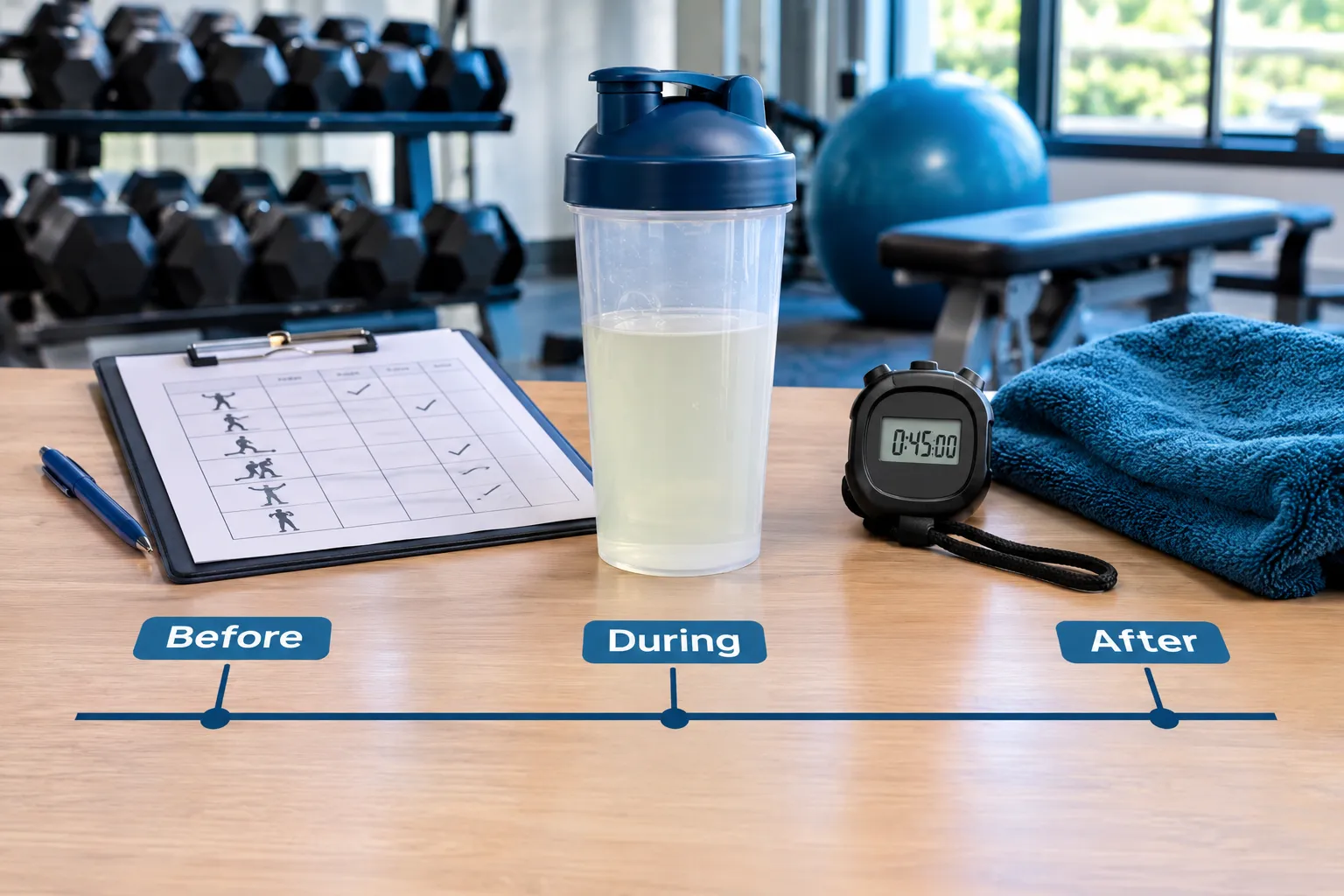
Creatine phosphate stores in muscle build up gradually over days and weeks, not minutes. For background on what creatine actually does in the body, see What Is Creatine and What Does It Do? The question of timing persists mostly because it feels actionable. A dose amount is abstract, but “before” or “after” feels like a concrete choice you can get right or wrong.
Let’s keep this practical: the appeal of a timing rule is that it promises a shortcut. We need to separate fact from hype here, because the research base on pre- versus post-workout dosing is thinner and more mixed than most fitness content suggests. A sensible starting point is treating timing as a secondary detail, not the main lever.
What timing research actually studied
Timing research has mostly compared two things: a dose taken shortly before training versus shortly after, usually within the same hour-long window around the session. The outcomes measured are typically strength changes, lean mass, and sometimes acute performance in a single session.
A handful of designs make up the current evidence:
- Acute, single-session studies. A 2026 randomized crossover pilot trial in 11 resistance-trained men tested a single dose taken 2 hours before training against during-session and post-session dosing, plus placebo. Pre-workout dosing showed better acute strength performance in that small group, but the authors were explicit that the sample size was tiny and the finding exploratory, not confirmatory.[1]
- Multi-week controlled trials. An 8-week, double-blind, placebo-controlled trial in 34 trained men and women compared 5 g taken within an hour before training against 5 g taken within an hour after, alongside a placebo arm. Muscle mass, strength, and performance did not differ meaningfully between the pre- and post-workout groups. The gap that mattered was supplementing at all, not when.[2]
- Within-subject designs. One study had each participant supplement one limb’s training session before and the other limb’s session after, controlling for individual variation entirely. Hypertrophy and strength gains were similar regardless of timing.
- Meta-analytic and review work. A brief pooled analysis of three studies found a small statistical edge for post-workout timing on muscle mass (standardized mean difference around 0.52), but not strength. Its authors stressed that the evidence base was limited and that both timings remained viable.[3]
The numbers matter here, and they tell a fairly boring story: differences, where found, are small and inconsistent across outcome types.
Before vs after a workout: what the evidence does and does not show
Based on current evidence, there is no reliable, repeated finding that before-workout or after-workout creatine produces meaningfully better long-term results for most people. What exists is a scattering of small, differently designed studies, some favoring one timing slightly, most showing no difference at all.
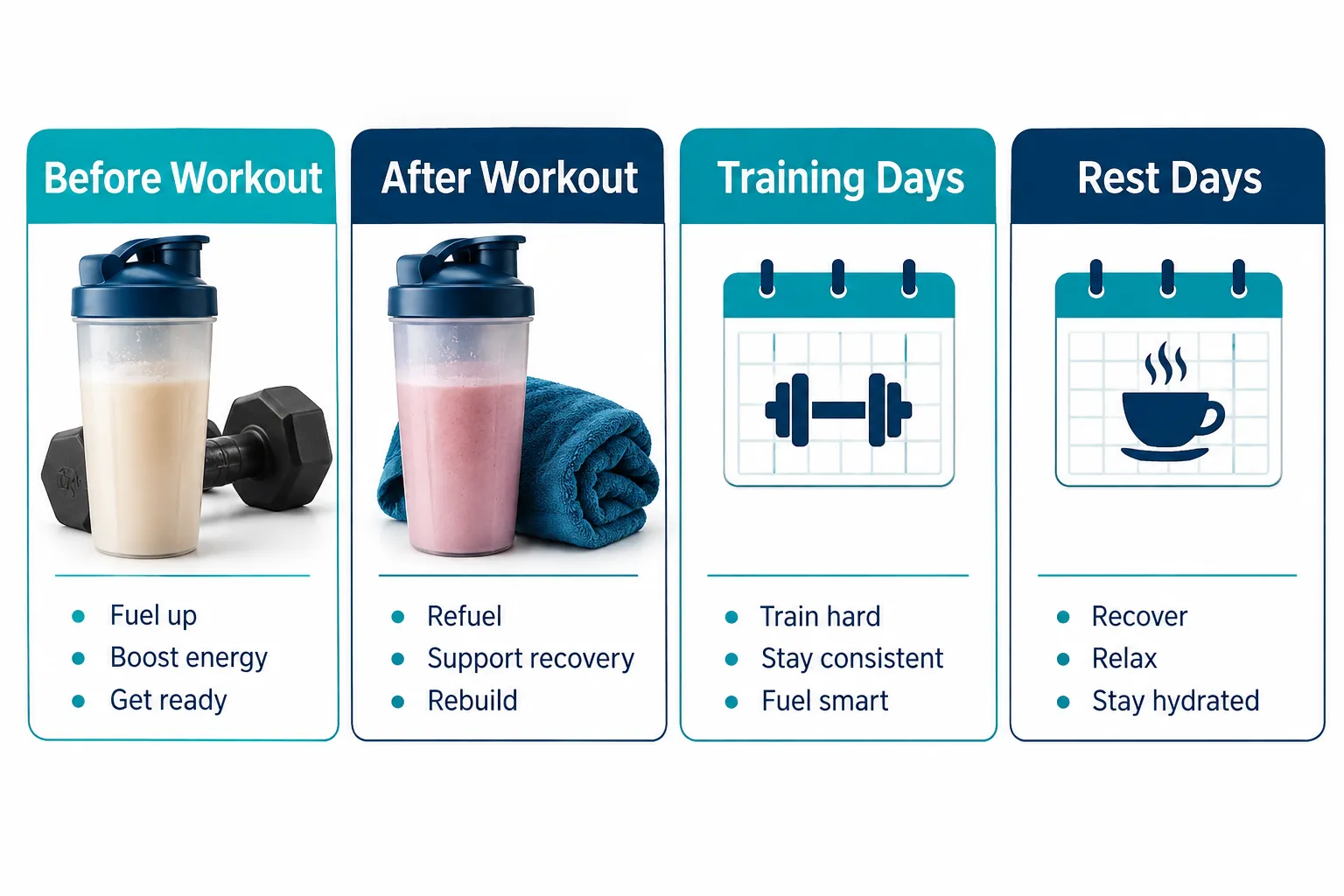
Here’s the real issue: the two studies most often cited as showing a “winner” point in different directions. The 2026 pilot leaned toward pre-workout for acute strength.[1] The 2021 meta-analysis leaned toward post-workout for hypertrophy, with no strength benefit.[3] A 2013 trial in recreational bodybuilders found post-workout “possibly more beneficial” for fat-free mass and bench press, using magnitude-based inference methods that are considered weaker than standard statistical testing, with the authors themselves describing the difference as small.[5]
Meanwhile, the 2022 “Creatine O’Clock” review, which specifically set out to resolve this question by summarizing the pre- versus post-workout literature, concluded that taking creatine immediately before or after training for 5 to 12 weeks produces similar gains in muscle mass and performance, with any post-exercise advantage being small and not consistently shown.[6] Examine.com’s evidence review, last updated in 2025, reached a similar conclusion: trials comparing before versus after generally show no meaningful difference in body composition or strength, and only one trial has even tested near-training versus far-from-training timing, so there isn’t enough data to call a true optimal window.[7]
The simplest way to look at it is this: total daily creatine intake, taken consistently over weeks, is the variable with real supporting evidence behind it. Clock position around the workout is a much smaller, less certain variable.
Decision rule: If your main goal is long-term strength and muscle gain over months, timing precision around the workout is not where your effort should go. If you’re an advanced lifter chasing marginal, same-day performance, the 2026 pilot data might make pre-workout dosing worth personal experimentation, but treat it as exactly that: an experiment, not a guarantee.
Training days and rest days: use routine rather than hype
On rest days, there is no workout to time creatine around, which is itself a clue about how timing works. Creatine’s benefit comes from maintaining elevated muscle phosphocreatine stores over time, not from a short-lived window of absorption tied to exercise.
In real-world terms, this means:
- On training days, taking creatine before or after the session both fit naturally into an existing routine, which is the main reason either works about equally well.
- On rest days, many people simply take it with a meal at a convenient, repeatable time, since there is no workout to anchor it to.
- The common mistake is skipping rest-day doses because “there’s no workout to boost.” That does not make a missed rest-day dose a medical problem; it does show why a repeatable routine matters more than trying to hit a supposedly perfect workout window.
The main takeaway from training-day versus rest-day comparisons: routine beats precision. A person who takes creatine at breakfast every day, workout or not, is likely getting more practical benefit than someone chasing an exact pre- or post-workout minute but missing doses on rest days or busy weeks. Keep it simple and consistent.
Mixing, food and caffeine: what should not be assumed
What you mix creatine with, and whether you take it with food, has not been shown by strong evidence to override the timing question, and claims that certain combinations “unlock” better absorption deserve skepticism. That is a strong claim and needs strong proof, and the current literature doesn’t supply it for most common mixing questions.

Some specifics worth separating from hype:
- Mixing with food or a protein shake: Taking creatine alongside a meal is common practice and fits into a daily routine, but no major trial shows this changes long-term results compared with taking it alone.
- Caffeine: There has been long-standing speculation that caffeine blunts creatine’s effects. The evidence for this is not strong enough to justify avoiding your usual coffee around supplementation, The available timing research does not support a universal rule that people must avoid their usual coffee when using creatine.
- Powder versus other formats: Questions about format, like gummies versus powder, are a separate decision from timing. If you’re weighing convenience, cost, and dosing precision between formats, see Creatine Gummies vs Powder: Cost, Convenience, and What Actually Matters.
- Water intake: General hydration guidance applies; this article does not prescribe a specific water volume, and total fluid needs vary by body size, climate, and activity level.
It is not that simple to say any single additive or pairing meaningfully changes outcomes. The basics still do the heavy lifting: a consistent daily amount, taken in a way you’ll actually sustain, outweighs mixing strategy.
A practical timing decision framework
A sensible starting point is choosing a time based on what fits your life, not what a label or ad implies is superior. Below is a simple framework for deciding, built around the reality that the evidence does not crown a clear winner.
| If this describes you | A reasonable approach |
|---|---|
| You already have a steady post-workout shake or meal | Add creatine to that existing habit |
| You prefer taking supplements before you leave for the gym | Take it with a small pre-workout snack or drink |
| You train at unpredictable times | Anchor it to a fixed daily event, like breakfast, instead of the workout |
| You lift only a few days a week | Still take it daily, including rest days, for steady muscle stores |
| You’re an experienced lifter chasing small acute gains | Do not treat a small acute study as a prescription; the evidence is preliminary[1] |
Step-by-step, a workable routine looks like this:
- Pick one anchor point in your day (a meal, a workout, a fixed clock time).
- Keep the same anchor point daily, including rest days.
- Track whether you’re actually sticking with it after two to four weeks.
- If adherence slips, move the anchor point rather than abandoning the habit.
- Reassess after a few months based on your own training log, not on marketing claims.
The main takeaway: start with what gives the biggest return, which is daily consistency, not minute-level timing. More is not always better, and more precision about clock time is not either, when the underlying evidence doesn’t support a strong timing effect.
What would change the answer?
A stronger answer would require larger, well-controlled trials that compare the same creatine preparation, the same total intake, and the same training program while measuring muscle creatine stores as well as strength and body composition. Researchers would also need to test women and men across different training ages, and compare pre-, during-, post- and non-workout timing fairly.
That work has not yet been done at the scale needed to turn a small difference into a reliable rule. So if a future headline claims that one narrow window is essential, the useful question is not whether it sounds plausible. It is whether the study directly compared the timings, controlled the total intake and training plan, and found a meaningful difference that was repeated elsewhere.
Safety and when to seek individual advice
Creatine monohydrate has a long safety record at commonly studied intakes in healthy adults, according to the ISSN’s position stand, which treats it as one of the most researched sports supplements available.[4] That said, safety is individual, and this article is not a substitute for personalized medical guidance.
Context matters, and a few groups should be more careful:
- People with existing kidney conditions should talk to a doctor before starting any creatine supplement, since altered kidney function changes how the body handles increased dietary load.
- People on medications that affect kidney function or fluid balance should check with a prescriber, since supplement interactions are not always obvious from general research.
- Anyone noticing unusual symptoms after starting creatine, such as unexpected swelling, digestive distress, or marked weight change, should stop and consult a healthcare provider rather than guessing at a cause.
- Claims about creatine treating fatigue, mood, brain conditions, sleep problems, or weight loss are outside the scope of current consensus evidence and outside the scope of this article; those are medical questions for a clinician, not supplement timing questions.
I would be careful with any source that promises creatine timing will diagnose, treat, or prevent a condition. That is not what the current evidence supports, and this article does not make that claim. This is where hype gets in the way of a genuinely useful, modest supplement with a well-studied safety profile.
FAQ
What does creatine actually do in your body?
Creatine helps regenerate a molecule called ATP during short, intense efforts, supporting strength and power output. For a full explanation, see What Is Creatine and What Does It Do?
How long does creatine take to start working?
Muscle creatine stores build gradually, typically noticeable over several weeks of consistent daily intake, according to trial designs lasting 5 to 12 weeks.[6]
Does timing really matter for creatine intake?
Based on current evidence, timing relative to a workout appears to matter little compared with taking a consistent daily amount; most controlled trials show no meaningful before-versus-after difference.[2][6][7]
Should I do a creatine loading phase?
This article does not prescribe a loading protocol or dose. Loading approaches vary by individual goals and should be discussed with a knowledgeable professional or based on product-specific guidance.
What are the side effects of taking creatine?
Commonly reported effects in research include mild water retention and occasional digestive discomfort; the ISSN position stand describes creatine as generally well tolerated in studied populations.[4] Individual reactions vary.
Is creatine safe if you have kidney problems?
Anyone with existing kidney conditions should consult a doctor before starting creatine, since the research base largely reflects healthy populations rather than people with impaired kidney function.
Do I need to drink more water with creatine?
General hydration matters for overall health; this article does not specify an exact water amount, since needs vary by body size, climate, and activity level.
Does creatine cause water retention or bloating?
Some water retention within muscle cells is commonly reported and is generally considered part of how creatine supports cell volume; it is not the same as unwanted systemic swelling.
How much creatine should I take per day?
This article does not prescribe a specific dose. The ISSN position stand references commonly studied intake ranges, but individual needs should be discussed with a healthcare provider or sports nutrition professional.[4]
Does creatine make you lose hair?
Evidence directly linking creatine to hair loss is limited and inconsistent; this is a question worth raising with a doctor if you have personal risk factors, rather than assuming a direct cause.
Can women take creatine safely?
Research on creatine has included both male and female participants in several of the controlled trials referenced here, including the 34-person 8-week trial.[2] Individual suitability should still be discussed with a healthcare provider.
Can you stop taking creatine anytime?
Stopping creatine is generally considered safe; muscle stores gradually return to baseline over time. This is not medical advice for your specific situation.
References
- Harris RC, et al. Acute Creatine Ingestion Before Resistance Training Enhances Strength Performance More than Ingestion During or After Training: A Randomized Crossover Pilot Trial. Nutrients. 2026.
- Dinan NE, et al. Effects of creatine monohydrate timing on resistance training adaptations and body composition after 8 weeks in male and female collegiate athletes. Frontiers in Sports and Active Living. 2022.
- Forbes SC, Candow DG. Timing of Creatine Supplementation and Resistance Training: A Brief Review. Journal of Exercise and Nutrition. 2018.
- Kreider RB, et al. International Society of Sports Nutrition position stand: safety and efficacy of creatine supplementation in exercise, sport, and medicine. Journal of the International Society of Sports Nutrition. 2017.
- Antonio J, Ciccone V. The effects of pre versus post workout supplementation of creatine monohydrate on body composition and strength. Journal of the International Society of Sports Nutrition. 2013.
- Forbes SC, et al. Creatine O’Clock: Does Timing of Ingestion Really Influence Muscle Mass and Performance?. Frontiers in Sports and Active Living. 2022.
- Ribeiro F, et al. Timing of Creatine Supplementation around Exercise: A Real Concern?. Nutrients. 2021.
Medical disclaimer

About the author
Dave James is the founder of All Perfect Health. He writes practical, evidence-aware health guides that separate established findings from marketing claims. He is not a doctor, and this article is not individual medical advice.